
International Research Journal of Engineering and Technology (IRJET) e-ISSN:2395-0056
Volume: 11 Issue: 03 | Mar 2024 www.irjet.net p-ISSN:2395-0072
International Research Journal of Engineering and Technology (IRJET) e-ISSN:2395-0056
Volume: 11 Issue: 03 | Mar 2024 www.irjet.net p-ISSN:2395-0072
U.V. Sai Madhumita1, Meghna Malla2, Ponnada Nikheel Deo3, S. Venkat Sai4 , Dr. Mrudula Owk5
1,2,3,4 Student, Dept. Of Computer Science Engineering, GITAM Institute of Technology (GIT), GITAM University, AP, INDIA
5Assistant Professor, Dept. Of Computer Science Engineering, GITAM Institute of Technology (GIT), GITAM University, AP, INDIA
Abstract - Communication is the cornerstone of human interaction, enabling individuals to express thoughts, emotions, and intentions. Whether verbal or non-verbal, language plays a pivotal role in fostering understanding and connection. However, the diversity of sign languages, such as American Sign Language (ASL) and Indian Sign Language (ISL), presents unique challenges for crosscultural communication. To address this, our work aims to bridge the gap between ASL and ISL through innovative technology solutions. The model takes ISL gestures as input Accurate translation between these languages is enabled by training the model on comprehensive datasets of ASL and ISL gestures. The model involves Machine Learning to capture data and create datasets (using OpenCV and Mediapipe), Deep Learning models to recognize the dynamic gestures (RNN architectures to deal with Sequential data), and Analysis tools such as NLTK (VADER for Sentiment Analysis). The model is trained on LSTM, LSTM+GRU, and GRU neural network architectures. Upon training, the network with the highest accuracy is used to implement the final gesture detection. The final result is given in ASL gestures (in GIF format) along with the tonality of the subject matter. We have noted from training and testing the model that the GRU model shows promising accuracy for the threemodels, followedby LSTM+GRUand LSTM.
Keywords: American Sign language (ASL), Gesture recognition, Indian Sign language (ISL), Machine learning, Mediapipeand Sign language.
Communication is a fundamental aspect of human life, enabling interaction and meeting basic needs. From makingrequeststosharingproblems,varioustasksrequire communication. While verbal communication is the primary mode for hearing individuals, non-hearing communitieshavedevelopedregional signlanguages.Sign language involves hand gestures and facial expressions representing words orphrases.Despite itslocal efficiency, global communication between sign language users faces challenges due to regional variations. Many deaf individualsarenottaughttoread;writtenlanguagesdiffer by location. To address this gap, we have proposed a systemthatconvertsonelanguage'ssignlanguagegesture to another. The focus was mainly on ASL – the most
popular sign language, and ISL- our local sign language. This initiative aims to improve cross-cultural communicationamongsignlanguageusersworldwide.
ASL, a visual language predominantly employed by Deaf, Mute, and hard-of-hearing communities in the United States and parts of Canada, possesses its grammar and vocabulary. Communication in ASL involves the use of hand shapes, facial expressions, and body movements. BeyondNorthAmerica,variousASLdialectsareutilizedin several West African and Southeast Asian countries. Originating nearly two centuries ago as a fusion of local sign languages and the French Sign Language (LSF), ASL exhibits a close relationship with LSF. ASL comprises 26 gestures corresponding to each letter in the alphabet and distinct signs for numbers 1-10. While precise statistics are elusive, an estimated half a million people in the US useASLastheirnaturallanguage.
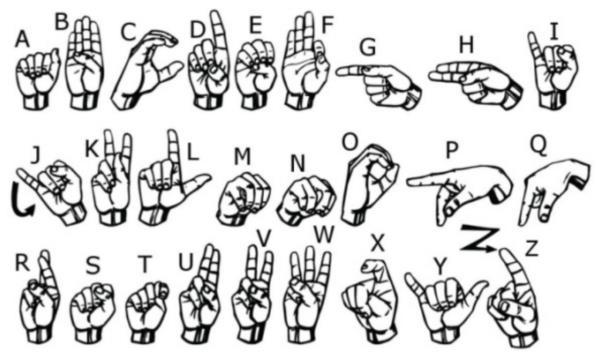
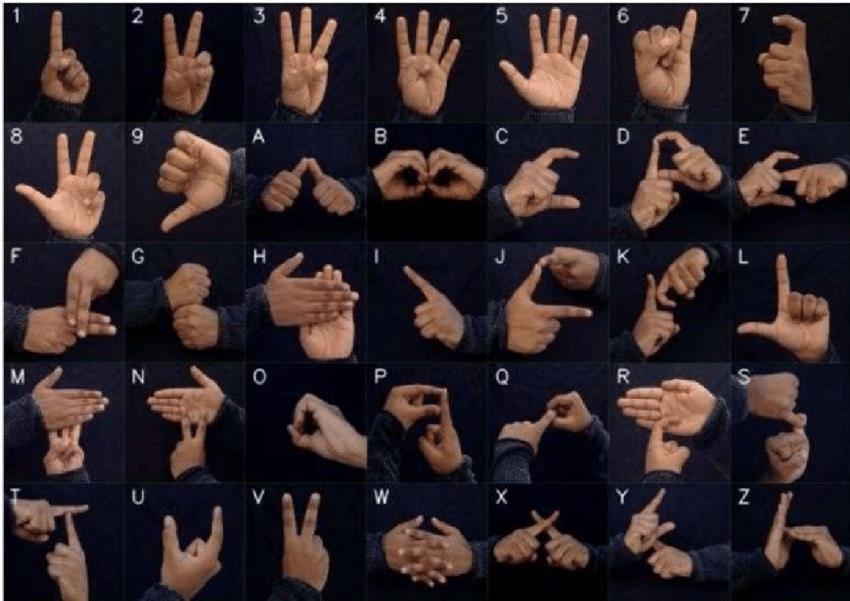
ISL is the sign language used in India since it is a country of linguistic riches and countless regional dialects. This languageisgestural andisexpressedusingthehandsand facewith originsintheearly20th century.Indo-Pakistani SignLanguageisusedbyabout15milliondeafpersonsin theSouthAsiansubcontinent.Therefore,ISL,likeASL,has unique signs for each letter of the alphabet. Legal recognition of the sign language in India shows the use and application of this language in the country’s communicational growth process. ASL and ISL are vital
International Research Journal of Engineering and Technology (IRJET) e-ISSN:2395-0056
Volume: 11 Issue: 03 | Mar 2024 www.irjet.net p-ISSN:2395-0072
tools in ensuring effective communication and supporting theircommunitydevelopment.
Media Pipe, which is a Google’s library-based system specifically for all sorts computer vision tasks, now featuresintheplatformvisiontasks.TheMediapipeisthe platform which mastered the problem of holistically estimation of a pose. This consists of the precise locating oficonicfeaturessuchastheeyes,nose,andthemouthas well as the body stance and hand movements. The utilization of Mediapipe in the advancement of the technologydemonstratesitscriticalroleinthetechnology transformation. This model takes a comprehensive pose estimation to a higher level, where it is applied to numerous applications like augmented reality facial recognition, gesture handlingandaninteractive interface [16] On-device ML can be difficult. MediaPipe Solutions makes it easy. You can customize advanced solutions to your needs, quickly and seamlessly. These flexible tools arebuiltontopofTensorFlowLiteforthebestend-to-end on-deviceMLandhardwareperformance
Sentiment recognition is an operational process that is employedforthepurposeofdescribingtheemotionthatis communicated.Itwilltriggerthe changesinmediasphere in the years to come. When it comes to the sentiment analysis mentioned, it is done with the help of VADER sentimentanalysislibrary.Thistextisaimedtorevealthe emotional state of the given sentence with the sentence one can consider the presence of the amount of positive, neutral, and negative emotional themes in the plot. The sentimentIntensityAnalyzer class from the VADER library is made to fulfil this purpose. The analysis results in a polarity score for each sentiment category: good-neutralnegative
The research on hand gesture recognition consists of various methodologies and techniques which aim to achieve high accuracy. One notable approach discussed in [1] utilizes a vision-based methodology employing static and dynamic hand gesture recognition. This method uses thecombinationofMediapipeandLSTM(LongShort-Term Memory) models, achieving an impressive accuracy of up to 99%. Similarly, [3] utilizes Mediapipe for landmark extraction but diverges by employing ML techniques such as the Random Forest algorithm for classification tasks. Meanwhile,[6]introducesalightweightmodelsuitablefor deploymentonsmartdevices,incorporatingSVM(Support VectorMachine)algorithmsalongsideMediapipe.
In exploring regional languages like Assamese, [2] proposesa methodutilizing2Dand3Dimagesofgestures trained through a feedforward neural network. This novel approach seeks to bridge language gaps by enabling gesture-based communication. In contrast, [10] extends thisconceptbyincorporatingSVMandMediapipe,focusing on recognizing alphabets, numbers, and commonly used words.
Many even experimented with specialized architectures and optimizations. For instance, [8] introduces MediaPipe optimized GRU (MOPGRU), modifying activation functions and layers to enhance performance. Additionally, [9] employs a transformer model to discern the most significant Mediapipe landmarks for prediction tasks, offeringinsightsintofeatureimportance.
Moreover, researchers have explored diverse models and datasets tailored to specific requirements. [4] adopts a straightforward yet comprehensive approach, detecting individual alphabet gestures in sign language and assembling them into sentences, subsequently converted into speech. Conversely, [11] focuses on dataset creation using media hand tracking and RNN (Recurrent Neural Network)training,emphasizingthe importance ofcurated datasetsforaccuraterecognition.
Furthermore, [5] and [7] delve into advanced models like LSTM, GRU,and feedback-basedarchitectures,showcasing theireffectivenessincapturingtemporal dependenciesfor gesture recognition. Additionally, [12] compares CNN (Convolutional Neural Network) and LSTM models for static and dynamic gesture recognition, shedding light on theirstrengthsandweaknesses.
3.1 Problem Statement
Translatingthesigns fromone signlanguagetoanotheris very difficult because of the characteristic features of the language. There are dissimilarities among sign languages
International Research Journal of Engineering and Technology (IRJET) e-ISSN:2395-0056
Volume: 11 Issue: 03 | Mar 2024 www.irjet.net p-ISSN:2395-0072
such as ASL and ISL. These languages are grammatically complicated, not only in structures but also in syntax, which hinders finding one standardized translation. Furthermore, effective communication entails a factor of culture that is also a complex concept. Moreover, a sign operating as an icon that implies one direct idea will take more work to understand in translation. We should also consider that deaf people from different nations can use entirelydifferentsignlanguagesforcommunication.While standard sign languages are generally used, the main problem is overcoming this gap by translating signs from onelanguagetoanotherforimprovedcommunication.
The pre-existing methods in sign-language accessibility andinclusivitydealmostlywithstaticgesturesoralphabet datasets using CNNs. They focus on various fields of sign language, which include sign language recognition, sign language generation, avatar creation, real-time conversion of sign language, multi-sensor integration, sign language dialect recognition, etc. Although they present with high accuracy,itcanbeinconvenienttouseaseverywordneeds to be spelled out. Moreover, the existing technologies concert either the sign gestures to text or vice versa. This approach largely overlooks the fact that many deaf and mute people and people from the non-hearing spectrum areunabletoread.Theyareeithernotliterateorhavenot been able to learn to read due to their disability-related challenges. Most of the proposed models are also trained on ASL datasets, the most prevalent and popular sign language.Otherlesspopularandvernacularsignlanguages are being overlooked. Therefore, our solution tries to do justicetoournationalIndianSignLanguage.
The proposed method is suitable for hard-of-hearing peoplewhosignindifferentlanguages.Itfocusesondeafto-deaf community conversation rather than the existing methods that deal with deaf-to-hearing communities and vice versa. The learning model is created in a way that considers the nuances and complexities of sign language interpretation. Phase one of the process involves creating our own ISL dataset of 30 words with 50 videos worth of data for each word. The dataset is split into training and testingsets.Eightypercentofthedataisusedfortraining, and20percentisusedfortesting.Themodelistrainedon three different architectures, and the best one out of the threeischoseninthesecondphase.Inthefinalphase,the output sentence is translated into ASL through GIFs, and the polarity of the sentence is determined. ASL and ISL were chosen for the model since ISL is our locally used sign language and due to the abundance of data available for ASL. This method can be used for any sign language basedontheavailableresources.
TheprimarypurposeistoensurethatthetranslationofISL signsintoASLisbeingdoneaccuratelywhilealsocapturing ASL's cultural and social nuances. Respect towards ISL users'culturalbackgroundsshouldalsobeconsidered.The system attempts to make a seamless, real-time translation from ASL to ISL, facilitating natural and spontaneous conversationsamongusers.Exactgifsshouldbeshownfor thewordpredicted,andthetonalityofthesentenceshould alsobepredictedpreciselyattheend.Byaddressingthese objectives, the system promotes understanding and inclusivity among individuals using different sign languages,ultimatelycontributingtoamoreaccessibleand connectedsociety.
4.1 Architecture
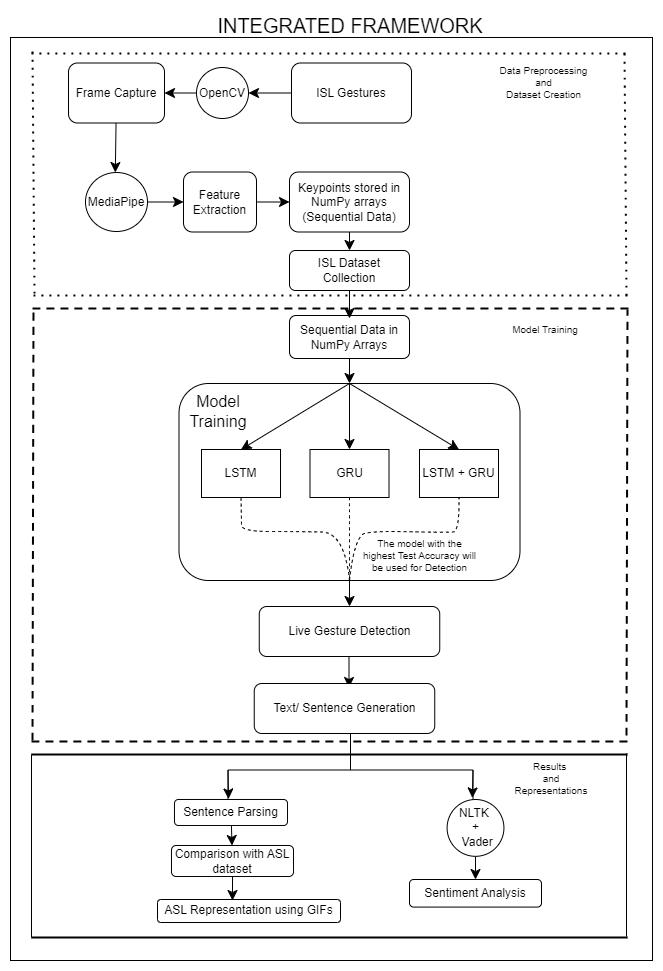
Fig -3:Aintegratedframeworkrepresentingthe conversionofISLtoASLthroughGIFSandidentifyingthe sentiments
International Research Journal of Engineering and Technology (IRJET) e-ISSN:2395-0056
Volume: 11 Issue: 03 | Mar 2024 www.irjet.net p-ISSN:2395-0072
OpenCV library is used to access live camera feed and to capture video data in the form of frames. Media Pipe modelisusedtodetectallthelandmarksandtheobtained key-points are stored in NumPy arrays for respective frames. Sequential data is obtained by using this method and an ISL dataset is created. The list of words includes (Bathroom, Coffee, dislike, drink, eat, ExcuseMe, favorite, GoodMorning, GoodNight, happy, hello, HowAreYou, I, icecream, idontunderstand, like, meet, name, please, repeat, sad, sandwich, Sorry, Thanks, time, want, water, What, Where, you). There are a total of 30 words in the list. For each word, data worth of 50 videos is recorded during dataset creation with each video having 30 frames each.
Once the dataset is created, it is used for training a deeplearning model. Since the data is sequential, RNN models are applied. Namely, LSTM and GRU. Three models have been trained over the given dataset - LSTM model, GRU model, LSTM+GRU model training Accuracy obtained across eachofthe3modelsiscomparedandthe bestone ischosen.Themodel withthehighesttrainingaccuracyis usedtoimplementthereal-timedetection.Afterimporting therequiredlibrariesSequentialmodelisinitialized.
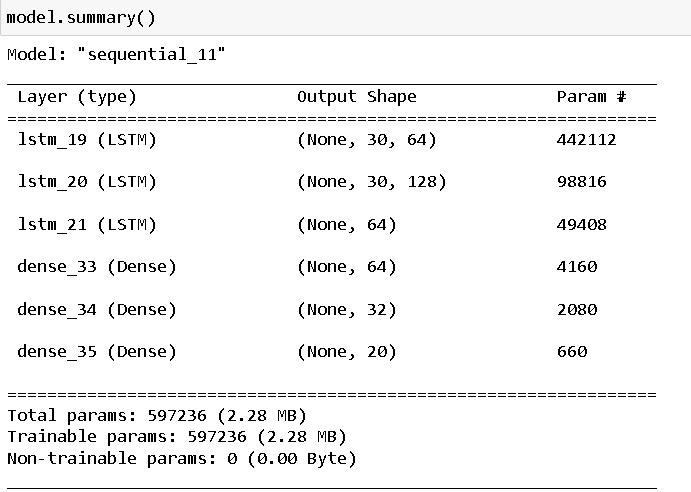
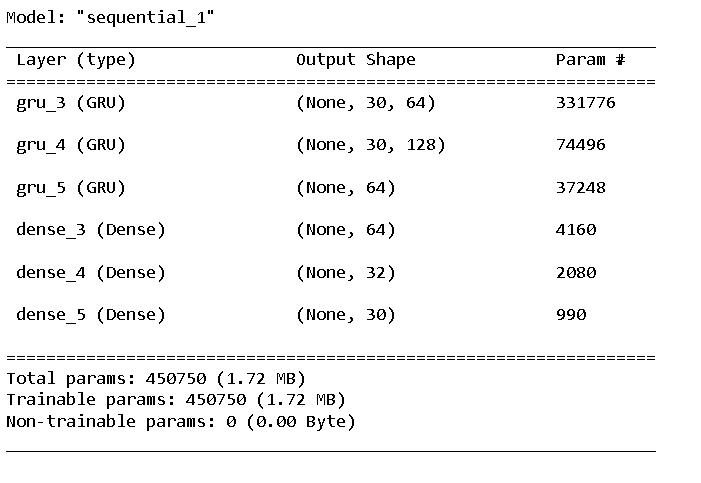
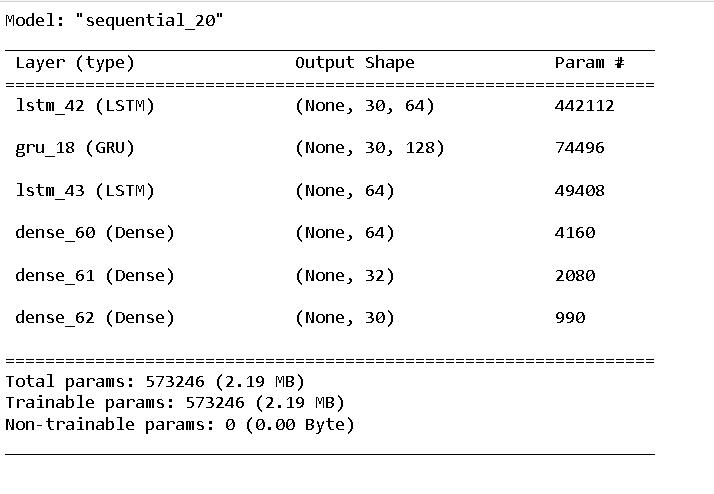
ThearchitectureofthestackedLSTMlayersinadditionto dense connection layers is responsible for hierarchical representation learning. For LSTM model, 3 LSTM layers areadded. The first,second andthirdlayershave64,128 and 64 units respectively. The 1st and 2nd layers return sequences which are given as input for the next layer except the 3rd layer. ReLU (Rectified Linear Unit) function used promotes non-linearity; neural networks with this activation can learn complex patterns easily. 3 dense layers are added after the LSTM layers to further process the extracted features for better classification. Adam optimizer is then used to compile the model and categorical_crossentropy is used as loss function. We choose the number of epochs for training the model and tracktheaccuracyusingTensorBoard. Thearchitectureof the model is same for GRU, LSTM+GRU model as well, except in LSTM+GRU model the first and third layers consist LSTM and the third layer consists of GRU respectively.
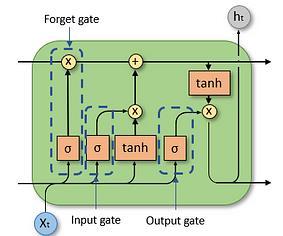
Long Short-Term Memory (LSTM) is a kind of recurrent neural network (RNN) architecture designed for action detection tasks, and therefore it is mostly suitable for actions such as sign language translation. It was introduced to address the vanishing gradient problem, which affects previous RNNs when training on long
sequencesofdata.LSTMnetworkshavememorycellsand threegates:theinputgate,theforgetgate,andtheoutput gate. These gates regulate the flow of information within thenetwork,whereitcanchoosewhichdatatoremember andwhattoforget.Theinputgatecontrolstheflowofnew information into the memory cell, the forget gate determines which information to remove from the cell's memory,andtheoutputgatetakescareoftheinformation outputfromthecell.
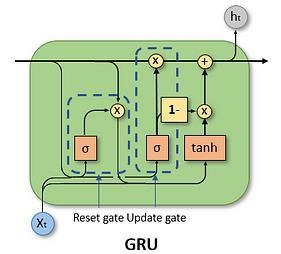
Gated Recurrent Unit (GRU) is a type of RNN architecture that is widely used for sequence modeling tasks, such as natural language processing and time series prediction. It was introduced as a simpler alternative to the LSTM architecture, designed to address some of the computational complexities of LSTM while maintaining similar performance GRU has gating mechanisms that control the flow of information within the network, allowing it to capture long-range dependencies in sequences effectively. Unlike LSTM, which has separate memorycellsandinput/outputgates,GRUcombinesthese functionalities into a single update gate and reset gate. This simplification results in fewer parameters and computations compared to LSTM, making GRU models
International Research Journal of Engineering and Technology (IRJET) e-ISSN:2395-0056
Volume: 11 Issue: 03 | Mar 2024 www.irjet.net p-ISSN:2395-0072
fastertotrainandoftenmoreefficientintermsofmemory usage.
4.3.3 LSTM+GRU
This neural network implements the LSTMs and GRU layerstogetherforsignlanguagetranslationtasks.Tothis end,hybridarchitecturecanusethecontextualrelationof the gesture sequence well by the LSTM layer connected with the GRU layer. These repeating layers extract meaningful contents of sign language gestures as the translation's basis, increasing the truthfulness. Another LSTM layer is used to process the data, followed by more denselyconnectedlayersviatheReLUactivationfunction, which allows for nonlinear learning. The model is taught to operate with the Adam optimizer, minimizing categorical cross-entropy loss. Category loss focuses on precision in the form of categorical accuracy during training. Another added feature is using TensorBoard to monitor training progress in real-time. After the training phase, the model summary section provides the details of itsarchitectureandparameters.
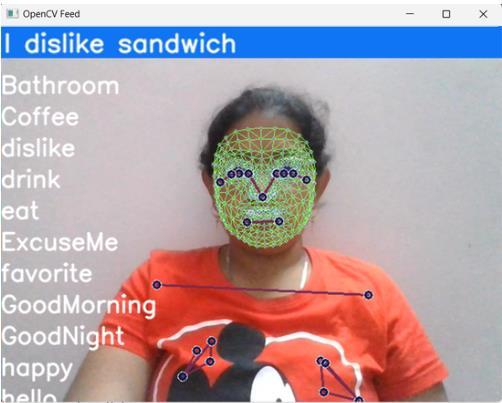
The trained model undergoes real-time testing using OpenCV's live capturing feature. Upon initiation, an OpenCV window displays a list of words used to train the model. As the user begins making gestures in front of the camera,thesystemidentifiesandhighlightsthewordthat closely matches the gesture. In cases where the gesture corresponds to multiple words, all relevant words are partially highlighted. Additionally, a highlight bar accompanies each word, indicating the percentage accuracy of detection. A full bar denotes 100% accuracy, while a partially highlighted bar signifies partial accuracy or misidentification. This setup enables users to interact with the system seamlessly, despite potential misidentifications, by providing real-time feedback on gesturerecognitionaccuracy.
4.5
The final accuracy and performance metrics of the model are proven visually through a series of graphs and charts.
International Research Journal of Engineering and Technology (IRJET) e-ISSN:2395-0056
Volume: 11 Issue: 03 | Mar 2024 www.irjet.net p-ISSN:2395-0072
A TensorBoard graph presentations how the learning graph of the model in the course of education. Also, a confusion matrix is generated to recognize word identification accuracy, helping to perceive any kinds of erred category or confusion. In addition, the output text undergoes sentiment evaluation to understand the emotional tone of the message, whether or not it's positive,negative,orneutral.Theseresultsprovideuseful insights into the model's effectiveness and emotional effect, permitting similarly refinement and optimization forimprovedoverallperformanceforusers.
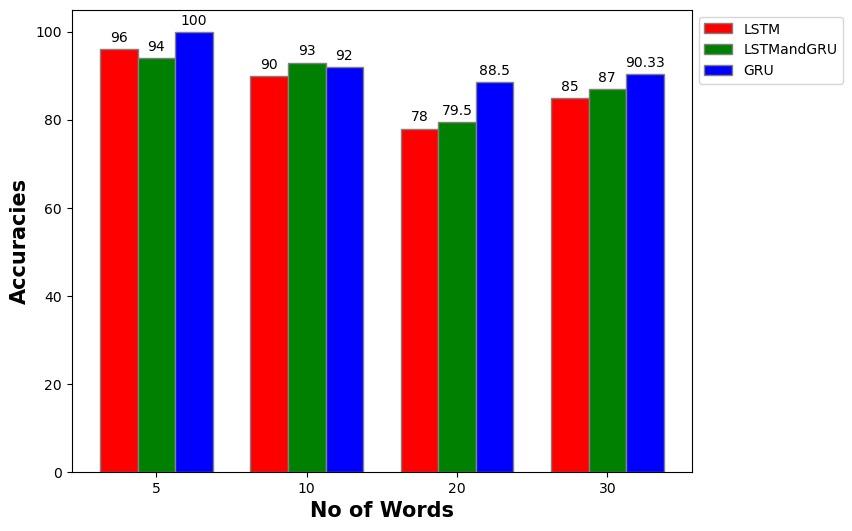
Fig -10: Bar-graphrepresentinghowtheaccuracies decreasewithanincreaseinthenumberofwords
Machine learning and computer vision are the most important frameworks and libraries used in this work, which help in performing complex model construction, training and visualization. The main base used is TensorFlow: an open framework that supports designing ML models, including the LSTM and GRU networks for action detection and visceral data streams in particular. Being an end-to-end ecosystem,itsflexibilityallowsusers to fine-tune their models which drives advancement of numerous applications. Also, OpenCV functions as an integralcomponentofcomputervision.Thetoolperforms multiple operations that include frame grabbing from camera images and videos, color space conversion, and feature superimposition. We have used OpenCV for collecting datasets in the form of frames for each dataset andatlastwehaveuseditforthedetectingtheaslsigns.
TheScikit-learnfeaturesawiderangeofmachinelearning tools that are great for data analysis and prediction because they offer classification, regression, clustering, and dimension reduction algorithms for sign language gestures and datasets. Matplotlib is in essence, the element bringing life to the visualization landscape in Python, presenting the ability to execute dynamic graph drawing coupled with diversified visualization opportunities to enhance the analysis and interpretation
ofdatarelatedtosignlanguagegestures.TensorBoardisa tool which can be seen as a platform for traceability and visualization of model performance, real-time monitoring and visualization in model development and performance optimizationarestressed.TensorBoardisusedtoenhance the analysis and interpretation of data related to sign language gestures. Collectively, these tools constitute the skeletonoftheentiremodel’spipeline.
The project was tested with various subsets of data. Initiallythedatasetwasmadeof30words,butforchecking the efficiency and performance of the model it has been splitinto5,10,20and30wordsrespectively.Thesesetsof words were trained on different neural network architecturesnamely LSTM,LSTM+GRU,andGRU.After attentive trial and error method, we identified the architectures yielding the highest accuracies and used them to generate sentences from the input. These sentences were then transformed into ASL GIFs with the help of IPython libraries. Sentiment analysis was conductedusingtheVADER(ValenceAwareDictionaryfor sEntiment Reasoning) framework to determine the emotional tone of the sentences. The polarity of the sentiments be it positive,negative, or neutral was then determined, offering valuable insights into the conveyed messages.
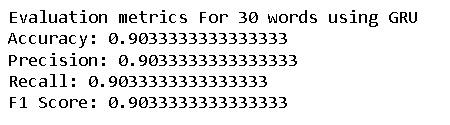
Fig -11:Evaluationmetricsfor30wordsusingGRU
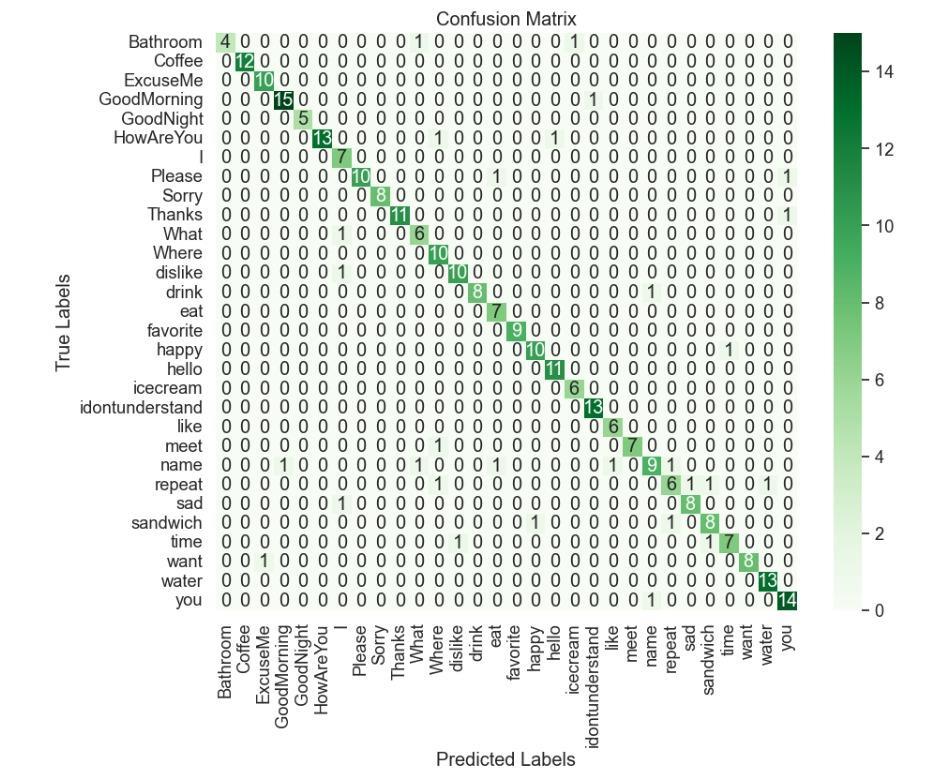
Fig -12:Confusionmatrixfor30wordsusingGRU
International Research Journal of Engineering and Technology (IRJET) e-ISSN:2395-0056
Volume: 11 Issue: 03 | Mar 2024 www.irjet.net p-ISSN:2395-0072
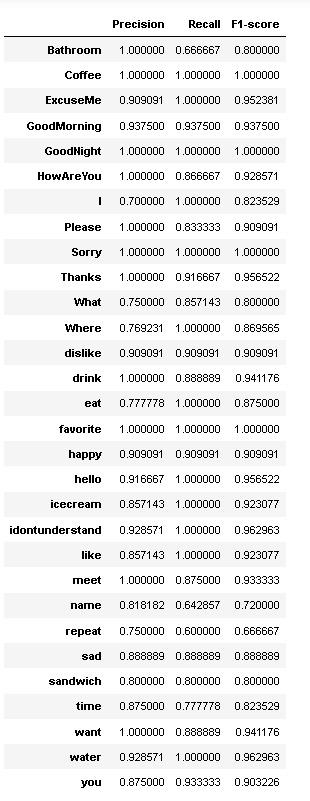
Fig -13:Evaluationmetricsforeachofthe30words
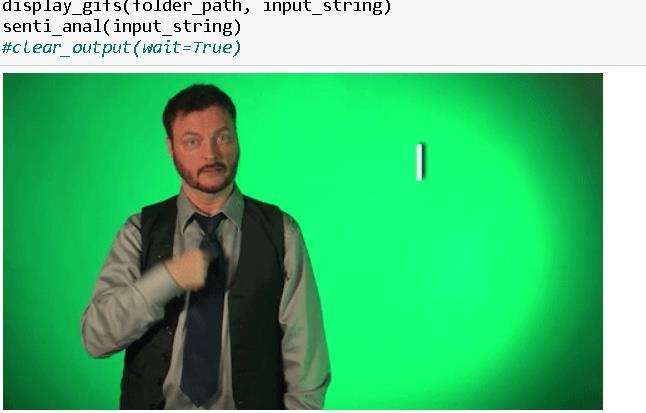
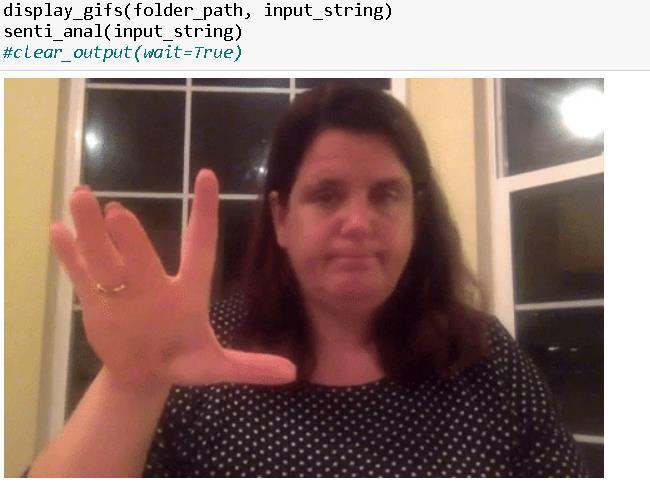
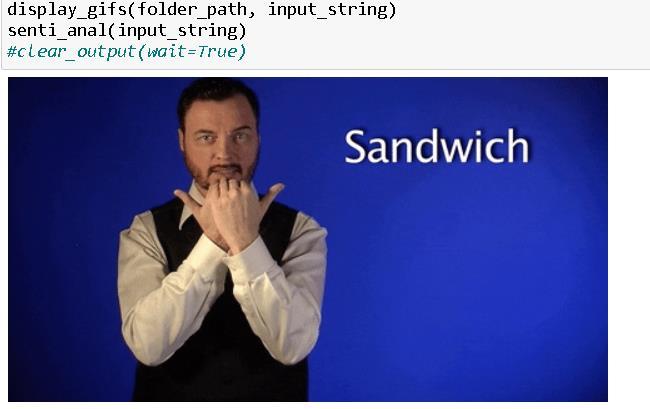
Fig -14:ASLrepresentationofwordsusingGIFs
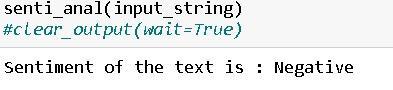
Fig -15:Sentimentanalysisresult
© 2024, IRJET | Impact Factor value: 8.226 | ISO 9001:2008 Certified Journal | Page1325
International Research Journal of Engineering and Technology (IRJET) e-ISSN:2395-0056
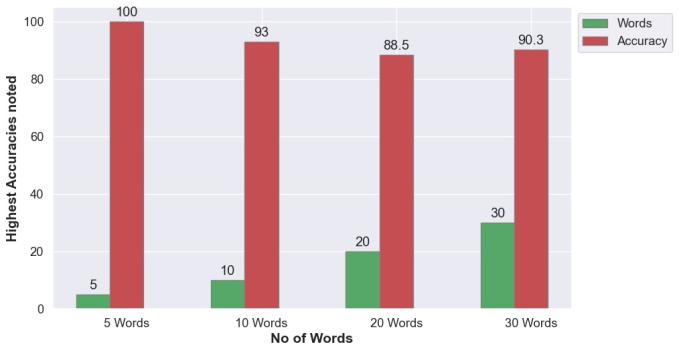
Fig -16:Bargraphrepresentingtheno.ofwordsand highestaccuracyobtainedforeachcase
From our comprehensive analysis, it's evident that the accuracy of our modelsis intricatelylinked to the number and nature of words considered for training. Different word types exhibit varying accuracies, underscoring the importance of meticulous data curation. Smooth training processesandhighaccuraciesareobservedforwordswith consistent data representations. Furthermore, the choice between LSTM, LSTM+GRU, or GRU architectures significantly influences both training speed and final accuracy. Notably, GRU requires the fewest parameters, whileLSTMtypicallydemandsmore.Theinclusionofmore wordsleadstoadeclineinfinalaccuracy,attributedtothe increased data volume and complexity of model parameters. Despite leveraging extensive datasets comprising50videoswith30frameseach,ourmodelsstill achievecommendableaccuracyvalues.
Looking ahead, the integration of both static and dynamic data presentsanexcitingavenueforfurtheradvancement. IncorporatingNLPtofurtherrefinethesentencestructures for a more seamless translation between languages also servesasa key point for future development. This holistic approach sets the stage for continued refinement and innovation in communication accessibility and sentiment analysisdomains.
[1] Sundar, B & Thirumurthy, Bagyammal. (2022). American Sign Language Recognition for Alphabets Using MediaPipe and LSTM. Procedia Computer Science.215.642-651.10.1016/j.procs.2022.12.066.
[2] Bora, Jyotishman & Dehingia, Saine & Boruah, Abhijit & Chetia, Anuraag & Gogoi, Dikhit. (2023). Real-time AssameseSignLanguageRecognitionusingMediaPipe and Deep Learning. Procedia Computer Science. 218. 1384-1393. 10.1016/j.procs.2023.01.117. M. Young, The Technical Writer’s Handbook. Mill Valley, CA: UniversityScience,1989.
Volume: 11 Issue: 03 | Mar 2024 www.irjet.net p-ISSN:2395-0072 © 2024, IRJET | Impact Factor value: 8.226 | ISO 9001:2008
[3] S. Adhikary, A. K. Talukdar and K. Kumar Sarma, "A Vision-basedSystemforRecognitionofWordsusedin Indian Sign Language Using MediaPipe," 2021 Sixth International Conference on Image Information Processing (ICIIP), Shimla, India, 2021, pp. 390-394, doi:10.1109/ICIIP53038.2021.9702551.
[4] Akshatharani, B. K., & Manjanaik, N. (2021). Sign language to text-speech translator using machine learning. International Journal of Emerging Trends in EngineeringResearch,9(7).
[5] Sheth, Pranav & Rajora, Sanju. (2023). Sign Language Recognition Application Using LSTM and GRU (RNN). 10.13140/RG.2.2.18635.87846.
[6] Tayade, Akshit & Halder, Arpita. (2021). Real-time Vernacular Sign Language Recognition using MediaPipe and Machine Learning. 10.13140/RG.2.2.32364.03203.
[7] Khartheesvar,G&Kumar,Mohit&Yadav,ArunKumar & Yadav, Divakar. (2023). Automatic Indian sign language recognition using MediaPipe holistic and LSTMnetwork.Multimedia ToolsandApplications.120.10.1007/s11042-023-17361-y.
[8] Subramanian, B., Olimov, B., Naik, S.M. et al. An integratedmediapipe-optimizedGRUmodelforIndian sign language recognition. Sci Rep 12, 11964 (2022). https://doi.org/10.1038/s41598-022-15998-7
[9] Cristina Luna-Jiménez, Manuel Gil-Martín, Ricardo Kleinlein, Rubén San-Segundo, and Fernando Fernández-Martínez. 2023. Interpreting Sign Language Recognition using Transformers and MediaPipe Landmarks. In Proceedings of the 25th International Conference on Multimodal Interaction (ICMI'23).AssociationforComputingMachinery,New York, NY, USA, 373–377. https://doi.org/10.1145/3577190.3614143
[10] Chandwani,Laveen&Khilari,Jaydeep&Gurjar,Kunal &Maragale,Pravin&Sonare,Ashwin&Kakade,Suhas &Bhatt,Abhishek &Kulkarni,Rohan.(2023).Gesture based Sign Language Recognition system using Mediapipe.10.21203/rs.3.rs-3106646/v1.
[11] Duy Khuat,B.,ThaiPhung, D.,ThiThuPham,H.,Ngoc Bui, A., & Tung Ngo, S. (2021, February). Vietnamese sign language detection using Mediapipe. In Proceedings of the 2021 10th International Conference on Software and Computer Applications (pp.162-165).
[12] Goyal, K. (2023). Indian sign language recognition using mediapipe holistic. arXiv preprint arXiv:2304.10256.
International Research Journal of Engineering and Technology (IRJET) e-ISSN:2395-0056
Volume: 11 Issue: 03 | Mar 2024 www.irjet.net p-ISSN:2395-0072
[13] https://www.researchgate.net/figure/Indian-signlanguage-for-numbers-andalphabets_fig1_357169928
[14] https://images.app.goo.gl/hoCvmmorVRTXQmBk7
[15] https://developers.google.com/mediapipe
[16] https://towardsdatascience.com/a-briefintroduction-to-recurrent-neural-networks638f64a61ff4