
International Research Journal of Engineering and Technology (IRJET) e-ISSN:2395-0056
Volume:11Issue:03|Mar2024 www.irjet.net p-ISSN:2395-0072
International Research Journal of Engineering and Technology (IRJET) e-ISSN:2395-0056
Volume:11Issue:03|Mar2024 www.irjet.net p-ISSN:2395-0072
1Mr.Saurabh Vinayak Kamble, 2Prof. V. P. Bhusare, 3Prof. Y. R. Suryawanshi
Jspm’s Imperial College Of Engineering & Research Wagholi, Pune- 412207,Maharashtra, India.
Abstract -TheP-deltaeffect, whichisimportant in structural analysis for tall structures, is investigated in this work utilizing linear static analysis in STAAD.Pro software. RCC-framed structures of varying heights are modeled using seismic loads from IS-1893(2016) for Zone III and load combinations from IS456(2000).Bending moments and narrative displacements are calculated using and without the Pdelta effect for various models. An iterative approach increases the rigidity of dangerous buildings to meet acceptablestandards.
The findings stress the importance of considering the Pdelta impact in 5-story structures and encourage adequate planning for buildings taller than 20 meters. Furthermore, up to 25 storeys, primary analysis is sufficient, with measures such as cross-section adjustment efficiently bringing dangerous structures insidepermissiblelimits.
Index Terms – P-delta effect, RCC building design, Structural analysis, STAAD.Pro software, Earthquake loads
The P-delta analysis approach is an important feature of structural engineering, especially for geometric nonlinearity in buildings subjected to lateral stresses such as wind or seismic forces. In contrast to linear analysis, real-world scenarios contain considerable lateral displacements that can change a structure's shape and the distribution of internalforces.P-deltaanalysistakesintoconsiderationboth axial loads (P) and lateral deformations (delta), which are especially significant in tall or flexible constructions. This cyclical procedure is frequently mechanized with powerful technologies, assuring compliance with building rules and accurate structural response assessments. Lateral loads, which include wind, seismic, and temperature-induced forces, are crucial in determining structure stability and design.Structural components such as shear walls, bracing systems, and damping systems help to withstand lateral loads, with different bracing types designed for specific structural requirements. STAAD.Prosoftware offersscalable structural analysis and design solutions, whereas RCDC
improvesconcreteanalysisbyexpeditingthedesignprocess forelementssuchasbeams,columns,andwalls.Thepurpose ofthisstudyistoevaluatetheP-deltaeffectonRCCcolumns usingSTAAD.Prosoftware,withobjectivesincludingstability analysis, comparing steel percentages for unsafe columns, and analyzing RCC structures with and without X-bracing to maximizeperformance.
Structural planning and design combine art and science, necessitatingcreativity,conceptual thinking,anda thorough understanding of structural engineering concepts. Akash Deep et al. (2016) stressed the need of following applicable design norms and standards to ensure structural safety while balancing cost and safety. Their research focused on constructing a G+5 building in Badarpur, New Delhi, with STAAD.PRO software, emphasizing the importance of rigorousplanningandtheuseofpowerfulsoftwaretoolsfor structuraldesign.
In earthquake-prone areas such as India, understanding earthquake behavior and building earthquake-resistant structures is critical. Bhavesh Kumar Daharwal et al. (2018) emphasized the importance of designing structures that can withstandseismicforcesinordertoavoidpotentialhazards. Theirresearchunderscoredtheimportanceofshearwallsin resisting lateral stresses during earthquakes, which contributestogreaterstructuralstability.
Concrete cracking and the second-order geometric effect of P-Delta are important factors in the seismic response of high-rise reinforced concrete buildings, as established by Ruaa A. Abdulhameed et al. (2022). Their research, which usedfiniteelementanalysiswithETABSsoftware,shedlight on the impact of concrete cracking and P-Delta effects on modal analysis, revealing the elongation of vibration time periodsandothercrucialparameters.
PrashantDhadveetal.(2019)exploredtheP-deltaimpactin high-rise buildings, highlighting its importance as the number of storeys increased. Their study, which used ETAB software, emphasized the need of taking P-delta effects into accountinstructuraldesign,especiallyfortallbuildingsthat experiencesignificantdeformation.
International Research Journal of Engineering and Technology (IRJET) e-ISSN:2395-0056
Volume:11Issue:03|Mar2024 www.irjet.net
Ahmed Sada Dheeb et al. (2019) investigated the secondorder geometric nonlinearity effects of P-Delta analysis on the dynamic response of high-rise steel structures to deterministic wind loads. Their study, which used nonlinear timehistoryanalysisandETABSsoftware,revealedvaluable insights into the dynamic behavior of tall steel buildings, resultinginbetterdesignmethods.
Furthermore,KanchanGuptaetal.(2020)demonstratedthe importance of P-delta analysis in flat slab buildings, emphasizing the need to include second-order effects to ensurestructuralintegrity.
In addition, CM Meera et al. (2013) and Renjith Raju et al. (2019) investigated novel methodologies for structural design and retrofitting, respectively, making major contributionstoadvancesinbuildingpractices.
Ontopofthat,KaifKhanetal.(2023)investigatedtheimpact of the significance factor on reinforcing steel % during seismic analysis, with the goal of improving seismic design methods. Finally, Dr. Khadeeja Priyan and Dr. J. R. Pitroda (2021) investigated the strain capacities of engineered cementitious composites (ECC), emphasizing its ductility in comparison to traditional concrete and the potential to revolutionizestructuralengineeringtechniques.
These studies collectively deepen our understanding of various aspects of structural engineering, including seismic design considerations, innovative material applications, retrofitting techniques, and the integration of advanced computational tools, all of which contribute to the field's ongoing advancement and the development of safer, more resilientstructures.
The methodology for P-delta analysis is a systematic approach specialized for structural analysis, particularly for tall or slender buildings where axial loads cause additional moments that affect overall stability. Initially, the structural geometry is determined, which includes dimensions, member sizes, and connections, as well as material parameterslikemodulusofelasticityandPoisson'sratio.
p-ISSN:2395-0072
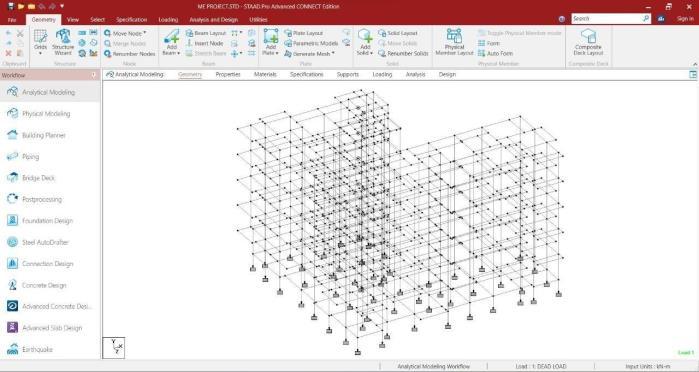
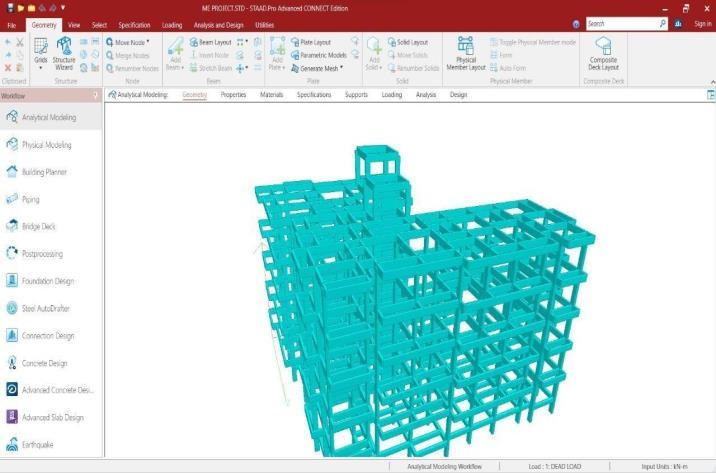
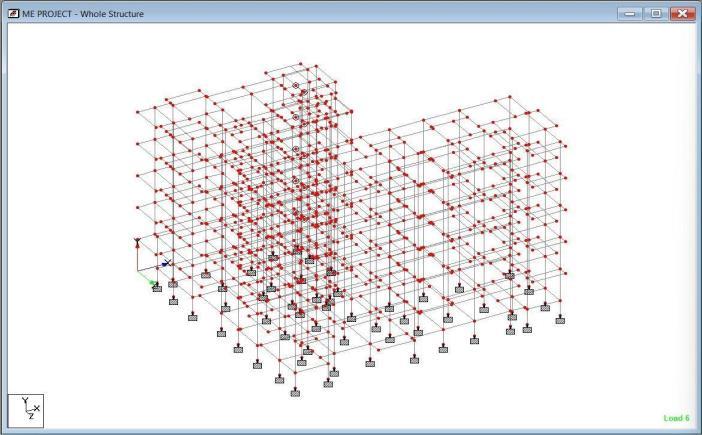
Then, using structural analysis software, a finite element modeliscreatedthatincludesallstructuralelementssuchas beams,columns,slabs,andbraces,withboundaryconditions appliedtosimulatestructuralsupports.
International Research Journal of Engineering and Technology (IRJET) e-ISSN:
Volume:11Issue:03|Mar2024 www.irjet.net
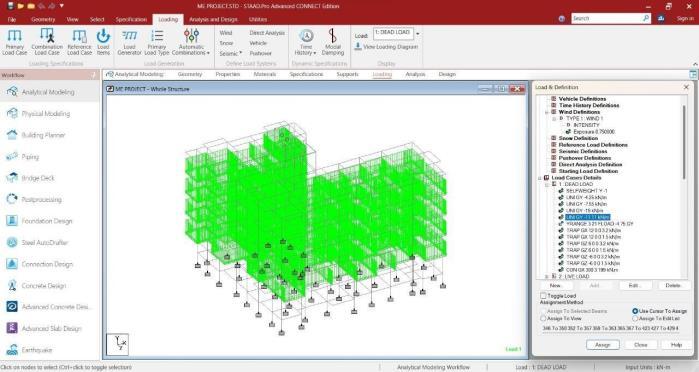
Allrelevantloads,suchasdeadloads,liveloads,windloads, andseismicloads,areconsideredandappliedincompliance withconstructionnormsandstandards.
AnalysisResultWithoutP-DeltaEffect
ComparisonofAnalysisResultsWithAndWithoutPDeltaEffect
Following that, a linear static analysis is performed to determine the structure's initial response to applied loads, resulting in initial displacements and member forces
International Research Journal of Engineering and Technology (IRJET) e-ISSN:2395-0056
Volume:11Issue:03|Mar2024 www.irjet.net
indicative of the structure's preliminary deformation. Distinctloadcasesarethendevelopedforeachappliedload, taking into account P-delta effects and accommodating lateral displacements generated from the linear analysis. To accommodate for P-delta effects, the structural stiffness matrix is modified in response to initial deformations. To reach convergence, an iterative analysis is performed, with the stiffness matrix being updated iteratively until the findings stabilize, frequently using conventional iterative methods such as the Newton-Raphson method. To assess compliance with code requirements for stability and safety, thefinal resultsarethoroughlyreviewed,includingmember displacements, rotations, and internal forces. Sensitivity analyses are then performed to determine the effect of parameter changes on P-delta values. Finally, a definitive Pdeltaanalysisisdonetoconfirmcompliancewithsafetyand performancestandards.
Our investigation on P-delta analysis in tall building design provides valuable insights into the behavior of structures under different loading scenarios. Using advanced technologiessuchasSTAAD.Pro,oursurveygeneratedsome significant findings. Initially, we found a considerable association between a building's height and the severity of theP-deltaeffect,emphasizingtheimportanceofaccounting for geometric nonlinearity in tall structures to avoid underestimating displacements and internal forces. When comparingP-deltaanalysistostandardstabilityanalysis,we regularly saw higher displacements predicted by P-delta, demonstrating that it has a significant impact on structural deformations. Furthermore, our analysis found that P-delta impactsgo beyondgravityloadstoencompasslateralforces like wind and seismic loads, emphasizing the significance of aholisticdesignapproach.
Furthermore, through parametric tests, we discovered Xbracing as an effective technique for minimizing P-delta effects, with the potential to minimize them by up to 95% andsoimprovestructuralstability.Inconclusion,oursurvey findings highlight the importance of P-delta analysis in assuring the robustness of tall buildings under dynamic loading situations, hence contributing to advances in structuralengineeringmethodsinthisfield.
Our work into P-delta analysis in tall building design demonstrates the need of adding geometric nonlinearity in structural assessment. The found association between building height and the P-delta effect stresses the need of usingP-deltaanalysisinhigh-risestructuresovertraditional stability analysis approaches. Furthermore, our findings
p-ISSN:2395-0072
show that displacements anticipated by P-delta analysis are approximately 10% higher than those predicted by normal analysis, demonstrating that geometric nonlinearity has a considerable impact on structural deformation. Furthermore, our investigation demonstrates that P-delta impactsgobeyondgravityloadstoencompasslateral forces like wind and seismic loads, demanding a comprehensive design approach. Furthermore, our research shows Xbracing as a viable technique for mitigating P-delta effects, with the potential to diminish them by up to 95%. In summary, our survey emphasizes the importance of P-delta analysis in tall building design, providing insights into improving structural stability and resilience in the field of structuralengineering.
1) Dr Ruaa Abdulateef Abdulhameed (Author) P-Delta Effect on The Dynamic Seismic Response of High Rise BuildingsPaperback–Import,22April2019
2) Amrul Kaish .A.B.M, Jamil.M,. Raman.S.N, Zain. M.F.M (2015) Axial behavior of ferrocement confined cylindrical concrete specimens with different sizes, Journal of ConstructionandBuildingMaterials
3) Mallikarjuna B.N1 , Ranjith A STABILITY ANALYSIS OF STEELFRAMESTRUCTURES:P-DELTAANALYSIS(2014)
4) Kanchan Gupta, Md. Tasleem Performance of P-Delta AnalysisofFlatSlabandRCFramedBuildings(2020)
5) Prashant Dhadve “Assessment of P-Delta Effect on High RiseBuildings”(2015)
6) Atul Rupanvar, Deokate K “Assessment of P-Delta Effect onHighRiseBuildings”(2016)
7) S.Sudheer, Analysis & design of g+5 residential building usingSTAADPro.
8) Mr.A.P.Patil,Mr.A.A.Choudhari,Mr.P.A.Mudhole,Mr. V.V.Patole,Ms.A.D.Dange,Ms.
9) S. K. Chendake, Design & Analysis of Multi Storeyed Building(G+10)ByUsingStaddProV8i.
10) S.Karthiga, Hanna Elza Titus, Reetwiz Raj Hazarika, Mohamed Harris, Design and comparison of a residential buildingforseismicforcesusingtheIS1893.