
International Research Journal of Engineering and Technology (IRJET) e-ISSN: 2395-0056
Volume: 11 Issue: 03 | Mar 2024 www.irjet.net p-ISSN: 2395-0072
International Research Journal of Engineering and Technology (IRJET) e-ISSN: 2395-0056
Volume: 11 Issue: 03 | Mar 2024 www.irjet.net p-ISSN: 2395-0072
Sameer S Mulani1, S. S. Kadam2 , G. D. Lakade3
1Research Scholer, Dept. Civil Engineering, SKN Sinhgad College of Engineering, Maharashtra, India
2Prof. Dr, Dept. Of Civil Engineering, SKN Sinhgad College of Engineering, Maharashtra, India
3Prof, Dept. Of Civil Engineering, SKN Sinhgad College of Engineering, Maharashtra, India
Abstract - An Elevated water tanks are lifelines of our water supply systems. However,earthquakesposeaimportant hazard to their stability [2]. This study investigates into the seismic response of a reinforced concrete (RC) elevated water tank using advanced computer models. The investigation focuses on a specific tank design with a 50 cubic meter capacity. We created a detailed numerical model incorporating its dimensions and assigned realistic material properties. Staad Pro software was then used to perform a time history analysis, simulating the tank's behavior under earthquake ground motions. Twohistoricalearthquakes,Bhuj and Uttarkashi, were chosen to represent different seismic scenarios. The analysis yielded valuable data on the tank's dynamic response under these varying conditions. This data includes roof displacement, velocity, acceleration, the force at the base (base shear), and the tank's natural frequencies of vibration. A key takeaway is the significant influence of water level on the tank's seismic behavior [15]. The study highlights how a full or partially filled tank reacts differently compared to an empty one. This knowledge is crucial for understanding critical failure mechanisms during earthquakes. Ultimately, this research contributes valuable insights into the seismic vulnerability of elevated water tanks. It covers the way for developing effective retrofitting strategies and improved design guidelines.
Key Words: Seismic response, Elevated water tank, Reinforcedconcrete(RC),Timehistoryanalysis,Waterlevel
Elevatedstoragereservoirsplayacriticalroleinensuring reliable water supply to communities, industries, and variousothersectors[3].However,theirstructuralintegrity and resilience under seismic events are of paramount importance,particularlyinregionspronetoearthquakes[3]. The seismic vulnerability of elevated storage reservoirs necessitates thorough evaluation and analysis to mitigate potentialrisksandensurethesafetyofwatersupplysystems [6].
The seismic performance of elevated storage reservoirs dependsonvarious factors suchasdesignconsiderations, materialproperties,structuralconfiguration,anddynamic response characteristics [20]. Understanding how these
factorsinteractunderseismicloadingconditionsisessential for developing effective design guidelines and retrofitting strategiestoenhancetheresilienceofexistingstructures[2].
In recent years, advancements in structural engineering, computational modeling, and seismic analysis techniques have facilitated more comprehensive assessments of the seismic performance of elevated storage reservoirs. Researchersandpractitionershaveemployedsophisticated numerical simulations, experimental testing, and field investigationstoevaluatethebehaviorofthesestructures underseismicforces.
This paper aims to contribute to the existing body of knowledge by conducting a systematic performance evaluation of elevated storage reservoirs subjected to earthquake forces. Through a combination of numerical modellingandexperimentalvalidation,theseismicresponse of elevated storage reservoirs will be investigated, with a focusonunderstandingcriticalfailuremechanisms,dynamic characteristics, and the effectiveness of retrofitting measures.
Theoutcomesofthisstudyareexpectedtoprovidevaluable insights into the seismic vulnerability of elevated storage reservoirs and inform the development of robust design guidelinesandriskmitigationstrategies.Byenhancingour understandingoftheseismicbehaviourofthesestructures, wecanbettersafeguardwatersupplysystemsagainstthe devastatingimpactsofearthquakes,ensuringtheresilience andreliabilityofcriticalinfrastructureinearthquake-prone regions.
2.1
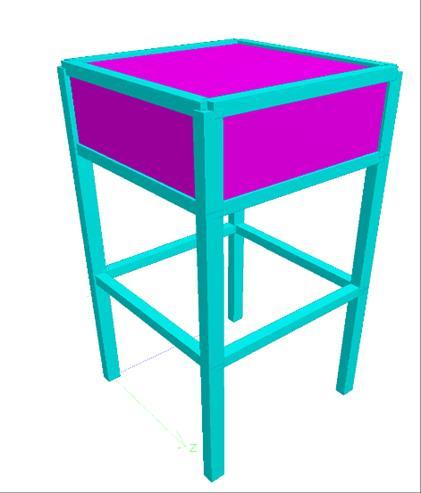
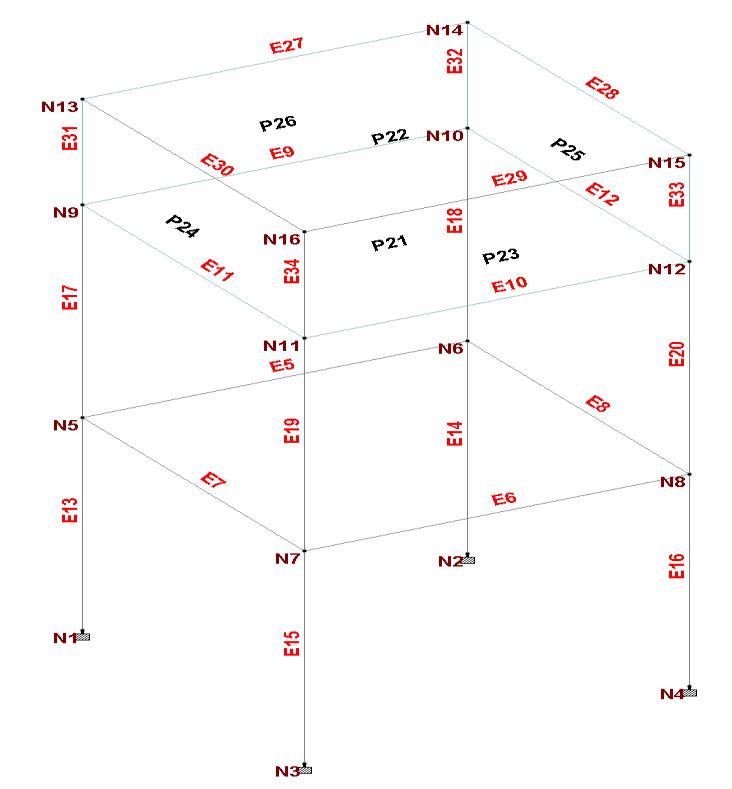
ARCElevatedwatertankhavingstoragecapacityof50 m3isconsideredinthisstudy.Thecontainerhasasquare baseofside5mandtheheightis2mwithaslab.Thesupport structureconsistsof4columnshavingcrosssection0.4mx 0.3m.Forstudypurposetankfullconditionisconsidered,the structure is subjected to two earthquake ground motions (BhujandUttarkashi).
International Research Journal of Engineering and Technology (IRJET) e-ISSN: 2395-0056
Volume: 11 Issue: 03 | Mar 2024 www.irjet.net p-ISSN: 2395-0072
Groundmotionisthebasicandprimeinputfortimehistory analysisofstructure.Therealgroundmotionrecordscanbe obtainedfromtherecordsofpreviousearthquakeeventsare preferred.Realgroundmotionareactualrecordsofseismic shaking produced by earthquakes. For current study purposetotal two real groundmotionsareconsideredfor
the dynamic analysis of the elevated water tank. Finite elementmodelismodelledinStaadProsoftware.
Table -1: Parametersofselectedgroundmotion
Followingthestructuralmodellingofbeamsandcolumns, materialassignmentconstitutesapivotalstageinthedesign process. In the context of this project, characterized by concretedesignspecifications,thebeamsandcolumnshave beendesignatedwithconcretematerialproperties.
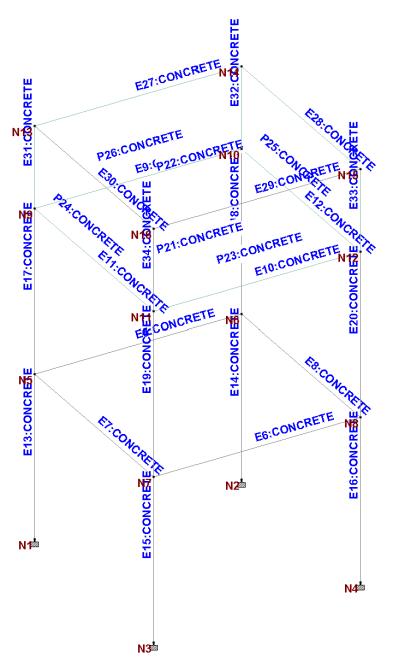
-3:Assigningconcretematerialtostructure
2.4 Time History analysis
Thestudyoftimehistoryanalysisistounderstandtheactual behaviorofastructureateveryadditionoftime,whenitis subjectedtoagroundmotion.Thetechniqueoftimehistory analysis represents the most sophisticated method of dynamicanalysisforthestructure.Themathematicalmodel ofthestructureissubjectedtoaccelerationfromearthquake atthebaseofthestructure.Timehistoryanalysisconsistsof a step-by-step direct integration over a time interval, the equationofmotionissolvedwiththeacceleration,velocities and displacements of the previous step serving as initial function.Thetwoearthquakegroundmotionsselectedare
International Research Journal of Engineering and Technology (IRJET) e-ISSN: 2395-0056
Volume: 11 Issue: 03 | Mar 2024 www.irjet.net p-ISSN: 2395-0072
consideredasaninputmotionforthetimehistoryanalysis and applied at the base of the structure. The seismic performanceoftheelevatedwatertankundertwodifferent selectedearthquakerecordswillbeexaminedfortankfull tank.StaadProv8isoftwareisusedfortimehistoryanalysis ofthestructure.
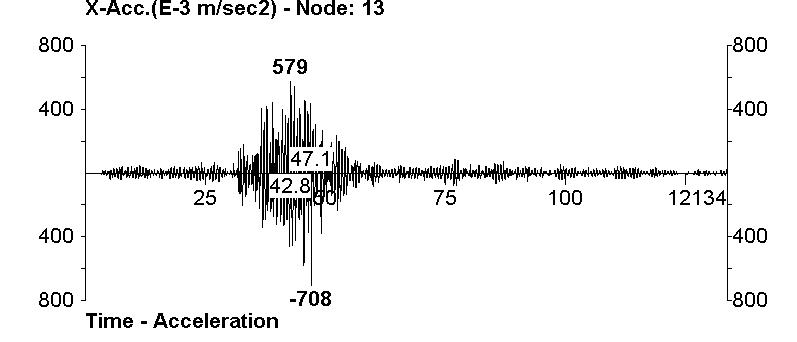
Chart -1:AccelerationGraphforBhujearthquakedata
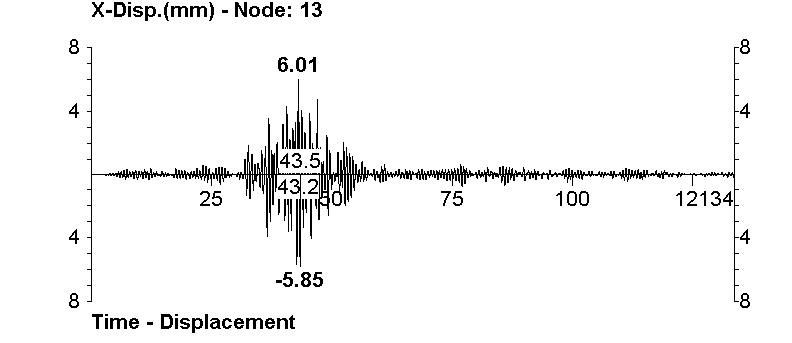
Chart -2:DisplacementGraphforBhujearthquakedata
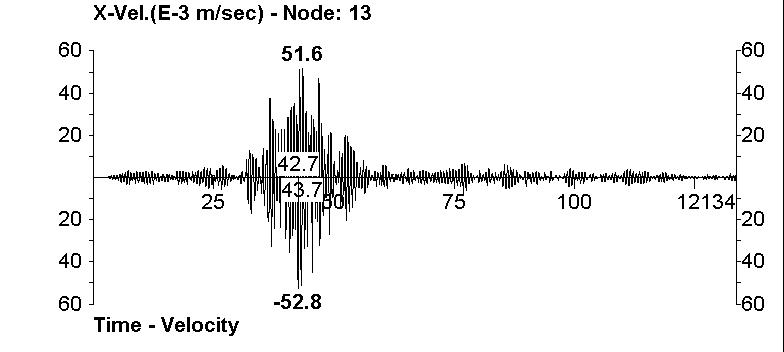
Chart -3:VelocityGraphforBhujearthquakedata
3. RESULTS AND ANALYSIS
Thetimehistoryanalysisiscarriedoutforthetankwithfull tankconditionusingabovementionedparameters.Foreach earthquakeseparatemodelisprepared.
The results are noted down in form of tank Roof displacement,velocity,acceleration,Baseshear,frequency. Thevalueofroofdisplacement,velocityandaccelerationis takenbyconsideringanode(nodeno.#13)intheroofofthe structure.
Roof displacement is an important serviceability criterion for any structure. Maximum roof displacement has been observed under Uttarkashi Earthquake ground under half tank condition and minimum roof displacement observed under Bhuj Earthquake ground record under empty tank condition.
Table -2: RoofDisplacementcomparison
Table2providesdataonroofdisplacementmeasuredata structureduringtheBhujandUttarkashiearthquakes.The tablehighlightstheimportanceofconsideringtheweightof watertanksonroofdisplacementduringseismicevents.The Bhujearthquakeresultedinhigherdisplacementscompared toUttarkashi,potentiallyduetoacombinationoffactorslike earthquake intensity and the specific structural characteristics.
Table -3: RoofVelocitycomparison
Table-3 complements the displacement data (Table-2) by showingtheroofvelocitymeasuredatastructureduringthe Bhuj and Uttarkashi earthquakes. Both displacement and velocitydataemphasizetheimportanceofconsideringthe weightofwatertanksontheseismicresponseofstructures. The higher velocities observed in Bhuj compared to Uttarkashi might be due to a combination of factors like earthquakeintensityandstructuralcharacteristics.
Table -4: RoofAccelerationcomparison
Earthquake
Acceleration(E-3m/sec2) Empty
Bhuj 708 697 581
Uttarkashi 1130 1740 1800
Table-4 (acceleration) alongside Tables-2 (displacement) and3(velocity)provideacomprehensiveoverviewofthe roof's response under different earthquake scenarios and water tank fill levels. While a trend of increased response
International Research Journal of Engineering and
Volume: 11 Issue: 03 | Mar 2024 www.irjet.net
with higher water weight is generally observed, the Bhuj dataforaccelerationshowsananomalywherethefulltank has a lower value compared to the half tank. Further investigationwithalargerdatasetandanalysisconsidering factorslikestructuralpropertiesandwatertankdynamicsis recommended.
Table -5: BaseSharecomparison
Baseshearisanestimateofthemaximumexpectedlateral forcethatoccursduetoseismicgroundmotionatthebaseof the structure. The base shear depends in probability of significantgroundmotionandthelevelofductilityandover strengthassociated withvariousstructural configurations andthetotalweightofthestructure.
Thebaseshearvaluesforbothearthquakes(Bhujand Uttarkashi) seemtovaryacross differenttimepoints duringtheevent.
Inmostcases,thebaseshearappearstobehigherfor the full tank scenario compared to the empty or half
tankscenarios,suggestingthattheincreasedweightof thewateraffectstheshearforcesatthefoundation.
Table-5explorestheinfluenceofwatertankfilllevelon baseshearatthefoundationduringearthquakes.The datasuggestsapotentialcorrelationbetweenincreased water tank weight and higher base shear values, particularly for the Bhuj earthquake. Further studies with a larger dataset and various structural configurations are necessary to validate this observationanditsimplicationsfordesign."
Table-5 provides base shear data for different earthquake scenarios and water tank fill levels. This data can be valuable for validating analytical models usedtoassesstheseismicresponseofstructureswith water tanks. Including more earthquake data and structural details would allow for a more comprehensive analysis of the impact of water tank weightonbaseshear.
Table -6: NaturalFrequencycomparison
Themodalanalysisdeterminesthevibrationcharacteristics suchasnaturalfrequenciesandcorrespondingmodeshapes. For dynamic loading conditions, the mode shapes and naturalfrequenciesareimportantparametersinthedesign ofastructure.Fromtheabovetable6,itisobservedthatthe natural frequencies of the structure generally decrease as the fill level increases, indicating a decrease in overall stiffness due to added mass. This trend is observed for modes 1, 2, and 3. However, mode 4 exhibits minimal variation in natural frequency across different fill levels. possible explanations for this behaviour is Localized VibrationPattern:Highermodes,likemode4,ofteninvolve more localized vibration patterns. In a rectangular tank, mode4mightprimarilyinvolvevibrationsinspecificareas, such as the corners, where the added liquid mass has minimal influence compared to its effect on the overall structureinlowermodes.
Timehistoryanalysiswasperformedforthefulltank conditionsubjectedtotwodifferentearthquakeground motions(BhujandUttarkashi).
International Research Journal of Engineering and Technology (IRJET) e-ISSN: 2395-0056
Volume: 11 Issue: 03 | Mar 2024 www.irjet.net p-ISSN: 2395-0072
The analysis results included roof displacement, velocity, acceleration, base shear, and frequency for eachearthquakeandfilllevel(full,half,empty).
A comparative study highlighted the significant influence of water tank fill level on the structural response during earthquakes. Key observations include:
Higher roof displacement, velocity, and accelerationwereobservedinfulltankscenarios comparedtoemptyorhalftankscenarios. Base shear values generally increased with increasedwaterweight,indicatingagreaterforce exertedonthefoundationduringearthquakes[5]. Natural frequencies tended to decrease with higher fill levels (except mode 4), suggesting a reduction in overall stiffness due to the added massofwater.
[1] Sunitha,K.R.,&Jacob,B.(2015).DynamicBucklingof SteelWaterTankunderSeismicLoading.International JournalofCivilEngineering(IJCE),4(6),81-90.
[2] Chougule, A. C., Chougule, P. A., & Patil, S. A. (2017). Studyofseismicanalysisofwatertankatgroundlevel. IntResJEngTechnol,4(7),2895-2900.
[3] Ghosh,P.,&Chowdhury,P.R.(2017).Acriticalstudyof seismicbehaviorofRCelevatedwatertanksonshafts type of staging system. International Journal of Engineering Research and Science & Technology (IJERST),6(1).
[4] Ninan,S.E.,&Hameed,A.S.(2018).SeismicAnalysisof Rectangular and Circular RC Elevated Water Tank. IJERT,6(6),01-04.
[5] Harsha,K.,Reddy,K.K.K.,&Kala,K.S.(2015).Seismic Analysis and Design of INTZE Type Water Tank. International Journal of Science Technology and Engineering,ISSN.
[6] Naik,S.C.,&Bhandiwad,M.S.(2016).SeismicAnalysis andOptimizationofaRectangularElevatedWaterTank. BonfringInternationalJournalofManMachineInterface, 4(Special Issue Special Issue on Computer Aided Analysis and Design of Structures| Editors: Dr. DK Kulkarni,Dr.RJFernandes,Dr.SBKulkarni),83-89.
[7] Azgar, M., & Smruthi, N. R. (2017). Design of Circular Water Tank by Using STAAD PRO Software. International Journal of Scientific Engineering and TechnologyResearch,6(29),5642-5650.
[8] Gupta,R.,Patil,V.,&Takkalaki,S.R.(2019),“Analysisof Dynamic Behaviour of RCC Elevated Water Tank”,
InternationalJournalofEngineeringDevelopmentand Research,vol.7(issue4),112-117.
[9] Raghavendra,G.,KeerthiGowda,B.S.,&Gururaj,M.H. (2014).Dynamicanalysisofoverheadwatertankunder shaft staging. International Journal of Advanced ScientificandTechnicalResearch,4(3),505-511.
[10] Pandey, B.H., Okazaki, K., & Ando, S. (2008). DissiminationOfEarthquakeResistantTechnologiesFor Non-EngineeredConstruction.
[11] Kumar, S.,Vig,R.,& Kapur, P.(2018). Development of Earthquake Event Detection Technique Based on STA/LTAAlgorithmforSeismicAlertSystem.Journalof theGeologicalSocietyofIndia,92,679-686
[12] Rossetto,T.,&Duffour,P.(2013).EarthquakeResistant Design.SpringerUS.
[13] Kumar, A. (2020). Seismic Isolation and Energy Dissipating System for Earthquake Resistant Design. International Journal of Engineering Applied Sciences andTechnology.
[14] Park, R., & Hamza, M.F. (2014). Earthquake Resistant Structures.
[15] Didari, A., Saddagh, M.H., & Ghadampour, Z. (2018). EvaluationofSeismicPerformanceofEarthDamsDueto theLevelofItsReservoirUsingFiniteElementMethod. Proceedingsofthe3rdInternationalConferenceonCivil, StructuralandTransportationEngineering(ICCSTE'18).
[16] Soroushnia,S.,Tafreshi,S.T.,Omidinasab,F.,Beheshtian, N.,&Soroushnia,S.(2011).SeismicPerformanceofRC Elevated Water Tanks with Frame Staging and Exhibition Damage Pattern. Procedia Engineering, 14, 3076-3087.
[17] Aware, R.J., & Mathada, D.V. (2015). Seismic PerformanceofCircularElevatedWaterTank.
[18] Kumar,H.,&Saha,S.K.(2021).SeismicPerformanceof Base-Isolated Elevated Liquid Storage Tanks Considering Soil–Structure Interaction. Practice Periodical on Structural Design and Construction, 26, 04020062.
[19] Bozorgmehrnia, S., Ranjbar, M.M., & Madandoust, R. (2013). Seismic Behavior Assessment of Concrete ElevatedWaterTanks.JournalofRehabilitationinCivil Engineering,1,69-79.
[20] Kadam,S.S.,Gandhe,G.R.,&Tupe,D.H.(2017).Finite Element Analysis of Hyperbolic Paraboloid Shell by UsingANSYS.IRJET,4,99.
International Research Journal of Engineering and Technology (IRJET) e-ISSN: 2395-0056
[21] Lakade, G. D., Pise, D. C., Kadam, S. S., Pawar, Y. P., Mohite,D.,&Deshmukh,C.M.(2015).Performanceof RC Building under Dynamic Forces and Suitability of StrengtheningbyFRPJacketing.InternationalJournalof CivilEngineeringandTechnology,6(9),2015.
Volume: 11 Issue: 03 | Mar 2024 www.irjet.net p-ISSN: 2395-0072 © 2024, IRJET | Impact Factor value: 8.226 | ISO 9001:2008
|