
International Research Journal of Engineering and Technology (IRJET) e-ISSN:2395-0056
Volume: 11 Issue: 03 | Mar 2024 www.irjet.net p-ISSN:2395-0072
International Research Journal of Engineering and Technology (IRJET) e-ISSN:2395-0056
Volume: 11 Issue: 03 | Mar 2024 www.irjet.net p-ISSN:2395-0072
P Pavana, C Elsona, M Rahula, S Preeta , Mr. Hemang R. Dhameliyab and Pravin zinzalab
aMechanical Engineering, L. J. University, Ahmedabad, India;
bMechanical engineering department, L.J. University, Ahmedabad, India
Abstract: This is a review paper based on design optimization of shell and tube type heat exchanger (STHE). It contains numbersofparameterswhichinfluencetheincreasedheattransferofSTHE.FordesigningofSTHE,TEMAstandardsareused to define the main configuration of exchangers and their classification for industry use. They are used along with the ASME codetodesignandfabricateexchangers,aswellascustomerspecifications.Weincludethefutureworkssuggestedtoenhance thedesigntoincreasetheeffectivenessofSTHE.Requiredresultsalsoincludedinourpaper.ThedesignoptimizationofSTHE is done to achieve the desired heat transfer rate while considering various aspects. This optimization process typically involvesminimizingfactorslikeinitialcost,operatingcost,pressuredrop,heattransferarea,weight,ormaterialusage.
1.Introduction:
Shell and Tube heat exchangers are widely used in various industries and applications, including boilers, oil coolers, condensers,pre-heaters,andrefrigerationandairconditioningsystems.Thedesignofaheatexchangerinvolvesdetermining the minimum heat transfer area required for a given heat duty, which directly affects the overall cost of the exchanger .The design engineer needs an efficient strategy to search for the global minimum, considering various design variables such as outerdiameter,pitch,lengthofthetubes,tubepasses,bafflespacing,andbafflecut.The thermalanalysisanddesignofshelland-tubeheatexchangersareessentialtopicsformechanical,thermal,andchemicalengineeringscholarsintheircurriculum and research activities[11].The paper focuses on the use of graphene nanofluids to enhance the thermal performance of a verticalshellandtubeheatexchanger[1].shellandhelicallycoiledtubeheatexchangers(SHCTHEXs)whicharecompactand havealargerheattransferareacomparedtotraditionalmodels. Theauthorscollectedinformationon21differentSHCTHEXs from a catalog for modeling purposes. Artificial neural network structures were created to predict heat transfer coefficient, pressuredrop,Nusseltnumber,andperformanceevaluationcriteriavalues.Inputsforthenetworkstructuresincludedtubing and coil diameters, Reynolds and Dean numbers, curvature ratio, and mass flow rate[2]. The optimization of segmental baffle (STHE)byusingcombinedbaffleandribbedtubeconfigurations.Theauthorsinvestigatetheperformanceoftriangular and circular ribbed tubes in STHE optimization. Considers the heat transfer coefficient, thermal performance, and pressure dropasmajorfactorsforevaluatingtheSTHE. Thecomplexityofbafflesisfound to enhanceheattransfer butalsoresultsin higherpressuredrop,requiringmorepumpingpowerandreducingsystemefficiency.Thepaperaimstominimizedeadzones and pressure drop to improve heat transfer and overall system efficiency[3].Metal foam and fins are commonly used structurestoenhanceheattransferinshell-and-tubeheatstorageunits.Theoptimalstructureforenergystorageperformance isstillunclear,andacomparisonbetweenmetalfoamandfinsisneeded[4].Thestudyaimstoaddresstheuncertaintiesinthe inlet and outlet temperatures, pressure drop factor, friction factor, Nusselt number, heat transfer coefficient, and pressure drop in the shell .A multi-criteria decision-making method is applied to select the best solution among the alternatives that satisfy the problem's constraints [5].The rapid growth of the industrial world, especially in the tourism sector, has led to an increased need for energy, with hotels being one of the largest energy users, particularly in terms of electrical energy consumption .Energy efficiency efforts are crucial to mitigate the energy crisis and ensure the sustainability of the tourism industry.Oneapproachtoenergyrecoveryinthehotelindustryisutilizingwastedheatenergyfromairconditioningsystems, which can be used as additional energy for heating water .The design of a heat exchanger plays a crucial role in this energy recoveryprocess,andtechnical dimensions,flowpatterns,material selection,andheattransfercriteria arekey challenges in heat exchanger design[6] .The counterflow configuration is considered the most effective for analysis in STEs. The Tubular Exchanger Manufacturers Association (TEMA) sets the standard for heat exchanger construction. Computational methods, such as CFD simulations, are extensively used to reduce experimental cost and time in analyzing heat exchangers[7].The design of shell and tube heat exchangers involves two parts: the shell side and the tube side, with the shell side being more complex[8].The effectiveness of the design parameters and boundary conditions is evaluated through the CFD simulations. The theoretical analysis results are compared with the CFD predictions to validate the accuracy of the simulation approach[12].Tubelayoutisidentifiedasakeyparameterintheanalysisofshellandtubeheatexchangers[13].Thedesignof
International Research Journal of Engineering and Technology (IRJET) e-ISSN:2395-0056
Volume: 11 Issue: 03 | Mar 2024 www.irjet.net p-ISSN:2395-0072
STHEs traditionally relies on users' experiences, leading to long computing time and suboptimal solutions .To address this issue,asystematicoptimizationmethodologyisrequiredforefficientandaccurateSTHEdesign[17].Theselectionofmaterials and the role of baffles in improving heat transfer capabilities are important factors in the design of these heat exchangers .Copper, aluminum, and steel are considered as materials for the heat exchanger, and their performance in terms of heat transfer is analyzed .copper performs better than aluminum and steel, with minimum baffle spacing, in terms of heat transfer[18].Thermal energy systems (TES) can help mitigate the mismatch between energy supply and demand by shifting load between on-peak and off-peak hours. Phase change materials (PCM) are gaining attention for their ability to provide higher energy storage capacity and efficiency compared to traditional TES systems[19].High-temperature fin-and-tube heat exchangersarewidelyusedinvariousindustriesduetotheirlargeheattransferareaandcompactshape.However,ensuring uniformvelocitydistributioninallthetubesiscrucialtopreventthermalstressandbreakdownoftheheatexchanger[20].
Key wards: STHE,effectiveness,baffles,tubelayouts,typeofflow
2. Literature review:
1. Mohammad Fares a, Mohammad AL-Mayyahi b , Mohammed AL-Saad c, discusses the use of graphene nanofluidsina vertical shell andtube heat exchanger to enhanceitsheattransfer performance. The graphene nanofluidswerepreparedusinggrapheneflakesderivedfromsugar-basedgraphitefoam.Thegrapheneflakes were characterized using artificial neural networking electron microscopy, X-ray diffraction, atomic force microscopy, and Raman spectroscopy. The effects of nanofluid concentration, flow rate, and inlet temperature on heat transfer coefficient and thermal efficiencies were studied. The results showed that using 0.2% graphene/waternanofluidsledtoamaximumincreaseintheheattransfercoefficientof29%and enhancedthe meanthermalefficiencyoftheheatexchangerby13.7%.ThepaperalsomentionstheuseoftheMaxwellmodel toestimatethethermalconductivityofgraphenenanofluids.
2. Andaç Batur Çolak, Dogan Akgul, Hatice Mercan d, Ahmet Selim Dalkılıç c,Somchai Wongwises focuses on the estimation of heat transfer parameters of shell and helically coiled tube heat exchangers (SHCTHEXs) using machine learning techniques. The authors collected information on 21 different SHCTHEXs from a catalog for modeling purposes. Two artificial neural network structures were created to forecast the heat transfer coefficient, pressure drop, Nusselt number, and performance evaluation criteria values as outputs. Inputs included tubing and coil diameters, Reynolds and Dean numbers, curvature ratio, and mass flow rate. The training algorithm used in the multi-layer perceptron network models was the Levenberg-Marquardt procedure. The results showed that the created artificial neural network structures accurately estimated the outputs,withacoefficientofdeterminationhigherthan0.99andameandeviationlessthan0.01%.
3. Ali Akbar Abbasian Arania, Reza Moradia focuses on the optimization of segmental baffle shell and tube heat exchangers (STHE) by using combined baffle and ribbed tube configurations. The authors investigate the
International Research Journal of Engineering and Technology (IRJET) e-ISSN:2395-0056
Volume: 11 Issue: 03 | Mar 2024 www.irjet.net p-ISSN:2395-0072
performanceoftriangularandcircularribbedtubesinSTHEoptimization.Thestudyconsiderstheheattransfer coefficient, thermal performance, and pressure drop as major factors for evaluating the STHE. The complexity of baffles is found to enhance heat transfer but also results in higher pressure drop, requiring more pumping power and reducing system efficiency. The paper aims to minimize dead zones and pressure drop to improve heattransferandoverallsystemefficiency.
4. Shuai Zhanga, Ziyuan Li b, Yuying Yana, Mark Alstona, Limei TianbThe study compares the heat transfer enhancement performances of metal foam and fins in shell-and-tube heat storage units .Three fin structures (fourfins,twoverticalfins,andtwohorizontalfins)areconsidered,anditisfoundthatincreasingthenumber offinshelpsacceleratethemeltingprocess.However,theunitenhancedbymetalfoamhasthehighestmelting rate, and metal foam is shown to be the best thermal enhancer, with an energy storage rate up to 10 times higher than that of the unit enhanced by fins.The study was supported by the National Key RD Program of China,H2020-MSCA-RISE-778104-ThermaSMART,andtheChinaScholarshipCouncil.
5. Machado-Coelhoc, Gustavo Luís Soares b,∗They investigate multi-criteria decision-making (MCDM) for shelland-tube heat exchangers (STHX) under uncertainty. While existing research utilizes MCDM for STHX design, incorporating uncertainty adds complexity. addresses this by modeling uncertainties within the mathematical model and utilizing MOPSO, a multi-objective optimization algorithm, to find the best heat transfer area and pumping power balance. It then incorporates a method for decision-making under uncertainty. Overall, the papercontributestothefieldbyapplyingMCDMwithuncertaintyconsiderationstoSTHXdesignoptimization.
6. Nanang Apriandi,Yusuf Dewantoro Herlambang,,Abdul Syukur Alfauzi,,Shun ,Ching Lee of the paper "Shell and TubeHeatExchangerDesign:Utilization of WastedEnergyinAirConditioningSystems "Thepaperfocuseson designing a shell and tube heat exchanger for recovering wasted heat from air conditioning systems in the hospitalityindustry.TheTubularExchangerManufacturersAssociation(TEMA)standardisusedasareference for the design of heat exchangers .Mathematical calculations based on the technical properties of the working fluid are carried out using Microsoft Excel to obtain values for other parameters in the design .The designed heat exchanger meets thestandardsintermsofdevice effectiveness,withan effectivenessvalue of more than 90% and an impurity factor of 0.014.The paper highlights the importance of energy efficiency in the hotel industryandthepotentialofutilizingwastedheatenergy fromairconditioningsystemsforheatingwater.The designparametersoftheheatexchanger,suchasheattransferrate,overallheattransfercoefficient,numberof tubes, and fouling factor, are calculated and meet the specific requirements .The proposed heat exchanger designhasahigheffectivenessvalueof90,whichisinlinewithapreviousstudy.
7. ShuvamMohantyandRajeshAroracomparesdifferentbafflecutsofashellandtubeheatexchanger(STE)and validates the findings by equating them with existing literature. The counterflow configuration is considered the most effective for analysis in STEs, as suggested by Mohanty et al. The paper aims to generalize between platebaffleheatexchangersandrodbaffleheatexchangersusingFluent6.3andGambit2.3.Paletal.conducted aCFDsimulationstudyonashellandtubeheatexchangerusingANSYSFluent,whichprovidedinformationon flowdistribution,heattransfercoefficient,andpressuredrop. ThepaperalsoreferstoanotherCFDsimulation study that analyzed different design parameters such as the number of baffles, baffle cuts, and baffle spacing, andexaminedoutputparameterslikepressuredrop,heattransfercoefficient,andtotalheattransfer.
8. Risti Ragadhita ,Asep Bayu Dani Nandiyant Shell and tube exchangers are the most commonly used heat exchange equipment in industries due to their larger heat transfer surface per unit volume, good mechanical arrangement, and availability in various construction materials .The fixed tube sheet design is the most basic and least expensive type of shell and tube exchanger .The recommended tube pitch is 1.25 times the tube outside diameter, and the minimum clearance between the tubes is 0.25 in. (6.4 mm) .The heat exchanger design is based on the TEMA (Tubular Exchanger Manufactures Association) standards, and calculations are carriedouttoanalyzeheattransfercorrectioncoefficientvalues,pressuredrops,anddesigneffectiveness.Heat exchangers are critical in chemical industries for efficient heat transfer, and the selection of a heat exchanger dependsonvariousfactorssuchasapplication,availableresources,cost,etc.
International Research Journal of Engineering and Technology (IRJET) e-ISSN:2395-0056
Volume: 11 Issue: 03 | Mar 2024 www.irjet.net p-ISSN:2395-0072
9. Aulia Rahman,Winarto,Eko Siswanto The paper investigates the optimal baffle design for shell and tube heat exchangers (STHeX) using numerical methods and three-dimensional modeling. It compares the heat transfer coefficient and pressure drop values of STHeX with Inclined-Segmental Baffles to conventional STHeX. The results show that while the heat transfer coefficient is lower in the new design, the pressure drop value is significantlyreduced.Theoverallheattransfercoefficientperpressureloss(U/∆P)isfoundtobesignificantly higher in STHeX with Inclined-Segmental baffles compared to conventional STHeX, indicating an increase in effectiveness. The simulation in the paper is carried out using ANSYS Workbench software, focusing on the relationshipbetweenfluidflow,pressuredrop,andheatgaincoefficient.Waterisusedasthefluidonboththe shellandtubesides.Thesimulationresultsarecomparedwiththeoreticalcalculations,showinga5.8%average deviation. The author also mentions the need to adjust the grid for different mass flow rates and the cost implications of detailed simulations. The research aims to develop an optimal design in terms of total heat coefficientandpressuredrop,andfurthertestingisplannedforthetorsionalflowtypeofSTHeXwithvarying baffles.
10. PETROKIMIAGRESIK,ErwanAdiSaputro,DelfianLutfiananda,AnnisaKurniaPratiwi,SutraAmeliaNugrohoThe paper focuses on assessing the efficiency of a shell and tube cooler-type heat exchanger in phosphoric acid production at PT. Petrokimia Gresik .It discusses the objective of evaluating the performance of the heat exchanger, determining compliance with design specifications, and identifying the need for cleaning and maintenance .The analysis of the heat exchanger's performance is crucial to prevent any impact on the produced product and ensure optimal heat transfer. The paper highlights the decrease in efficiency of the E2502heatexchangerduetoscalingcausedbythecooledP2O5Acidsolutionduringtheheattransferprocess.It emphasizestheimportanceofinitiatingacleaningprocessfortheheatexchangertooptimizetheheattransfer mechanismandimproveefficiency.Theauthorsprovidetheirfindingsandrecommendationsbasedonthecase study at PT. Petrokimia Gresik .The paper is authored by Erwan Saputro, Delfian Lutfiananda, Kurnia Annisa, Pratiwi,AmeliaSutra,Nugroho,andErwanAdiSaputro.
11. ArjunKumarPrasad,Mr.KaushikAnandShellandTubeheatexchangersarewidelyusedinboilers,oilcoolers, condensers, pre-heaters, and refrigeration and air conditioning systems .The design of a heat exchanger involvesdeterminingtheminimumheattransferarearequiredforagivenheatduty,consideringvariousdesign variables such as outer diameter, pitch, length of the tubes, tube passes, baffle spacing, and baffle cut .The application of Differential Evolution (DE) has been proposed for the optimal design of shell-and-tube heat exchangers,aimingtoachievetheminimumheattransferareaandoverallcost.Thethermalanalysisanddesign of shell-and-tube heat exchangers are essential topics for mechanical, thermal, and chemical engineering scholars in their curriculum and research activities. The heat exchanger must meet process requirements, be maintainable, and cost-effective, while considering factors such as pressure drops, corrosion, erosion, and vibration.The number of rows crossed in one crossflow section and the Reynolds number based on tube outside diameter and velocity are important parameters in heat exchanger design.Shell and Tube heat exchangers have advantages such as compactness, high pressure handling capability, lower cost, and lower pressuredropacrossthetubes.
12. Tesfaye Barza1, Mesay Dejene2 Shell and Tube Heat Exchangers (STHE) are commonly used in various industriesforheattransferapplications.Theuseofbafflesinheatexchangershasbeenstudiedtoenhancethe flowrateofhighlyviscousfluids.Computationalfluiddynamics(CFD)analysishasbeenwidelyusedtopredict the performance of heat exchangers and optimize their design.ANSYS Fluent and ANSYS CFX are industryleadingCFDsoftwarethatprovidesaccurateandrobustresultsforfluidandmultiphysicsapplications.TheBell Delaware method is a commonly used approach for rating analysis in heat exchangers, providing accurate predictionsofheattransfercoefficientsandpressuredrops.CFDsolvers,suchasANSYSFluentandANSYSCFX, extendthelimitsofwhatispracticalinimprovingtheefficiencyandperformanceofheatexchangers.
13. Sachin Kallannavar ⇑, Suresh Mashyal, Manik Rajangale discusses the importance of optimizing the design of shell and tube heat exchangers to achieve efficient heat transfer .It emphasizes the need for a balanced approach between thermal design and pressure drop in the design of these heat exchangers .The analysis of shellandtubeheatexchangersisdividedintoshellsideanalysisandtubesideanalysis,withtubelayoutbeinga
International Research Journal of Engineering and Technology (IRJET) e-ISSN:2395-0056
Volume: 11 Issue: 03 | Mar 2024 www.irjet.net p-ISSN:2395-0072
key parameter. Experimental analysis is conducted to understand the effect of different tube layouts on the performanceofheatexchangers.Thetestsareconductedforbothparallelandcounterflowconditions,andthe heat transfer rate is calculated for different tube layouts .The obtained results are tabulated and plotted for betterunderstanding.
14. AbdullahKhan1,ImranShah2,*, WaheedGul1,TariqAminKhan2,YasirAli2andSyedAtharMasoodCFD analysisiscommonlyusedtostudythecharacteristicsofheatexchangers,allowingfortheobservationofflow characteristicsatinaccessiblelocations.Previousresearchhasfocusedonanalyzingtheflowandheattransfer characteristicsofshellandtubeheatexchangersusingdifferenttechniquesandgeometries.GurbirSinghetal. conducted CFD analysis of a single shell and tube-type heat exchanger and compared the results with experimental data .Chuncula Babu et al. studied passive techniques that can be applied in the tube of a heat exchanger .Ram Kishan et al. numerically investigated different flow patterns in the tubes of a shell and tube heatexchanger.Sharmaetal.examinedflowpatterns,pressuredrop,andheattransfercoefficientinstaggered andinlineshell-tubeheatexchangers.Kumaretal.studiedtheheatandflowcharacteristicsofdoublehelically coiled tube heat exchangers .However, there is a lack of research on investigating tubes in a turbulent flow regime and optimizing tube geometry for improved heat exchanger efficiency. The present study aims to address this gap by analyzing the performance of shell and tube heat exchangers with round and hexagonal tubesthroughCFDsimulationsandexperimentalanalysis.
15. Babak Masoumpour, Mohammad Ataeizadeh, Hassan Hajabdollahi, Mohammad Shafiey Dehaj investigates the effect of mass flow rate recovery (MFRR) on the thermo-economic optimization of a shell and tube heat exchanger (STHE) .The authors consider effectiveness and total annual cost(TAC)asobjectivefunctionsandanalyze ninedesignparameters relatedtothe STHEparameters,aswell as reflux ratio and recovery tube diameter .The results show a significant improvement in both TAC and effectivenesswhenconsideringMFRRcomparedtoaconventionalheatexchangerwithoutstreamrecovery.For example, a 5.8% improvement in effectiveness is observed with MFRR compared to the conventional heat exchanger,andtheTACdecreasesby24%withMFRRforafixedeffectiveness.Theauthorsalsostudytheeffect ofMFRRatdifferentmassflowratesofthetubesideandfindthatthebestresultsareobtainedatamassflow rateof5kg/s.Additionally,thepaperdiscussestheeffectofrefluxratioontheoptimumobjectivefunctions.
16. Umer Zahid, Ahmad Hanan, Tariq Feroze & Sohaib Khan discusses the performance analysis and design optimization of a shell and tube heat exchanger using computational fluid dynamics (CFD) .It compares the performance of different models of the heat exchanger by varying parameters such as inlet velocity, thermal conductivityoftheheatexchangermaterial,bafflespacing,andtubebundlearrangement.Thestudyshowsthat a decrease in inlet velocity, an increase in thermal conductivity, a reduction in baffle spacing, and the use of a triangulartubebundlearrangementhavea significantinfluenceon reducingthecondensatetemperature.The effectsoftheseparametersontemperaturedistributionandheattransferratearealsodiscussed.Theliterature reviewconductedinthepaperhighlightstheresearcheffortsinachievingdesignandperformanceoptimization ofheatexchangers,consideringfactorssuchasdesignconfigurationandoperatingparameters.
17. Zekun, Yang, Yingjie, MaNan, Zhang, Robin, Smith presents a generalized disjunctive programming (GDP) modelfortheoptimizationofshellandtubeheatexchanger(STHE)design,aimingtoimprovetheperformance ofSTHEs.Themodel is formulatedasa mixed integer non-linear programming(MINLP)problem,considering 12technologycombinationsfortube-sideandshell-sidetechniques.Themodelisappliedtominimizethetotal capital cost of the heat exchanger .The results show that the developed method provides a better design solution compared to conventional STHE design procedures .The constraints for the STHE design include geometric constraints and process constraints .The geometric constraints involve the selection of tube sizes, whicharedeterminedbasedonpopularsizes.Theprocessconstraintsconsiderfactorssuchastheapplication ofhelicalbafflestoreduceshell-sidepressuredrop.
18. Erica Jacqueline Fernandes and Sachidananda Hassan Krishanmurthy the paper discusses the design and analysis of shell and tube heat exchangers, focusing on the selection of materials and the role of baffles in improving heat transfer capabilities. The authors used PTC Creo parametric for design and modeling, and
International Research Journal of Engineering and Technology (IRJET) e-ISSN:2395-0056
Volume: 11 Issue: 03 | Mar 2024 www.irjet.net p-ISSN:2395-0072
ANSYS Fluent for CFD analysis. They considered copper, aluminum, and steel as materials for the heat exchanger. The study found that copper performed better than aluminum and steel, with minimum baffle spacing,intermsofheattransfer.However,duetoitshighcost,coppermaynotbesuitableforallpartsofthe heatexchangerbutcanbeusedforbaffles.Aluminum,beinglightweight,canbe analternativeoption.Material selection is crucial for long-term heat transfer efficiency, as poor choices can lead to leaks, fluid mixing, and pressureloss. Theresearch emphasizesthesignificance ofbafflespacingin determining theheattransferrate inshellandtubeheatexchangers.
19. Haobin Liang, Jianlei Niu, Yixiang Gan discusses the use of phase change materials (PCM) in thermal energy storagesystems(TES)toaddresstheincreasingdemandforrenewableenergyandstablesystemoperation.It explores the design factors ofa shell-and-tubelatent heatthermal energy storage(LHTES)systemusing PCM, including the tube length-diameter ratio, PCM volume ratio, effective thermal conductivities, and flow conditionsoftheheattransferfluid(HTF).ThestudyaimstooptimizethePCMvolumeratiobymaximizingthe effective energy storage ratio (Est) through over 500 sets of parametric studies. The paper also discusses the challengesposedbythelowthermalconductivityofPCMandexploresmethodstoenhanceheattransfer,such as combining high thermal conductivity materials with PCM or encapsulating PCM. The properties of the PCM usedfortheparametricstudiesarelistedinTable1,andtheeffectivespecificheatcapacityofPCMvaryingwith temperatureisshowninFigure.
20. Paweł Ocłon , Stanisław Łopata , Tomasz Stelmach , Mingjie Li , Jian-Fei Zhang Hocine Mzad , Wen-Quan Tao High-temperature fin-and-tube heat exchangers are widely used in industries such as petrochemical, automotive,andenergysectors.Themajoradvantageoftheseheatexchangersistheirlargeheattransferarea within a compact shape .Ensuring uniform velocity distribution in all the tubes is crucial to prevent thermal stressandbreakdownoftheheatexchanger.Thesmallvolumeofcollectorsintheheatexchangerscanleadto improperflowconditionsinsidethetubes,causingunsuitabledistributionofthermalandmechanicalloads.The paper focuses on the design optimization of a high-temperature fin-and-tube heat exchanger manifold to improve flow distribution and reduce thermal stress .Particle Swarm Optimization and Continuous Genetic Algorithms are used for the design optimization .Computational fluid dynamics (CFD) simulations and structural analysis using ANSYS are performed to evaluate flow distribution and thermal stresses .The new design of the heat exchanger manifold significantly reduces tube wall temperature and compressible stresses comparedtotraditionaldesigns.
3. Components of STHE:
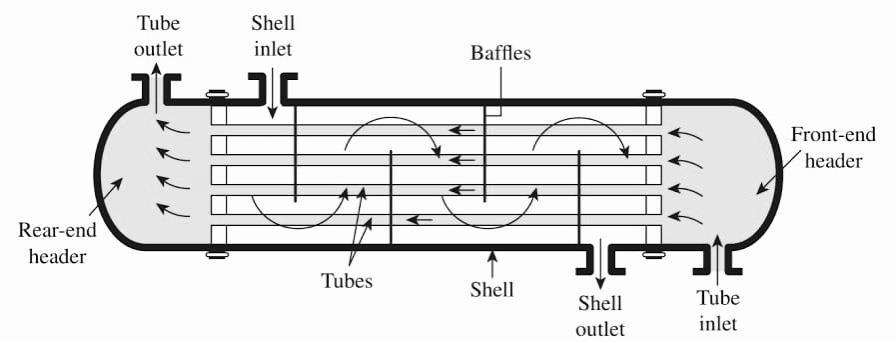
Shell:Theshellistheoutercylindricalcomponentoftheheatexchangerthatcontainsthetubebundleandtheprocessfluid.It providesstructuralsupportandhousesthetubes.
Tubes:Tubesarethemainheattransfersurfaceinashellandtubeheatexchanger.Theyaretypicallymadeof copperorsteel alloysandprovideapathwayfortheprocessfluidstoflow.Theheatistransferredbetweenthefluidsthroughthetubewalls.
TubeSheets:Tubesheetsaremetalplatesthatareusedtosupportandsealtheendsofthetubes.Theyaretypicallylocatedat bothendsoftheshellandprovideasecureattachmentforthetubes.
Baffles: Baffles are plates or rods that are placed inside the shell to direct the flow of the process fluids. They enhance heat transferbycreatingturbulenceandpreventingfluidbypass.Theyalsoprovidesupporttothetubesandpreventsagging.
Shell Side and Tube Side Fluid Inlets and Outlets: These are the points where the process fluids enter and exit the heat exchanger.Theshellsidefluidflowsoutsidethetubes,whilethetubesidefluidflowsinsidethetubes.
TubeSupportPlates:Tubesupportplatesareusedtoholdthetubesinplaceandpreventthemfromsaggingorvibrating.They aretypicallylocatedatregularintervalsalongthelengthofthetubes.
International Research Journal of Engineering and Technology (IRJET) e-ISSN:2395-0056
Volume: 11 Issue: 03 | Mar 2024 www.irjet.net p-ISSN:2395-0072
ShellSideandTubeSidePasses:Shellandtubeheatexchangerscanhavemultiplepassesonboththeshellsideandthetube side. Passes refer to the number of times the fluid flows through the exchanger before exiting. Multiple passes increase the heattransferefficiency.
Shell Sideand Tube SideFlowDirectors:Flow directors,suchasbafflesor flow plates,areusedto control theflowdirection andvelocityoftheprocessfluids.Theyhelpoptimizeheattransferandpreventfluidbypass.
ShellSideandTubeSideFluids:Shellandtubeheatexchangershavetwoseparatefluidstreams -theshellsidefluidandthe tubesidefluid.Thesefluidscanbeofdifferenttypes,suchasliquidsorgasses,andtheyexchangeheatthroughthetubewalls.
SupportStructure:Theheatexchangerissupportedbyastructurethatholdsitinplaceandprovidesstability.Thisstructure canbemadeofsteelorothersuitablematerials.[11]
4. Parameters :
Heattransfercoefficient:Itusesmachinelearningmodelstoestimate theheattransfercoefficientofshellandhelicallycoiled tubeheatexchangers(SHCTHEXs).
Pressuredrop:ThemachinelearningmodelsarealsousedtoestimatethepressuredropinSHCTHEXs.
Nusselt number: The Nusselt number, which represents the convective heat transfer coefficient, is estimated using the machinelearningmodels.
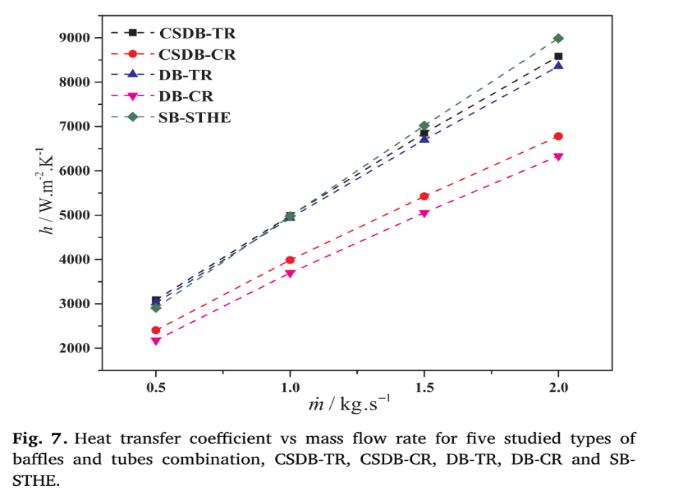
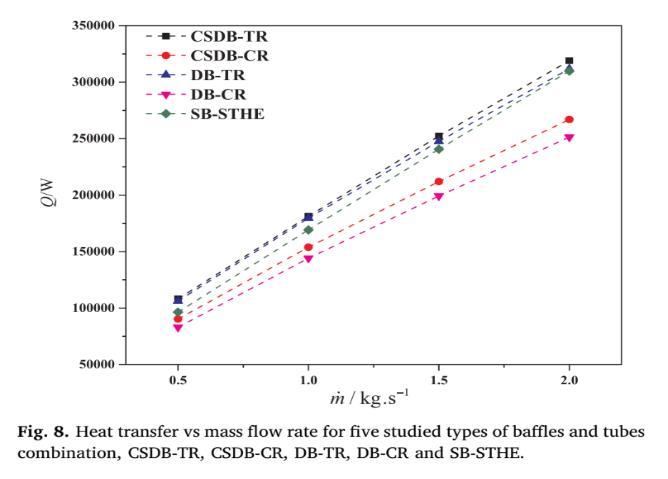
Performance evaluation criteria values: The machine learning models are used to estimate various performance evaluation criteria values of SHCTHEXs, which can provide insights into the efficiency and effectiveness of the heat exchangers .These parametersareimportantinthedesignandoptimizationofheatexchangers,astheyhelpinunderstandingtheheattransfer characteristicsandperformanceofthesystem.Byaccuratelyestimatingthese parametersusingmachinelearning,engineers and researchers can make informed decisions and improve the efficiency of SHCTHEXs[2].The heat transfer coefficient and heat transfer with mass flow rate were studied for five types of shell and tube heat exchangers (STHE) within the range of massflowratesbetween0.5and2.0kg/s.Underthemaximummassflowrateof2 kg/s,theaveragevalueofshell-sideheat transfer coefficient for the DB-TR (disk baffle triangular rib) and CSDB-TR(Combined Segmental-Disk Baffle triangular rib) configurations was found to be 26.6% and 31.9% higher than the DB-CR (disk baffle circular rib) and CSDB-CR (Combined Segmental-DiskBafflecircularrib)configurations,respectively.Atthereferredmassflowrateof2kg/s,theaveragevalueof shell-sideheattransferfortheDB-TRandCSDB-TRconfigurationswas24%and19.5%higherthantheDB-CR andCSDB-CR configurations, respectively. Heat transfer coefficient, heat transfer, and pressure drop: These parameters all increase with increasingmassflowrate.Thisislikelybecausehigherflowratesleadtogreaterfluidmovementandinteractionwiththeheat transfer surfaces, but also result in more friction and resistance to flow. Performance evaluation factor (Q/Δp) and performanceevaluationcriteria(PEC):Bothdecreasewithincreasingmassflowrate.[3].
International Research Journal of Engineering and Technology (IRJET) e-ISSN:2395-0056
Volume: 11 Issue: 03 | Mar 2024 www.irjet.net p-ISSN:2395-0072
Twomethodsforenhancingheattransferwereinvestigated:metalfoamandfins.
Metal Foam: This is a porous metal structure that increases the surface area for heat exchange between the PCM and the workingfluid withinthestorageunit. Whilemetal foamofferssuperior performance,it mightbemorecomplextointegrate into existing thermal storage systems due to its structure. Additionally, manufacturing intricate metal foam shapes can be morechallengingandexpensive.
Fins: These are thin, projected structures that also increase the surface area for heat transfer. Three different fin configurations were examined. Although fins provide less improvement in heat transfer compared to metal foam, they are likelyeasiertoinstallandintegrateintoexistingsystems.Finscanalsobereadilymanufacturedinvariousshapesandsizesto fitspecific needs[4].Massflowrate:Increasingthemass flowrateof eitherhot orcoldfluidcanenhanceheattransfer, but it also leads to a higher pressure drop across the exchanger. This requires a balance between maximizing heat transfer and minimizepumpingcosts.
Temperature difference: A larger temperature difference between the hot and cold fluids at the inlet will result in a greater potentialforheattransfer.However,thisisoftendictatedbythespecificapplicationoftheheatexchanger.
Fluid properties: The thermal conductivity, viscosity, and specific heat capacity of the fluids all influence the rate of heat transfer. Choosing fluids with high thermal conductivity and specific heat capacity can benefit heat transfer. Overall heat transfercoefficient(U):Thisisacombinedparameterthatreflectstheeffectivenessofallthefactorstransferringheatacross theexchanger.AhigherUvalueindicatesbetterheattransferperformance.
Pressuredrop:increasingtheflowratesorusingcomplexflowpathscanleadtoahigherpressuredropacrosstheexchanger. This requires more pumping power, which can be an operational cost. Optimizing the design for a balance between heat transferandpressuredropiscrucial[5].
5. Type of flow:
Laminar Flow: Laminar flow refers to a smooth and orderly flow pattern where fluid particles move in parallel layers with minimal mixing or turbulence. It is characterized by low Reynolds numbers and is generally associated with higher effective energystorageratiosinlatentheatthermalenergystorage(LHTES)systems.
Turbulent Flow: Turbulent flow is characterized by chaotic and irregular fluid motion with high Reynolds numbers. In turbulent flow, fluid particles mix vigorously, resulting in enhanced heat transfer. However, fully turbulent flows in LHTES systemstendtohavelowereffectiveenergystorageratioscomparedtolaminarflows.
Transition Region: The transition region refers to the range of Reynolds numbers where the flow behavior transitions from laminar to turbulent. Further experimental studies in the low-Re turbulence transition region would be valuable for understanding the performance of LHTES systems. Laminar flow is favorable for heat exchangers due to its smooth and orderlyflowpattern,allowingforefficientheattransfer.Laminarflowminimizesmixingandturbulence,resultinginreduced pressure dropand energyconsumption. Laminar flow providesa higher effective energystorage ratio in latent heatthermal energystorage(LHTES)systemscomparedtofullyturbulentflow.Laminarflowallowsforbettercontrolandpredictabilityof heat transfer performance in heat exchangers. Laminar flow is suitable for applications where precise temperature control and uniform heat distribution are required. Overall, laminar flow is favorable for heat exchangers due to its efficient heat transfercharacteristics,reducedpressuredrop,andbettercontroloverheattransferperformance.Itisparticularlybeneficial inLHTESsystems,whereitprovideshigherenergystorageratios[19].
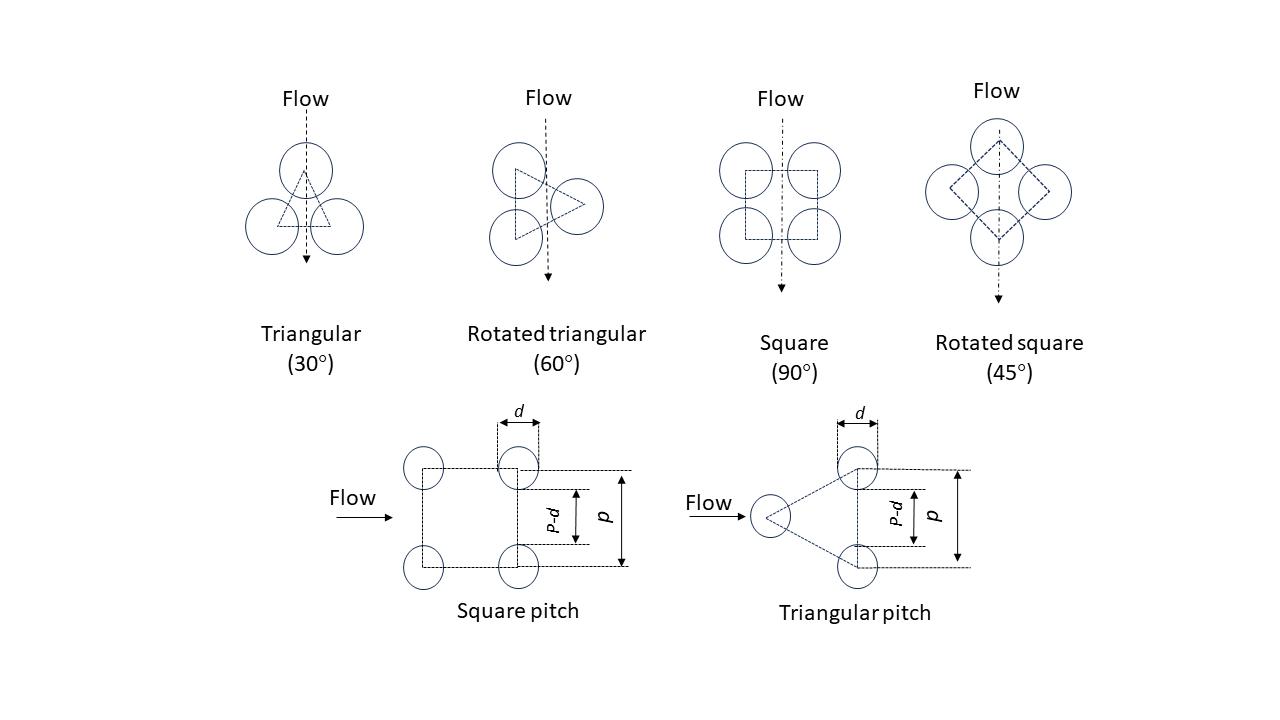
TubearrangementsinSTHEcanbeorganizedinequilateraltriangular,square,orrotatingsquarepatterns,withtriangularand rotatedsquarepatternsprovidinghigherheattransferratesbutalsohigherpressuredrops.Squarearrangementsareusedfor heavily fouling fluids that require mechanical cleaning of the tube exteriors. The recommended tube pitch is 1.25 times the tube outside diameter, and a minimum clearance of 0.25 in. (6.4 mm) is recommended between tubes in a square pattern Tube-side passesare used toincreasethelength ofthe flowchannel,withthenumberof passesdetermined bythe required
International Research Journal of Engineering and Technology (IRJET) e-ISSN:2395-0056
Volume: 11 Issue: 03 | Mar 2024 www.irjet.net p-ISSN:2395-0072
tube-sidedesignvelocity.Exchangerscanhaveonetosixteentubepasses,organizedusingpartitionplates.Shelldiametersare covered by British standard BS 3274 and TEMA standards, with shells up to 24 in. (610 mm) typically made of tubing and largershellsrolledfromplates. Thetube-sheetlayoutisdeterminedbythenumber oftubesandtubepasses,withconstants provided for triangular and square tube-sheet layouts[8].with an increase in mass flow rate, there was a decrease in heat transfer.
Thetestswereconductedforbothparallelandcounterflowconditions,anditwasfoundthatheattransferwasmaximumfor alltubelayoutsinthecounterflowconfiguration.
Amongthefourdifferenttubelayouts(30°,45°,60°,and90°),itwasobservedthatthe30°tubelayouthadbetterheattransfer comparedto the otherlayouts. Experimental analysisshowedthattheheat transferratedecreasedwithanincrease inmass flow rate. Heat transfer was found to be maximum in the counter flow configuration for all tube layouts. Among the four differenttubelayouts(30°,45°,60°,and90°),the30°tubelayoutexhibitedbetterheattransferperformance.
TheoverallheattransfercoefficientwasselectedaccordingtoTEMAstandardsforwatertowaterheatexchangers. Triangular layout:Thisisthemostcommontubelayoutandisconsideredtobethemostefficientforheattransfer.Inatriangularlayout, thetubesarearrangedinatriangularpattern,witheachtubesurroundedbysixothertubes.Thisclosepackingoftubesallows foralargeheattransfersurfacearea,whichpromotesefficientheattransfer.
Squarelayout:Inasquarelayout,thetubesarearrangedinasquarepattern,witheachtubesurroundedbyfourothertubes. Thislayoutisless efficient forheattransfer thanthe triangularlayout,butit can be easiertoclean and is lesssusceptibleto fouling.
Rotatedtriangularlayout:Thislayoutisavariationofthetriangularlayout,inwhichthetubesarerotatedby30degrees. This canimproveheattransferperformancecomparedtothestandardtriangularlayout,butitcanalsoincreasepressuredrop.
Rotatedsquarelayout:Thislayoutisavariationofthesquarelayout,inwhichthetubesarerotatedby45degrees.Thislayout canofferabalancebetweenheattransferperformanceandpressuredrop.Theselectionofthebesttubelayoutforaparticular application will depend on a variety of factors, including the desired heat transfer rate, pressure drop limitations, cleaning requirements, and fouling potential[13].The introduction of hexagonal structure tubes in shell and tube heat exchangers resultedinanincreasedrateofheattransferduetobetterflowdisruptioncomparedtoroundtubes[14].
International Research Journal of Engineering and Technology (IRJET) e-ISSN:2395-0056
Volume: 11 Issue: 03 | Mar 2024 www.irjet.net p-ISSN:2395-0072
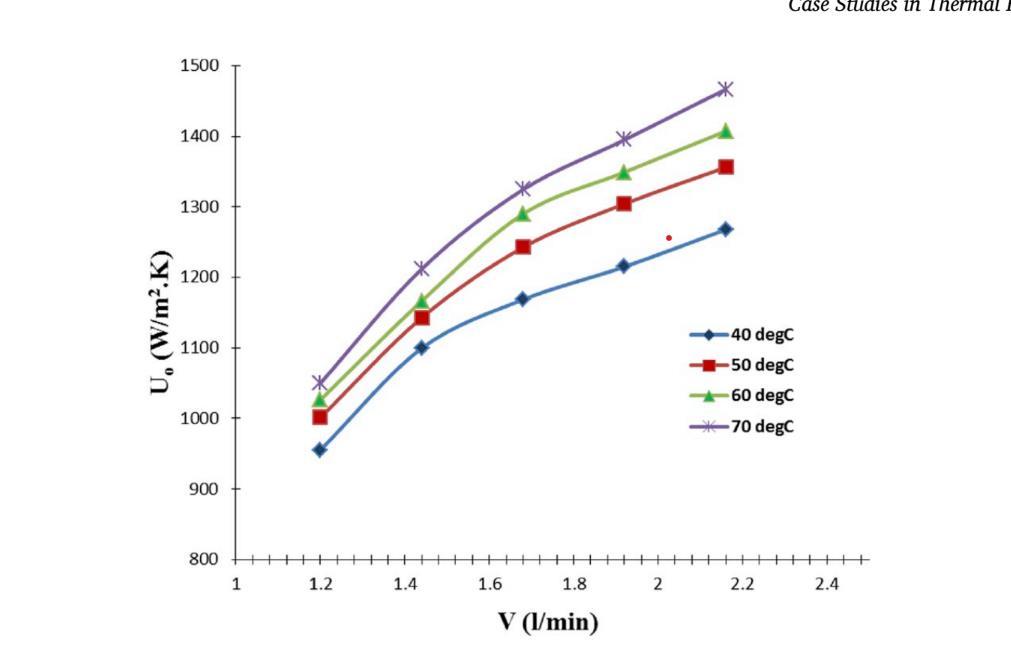
the hot side flow rate increases, the convective heat transfer coefficient also increases. At higher tube side flow rates, the influenceofthehotfluidinlettemperatureontheheattransfercoefficientishigher.Thehighestvalueoftheconvective heat transfercoefficient(Uo)was1466W/m^2×Kataflowrateof2.16l/minandaninlettemperatureof70°C.Thisrepresentsan increaseof15.6%comparedtoitsvalueat40°C[1].
Higher flow rates lead to greater fluid movement and interaction with the heat transfer surfaces, but also result in more friction and resistance to flow. Performance evaluation factor (Q/Δp) and performance evaluation criteria (PEC): Both decrease with increasing mass flow rate. These metrics consider the trade-off between heat transfer (Q) and the pumping powerrequiredtoovercomepressuredrop(Δp).Asthepressuredropincreasesdisproportionatelywithflowrate,theoverall performance (Q/Δp and PEC) suffers[3].mass flow rate recovery in the design and optimization of shell and tube heat exchangers,leadingtoimprovedefficiencyandcost-effectiveness[15].
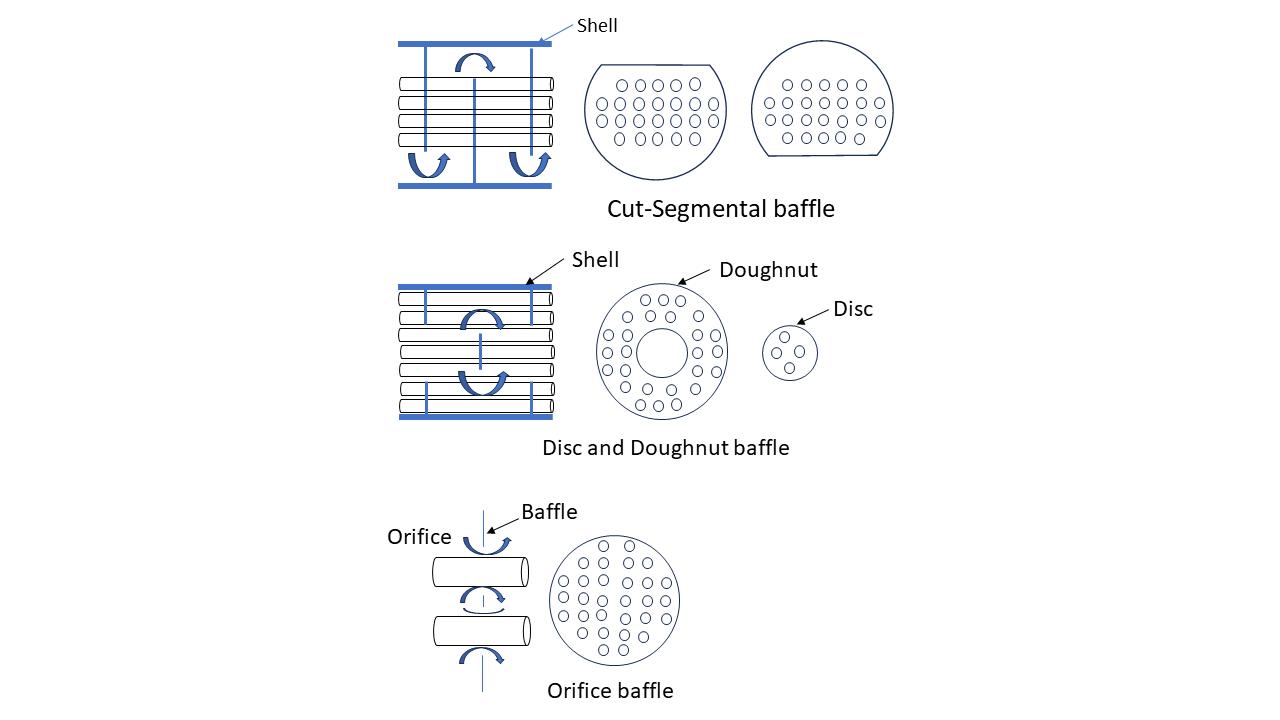
CombinedSegmental-DiskBaffle(CSDB)hasagreaterimpactonheattransferthanaddingribs,andtriangularribsaremore effective than circular ribs in enhancing heat transfer. The heat transfer coefficient is a measure of how efficiently heat is transferred from the tube to the fluid. Based on the study, CSDB-STHE has the highest heat transfer coefficient, followed by DB-TR (triangular rib), CSDB-CR (circular rib), and finally DB-STHE (smooth tube).Segmental Baffle STHE (SB-STHE) experiencesthehighestpressuredropduetothesuddenchangesinflowdirectionandpresenceofdeadzones[3].Bafflesina heatexchangercanaltertheflowpatternsandturbulence,impactingthefluidflow.Thearrangementanddesignofbafflescan change the direction and velocity of the fluid flow. Baffles create gaps and obstructions in the flow path, leading to nonuniform flow and variations in flow velocity. The presence of baffles can cause blockage of fluid flow in certain sections, resultinginlowerflowvelocityinthoseareas.Differentbaffleconfigurations,suchasinclined-segmentalbaffles,canaffectthe flowcharacteristicsanddistributionoffluidflow.Theimpactofbafflesonfluidflowcanbestudied usingcomputationalfluid dynamics (CFD) simulations, which provide insights into the flow behavior and velocity distribution[9].Reducing the space between baffles and using more baffles significantly improves heat transfer. This is because it forces the hot fluid to take a morewindingpath,mixingitupmoreandincreasingcontactwiththecoolerfluid.Imagineacomplexmaze;ittakeslongerto getthroughbutallowsformoreinteractionwiththesurroundings.Thematerialofthebafflesandtubesplaysarole.Materials withhigherthermalconductivity,likecopper,transfersheatmoreefficientlythanthosewithlowerconductivity,likestainless steel [16].The Tubular Exchanger Manufacturers Association (TEMA) publishes standards that provide guidelines for baffle
International Research Journal of Engineering and Technology (IRJET) e-ISSN:2395-0056
Volume: 11 Issue: 03 | Mar 2024 www.irjet.net p-ISSN:2395-0072
designandplacementinshellandtubeheatexchangers[17].Bafflesareplatesorrodsplacedinsidetheshellofashelland tube heatexchangertodirecttheflowofprocessfluids. Bafflescreateturbulenceintheshellsidefluid,enhancing heattransferby promoting better mixing and increasing the contact between the fluid and the tube surface. They prevent fluid bypass, ensuringthattheshellsidefluidflowsacrosstheentiretubebundle, maximizingheattransferefficiency.Bafflesalsoprovide supporttothetubes,preventingsaggingorvibrationduringoperation[11].
Theresultsindicatethatusingthesenanofluidscanimprovethethermalefficiencyofboththehot(tubeside)andcold(shell side) fluids. In this experiment, a 0.2 wt% concentration of graphene nanofluid led to a 24.4% and 7.3% increase in thermal efficiency for the hot and cold sides, respectively, but only applicable for vertical types of heat exchanger[1].Heat transfer coefficient:Thepaperusesmachinelearningmodelstoestimatetheheattransfercoefficientofshellandhelicallycoiledtube heat exchangers (SHCTHEXs) .Pressure drop: The machine learning models are also used to estimate the pressure drop in SHCTHEXs.Nusseltnumber:TheNusseltnumber,whichrepresentstheconvectiveheattransfercoefficient,isestimatedusing the machine learning models .Performance evaluation criteria values: The machine learning models are used to estimate variousperformanceevaluationcriteria valuesofSHCTHEXs,whichcanprovideinsightsintotheefficiencyandeffectiveness of the heat exchangers[2].Using materials with high thermal conductivity for the heat transfer surfaces will improve heat transfer between the fluids. Common choices include copper, aluminum, and stainless steel[5]. Effectiveness in heat exchangers refers to the ability of the heat exchanger to transfer heat efficiently between the hot and cold fluids. It is a measure of how well the heat exchanger performs in terms of heat transfer efficiency. The effectiveness of a heat exchanger depends on the temperature difference between the inlet and outlet of the fluids. A higher effectiveness value indicates a better performance of the heat exchanger in transferring heat. In the designed heat exchanger, the effectiveness value is reported to be high, with a value of 90, meeting the standards set by the Tubular Exchanger Manufacturers Association (TEMA).Theeffectivenessoftheheatexchangerisanimportantparameterindesigningan efficientheatrecoverysystemfor airconditioningsystems,asitdeterminestheamountofwastedheatthatcanberecoveredandutilized.Thedesignoftheheat exchanger,withitsspecificdimensionalspecificationsandarrangements,ensuresefficientheattransferandminimizesenergy losses[6]. Increase baffle cut for better heat transfer. Use 50 baffle cuts for improved performance. Implement double segmentalbafflestoovercomefutureissues[7].Optimizebafflecutsforgoodheattransferrates. Useequilateraltriangularor square tube arrangements for higher rates. Consider shell and tube passes to enhance efficiency[8].Presence of deposits or
International Research Journal of Engineering and Technology (IRJET) e-ISSN:2395-0056
Volume: 11 Issue: 03 | Mar 2024 www.irjet.net p-ISSN:2395-0072
scalingontheinteriorsurfacesoftheheatexchangerintroducesadditionalresistancetoheatflow,leadingtofouling.Fouling can occur due to the deposition of solids carried by the flowing fluid .Corrosive chemical processes can also contribute to fouling in heat exchangers. Scaling, particularly from the cooled P2O5 Acid solution, is a significant factor contributing to foulingintheE-2502HeatExchanger.Theaccumulationoffoulingdiminishestheheattransferrateandreducestheefficiency of the heat exchanger. Regular cleaning of the heat exchanger, such as through mechanical methods like hydro jetting, is necessary to remove the accumulated deposits and maintain optimal heat transfer[10]. Increasing the thermal conductivity can be achieved by combining materials with high thermal conductivity, utilizing additives or encapsulation techniques, and incorporating fins or nanoparticles to enhance heat transfer. A higher tube length-diameter ratio is recommended for better energy storage performance, but the specific optimal values should be determined based on system requirements and constraints [19].The effectiveness depends on factors like pressure drop limitations. In this case, helical baffles were less effective due to this constraint[17]. mass flow rate recovery in a shell and tube heat exchanger, leading to improved effectivenessandreducedtotalannualcost.Theoptimizationprocessconsidersvariousdesignparametersandtheinfluence oftherefluxratio,providingvaluableinsightsforthedesignandoperationofheatexchangers[15].
10. Future works suggested :
GrapheneNanofluids:
o Conduct experiments to study the effects of different concentrations of graphene nanofluids on convective heattransferinashellandtubeheatexchanger.
o Explore the influence of flow rate and inlet temperature on the heat transfer coefficient and thermal efficienciesusingthesenanofluids.
BaffleandTubeConfigurations:
o Investigate the performance of different baffle and tube configurations (e.g., helical, segmented) to optimize thermalperformanceandpressuredropwithintheSTHE.
o Analyzetheeffectsofribbedtubes(e.g.,longitudinaltriangular)onheattransferandoverallsystemefficiency comparedtosmoothtubes.
o MachineLearningforHeatTransfer:
o DevelopandtrainartificialneuralnetworkstructurestoestimateheattransferparametersforvariousSTHE designs.
o Incorporate additional input parameters into the machine learning models that might impact heat transfer performance(e.g.,surfaceroughness,fluidproperties).
o Increase the size and diversity of the training data for machine learning models to improve prediction accuracy.
o Conductcomparativestudiestoevaluatetheperformanceofmachinelearningapproachesagainsttraditional methodsforheattransferparameterestimation.
OptimizationStrategies:
MOPSOAlgorithmImprovement:
o Further develop or compare the Multi-Objective Particle Swarm Optimization(MOPSO) algorithm used with other optimization algorithms (e.g., Genetic Algorithm, Simulated Annealing) to enhance its performance in solvingSTHEdesignproblems.
International Research Journal of Engineering and Technology (IRJET) e-ISSN:2395-0056
Volume: 11 Issue: 03 | Mar 2024 www.irjet.net p-ISSN:2395-0072
UncertaintyandMulti-CriteriaDecisionMaking:
o Investigate the impact of uncertainties in factors like flow rates or material properties on the optimization resultsforamorecomprehensiveunderstandingofthesolution'srobustness.
o Explore the application of multi-criteria decision-making methods under uncertainty to evaluate and select the best STHE design solutions considering multiple objectives (e.g., heat transfer, pressure drop, cost) and uncertainties.
Real-WorldApplications:
AirConditioningSystemOptimization:
o Design and optimize STHEs specifically for air conditioning systems in the hospitality industry, considering factorslikeflow patterns,material types,constructionmethods,andlong-termperformancewithregardsto foulingandmaintenancerequirements.
CleaningTechniques:
o Develop new techniques or technologies for efficiently cleaning the outside of tubes in STHEs to minimize maintenanceneedsandimproveoverallefficiency.
SystemIntegration:
o Explore the integration of STHEs with other systems or processes (e.g., waste heat recovery systems) to improveoverallenergyefficiencyandpromotesustainabilityinindustrialapplications.
FlowandPerformance:
TorsionalFlowOptimization:
o Conduct further testing on STHEs with varying baffle configurations to achieve a torsional flow design that optimizesthetotalheattransfercoefficientandpressuredrop.
BaffleArrangementAnalysis:
o Analyzetheflowcharacteristicsof baffle arrangements in more detail,particularlyfocusing on non-uniform flowcausedbygapsbetweenbaffles.
o Investigatetheeffectofdifferentbaffleanglesonflowdirection,velocity,andpotentialblockageof fluidflow inspecificsectionsoftheSTHE.
Inclined-SegmentalBaffleImprovement:
o Conduct research on optimizing the heat transfer coefficient in STHEs with Inclined-Segmental Baffles, as theywerefoundtohavelowervaluescomparedtoconventionaldesigns.
Flow-HeatTransferRelationship:
o Perform further analysis and experimentation to understand the relationship between the fluid flow characteristicsontheshellsideoftheSTHEandtheresultingpressuredropandheatgaincoefficient.
International Research Journal of Engineering and Technology (IRJET) e-ISSN:2395-0056
Volume: 11 Issue: 03 | Mar 2024 www.irjet.net p-ISSN:2395-0072
MaterialExplorationforHeatStorage:
o Researchanddevelopnewmaterialsorstructureslikemetalfoamswithenhancedporosityandfindesignsto improveheattransferandenergystoragecapacityinthermalstorageunits.
o Study the effect of different parameters like porosity and metal volume fraction on the heat transfer enhancementofthesematerials.
o Explore the impact of different fin structures and arrangements on the melting process and energy storage ratewithintheunit.
11. Conclusion:
1.NanofluidsforEnhancedHeatTransfer:
Impact: The addition of graphene nanofluids to water-based coolants significantly increases the heat transfer coefficientofSTHEs.Studiesshowamaximumimprovementof29%using0.2%graphenenanofluidconcentration.
Mechanism: This enhancement is attributed to the exceptional thermal properties of graphene compared to water. Graphene'shighthermalconductivityallowsformoreefficientheattransferwithintheexchanger.
2.MachineLearningforHeatTransferPrediction:
Technique:Artificialneuralnetworks(ANNs)areemployedtoaccuratelypredictcrucialheattransferparametersfor STHEdesigns.
Performance: ANNs demonstrate remarkable precision with a coefficient of determination exceeding 0.99 and minimalmeandeviation(lessthan0.01%).
Benefits:ThislevelofaccuracyallowsengineerstodesignSTHEswithtargetedheattransferperformance,optimizing theirefficiencyforspecificapplications.
3.OptimizedBaffleandTubeConfigurations:
Conventional vs. Optimized Designs: The research identified baffle and ribbed tube configurations that outperform traditionaldesignsintermsofheattransferefficiency.
EffectiveConfigurations:Configurationslikediskbaffleswithtriangularribbedtubes(DB-TR)andcircularsegmental disk baffles with triangular ribbed tubes (CSDB-TR) showed a significant improvement of 39% compared to conventionalSTHEs.
Mechanism: These optimized configurations promote better fluid mixing and turbulence within the heat exchanger, leadingtomoreefficientheattransferbetweenthehotandcoldfluids.
4.MetalFoamforSuperiorThermalEnhancementinHeatStorage:
Comparison:Metalfoamprovestobeamoreeffectivethermalenhancerthanfinsinshell-and-tubeheatstorageunits, especiallyathighermetalvolumefractions(around3%).
Performance: Studies indicate that metal foam can achieve up to 10 times higher energy storage rates compared to unitswithfins.
Reasoning:Theintricatestructureofmetalfoamprovidesalargersurfaceareaforheattransferandreducesthermal resistancewithintheunit,leadingtofasterandmoreefficientheatstorage.
International Research Journal of Engineering and Technology (IRJET) e-ISSN:2395-0056
Volume: 11 Issue: 03 | Mar 2024 www.irjet.net p-ISSN:2395-0072
5.Multi-ObjectiveOptimizationforSTHEDesign:
Optimization Approach: Multi-objective particle swarm optimization (MOPSO) algorithms are successfully used to optimizeSTHEdesignbyconsideringmultiplefactorssimultaneously.
Factors Considered: These factors include heat transfer area, pumping power required for fluid circulation, and uncertaintiesassociatedwithvariousdesignparameters.
Decision-Making: Additionally, a multi-criteria decision-making method is employed to select the optimal design solutionthatsatisfiesalltheproblemconstraints.
Benefits: This multi-faceted approach ensures a well-balanced STHE design that achieves both high heat transfer efficiencyandminimalenergyconsumptionforpumping.
1. (1)Fares,M.;AL-Mayyahi,M.;AL-Saad,M.HeatTransferAnalysisofaShellandTubeHeatExchangerOperatedwith Graphene Nanofluids. Case Studies in Thermal Engineering 2020, 18, 100584. https://doi.org/10.1016/j.csite.2020.100584.
2. (1)Çolak,A.B.;Akgul,D.;Mercan,H.;Dalkılıç,A.S.;Wongwises,S.EstimationofHeatTransferParametersofShelland Helically Coiled Tube Heat Exchangers by Machine Learning. CaseStudiesinThermalEngineering 2023, 42, 102713. https://doi.org/10.1016/j.csite.2023.102713.
3. (1) Abbasian Arani, A. A.; Moradi, R. Shell and Tube Heat Exchanger Optimization Using New Baffle and Tube Configuration. Applied Thermal Engineering 2019, 157, 113736 https://doi.org/10.1016/j.applthermaleng.2019.113736.
4. (1)Zhang,S.;Li,Z.;Yan,Y.;Alston,M.;Tian,L.ComparativeStudyonHeatTransferEnhancementofMetalFoamand Finsina Shell-and-TubeLatentHeatThermal EnergyStorageUnit. EnergyStorageandSaving 2023, 2 (3),487–494. https://doi.org/10.1016/j.enss.2023.03.004.
5. (1) Saldanha, W. H.; Arrieta, F. R. P.; Ekel, P. I.; Machado-Coelho, T. M.; Soares, G. L. Multi-Criteria Decision-Making under Uncertainty Conditions of a Shell-and-Tube Heat Exchanger. InternationalJournalofHeatandMassTransfer 2020, 155,119716.https://doi.org/10.1016/j.ijheatmasstransfer.2020.119716.
6. (1) Apriandi MS, N.; Herlambang, Y. D.; Alfauzi, A. S.; Lee, S.-C. Shell and Tube Heat Exchanger Design: Utilization of WastedEnergyinAirConditioningSystems. Eksergi 2023, 19 (2),39.https://doi.org/10.32497/eksergi.v19i2.4461.
7. (1) Mohanty, S.; Arora, R. CFD Analysis of a Shell and Tube Heat Exchanger with Single Segmental Baffles. International Journal of Automotive and Mechanical Engineering 2020, 17 (2), 7890–7901. https://doi.org/10.15282/ijame.17.2.2020.08.0589.
8. (1)RistiRagadhita,;AsepBayuDaniNandiyanto*.HowtoCalculateandDesignShellandTube-TypeHeatExchanger withaSingleHeatTransfer. ASEANJournalforScienceandEngineeringinMaterials 2024, 3(1),21–42.
9. (1) Rahman, A.; Winarto, W.; Siswanto, E. OPTIMIZATION OF SHELL AND TUBE HEAT EXCHANGER DESIGN WITH INCLINEDBAFFLES. InternationalJournalofMechanicalEngineeringTechnologiesandApplications 2024, 5 (1),63–72. https://doi.org/10.21776/mechta.2024.005.01.7.
10. (1)Saputro,E.A.;Lutfiananda,D.;Pratiwi,A.K.;Nugroho,S.A.ASSESSINGANDOPTIMIZINGTHEPERFORMANCEOF A SHELL AND TUBE HEAT EXCHANGER (E-2502) IN PHOSPHORIC ACID PRODUCTION: A CASE STUDY AT PT. PETROKIMIAGRESIK. InternationalJournalofMechanicalEngineeringTechnologiesandApplications 2024, 5 (1),23–29.https://doi.org/10.21776/mechta.2024.005.01.3.
International Research Journal of Engineering and Technology (IRJET) e-ISSN:2395-0056
Volume: 11 Issue: 03 | Mar 2024 www.irjet.net p-ISSN:2395-0072
11. (1)ArjunKumarPrasad;KaushikAnand.DesignAnalysisofShellTubeTypeHeatExchanger. InternationalJournalof EngineeringResearchand 2020, V9 (01).https://doi.org/10.17577/ijertv9is010215.
12. (1) Barza, T.; Dejene, M. DESIGN AND SIMULATION OF SHELL-AND-TUBE HEAT EXCHANGER (STHE) WITH THE EFFECT OF BAFFLES USING CFD-TOOL. Engineering and Technology Journal 2023, 08 (05). https://doi.org/10.47191/etj/v8i5.02.
13. (1) Kallannavar, S.; Mashyal, S.; Rajangale, M. Effect of Tube Layout on the Performance of Shell and Tube Heat Exchangers. MaterialsToday:Proceedings 2020, 27,263–267.https://doi.org/10.1016/j.matpr.2019.10.151.
14. (1)Khan,A.;Shah,I.;Gul,W.;Khan,T.A.;Ali,Y.;Masood,S.A.NumericalandExperimentalAnalysisofShellandTube HeatExchangerwithRoundandHexagonalTubes. Energies 2023, 16 (2),880.https://doi.org/10.3390/en16020880.
15. (1) Masoumpour, B.; Ataeizadeh, M.; Hajabdollahi, H.; Shafiey Dehaj, M. Performance Evaluation of a Shell and Tube Heat Exchanger with Recovery of Mass Flow Rate. Journal of the Taiwan Institute of Chemical Engineers 2021. https://doi.org/10.1016/j.jtice.2021.05.022.
16. (1)Hanan,A.;Zahid,U.;Feroze,T.;Khan,S.Z.AnalysisofthePerformanceOptimisationParametersofShellandTube Heat Exchanger Using CFD. Australian Journal of Mechanical Engineering 2021, 21 (3), 830–843. https://doi.org/10.1080/14484846.2021.1914890.
17. (1) Yang, Z.; Ma, Y.; Zhang, N.; Smith, R. Design Optimization of Shell and Tube Heat Exchangers Sizing with Heat Transfer Enhancement. Computers & Chemical Engineering 2020, 137, 106821. https://doi.org/10.1016/j.compchemeng.2020.106821.
18. (1)Fernandes,E.J.;Krishanmurthy,S.H.DesignandAnalysisofShellandTubeHeatExchanger. InternationalJournal forSimulationandMultidisciplinaryDesignOptimization 2022, 13,15.https://doi.org/10.1051/smdo/2022005.
19. (1) Liang, H.; Niu, J.; Gan, Y. Performance Optimization for Shell-and-Tube PCM Thermal Energy Storage. Journalof EnergyStorage 2020, 30,101421.https://doi.org/10.1016/j.est.2020.101421.
20. (1) Ocłoń, P.; Łopata, S.; Stelmach, T.; Li, M.; Zhang, J.-F.; Mzad, H.; Tao, W.-Q. Design Optimization of a HighTemperature Fin-and-Tube Heat Exchanger Manifold – A Case Study. Energy 2021, 215, 119059. https://doi.org/10.1016/j.energy.2020.119059.
2024, IRJET | Impact Factor value: 8.226 | ISO 9001:2008