
International Research Journal of Engineering and Technology (IRJET) e-ISSN: 2395-0056
Volume: 11 Issue: 03 | Mar 2024 www.irjet.net p-ISSN: 2395-0072
International Research Journal of Engineering and Technology (IRJET) e-ISSN: 2395-0056
Volume: 11 Issue: 03 | Mar 2024 www.irjet.net p-ISSN: 2395-0072
Tushar Patil 1 , Yogiraj Patil2 , Sanket Patil 3 , Sourabh Jamadagni 4
Tushar R Patil A/p kavathesar Dist Kolhapur
Sanket M Patil A/p Kadave Dist Kolhapur
Yogiraj D Patil A/p Panhala Dist Kolhapur
Prof. S. S. Jamadagni, Dept. of Civil Engineering, D Y Patil Technical Canpus, Talsande, Maharastra, India
Abstract - The aim of this research is to investigate the strength and hardness of concrete that has been handled with water-soluble polyethylene glycol as a self-curing agent. The objective of a self-curing agent is to avoid the evaporation of water from cement. It is necessary to use self-curing admixture ,particularly as water resources grow more valuable by the day. Concrete was treated with polyethylene glycol in amounts of 1%, 7 1.5%, and 2%. (i.e., each 1m3 of concrete needed approximately 3m3 of water to construct). The most of it is for the sake of recovery. At 7, 14, and 28 days of age, concrete made from The compressive resistance, the split tensile and flexure strength were measured for the M20-grade mix and the results were comparable with normal concrete.
Key Words: Polyethylene Glycol, Self-Curing Agent, M20-Grade, Admixture, Strength, etc
1.INTRODUCTION
Concrete is the most commonly used building tool on the planet. Many aspects of our daily lives depend on real, whetherexpresslyorindirectly.Concreteismanufactured by mixing widely available materials such as cement, concrete, and water. Concrete is unique to large building materialsbecauseitisparticularlyengineeredforcomplex structural project engineering. Concrete is a building materialthatconsistsofgranularmaterialssuchascoarse concrete, linked by a morter or binder filling and holding them together within the spaces between the particles. Concrete is widely utilised in the construction and renovation of facilities around the world. Finding suitable alternatives for concrete planning is becoming more challenging. As a consequence, natural aggregate sources otherthansandandgravelarebecomingmorerelevant.
1.1 CONCRETE
Concreteisacompositemediuminwhichaninertparticle ofwell-gradedfineandcoarseconcreteisbondedtogetherby abindingmaterialmixedinwaterandsolidified.
1.2 CLASSIFICATION OF CONCRETE
Concreteareclassifiedintodifferenttypes: Accordingto bindingmaterialsusedinconcrete Accordingtodesignof concrete.
Collection of Raw Materials: The materials used in this project are Ordinary Portland cement (OPC), Coarse aggregate, Fine aggregate, PEG-400(polyethylene glycol), Flyash(coalburningproduct)areeasilyavailableinmarket
Table -1: Material Required
Sr. No Material Used
1 Cement
2 CourseAggregate
3 FineAggregate
4 Polyethyleneglycol
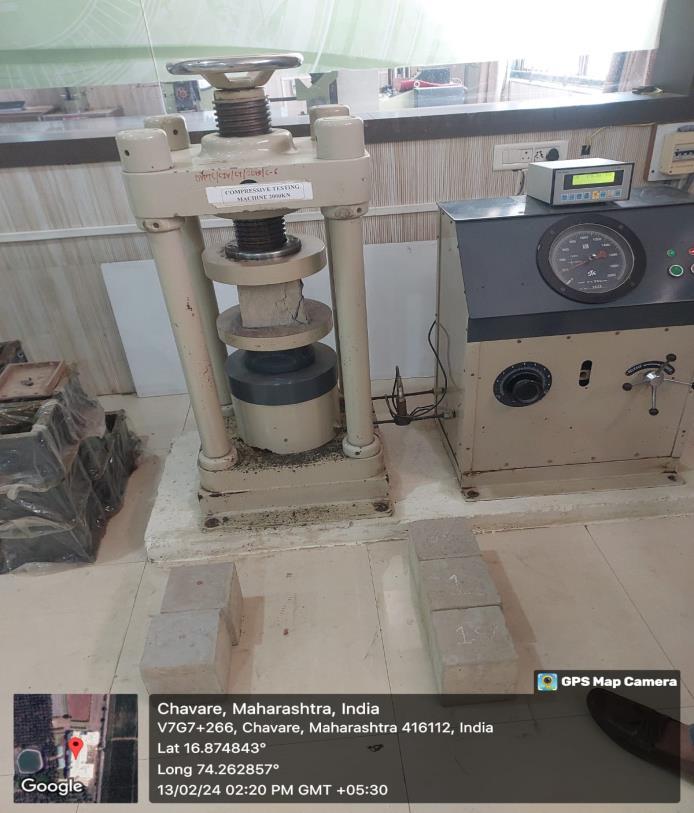
Compressive Strength: This metric determines the compressive strength of reinforced concrete. The compressive strength of concrete is shown by the compressivetestinoptimalcircumstances.Thecompressive strengthofconcreteisanindicatorofitsstrengthonceithas hardened.Testingshouldbecarriedoutwithcare.Thetest was carried out at a standardised stress of 140 kg/cm2/minute after the specimen was centred in the measurement unit. Loading continued until the dial gauge needlesimplyreverseditsmovement.Theneedle'spathhas beenredirected,meaningthatthespecimenfailed.Thedial gauge reading at the time, which was maximum load, was registered. The ultimate cube compressive power is proportional to the ultimate load separated by the specimen'scrosssectionalarea.Thecompressivestrengthof concrete reveals information about the material's general quality.Thetestspecimeniscubicalinshapeandmeasures 150mmx150mmx150mm.Ifthehighestnormaldimensionof theaggregateislessthan20mm,10mmcubeswouldbeused instead. Compressive strength checks are conducted on specimensofprovenage,ideallyfromdifferentbatchesmade foreachageofprocessing.Allofthecubesweretestedina saturatedconditionafterthesurfacemoisturewasremoved. At7daysand28daysofself-curing,eachtrailmixmixture three cube was tested using a compression measuring machinewithacapacityof2000KNaccordingtoIS516-1959.
International Research Journal of Engineering and Technology (IRJET) e-ISSN: 2395-0056
Volume: 11 Issue: 03 | Mar 2024 www.irjet.net p-ISSN: 2395-0072
Cementused:OPC53gradeconfirmingIS8112
Specificgravityofcement:3.15Specificgravityof
Fineaggregate:2.65
Coarseaggregate:2.67
Fineaggregate:NIL
Coarseaggregate:NIL
TEST ON FINE AGGREGATE
Fineness modulus test
Thefinenessmoduluswasusedtocalculatethefinenessof the aggregates. Sieve analysis is used in this test. One kilogrammeoffineaggregatewasobtained.Thesievesets werepositionedwiththepanatthebottomandrangingin sizefrom4.36mmto75micron.Theaggregatesamplewas placedina4.36mmsieve,capped,andrunfor10minutes. Theweightofeachsieve'spreservedsamplewasrecorded after10minutesSpecificgravitytestMoisturecontenttest
SPECIFIC GRAVITY TEST
Aprecisegravitytestwascarriedoutusingapycnometer. First,w1isthepycnometer'semptyweightwithcover.The pycnometer's weight, which had been filled with 400g of sand,wasthenrecordedasw2.Theweightwasrecordedas w3afterfillingthepycnometeruptothelidwithwater.The pycnometerwasthenproperlywashedandfilledwithwater asw4.
TEST ON COARSE AGGREGATE
Specific gravity test
A pyrometer is sometimes used to calculate the precise gravityofcoarseaggregate Athirdofthepycnometerwas filledwithcoarseaggregatesievedthrougha20mmsieve.
Consistency Test
The volume of water used to make the cement paste is referredtoasthecement'sregularconsistency.Thispasteis usedtoassesstheinitialandfinalsettingtimesofcement,as well as its soundness. The Vicat apparatus is used to determinetheconsistencyofthecementpaste.
Initial Setting Time
Thevicatapparatuswasoftenusedtodeterminetheinitial setting time of cement. 500g of cement and usual quality watercontentisusedtomakecementpaste.Afterthat,the pastewasput ina vicatmouldandleftinplace.TheVicat needlewasputonthesurfaceofthecementpasteandthen released.Itwasrecordedhowlongittooktohitadepthof 33-35mm.
SLUMP CONE TEST
Theslumpconescale,whichemploysa30cmslumpcone,is used to assess the intensity of fresh concrete. The slump conewasrefilledwithnewconcreteand tamped 15 times. When the concrete has been cored, the slumpconeisremovedverticallyandtheconcreteisableto remainalone.Theconcretewouldthensettleandtheheight ofthesubsidedconcretewillbemeasured.Thisexperiment wasrepeatedmanytimeswithvariouswatercementratio
Fineness modulus test
Fineaggregateisgradedintofourgradingzonesaccordingto IS383-1970,rangingfromcoarserand(zone1)tofinessand (zone4)
COMPACTION FACTOR TEST
The compaction element is often used to evaluate the workability of fresh concrete. A compaction factor unit is used in this study. To begin, new concrete with a lower water cement ratio was mixed. The compaction factor machineismadeupofanupperhopper,alowerhopper,and acylinder.Atthelowerpartofthehoppers,trapdoorsare provided.Theemptyweightofthecylinderwasdetermined.
International Research Journal of Engineering and Technology (IRJET) e-ISSN: 2395-0056
Volume: 11 Issue: 03 | Mar 2024 www.irjet.net p-ISSN: 2395-0072
After that, the upper hopper is packed with concrete and compacted. The trap door in the upper hopper was then opened, allowing concrete to spill into the lower hopper. After that, the lower trap door was opened, allowing the concretetofallonthecylinder.Thesurfaceofthecylinder wasrubbedclean,andtheweightwastaken.Followingthat, concrete as poured and compacted into the upper ho per, andtheprocesswasrepeated.
Result:
1
2
3. CONCLUSIONS
The compressive strength rises as percent polyethylene glycolisincreases,and When0.5–1.5%PEGisadded,the split tensile strength increases; when PEG is added, the intensityincreases.Flexuralpressurerisesas percentPEGis applied The PEG optimum ideal dose with the highest compressive strength and split tensile strength was
discovered to be 0.5 – 1.5% of the PEG optimum ideal dosage. Aworkabilityanalysisshowsthatthepercentageof PEG-4inconcreteimprovesasthepercentageofPEGrises. Self-curingconcreteisthealternativewherethereisalarger scarcityofwater.Forcuringinthestudy,castcubes,rods, andprismswerekeptatroomtemperature.
1.“ABriefonaneffectofpolyethyeleneglycolonselfcuring concrete”byB.Hemanthakumar,P.Radhakrishnavolume6 (2017)pgno35-40
2.“Anexperimentalinvestigationofselfcuringconcretewith polyethylene glycol as selfcuring agent” by Shikha Tyagi volume2(2015)pgno62-68
3.“Anexperimentalstudyonmechanicalpropertiesofself curingconcrete”byAksharaDivyaSasivolume7(2016)pg no 41-48, Bureau of Indian standards, is 1026 : 2009, concretemixproportioning,BureauofIndianstandards,is 456:2000,forplainconcretepgno72-77.
4. “Eco-friendly self curing concrete incoparated with polyethylene glycol as self curing agent” by G.Thrinath, P.Sundarakumarvolume30(2017)pgno21-28.
5. “Improving the efficiency of concrete by self curing technique with that application of polyethylene glycol” by C.Ramesh,R.Sethuraman,S.Srumathivolume15(2016)pg no31-37
6. “Preliminary studies of self curing concrete with the addition of polyethylene glycol” by T.Santhanandham, R.Gobinath,M.NaveenPrabhuvolume(2013)pgno23-28.