
International Research Journal of Engineering and Technology (IRJET) e-ISSN:2395-0056
Volume: 11 Issue: 03 | Mar 2024 www.irjet.net p-ISSN:2395-0072
International Research Journal of Engineering and Technology (IRJET) e-ISSN:2395-0056
Volume: 11 Issue: 03 | Mar 2024 www.irjet.net p-ISSN:2395-0072
Mohammad Sufian1, Mr. Ajeet Kumar2
1Master of Technology, Mechanical Engineering, SITM, Barabanki, Uttar Pradesh, India
2Assistant Professor, Department of Mechanical Engineering, SITM, Barabanki, Uttar Pradesh, India
Abstract - The article explores the potential of hybrid hydrogen fuel cell-electric vehicles (H2FCEVs) as a means to reduce greenhouse gas emissions and decrease reliance on fossil fuels in the automotive industry. It begins with an overview of the current state of H2FCEV technology, highlighting the advantages and limitations of electric and hydrogenfuelcellpropulsion systems.Thearticlethendelves into various optimization strategies, including powertrain designs,energymanagementsystems,andcontrolalgorithms, aimed at enhancing the efficiency, range, and overall performanceofH2FCEVsinreal-worlddrivingconditions.The article discusses the integration of renewable energy sources like solar and wind into H2FCEV systems to enhance sustainability and reduce environmental impact. It also addresses challenges related to the widespread adoption of H2FCEVs, particularly focusing on innovations in hydrogen infrastructure such as production, storage, and refueling technologies. The importance of interdisciplinary collaboration and innovation is emphasized as crucial for realizing the full potential of H2FCEVs in achieving a sustainable transportation ecosystem. The article concludes with a discussion on future research directions and potential advancements in optimizing the performance of H2FCEVs.
Key Words: Hybrid hydrogen fuel cell-electric vehicles, Performance optimization, Real driving cycles, Control algorithms,Energymanagementsystems.
Thehistoryofenhancingtheefficiencyofhybridhydrogen fuelcellelectricvehicles(H2FCEVs)hasprogressedfromthe earlystagesoffuelcelltechnologytothecurrentrecognition of hydrogen as a clean energy carrier for transportation. While fuel cells were conceptualized in the 19th century, widespread usage only occurred in the mid-1900s. Hydrogen'savailabilityandlowenvironmentalimpacthave contributedtoitsrecognitionasacleanfuel,leadingtothe popularityofH2FCEVs,combiningelectricandhydrogenfuel cell technology for zero-emission mobility with extended drivingranges.Challengesinensuringeffectiveperformance inrealdrivingconditionspromptedextensiveresearchand development. These efforts focused on refining energy management systems, improving vehicle aerodynamics, enhancinghydrogenstorageanddistributionsystems,and optimizing fuel cell systems. Advances in computer
modeling, engineering, and materials science have significantlyimprovedtheefficiencyofthesevehicles.Realworld testing and validation have proven crucial to evaluating performance and identifying areas that still require attention. The persistent innovation and collaborativeeffortsinthefieldaredrivingthedevelopment ofhybridhydrogenfuelcellelectriccartechnology,creating newopportunitiesforsustainabletransportationsolutions.
Alternative vehicle energy sources are receiving a lot of attention as a result of the search for environmentally friendlytransportationoptions,withhydrogenemergingas aviableoption.Inthisfield,hybridhydrogenfuelcellelectric vehiclesarestate-of-the-artbecausetheyhavetheabilityto providelongerrangesandzeroemissions.Nevertheless,it hasprovendifficulttorealisetheirfulleffectivenessinrealworld driving situations, requiring targeted research and development efforts. This introduction examines the backgroundandpresentstateofresearchintoimprovingthe practical driving efficiency of hybrid hydrogen fuel cell electric vehicles, highlighting significant developments, obstacles,andthesignificanceofcontinuousinnovationin determiningthedirectionofcleantransportation.
International Research Journal of Engineering and Technology (IRJET) e-ISSN:2395-0056
Volume: 11 Issue: 03 | Mar 2024 www.irjet.net p-ISSN:2395-0072
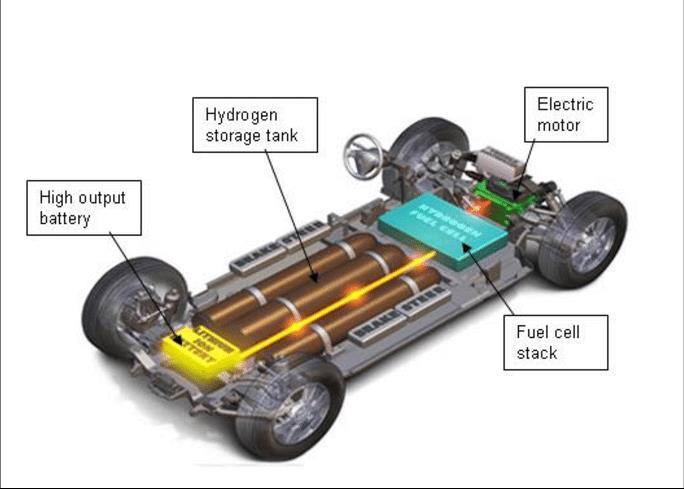
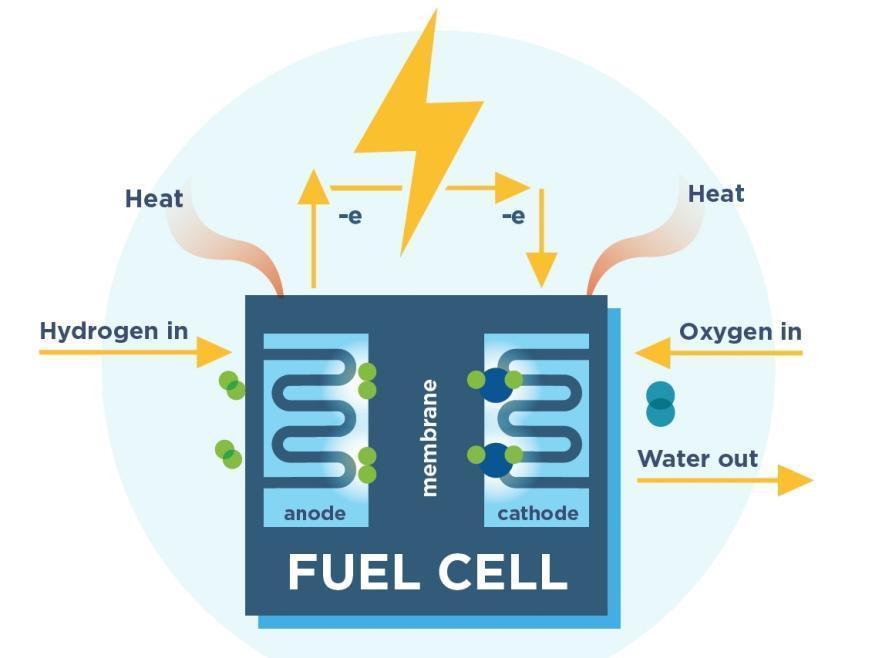
Hydrogen fuel cells undergo an electrochemical process convertingthechemicalenergyofhydrogenandoxygeninto electricity, heat, and water. This process involves several components: the anode, where hydrogen gas splits into protonsandelectrons;thecathode,whereoxygencombines with electrons and protons to form water; an electrolyte membranefacilitatingionpassagewhileblockingelectrons; catalysts, typically platinum, enabling the electrochemical reactions; and an external circuit channeling electrons to create electric current for powering loads. Despite high energyefficiencyandwatervaporastheprimaryproduct, hydrogen fuel cell use is limited due to challenges in economical large-scale hydrogen production, distribution, and safety concerns regarding storage and handling. Nonetheless, ongoing technological advancements aim to address these hurdles, fostering the potential commercialization of hydrogen fuel cells for applications such as transportation and stationary power generation, empoweringeverydayappliances.
2.2.Principle of Hydrogen Fuel Cell in the Vehicle.
Invehicles,ahydrogenfuelcellconvertshydrogengasinto electricity to propel the car, stored within the vehicle and undergoing reactions to generate power. This method is environmentally friendly, as it produces no harmful emissions. Despite its benefits, there are remaining challenges to address before widespread adoption. Nonetheless,utilizinghydrogenfuelcellsincarsstandsasa promising avenue to contribute positively to the environmentandpromotesustainabletransportation.
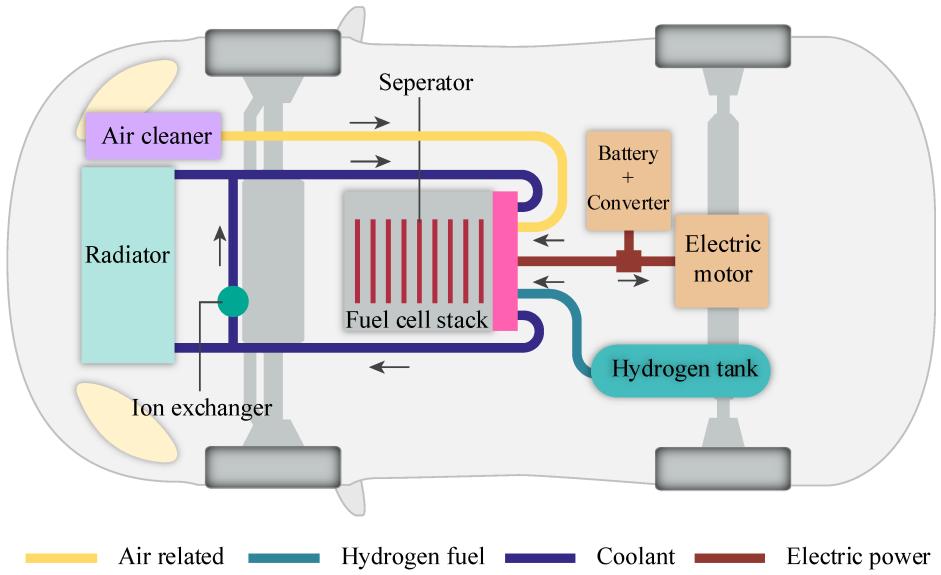
Figure-3: PrincipleofHydrogenFuelCellintheVehicle.
Inthesectionoftheliteraturereview,studiedtheprevious research paper related to the hydrogen fuel cell in the vehicle.Thesummaryoftheallpreviousresearchpaperare givenbelow:
Sasidhar, Sailaja (2019): The optimization of hydrogen production processes aims for simplicity, low cost, and environmentalsustainability.Successreliesontechnological advancementsyieldingmoresignificantoutcomes.Despite progressinstoragetechniques,amajorchallengeremainsin achievingexperimentalresultsthatfullymeetrequirements, hinderingthehydrogeneconomy'sviability.Transportation demandscarefulattention,withefficientstoragesolutions vital for viable transport methods. Fuel cell selection for vehiclesconsidersfactorslikeefficiency,cost,andconsumer preferences among six main types. Yet challenges persist, including high fuel cell costs and durability/reliability concerns.
Jiang et.al (2020): Statistical analysis, conducted on a dataset of one thousand random cycles with identical statistical characteristics, reveals that Stochastic Dynamic Programming (SDP) methods outperform other methods across both evaluation criteria. Specifically, Markov-SDP demonstrates optimal performance with well-centered outcomes and minimal standard deviations. Conversely, AdaptiveEquivalentConsumptionMinimizationStrategy(AECMS)showshighsensitivitytotuningparameters,resulting inelevatedfuelconsumptionandinadequatefinalState of Energy(SOE)control,particularlyindiversecyclescenarios. The complexity of SDP methodologies is justified by their efficacy,withMarkov-SDPbeingthemostpromisingamong them. However, A-ECMS stands out for its ease of implementation. Future research should address the computational complexityassociatedwithofflineMarkovSDPanalysisandtheneedforonlinedatastorageresources.
International Research Journal of Engineering and Technology (IRJET) e-ISSN:2395-0056
Volume: 11 Issue: 03 | Mar 2024 www.irjet.net p-ISSN:2395-0072
Qing et.al (2020): This study introduces a new life cycle assessmentmethodforFuel CellElectricVehicles(FCEVs) usingMATLAB/SimulinkandGREETsoftware.Itexamines howdrivingcyclesandhydrogensupplymethodsaffectfuel economyandgreenhousegas(GHG)emissionsofFCEVsin Korea. The research compares and analyzes findings to understandtheenvironmentalsustainabilityofFCEVs.The NEXO FCEV demonstrates better fuel economy across variousdrivingcycles,makingitsuitableforurbanareasin Koreaandbeyond.However,incongestedcities,improving theregenerativebrakingsystemisimportant.Thedominant hydrogen production method in Korea, from naphtha, has high GHG emissions, hindering FCEV market growth. Electrolysis-based hydrogen production has benefits but requires more renewable energy in the Korean electricity grid. On-site hydrogen production from natural gas is potentiallymoreenvironmentallysustainable,butitsscalein Korea is limited. Lifetime GHG emissions from the NEXO FCEVareestimatedat12,500to16,000kgCO2-equivalent, less than one-fourth of an Internal Combustion Engine Vehicle (ICEV) using gasoline. This highlights FCEVs' significant potential in reducing transportation's environmentalimpact.
Plamen,Tsvetomir(2020): Thevehicle'sdevelopmentwas aimed at participating in the Shell Eco-marathon's Urban Concept category, focusing on minimizing energy consumption.Asimulationmodelwascreated,considering vehicledynamicsandreal-worldefficiencyofcomponents likeDC/DCconverters,motorcontrollers,andtransmission. Five propulsion schemes and driving strategies were evaluatedusingthismodel.Fuelcelloutputparameterswere experimentallydetermined, andenergy requirementsand hydrogen consumption were estimated for each scheme. Additionally,anempiricalinvestigationintofuelcelloutput powerandhydrogenconsumptionwasconductedfortwo propulsionschemes,distinguishingbetweenhybridandnonhybrid power sources. The hybrid scheme involved integrating supercapacitors as energy storage elements, chargedfromthefuelcellataconstantcurrentrateof10A.
Gürsel, Merg (2020): The investigation explores temperature regulation of hydrogen vessels through flow rate control, comparing parallel and successive order strategies. Parallel flow exhibits uniform exponential temperature variations, while successive order control results in variable rates of temperature adjustments, reducingtemperaturefluctuationsbyapproximately35.14% compared to parallel flow. A Feedback Linearization (FL) algorithmregulatestheFlowSplittingSystem(FSS)basedon vesseltemperatures,leadingtoreducedenergyconsumption by the Temperature Management System (TMS) by up to 15%,79.31%,and58.74%atambienttemperaturesof10°C, 18°C, and 35°C respectively. These results highlight the importanceofwasteheatutilizationandcontrolmechanisms in enhancing overall system efficiency. Efforts to improve electricvehicle(EV)efficiencyincludestrategiestomaintain
optimal operating temperatures for energy sources. An algorithmoverseestemperatureregulationforbatteriesand fuelcells,prioritizingthefuelcellastheprimarypropulsion energy source when battery temperaturesexceedoptimal levels, and vice versa. The Energy Management System (EMS) optimizes energy utilization across sources, enhancingoverallEVefficiency.
Hossein et.al (2020): A Life Cycle Assessment (LCA) analysiswasconductedtothoroughlyassesstheprosand consofdifferentbuspropulsionalternatives.Electricbuses, despiteshowingsuperioroperationalefficiencyandminimal energylossduringoperation,haveahigherenvironmental impactduringmanufacturing,consumingnearlydoublethe energyofotheroptions.However,overthetotallifecycle, theirenergyconsumptiondiffersbyonly5%comparedto fuelcellanddieselbuses.IntermsofCO2emissions,diesel Internal Combustion (IC) buses emit 201 kg per 100 km, withmostofthisduringoperation.Fuelcellbusesemit130 kgper100km,mainlyduringthewell-to-pumpstage,with noemissionsduringoperation.Electricbusesproduce78kg per100kmduringthewell-to-pumpstageandatotalof121 kg per 100 km. While diesel buses may offer economic benefits,theyalsohavethehighestemissionsprofile,posing adisadvantagedespitetheireconomicviabilityinbusfleet operations.
Akhoundzadeh et.al (2021): A model of a hydrail powertrain was developed based on a specific drive cycle derivedfromDieselMultipleUnits(DMUs)operatingonthe AirRaillinktracksinToronto,Ontario,Canada.Themodel includesfivesubsystems:battery,hydrogenfuelcell,vehicle dynamics, power split, and high-level controller. A novel power split subsystem was designed to allocate power demand between the two energy systems, integrating an InfiniteImpulseResponse(IIR)filterandarule-basedhighlevelcontrolmechanismforenergyflowmanagement.Cost functions related to battery State of Charge (SOC) and available hydrogen levels govern the power split progression.Asensitivityanalysiswasconductedtoevaluate subsystem responses to different parameters. Validation involved comparing outputs from different subsystems against real-world DMU data and benchmarking against similarstudiesfromtheliterature.Thestudydemonstrated satisfactoryagreementswithbothbenchmarks,confirming themodel'sfidelity.
Gaurav et.al (2021): Recent research and projects have explored various solutions and approaches in hybrid, fuel cell, and electric vehicle technologies. Validating control systemsformotorsoperatingasbothmotorandgenerator alongside fuel cells through computational simulation requirescarefulconsiderationofallhybridelectricvehicle subsystems.Thistaskiscomplexandtime-intensive.Hybrid electriccarsaresignificantlymoreenvironmentallyfriendly than Internal Combustion Vehicles (ICVs). Efforts are ongoing to develop batteries with extended lifespans,
International Research Journal of Engineering and Technology (IRJET) e-ISSN:2395-0056
Volume: 11 Issue: 03 | Mar 2024 www.irjet.net p-ISSN:2395-0072
enablingeconomicallyviablebatteryrecyclingoncehybrid cars become widespread. Continued research into alternativeenergysourceslikefuelcellsandrenewablefuels shows promise for the future of hybrid vehicles. The trajectoryofFuelCellVehicles(FCVs)andElectricVehicles (EVs)dependsonthequalityoftheirbatteriesandfuelcells. Advancementsinbatteryandfuelcelltechnologyarecrucial for realizing a promising future for these vehicles. If researcherssucceedindevelopingsuperbatteriesorsuper fuel cells, the future outlook for these vehicles is indeed promising.
Ahmet,Mert(2021): Implementingatransmissionsystem in Hydrogen Fuel Cell Electric Vehicles (HFCEVs) can significantly reduce energy consumption compared to alternative powertrain setups by optimizing operating conditions for electric motors. Automated transmission systems are crucial for enhancing energy efficiency, especially when high torque is needed at lower vehicle speeds. Additionally, integrating a Regenerative Energy Storage and Conversion (RESC) system into an in-wheel motorlayoutimprovesenergyrecoveryefficiency,resulting inoveralllowerenergyexpenditure,exceptforsetupswith downsized electric motors and two-stage automatic transmissions.In-wheelarchitecturewithanRESCsystem offersadvantages,particularlyoncurvedroads,leadingto significant energy savings. Continuously Variable Transmission (CVT) transmission allows for reducing the peak torque requirement of the electric motor, enabling motordownsizing.Thisnotonlyreducesmotorweightbut also that of associated components and power units, ultimatelyachievingthelowestenergyconsumption rates amongvariouslayoutconfigurations.
Santosh et.al (2022): Thesimulationofareal-worldFuel Cell Hybrid Electric Vehicle (FCHEV) mid-size automobile model under various Drive-to-Hybrid (DoH) performance scenarios. The hybrid powertrain is accurately modeled using ADVISOR software within a MATLAB/Simulink framework. Results show that increasing the DoH significantly improves the vehicle's acceleration performance.Moreover,higherDoHconfigurationsnotably enhance fuel economy, with a marked 16.3 percent performance improvement observed compared to the originalDoHsetup,evenwhilemaintainingconsistentfuel economy. Acceleration performance sees significant improvements by reducing fuel cell power and increasing batterymodules'pulsepowercapabilities,leadingtosmaller fuel cell stack sizes and costs while enhancing vehicle acceleration. Simulation results on an actual Toyota Mirai FCHEVacrossvariousdrivingcyclesdemonstrateadmirable performance under both European and Japanese driving conditions.
Suraj et.al (2023): Hydrogen fuel gas-powered vehicles, producing only water and heat as byproducts, offer a promisingsolutionforreducingpollutionandgreenhouse
gas emissions. With hydrogen's superior energy storage capacity,thesevehiclesboastshorterrechargingtimesand longerdrivingranges.However,asignificantchallengeliesin hydrogen procurement due to limitations in conventional production technologies, including energy loss and environmental degradation. Ongoing research aims to overcomethesechallengesthroughalternative generation techniqueslikeprotonexchangemembranetechnology,with anestimatedefficiencyrateof86%.Exploringoptionssuch as using surplus energy sources for hydrogen production anddevelopinghybridhydrogen-lithium-ionvehiclesshows promiseforadvancinghydrogen-poweredtransportation.
Thereviewpapertitled"Enhancingtheefficiencyofhybrid hydrogenfuelcellelectriccars"highlightstheimperativeof sustained academic inquiry and collaborative endeavors aimedatadvancingthedomainofhybridFuelCellElectric Vehicles (FCEVs). Notable strides have been achieved through the integration of fuel cell technology with complementary systems such as batteries or supercapacitors, resulting in enhancements in efficiency, range, and overall performance. However, persistent challenges including cost constraints, infrastructure limitations, and technological barriers underscore the necessity for ongoing research and interdisciplinary cooperation. Future research initiatives should prioritize exploration into novel materials, innovative system integrationmethodologies,andadvancementsinhydrogen production, storage, and distribution infrastructure to addressexistingchallengescomprehensively.Furthermore, theestablishmentofsupportiveregulatoryframeworksand strategic investments is imperative for facilitating the widespreadadoptionofFCEVsandassociatedinfrastructure. Through concerted efforts from academia, industry, and policymakers, the transition towards a sustainable and efficient transportation landscape centered on hybrid hydrogenfuelcellelectricvehiclescanberealized.
1. M.Sasidhar1,M.Sailaja2“HYDROGENFUELCELL” 2019, International Research Journal of Engineering andTechnology(IRJET)e-ISSN:2395-0056Volume:06 Issue:12|Dec2019www.irjet.netp-ISSN:2395-0072.
2. Qi Jiang, O. Bethoux* , F. Ossart, E. Berthelot, C. Marchand ”A comparison of real-time energy managementstrategiesofFC/SChybridpowersource: Statistical analysis using random cycles” 2020, https://doi.org/10.1016/j.ijhydene.2020.09.02403603199/© 2020 Hydrogen Energy Publications LLC. PublishedbyElsevierLtd.
3. QingShengWei,XiaZhang,ByeongSooOh*“Theeffect ofdrivingcyclesandH2productionpathways onthe lifecycleanalysisofhydrogenfuel cell vehicle:Acase
International Research Journal of Engineering and Technology (IRJET) e-ISSN:2395-0056
study in South Korea” 2020, https://doi.org/10.1016/j.ijhydene.2020.09.02403603199/© 2020 Hydrogen Energy Publications LLC. PublishedbyElsevierLtd.
4. Plamen Punov* , Tsvetomir Gechev “Energy managementofafuelcellhybridultra-energyefficient vehicle” 2020, https://doi.org/10.1016/j.ijhydene.2020.09.05903603199/© 2020 Hydrogen Energy Publications LLC. PublishedbyElsevierLtd.
5. Gürsel S¸ efkat, Mert Ali Ozel “Experimental and numerical study of energy and thermal management systemforahydrogenfuelcell-batteryhybridelectric vehicle” 2020, https://doi.org/10.1016/j.energy.2021.12179403605442/©2021ElsevierLtd.
6. Shital Madhukar Nikam1, Er. Dr. Rakesh G. Shriwastava2“FuelCellinHybridElectricVehicle” 2020, International Research Journal of Engineering andTechnology(IRJET)e-ISSN:2395-0056Volume:07 Issue:08|Aug2020www.irjet.netp-ISSN:2395-0072.
7. Hossein Gharaei, Pouria Ahmadi* , Mehdi Ashjaee “Comparativelifecycleassessmentofdiesel,hydrogen andelectricbusesinrealdrivingcyclesinTehran” 2020,InternationalJournalofAutomotiveEngineering, Vol.10,No.2,(2020),3210-3226.
8. M.HajiAkhoundzadeha,*,S.Panchalb,E.Samadanib, K. Raahemifar c,a,d , M. Fowler a , R. Fraser b “Investigationandsimulationofelectrictrainutilizing hydrogen fuel cell and lithium-ion battery” 2021, SustainableEnergyTechnologiesandAssessments46 (2021)101234.
9. Gaurav Sorte1, Rushikesh Marathe2 , Ashutosh Satpute3,SandipManwatkar4,PratikGanorkar5,Prof. R.G.Bodkhe6“DevelopmentAndAnalysisOfPemFuel Cell For Hybrid Electric Fuel Cell Vehicle” 2021, International Research Journal of Engineering and Technology (IRJET) e-ISSN: 2395-0056 Volume: 08 Issue:04|Apr2021www.irjet.netp-ISSN:2395-0072.
10. AhmetYildiz1,*andMertAliÖzel2 “AComparative Study of Energy Consumption and Recovery of Autonomous Fuel-Cell Hydrogen–Electric Vehicles Using Different Powertrains Based on Regenerative BrakingandElectronicStabilityControlSystem”2021, Appl. Sci. 2021, 11, 2515. https://doi.org/10.3390/app11062515.
11. PuvvadaSantoshManikanta1,SRShravanKumar2,G. AmbaPrasadRao3“EffectsofDegreeofHybridization andVehicleDrivingCycleonthePerformanceofFuel Cell-Battery Hybrid Electric Vehicle ” 2022,
Volume: 11 Issue: 03 | Mar 2024 www.irjet.net p-ISSN:2395-0072 © 2024, IRJET | Impact Factor value: 8.226 |
International Research Journal of Engineering and Technology (IRJET) e-ISSN: 2395-0056 Volume: 09 Issue:10|Oct2022www.irjet.netp-ISSN:2395-0072.
12. SurajKantheti1,S.SaiKoushikGoud2,M.K.SaiSrikar3 “Hydrogen Fuel Cell AutoMobile: AComprehensive Overview” 2023, International Research Journal of EngineeringandTechnology(IRJET)e-ISSN:2395-0056 Volume:10Issue:02|Feb2023www.irjet.netp-ISSN: 2395-0072.
13. Carlos Armenta-Déu * and Alejandro Arenas “PerformanceAnalysisofElectricVehicleswithaFuel Cell–SupercapacitorHybridSystem”2023,Eng2023,4, 2274–2292.https://doi.org/10.3390/eng4030130