
International Research Journal of Engineering and Technology (IRJET) e-ISSN: 2395-0056
Volume: 11 Issue: 03 | Mar 2024 www.irjet.net p-ISSN: 2395-0072
International Research Journal of Engineering and Technology (IRJET) e-ISSN: 2395-0056
Volume: 11 Issue: 03 | Mar 2024 www.irjet.net p-ISSN: 2395-0072
Kirti Mangliya1, Vivek Trivedi2
1ME Scholar, Dept. of Mechanical Engineering, L.D. College of Engineering, Gujarat, India.
2Assistant Professor, Dept. of Automobile Engineering, L.D. College of Engineering, Gujarat, India.
Abstract - Traditionalfuelsandinternalcombustionenginesarethelargestsourcesofcarbondioxideemissionsandcause environmental pollution. Electric vehicles (EV) are considered a green energy solution for a pollution-free future. The importance of the environment has grown significantly in recent years, and companies operating in several technological sectorsaremovingtowardsenvironmentallyfriendlysolutions.Oneofthemostdiscussedtopicsintheautomotiveindustryis lithium-ion batteries for electric vehicles and their battery thermal management systems (BTMS). Electric cars use Li-ion batteriesforenergystorageandhavemanychallenges,suchaslowefficiencyatlowandhightemperatures,hightemperature electrodelife,andsafetyissuesrelatedtothethermaldrainageofLi-ionbatteries,whichdirectlyaffectperformance,vehicle reliability,priceandsafety.Overheatingcausedbythemovementofelectronsduringchemicalreactionsduringtheprocessof charging and discharging at high temperatures can cause batteries to die. That’s why an efficient battery thermal managementsystem(BTMS)isoneofthemostimportanttechnologiesforthelong-termsuccessofelectricvehicles.Astheuse oflithium-ionbatteriesincreases,higherdemandsareplacedonbatterythermalmanagementsystems.Comparedwithother cooling methods, liquid cooling is an effective cooling method that can control the maximum temperature and maximum temperature difference of the battery within a reasonable range. This article reviews the latest research on thermal managementsystemsforliquid-cooledbatteriesfromtheperspectiveofindirectliquidcooling.
Key Words: electric vehicle; battery thermal management system; liquid cooling; indirect liquid cooling; CFD simulations; heat transfer
As the energy crisis and environmental pollution become prominent, the vigorous development of clean energy, the improvement of the environment and the promotion of green and low CO2 construction have become an important task. Conventional fuel vehicles run mainly on non-renewable fossil energy, which not only consumes more fossil energy, but also produces emissions that contribute to the greenhouse effect. In this context, electric vehicles have attracted much attentionduetotheiradvantagessuchaslowpollutionandhighefficiency[1].Acentraltaskinthedevelopmentofelectric vehicles is to find a suitable energy storage system that allows battery vehicles to drive for a long time and accelerate quickly.Currentlithium-ionbatteries(LIB’s)havebeenwidelyusedinelectricvehiclesandhavehighspecificenergy,high specific capacity,lowself-dischargerate,highvoltage, relativelylongservicelifeandgood recyclabilityisconsidered the mostsuitableenergystorageforelectricvehicles [2].However,theoperatinganduniformstoragetemperatureaffectsthe performanceofLi-ionbatteries.Ingeneral,theoptimaloperatingtemperaturerangeofLi-ionbatteriesis15-40°C,andthe maximum temperature difference of the batteries should be regulated within 5°C [3]. The maximum temperature rise is the maximum difference between the battery temperature and the ambient temperature. The maximum temperature differenceisthemaximumdifferencevaluestoredinthebattery.Hightemperaturesincreasethereactionrateresultingin higher powerandoutput butatthesametimecause evenhighertemperaturesand increasedheatload [4]. Iftheheatis not dissipated at least as fast as it is generated in the batteries, temperatures can rise uncontrollably, leading to degradation of materials and components or even thermal runaway of the batteries. Thermal runaway is an event that leads to a sudden increase in temperature, gas formation and even battery explosion, which endangers the safety of the vehicle and its occupants [5]. Therefore, a reasonable and efficient battery thermal management system (BTMS) is necessary for the safe operation of the battery module and good charging and discharging performance. There are two main sources of heat production in a battery cell which are electrochemical action and joule heating caused by the movement of electrons in the battery cells [6]. The temperature of 15°C to 40°C provides ideal working conditions for lithium-ion batteries, and if the temperature rises above 50°C, it becomes harmful to the life of the batteries. Premature wearofevenonecellcansignificantlyreducetheperformanceandefficiencyoftheentirebattery [7] Themainpurposeof BTMSistoregulatethetemperatureofthebatterycellsandthusextendthelifeofthebattery.CurrentlypopularBTMSs canbedividedintoaircooling,liquidcooling,phasechangematerial(PCM),heatpipesandcompositecooling.
International Research Journal of Engineering and Technology (IRJET) e-ISSN: 2395-0056
Volume: 11 Issue: 03 | Mar 2024 www.irjet.net p-ISSN: 2395-0072
2.1.HeatGenerationMechanism
Lithium-ion batteries consist of four parts: anode (negative electrode), cathode (positive electrode),electrolyteand separator. Duringbatterycharging anddischarging,as shown in Figure 1, Lib’sdischargeback and forth between the positive and negative electrodes through the electrolyte and separator, hence the name“rocking chairbattery”.During charging,lithiumionsreceiveenergyfromtheoutside,movetoanode,andsinktotheanode,forminganionspacerichin lithium ions on the anode. During discharge, lithium ions transport energy from the negative electrode, while electrons movebackandforththroughtheexternalcircuit,generatingcurrentduringcharginganddischarging.
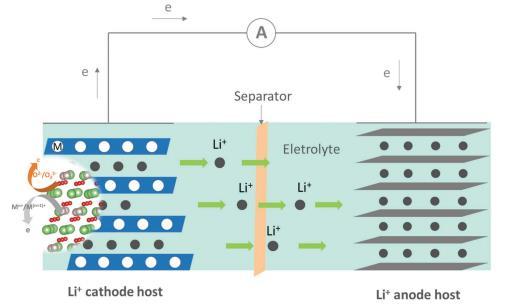
During the normal charging and discharging of a battery, a large number of chemical reactions take place inside the battery, and these complex chemical reactions usually involve the generation of heat. If the heat cannot be dissipated in time,thetemperatureofthe battery will riserapidlywiththecontinuous generation andaccumulationofheat,causinga series of abnormal side reactions that will cause the performance of the battery to deteriorate and even trigger thermal runaway. Therefore, it is necessary to investigate the heat generation mechanism of LIB. Broadly speaking, LIB heat productioncanbedividedintotwoparts:renewableheatandirreversibleheat.Reversibleheatistheheatreleasedwhen lithium ions are decalcified between the positive and negative electrodes. This is due to the reversible entropy change causedbytheelectrochemicalreactioninsidethebattery,alsocalledheatofreactionorheatofentropy.Irreversibleheat includes polarization heat and ohmic heat [9]. Polarization heat results from lithium ions overcoming resistance during internalmotion,whileohmicheatorJouleheatisassociatedwithresistancewithinthebattery.
OneofthemostcommonlyusedbatteryheatgenerationequationsproposedbyBernardi [10] isusedtopredicttheheat generationrateofanindividualbattery.Theexpressionis

where , , , and are expressed as heat generating power, operating current, cut-off voltage, operating voltage and operating temperature. The first term ( − ) on the right represents irreversible heat. The second term -IT(DE/DT) represents reversible heat, which is negative during charging and positive during discharging, while the thermal coefficientof entropy (DE/DT) is related todensity,stateof charge (SOC), and battery temperature. Theheat generation model has been widely used because of its convenient operation and reasonable accuracy, but it does not consider the existenceofphasechangeheatandheatofmixing.Incaseofirreversibleheat (E − U) canbereplacedby IR; R represents theinternalresistanceofthebatteryandtheformulacanbesimplifiedasfollows:

International Research Journal of Engineering and Technology (IRJET) e-ISSN: 2395-0056
Volume: 11 Issue: 03 | Mar 2024 www.irjet.net p-ISSN: 2395-0072
Comparedtothenon-recoverableheat,therecoverableheatcanbenegligibleinpracticalhybridelectricvehiclesandpure electriccarapplications.Therefore,theformulacanalsobeexpressedintheform[11]:

where∆Srepresentstheentropychange,whichisnegativeduringchargingandpositiveduringdischarging.FisFaraday's constant.
Batteryperformanceandstateofhealth(SOH)arestrictlydependentonthetemperatureoftheoperatingenvironment.A large amount of heat is generated inside the package, especially during the rapid loading and unloading process due to severalchemicalreactionsandelectrochemicaltransportphenomenathatincreasethetemperatureofthebattery.
The heat generated is greatest because hundreds of cells are connected in series or parallel, and the irregularity and thermal conditions of the battery cause a temperature difference between them. The exothermic existence of all these reactionsindicatesthattemperatureaffectsbatteryperformanceandheatremainsinsidethebatteryifitisnotsufficiently dissipated. It has been found that the voltage, electricity, efficiency and life cycle of a cell are profoundly affected by its operating temperature. Temperature uniformity has a significant effect on the condition of the battery in the long term. Lithium-ion batteries have two important issues: First, the operating temperature exceeds the appropriate temperature limit.Second,lowtemperatureuniformityreducesbatterylife.
TheLIBbelowtheoptimaltemperaturerangecandegradebatteryperformance,limitingitsuseincoldenvironments.Low ambient temperature causesmany problems,suchashighresistance to acceptcharge. battery lifeand performance. The charger cannot charge the battery quickly when the battery is operating below 5°C. When the battery temperature is below0°C,itlosescharge,power,accelerationandrange.Itfoundthatwhenthebatteryisusedforalongtimeatalower ambient temperature, the battery anode corrodes the lithium brick, reducing the safety of the battery. Smart et al. [12] showedthatchargingabatteryatmaximumcapacityisdifficultbecauselithiumdepositioncanoccurathighchargelevels atroomtemperature.
2.2.2.
At high temperatures, as the temperature continues to rise, LIBs undergo a series of reactions that affect their performance. The solid electrolyte interface (SEI) film is first degraded at 90 °C or even lower. During the first chargedischargecycleofaLIB,apassivationlayercalledSEIiscreatedonthesurfaceofthenegativeelectrode.Itcansuccessfully prevent the organic solvent in the electrolyte from damaging the electrode material, thus improving the battery performance.Second,lithiumreactswiththeelectrolyte.Thenafter135°Ctheseparatormeltswhichcausesashortcircuit betweenthetwoelectrodes [13].Whenthetemperaturerisesto200°C,ittriggersaseriesofcomplexreactions.Aslithium ions and electrolytes are consumed in large quantities, the capacity and performance of the battery will decrease dramatically.Zhaoetal. [14] highlightedthatevery1°Cincreaseintemperaturebetween30°Cand40°Cshortensbattery lifebytwomonths.Ramadassetal.[15]comparedcharge-dischargecyclesatroomtemperature,45°C,50°C,and55°C.The results showed a battery capacity loss of 30% after 800 cycles at a room temperature and a capacity loss of up to 70% after490cyclesat55°C.Asthetemperatureandnumberofcyclesincreased,thisreducedcapacityandhigherimpedance reducedbatteryperformance.
ThebasictypesofBTMSarelistedbelow;
1. Aircooling
2. Directrefrigerantcooling
3. Phasechangematerialcooling
4. Heatpipecooling
5. Thermoelectriccooling
6. Liquidcooling
International Research Journal of Engineering and Technology (IRJET) e-ISSN: 2395-0056
Volume: 11 Issue: 03 | Mar 2024 www.irjet.net p-ISSN: 2395-0072
Airsystemsuseairasa heatcarrier.Theincomingaircanbe eitherdirectlyfromtheatmosphereorfromthecabin,and thisaircanalsobecleanedaftertheheaterorevaporatoroftheairconditioner.Thefirstiscalledapassiveairsystem and the second is called an active air system. Active systems can provide additional cooling or heating capacity. A passive systemcanprovidehundredsofwattsofcoolingorheatingpower,andtheactivepowerofthesystemislimitedto1kW [16].Sinceinbothcasestheairissuppliedbyafan,theyarealsocalledforcedsystems.
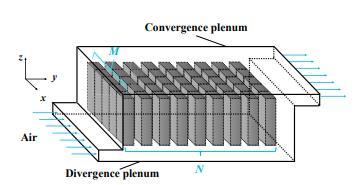
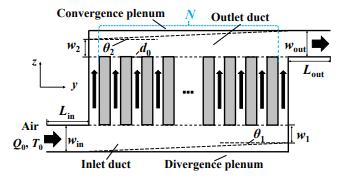
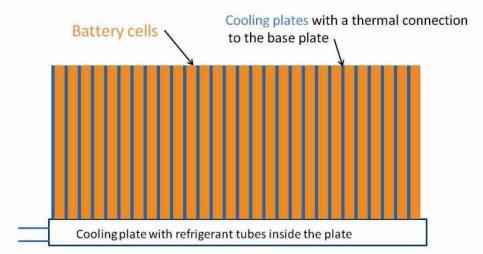
Like active fluid systems, the Direct Refrigerant System (DRS) consists of an air conditioner circuit, but the direct refrigerantsystemusestherefrigerantdirectlyasaheattransferfluidthatcirculatesthroughthecoil[6].
International Research Journal of Engineering and Technology (IRJET) e-ISSN: 2395-0056
Volume: 11 Issue: 03 | Mar 2024 www.irjet.net p-ISSN: 2395-0072
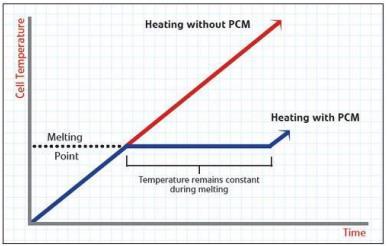
Thephasechangematerialabsorbsheatduringthemeltingprocessandstoresitaslatentheatuntilitreachesamaximum value.Thetemperatureisheldatthemeltingtemperatureforawhileandthenthetemperatureriseisdelayed.HencePCM isusedasadriverandbufferinBTMS.Inaddition,thePCMisalwaysconnectedtoanotherBTMSsystem,suchasaliquid orair-coolingsystem,tomonitortheinternaltemperatureofthebattery[17].
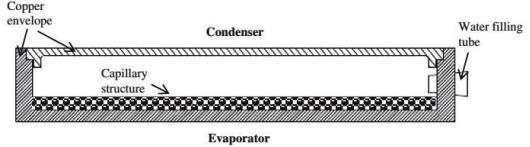
Itisapassivecoolingsystem,whichisbasicallyaclosedtubefilledwithrefrigerant,whichabsorbsheatbyevaporatingthe refrigerant on the hot side, and it removes the heat to the environment by condensing the refrigerant back into a liquid, formingonthecoldside.andthenflowsbackapartialvacuumwhichismaintainedintheheatpipebody,andacapillary structure is used inside the heat pipes to increase the heat transfer rate of the heat pipes, which raises the surface temperature. The heat pipe can use water or any coolant like the coolant and this cycle repeats itself over and over. The batteryactsasaheatsourceandislocatedundertheheatpipe(evaporationside),andthecoolingfinsactasheatsinksin theheatpipe(condensation side).Accordingtotests,a30%reductioninthermal resistancewasobservedina heatpipe cooling system with natural convection compared to without a heat pipe. In case of convection with low air speed, the thermal resistance decreases by 20%. The main problem with this cooling is the security of the system, which can be a concern in an emergency; a battery cell coolant leak can cause a short circuit that can cause vehicle failure and death. Capillarytubesalsorequireaminimumdiametertomaintainadequatepressuredropandpreventclogging[18].
International Research Journal of Engineering and Technology (IRJET) e-ISSN: 2395-0056
Volume: 11 Issue: 03 | Mar 2024 www.irjet.net p-ISSN: 2395-0072
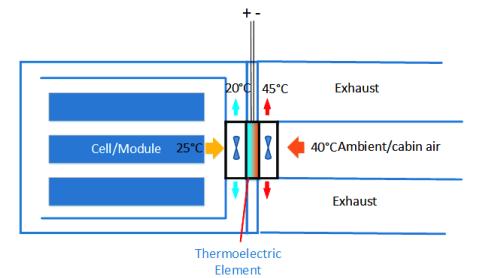
There are two possible upgrades to improve the cooling/heating of passive air systems. One is through thermoelectric modules.Athermoelectriccoolingsystemconvertsanelectricalvoltageintoatemperaturedifferenceandviceversa.This section discusses the conversion of electrical voltage to temperature. It removes heat through the components by dischargingelectricitydirectly.Thefansareequippedwithforcedconvectiontoimproveheattransfer.Mixingthepassive air system with the thermoelectric system and the connected system cools the battery temperature even lower than the incomingairtemperature,andthepowerislimitedtolessthanonekW [6].Itcanbeusedtoswitchbetweencoolingand heatingfunctionsandonlythepolarityoftheelectrodesneedstobechanged.
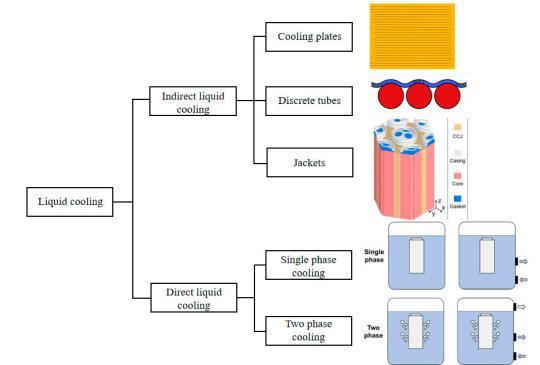
It is a cooling system that uses water as a coolant to cool the battery. Liquid cooling is the most commonly used cooling system due to its convenient design and good cooling capacity. Liquid cooling can be divided into indirect and direct cooling (also known as immersion cooling) depending on whether the cooling liquid is in contact with the battery, as showninFigure7.Indirectliquidcoolingusuallyinvolvesplacingheatsinks,separatepipesorenclosuresonthesurface ofthecell[19].Thiscoolingtechnologytransferstheheatproducedbythebatterytotheoutsidewiththeflowingcoolant, avoidingdirectcontactbetweenthecoolantandthebattery.Withdirectliquidcooling,thecoolantisindirectcontactwith thebattery,whichrequirestheuseofanon-conductivecoolant.Directliquidcoolinggreatlyimprovesthecontactsurface between the battery and the coolant, resulting in very high heat transfer rates. Direct liquid cooling can be divided into single-phase and two-phase according to whether there is a phase change in the cooling liquid. Compared with indirect liquidcooling,directliquidcoolinghasabettercoolingeffectandcanimprove theuniformityoftemperaturedistribution [20]. Liquid cooling lends itself easily to prismatic cells due to their regular shape, which allows for compact BTMS placement, while cylindrical cells require special structures to integrate cooling channels, increasing system complexity andweight.Forprismand pouchbatteries,themost commonsolutionis toapplycoolingplates.General studiesanalyse temperature and velocity distribution in cooling plates. In this section, the main research progress of indirect liquid coolingisintroduced.
International Research Journal of Engineering and Technology (IRJET) e-ISSN: 2395-0056
Volume: 11 Issue: 03 | Mar 2024 www.irjet.net p-ISSN: 2395-0072
Inthedirectliquidcoolingsystem,therefrigerantandthebatteryareindirectcontact,whichincreasestheheattransfer processandsimplifiesthesystemstructure,andreducesthecontactthermalresistance.Therefrigerantoftheliquiddirect coolingsystemmustbewellinsulated,non-flammableandenvironmentallyfriendly.Commonlyusedfluidsaresiliconeoil, transformer oil, fluoroether, etc. Compared with indirect liquid cooling, it can save space and cost and reduce overall weight, but in terms of energy consumption, direct liquid cooling systems require more energy because the coolant has highviscosity[13].SeveralresearchershavefoundthatdirectliquidcoolingsystemsforBTMSmaynotbesuitableforuse duetotheirhigherviscosity,whichconsumesmoreenergythanindirectliquidcooling[3].
In the case of indirect liquid cooling, different forms of batteries are suitable for different cooling devices. Cylindrical batteries usually use separate tubes or casing to increase the contact area between the surface and the coolant. For prismatic batteries or lidded bags, flat cold plates are usually the best choice. The air gap between the heat sink or tube andthebatterycontributestothermalinsulationandreducesheattransferefficiencybecausethecoolantandbatteryare not in direct contact with each other. To eliminate air gaps, high-precision cold metal plate and grease or epoxy binder withhighthermalconductivityarerequiredtoreducethermalcontactresistance [21].Inordertoimprovetheremovalof heat from the battery, researchers have done a lot of research on indirect liquid cooling. Selection of coolants, design of flowchannelsandoptimizationofsystemstructureshavereceivedmuchattentionandthesestudiesarediscussedinthis section.
3.6.2.1.
Coolant viscosity, density, thermal conductivity, specific heat capacity, and flow rate are important variables that determinethecoolingcapacityandheattransferefficiencyofaliquidcooledBTMS.Inorderforthepumpingpowernotto increaseandthecoolingcapacityofthesystemtoimprove,a coolantwithhighthermal conductivityandlowviscosityis needed. Because water is the simplest fluid in life, it has been widely used in indirect liquid cooling systems. It has been found that using water as a coolant can ensure battery temperature uniformity and improve BTMS cooling. In addition, water has a higher thermal conductivity and specific heat capacitythan air and a lower viscosity than oil, which ensures heattransfercapacityandhelpsreduceadditionalenergyconsumption.Tolowerthefreezingpointofwatersothat BTMS can be used at lower temperatures (sub-zero), a water/glycol mixture is typically used as the coolant. The addition of glycol to the water can greatly extend the use of the BTMS and reduce the risk of battery damage due to the increased volume due to condensation of the water. To eliminate short-circuit problems caused by contact with the battery after liquidleakage,waterorwater/glycol-basedBTMSshouldstrictlyavoiddirectcontactbetweenthecoolantandthebattery [22].
Wang et al [23] investigated the performance of hollow cold plates for pouch lithium-ion batteries using 50% aqueous ethylene glycol as the coolant. The effect of mass flow of coolant on the maximum temperature of the battery was investigated.Themaximum cell temperature graduallydecreasesasthe massflow rate(qm)increases.When qmis0.01 kg/s,thehighestpeaktemperatureofthecellis38.3°Cat720s,anditdecreasesby2.6°Cwhenqmis0.005kg/s,witha reductionrateof6.36%.Whenqmis0.015kg/s,thehighestmaximumcelltemperatureappearsat630sanddecreasesby 1.6°Cwhen qmis0.01kg/s,witha decreaserateof4.18%.When qm is0.02kg/s, themaximumhighesttemperatureis 35.4°Cat570sanditdecreasesby1.3°Cwhenqmis0.015kg/sandthedecreaserateis2.99%.Whenqmis0.025kg/s, thehighestmaximumtemperatureappearsat540s,whichis0.9°Clower,andthereductionrateis2.54%.Thus,itcanbe seenthatwhenqmisgreaterthan0.01kg/s,themaximumtemperaturefirstincreasesand thendecreaseswithdischarge time,andbotharebelow40°C.Aldosryetal.[24]usedtwotypesoffluidsintheirstudy,namelyG13ethyleneglycoland distilledwaterinfivestages,10%ethyleneglycol,100%distilledwater,75%ethyleneglycol+25% distilledwater,50% ethyleneglycol+50%distilledwaterand25%ethyleneglycol+75%distilledwater.Threedifferentflowratesof0.3,0.5 and0.7gramsperminute(GPM) wereusedtomaximizefluidandheattransferproductivitythroughthegate valve.The cold plate consists of an inclined fin, which is able to increase the rate of heat transfer from the heater to the liquid cold plate.TheGPM0.7achievedthelowestbatterysurfacetemperatureatthreedifferentflowlevels.Thecoldplatecankeep the surface temperature around the batteries slightly below the permitted operating temperature of 50°C. Pan et al. [25] investigated the effects of the number of channels, cold plate panel thickness, coolant mass flow rate, and cooling tube thickness on the cooling efficiency of a battery system. The heat dissipation performance of the battery was found to be slightlyimpactedbythethicknessofcoolingplateorcoolingtubeduringtheorthogonal test,butsignificantly influenced byhowmanycoolingchannelsandcoolingmassflowrate.Asimplermethodalsorevealedthatthesevariableshadlittle
International Research Journal of Engineering and Technology (IRJET) e-ISSN: 2395-0056
Volume: 11 Issue: 03 | Mar 2024 www.irjet.net p-ISSN: 2395-0072
impact on this factor. By increasing the mass flow rate of coolant, it is found that it’s an effective way to increase heat dissipationfromthebattery.
In addition to investigating coolants with different thermal conductivities to improve the cooling performance of BTMS, some researchers also investigated coolant inlet temperature. Panchal et al. [26] designed a microchannel cold plate for coolingtheprismaticbatteryandinvestigatedtheeffectofwatercoolingatthreeoperatingtemperaturesofthe,5°C,15°C and 25°C. Coolant temperature was found to affect the cooling of the cold plate. Malik et al. [27] investigated the performanceofabatteryatdifferentcoolingtemperatures(10°C,20°C,30°Cand40°C)basedonacoldplate.Testresults showedthatbatteryperformanceimprovedasthecoolanttemperatureincreased.Theyfoundthatwhenthetemperature ofthecoolantis30°C,themaximumandaveragetemperatureofthebatterycanbecontrolledbetween25°Cand40°Cat eitheralowdischargerateorahighdischargerate.
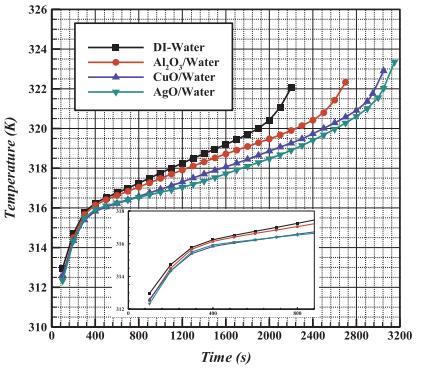
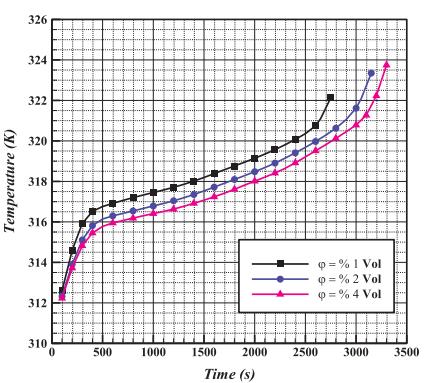
Water-based coolants have a lower viscosity and a higher heat transfer coefficient than most petroleum coolants. To further improve thermal conductivity, metal particles or metal oxides such as Al, Cu, Ag, Ni, alumina, titanium dioxide, silicondioxide,etc.canbeaddedtocommonliquidrefrigerants.Coolantswithaddedliquidmetalsandnanoparticlesmay beconsideredabetteralternativetoindirectliquidcooledBTMSwaterorwater/ethyleneglycolsolutioncooledcoolants. Ifmetalparticlesareaddedtotraditionalfluids,theybecomenanofluids.Whenadded,thethermalconductivityofcoolant increasessignificantly.Asaresult,thethermalconductivityofmetalismuchhigherthanthatofconventionalheattransfer fluids. Zakaria et al. [28] investigated the effect of Al2O3 (aluminium oxide) nanoparticles at different volume concentrations(0.1,0.3and0.5%)onthermalconductivityinawater/glycolmixture.Theresultsshowedthatthethermal conductivity increased when the concentration of nanoparticles was in the water/glycol mixture. In the water/glycol mixture with a 1:1 volume ratio of the nanoparticle volume concentrations was 0.1%, 0.3%, and 0.5%, and the thermal conductivityincreasedby2%,4.2%and7.5%.respectively.Maheshwarietal. [29]investigatedtheeffectofconcentration, size,andshapeofTiO2(titaniumdioxide)nanoparticlesonthethermalconductivityofnanofluids.Experimentaldatashow thatthermalconductivityincreaseswithconcentration.Thermalconductivitycanalsobeimprovedbychangingtheshape andsizeofparticles,althoughconcentrationhasthegreatesteffectonthisproperty. Kianietal [30]testeddifferentoxide nanofluids with three types of nanoparticles, aluminium oxide (Al2O3), copper oxide (CuO), and silver oxide (AgO). Test result showed a significant improvement in the cooling efficiency of the nanofluidic system, of which AgO was the best candidate.Comparedtothethermalmanagementsystemofthepurewaterbattery,the2%AgO/waternanofluidicsystem reduced the peak temperature of the battery by about 4.1 K. As shown in Figure 8(a), the addition of nanoparticles significantly improves the heat transfer rate. Figure 8(b) shows the change in the peak temperature of the battery at differentvolumefractionsofAgOnanoparticlesatthreedifferentconcentrations.Toinvestigatetheeffectsofnanoparticle volume fraction and nanofluid flow rates on cooling performance, Bin-Abdun et al. [31] studied the thermophysical properties and heat transfer rates of CuO/deionized water nanofluids with and without sodium dodecyl sulphate (SDS) surfactant. They analysed the effect of flow rate and surfactants on the heat transfer rate of nanofluids with different volumeconcentrationsof0.08%,0.16%,and0.40%.Thesizeandmorphologyofcopperoxidenanoparticlesareshownin Figure8(c).TheresultsshowedthatthehighestheattransferratewasachievedwithCuO/deionizedwaternanofluidwith volume concentration 0.40% and SDS surfactant. The heat transfer rate results with deionized water and copper oxide nanoparticlevolumeconcentrationsof0.08%,0.16%,and0.40%atdifferentflowratesareshowninFigure8(d).
International Research Journal of Engineering and Technology (IRJET) e-ISSN: 2395-0056
Volume: 11 Issue: 03 | Mar 2024 www.irjet.net p-ISSN: 2395-0072
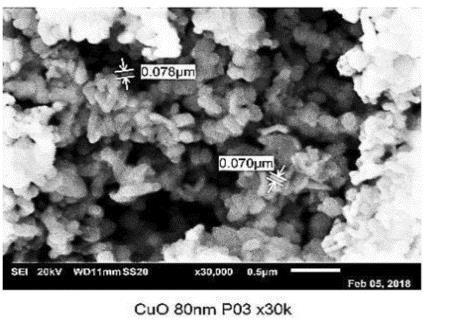
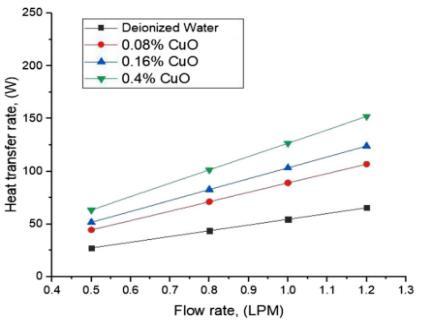
Figure 8. (a)Effectofvariousnanofluidsonthecoolingsystem[30]. (b)Effectofnanoparticlevolumefractiononthe coolingperformance[30].(c)SEMimagesofCuOnanoparticles[31].(d)Heattransferrateversusflowratefordeionized waterandnanofluids[31].
For indirect cooling methods, the thermal resistance must be considered more accurately due to the addition of channel materials and electrical insulating coatings. To improve the cooling capacity of the cooling system, the system structure can be optimized. In case of indirect liquid cooling, the coolant must pass through certain channels. However, different channeldesignscanhavedifferenteffectsonBTMSthermalefficiencyandpowerconsumption,whichiswhyresearchers haveconductedmanystudiesonchannels.
Ye et al. [32] designed a multichannel parallel cold plate (Figure 9a). In his study a complex heat transfer model was created for the entire module, which included batteries, two cooling plates, silicone gel pads and coolant. An orthogonal experimentaldesignwithnumericalanalysiswasappliedtooptimizethemainparametersof themodule.Thegeometry of the plate was further optimized using the surrogate model method. The plate with optimized geometry was reconstructed into the thermal model of the module for analysis. The comparison showed that the maximum and minimum temperature difference of the heat was reduced by 5.24% and the pressure drop was reduced by 16.88%. Analysisofthe orthogonal design concludedthatthe battery temperature difference andpressure dropdecreasedasthe coolantchannelcross-sectionandnumberincreasedwhencoolantflowwasconstantattheinlet.Quianetal. [33]designed a parallel coldplatewithmultiplechannels.The effects ofchannel number,flowdirection, massflow,andchannel width onbatterytemperaturewereinvestigatedusingnumericalsimulation.Itisfoundthatthemini-channelcoldplatethermal managementsystemprovidesgoodcoolingperformanceincontrollingthetemperatureofthebattery.Onlythe2-channel cold plate can keep the maximum temperature below 40°C for more than half discharge times. The more channels, the better the cooling capacity of the BTMS. Even so, there are no obvious advantages to a cold plate with more than five channels.Themaximumtemperatureandtemperaturedifferencecanbereducedbyincreasingtheinletmassflowwhich is more effective than other methods. However, this costs energy consumption. Increasing the channel width can reduce powerconsumption.Whenchannelwidthwaschangedfrom3mmto6mm,thepressuredropisreducedby55%.Dueto thehigherheatproductionofthenearelectrodeareaandthedifferentcoolingeffectofeachbattery,itisverydifficult to reduce the temperature difference below 5°C. Huo et al. [34] designed a parallel cold plate with multiple channels. The effectsofchannelnumber,flowdirection,massflow,andambienttemperatureonbatterytemperaturewereinvestigated usingnumericalsimulation.
Huangetal.[35]usedstreamlinedchannelsforindirectliquidcooling,asshowninFigure9b.Theyfoundthatthischannel caneffectivelyreducethefluidflowresistanceandimprovethetemperaturedistributionofthebattery. Straightchannel and streamlined channel were investigated by numerical solution. It has been observed that for typical straight channel designs, even-channel plates always have a higher resistance to flow than odd-numbered plates. At a mass flow rate of 0.005 kg/s, the pressure drop can be as high as 6581 Pa and 6043 Pa for four and six typical straight channel numbers. Whenusingstreamlinedchannels,themaximumpressuredropisonly3877Pa.Thus,streamlinedchannelscaneffectively reducepressureloss and avoiddirect flow effect, especiallyinpairedchannel coolingplates.Thetemperaturedifference between streamlined designs with different number of channels is quite similar to a typical straight 5-channel design, whichmeansthatthestreamlinedductdesigncanmaintainthecoolingcapacityatthesamelevelasanormalstraightduct design.Theeffectofdifferentnumbersofchannelsonthecoolingcapacitycanbecontrolledbyadoptingtheconceptofthe streamlinedshapeofthemini-channelcoolingplate.Shettyetal.[36]analysedtheperformanceofstreamlinecoolingplate
International Research Journal of Engineering and Technology (IRJET) e-ISSN: 2395-0056
Volume: 11 Issue: 03 | Mar 2024 www.irjet.net p-ISSN: 2395-0072
with different configurations in a 3, 4, 5, 6, and 7 channel. The purpose of the analysis is to determine the optimal configuration of the cold plate. In addition, the performance of the optimal plate configuration is evaluated at different temperatures between 300 and 328 K. The results show that the streamline plate perform is satisfactorily at different temperatures and the 7-channel configuration performs best at 328 K. The maximum temperature of the solid plate is 302.677Kwithamassflowrateof0.005kg/s,whichiswellwithintheoptimaloperatingtemperaturerangeforaLi-ion battery.
Wei et al. [37] used a U-shaped serpentine channel cold plate (Figure 9c) to reduce the resistance of liquid flow in the channel.Hisworkpresentedamethodbasedonresponsesurfacemethodology(RSM)andnon-dominatedsortinggenetic algorithm II (NSGA-II) to achieve optimization of operating parameters with relatively low current resistance. These methods can be used to quickly obtain optimized operating parameters to balance the maximum temperature, average temperature and cold plate pressure drop in BTMS. The results can guide the design of a battery thermal management operationalstrategy.Whentheflowratechangesfrom0.0019to0.0249kg/s,thepressuredropincreasesfrom27.77Pa to 1360.47 Pa. The average temperature increases to 9.93°C when the inlet temperature increases from 20 to 30°C. Althoughincreasingtheflowrateandloweringtheinlettemperaturecanimprovethecooling efficiencyoftheliquidcold plate,aflowrategreaterthan0.0249kg/sdoesnotsignificantlyaffectthetemperatureuniformityoftheliquidcoldplate. Optimizing BTMS operating parametersiscritical toachieving betteroverall liquidcoldplateperformance.Basedon the RSM design, regression models are obtained for average temperature, maximum temperature difference and pressure drop with coefficients of variation (C.V) below 0.3%, which ensures the accuracy of the regression models. The average temperatureandpressure drop deviations between model predictionsand CFDsimulationsare lessthan 11%. Fanet al. [38]hasdesignedaU-shapeserpentinechannelwithellipticalgrooves(Figure9d)andsecondarychannels.Theeffectsof widthofthemainchannelandnumberofellipticalgrooveswereinvestigatedusingnumericalsolution.Whenthewidthof themainchannel(D)increasesfrom4mmto10mm,themaximumtemperature(Tmax)andaveragetemperature(ΔTavg) decrease by 2.67℃ and 1.32K respectively. When D is 10mm, Tmax and ΔTavg are 39.33°C and 2.74K respectively. Only thedesignwithDof10mmreachedthetemperaturetargetofthebatterymodulewithTmaxbelow40°CandΔTavgbelow 3°C.ThisshowsthataliquidcoolingplatewithawiderDisusefulforcoolingthebatterymodule,andthelargertheD,the morecoolantcanaccesstheliquidcoolingplate,whichismoreusefulforheattransfer.Asthenumberofellipticalgrooves increases from 4 to 7, the Tmax and ΔTavg of the battery module increase by 0.84°C and 0.49615K, respectively. This showsthatchangingthenumberofellipticalgrooveshaslittleeffectonthetemperatureofthebatterymodule.Jayarajan et al. [39] used a u-shaped serpentine channel cold plate with zig-zag pattern (Figure 9e). The effects of number of the coolingchannel,changeinchannelwidth,inletmassflowrate,changeinheatfluxandchangeininletcoolanttemperature wereinvestigatedusingnumericalsolution.Resultsshowedthatthecoldplatewithalargernumber ofchannelshadgood temperatureuniformity(Tσ),thatis,Tσ=3.2Kforthe13-channelcoldplateandTσ=6.01Kforthe3-channelcoldplate, andthemaximumtemperatureTmaxforthe3-channelcoldplatewas330.84K,whileforthe13-channelcoldplateitwas 316 K. This trend was reversed for pressure drop. As the number of channels increased from 3 to 13, the resistance increased. Therefore, the 13-channel cold plate showed a higher pressure drop (13.34 × 10³ Pa) compared to the 3channel cold plate (3.84 × 10³ Pa). The heat transfer rate followed the same trend as Tmax and Tσ, that is due to the removal of material, which resulted in a decrease in the conductivity of the cold plate. As the number of channels increased,theheattransferratedecreased.Thepressuredropwastoohighinchannels11and13,andthe3-channelcold platehadpoortemperatureuniformity.Increasingthechannelwidthsignificantlyreducedthepressureanddidnotshow significant changes in other parameters. 5-channel width 16 mm and 18 mm and 7-channel width 16 mm showed an improvementinpressuredrop.Theincreaseinmassflowreducedthemaximumtemperatureandimprovedthestandard surface temperature and heat transfer rate, but increases the pressure drop by almost 49%. Inlet cooling temperature dropshowedanimprovementinmaximumtemperaturedropforthe5and7-channelmodelsatdischargeratesof2C,3C and4C.
International Research Journal of Engineering and Technology (IRJET) e-ISSN: 2395-0056
Volume: 11 Issue: 03 | Mar 2024 www.irjet.net p-ISSN: 2395-0072
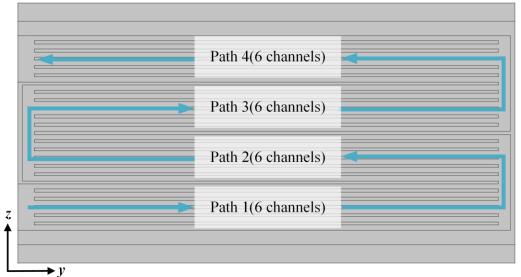
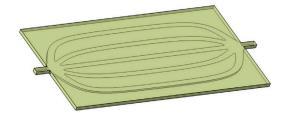
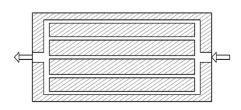
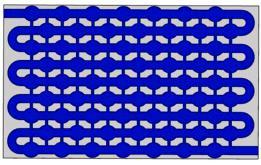

Figure 9. Typicaldesignofthechannel:(a)Parallelchannel[32].(b)Streamlinedchannel[35].(c)U-shapedserpentine channel[37].(d)U-shapedserpentinechannelwithellipticalgrooves[38].(e)U-shapedserpentinechannelwithzig-zag pattern[39].
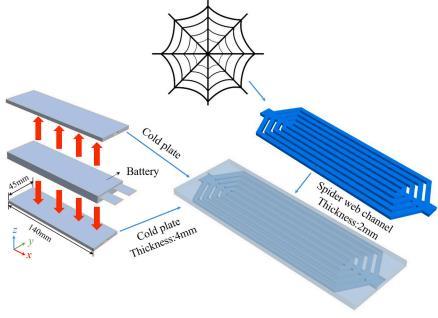
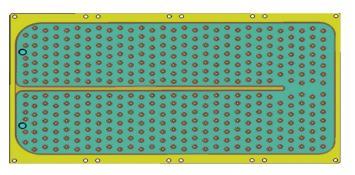
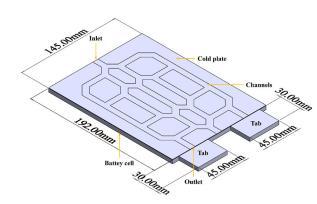
Wangetal.[40]proposedanewtypeofspiderwebchannelcoldplate(Figure10a)andinvestigateditscoolingeffectand thermal balance performance for a pouch lithium-ion battery. The battery heat generation model was obtained by numericalsimulation,whichaccuratelysimulatesthetemperaturedistributionofthebatterywithadischargerateof12C. A three-factor, four-level orthogonal test set was used to find the best combination of different structural parameters of the spider web channel. The simulation results showed that the cold plate performance was most affected by channel width(l),secondbynumberofchannels(n),andleastaffectedbychannelangle(α).Thebestcombinationobtainedfrom the orthogonal experiment contained l4 = 3 mm, n4 = 11 and α3 = 120° where the Li-ion battery had the lowest temperature (37.892°C) and the smallest temperature difference (8.864 °C). The pump loss was lower on the cold plate (27.06Pa).Lietal.[41]analysedtheperformanceoffourdifferentcoldplatesnamelyU-shaped,aerofoil,honeycomband convexstructure(Figure10b).Aftercomparingandanalysingthefourliquid-cooledplates,itwasfoundthattheconvexshapedcoolingplatehadthelowestpressurelossatdifferentflowrates,andtheresistancesofthehoneycomb structure
© 2024, IRJET | Impact Factor value: 8.226 | ISO 9001:2008 Certified Journal | Page1161
International Research Journal of Engineering and Technology (IRJET) e-ISSN: 2395-0056
Volume: 11 Issue: 03 | Mar 2024 www.irjet.net p-ISSN: 2395-0072
and the air foil structure were the highest. The heat exchange characteristics of several cooling plates were basically the same,butthetemperatureuniformityofthecellstructurewastheworst,andthecoolingperformanceofthecoolingplate wasgreatlyaffectedbytheflowrate.Themaximumtemperatureofthistypeofplatealwaysexistsatacertainmassflow, whichisdifficulttoremove.Toensureatemperaturedifference(≤10K)betweentheinletandoutletofthecoolingplate,it isnecessarythatthemassflowofthecoolingplateisatleast0.0223kg/s.Increasingthemassflowisaneffective wayto cool the battery in a short period of time. Luo et al. [42] has developed a new cold plate called constructal cold plate (Figure 10c) using the constructal theory. The constructal pate was analysed and its results were compared with conventionalstraightandserpentineplate.Comparedtotheconventionalcoldplate,theconstructalcoldplatehasbetter performance. Compared with a straight channel cold plate, the constructal cold plate allows the cell to reach its optimal operating temperature earlier, reducing TimeT (time required for battery average temperature to drop to 25 ◦C) and TimeΔT (time required for battery maximum temperature differential to drop to 5 ◦C) by 15.25% and 10.58%, respectively,andΔp(pressuredrop)by22.89%.Comparedwiththeserpentinecoldplate,theconstructalcoldplatehasa slightlyworsecoolingeffect,buttheflowresistanceisgreatlyreduced,and thepressuredropoftheserpentinecoldplate isabouttentimesgreaterthanthatofthestructuralcoldplate.
International Research Journal of Engineering and Technology (IRJET) e-ISSN: 2395-0056
Volume: 11 Issue: 03 | Mar 2024 www.irjet.net p-ISSN: 2395-0072
Basedonthetypicalchannelstructure,parallelchannelsandserpentinechannelsaregraduallyreplacedbychannelswith better cooling effect. Monica et al. [43] illustrates six cold plate designs (Figure 11a) that were compared with the same channel volume, including straight,serpentine, U-shaped, pumpkin- shape, spiral, and hexagonal structure. Numerical analysis found that despite the large pressure drop, the snakechannel and hexagonal channel have good cooling properties and can significantly improve the temperature distribution of the battery. In addition, Chen et al. [44] investigated the cooling of BTMS based on a parallel mini-channel cold plate (PMCP) and designed three different PMCP flowchannels(typeI,ZandU).PMCPcoolingefficiencywasfoundtobesignificantlyimprovedbychangingtheedgewidth andchannelwidthofthecoldplate.Chen'sstudyalsoconstructedthreesymmetricalPMCPS,asshowninFigure11b.The resultsshowedthatthesymmetrical coldplatecancontrol themaximumtemperatureandtemperaturedifferenceofthe batterymoduleinalowrange,andithelpstoreducetheenergyconsumptionofthesystem.
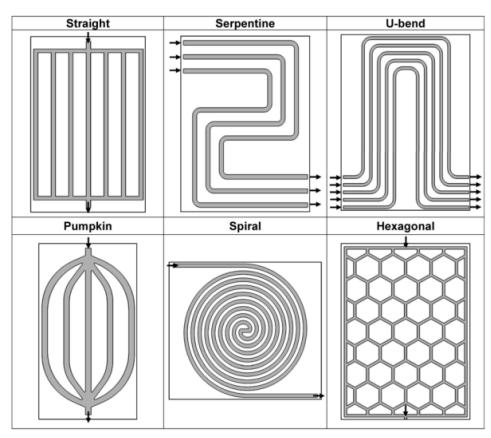
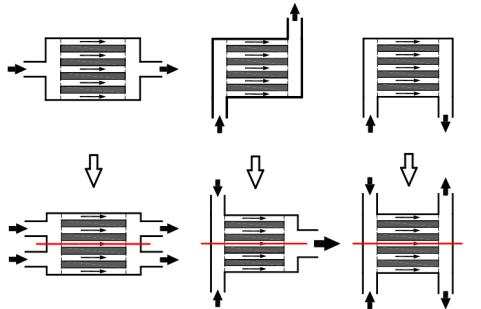
11. (a)Designofsixcoldplatechannels[43].(b)ThreesymmetricPMCPs[44].
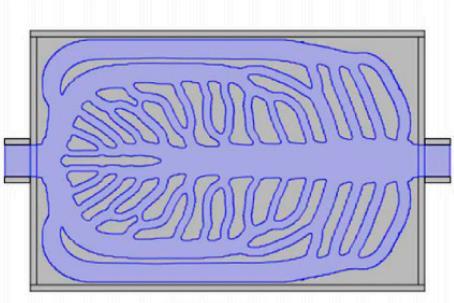
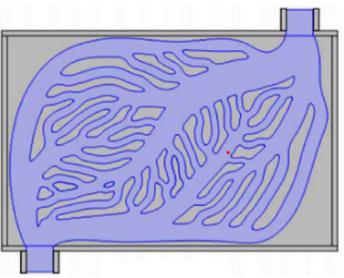
Byoptimizingthe flow channel geometry, topology optimization (TO) can be used toincreasethe heat transfer efficiency ofthecoldplateanddecreaseflowslosses.AnewchannelstructurecoolingplateforTOwasdesignedbyChenetal. [45] as illustrated in Figure 12. From numerical analysis it was revealed that in comparison with the traditional rectangular channelcoldplate(RCP)andserpentinechannelcoldplate(SCP),the topologyoptimizationcoldplate(TCP)hasahigher heat transfer coefficient. At the same inlet pressure, TCP-RCP has a maximum temperature, temperature difference and temperaturestandarddeviationof0.27%,19.5%and24.66%lowerthanthatoftherectangularchannelcoldplate(RCP).
Thus, the cooling performance of indirect liquid cooling can be improved by adjusting the channel structure and configuration, including channel geometry, channel width, channel spacing, number of inlets and outlets, microchannels, etc.
International Research Journal of Engineering and Technology (IRJET) e-ISSN: 2395-0056
Volume: 11 Issue: 03 | Mar 2024 www.irjet.net p-ISSN: 2395-0072
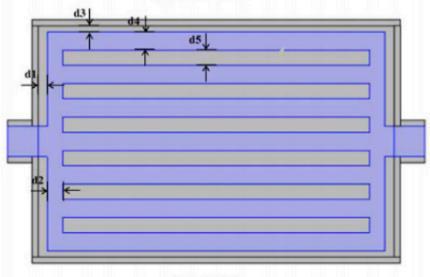
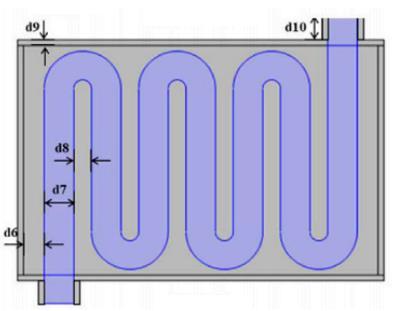
The number of cooling channel and flow rate of coolant have an important influence on the performance of the liquid cooledBTMS.Alongwiththisthepositionofthecoldplates,numberofcoldplatesandthecontactareabetweenthecold plateandbatteryisalsoinfluencesthecoolingperformance.
Usinga multichannel flattube(MCFT),Renetal. [46] developeda methodfor bottomliquidcooling(BLC)toanalysethe temperaturedistributionofthebatterymoduleaccordingtotheBLCmethod,acomparativetestwithpassivecoolingwas performed.Figure13ashowstheoutlineofamoduleconsistingofLIB,MCFT,andaluminiumshell.Theresultsindicated that the BLC, which was based on an MCFT, significantly enhanced the temperature uniformity of the module and also minimizedtheoveralltemperatureincreaseofitsbatterymodule.Darcovichetal.[47]investigatedtheperformanceofthe cooling system by placing cold plates on the bottom and side of the battery. The results showed that the side plate can keep the temperature on the cell surface quite constant between 304.2 and 304.6 K, while the temperature range of cooling with the cold plate can be seen as almost 5 K under the same test conditions. It is understood that chemical and electrochemical systems work well at this temp. Since side cooling has more contact areas with the battery than bottom cooling, its maximum temperature is lower and temperature uniformity is better. Qian et al. [33] utilized two distinct cooling systems that were constructed using different numbers of cold plates (Figure 13b). The results of simulation showedthatthreecoldplateshelpedtoimprovethetemperaturedistribution.Whenthecoolantflowrateis1×10-3kg/s, thedifferencebetweenthemaximumbatterytemperatureandthetemperaturedecreasesby13.3%and43.3%.Dengetal. [48],designedsixdifferentcoldplatelayoutpatterns(Figure13c)toinvestigatetheeffectofbatteryheatdissipation.The maximum temperature ofthe batterydecreasedasthe numberof coldplatesincreased. Whenthe numberof coldplates increased to five, the heat removal performance of the system was the best. The author emphasized that if there are the same number of cold plates, equally placing the cold plates near the buffer battery is useful to lower the maximum temperature.Therefore,the sidecoldplatesshould beselectedasmuchaspossible withinthe allowablecostandpower range,andthenumberofcoldplatesshouldbeincreased.Jinetal. [49] investigatedtheeffectofbatterylayoutstructure ontheperformanceofthermalrunawayincell-to-chassis(CTC)systems.Thefindingsindicatedthatthebatterysystem's safety can be enhanced by modifying the batteries' structure. By changing the arrangement of the battery from a conventional in-line configuration to a brick configuration, the propagation of thermal runoff in the battery can be effectively prevented due to the lower thermal peak current and heat in the brick configuration is transferred to more adjacentbatteries.
International Research Journal of Engineering and Technology (IRJET) e-ISSN: 2395-0056
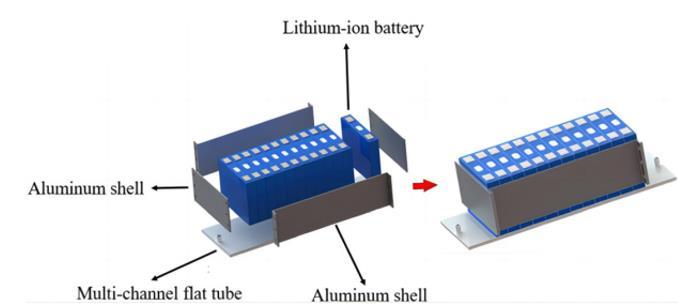
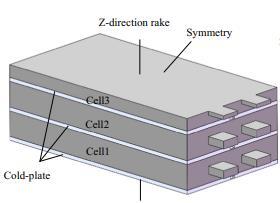
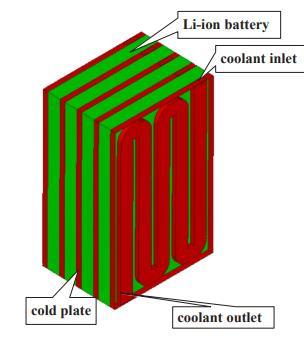
13. Coldplatediagram(a)structurediagramoftheBLCbasedonMCFT[46].(b)bottomliquidcooling[48].(c)side liquidcooling[49].
Fu et al. [50] analysed the heat dissipation capacity of a liquid cold plate battery with different heat transfer fins (Figure 14a). Compared with the liquid cold plate without fins, the liquid cold plate with 8 mm - 15° fins lowers the maximum temperatureofthebatteryby1.75Kwhenthetemperaturedifferenceis0.32K.Whentheangleofthefinschangesfrom 30°to45°,thepeaktemperatureandthebatterytemperaturesthedifferencedecreasesastheriblengthincreases.Thus, addingheattransferfinsinsidetheliquidcoldplatecan significantly reducethepeak temperature ofthebatterymodule andthetemperaturedifferencebetweenthecells.Ometal. [51] designedaliquidcooledplate(LCP)withthreedifferent angle fin arrangements inline (Figure 14b), incline (Figure 14c) and louvered (Figure 14d). The flow and heat transfer properties of these fins are compared through experimental and numerical simulation studies. From the results, it is observed that louvered fin arrangement has the highest value of Nusselt number followed by inline and inclined
Volume: 11 Issue: 03 | Mar 2024 www.irjet.net p-ISSN: 2395-0072 © 2024, IRJET | Impact Factor value: 8.226 | ISO 9001:2008 Certified Journal | Page1165
International Research Journal of Engineering and Technology (IRJET) e-ISSN: 2395-0056
arrangement.ThedesignedLCPwithadifferentarrangementoffins cankeepthesurfacetemperatureoftheheaterblock below50°CatReynoldsnumber400-1200.
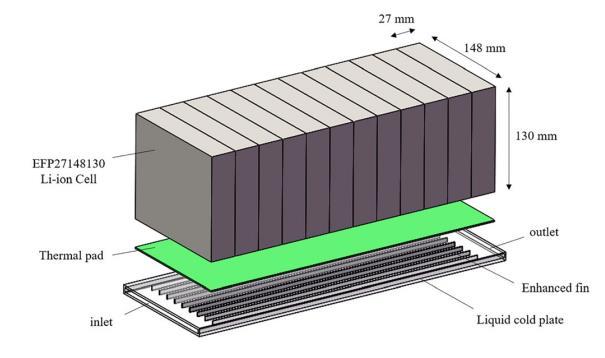
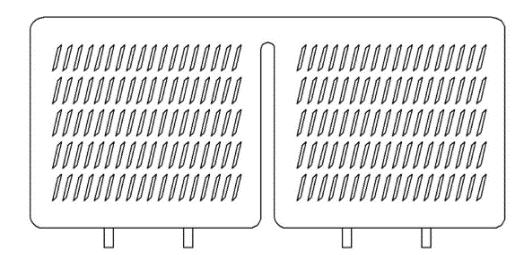
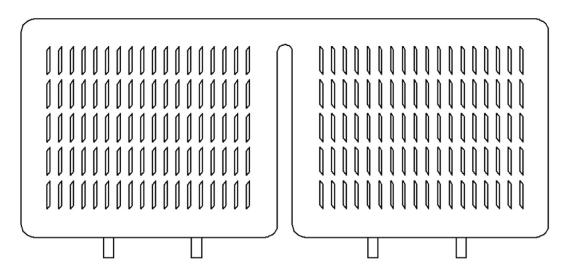
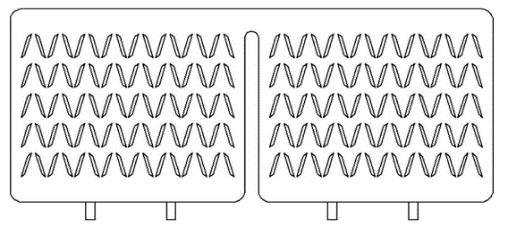
14. (a)Modulecomponents [51].(b)Inlineobliquefinarrangement [52]. (c)Inclineobliquefinarrangement [52]. (d)Louveredobliquefinarrangement[52].
Summary and prospect
Basedontheabovestudies, liquid coolingisa veryeffectivethermal managementtechniquethatcancontrol thebattery temperature and temperature difference within an acceptable range. This paper reviews the literature on indirect liquid coolingofBTMS. The reviewprovidesa comprehensiveoverviewofdesignimprovementtechniquesandhighlightstheir effectivenessinimprovingcoolingperformance.Factorssuchasselectionofcoolant,flowrateofcoolant,temperatureand geometryandstructureofsystemgreatlyaffectoverallsystemperformance.Futureresearchshouldfocusondeveloping improvedliquidcoolants,simplifyingcoolingchannelsandoptimizingheattransferofthecoolingplates.Theresearchof different cooling methods with different compatibility holds the potential for liquid cooling solutions for commercial electric vehicles. In summary, this study highlights the huge potential of liquid-cooled BTMS to improve thermal managementofLi-ionbatteries,whichrequiresfurtherdevelopmentandoptimizationofliquidcoolingtechnology.
Volume: 11 Issue: 03 | Mar 2024 www.irjet.net p-ISSN: 2395-0072 © 2024, IRJET | Impact Factor value: 8.226 | ISO 9001:2008
International Research Journal of Engineering and Technology (IRJET) e-ISSN: 2395-0056
Volume: 11 Issue: 03 | Mar 2024 www.irjet.net p-ISSN: 2395-0072
Nomenclature
LIB Lithium-ionBattery
BTMS BatteryThermalmanagementsystem
PCM Phasechangematerial
SOC Stateofcharge
SOH Stateofhealth
SEI Solidelectrolyteinterface
DRS Directrefrigerantsystem
CFD Computationalfluiddynamics
GPM Gramsperminute
Al2O3 Aluminiumoxide
TiO2 Titaniumdioxide
CuO Copperoxide
AgO Silveroxide
SDS Sodiumdodecylsulphate
RSM Responsesurfacemethodology
NSGA-II Non-dominatedsortinggeneticalgorithmII
C.V Coefficientsofvariation
D Widthofthemainchannel(mm)
Tmax Maximumtemperature(°C)
ΔTavg Averagetemperature(°C)
Δp Pressuredrop(pa)
Tσ Temperatureuniformity
PMCP Parallelmini-channelcoldplate
TO Topologyoptimization
MCFT Multichannelflattube
BLC Bottomliquidcooling
CTC Cell-to-chassis
International Research Journal of Engineering and Technology (IRJET) e-ISSN: 2395-0056
Volume: 11 Issue: 03 | Mar 2024 www.irjet.net p-ISSN: 2395-0072
[1] Zhao, C.; Zhang, B.; Zheng, Y.; Huang, S.; Yan, T.; Liu, X. Hybrid Battery Thermal Management System in Electrical Vehicles:AReview. Energies2020,13,6257. 6257;Doi:https://doi.org/10.3390/en13236257
[2]Aneke,M.;Wang,M.Energystoragetechnologiesandreallifeapplications-Astateoftheartreview. Appl.Energy2016, 179,350–377;Doi: http://dx.doi.org/10.1016/j.apenergy.2016.06.097
[3] Liu, J.; Chen, H.; Huang, S.; Jiao, Y.; Chen, M. Recent Progress and Prospects in Liquid Cooling Thermal Management SystemforLithium-IonBatteries. Batteries2023,9,400;Doi:https://doi.org/10.3390/batteries9080400
[4]Wang,Q.;Jiang,B.;Li,B.;Yan,Y.Acriticalreviewofthermalmanagementmodelsandsolutionsoflithium-ionbatteries for the development of pure electric vehicles. Renew. Sustain. Energy Rev. 2016, 64, 106–128; Doi: http://dx.doi.org/10.1016/j.rser.2016.05.033
[5]Kim,J.;Oh,J.;Lee,H.Reviewonbatterythermalmanagementsystemforelectricvehicles. Appl.Therm.Eng.2019,149, 192–212;Doi: https://doi.org/10.1016/j.applthermaleng.2018.12.020
[6]Sourav Singh Katoch and M Eswaramoorthy 2020 IOP Conf. Ser.: Mater. Sci. Eng. 912 042005; Doi: https://doi.org/10.1088/1757-899X/912/4/042005
[7] Wang, Q.; Mao, B.; Stoliarov, S.I.; Sun, J. A review of lithium ion battery failure mechanisms and fire prevention strategies. Prog.EnergyCombust.Sci.2019,73,95–131;Doi:https://doi.org/10.1016/j.pecs.2019.03.002
[8]Li, B.; Xia, D. Anionic Redox in Rechargeable Lithium Batteries. Adv. Mater. 2017, 29, 1701054; DOI: https://doi.org/10.1002/adma.201701054
[9]Lai,Y.;Du,S.;Ai,L.;Ai,L.;Cheng,Y.;Tang,Y.;Jia,M.Insightintoheatgenerationoflithium-ion batteriesbasedonthe electrochemical-thermal model at high discharge rates. Int. J. Hydrog. Energy 2015, 40, 13039–13049; Doi: https://doi.org/10.016/j.ijhydene.2015.07.079
[10]Bernardi,D.;Pawlikowski,E.;Newman,J.AGeneralEnergyBalanceforBatterySystems. J.Electrochem.Soc.2019,132, 5–12;Doi: https://doi.org/10.1149/1.2113792
[11] Fathabadi, H. A novel design including cooling media for Lithium-ion batteries pack used in hybrid and electric vehicles. J.PowerSources2014,245,495–500;Doi: https://doi.org/10.1016/j.jpowsour.2013.06.160
[12]Smart,M.C.;Ratnakumar,B.V.;Whitcanack,L.D.;Chin,K.B.; Surampudi,S.;Croft,H.;Tice,D.;Staniewicz,R.Improved Low-TemperaturePerformanceofLithium-IonCellswithQuaternaryCarbonate-BasedElectrolytes. J.PowerSources2003, 119-121,349-358;Doi: https://doi.org/10.1016/S0378-7753(03)00154-X
[13] Liu, H.; Wei, Z.; He, W.; Zhao, J. Thermal issues about Li-ion batteries and recent progress in battery thermal management systems: A review. Energy Convers. Manag. 2017, 150, 304–330; Doi: https://doi.org/10.1016/j.enconman.2017.08.016
[14] Zhao, R.; Gu, J.; Liu, J. An experimental study of heat pipe thermal management system with wet cooling method for lithium-ionbatteries. J.PowerSources2015,273,1089–1097;Doi:https://doi.org/10.1016/j.jpowsour.2014.10.007
[15] Ramadass PH BW RP, B.; Haran, B.; White, R.; Popov, B.N. Capacity fade of Sony 18650 cells cycled at elevated temperatures Part I. Cycling performance J. Power Sources 2002, 112, 606–613; Doi: https://doi.org/10.1016/S03787753(02)00474-3
[16]Chen,K.;Li,Z.;Wang,S.DesignofParallelAir-CooledBatteryThermalManagementSystemthroughNumericalStudy. Energies2017,10,1677;Doi: https://doi.org/10.3390/en10101677
[17] Chung, Y.; Kim, M.S. Thermal analysis and pack level design of battery thermal management system with liquid cooling for electric vehicles. Energy Conversion and Management 196 (2019) 105-116; Doi: https://doi.org/10.1016/j.enconman.2019.05.083
© 2024, IRJET | Impact Factor value: 8.226 | ISO 9001:2008 Certified Journal | Page1168
International Research Journal of Engineering and Technology (IRJET) e-ISSN: 2395-0056
Volume: 11 Issue: 03 | Mar 2024 www.irjet.net p-ISSN: 2395-0072
[18] Tran, TH.; Harmand, S.; Desmet, B.; Filangi, S. Experimental investigation on the feasibility of heat pipe cooling for HEV/EV lithium-ion battery. Applied Thermal Engineering 63 (2014) 551-558; Doi: http://dx.doi.org/10.1016/j.applthermaleng.2013.11.048
[19]E,J.;Xu,S.;Deng,Y.;Zhu,H.;Zuo,W.;Wang,H.;Chen,J.;Peng,Q.;Zhang,Z.Investigationonthermalperformanceand pressurelossofthefluidcold-plateusedinthermalmanagementsystemofthebatterypack. Appl.Therm.Eng.2018,145, 552–568;Doi:https://doi.org/10.1016/j.applthermaleng.2018.09.048
[20] Thakur, A.K.; Prabakaran, R.; Elkadeem, M.R.; Sharshir, S.W.; Arıc, M.; Wang, C.; Zhao, W.; Hwang, J.-Y.; Saidur, R. A stateofartreviewandfutureviewpointonadvancecoolingtechniquesforLithium–ionbatterysystemofelectricvehicles. J.EnergyStorage2020,32,101771;Doi: https://doi.org/10.1016/j.est.2020.101771
[21]Ke,Q.;Li,X.;Guo,J.;Cao,W.;Wang,Y.;Jiang,F.Theretardingeffectofliquid-coolingthermalmanagementonthermal runaway propagation in lithium-ion batteries. J. Energy Storage 2022, 48, 104063; Doi: https://doi.org/10.1016/j.est.2022.104063
[22] Jarrett, A.; Kim, I.Y. Design optimization of electric vehicle battery cooling plates for thermal performance. J. Power Sources2011,196,10359–10368;Doi:https://doi.org/10.1016/j.jpowsour.2011.06.090
[23] Wang, T.; Zhang, X.; Zeng, Q.; Gao, K. Thermal management performance of cavity cold plates for pouch Li-ion batteriesusinginelectricvehicles. EnergySciEng.2020;8:4082–409; Doi:https://doi.org/10.1002/ese3.798
[24] Aldosry, A.M.; Zulkifli, R.; Wan Ghopa, W.A. Heat Transfer Enhancement of Liquid Cooled Copper Plate with Oblique Fins for Electric Vehicles Battery Thermal Management. World Electr. Veh. J. 2021, 12, 55; Doi: https://doi.org/10.3390/wevj12020055
[25] Pan, C.; Tang, Q.; He, Z.; Wang, L.; Chen, L. Structure Optimization of Battery Module With a Parallel Multi-Channel Liquid Cooling Plate Based on Orthogonal Test. J. Electrochem. Energy Convers. Storage 2020, 17, 021104; Doi:https://doi.org/10.1115/1.4045197
[26] Panchal, S.; Khasow, R.; Dincer, I.; Agelin-Chaab, M.; Fraser, R.; Fowler, M. Thermal design and simulation of minichannel cold plate for water cooled large sized prismatic lithium-ion battery. Appl. Therm. Eng. 2017, 122, 80–90; Doi: https://doi.org/10.1016/j.applthermaleng.2017.05.010
[27] Malik, M.; Dincer, I.; Rosen, M.A.; Mathew, M.; Fowler, M. Thermal and electrical performance evaluations of series connected Li-ion batteries in a pack with liquid cooling. Appl. Therm. Eng. 2018, 129, 472–481; Doi: https://doi.org/10.1016/j.applthermaleng.2017.10.029
[28]Zakaria,I.;Azmi,W.H.;Mohamed,W.A.N.W.;Mamat,R.;Najafi,G.ExperimentalInvestigationofThermalConductivity and Electrical Conductivity of Al2O3 Nanofluid in Water Ethylene Glycol Mixture for Proton Exchange Membrane Fuel Cell Application. Int. Commun. Heat Mass Transf. 2015, 61, 61–68; Doi: https://doi.org/10.1016/j.applthermaleng.2017.10.029
[29] Maheshwary, P.B.; Handa, C.C.; Nemade, K.R. A comprehensive study of effect of concentration, particle size and particle shape on thermal conductivity of titania/water based nanofluid. Appl. Therm. Eng. 2017, 119, 79–88; Doi: https://doi.org/10.1016/j.applthermaleng.2017.03.054
[30] Kiani, M.; Omiddezyani, S.; Houshfar, E.; Miremadi, S.M.; Ashjaee, M.; Nejad, A.M. Lithium-ion battery thermal management system with Al2O3/AgO/CuO nanofluids and phase change material. Appl. Therm. Eng., 2020, 180, 115840; Doi: https://doi.org/10.1016/j.applthermaleng.2020.115840
[31] Bin-Abdun, N.A.;Razlan,Z.M.; Bakar, S.A.;Voon,C.H.; Ibrahim,Z.;Wan, W.K.;Ridzuan, M.J.M. Heat transfer improvement in simulated small battery compartment using metal oxide (CuO)/deionized water nanofluid. Heat Mass Transfer,2019,56,399–406;Doi: https://doi.org/10.1007/s00231-019-02719-6
[32] Ye, B.; Haque Rubel, M.R; Li, H. Design and Optimization of Cooling Plate for Battery Module of an Electric Vehicle. Appl.Sci.2019,9,754;Doi: https://doi.org/doi:10.3390/app9040754
International Research Journal of Engineering and Technology (IRJET) e-ISSN: 2395-0056
[33]Qian,Z.;Li,Y.;Rao,Z.Thermalperformanceoflithium-ionbatterythermalmanagementsystembyusingmini-channel cooling. Energy Conversion and Management 126 (2016) 622–631; Doi: http://dx.doi.org/10.1016/j.enconman.2016.08.063
[34]Huo,Y.;Rao,Z.;Liu,X.;Zhao,J.Investigationofpowerbatterythermalmanagementbyusingmini-channelcoldplate. EnergyConvers.Manag.2015,89,387–395;Doi:https://doi.org/10.1016/j.enconman.2014.10.015
[35] Huang, Y.; Mei, P.; Lu, Y.; Huang, R.; Yu, X.; Chen, Z.; Roskilly, A.P. A novel approach for Lithium-ion battery thermal management with streamline shape mini channel cooling plates. Appl. Therm. Eng. 2019, 157, 113623; Doi: https://doi.org/10.1016/j.applthermaleng.2019.04.033
[36]Shetty,D.;Vivek,V.;Pradeep,R.;Mohammad,Z.;Irfan,A.B.;Chandrakant,K.Computationalflowanalysisofdifferent streamline cooling plates for thermal management of lithium-ion battery. Cogent Engineering (2022), 9: 2048996; Doi: https://doi.org/10.1080/23311916.2022.2048996
[37]Wei,L.;Zou,Y.;Cao,F.;Ma,Z.;Lu,Z.;Jin,L.AnOptimizationStudyonthe OperatingParametersofLiquid ColdPlate forBatteryThermalManagementofElectricVehicles. Energies2022,15,9180;Doi:https://doi.org/10.3390/en15239180
[38]Fan,L.;Li,J.;Chen,Y.;Zhou,D.;Jiang,Z.;Sun,J.Studyonthecoolingperformanceofanewsecondaryflowserpentine liquid cooling plate used for lithium battery thermal management. International Journal of Heat and Mass Transfer 218 (2024)124711;Doi:https://doi.org/10.1016/j.ijheatmasstransfer.2023.124711
[39]Jayarajan,S.A.;Azimov,U.CFDModelingandThermalAnalysisofaColdPlateDesignwithaZig-ZagSerpentineFlow PatternforLi-IonBatteries. Energies2023,16,5243;Doi: https://doi.org/10.3390/en16145243
[40]Wang,J.;Liu,X.;Liu,F.;Liu,Y.;Wang,F.;Yang,N.Numericaloptimizationofthecoolingeffectofthebionicspider-web channel cold plate on a pouch lithium-ion battery. Case Studies in Thermal Engineering 26 (2021) 101124; Doi: https://doi.org/10.1016/j.csite.2021.101124
[41]Li,M.;Wang,J.;Guo,Q.;Li,Y.;Xue,Q.;Qin,G.NumericalAnalysisofCoolingPlateswithDifferentStructuresforElectric Vehicle Battery Thermal Management Systems. J. Energy Eng., 2020, 146(4): 04020037; DOI: https://doi.org/10.1061/(ASCE)EY.1943-7897.0000648
[42]Luo,L.;Liao,Z.;Wang,Z.;Liu,Y.;Zhong,J.;Hong,X.Investigationoftheheatgenerationcharacteristicsoflithium-ion batteryandorthogonalanalysisofitsconstructalcoldplatestructureparameters.CaseStudiesinThermalEngineering52 (2023)103750;Doi:https://doi.org/10.1016/j.csite.2023.103750
[43] Monika, K.; Datta, S.P. Comparative assessment among several channel designs with constant volume for cooling of pouch-type battery module. Energy Convers. Manag. 2022, 251, 114936; Doi: https://doi.org/10.1016/j.enconman.2021.114936
[44]Chen,K.;Chen,Y.;Song,M.;Wang,S.Multi-parameterstructuredesignofparallelmini-channelcoldplateforbattery thermalmanagement. Int.J.EnergyRes.2020,44,4321–4334;Doi:https://doi.org/10.1002/er.5200
[45]Chen,F.;Wang,J.;Yang,X.Topologyoptimizationdesignandnumericalanalysisoncoldplatesforlithium-ionbattery thermal management. Int. J. Heat Mass Transf. 2022, 183, 122087; Doi: https://doi.org/10.1016/j.ijheatmasstransfer.2021.122087
[46]Ren,R.;Zhao,Y.Experimentalstudyonthebottomliquidcoolingthermalmanagementsystemforlithium-ionbattery based on multichannel flat tube. Appl. Therm. Eng., 2023, 219(C), 119636; Doi: https://doi.org/10.1016/j.applthermaleng.2022.119636
[47] Darcovich, K.; MacNeil, D.D.; Recoskie, S.; Cadic, Q.; Ilinca, F. Comparison of cooling plate configurations for automotive battery pack thermal management. Appl. Therm. Eng. 2019, 155, 185; Doi: https://doi.org/10.1016/j.applthermaleng.2019.03.146
[48]Deng,T.;Zhang,G.;Ran,Y.;Liu,P.Thermalperformanceoflithiumionbatterypackbyusingcoldplate. Appl.Therm. Eng.2019,160, 114088;Doi: https://doi.org/10.1016/j.applthermaleng.2019.114088
Volume: 11 Issue: 03 | Mar 2024 www.irjet.net p-ISSN: 2395-0072 © 2024, IRJET | Impact Factor value: 8.226 | ISO 9001:2008 Certified Journal | Page1170
International Research Journal of Engineering and Technology (IRJET) e-ISSN: 2395-0056
Volume: 11 Issue: 03 | Mar 2024 www.irjet.net p-ISSN: 2395-0072
[49] Jin, C.; Sun, Y.; Yao, J.; Feng, X.; Lai, X.; Shen, K.; Wang, H.; Rui, X.; Xu, C.; Zheng, Y.; et al. No thermal runaway propagationoptimizationdesignofbatteryarrangementforcell-to-chassistechnology. eTransportation2022,14,100199; Doi:https://doi.org/10.1002/er.7990
[50]Fu,J.;Xu,X.;Li,R.Batterymodulethermalmanagementbasedonliquidcoldplatewithheattransferenhancedfin. Int JEnergyRes.2019;43:4312–4321;Doi:https://doi.org/10.1002/er.4556
[51] Om, N.I.; Zulkifli, R.; Gunnasegaran, P. Influence of the oblique fin arrangement on the fluid flow and thermal performance of liquid cold plate. Case Studies in Thermal Engineering 12 (2018) 717–727; Doi: https://doi.org/10.1016/j.csite.2018.09.008
© 2024, IRJET | Impact Factor value: 8.226 | ISO 9001:2008 Certified Journal | Page1171