
International Research Journal of Engineering and Technology (IRJET) e-ISSN:2395-0056
Volume:11Issue:03|Mar2024 www.irjet.net p-ISSN:2395-0072

International Research Journal of Engineering and Technology (IRJET) e-ISSN:2395-0056
Volume:11Issue:03|Mar2024 www.irjet.net p-ISSN:2395-0072
Mr.Saurabh Vinayak Kamble1 , Prof. V. P. Bhusare2 , Prof. Y. R. Suryawanshi3
Jspm’s Imperial College of Engineering & Research Wagholi, Pune- 412207, Maharashtra, India.
Abstract - The P-delta effect, also known as the geometric nonlinearity effect, emerges as a significant component in structural analysis, particularly in tall structures.ThisstudylooksintotheeffectsoftheP-delta effect onhigh-risebuildings,withafocusonlinearstatic analysis performed without P-delta considerations. Employing STAAD.Using Pro software, several RCCframed edifices of varying heights are digitally drawn, and seismic loads are applied in compliance with IS1893(2016) criteria for Zone III. The analytical path is guided by the load combinations specified in IS456(2000). Following that, rigorous calculations are performed to determine bending moments and narrative displacements, comparing results obtained withandwithoutfactoringintheP-deltaeffectacrossall models.
Furthermore, iterative experimentation is used to investigate approaches for improving hazardous structures by increasing their rigidity. This includes fine-tuning the building's cross-sectional properties to meet acceptable levels. Our findings highlight the need of acknowledging the P-delta effect, particularly for 5story and larger structures. Thus, buildings with altitudes equal to or more than 20m require careful consideration of the P-delta impact during the design process. However, our findings suggest that for structures up to 25 storeys, primary assessments are sufficient, eliminating the compelling need to consider theP-deltaeffect.Measuressuchasincreasingstructural rigidity by careful cross-sectional alterations or structural reinforcements are effective ways to assure adherencetosafetyprocedures.
Index Terms – P-delta effect, RCC building design, Structural analysis, STAAD.Pro software, Linear static analysis,Geometricnonlinearity.
In the next step of our P-delta analysis research, we transition from theory to practice, applying what we've learnedtoreal-worldstructural engineering.Weareputting the findings from our survey paper into action. Our primary
focus is on how non-linear elements of structural geometry affect RCC structures under wind, seismic, and temperature loads. We strive to bridge the gap between theoretical and real-world design issues. We want to understand how structural shape, materials, and external pressures interact by carefully modeling, analyzing, and refining them. Our missionistoprovideengineersandarchitectswithpractical assistance for designing safer, stronger structures that can withstandavarietyofenvironmentalconditions
Aswebegintheimplementationphase,wearefullyawareof the scale and importance of our task. We're looking at RCC buildings of varying heights to ensure that our findings are applicableintheactualworld.Weanticipatehurdles,suchas coping with diverse materials and construction methods, as wellaschangingenvironmentalcircumstances.However,we consider these problems as opportunities to learn and improve. By attacking issues head on, we seek to push the bounds of structural engineering. Our ultimate goal is to contribute to a society in which buildings are not just functional,butalsorobustandsustainable,preparedtomeet whateverthefuturebrings.
During this implementation phase, our goals focus around twokeyobjectives.First,wewanttovalidatethetheoretical insights gained from the survey study by applying them to real-worldstructural design scenarios.Ourgoal withhandson tests and analysis is to validate the practicality and applicability of the theoretical discoveries made during the survey stage. Second, we aim to transform this theoretical understanding into practical recommendations and guidelines for engineers and architects working on RCC building design. Our goal in giving practical demonstrations and case studies is to provide straightforward and useful insightsthatcanbedirectlyadoptedinreal-worldscenarios, henceimprovingthesafetyandresilienceofRCCstructures.
Furthermore, this phase of implementation will focus on specific practical aspects and real-world scenarios in which theoretical insights can be effectively used. This includes carryingoutstructuralevaluationsusingsoftwaretoolssuch as STAAD.Pro and RCDC to simulate real-world situations and assess the impact of geometric nonlinearity on RCC buildings. In addition, we will developdesign principles and
International Research Journal of Engineering and Technology (IRJET) e-ISSN:2395-0056
Volume:11Issue:03|Mar2024 www.irjet.net
recommendations based on the analytical results, with an emphasis on increasing structural efficiency and strengtheningresilienceto environmental pressuressuchas wind, earthquake, and temperature-induced loads. Collaborativeeffortswithindustryexpertsandstakeholders willbecriticalindemonstratingthepracticalapplicabilityof the suggested principles and recommendations using realworld scenarios and applications. Finally, providing training and instructional resources to engineers and architects wouldhelp themintegratetherecommendedprinciples and recommendations into their projects. Overall, the goals of this implementation phase are to bridge the gap between theoreticalunderstandingandactualapplication,resultingin safer, more resilient RCC structures in real-world environments.
Theimplementationpartofourresearchentailsasystematic methodtoapplytheinsightsgatheredfromoursurveypaper to real-world structural design problems. We will validate and operationalize the theoretical findings through a series ofmeticulousprocesses.
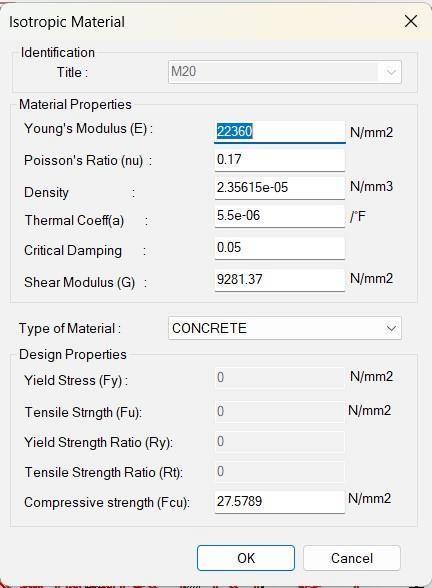
To begin, we will define the structural geometry of RCC buildings,includingdimensions,membersizes,andmaterial parameterssuchasmodulusofelasticityandPoisson'sratio thatappropriatelyreflectreal-worldsituations.Wewillthen use sophisticated structural analysis software like STAAD.Pro and RCDC to generate finite element models of thestructures,includingallnecessarycomponentsincluding beams,columns,slabs,andbraces.
p-ISSN:2395-0072
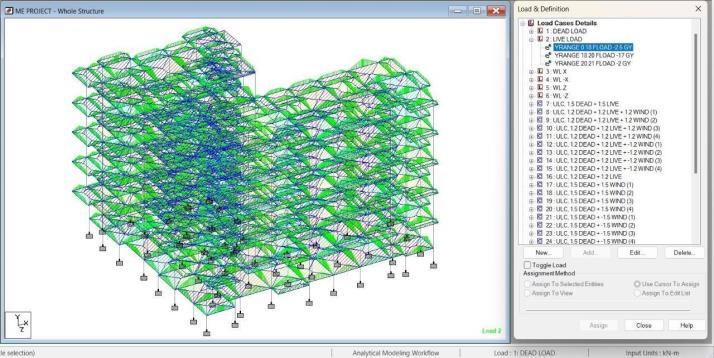
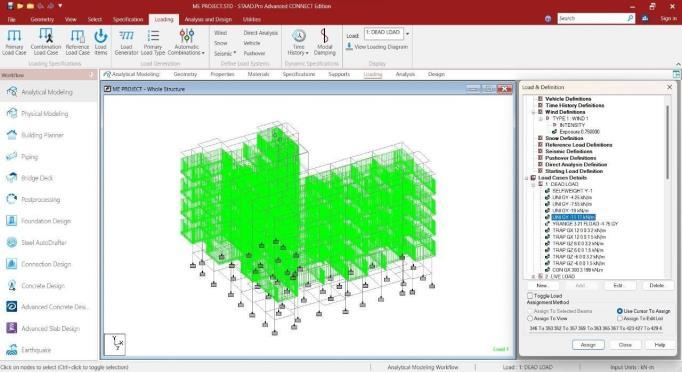
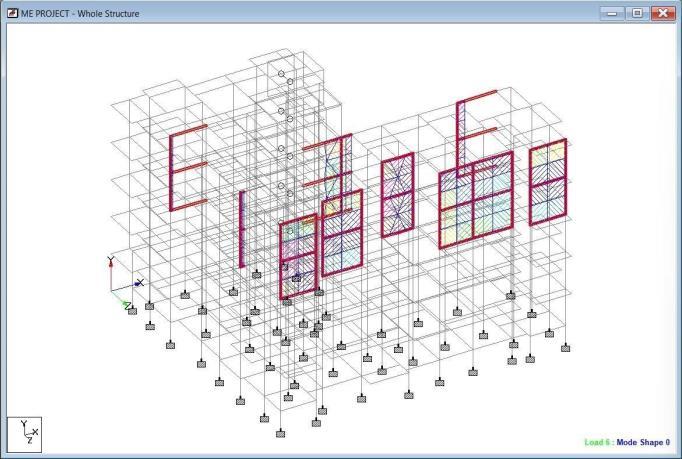
Once the models are established, we will apply loads in accordance with existing building norms and standards, includingdeadloads,liveloads,windloads,andseismic.
Furthermore, sensitivity analyses will be undertaken to determine the effect of changes in parameters such as material qualities and loading circumstances on the P-delta results, offering significant insights into the design's robustness.
International Research Journal of Engineering and Technology (IRJET) e-ISSN:2395-0056
Volume:11Issue:03|Mar2024 www.irjet.net p-ISSN:2395-0072
CaseStudies:
814
1
2
3
4
5
Finally, a complete final P-delta analysis will be performed toensurethatthe redesignedstructuremeetsthe necessary safety and performance criteria, validating the practical application of the implemented findings. Our goal with this rigorous methodology is to bridge the gap between theory and practice, promoting the development of safer and more resilientRCCstructuresforreal-worldapplications.
In the practical application phase, we focus on applying the methodologydevelopedinourP-deltaanalysistoreal-world structural design difficulties. Through case studies and examples, we demonstrate how our research leads to actionable ideas for improving structural stability and resilience.
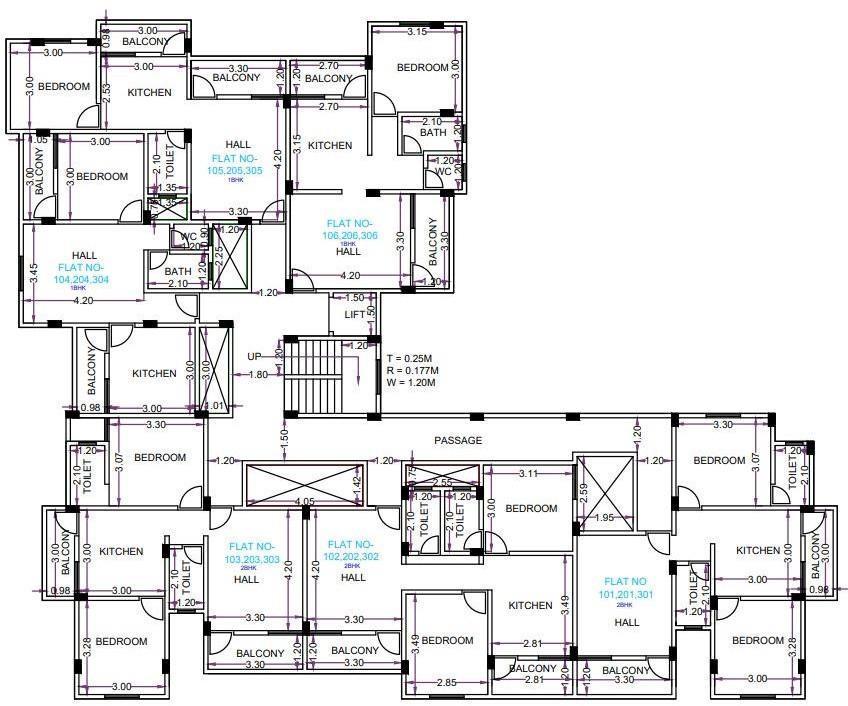
ResidentialBuildingPlan.
One example is applying our methods to the design of a residential structure with STAAD.Pro. We evaluate its performance under various scenarios by modeling and applying necessary loads in accordance with building codes, identifyingareasforimprovement.
Another possibility is modifying a commercial structure to increase its seismic resilience. We use STAAD.Pro to do iterative refinement and sensitivity assessments to assess the consequences of structural adjustments while assuring compliancewithsafetyregulations.
Real-worldDataandObservations:
Throughout the implementation phase, we gather empirical dataandobservationstovalidateourmethod.Fieldtestsand structural assessments provide actual proof that P-delta analysis improves structural performance. This data serves as a benchmark for evaluating our approach's accuracy and reliability.
Challengesandsolutions:
Real-world initiatives inevitably present problems. Discrepancies between theoretical predictions and actual structural behavior, combined with budget and resource limits, pose considerable challenges. To address these problems,wetakeasystematicapproach,constantlyrefining our analysis methodologies to provide best solutions. By overcomingthesechallenges,weensurethatourfindingsare successfullyusedinactualcontexts.
International Research Journal of Engineering and Technology (IRJET) e-ISSN:2395-0056
Volume:11Issue:03|Mar2024 www.irjet.net
The findings and analysis of our research into P-delta analysis in the design of tall buildings provide important insights into how these structures respond under various loadingscenarios.Ourmodelingandanalyticalefforts,which used advanced tools such as STAAD.Pro, resulted in several notable results. Initially, we observed a clear relationship between a building's height and the severity of the P-delta effect, emphasizing the importance of accounting for geometric nonlinearity in tall structures to avoid underestimating displacements and internal forces. In a comparison of P-delta and traditional stability analysis, we regularly observed larger displacements predicted by Pdelta, indicating its significant influence on structural deformations.Furthermore, our findings revealed that Pdelta impacts extend beyond gravity loads to include lateral forces such as wind and seismic loads, demanding a comprehensive design approach. Furthermore, through parametricinvestigations,wefoundX-bracingasa powerful techniqueformitigatingP-deltaeffects,withthepotentialto reduce them by up to 95%, hence improving structural stability. In essence, our findings underline the crucial functionofP-deltaanalysisincreatingdurabletallbuildings capableofsustainingdynamicloadingsituations.
In conclusion, the use of P-delta analysis becomes increasingly important, particularly in tall buildings where its influence grows with height. Our findings emphasize the needofprioritizing P-delta analysisabovestandardstability assessments in order to appropriately predict structural behavior. Our findings show that displacements in P-delta analysisareapproximately10%higherthanthoseinregular building analyses, stressing the importance of carefully considering geometric nonlinearity. It is worth emphasizing that P-delta effects are influenced not just by gravity loads, but also by lateral forces, demanding a thorough structural analysisapproach.IntegratingX-bracingintothestructureis a successful technique for mitigating P-delta effects, with reductions of up to 95% reported. By incorporating these insights into structural design approaches, we may improve building safety and resilience, guaranteeing that they can withstand the various stresses encountered in real-world scenarios.
1. DrRuaaAbdulateefAbdulhameed(Author)PDeltaEffectonTheDynamicSeismicResponseof HighRiseBuildingsPaperback–Import,22April 2019
p-ISSN:2395-0072
2. Amrul Kaish .A.B.M, Jamil.M,. Raman.S.N, Zain. M.F.M (2015) Axial behavior of ferrocement confined cylindrical concrete specimens with different sizes, Journal of Construction and BuildingMaterials
3. MallikarjunaB.N1,RanjithASTABILITYANALYSIS OF STEEL FRAME STRUCTURES: P-DELTA ANALYSIS(2014)
4. Kanchan Gupta, Md. Tasleem Performance of PDelta Analysis of Flat Slab and R C Framed Buildings(2020)
5. Prashant Dhadve “Assessment of P-Delta Effect on HighRiseBuildings”(2015)
6. Atul Rupanvar, Deokate K “Assessment of P-Delta EffectonHighRiseBuildings”(2016)
7. S.Sudheer, Analysis & design of g+5 residential buildingusingSTAADPro.
8. Mr. A. P. Patil, Mr. A. A. Choudhari, Mr. P. A. Mudhole,Mr.V.V.Patole,Ms.A.D.Dange.