
International Research Journal of Engineering and Technology (IRJET) e-ISSN: 2395-0056
Volume: 11 Issue: 03 | Mar 2024 www.irjet.net p-ISSN: 2395-0072
International Research Journal of Engineering and Technology (IRJET) e-ISSN: 2395-0056
Volume: 11 Issue: 03 | Mar 2024 www.irjet.net p-ISSN: 2395-0072
Amit Kumar Chaurasia1, Mr. Ushendra Kumar2
1Master of Technology, Civil Engineering, Lucknow Institute of Technology, Lucknow, India
2Head of Department, Department of Civil Engineering, Lucknow Institute of Technology, Lucknow, India
Abstract - Thepresenceofemergingcontaminantsinwater sources poses a significant challenge to public health and environmental sustainability. These contaminants, ranging from pharmaceuticals and personal care products to industrial chemicals, have raised concerns due to their persistence, potential toxicity, and adverse effects on ecosystems. Consequently, there is a growing demand for effective removal strategies to mitigate their impact. This review paper explores recent advancements in techniques aimed at enhancing the efficiency of emerging contaminant removalfrom water. Itprovidesacomprehensiveanalysisof varioustreatmentmethods,includingphysical,chemical,and biological approaches, highlighting their mechanisms, advantages, and limitations. Furthermore, emerging technologies such as advanced oxidation processes, nanotechnology-based treatments, and hybrid systems are critically evaluated for their potential to address the challenges associated with emerging contaminants. Additionally,thepaperdiscussestheimportanceofoptimizing operating conditions, considering factors such as pH, temperature, and reaction time, to maximize treatment efficiency. Furthermore, the review examines the role of emergingmaterialsandadsorbentsinenhancingcontaminant removal, emphasizing their adsorption capacity and regeneration potential. Moreover, the paper addresses challenges related to the scale-up and implementation of treatment technologies, emphasizing the need for costeffectivenessandsustainability.Overall,thisreviewprovides valuableinsightsintothecurrentstateoftheartinemerging contaminant removal from water and identifies promising avenues for future research and development in this critical field.
Key Words: Emerging contaminants, Water treatment, Removal efficiency, Advanced oxidation processes, Nanotechnology,Adsorption,Biologicaltreatment.
The endeavor to augment the efficacy of eliminating emerging contaminants from water has undergone a progressiveevolution,withitsinceptionrootedinthelatter portionofthe20thcentury.Asscientificinquiryelucidated theprevalenceofpharmaceuticals,personalcareproducts, andindustrialchemicalsinwatersources,itbecameevident that conventional water treatment methodologies were
inadequateinmitigatingtheseemergingcontaminants.The latterdecadesofthe20thcenturyandtheinitialyearsofthe 21st century bore witness to a surge in research and development endeavors, precipitating the emergence of advancedtreatmentmodalities.Notably,advancedoxidation processes (AOPs) and membrane filtration technologies assumedpivotalrolesinthistrajectory.AOPs,harnessingthe reactivityofhydroxylradicals,usheredinabreakthroughby efficaciously degrading a broad spectrum of organic pollutants.Concurrently,membranefiltrationtechnologies underwentsubstantialenhancements,affordingheightened removal efficiencies for contaminants. The integration of nanotechnology further augmented adsorption processes, yielding proficient nanomaterial-based adsorbents. The adoption of these technologies was propelled by both regulatory imperatives and the industry's dedication to safeguarding water integrity. Notwithstanding substantial strides, the journey persists, with ongoing research endeavors concentrating on optimization strategies, innovativetreatmentmethodologies,andtheamalgamation of diverse barriers to comprehensively tackle emerging contaminants in water. The concerted endeavors of scientists, engineers, and policymakers on a global scale underscore a steadfast commitment to preserving public healthandenvironmentalintegrityasthisjourneyunfolds.
Itiswidelyacknowledgedthatamongthearrayofemerging contaminants,antibioticsrepresentaparamountconcern,as their discharge into the environment can engender an elevated prevalence of antibiotic-resistant bacteria within ecologicalsystems.Nevertheless,otheremergingsubstances, particularly those of a polar nature such as acidic pharmaceuticals,acidicpesticides,andacidicmetabolitesof non-ionic surfactants, warrant significant attention. By virtue of their physico-chemical characteristics namely, highwatersolubilityandfrequentlylimiteddegradability thesecompoundspossessthecapacitytopermeatethrough natural filtration processes and engineered treatment systems, thus posing a potential hazard to the integrity of drinkingwatersupplies.
Various categories of emerging contaminants, notably surfactantbyproducts, pharmaceuticalsandpersonal care products(PPCPs),andpolarpesticides,havebeenobserved
International Research Journal of Engineering and Technology (IRJET) e-ISSN: 2395-0056
Volume: 11 Issue: 03 | Mar 2024 www.irjet.net p-ISSN: 2395-0072
to exhibit relatively modest elimination rates, with detections recorded in both wastewater treatment plant (WWTP) effluents and the adjacent surface waters. Nonetheless, comprehensive data pertaining to the occurrence,riskassessment,andecotoxicologicalimpactsof mostemergingcontaminantsremainscarce,renderingthe prognosis of their fate within aquatic ecosystems challenging. This scarcity can be attributed in part to the dearthofanalyticaltechniquescapableofdiscerningthese compoundsattraceconcentrations.Indeed,theanalysisof emerging contaminants presents a substantial analytical hurdle, owing not only to the diverse chemical properties exhibited by these substances but also to their typically minusculeconcentrations(typicallyintherealmofpartsper billion or parts per trillion) and the intricacies of the matricesinwhichtheyarefound.
Theanalysisofemergingcontaminantswithinwastewater necessitates a comprehensive approach encompassing severaldistinctphases.Initially,asystematicidentification andprioritizationofpotentialcontaminantsareundertaken basedontheirperceivedrisksandimplications.Following this, meticulous sampling and monitoring protocols are establishedtoprocurerepresentativewastewatersamples from diverse sources. Advanced analytical methodologies, includingLiquidChromatography-MassSpectrometry(LCMS)andGasChromatography-MassSpectrometry(GC-MS), are subsequently deployed to ascertain the presence and quantify the concentrations of these contaminants with precision and accuracy. The resultant data gleaned from theseanalysesaresubjectedtorigorousscrutinytoelucidate occurrence trends, potential sources, and temporal variations of the identified contaminants. Concurrently, comprehensiveriskassessmentsareconductedtoevaluate thepotentialhazardsposedbythesecontaminantstoboth humanhealthandthesurroundingenvironment.Intandem, varioustreatmentstrategiesareexploredandassessedfor their efficacy in attenuating the presence of emerging contaminantswithinwastewaterstreams.
Central to this endeavor is sustained collaboration with regulatorybodiesandagenciestoinformthedevelopmentof robust policy frameworks and regulatory measures. Furthermore,initiativesaimedatfosteringpublicawareness andengagementaredeemedindispensableforelucidating stakeholders about the critical importance of managing emergingcontaminantswithinwastewatersystems,thereby safeguardingtheintegrityofwaterresourcesandensuring thepreservationofpublichealth.
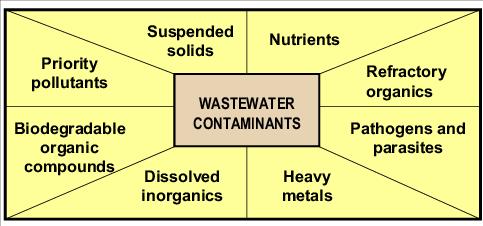
The composition of wastewater can vary significantly depending on its origin and the environmental context.
Amongthemyriadofsubstancesencounteredinwastewater, someprevalentcontaminantsinclude:
4.1.Pathogens
Thesearedisease-causingmicroorganismssuchasbacteria, viruses,andparasites.Theycanposeserioushealthrisksif wastewaterisnotproperlytreatedbeforedischarge.
4.2.Organic Matter
Wastewater comprises organic compounds, including proteins, carbohydrates, and fats originating from human waste, food waste, and various other sources. Inadequate treatmentofthesecompoundscaninduceoxygendepletion in aquatic environments, thereby precipitating adverse repercussionsonaquaticecosystemsandtheirinhabitants.
4.3.Nutrients
Wastewater often contains nutrients like nitrogen and phosphorus,whichareessentialforplantgrowth.However, excessive amounts of these nutrients can lead to eutrophication,causingalgalbloomsanddisruptingaquatic ecosystems.
4.4.Heavy Metals
Industrial wastewater may contain heavy metals such as lead,mercury,cadmium,andchromium,whicharetoxicto humansandaquaticlifeevenatlowconcentrations.These metalscanaccumulateintheenvironmentand poselongtermriskstoecosystemsandhumanhealth.
4.5.Chemical Pollutants
Various chemicals from industrial processes, household products,andagriculturalrunoffcanendupinwastewater. These include pesticides, pharmaceuticals, detergents, solvents, and other synthetic compounds, which can have harmfuleffectsonbothhumanhealthandtheenvironment.
4.6.Suspended Solids
Wastewaterfrequentlyencompassessuspendedsolidssuch as sediment, soil particles, and other forms of particulate matter. Without appropriate management, these constituents have the potential to obscure water clarity, impedethefunctionalityofwatertreatmentinfrastructure, anddetrimentallyaffectaquaticecosystemsbysmothering habitats.
4.7.Oil
Wastewaterfromindustrialactivitiesorurbanrunoffmay contain oils, greases, and other hydrocarbons. These can form surface slicks, coat aquatic organisms, and degrade waterqualityifreleaseduntreated.
International Research Journal of Engineering and Technology (IRJET) e-ISSN: 2395-0056
Volume: 11 Issue: 03 | Mar 2024 www.irjet.net p-ISSN: 2395-0072
Thereareseveralmethodsusedfortheremovalofemerging contaminantsfromwastewater,whichinclude:
5.1.Activated Carbon Adsorption
Activated carbon is highly effective in adsorbing a wide rangeoforganiccontaminantsfromwastewaterduetoits highsurfaceareaandadsorptivecapacity.
5.2.Advanced Oxidation Processes (AOPs)
AOPssuchasozonation,UV/H2O2,andphotocatalysis(e.g., using titanium dioxide) generate highly reactive hydroxyl radicals that can degrade organic contaminants into harmlessbyproducts.
5.3.Membrane Filtration
Techniques such as reverse osmosis (RO), nanofiltration (NF), and ultrafiltration (UF) can effectively remove contaminants by physical separation based on size and molecularweight.
5.4.Biological Treatment
Processeslikeactivatedsludge,biofiltration,andconstructed wetlands utilize microorganisms to degrade organic pollutantsthroughbiologicalactivity.
5.5.Chemical Precipitation
Additionofchemicalssuchascoagulants(e.g.,alum,ferric chloride)canfacilitatetheprecipitationofcontaminantsfor subsequentremoval.
5.6.Ion Exchange
Ionexchangeresinscanremovecontaminantsbyexchanging ionsinthewastewaterwithionsontheresinsurface.
5.7.Electrochemical Treatment
Techniques like electrocoagulation, electrooxidation, and electrochemicaladvancedoxidationprocesses(EAOPs)can effectively degrade contaminants by applying an electric current.
5.8.Hybrid Processes
Combining multiple treatment methods (e.g., membrane bioreactors, AOPs followed by membrane filtration) can enhance removal efficiency and treat a wider range of contaminants.
5.9.Phytoremediation
Usingplantstouptake,accumulate,ordegradecontaminants presentinwastewater.
5.10.Adsorbent Materials
Besidesactivatedcarbon,variousotheradsorbentmaterials suchasgrapheneoxide,metal-organicframeworks(MOFs), andbiochararebeinginvestigatedfortheireffectivenessin removingemergingcontaminants.
6.LITERATURE SURVEY
Inthissectionoftheliteraturereview,wehavestudiedthe previous(past)researchworkbasedontheremovalofthe contaminants in the waste water, and summary of the all previousresearchworkisgivenbelow:
Honglan et.al (2012): Although emerging contaminant compounds are typically present in waters at trace concentrations, their potential adverse effects on aquatic organisms, wildlife, and human health should not be underestimated,giventheircontinuousreleaseintowater systems. The assessment and removal of emerging contaminants and their transformation products present formidable challenges due to the intricate nature of contaminants within water samples. Nonetheless, considerable strides have been achieved in assessing numerousemergingcontaminants,owingtothededicated effortsofscientistsacrossvariousresearchdomains.Future trends in the assessment and removal of emerging water contaminants are expected to focus on the oxidation/degradation products and metabolites of emerging contaminants, as their comprehensive documentation remains incomplete. Leveraging advanced analytical techniques enables the identification and quantification of these contaminants, thereby enhancing understanding of their occurrence, formation, properties, andpathways.Thedevelopmentofviabletechniquesforthe removal ofthesecontaminants,encompassing precursors, degradates,anddisinfectionbyproducts(DBPs),ispoisedto emerge as a principal priority in the coming years. Establishing effective methodologies for their removal or
International Research Journal of Engineering and Technology (IRJET) e-ISSN: 2395-0056
Volume: 11 Issue: 03 | Mar 2024 www.irjet.net p-ISSN: 2395-0072
mitigation below regulated thresholds is imperative to safeguardwaterqualityandpublichealth.
Djamel , Noureddine (2019): Integratedsystems,suchas Membrane Bioreactors (MBR) coupled with Reverse Osmosis (RO), Nanofiltration (NF), or Ultrafiltration (UF), exhibit enhanced efficacy in the removal of Endocrine DisruptingCompounds(EDCs)andpharmaceuticals,albeit demonstrating lower performance in pesticide reduction. Ozonation combined with a biological activated carbon hybrid system has demonstrated efficiency in reducing pesticides, beta-blockers, and pharmaceuticals. Similarly, ozonationintegratedwithultrasoundsystemshasshownthe potential to eliminate up to 100% of certain pharmaceuticals, including salicylic acid, ibuprofen, naproxen,acetaminophen,cocaethylene,benzoylecgonine, enalapril, nor-benzoylecgonine, ketoprofen, atorvastatin, bezafibrate, clindamycin, sulfamethazine, and 4aminoantipyrine. Hybrid systems incorporating activated sludgecoupledwithUForactivatedsludgecombinedwith gamma radiation have demonstrated cost-effectiveness in eliminating various EDCs, pesticides, and analgesic pharmaceuticals.Combinedsetupsemployingultrafiltration and activated carbon, followed by ultrasound processing, presentapromisingtechnologyforaddressingawiderange of Emerging Contaminants (ECs); however, their costeffectivenessmayvary.
Bwapwa, Jaiyeola (2019): Thepresenceofcontaminantsin both drinking water and wastewater poses multifaceted riskstotheenvironment,spanningdevelopmental,growth, and reproductive impacts. Identifying the causal factors behind these effects is imperative. Implementing optimal strategiesisparamounttomitigatingadverseenvironmental consequences associated with contaminants in drinking water and wastewater. Thus, interventions aimed at elucidating contamination sources and addressing associated challenges are strongly advocated to uphold environmentalsafetyandsustainability.Thecurrentefficacy ofremovingtheaforementioned"emergingcontaminants" from wastewater and treating drinking water is not as satisfactoryasdesired.Enhancingtreatmentprocessesand ensuringstringentcontrolthereofarecrucialtomaximizing theeliminationofsuchmicropollutants.Utilizationofreadily availableabsorbentsforwastewatertreatmentcontaining pollutants is commonplace. However, achieving optimal pollutant removal depends largely on selecting the most suitableadsorbents,whichposesaprimarychallenge.The effectiveness of treatment hinges on various factors, including not only the adsorbent and adsorbate characteristics but also environmental conditions and several operational variables pertinent to the adsorption process. Examples of such variables encompass pH, ionic strength, temperature, presence of competing organic or inorganicspeciesinthesolution,prioradsorbateexposure, adsorbent concentration, contact time, agitation rate, and particlesizedistribution.
Riya, Kanmani (2020): Certain Emerging Contaminants (ECs) have been consistently identified as prevalent and widespread. Among them are carbamazepine, sulfamethoxazole, caffeine, triclosan, triclocarban, perchlorate, sucralose, and organochlorine pesticides. Elevated levels of antibiotics, Active Pharmaceutical Ingredients (API), and Antibiotic Resistance Genes (ARG) have been detected in regions proximate to major pharmaceuticalmanufacturingcenterssuchasHyderabad. NumerousstudieshavedocumentedthepresenceofECsin various water sources, including surface water, groundwater, drinking water, as well as in treated wastewater from Sewage Treatment Plants (STP) and Common Effluent Treatment Plants (CETP). Endocrine Disrupting Compounds (EDCs), such as plasticizers, Polychlorinated Biphenyls (PCBs), and steroid hormones, have also been identified in water samples, with Di(2ethylhexyl) phthalate (DEHP) emerging as a commonly observed phthalate compound. ECs have the potential to induce harmful effects on aquatic and terrestrial wildlife, vegetation, and human populations, persisting in the environment, bioaccumulating, and exerting toxicological impacts. Biological treatment and adsorption techniques have demonstrated limited efficacy in removing ECs, prompting exploration of advanced oxidation processes utilizingvisiblelight-drivenphotocatalyticozonation,which hasshownhigheffectivenessinremovingmostECs,withthe exceptionofPerfluorinatedCompounds(PFCs),whichare moreefficientlyremovedthroughelectrochemicalmethods. Consequently, the review underscores the importance of integratingAdvancedOxidationProcesses(AOPs)intoSTPs, CETPs,andWaterTreatmentPlants(WTPs)toenhancethe removalofECsfromwatersources.
Lopez et.al (2021): A comprehensive investigation was conductedtoassesstheimpactofaWastewaterTreatment Plant (WWTP) on the Manzanares River in Madrid, Spain. Thestudyfocusedon40PharmaceuticalandPersonalCare Products (PhACs) and 7 pesticides listed in the EU Watch List(2018).Thefindingsrevealedanotableenhancementin WWTPremovalefficiencyfollowingtheimplementationof tertiary advanced treatment measures, which included microfiltration using textile mesh, advanced oxidation treatmentemployingozonegenerators,andultraviolet(UV) disinfection. The influence of wastewater effluents on the Manzanares River was discernible through elevated concentrationsofpharmaceuticalsandpesticides,aswellas anincreasednumberofdetectedcompoundsdownstreamof the WWTP discharge point. Specifically, only two pharmaceuticals(gabapentinandiopromide)exceeded500 ng/L,whilesixothers(clarithromycin,irbesartan,salicylic acid, tramadol, valsartan, and venlafaxine) surpassed the threshold of 100 ng/L. Regarding pesticides, only imidacloprid and acetamiprid were detected in samples collecteddownstreamofthedischarge.
International Research Journal of Engineering and Technology (IRJET) e-ISSN: 2395-0056
Volume: 11 Issue: 03 | Mar 2024 www.irjet.net p-ISSN: 2395-0072
Nadia et.al (2021): Research in the field of biological technologies aimed at the degradation of emerging contaminantsandmitigationoftheirenvironmentalimpact is currently experiencing significant development, with substantial advancements anticipated in the future. Biological approaches encompass a variety of techniques, including constructed wetlands, biomembrane reactors, strategies utilizing algae, fungi, and bacteria, as well as enzymaticdegradation.Whilemembranefiltrationisalready utilizedasatertiarytreatmentmethodcapableofeffectively removing a broad spectrum of pollutants and pathogens fromwater,itswidespreadadoptionishinderedbyitshigh cost and issues related to membrane clogging. Advanced oxidation processes stand out as particularly promising strategies due to their efficiency and simplicity, with the potentialforintegrationintowastewatertreatmentplantsat various stages (primary, secondary, and tertiary). Despite the anticipated progress in this area, considerations pertaining to investment, operational requirements, and maintenance costs remain pivotal. Convincing industrial stakeholders to incorporate these technologies into municipalwastewatertreatmentfacilitieswillbeessential movingforward.
Lichtfouse et.al (2022): Materials such as cyclodextrin polymers,metal-organicframeworks,molecularlyimprinted polymers, chitosan-based materials, and nanocelluloses exhibitsignificantpotentialinenvironmentalapplications; however,theyarecurrentlyinthelaboratorystudyphase. Furtherresearchisimperativetoelucidatethemethodsfor integratingtheseadsorbentsintofull-scaletreatmentplants. Amongthevariousdisinfectionmethods,chlorinationand ozonation demonstrate promising results in terms of effectively removing both pathogens and emerging contaminants. Nevertheless, additional investigations are necessary to assess the potential toxic characteristics of disinfection by-products in comparison to their parent compounds,aswell asto discern the potential synergistic adverse effects of by-product mixtures even at trace concentrations.
Anupama et.al (2022): Relyingsolelyonasingletreatment advancement may not be the optimal approach for effectivelyremovingEmergingContaminantsfromwater.It isessentialtoexploretheuseofcoupledsystemsthatcan addressthelimitationsinherentinindividualinnovationsfor removing these complex contaminants from the aquatic environment. Scaling-up studies focusing on natural processes often lack identification of the microorganisms responsibleforremovingEmergingContaminants,instead onlyindicatingtheirutilizationasactivatedsludgecapable of eliminating contaminants. Furthermore, while such processes have demonstrated efficiency in treatment, scaling-up studies often do not include exploratory development or detailed characterization of the various processesinvestigated.
Ishfaq et.al (2022): Thereremainsasignificantdearthof understanding regarding the fate of Emerging Pollutants (EPs)throughoutwastewatertreatmentprocessesandtheir subsequentimpactwithinecosystems.Concernshavebeen raisedregardingtheaccuratedetectionofEPsbytreatment facilities, attributed to limitations inherent in commonly utilizedsamplingtechniques.Therefore,there-evaluationof the removal efficiency of different treatment processes under various operational conditions, facilitated by improvedsamplingmethodologies,isimperative.Suchreevaluation will inform the implementation of appropriate measures to address EP proliferation. The ongoing trend towardstheadoptionofstrategiesaimedatreducingenergy consumption in wastewater management is expected to fostertheutilizationofinnovativetreatmentmethodologies. Algae ponds, for instance, present a promising avenue for secondary effluent treatment, offering the potential for indirect energy generation through biogas processing. However, there is a paucity of reports documenting the successofalgaepondsinEPelimination,underscoringthe needforfurtherresearchinthisdomain.
To elucidate the fate and elimination of EPs throughout treatment processes, comprehensive studies of such processingstepsarenecessary,consideringtheirpractical application in traditional treatment protocols. A holistic approach must also extend to environmental monitoring, encompassing the assessment of EP destiny and impact acrossterrestrialenvironmentsthroughouttheirentirelife cycle.ThisinvolvesquantifyingEPpresenceinbiosolidsand amendedsoils,alongsideconductingresearchtounderstand theirbehavior.Comprehensiveinvestigationsoftransformed soils under environmental conditions are essential to analyze phenomena such as leaching, drainage, effects on surfacewaterquality,soildegradation,toxicitytoterrestrial species,andpotentialabsorptionbyplants,thusintegrating intothefoodweb.Similarmethodologiesmaybeemployed for tracking EPs in other polluted environmental compartments,suchasriversediments.Theintegrateduse ofbiochemicalassessmenttoolswillenableamorethorough evaluationoftheenvironmentalrisksposedbyEPs,thereby facilitatingthedevelopmentofdetailedenvironmentalrisk assessments.
Cristina et.al(2023): The challenge associated with this material lies in reducing its costs, exploring alternative materials for its production, employing environmentally friendlier substances for activation/regeneration, and maintaining its adsorption efficiency post-regeneration. Nanomaterials also show promise as an alternative for removingEmergingContaminants(ECs);however,scaling up production and improving their separation from the aqueousmediumarenecessary.Industrialwasteandagroindustrialresidues,suchasricehusks,coconutfibers,corn cobs, peanut shells, sugarcane bagasse, and fruit shells/seeds, present promising alternatives to replace activatedcarbon.Thesematerialsofferlowtozerocost,high
International Research Journal of Engineering and Technology (IRJET) e-ISSN: 2395-0056
Volume: 11 Issue: 03 | Mar 2024 www.irjet.net p-ISSN: 2395-0072
availability,andrelativelyhighadsorptioncapacities(upto 300mg/g).Furthermore,utilizingagro-industrialwastefor thispurposenotonlyaddresseswastemanagementissues butalsoalignswiththeprinciplesof thecirculareconomy andsustainabledevelopmentgoals.Additionally,duetothe lowtoxicityofagro-industrialresidues,theycanbeutilized aloneorincombinationinbiofiltrationtechnologies.
Xiaohu et.al (2023): With the continual advancement in research and practical implementation, treatment technologiesforemergingcontaminantshaveprogressively evolvedandmatured.Carbon-basedadsorptiontechnology, membrane separation technology, advanced oxidation methods, and constructed wetlands have demonstrated efficacy in removing emerging contaminants from water; however, they also exhibit inherent limitations and application constraints. Among these approaches, photocatalytictechnologystandsoutasapromisingsolution duetoitshighefficiencyandminimalsecondarypollution. Immobilization plays a crucial role in the application of photocatalytictechnology.Variousimmobilizationmethods have been explored through experiments and practical applications.Nonetheless,tofurtherenhancetheapplication of photocatalytic technology, there is an urgent need for more extensive research on existing immobilization methods. Specifically, it is recommended to conduct comprehensive small-scale and pilot-scale experimental studies and application research on real water bodies to advancethefield.
Inconclusion,thecomprehensivereviewpresentedherein underscoresthepressingneedforenhancedmethodologies to address the removal of emerging contaminants from watersources.Throughameticulousexaminationofexisting literature, it becomes evident that while various technologies exhibit promising capabilities, there remains significant room for advancement to achieve optimal efficiencyandefficacy.Themultifacetednatureofemerging contaminants necessitates a multidisciplinary approach, integrating advancements in materials science, chemistry, engineering,andenvironmentalscience.Furthermore,the identification of novel treatment strategies and the refinement of existing techniques underscore the importanceofongoingresearchandinnovationinthisfield. Collaborative efforts between academia, industry, and governmental agencies are imperative to catalyze the translationofresearchfindingsintopracticalsolutionsfor watertreatmentinfrastructureworldwide.Ultimately,the pursuitofincreased efficiencyintheremoval ofemerging contaminants from water is integral not only for safeguardingpublichealthandenvironmentalintegritybut alsoforfosteringsustainablewatermanagementpractices forgenerationstocome.
1. Honglan Shi1, Xiaoliang Cheng2 , Qihua Wu1 , Ruipu Mu1 and Yinfa Ma1 * “Assessment and Removal of Emerging Water Contaminants” 2012, Journal of Environmental & Analytical Toxicology, Shi et al., J Environ Anal Toxicol 2012, S:2 DOI: 10.4172/21610525.S2-003.
2. Djamel Ghernaout1,2*, Noureddine Elboughdiri1,3 “WaterReuse:EmergingContaminantsElimination Progress and Trends” 2019, DOI: 10.4236/oalib.1105981 Dec. 27, 2019, Open Access LibraryJournal.
3. JKBwapwaandATJaiyeola“EmergingContaminants in Drinking Water and Wastewater, Effects on Environment and Remediation” 2019, International Journal of Applied Engineering Research ISSN 09734562 Volume 14, Number 2 (2019) pp. 539-546 © Research India Publications. http://www.ripublication.com.
4. B.SenthilRathi1,P.SenthilKumar2,3*andPau-Loke SHOW4“EffectiveRemovalofEmergingContaminants from Aquatic Systems: Current Trends and Scope for Further Research ” 2020, Journal of Hazardous Materials, https://doi.org/10.1016/j.jhazmat.2020.124413.
5. Riya Ann Mathew*† and S. Kanmani** “Emerging Contaminants in Indian Waters and Their Treatment Technologies ” 2020, Nature Environment and Pollution Technology An International Quarterly ScientificJournal,pp.549-562.
6. F.J. Lopez a,1 , E. Pitarch a,1 , A.M. Botero-Coy a , D. Fabregat-Safonta,M.Ibáñeza,J.M.MarinaN.Ontañón b,S.Martínez-Morcilloc,d,A.Olallac,d,Y.Valcárcelc,d ,I.Varóe,f,F.Hernándeza,⁎ “Removalefficiencyfor emerging contaminants in a WWTP from Madrid (Spain) after secondary and tertiary treatment and environmentalimpactontheManzanaresRiver”2021, ScienceoftheTotalEnvironment812(2022)152567.
7. NadiaMorin-Crini,EricLichtfouse,Marc Fourmentin, Ana Rita Lado Ribeiro, Constantinos Noutsopoulos, Francesca Mapelli, Éva Fenyvesi, Melissa Gurgel Adeodato Vieira, Lorenzo “Remediation of emerging contaminants” 2021, N. Morin-Crini et al. (eds.), In: Emerging Contaminants Vol. 2, Environmental Chemistry for a Sustainable World 66, pp. 1-106. https://doi.org/10.1007/978-3-030-69090-8_1
8. Nadia Morin-Crini1 · Eric Lichtfouse2 · Marc Fourmentin3 ·AnaRitaLadoRibeiro4 ·Constantinos Noutsopoulos5 ·FrancescaMapelli6 ·ÉvaFenyvesi7 · Melissa Gurgel Adeodato Vieira8 · Lorenzo A.
International Research Journal of Engineering and Technology (IRJET) e-ISSN: 2395-0056
Volume: 11 Issue: 03 | Mar 2024 www.irjet.net p-ISSN: 2395-0072
Picos-Corrales9 · Juan Carlos Moreno-Piraján10 · Liliana Giraldo11 · Tamás Sohajda7 · Mohammad Mahmudul Huq12 · Jafar Soltan12 · Giangiacomo Torri13 · Monica Magureanu14 · Corina Bradu15 · GrégorioCrini1 “Removal ofemergingcontaminants from wastewater using advancedtreatments. ”2022, Environmental Chemistry Letters https://doi.org/10.1007/s10311-021-01379-5
9. BeautyR1AndAnupamaS2*“EmergingContaminants In Water And Their Removal Technologies” 2022, IJBPAS,February,2022,11(2):448-458.
10. Scenario Ishfaq Showket Mir 1, * , Monaza Rashid 2 , Javeed Ahmad Khan 3 and Bisma Dar 4 “Emerging Pollutants- A review of current understanding and future”2022, WorldJournalofAdvancedResearchand Reviews,2022,16(02),074–088.
11. CristinaE.Almeida-Naranjo1,2,VíctorH.Guerrero3,* andCristinaAlejandraVillamar-Ayala4,5,* “Emerging ContaminantsandTheirRemovalfromAqueousMedia UsingConventional/Non-ConventionalAdsorbents:A Glance at the Relationship between Materials, Processes, and Technologies” 2023, Water 2023, 15, 1626. https://doi.org/10.3390/w15081626 https://www.mdpi.com/journal/water.
12. XiaohuLin1,2,3,HaifengFang1,3,ShiyiLi1,3,Shengjie Fu1,3,BaohuaZhang1,WenmingZhou1,3*,Jingcheng Xu2*, Juwen Huang2 “Research progress and application exploration of techniques to remove emerging contaminants from water environment ” 2023, E3S Web of Conferences 393, 01017 (2023) https://doi.org/10.1051/e3sconf/202339301017 EPPCT2023
2024, IRJET | Impact Factor value: 8.226 |