
International Research Journal of Engineering and Technology (IRJET) e-ISSN: 2395-0056
Volume: 11 Issue: 03 | Mar 2024 www.irjet.net p-ISSN: 2395-0072
International Research Journal of Engineering and Technology (IRJET) e-ISSN: 2395-0056
Volume: 11 Issue: 03 | Mar 2024 www.irjet.net p-ISSN: 2395-0072
V.MOUNICA1 , M.SAMUEL FINNY2 , V.LEELA PAVAN KALYAN3 ,P.RATNA SAI TEJA4 , K.MANOHAR5
1 Assistant professor MTech(Ph.D.) , Dept of Artificial Intelligence and Data Science and Engineering, Vasireddy Venkatadri Institute of Technology, Nambur, Andhra Pradesh, India 2-5 UG Students, Dept of Artificial Intelligence and Data Science and Engineering, Vasireddy Venkatadri Institute of Technology, Nambur, Andhra Pradesh, India
Abstract - Object identification holds significant importance in digital forensics for validating media integrity and expediting criminal inquiries. This study introduces an innovative method employing YOLOv8, an advanced object detection model, to automate the identification of diverse items such as firearms, blades, bloodstains, and authentic and forged facial images within digital content. Through the utilization of machine learning techniques, specifically Convolutional Neural Networks (CNNs),theproposedmodelaimstostreamlinemanualdata processing in digital forensics, thus reducing investigation time. Furthermore, this initiative not only hastens the investigative process but also aids in crime prevention by bolstering security in prominent venues through ClosedCircuit Television (CCTV) surveillance. The manuscript deliberatesonthechallengesassociatedwithmanualdigital data processing, evaluates existing literature on machine learning for crime detection and object recognition, and delineates a systematic approach for implementing the proposed model. Additionally, it provides an overview of fundamental algorithms, such as CNNs, YOLOv8, supervised learning, elucidating their roles, importance, and potential utilities. This project showcases a promising avenue for intelligent digital data processing in criminal investigations and suggests future avenues for refining security protocols andconfrontingemergingchallenges.
Key Words: Digital forensics, CNN, Fake faces, Real faces,YOLOv8.
Digital forensics plays a crucial role in contemporary law enforcement, serving to authenticate media, probe criminal activities, and safeguard digital evidence. However, the manual handling of extensive digital datasets presents formidable obstacles, often leading to prolongedandlaboriousinvestigations.Withtheevolution of machine learning methodologies, there exists an opportunity to streamline this procedure by automating object recognition in digital content. This manuscript introduces a project dedicated to harnessing YOLOv8, an advanced object detection model, alongside machine learning algorithms to expedite investigative processes in digital forensics. Through the precise identification of items such as firearms, blades, bloodstains, and facial
characteristics,theproposedmodelendeavorstooptimize theefficacyofcrimeinvestigationswhilealsocontributing to crime deterrence via proactive surveillance measures. The document offers an overview of pertinent literature, addresses the challenges inherent in manual data processing, and delineates the sequential methodology andessentialalgorithmsintegraltothedeploymentofthe proposedmodel.
Challengesinmanuallyprocessingdigitaldataforcrime investigationaremanifoldandcansignificantlyimpedethe investigativeprocess.Firstly,themanualhandlingofdigital data is inherently time-consuming and labor-intensive. Investigators often need to sift through vast amounts of data, such as images, videos, and documents, which can consumeconsiderabletimeandresources.
Moreover, manual processing suffers from limited scalability and efficiency. As the volume of digital data continuestogrowexponentially,manualmethodsstruggle to keep pace,leading to bottlenecks ininvestigations. This limitation hampers the timely analysis of evidence, potentially delaying crucial breakthroughs in criminal cases.
Additionally, manual processing is susceptible to human error and bias. Investigators may inadvertently overlook important details or misinterpret evidence, leading to flawedconclusions. Furthermore, human biases caninfluencedecision-makingduringtheanalysisprocess, potentially compromising the integrity and objectivity of theinvestigation.
Addressing these challenges requires the adoption of automated toolsandtechniques,suchas machinelearning algorithms and object detection models. These technologies offer the potential to streamline data processing,enhancescalabilityandefficiency,andmitigate the risk of human error and bias. By automating object identification and analysis, investigators can expedite the investigative process, improve theaccuracyof results,and ultimately facilitate moreeffectivecrimeinvestigationand resolution.
International Research Journal of Engineering and Technology (IRJET) e-ISSN: 2395-0056
Volume: 11 Issue: 03 | Mar 2024 www.irjet.net p-ISSN: 2395-0072
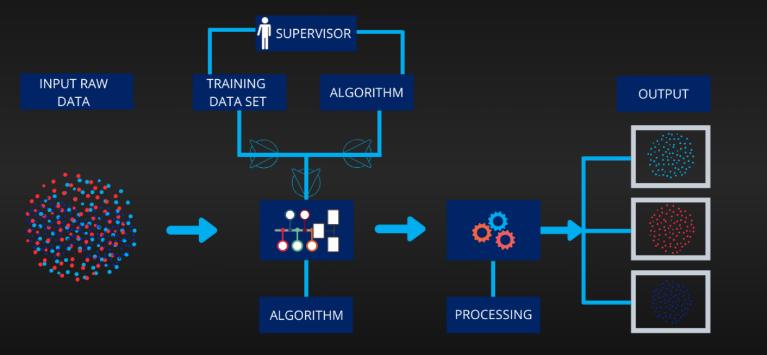
Machine learning techniques present promising avenues for automating and accelerating crime investigationprocedures.
1.2.1
Machine learning algorithms, particularly those based on deep learning architectures like Convolutional Neural Networks (CNNs), excel in object detection and recognition tasks. By training models on labeled datasets, these algorithms can accurately identify and classify objectsofinterestwithindigitalcontent,suchasweapons, vehicles,orpersonsofinterest.Objectdetectionfacilitates the rapid extraction of relevant information from vast amounts of data, aiding investigators in identifying potentialevidenceandnarrowingdowntheirfocusduring investigations.
Machine learning algorithms are proficient in recognizing patterns and identifying anomalies within datasets. In the context of crime investigation, these techniques can be used to identify suspicious activities or behaviors that deviate from established norms. By analyzing historical data, machine learning models can learn to distinguish between normal and abnormal patterns, thereby flagging potentially fraudulent or criminal activities for further investigation. This capability is particularly valuable in detecting fraud, cybercrime, or other illicit activities that maynotbeimmediatelyapparenttohumaninvestigators.
Machine learning enables the development of predictive models for assessing and mitigating risks associated with criminal activities. By analyzing historical crime data, socioeconomic factors, and other relevant variables, machine learning algorithms can forecast future crime trends,identifyhigh-riskareas, and allocate resources effectively to prevent or respond to criminal incidents. Predictivemodelingcaninformlawenforcementagencies' strategic planning and resource allocation decisions,
enablingproactivemeasurestocombatcrimeandenhance publicsafety.
Incorporating machine learning techniques into crime investigation processes holds the potential to revolutionize law enforcement practices, enabling more efficient, data-driven approaches to combating crime and enhancing public safety. By automating routine tasks, identifyingpatterns,andpredictingfuturetrends,machine learning empowers investigators to focus their efforts more effectively, ultimately leading to more timely and effectivecrimepreventionandresolution.
Smart digital data processing in crime investigation is facilitated by harnessing the capabilities of machine learning models like YOLOv8 and CNN. These models empowerautomatedobjectidentificationandrecognition, allowing investigators to swiftly identify crucial elements such as weapons, bloodstains, or suspect faces within digital content. Furthermore, the integration of these models facilitates real-time analysis and decision-making, enabling law enforcement agencies to respond promptly to emerging threats or incidents. By leveraging machine learning, investigations benefit from enhanced accuracy and efficiency, minimizing manual processing time and enabling more focused allocationofresources.Ultimately, these advancements in smart digital data processing hold immense promise for expediting crime investigation processesandbolsteringpublicsafetyefforts.
In the realm of machine learning for crime investigation, persistent challenges must be addressed to maximize the potential of these technologies. These challenges include safeguarding data privacy and security, navigating ethical considerations and biases inherent in algorithmic decision-making, and staying abreast of evolving threats andtechnologicaladvancements.
Lookingforward,futureresearchanddevelopmentefforts shouldprioritizeseveralkeyareas.Firstly,thereisaneed to integrate multi-modal data sources, such as text, images, and sensor data, to enable more comprehensive and nuanced analysis of criminal activities. Additionally, efforts should focus on developing machine learning models that are not only robust and accurate but also interpretable, allowing investigators to understand and trust the reasoning behind algorithmic decisions. Furthermore, collaboration with legal and regulatory stakeholders is essential to ensure the responsible deployment and use of AI technologies in crime investigation. This involves establishing frameworks for
International Research
Volume: 11 Issue: 03 | Mar 2024 www.irjet.net p-ISSN: 2395-0072
ethical AI development, ensuring transparency and accountabilityinalgorithmicdecision-making,and protecting individuals' rights and freedoms in the context ofdata-driveninvestigations.
By addressing these challenges and pursuing future researchdirections,thefieldofmachinelearningforcrime investigation can continue to evolve and advance, ultimately contributing to more effective and equitable approaches to combating crime and ensuring public safety.
3. Key Algorithms used
3.1 CNNs:
Purpose: Convolutional Neural Networks (CNNs) serve the purpose of handling image processing tasks, prominently focusing on object detection andrecognitionwithinimages.
Overview: CNNs are composed of numerous layers of convolutional and pooling operations, followed by fully connected layers dedicated to classificationtasks.
Significance: CNNs have significantly transformed computer vision applications, becoming indispensable in tasks such as object detection, image classification, and image segmentation.
3.2 YOLOv8(You Only Look Once):
Purpose: YOLOv8 (You Only Look Once version 8) is devised as an advanced object detection model, particularly lauded for its real-time performanceandremarkableaccuracy.
Overview: YOLOv8 implements a single neural network to process the entire image, partitioning it into grids to predict bounding boxes and class probabilitiesdirectly.
Significance: YOLOv8standsoutforitsefficiency and efficacy in object detection across diverse domains, prominently including crime investigationandsurveillanceapplications.
4. Steps involved for creating efficient model:
Step-1
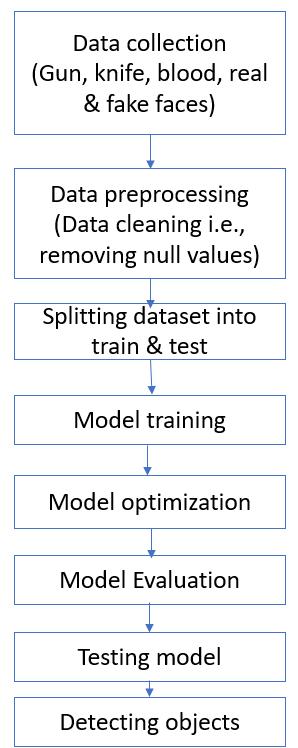
Data Collection: Procuredigital data,comprising images and videos, from diverse sources like OpenCV and Kaggle, encompassing pertinent objectsforcrimeinvestigation.
Step-2
Data Preprocessing: Prepare the amassed data by standardizing dimensions, normalizing pixel values, and applying augmentation techniques to enhancemodelrobustnessandgeneralization.
International Research Journal of Engineering and Technology (IRJET) e-ISSN: 2395-0056
Volume: 11 Issue: 03 | Mar 2024 www.irjet.net p-ISSN: 2395-0072
Step-2
Data Preprocessing: Prepare the amassed data by standardizing dimensions, normalizing pixel values, and applying augmentation techniques to enhancemodelrobustnessandgeneralization.
Step-3
Train/Test Splitting: Partition the preprocessed data into distinct subsets for training and testing, facilitating model training on labeled samples whileevaluatingperformanceonunseendata.
Step-4
Model Training: Employ the YOLOv8 model to undergo training using the designated training dataset, enabling it to learn to discern a range of objects crucial for investigation, such as firearms, blades,bloodstains,andfacialattributes.
Step-5
Model Optimization: Refine the trained model through parameter fine-tuning, architectural adjustments, and regularization methods to heightenefficacyandaccuracy.
Step-6
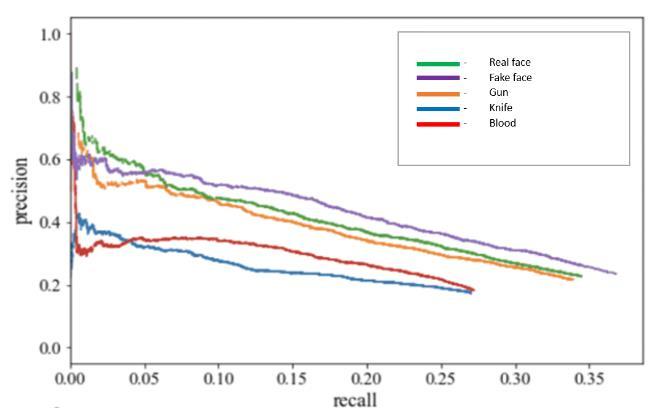
Model Evaluation: Assessthetrainedmodel's performanceonthetestingdataset,employing metricslikeprecision,recall,andmeanaverage precision(mAP)togaugeitsprecisionand effectiveness.
Step-7
Testing: Implement the trained model for inference on novel data, utilizing it to detect objects of interest in digital content like crime sceneimagesorsurveillancefootage.
Step-8
Object Detection: Leverage the trained model's capabilities to pinpoint and localize various objects, including weapons, evidence of violence like bloodstains, and facial features, thereby facilitating crime investigation and prevention endeavors.

In conclusion, this paper has outlined a comprehensive overview of our proposed project, emphasizing its objectives, methodology, and potential impact on crime with the help of latest technology YOLOv8, our project endeavors to streamline digital forensic processes, thereby expediting investigations and bolstering crime preventionefforts.Byautomatingobjectidentificationand recognition tasks, we aim to minimize manual data processing burdens while enhancing the accuracy and efficiencyofforensicanalyses.
Looking ahead, the implications of our project extend far beyond its immediate application. By laying the groundworkforintelligentdigitaldataprocessingincrime investigation,wepavethewayforfutureadvancementsin forensicscienceandlawenforcement.Theinsightsgained from our research and development efforts have the potential to inform the development of innovative solutions and strategies for addressing emerging challenges in the ever-evolving landscape of criminal activity.
In essence, our project represents a pivotal step towards the realization of a smarter, more effective approach to crime investigation and prevention. By embracing the transformativecapabilitiesofmachinelearningandobject detection technologies, we stand poised to make significant strides in safeguarding communities and upholdingtheprinciplesofjusticeinthedigitalage
[1] Vaidehi, K., Subashini, T.: Automatic classification and retrieval of mammographic tissue density using texture features. In: 2015 IEEE 9th International ConferenceonIntelligentSystemsandControl (ISCO), pp.1–6.IEEE(2015)
[2] Nosato,H.,Sakanashi,H.,Takahashi,E.,Murakawa,M.: Method of retrieving multi-scale objects from optical colonoscopy images based on image-recognition
International Research Journal of Engineering and Technology (IRJET) e-ISSN: 2395-0056
Volume: 11 Issue: 03 | Mar 2024 www.irjet.net p-ISSN: 2395-0072
techniques. In: 2015 IEEE Biomedical Circuits and SystemsConference(BioCAS),pp.1–4.IEEE(2015)
[3] Li,J.,Ye,D.H.,Chung,T.,Kolsch,M.,Wachs,J.,Bouman, C.: Multi-target detection and tracking from a single camera in unmanned aerial vehicles (UAVs). In: 2016 IEEE/RSJ International Conference on Intelligent Robots and Systems (IROS), pp. 4992–4997. IEEE (2016)
[4] Rao, R.S., Ali, S.T.: A computer vision technique to detect phishing attacks. In: 2015 Fifth International Conference on Communication Systems and Network Technologies(CSNT),pp.596–601.IEEE(2015)
[5] Herrmann,C., Beyerer,J.:Faceretrievalonlarge-scale video data. In: 2015 12th Conference on Computer andRobotVision(CRV),pp.192–199.IEEE(2015)
2024, IRJET | Impact Factor value: 8.226 | ISO 9001:2008