
International Research Journal of Engineering and Technology (IRJET) e-ISSN: 2395-0056
Volume: 11 Issue: 03 | Mar 2024 www.irjet.net p-ISSN: 2395-0072
International Research Journal of Engineering and Technology (IRJET) e-ISSN: 2395-0056
Volume: 11 Issue: 03 | Mar 2024 www.irjet.net p-ISSN: 2395-0072
R. D Wangde1 , Arbaj Shaikh2 , Rohan Nachare3 , Udayan More4 , Omkar Phadatare5 , Pravin Jalak6
Dept. of Civil Engineering, Dnyanshree Institute of Engineering and Technology, Maharashtra, India
Abstract - This has been undertaken to investigate the effects of wind load on the RC structure. The proliferation of wind energy has led to an increased deployment of windmill, including the construction of wind farms in various regions. These windmills generate substantial loads on surrounding structures, particularly on reinforced concrete (RC) buildings and infrastructure. Understanding the effect and behavior of RC structures under windmill loads is paramount for ensuring their structural integrity, safety, and longevity.
Key Words: Wind Load, RC structure, Structure Integrity, SFD, BMD, Load distribution.
1.INTRODUCTION
In recent years, wind energy has emerged as a vital componentoftheglobalrenewableenergylandscape,with wind turbines serving as iconic symbols of sustainable power generation. As the demand for clean energy continuestogrow,sodoestheinstallationofwindturbines, both onshore and offshore. However, the proliferation of these structures also brings forth significant challenges, particularly in understanding their interaction with the builtenvironment.
Theimpactofwindmillloadsonreinforcedconcrete(RC) structures, which form the backbone of modern infrastructure worldwide. While substantial research has beendevotedtoanalyzingthebehaviorofbuildingsunder conventional wind loads, the unique characteristics of
2. Need of the study.
Understanding how windmill loads affect RC structures is crucialforensuringtheirsafetyandthesafetyofoccupants. Engineers can optimize designs to withstand these loads efficiently, potentially leading to cost-effective solutions. Additionally, this understanding helps minimize the environmental impact of windmills by addressing issues likevibrations,noise,andstructuraldamage.
Windmill Loads: A Forceful Breakdown
Thrust - The Powerhouse Force: Imagine a giant hand pushing the windmill blades constantly downwind. That push is the thrust force, and it's the driving force behind electricity generation. This force acts parallel to the windmill's shaft, pushing the entire structure downwind. The crucial point here is that thrust doesn't just spin the blades; it also exerts a significant horizontal load on the windmilltower.Thisloadneedstobetransferreddownthe tower to the foundation, ultimately impacting any nearby RCstructures.
windmill-induced forces necessitate a more focused
Lift - Keeping the Blades Aloft: Liftactsperpendicularto the thrust force, creating an upward lift that balances the weightofthebladesandkeepsthemspinning.Thinkofitas thecounterweighttogravity.Whileliftisessentialforblade rotation,itdoesn'tdirectlyaffecttheRCstructureasitacts primarilyonthebladesthemselves.
blowsacrosstheblades,itcreatesabendingforcethattries toflexthem.Thisistheprimaryconcernforwindmillblade design, ensuring they're strong enough to resist bending and potential failure. While the bending moment doesn't directly impact the RC structure, blade failure due to excessive bending could potentially cause catastrophic consequencesfornearbystructures.
Bending Moment - The Blade's Nemesis: As the wind investigation. These forces, stemming from the rotating blades of wind turbines, introduce dynamic and cyclical loading patterns that can exert considerable stress on RC structures, potentially leading to structural instability, fatigue,andevenfailure.UnderstandingtheresponseofRC structurestowindmillloadsiscrucialnotonlyforensuring thesafetyandresilienceofexistinginfrastructurebutalso for informing the design and construction of future buildings and critical facilities in regions with high wind energy potential. By elucidating the complex interaction between windmill-induced forces and RC structures, engineersanddesignerscandevelopmorerobustbuilding codes, innovative structural systems, and cost-effective retrofittingstrategiestomitigatetherisksassociatedwith windenergydevelopment.
Understanding how RC structures respond to windmill loads ensures the safety of the structures themselves and the people who use them. Windmill loads can exert significant forces on structures, and if not properlyaccountedfor,theycouldleadtostructuralfailure orcompromisesafety.
International Research Journal of Engineering and Technology (IRJET) e-ISSN: 2395-0056
Volume: 11 Issue: 03 | Mar 2024 www.irjet.net p-ISSN: 2395-0072
By studying the behavior of RC structures under windmillloads,engineerscanoptimizethedesignofthese structures to withstand such loads more efficiently. This could lead to more cost-effective designs and structures thatperformbetterunderwindmill-inducedstresses.
Wind energy is a rapidly growing renewable energy source, and windmills are becoming increasingly commonaroundtheworld.Understandingtheinteraction between windmills and RC structures helps minimize any negativeenvironmentalimpactcausedbythesestructures, suchasvibrations,noise,orstructuraldamage
3. Research methodology
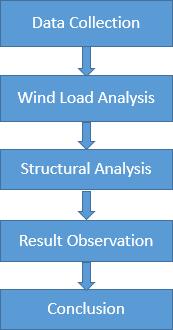
Research methodology for studying the effect and behavior of Reinforced Concrete (RC) structures under windmill load by pointwise steps involves several keys to ensure a systematic and comprehensive investigation. Belowisasuggestedmethodology:
A factorial design is a powerful statistical method used in experiments where you want to investigate the effects of multiple factors (independent variables) on a single outcome variable (dependent variable). It allows you to studynotonlytheindividualeffectsofeachfactorbutalso howthesefactorsinteractwitheachothertoinfluencethe outcome. A factorial design is a good choice when you're interested in studying the combined effects of multiple factors on an outcome. It's particularly valuable for exploringpotentialinteractionsbetweenfactorsthatmight notbeevidentbystudyingtheminisolation.
3.1 Data Collection:
Gather data on windmill characteristics, including blade dimensions,rotationalspeeds,andwindconditions.Collect structural data for the RC model, including material properties, dimensions, reinforcement details, and boundary conditions. Acquire software tools or develop computational models for structural analysis under windmillloads.
3.2
Simulate windmill loads on the RC structure using appropriate load models. Consider the dynamic effects of wind,suchasturbulence,gusts,anddirectionalvariations. Apply wind loads at critical points on the structure based onwindmillorientationanddistance.
3.3
Perform structural analysis under windmill loads using the established computational model. Analyze stress distribution, deflections, and dynamic responses of the RC structure. Identifycritical points where stress concentrations or structural vulnerabilities occur.
3.4 Results Interpretation:
Interpret the analysis results in the context of the study objectives.ComparethebehavioroftheRCstructureunder windmill loads to conventional static loads or other dynamicloadingconditions.Discusstheimplicationsofthe findingsonstructuraldesign,safety,andperformance.
International Research Journal of Engineering and Technology (IRJET) e-ISSN: 2395-0056
Volume: 11 Issue: 03 | Mar 2024 www.irjet.net p-ISSN: 2395-0072
3.5 Observations:
Summarizethekeyfindingsofthestudyregardingthe behaviorofRCstructuresunderwindmillloads.
AssumeBeamparameters:-
a)Beamlength(l)=6m
b)Beamwidth(b)=230mm
c)Beamdepth(d)=450mm
d)Characteristicsofsteel(Fy)=415N/mm2
e)Characteristicsofconcrete(Fck)=20N/mm2
AssumeWindmillparameters:-
a)Outerdiameteroftower(R2)=150mm
b)Innerdiameteroftower(R1)=100mm
c)Heightoftower=3m
d)Mass(withouttower)=220kg
e)Density(ρ)=7850kg/m3
Now,calculate,massofwindmilltower
Area=πR22 –πR12 (1)
= 0.0392 m2
Vibrations - The Unseen Disruption: The windmill's operation creates vibrations that travel through the ground,likeripplesinapond.Thesevibrationscanoccurat various frequencies depending on the windmill's design and operational speed. Here's the catch: low-frequency vibrations are more likely to cause resonance in the RC structure.Resonanceislikepushingaswingatjusttheright moment,causinglargermovementswitheachpush.Inthe caseofRCstructures,resonancecanamplifythevibrations, leadingtomagnifiedeffectslikeincreasedcracking.
Volume(v)=0.0392x3.....................................(2)
=(0.15–0.10)x(0.15+0.10)π =0.1176m3
Massofwindmilltower=Vxρ (3)
=0.1176x7850 =923.16kg ~925kg
Overallmassofwindmill=220+925
= 1145 kg
Now, calculate ShearForce Diagram, Bending Moment DiagramandDeflectionofthebeam.
Dynamic Loads- The ConstantThreat: Unlikestaticloads (liketheconstant weightof furniture),thewindloadon a windmillisconstantlychangingindirectionandmagnitude as the blades rotate. These are dynamic loads, and they poseasignificantthreattoRCstructures.Overtime,these constantlychangingforcescancausefatigueintheconcrete and steel reinforcement, eventually leading to cracks and potentialstructuralfailure.
Overturning Moment - The Leveraging Effect: Imagine thewindmilltowerasagiantleverarm,thethrustforceas theforceactingononeend,andthewindmill'sfoundation as the fulcrum (the fixed point). This creates a moment, a twisting force, that tries to topple the tower over. Nearby structurescanbeindirectlyaffectedifthefoundationisn't strongenoughtoresistthismoment.Thinkofitliketrying to pry a rock loose with a crowbar; if the ground beneath the crowbar is weak, it might give way before the rock actuallymoves.
Distance Matters - The Proximity Problem: The closer the RC structure is to the windmill, the stronger the vibrations and wind loads it will experience. Just like the sound gets louder the closer you are to the speaker, the windmill's effects are more pronounced on nearby structures. The "safe" distance depends on the size and poweroutputofthewindmill.Largerwindmillswithhigher
International Research Journal of Engineering and Technology (IRJET) e-ISSN: 2395-0056
Volume: 11 Issue: 03 | Mar 2024 www.irjet.net p-ISSN: 2395-0072
power generation capacity will naturally exert stronger forcesonsurroundingstructures.
Structural Integrity - The Foundation of Resilience: A well-maintained RC structure with proper reinforcement (steel bars embedded in the concrete) and strong connections between beams, columns, and walls will be moreresistanttocrackinganddamagefromvibrationsand dynamic loads. Think of it like a well-built house versus a hastily constructed shed. The house, with its robust structure, can withstand stronger winds and forces comparedtotheshed.
[3] B. Shobha, H Sudarshan Rao, Vaishali G Ghorpade “Effectofwindloadonlow,medium,Highrisebuildingsin differentterraincategory”(2018).
[4] Deshmukh Poonam. R.,Prof G. N. Shete " Behaviour Of Windmill Structure Under Wind Loading With ConsiderationOfSoilstructureInteraction"(2017)
[5] Hani M. Negma, Karam Y.Sarah Maalawi “ Structural designoptimizationofwindturbinetowers”(2000)
[6]HelgeAagaardMadsen,KennethThomsen“Analysisof WindTurbineLoads”(2011)
[7]Mallikarjun,ChandanR,Dr.ShivappaHA,ByregowdaK C, Preethi K "Design And Structural Analysis Of Wind TurbineTower"(2021)
[8]RohitJagtap,PankajKumar,AnuragSawant"Modal AnalysisofBeamTypeStructures"(2015)
[9] S. Jerath and S. Austin" f Wind Turbine Towers to Seismic Loading at Different Damping Ratios Structures Congress."(2017)
ChartNo:3LoadVsDeflection
3. CONCLUSIONS
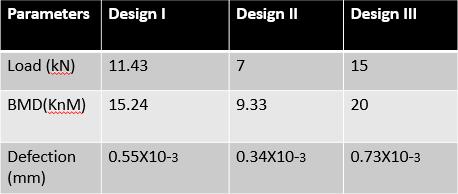
In conclusion, a comprehensive analysis of an RC structure's behavior under different wind loads provides valuable insights into its performance, safety, and resilience. These insights inform future design practices, maintenancestrategies,andregulatorystandardsaimedat ensuringthestructuralintegrityandsafetyofbuildingsand infrastructureinwindyenvironments.
4.REFERENCES
[1] Aiswaria, Jisha SV “Along & cross wind load acting on tallbuildings1”(2018)
[2]AlkeshBhalerao,S.B.Shinde“EffectofStructuralShape onWindAnalysisofMultistoriedRccStructures”(2016)
[10] Shaik Md Younus, V.Purushotham, V.Purushotham “ DesignAndOptimizationOfWindPowerGeneratorFrame ForStructuralLoads”(2018)
[11] Tahera, Vedanth Raghav P, Timoranjan, Vishwapriya V, Yashwanth M K “Wind Effect On Different Structural ConfigurationAndAnalysis–AReview”(2020)
[12] W S van Zyl, G P A G van Zijl “ Dynamic behavior of normally reinforced concrete wind turbine support system”(2015)
BIOGRAPHIES


ArbajShaikh
B,TechincivilEngineering
DnyanshreeInstituteof EngineeringandTechnology, Satara
RohanNachare
B,TechincivilEngineering
DnyanshreeInstituteof EngineeringandTechnology, Satara
International Research Journal of Engineering and Technology (IRJET) e-ISSN: 2395-0056
Volume: 11 Issue: 03 | Mar 2024 www.irjet.net p-ISSN: 2395-0072



UdayanMore
B,TechincivilEngineering
DnyanshreeInstituteof EngineeringandTechnology, Satara
OmkarPhadatare
B,TechincivilEngineering
DnyanshreeInstituteof EngineeringandTechnology, Satara
PravinJalak
B,TechincivilEngineering
DnyanshreeInstituteof EngineeringandTechnology, Satara