
International Research Journal of Engineering and Technology (IRJET) e-ISSN:2395-0056
Volume: 11 Issue: 03 | Mar 2024 www.irjet.net p-ISSN:2395-0072

International Research Journal of Engineering and Technology (IRJET) e-ISSN:2395-0056
Volume: 11 Issue: 03 | Mar 2024 www.irjet.net p-ISSN:2395-0072
Dr. Y. Ramamohan Reddy1 Aman S2 Misba P3 Eshwar S4 Hafriz D5 Harsha A6
1Associate professor, Department of Mechanical Engineering, Srinivasa Ramanujan Institute of Technology, Ananthapuramu, Andhrapradesh. (yrammohanreddy@gmail.com)
2,3,4,5,6 Students, Department of Mechanical engineering, Srinivasa Ramanujan Institute of Technology, Ananthapuramu, Andhra Pradesh. ***
Abstract:
TheprimarygoaloftheDesignandFabricationofFour-WheelSteeringMechanismistocreateasimpleyeteffectivefourwheel steering system that improves vehicle control and manoeuvrability. Conventional cars often only feature frontwheel steering, limiting their turning radius and agility. This concept provides a solution to this restriction by incorporating a four-wheel steering mechanism that allows both the front and back wheels to actively participate in steering.Thesedays,theissueofincreasedstreetmobilityhasmadevehicletreatmentmoredifficult.Asaresult,thereisa needtodevelopanalternativemechanismfor easyvehiclesteering.Whena vehicle isina congestedorlimited region,a betterturningresponseisdesired,orwemaywishthecartodrivewithlessmovement.Thisfour-wheelsteeringsystemis made of mild steel and employs a linkage system, in which the front and back wheels are linked together so that both wheelsturnatthesametime. Therearenumerousbenefitstousingafour-wheelsteeringsystem,includingtheabilityto drivethevehiclemoreprecisely,particularlywhencornering,parking,ortravelinginnarrowlocations.
Keywords: Four-wheelsteering,Fabrication,Steering,Stability,Mechanism.
Theevolutionofautomotivetechnologyhaswitnessedcontinuousadvancementsaimedatenhancingvehicleperformance, safety,andmanoeuvrability.OnesuchinnovativefeatureistheFour-WheelSteering(4WS)mechanism,whichintroduces steeringcontroltoallfourwheelsofavehicle.[1]Lohith,K.,S.R.Shankapal,andH.MonishGowda."Developmentoffourwheel steering system for a car." SASTech-Technical Journal of RUAS 12.1 (2013): 90-97. Traditionally, vehicles are equipped withfront-wheel steeringsystems,buttheincorporation of4WS offers numerous benefits,including improved stability, reduced turning radius, enhanced handling, and increased safety.[2] PADWAL, PRANITA, et al. "Four-Wheel Steering Mechanism-Review." JournalNX 4.10 (2017): 1-4. Four-wheel steering (4WS) is a vehicle control system that allows all four wheels to be steered in response to driver input, enhancing stability. Four-wheel steering gives an extra level of control by allowing the back wheels to turn, in contrast to conventional two-wheel steering systems that only guide the front wheels.[3] Vanamala, Uma Maheshwar. An innovative design concept of four-wheel steering mechanism for an automobile. No. 2013-01-2845. SAE Technical Paper, 2013. This novel device is intended to enhance a car's handling qualities, especially in low-speed situations and when performing tight turns.[4] Kolekar, Mr Aniket, et al. "Review on Steering Mechanism." (2017). This comes in two primary varieties: passive and active. In passive systems, the steering angle and vehicle speed, among other variables, control how the rear wheels, which are mechanically connected to the front wheels, turn. This design improves low-speed agility, which makes parking and navigating through crowded locations easier. [5] Rehan, Ansari, et al. "Design & Synthesis of Four-Wheel Steering Mechanism." International Refereed Journal of Engineering and Science 6.4(2017):17-20.Conversely,activesystemsprovideagreaterdegreeofadaptabilityto variousdrivingsituationsbyusingelectroniccontroltoindependentlysteertherearwheels.Inordertoevaluatevariables likevehiclespeed,steeringinput,andlateral accelerationandmodifythe rear wheel anglesappropriately,these systems frequently use sensors and algorithms. Increased stability is one of the main advantages of four-wheel steering, particularlywhilelanechangingandcorneringathighspeeds.[6]Bhishikar,Saket,etal."Designandsimulationof4-wheel steering system." International Journal of Engineering and Innovative Technology 3.12 (2014): 351-367. The car performs betteroverallwhentherearwheelsaredriveninthesamedirectionasthefrontwheelsathigherspeeds.Thismakesthe car more responsive and stable. Furthermore, the ability to turn the rear wheels in the opposite direction of the front wheels minimizes the turning radius, making the vehicle more agile while navigating tight places or parking at reduced
International Research Journal of Engineering and Technology (IRJET) e-ISSN:2395-0056
Volume: 11 Issue: 03 | Mar 2024 www.irjet.net p-ISSN:2395-0072
speeds. Four-wheel steering systems can increase a vehicle's complexity and cost despite their benefits.[7] Singh, Bhupendra Pratap, et al. "Advanced four-wheel steering system." International Journal of Research in Engineering & Advanced Technology [IJIERT] 3.2(2015).Equipmentandspecificknowledgemaybeneededformaintenanceandrepairs. Additionally,thesteeringreactionmayfeeldifferentfromconventionaltwo-wheelsteeringsystems,thusthedrivermust adjust. Four-wheel steering will probably be improved considerably more as technology develops, providing even more accuratecontrolandhelpingtoimproveautomobileperformanceand safety.[8]Shadab,Alam,etal."FourWheelSteering System."(2018).
Widelyusedtwo-wheelsteeringsystemlagsinstabilityduringhighspeeds,lanechangingbecomesadifficulttask,italso facesproblemwhileparallelparking.Sincethefrontwheelsareoverburden,asengineisplacedatfrontierposition,due to these front tyres wear out quickly. As wheels are overburdened, it tends to under steer. [9] Whitehead, John C. "Four wheel steering: Maneuverability and high speed stabilization." SAE Transactions (1988): 668-679. While a heavy front providesadequatestartingtorqueonwetroads,inallotherconditionstorquefromafrontwheelsteervehicleisinferior toarearwheelsteervehicle.Thisisduetonon-uniformweightdistribution.Therearendofafrontwheelsteervehicleis considerably lighter than its front end, which means the rear tyres do not grip the road very well. Since steering and enginepowerishandled by thefront wheels,thelatter sometimestendstocompromisetheformer.Theforce generated front the engine, sometimes tends to pull the either to the right or to the left.[10] Shekh, Mubina, O. P. Umrao, and Dharmendra Singh. "Kinematic Analysis of Steering Mechanism: A Review." Proceedings of International Conference in Mechanical and Energy Technology: ICMET 2019, India. Springer Singapore, 2020. This is referred to as torque steering. AccordingtonewspublishedinTheEconomicTimesdated28.dec.2016whichclearlystatedthatIndiaranksfirstinRoad deaths in the world, where India accounts for 10 percent of global road accidents with more than 1.46 lakh fatalities annually,highestinworld.ByresearchdonebyNPTEL,BankBazar,Lowmanlawfirmmechanicalfailurethatcausesroad accidentsreportssteeringsystemtobeonthirdposition.Mumbai-PuneexpresswayroadaccidentstudyconductedbyJP ResearchIndiaconcludedtopcontributingfactorsinfluencingoccurrenceofaccidents.
Visualizingadesignonpaperisafundamentalandessentialstageinthecreativeprocess.Itservesasthecanvasforinitial ideas,allowingdesignerstoquicklysketchandexploredifferentconcepts.Thetangiblenatureofpaperprovidesahandsonexperiencethatfosterscreativityandallowsforrapiditeration.Thismethodnotonlyaidsinrefiningdesignelements but also acts as a powerful tool for effective communication. Hand-drawn sketches offer a clear and immediate way to conveyideastoclientsandteammembers,aligningeveryone'svisionbeforemovingintodigitalormoredetailedphasesof the design process. In essence, visualizing on paper is a dynamic starting point that sets the foundation for successful designexecution.Belowaresomeofthereferencesoftheroughdesignsonthepaperwecameupwithbeforegoingtothe nextstepi.e.designingonCAD(ComputerAidedDrafting)
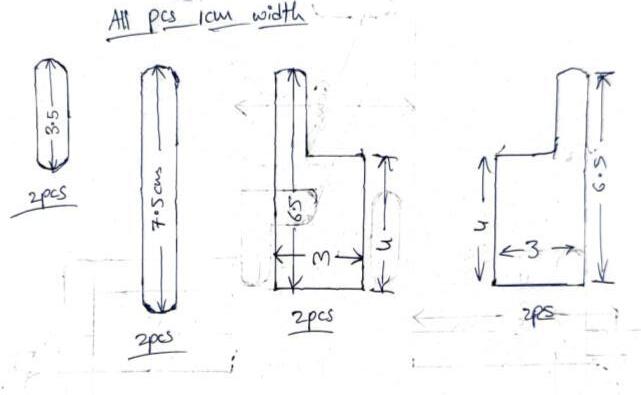
Figure1.Roughsketchoflinks
International Research Journal of Engineering and Technology (IRJET) e-ISSN:2395-0056
Volume: 11 Issue: 03 | Mar 2024 www.irjet.net p-ISSN:2395-0072
The preliminary illustration depicts the integral components involved in the construction of a four-wheel steering mechanism. Specifically,the initial figuresshowcasethe linkagepartsthat playa crucial roleinthissystem. Thelasttwo pieces highlighted in the depiction are poised to establish a connection with the wheels. These final components are designed to actively engage with the wheels, effectively translating the applied force from the other links into rotational motion.Inessence,theselasttwopiecesactastheintermediaries,respondingtotheforcesexertedonthembytheother components and translating that energy into the desired movement of the wheels. The careful integration of these elements in the four-wheel steering mechanism is paramount to achieving synchronized and responsive steering, enhancingtheoverallmanoeuvrabilityandcontrolofthevehicle.
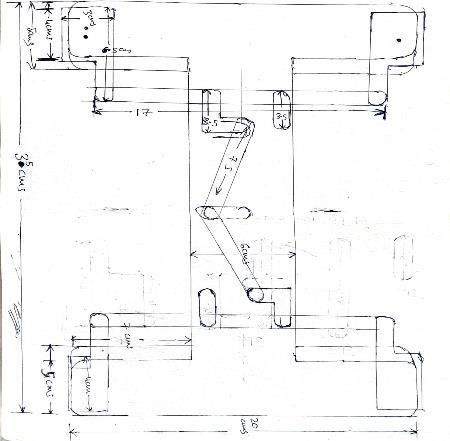
Theinitialfigureprovidesacomprehensiverepresentationofthechassisintendedforuseinourproject,offeringdetailed insightsintoitsshape,design,anddimensions.Thisvisualdepictionservesasafoundationalreferenceforthefabrication process,outliningthestructuralframeworkthatwillformthebackboneofourproject.Thefigurenotonlyshowcasesthe overall silhouette of the chassis but also captures the intricate design elements that contribute to its functionality. By presentingthedimensions,thisvisualaidplaysacrucialroleinensuringprecisionduringthefabricationphase,actingas a guidefortheaccurateassemblyofthechassiscomponents.Theclarityprovidedbythisvisualreferenceisinstrumentalin aligning the fabrication team with the project specifications, promoting consistency and reliability in the construction of thechassisforourendeavor.
The3Ddrawingsforthe four-wheel steeringmechanism weremeticulouslycreated usingComputer-AidedDesign(CAD) software, specifically CATIA. This sophisticated software played a crucial role in transforming initial rough sketches into detailed and accurate representations of the mechanical components that constitute the steering system. The design process began with the collection of conceptual sketches, which served as the foundation for the 3D modelling. CATIA's intuitive interface and robust modelling tools allowed the designers to translate these rough ideas into a digital format. Each component of the steering mechanism, including linkages, joints, and support structures, was carefully modelled to ensure precision and adherence to design specifications. CATIA's parametric modelling capabilities were instrumental in makingthedesignadaptabletochangesanditerations.Thisfeaturealloweddesignerstomodifydimensions,angles,and otherparametersseamlessly,facilitatingtheoptimizationofthefour-wheelsteeringmechanismforoptimalperformance. Thesoftware'sabilitytocreateassembliesenabledtheintegrationofindividual components,providinga comprehensive view of how the entire system would function cohesively. Moreover, CATIA's rendering capabilities allowed for the creationofrealistic visualizationsofthefour-wheel steeringmechanism.Thesevisualizationsplayeda crucialroleinthe
International Research Journal of Engineering and Technology (IRJET) e-ISSN:2395-0056
design review process, providing stakeholders with a clear and vivid understanding of the final product before the fabrication phase. On ce the 3D models were finalized, they served as the basis for generating detailed engineering drawings. These drawings, created with precision and accuracy, included all necessary dimensions, and annotations required for the fabrication process. CATIA's drafting tools facilitated the creation of these detailed drawings, ensuring that the fabrication team had the essential information needed to bring the design to life In summary, the utilization of CATIAinthedesignprocesswaspivotaltothesuccessoftheproject.Thesoftware'scapabilitiesnotonlyallowedforthe transformationofroughsketchesintointricate3Dmodelsbutalsostreamlinedthedesigniterationprocessandfacilitated effective communication between the design and fabrication teams. The result is a well-conceived and precisely engineeredfour-wheelsteeringmechanismreadyforfabricationandtesting.
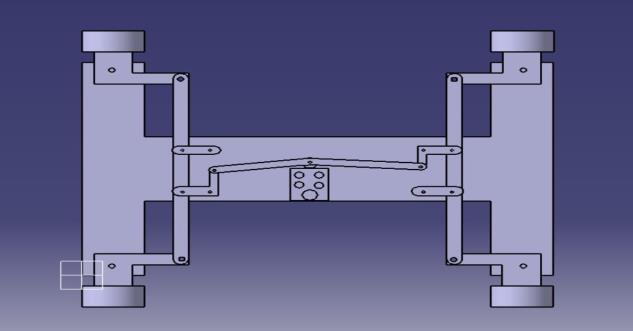
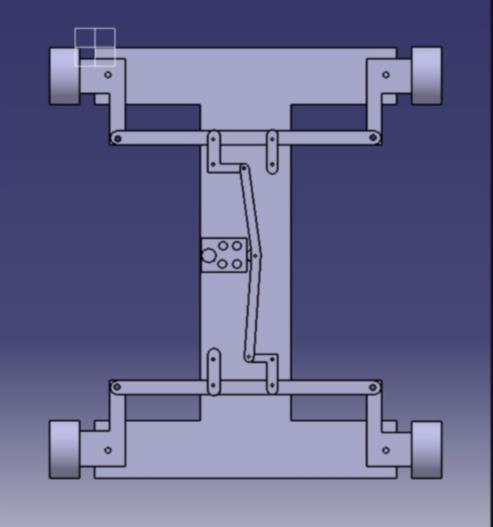
The top views of the four-wheel steering project provide a comprehensive visual representation of the entire steering mechanism.Thisincludesvariouslinkagesandtheirinterconnections,whichareessentialforcoordinatingthesteeringof all four wheels simultaneously Linkages are mechanical connections that transmit motion and force between different partsofasystem.Inthisproject,thelinkagesarecrucialelementsthatenablethesynchronizedsteeringofallfourwheels. Theyarelikelydesignedtoconverttherotationalmotiongeneratedbythesteeringmechanismintothelateralmovement requiredtoturneachwheel.Thetopviewrevealsthearrangementandpositioningofthelinkages,showinghowtheyare connectedtoeachotherandtoothercomponentswithinthesystem.Thislayoutismeticulouslydesignedtoensureproper coordinationandsynchronizationofthesteeringactionacrossallfourwheels.Thedepictionofthewheelsinthetopview provides insight into their positioning relative to each other and to the vehicle's chassis. Proper wheel placement is essential forachievingstability,maneuverability,andoptimal performance during steeringmaneuvers. The placementof motorsresponsibleforoperatingthelinkagesisalsovisibleinthetopview.Thesemotorsplayacrucialroleintranslating the driver's steering inputs into mechanical motion, which in turn adjusts the orientation of the wheels accordingly.
Volume: 11 Issue: 03 | Mar 2024 www.irjet.net p-ISSN:2395-0072 © 2024, IRJET | Impact Factor value: 8.226 | ISO 9001:2008 Certified Journal | Page954
International Research Journal of Engineering and Technology (IRJET) e-ISSN:2395-0056
Volume: 11 Issue: 03 | Mar 2024 www.irjet.net p-ISSN:2395-0072
Through the visual representation, one can infer how the motors interact with the linkages to control the steering of all fourwheelssimultaneously. Thisoperationislikelybasedona sophisticatedcontrol systemthatinterpretsinputsignals andcoordinatesthemovementofthelinkagestoachievethedesiredsteeringanglesforeachwheel.
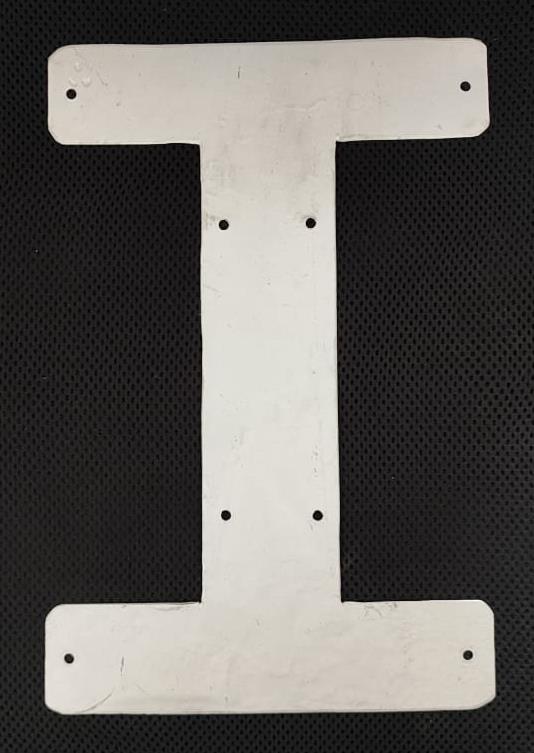
We have opted to use an 18-gauge mild steel metal sheet for fabricating our prototype. This choice offers several advantages, Mild steel is known for its strength and durability, making it suitable for withstanding various stresses and impacts. The material's strength ensures that the prototype can withstand the forces exerted on it during operation or testingwithoutdeformingorbreakingeasily. Despitebeingrobust,mildsteel isrelativelylightweightcompared toother metals,whichisadvantageousforportabilityandhandling. Mildsteelisoftenmoreaffordablecomparedtoothermetals, contributing to cost efficiency in prototype fabrication. we have considered the dimensions of the prototype to ensure clarity in understanding how the links control the front and rear wheels simultaneously, as well as ensuring portability. Thisinvolves:Bydesigning theprototypewithdimensionsthatallowforeasyvisualizationofhowthelinksoperate,you makeitsimplerforobserverstounderstandthemechanismbehindcontrollingbothsetsofwheelsconcurrently.Ensuring thatthedimensionsarecomprehensibletoeveryoneimpliesthattheprototype'sdesignisuser-friendlyandaccessibleto a wide audience, facilitating communication and collaboration in development or demonstration. Dimensional considerationsextendtomakingtheprototypeportable,meaningitcanbeeasilytransportedormovedfromonelocation toanother.Thisenhancesitspracticalityandusabilityfortestingor showcasingpurposes.Componentsofthefabrication consiststheI-shapedbaseframe,craftedfromcoldrolledmildsteel,embodiescrucialattributes:durability,strength,and lightweightconstruction.Thismaterialselectionensuresthebaseframecanwithstandtherigorsofoperationaldemands whilemaintainingstructuralintegrityovertime.Itsrobustnatureenablesittosupportalltheintricatecomponentsofthe mechanism without succumbing to deformation or failure. Despite its formidable strength, the base frame remains remarkably light, easing transportation, installation, and handling processes. Furthermore, cold rolled mild steel's inherent resistance to corrosion enhances the longevity of the base frame, ensuring sustained performance even in challenging environmental conditions. Its malleability facilitates precise fabrication, allowing for the creation of a meticulously designed component tailored to the specific requirements of the mechanism. Additionally, the costeffectiveness of mild steel makes it an economically viable choice, providing an optimal balance between quality, performance, and affordability. Overall, the I-shaped base frame, forged from cold rolled mild steel, stands as a cornerstoneofstability,durability,andfunctionalitywithinthemechanism'sarchitecture.
International Research Journal of Engineering and Technology (IRJET) e-ISSN:2395-0056
Volume: 11 Issue: 03 | Mar 2024 www.irjet.net p-ISSN:2395-0072
The linkages, crucial components within the mechanism's steering system, are crafted from cold rolled cast iron sheet,
albeitwithaslightlythinnergaugeof20insteadof18.Despitetheslightreductioningauge,thecoldrolledcastironsheet maintains sufficient strength to support the demands of steering all four wheels simultaneously. The precise fabrication and assembly of the linkages allow for seamless connection, enabling synchronized steering across all wheels. By coordinating the movement of all four wheels, the linkages contribute to the stability and responsiveness of the mechanism,whethertraversingruggedterrainornavigatingtightspaces.Overall,thelinkages,meticulouslycraftedfrom coldrolledcastironsheet witha gaugeof 20,serveas integral componentsin the steeringsystem, ensuringcoordinated movementandenhancingtheoverallperformanceandfunctionalityofthemechanism. Wehaveuseda300-rpmdcmotor in this project to automatically operate the linkages and steer all the four wheels at the same time. These motors aresimpleDCMotorsfeaturinggearsfortheshaftforobtainingtheoptimalperformancecharacteristics.Theyareknown as Center Shaft DC Geared Motors because their shaft extends through the center of their gearbox assembly. These standard size DC Motors are very easy to use. A two-way toggle switch is a type of electrical switch commonly used in circuitstocontroltheflowofelectricity.Itiscalleda"two-way"switchbecauseithastwopossiblepositionsthatitcanbe toggled between. In a typical two-way toggle switch setup, there are three terminals: one common terminal and two travellerterminals.Whentheswitchistoggledto oneposition,thecommonterminal isconnectedtooneofthe traveller terminals,andwhentoggledtotheotherposition,thecommonterminalisconnectedtotheother travellerterminal.This arrangementallowselectricitytoflowthroughthecircuitwhentheswitchisineitherposition,completingthecircuitand turning the light or other electrical device on, and breaking the circuit to turn it off. Wheels are essential components of transportation and mobility, acting as basic instruments for moving across varied terrains and situations. These circular devices,whicharefrequentlymountedonaxles,areintendedtoreducefrictionbetweenamovingobjectandthesurfaceit traverses,allowingforsmootherandmoreefficientmotion.Fromthesolidwheelsofancientcartstothepneumatictires ofmodernautomobiles,theevolutionofwheeltechnologyhasbeeninextricablylinkedwithhumanprogress.Wheelsare ubiquitous throughout sectors and applications, whether as casters for furniture movement, spoked wheels for bicycle performance,orlargeearthmovingtiresforheavymachines.Beyondtheirpracticalutility,wheelsrepresentinventionand inventiveness,representinghumanity'snever-endingdriveforincreasedmobilityandefficiency.
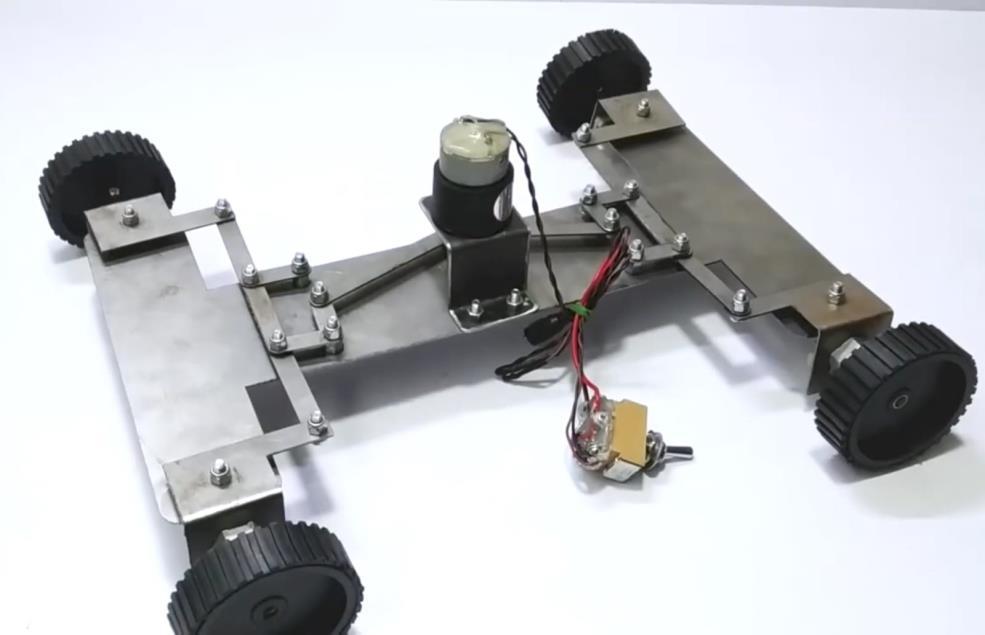
The final assembly shows how a four-wheel steering mechanism linkage will look like after assembling all the parts togetherandhowitwill functionshowcasingtheworkingoffour-wheel steering. Thelinksrelatetothehelpof nuts and screws on the I shaped base frame. The four wheels are attached to the links with the help of a freely rotating wheel coupler.TheDCmotorisconnectedtothe2-waytoggleswitchandthemiddlelink.Tooperatethemotor,a12Vbatteryis connected along with a switch to control the power supply. When the power is supplied to the motor from the battery through the toggle switch, the motor will rotate and the links connected in series to the motor and wheels will turn the wheelsinonedirection,withthehelpofatoggleswitchwecansteerthewheelsinboththedirections.
International Research Journal of Engineering and Technology (IRJET) e-ISSN:2395-0056
Volume: 11 Issue: 03 | Mar 2024 www.irjet.net p-ISSN:2395-0072
A four-wheel steering mechanism provides unique ideas for improving vehicle dynamics and manoeuvrability. Unlike typical two-wheel steering systems, which solely control the front wheels, four-wheel steering uses technology to allow the back wheels to turn in tandem with the front. This innovative technique tackles numerous major issues with traditional steering configurations. Primarily, the four-wheel steering system excels in addressing the intricacies of lowspeedmanoeuvrability.Negotiatingtightspacesandparkinginurbanenvironmentsbecomesmarkedlymoreeffortlessas therear wheelspivotinthe oppositedirectiontothe frontwheels.Thisintricatechoreographysubstantiallyreducesthe turning radius,providinga heightenedlevel ofagilitycrucial for navigatingconfinedspaceswithfinesse. Moving beyond therealmoflow-speedscenarios,thesystem'sprowessextendstohigherspeeds,whereitbecomesastalwartcontributor to stability and superior handling. The rear wheels can pivot in tandem with the front wheels, bolstering the vehicle's stability during rapid lane changes and high-speed manoeuvres. This translates to a driving experience imbued with heightened confidence and control, particularly when faced with challenging road conditions or emergency situations. Beyond the realms of manoeuvrability and stability, the four-wheel steering mechanism emerges as a linchpin in optimizing overall vehicle performance. By intelligently distributing the steering load across all four wheels, the system enhances traction and control, particularly evident during cornering. This meticulous load distribution translates into improvedgrip,effectivelymitigatingtheriskofundersteeroroversteertendencies.Thenetresultisavehiclethatboasts heightened responsiveness and handling precision, elevating the driving experience to new levels of sophistication. In summation,thefour-wheelsteeringmechanismrepresentsaparadigmshiftinautomotiveengineering,offeringaholistic and nuanced approach to vehicle dynamics. From the finesse required in low-speed scenarios to the demands of highspeed stability and the intricacies of cornering, this innovative technology seamlessly addresses these challenges, redefiningtheexpectationsassociatedwithconventionalsteeringsystems.
In conclusion, the design and fabrication of the four-wheel steering mechanism project has proven to be a significant endeavor with promising outcomes. Through meticulous planning, innovative design considerations, and precise fabricationtechniques,ourteamhassuccessfullydevelopedasystemthatenhancesthemaneuverabilityandstabilityofa four-wheeled vehicle. The integration of four-wheel steering introduces a futuristic shift in traditional vehicle dynamics, providingadvantagesintermsofreducedturningradius,improvedhandling,andenhancedsafety.Ourprojectaimednot only to conceptualize and design the mechanism but also to bring it to fruition through careful fabrication and assembly processes. Throughout the project, we encountered and overcame various challenges, such as optimizing the linkage system, ensuring synchronization between front and rear wheels, and addressing potential issues related to control and
International Research Journal of Engineering and Technology (IRJET) e-ISSN:2395-0056
Volume: 11 Issue: 03 | Mar 2024 www.irjet.net p-ISSN:2395-0072
feedback.Thesuccessfulimplementationofthisprojectopenspossibilitiesforfutureapplicationsinbothcommercialand automotivesectors.Thetechnologydevelopedcanbefurtherrefinedandadaptedfordifferentvehicletypes,contributing to advancements in the field of transportation. The insights gained from this project can also serve as a foundation for futureresearchanddevelopmentinthe questformore efficientanddynamicvehicle systems.Inessence,thedesignand fabrication of the four-wheel steering mechanism project not only demonstrates our engineering prowess but also underscores our commitment to pushing the boundaries of conventional automotive design. The knowledge and experiencegainedfromthisprojectwillundoubtedlypavethewayforfutureinnovationsinvehicle
1. Lohith,K.,S.R.Shankapal,andH.MonishGowda."Developmentoffour-wheelsteeringsystemforacar." SASTechTechnical Journal of RUAS 12.1(2013):90-97.
2. PADWAL,PRANITA,etal."Four-WheelSteeringMechanism-Review." JournalNX 4.10(2017):1-4.
3. Vanamala,UmaMaheshwar. An innovative design concept of four-wheel steering mechanism for an automobile.No. 2013-01-2845.SAETechnicalPaper,2013.
4. Kolekar,MrAniket,etal."ReviewonSteeringMechanism."(2017).
5. Rehan, Ansari, et al. "Design & Synthesis of Four-Wheel Steering Mechanism." International Refereed Journal of Engineering and Science 6.4(2017):17-20.
6. Bhishikar, Saket, et al. "Design and simulation of 4-wheel steering system." International Journal of Engineering and Innovative Technology 3.12(2014):351-367.
7. Singh, Bhupendra Pratap, et al. "Advanced four-wheel steering system." International Journal of Research in Engineering & Advanced Technology [IJIERT] 3.2(2015).
8. Shadab,Alam,etal."FourWheelSteeringSystem."(2018).
9. Whitehead,JohnC."Fourwheelsteering:Maneuverabilityandhighspeedstabilization." SAE Transactions (1988): 668-679.
10. Shekh, Mubina, O. P. Umrao, and Dharmendra Singh. "Kinematic Analysis of Steering Mechanism: A Review." Proceedings of International Conference in Mechanical and Energy Technology: ICMET 2019, India. SpringerSingapore,2020.