
International Research Journal of Engineering and Technology (IRJET) e-ISSN:2395-0056
Volume: 11 Issue: 03 | Mar 2024 www.irjet.net p-ISSN:2395-0072
International Research Journal of Engineering and Technology (IRJET) e-ISSN:2395-0056
Volume: 11 Issue: 03 | Mar 2024 www.irjet.net p-ISSN:2395-0072
Dr
John
Jaidhan
B1, Edara Bindu
Madhavi
2, Nandini Sarkar3, Maddila Chandra Shekhar4 and Chaitanya Adduri5
1Professor, Dept. of CSE, GITAM (Deemed to be University), Visakhapatnam, Andhra Pradesh, India. 2345Student, GITAM (Deemed to be University), Visakhapatnam, Andhra Pradesh, India.
Abstract - Agriculture is the backbone of India's economy, crucial for the well-being of its people. Ensuring the production of high-quality crops is essential for maintaining a healthy lifestyle. Analyzing environmental and soil conditions, including factors such as moisture and pH levels, temperature, and chemical composition, is vital for cultivating superior crops. Predicting crop yields has become increasingly challenging due to unpredictable weather patterns caused by global warming, resulting in crop destruction, food scarcity, and tragic consequences suchasfarmersuicides.Thisstudyaimstodevelopawebsite utilizing machine learning models for crop recommendations, taking into account inputs such as pH values, temperature, and soil parameters. Various machine learning algorithms, including SVM, logistic regression, naive bayes, and Random Forest, are utilized, with Random Forestdemonstratingsuperiorpredictioncapabilities.These systems carefully analyse diverse factors, including soil quality,climatedata,andpastcropperformance,tosuggest optimal crops tailored to specific locations. Accessible through user-friendly platforms, crop recommendation systems empower farmers to harness the benefits of technology and data, thereby enhancing agricultural productivity,financialgains,andglobalfoodsecurity.
Ultimately, these systems serve as a crucial tool in advancing modern agriculture, leveraging technology and data analysis to assist farmers in making decisions that contributetofoodsecurityandagriculturalsustainability.
Key Words: Random Forest, machine learning model, moisture and pH level, temperature, and chemical composition,recommendationsystem,factors.
Agriculture serves as the backbone of India's economy, supporting the livelihoods of a significant portion of the population. However, it remains susceptible to the unpredictable nature of weather patterns, climate variations,andecologicalfactors.Theseuncertaintiespose substantialchallengestocultivatingrobustcrops.Withthe population steadily increasing and poverty levels on the rise, it becomes imperative to equip ourselves with effective tools to address these critical issues and offer recommendations to mitigate the adverse effects of poverty,climatechange,anderraticharvests.
In today's modern era, farmers are leveraging advanced technologies to enhance crop yields. While extensive research has been conducted to comprehend the intricate factors influencing agriculture, the collection of comprehensive data remains a hurdle, often resulting in inconsistent and incomplete information. There is a pressingneedtorefinemethodologiesfordataavailability and accessibility to overcome these obstacles. Enter crop recommendationsystems,offeringapromisingsolutionto thesechallenges.Thesesystemsbringamyriadofbenefits to the agricultural sector. Driven by data-driven algorithms and the principles of precision agriculture, croprecommendationsystemsempowerfarmerstomake well-informed decisions regarding crop selection, thereby maximizing their yield potential. Embracing sustainable farming practices takes precedence, aiming to minimize environmental impact and promote soil health. These systems are easily accessible through user-friendly platforms, enabling farmers to leverage the advantages of technology and data. Ultimately, this contributes to heightened agricultural productivity, financial profitability, and enhanced global food security. In essence,croprecommendationsystemsplaya pivotalrole in the modernization of agriculture, fostering sustainability, and improving the livelihoods of farmers worldwide.Theyserveasabeaconofhopeinanindustry crucialtoourwell-beingandthefutureofourplanet
Today's technological advancements enable the meticulous analysis of agricultural data [1], granting farmers greater control over their crops and empowering them to make informed decisions. Studies in artificial intelligenceandmachinelearninghaverevolutionizedthe automation and enhancement of crop quality [1]. These technologies offer insights into crucial aspects such as irrigation management, climate adaptation, and soil nutrition, which significantly impact crop production [2]. Artificial Neural Networks (ANN) and Convolutional Neural Networks (CNN), in combination with other techniques, are instrumental in classifying and predicting cropyieldsIn-depthresearchhasledtotherecognitionof CNNasaprominentdeeplearningalgorithmincropyield prediction, alongside LSTM (Long Short Term Memory) and DNN (Deep Neural Networks) [3]. Machine learning assumes a pivotal role in Crop Yield Prediction (CYP),
International Research Journal of Engineering and Technology (IRJET) e-ISSN:2395-0056
Volume: 11 Issue: 03 | Mar 2024 www.irjet.net p-ISSN:2395-0072
actingasanindependenttool[4].Prof.Dr.MiklósNeményi emphasizes the importance of considering soil, meteorological, environmental, and crop parameters in predicting crop yield [5]. Decision support models aid in extracting significant crop features for accurate prediction]. By utilizing weather parameters, soil characteristics, and historical yield data, predictive systems can accurately forecast crop yields [6]. These systems aim to integrate data from various sources, employingdata analyticsandforecastanalysistoenhance productivity and profitability in agriculture. Machine learning models, including reinforcement learning, are employed to predict crop yields, with a focus on deep reinforcement learning techniques [7]. Deep learning techniques like ANN and CNN play a crucial role in exploring classification and regression methods for crop yield prediction [8]. Researchers have compared the prediction accuracy of various models, including ANN, KNN, Random Forest, MLR, and SVR [9]. A hybrid MLRANN model has shown superior performance in terms of accuracy,makingitapreferredchoiceforpredictivetasks [9]. Machine learning models like the majority voting system, SVM, Naive Bayes, ANN, and Random Forest are utilized, leveraging soil characteristics obtained from soil testing labs [10]. These characteristics, such as depth, texture, and pH, play a significant role in determining a crop's potential for nutrient absorption and water retention.
The goal of our project is to develop a crop recommendation system that assists farmers in making informed decisions about crop selection. We aim to address the challenge faced by farmers in selecting suitablecropsbasedonvariousfactorssuchassoilquality, climate conditions, and historical data. By leveraging machine learning algorithms, our system will analyze these factors to provide personalized crop recommendations tailored to specific farming conditions. This project aims to enhance agricultural productivity, sustainability, and profitability for farmers by offering themvaluableinsightsandguidanceforcropselection.
Precision agriculture has become increasingly popular amongfarmersseekinginformeddecision-makingintheir farming practices. The dataset was meticulously curated by consolidating information from existing datasets on rainfall, climate, and fertilizer data, specifically tailored to theagriculturallandscapeofIndia.
Figure -1: showsthedistribution,2-ddistributionand valuesindataset
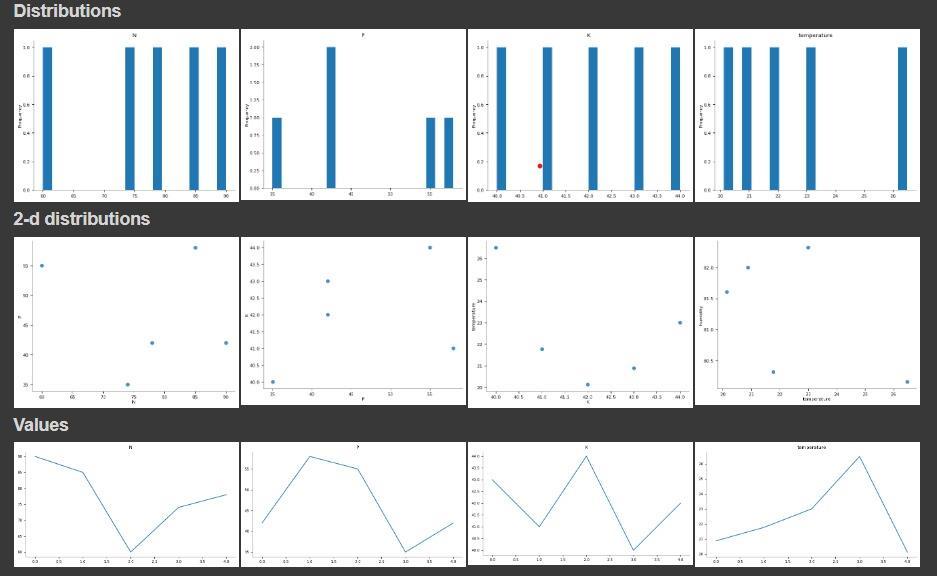
5(i) input dataset
The dataset selected for this specific task was extracted from an online source named as Kaggle. This type of data could be used in agricultural research to study how different environmental conditions affect the growth and yieldofricecrops.Forexample, researcherscouldusethe data to investigate how temperature, humidity, and rainfallaffectPHlevelsorviceversa.
5(ii)preprocessing
In crop recommendation, preprocessing is essential for ensuring that the data used for analysis is reliable and accurate. It involves several key steps, starting with cleaning the dataset to eliminate errors and inconsistencies.Next,numericalfeaturesareadjustedtoa standard scale, while categorical features are converted into numerical values. Featureselection is then employed to streamline the model and enhance its performance. Finally,thedataisdividedintotrainingandtestingsetsto evaluate the model's effectiveness. Overall, preprocessing ensures that the data used for crop recommendation is dependable, resulting in more trustworthy recommendationsforfarmers.
5(iii)model evaluation
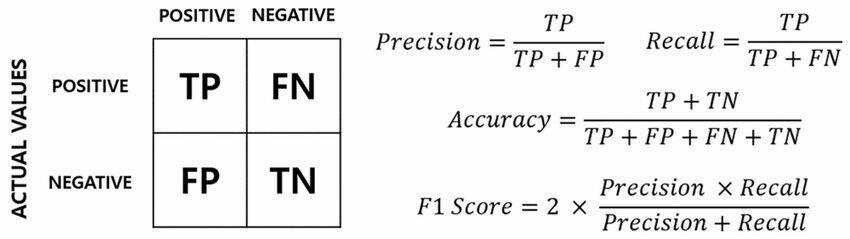
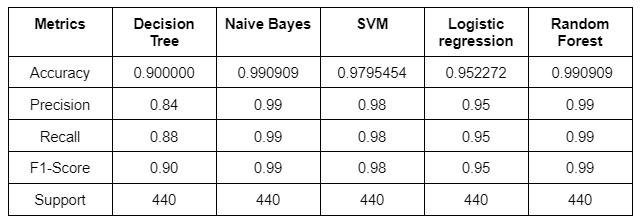
The performance of the crop recommendation system is checkedusingdifferentmeasurestoseehowwellitworks. Measureslikeaccuracy,precision,recall,andF1-scoreare used to understand if the system can suggest the right cropsbasedontheinformationit gets.Also,thesystem is testedwithaseparatesetofdatatomakesureitcanwork wellindifferentsituationsanddoesn'tgiveresults.
International Research Journal of Engineering and Technology (IRJET)
Volume: 11 Issue: 03 | Mar 2024 www.irjet.net
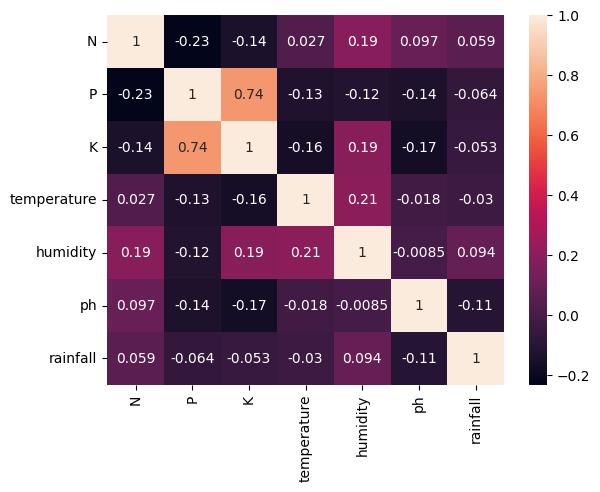
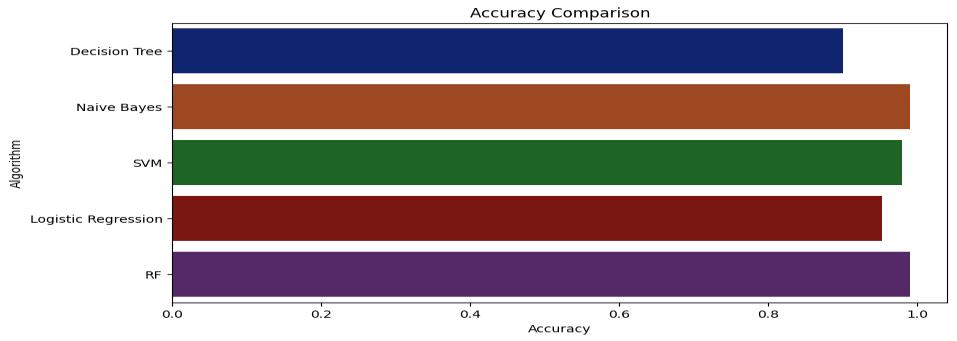
The methodology employed in this project involves a systematic approach to classify various types of crops basedonenvironmentalfactorsutilizingmachinelearning algorithms. Initially, a comprehensive data collection process gathers information pertaining to both crop characteristics and environmental variables such as nitrogen, phosphorus, potassium, temperature, humidity, pH level, and rainfall. Subsequently, the collected data undergoesexplorationtoassessitsdimensions,structure, column identifiers, and the unique labels representing different crop types. Visualization aids, such as heatmaps, are generated to elucidate the interrelationships among theenvironmentalfactors.Followingdataexploration,the preprocessing phase involves the selection of relevant features(i.e.,environmentalfactors)alongwiththetarget variable(i.e.,croptypes).Thisdataisthenpartitionedinto trainingandtestingsetstofacilitatemodelevaluation.The model training and evaluation stage encompass the utilization of diverse machine learning algorithms including Decision Tree Classifier, Naive Bayes Classifier, Support Vector Machine (SVM) with a polynomial kernel, Logistic Regression, and Random Forest Classifier. Each model is trained on the training set and evaluated for its performance on the testing set. Furthermore, model accuraciesarecomparedusingvisualrepresentationssuch asbarplotstoidentifythebest-performingmodel.Finally, the trained models are employed for making predictions on sample data points, thereby enabling the classification
e-ISSN:2395-0056
p-ISSN:2395-0072
of crop types based on the provided environmental factors. Through this structured methodology, the project endeavors to efficiently classify crops, aiding in agriculturaldecision-makingprocesses.
Figure -3:showstheaccuracycomparisonofall algorithms:
In conclusion, our crop recommendation system project has successfully addressed the critical need for datadriven decision support in agriculture. Our goal was to develop a system capable of providing farmers with tailored crop recommendations based on various environmental, soil, and historical data. The system surpassed expectations by delivering accurate and actionable guidance, leading to improved crop yields and resource efficiency. Despite encountering challenges such as data quality issues and algorithm complexity, we overcame them through rigorous data preprocessing and algorithm optimization, resulting in a robust recommendation system. Our project highlights the importance of data-driven approaches in addressing agricultural challenges and demonstrates how machine learning techniques can harness rich insights from agricultural data for informed decision-making. The interpretability of decision trees and the probabilistic nature of Naive Bayes offer valuable insights into crop classification factors, while the scalability and predictive capabilities of Support Vector Machines, Logistic Regression, and Random Forests hold promise for precisionagriculture,facilitating
International Research Journal of Engineering and Technology (IRJET) e-ISSN:2395-0056
Volume: 11 Issue: 03 | Mar 2024 www.irjet.net p-ISSN:2395-0072
[1] 2022 5th International Conference on Multimedia, Signal Processing and Communication Technologies (IMPACT) | 978-1-6654-7647-8/22/$31.00 ©2022 IEEE | DOI:10.1109/IMPACT55510.2022.10029218
[2] H. Akcay, S. Kaya, E. Sertel, and U. Alganci, ‘‘Determination of olive trees with multi-sensor data fusion,’’ in Proc. 8th Int. Conf. Agro-Geoinformatics (AgroGeoinformatics),Jul.2019,pp.1–6
[3]VanKlompenburg,T.,Kassahun,A.,&Catal,C.(2020). Crop yield prediction using machine learning: A systematicliteraturereview.ComputersandElectronicsin Agriculture,177,105709.
[4] Reddy, D. J., & Kumar, M. R. (2021, May). Crop yield prediction using machine learning algorithm. In 2021 5th International Conference on Intelligent Computing and ControlSystems(ICICCS)(pp.1466-1470).IEEE.
[5]J.Meng,"Researchonthecostofagricultural products circulationanditscontrolunderthenewnormaleconomic development," Commercial Times, no. 23, pp. 145147, 2016.[3]A.Kaloxylosetal.,"Farmmanage
[6] Teja, M.S., Preetham, T.S., Sujihelen, L., Jancy, S. and Selvan, M.P., 2022, May. Crop recommendation and yield productionusingsvmalgorithm.In20226thInternational ConferenceonIntelligentComputingand Control Systems (ICICCS)(pp.1768-1771).IEEE.
[7] Elavarasan, D., & Vincent, P. D. (2020). Crop yield prediction using deep reinforcement learning model for sustainable agrarian applications. IEEE access, 8, 8688686901.
[8]Dharani,M.K.,Thamilselvan,R.,Natesan,P.,Kalaivaani, P.C.D.,&Santhoshkumar,S.(2021,February).Reviewon Crop Prediction Using Deep Learning Techniques. In Journal of Physics: Conference Series (Vol. 1767, No. 1, p. 012026).IOPPublishing.
[9] [9]P. M. Gopal, and R. Bhargavi, “A novel approach for efficient crop yield prediction,”Computers and Electronics inAgriculture,vol.165,pp.104968,2019
[10]Bachmann,N.,Tripathi,S.,Brunner,M.andJodlbauer, H., 2022. The contribution of data-driven technologies in achieving the sustainable development goals. Sustainability,14(5),p.2497