
International Research Journal of Engineering and Technology (IRJET) e-ISSN:2395-0056
Volume: 11 Issue: 03 | Mar 2024 www.irjet.net p-ISSN:2395-0072
International Research Journal of Engineering and Technology (IRJET) e-ISSN:2395-0056
Volume: 11 Issue: 03 | Mar 2024 www.irjet.net p-ISSN:2395-0072
Prasanna
Kandekar1 , Manjiri Raut2 , Shravani Kadam3 , Atharv Aundhkar4 , Ajinkya Divekar5,Pushpak Ithule6
1,2 Assistant Professor, Dept of Computer Engineering, Keystone School of Engineering, Maharashtra, India
3,4,5,6 BE student, Dept of Computer Engineering, Keystone School of Engineering, Maharashtra, India ***
Abstract-Smart Prep is an innovative project poised to revolutionize the recruitment landscape by leveraging machine learning and interview assessments to forecast an individual's likelihood of securing a position within a specific company. Building upon the success of "Smart Hire," which utilizes image recognition technology in interviews, Smart Prep combines traditional interview metrics with advanced data-driven techniques to provide invaluable insights into candidate suitability. By meticulously analyzing factors such as communication skills, problem-solving abilities, and cultural compatibility, Smart Prep generates a predictive model that accurately forecasts a candidate's chances of success. Moreover, by integrating image recognition technology,SmartPrep offersanadditionallayerofinsightby analyzing non-verbal cues and expressions. In a rapidly evolving job market, where making informed hiring decisions is crucial, Smart Prep empowers companies with a refined, data-backed approach to recruitment, thereby minimizing mismatches and streamlining the hiring process.
Key Words: Machine Learning, Interview Assessment, Candidate Evaluation, Predictive Analysis, Image Recognition.
1.1
Online placement preparation has become increasingly crucialintoday'scompetitivejobmarket,wherecandidates must demonstrate proficiency in various skills to secure employment opportunities. Traditional methods of preparation often lack personalized feedback and fail to adapt to individual learning styles, leading to suboptimal outcomesforcandidates.Inthiscontext,thedevelopmentof advanced online tools like SMART PREP, utilizing AI/ML technologies, offers a promising solution to enhance the efficiencyandeffectivenessofplacementpreparation.
ThemotivationbehindthecreationofSMARTPREPstems fromtherecognitionofthechallengesfacedbycandidatesin navigating the complex landscape of placement examinations and interviews. By leveraging the power of AI/MLalgorithms,SMARTPREPaimstoprovidecandidates with tailored study materials, personalized feedback, and predictiveinsightsintotheirplacementprospects.Thisnot only empowers candidates to make informed decisions abouttheir preparation strategiesbutalsoenhancestheir overallconfidenceandreadinessfortheplacementprocess.
Theneedforresearchinthisdomainarisesfromthedesire to address the shortcomings of existing online placement preparationtoolsandtechniques.Whileseveralplatforms offer study materials and practice tests, few integrate advanced AI/ML capabilities to provide personalized guidanceandpredictiveanalytics.Byconductingresearchon thedevelopmentandevaluationofSMARTPREP,thispaper seeks to contribute to the ongoing discourse on the intersectionoftechnologyandeducation,particularlyinthe context of placement preparation. Through empirical analysisanduserfeedback,thisresearchaimstoassessthe efficacy and impact of AI/ML-driven approaches in improving candidate outcomes and bridging the gap betweenacademicknowledgeandindustryrequirements
Title: AdvancementsinStudentPlacementPredictionThrough Machine Learning Techniques
Publicationyear:March2022
Findings: In the research, Author delves into machine learningalgorithms,focusingonDecisionTree,NaïveBayes, andRandomForest.ThestudyconcludesthattheRandom Forest classifier exhibits superior accuracy, reaching an impressive86%comparedtoDecisionTreeandNaïveBayes.
International Research Journal of Engineering and Technology (IRJET) e-ISSN:2395-0056
Volume: 11 Issue: 03 | Mar 2024 www.irjet.net p-ISSN:2395-0072
ThisunderscoresthepotentialofRandomForesttonotonly outperformitscounterpartsbutalsotoenhanceprecision andreliabilityinstudentplacementclassificationmethods. These findings underscore the importance of employing advanced machine learning techniques for accurate and effective student placement predictions in educational settings.[1]
Title: PredictiveModelsforPlacementSuccess:AComparative Analysis
Publicationyear:May2021
Findings: In this comprehensive study, the Authors meticulously examined various factors influencing job placements, deploying state-of-the-art machine learning models, including KNN, Logistic Regression, and Random Forest.Theresearchculminatedinastrikingrevelation the RandomForestmodelemergedastheunrivaledperformer, surpassingitscounterpartswithanimpressiveaccuracyrate of88.41%.Thissignificantfindingunderscoresthesuperior predictivecapabilitiesofRandomForestinthecontextofjob placements and highlights its remarkable efficacy in navigating the intricacies of complex placement-related variables. The study contributes valuable insights to the field, emphasizing the growing importance of advanced machinelearningtechniquesinenhancingtheprecisionand reliabilityofplacementsuccesspredictions.[2]
Title: Unveiling Insights into Campus Placements Through Machine Learning
PublicationYear:2022
Findings: In this insightful study, Authors explores the innovativeapplicationofmachinelearningalgorithms,with LogisticRegressionemergingasthestarperformer,boasting animpressiveaccuracyrateof95.34%.Theresearchdelves into the key features contributing to this exceptional accuracy, encompassing variables such as gender, SSC percentage, SSC Board, HSC percentage, HSC Board, and others.TheseFindingsunderscorethepotentialofmachine learning in providing nuanced insights into campus placements, with Logistic Regression leading the way in terms of predictive accuracy and highlighting the significanceofvariouscontributingfactors.[3]
Title : SMART CAMPUS – An Academic Web Portal with Android Application
Publicationyear:Apr-2016
Findings: The SMART CAMPUS is a mobile and web application aimed at providing students and faculty with academic information, complaint resolution, placement activities, and departmental notices. It caters to four user types: Students,Teachers,H.O.D.,and Principal, eachwith
theirowncustomizedviewsandprivileges.Theapplication centralizes academic operations, granting administrative controltoH.O.D.andPrincipalforoverseeingandmanaging overalloperations.[4]
Title: Automate Traditional Interviewing Process Using Natural Language Processing and Machine Learning
Publicationyear:April2021
Findings:Inthisinsightfulexploration,thepaperdelvesinto the transformative realm of Natural Language Processing (NLP) and machine learning, offering a comprehensive overview of their application to revolutionize traditional interviewing processes. The Authors discuss cutting-edge advancements across multiple fronts, including image processing, pattern recognition, facial recognition, speech recognition,andtextclassification.
TheFindingsilluminatethestridesmadeintheintegration ofNLPandmachinelearningtechnologies,showcasingtheir potential to reshape and automate key facets of the interviewinglandscape.Thedetailedexaminationofimage processingunderscorestheroleofvisualdataincandidate assessment, while advancements in pattern recognition contributetotherefinementofevaluativemethodologies.[5]
Title: UsingText-to-Speech(TTS)forAudioComputer-Assisted Self-Interviewing (ACASI)
Publicationyear:2016
Findings: In this paper, Authors delve into the innovative realm of Text-to-Speech (TTS) technology for Audio Computer-AssistedSelf-Interviewing(ACASI).Theresearch meticulouslycomparestheutilizationofTTSwithrecorded human voice, offering a comprehensive analysis of item distributions,missingdatarates,interviewerobservations, and time stamps. The Findings not only shed light on the technological nuances of TTS but also provide valuable insightsintoitspracticalapplicationswithinthecontextof ACASI.Thestudystandsasanoteworthycontributiontothe intersectionoftechnologyandsurveymethodologies,paving the way for enhanced and efficient audio-assisted selfinterviewingprocesses.[6]
Title: The Balance Careers, Hard Skills vs. Soft Skills: What's the Difference?
Findings:Inthisinsightfularticle,authoredbycareerexpert Alison Doyle, the fundamental disparities between hard skills and soft skills are comprehensively elucidated. The distinction underscores the vital role that each category plays in an individual's professional success. Doyle particularly accentuates the significance of soft skills, emphasizing their complementary role to hard skills. The article provides valuable insights into the symbiotic
International Research Journal of Engineering and Technology (IRJET) e-ISSN:2395-0056
Volume: 11 Issue: 03 | Mar 2024 www.irjet.net p-ISSN:2395-0072
relationship between these skill sets and how their harmonious integration is pivotal for achieving optimal performance and career advancement. Doyle's expertise shinesthroughindeliveringanuancedunderstandingofthe intricatedynamicsbetweenhardandsoftskills,contributing toaholisticperspectiveonthemultifacetednatureofskill developmentinthecontemporaryworkplace.[7]
Title: Robotic Process Automation for Recruitment Process
year:March2019
Findings:Inthiscomprehensiveexploration,Authorsdelves intothetransformativerealmofRoboticProcessAutomation (RPA)anditspotentialapplicationswithintherecruitment industry. The paper meticulously examines how RPA can redefine and streamline recruitment processes, shedding light on its multifaceted impact on both the operational intricacies and client interactions within the recruitment domain.[8]
Title: NLP Algorithm Based Question and Answering System
Publicationyear:December2014
Findings:TheresearchpaperintroducesaninnovativeNLP algorithm-based question and answering system. This systemenablesuserstointeractseamlessly,utilizingeither text-basedorvoice-basedqueries.Notably,theintegrationof the Google API for voice-to-text conversion and query processing enhances the system's efficiency, providing a versatile and user-friendly experience. The findings underscore the potential of NLP algorithms in developing interactive and accessible question-answering systems, paving the way for enhanced human-computer interactions.[9]
Title: Data Preprocessing and Visualizations Using Machine Learning for Student Placement Prediction
Publicationyear: October2022
Findings: This paper investigates the impact of academic performance on job prospects post-graduation. Utilizing machinelearning,weanalyzestudentdatafromareputable technical institute, exploring various influencing factors throughvisualizations.Ourfocusliesonpreprocessingand understanding the data before applying predictive algorithms to assess student placement chances accurately.[10]
3. SYSTEM DESIGN
3.1 Aim
TheaimoftheprojectistocreateasophisticatedPlacement PreparationWebApplication,integratingAI/MLalgorithms
for personalized learning experiences and real-time feedback. It seeks to empower students with holistic preparationencompassingaptitude,technical,andinterview rounds,ultimatelyenhancingtheirchancesofsuccessinthe competitivejobmarket.
1.TodevelopUnifiedPlatform:Developacomprehensive web platform integrating various assessment rounds and interviewsimulationsforaholisticplacementpreparation experience.
2To implement Real-Time Feedback and Performance Tracking: Implement instant feedback mechanisms to aid students in tracking progress and identifying areas for improvement. To establish a comprehensive analytics systemtotracksystemusageanduserengagement,aidingin continuousimprovement.
3. Company-Student Matching Enhancement: Create an algorithm to match candidates with suitable companies based on performance and preferences, streamlining the recruitmentprocess.
4. AI/ML Integration for Advanced Assessment: Employ advanced AI/ML models to enhance assessment accuracy and depth, providing detailed insights into candidate capabilities.
5To calculate Confidence Assessment through Webcam: Utilizewebcam-basedassessmentstoevaluatecandidates' confidence levels, preparing them for real-world interactions.
Thisprojectaimstoaddressthelackofacomprehensiveand user-centric platform for college students' job placement preparation.Keyissuesincludefragmentedresources,lack ofpersonalization,limitedfeedback,privacyconcerns,and scalability challenges. By creating a unified platform with adaptiveresources,immediatefeedback,androbustprivacy measures, this project seeks to enhance students' preparation experience and improve their placement prospects.
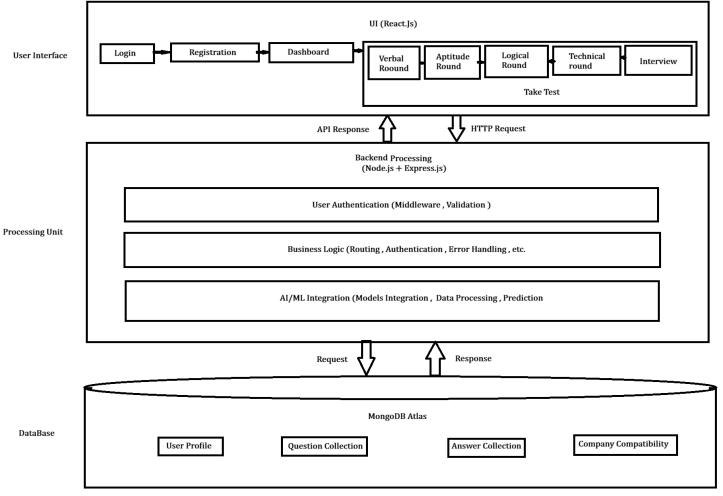
Frontend (React) The React-based frontend provides a dynamicandresponsiveuserinterface.Itconsistsofvarious components,includingdashboards,assessmentinterfaces, andrecommendationdisplays.
Backend (Node.js and Express.js) Thebackend,powered byNode.jsandExpress.js,handlestheapplication’sbusiness logic,routing,andinteractionswiththedatabase.Itincludes
International Research Journal of Engineering and Technology (IRJET) e-ISSN:2395-0056
Volume: 11 Issue: 03 | Mar 2024 www.irjet.net p-ISSN:2395-0072
multiple middleware functions for user authentication, logging,anderrorhandling.
Database (MongoDB) MongoDB serves as the primary database,storinguserprofiles,assessmentdata,totalmarks, and other relevant information. The NoSQL nature of MongoDBallowsforflexibilityindatastorageandretrieval.
Machine Learning Integration AI/ML models are integrated into the backend using relevant libraries and frameworks.Thesemodels,includingTFIDF,NaiveBayes, CNN, NLP, and STT, contribute to real-time assessment, personalizedstudyplans,andcompanymatchingalgorithms.
User Authentication is a crucial aspect of the system, ensuringsecureaccesstouser-specificdata.JWT(JSONWeb Token)authenticationisimplemented,providingastateless andsecuremethodforuserverification.
Assessment Rounds Whenauserinitiatesanassessment round, the frontend sends a request to the backend. The backendorchestratestheassessmentprocess,invokingthe appropriateAI/MLmodels.Userresponsesareprocessed, andscoresarecalculatedandstoredinthedatabase.
Total Marks Calculation Thebackendcomputesthetotal marks by aggregating scores from individual assessment rounds.Thistotalmarksinformationisupdatedintheuser profileandutilizedforsubsequentprocesses.
Webcam-BasedConfidenceAssessment Fortheinterview round,theapplicationactivatesthewebcamtocapturethe user’s responses. The recorded data is processed through AI/MLmodels,evaluatingcorrectnessandconfidencelevels. Real-timefeedbackisgeneratedandstoredforreference.
Company Matching Algorithm The Company Matching Algorithm takes into account the user’s total marks and preferences.Itgeneratesacuratedlistofeligiblecompanies, considering the evolving requirements of both the companies and the users. The list is regularly updated for accuracy.
Admin Panel The Admin Panel, secured through authentication, provides administrators with a comprehensive interface. It includes tools for monitoring useractivity,managingcontent(questions,studymaterials), andperformingnecessary maintenancetasks.Adminscan also access analytics and reports to gain insights into the overallsystemperformance
1:UserLogin:
2:1.Userprovidescredentials(usernameandpassword).
3:2.Systemverifiesthecredentials.
4:ifcredentialsarevalidthen
5:Proceedtothenextstep.
6:else
7:Displayanerrormessageandreturntostep1.
8:endif
9:TakeAssessment:
10:1.Userinitiatestheprocessoftakinganassessment.
11:2.Systemretrievesalistofavailableassessments.
12:3.Systempresentsthelistofassessmentstotheuser.
13:4.Userselectsanassessmenttotake.
14:StartAssessment:
15: 1. System retrieves questions for the selected assessment.
16:foreachquestionintheassessmentdo
17:1.Displaythequestiontotheuser.
18:2.Useranswersthequestion.
19:endfor
20:SubmitAnswers:
21:1.Usercompletesallquestionsintheassessment.
22:2.Usersubmitstheanswers.
International Research Journal of Engineering and Technology (IRJET) e-ISSN:2395-0056
Volume: 11 Issue: 03 | Mar 2024 www.irjet.net p-ISSN:2395-0072
23:3.Systemevaluatesthesubmittedanswersandcalculates thetotalmarks.
24:ViewFeedback:
25:1.Systemprovidesfeedbacktotheuser.
26:2.Displaythetotalmarksachieved.
27:foreachquestionintheassessmentdo
28:1.Displaythecorrectanswer.
29:2.Indicatewhethertheuser’sanswerwascorrect.
30:3.Provideadditionalfeedbackifnecessary.
31:endfor
32:EndAssessmentProcess.
5.2 Flowchart
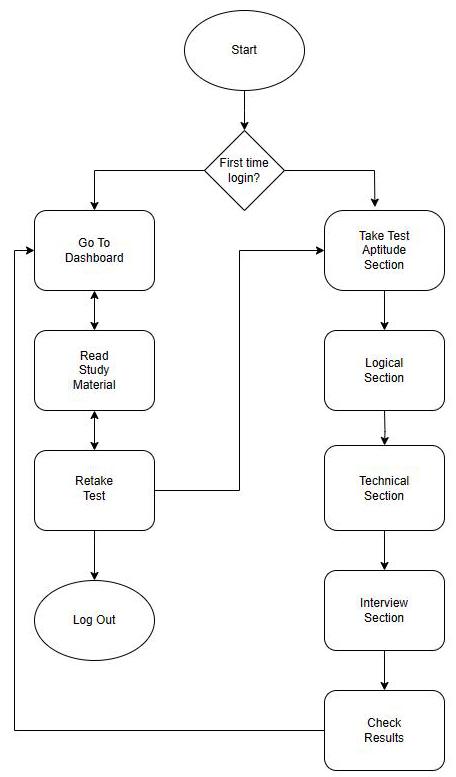
Figure 2: Flowchart
6. REQUIREMENTS
6.1 Hardware Requirements
1.Processor (For image analysis and building models):A multi-coreprocessorwithhighclockspeedisrecommended forefficientimageanalysisandmodeltraining.Aprocessor from the Intel i5 or i7 series, or an equivalent AMD processor,wouldbesuitable.
2.RAM(Forimageanalysisandbuildingmodels):Aminimum of 16GB of RAM is recommended for running machine learning tasks efficiently. More RAM may be required for handlinglargerdatasetsorcomplexmodels.3.Storage: An SSD (Solid State Drive) with at least 256GB of storage is recommended for faster read/write speeds, which is beneficialforhandlinglargedatasetsandrunningmachine learningtasks.
4.GPU(Optional forGPU-acceleratedMachine Learning):If you plan to use GPU-accelerated machine learning frameworkslikeTensorFlowwithGPUsupport,considera compatibleNVIDIAGPUwithCUDAsupportforfastermodel training.
5.Microphone:Sinceaudioanalysisispartoftheproject,a good quality microphone is required for capturing and processingaudiodata.
6.Camera:Sincevideoanalysisorimagecaptureisinvolved, awebcamorcamerawithsuitableresolutionandframerate capabilitiesisneeded.
1.IDE(IntegratedDevelopmentEnvironment):VisualStudio Code (VSCode): Visual Studio Code is a lightweight but powerful source code editor that runs on your desktop. It comeswithbuilt-insupportforJavaScript,TypeScript,and Node.js, making it an excellent choice for MERN stack development.
2. Package Manager and Project Execution: npm (Node PackageManager):npmisthedefaultpackagemanagerfor JavaScriptruntimeenvironmentNode.js.Itisusedtomanage andinstalldependenciesforyourproject,makingitacrucial toolforMERNstackdevelopment.
3.Front-endDevelopment:React.js:React.jsisawidely-used JavaScriptlibraryfor buildinguserinterfaces,particularly for single-page applications where data can change over time. It allows for efficient rendering and updating of UI components. Material-UI:Material-UIisapopularReactUI framework that provides pre-designed, customizable components following the Material Design guidelines. It acceleratesthefront-enddevelopmentprocessandensures aconsistent,visuallyappealinguserinterface.
4. Backend Development: Node.js: Node.js is a runtime environmentthatallowsyoutorunJavaScriptontheserverside. It’s well-suited for building fast, scalable network applications. Express.js: Express.js is a minimalist web applicationframeworkforNode.js.Itsimplifiestheprocess ofcreatingrobustandscalableAPIsandwebapplications.
5. Database: MongoDB Atlas: MongoDB Atlas is a fully managedclouddatabaseserviceforMongoDB.Itprovides
International Research Journal of Engineering and Technology (IRJET) e-ISSN:2395-0056
Volume: 11 Issue: 03 | Mar 2024 www.irjet.net p-ISSN:2395-0072
high availability, automatic scaling, and robust security features,makingitanexcellentchoiceforyourproject.
6.CloudServices:AmazonWebServices(AWS):AWSoffersa widerangeofcloudcomputingservices,includinghosting, storage, and machine learning capabilities. It provides a scalableandreliableplatformfordeployingandmanaging webapplications.
Asofthecurrentstageofdevelopment,significantprogress hasbeenmadeinimplementingcorefunctionalitiesofthe "SmartPrep"project.Thefollowingcomponentshavebeen successfullyimplemented
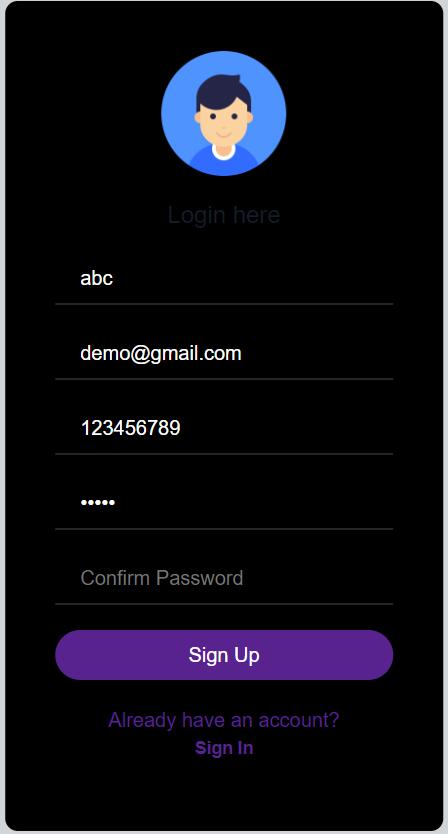
Signup Page:
Username: Field for the user to enter their desired username.
Email:Fieldfortheusertoentertheiremailaddress.
Password:Fieldfortheusertocreateapassword.
Confirm Password: Field for the user to re-enter their passwordforconfirmation.
SignUpButton:Buttontosubmitthesignupform.
Validation:
Ensurethatallfieldsarefilledoutcorrectlybeforeallowing theusertosubmittheform.
Display error messages if any fields are missing or if the passwordandconfirmpasswordfieldsdonotmatch.
Validateemailformattoensureitisinthecorrectformat.
International Research Journal of Engineering and Technology (IRJET) e-ISSN:2395-0056
Volume: 11 Issue: 03 | Mar 2024 www.irjet.net p-ISSN:2395-0072
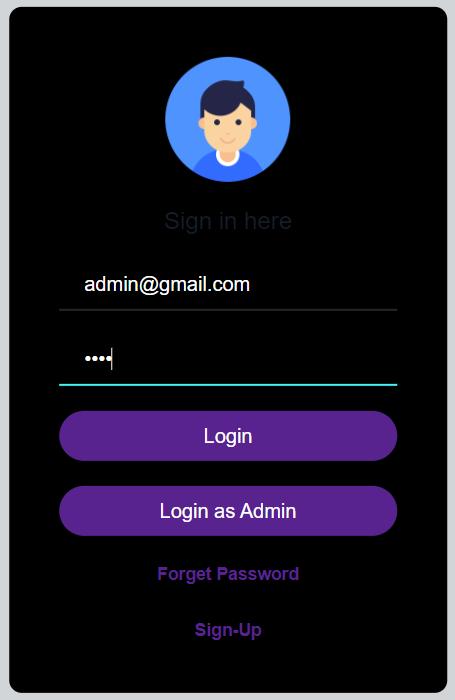
Login Page:
Username or Email: Field for the user to enter their usernameoremailaddress.
Password:Fieldfortheusertoentertheirpassword.
Forgot Password Link: Link to reset the password if forgotten.
LoginButton:Buttontosubmittheloginform.
Validation:
Ensurethatboththeusername/emailandpasswordfields arefilledoutbeforeallowingtheusertosubmittheform.
Display error messages if the credentials provided are incorrectoriftheaccountisnotyetregistered.
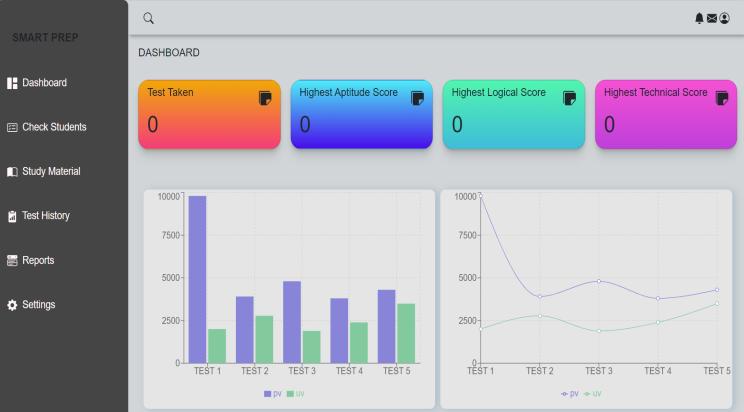
LeftPanel:
Displayasidebarmenuwithoptionssuchas:
StudyMaterial:Allowsuserstoaccessstudyresources.
TestHistory:Showsahistoryofteststakenbytheuser.
Reports:Providesinsightsandanalyticsonperformance.
Settings:Allowsuserstocustomizetheiraccountsettings.
MainDashboard:
Displayfourmaincardsonthedashboard,eachshowcasing differentmetrics:
NumberofTestsTaken:Displaysthetotalnumberoftests takenbytheuser.
Highest Score of Each Round: Shows the highest score achieved by the user in each placement round (verbal, technical,logicalreasoning,aptitude).
PerformanceGraphs:Graphicalrepresentationoftheuser's performanceovertime,showingtrendsandimprovements.
OverallProgress:Providesanoverviewoftheuser'soverall progressandreadinessforplacement.
ThePlacementPreparationWebApplicationrevolutionizes studentreadinessandrecruitmentwithholisticassessments, AI integration, and webcam-based interviews. It may empowersstudentswithpersonalizedfeedback andstudy material. Dynamic matching aligns opportunities with individualcapabilities.Thisinnovativetoolfostersrealistic preparationandanticipatesmarketneeds,tailoringjourneys forprofessionalsuccess.Inessence,it'snotjustatoolbuta catalystforstrategiccareerreadiness,markinganeweraof growth.
[1]Saraswat,Kajal.(2022).StudentsPlacementPrediction UsingMachineLearningAlgorithms.
[2] W. Alghamdi, "A Comparative Analysis on Machine Learning Based Student Placement Prediction," 2023 International Conference on Sustainable Communication NetworksandApplication(ICSCNA),Theni,India,2023,pp. 986-991,doi:10.1109/ICSCNA58489.2023.10370392.
[3] Shahane, Priyanka. (2022). Campus Placements Prediction & Analysis using Machine Learning. 1-5. 10.1109/ESCI53509.2022.9758214.
[4]Rajebhosale,Sagar,etal."SMARTCAMPUS–AnAcademic Web Portal with Android Application." International Research Journal of Engineering and Technology 3.4(2016): 389-394.
[5] Senarathne, Pasindu, et al. "Automate traditional interviewingprocessusingnaturallanguageprocessingand machine learning." 2021 6th International Conference for Convergence in Technology (I2CT).IEEE,2021.
[6] Couper, M. P., Berglund, P., Kirgis, N., & Buageila, S. (2016). Using Text-to-speech (TTS) for Audio ComputerassistedSelf-interviewing(ACASI).FieldMethods,28(2),95111.https://doi.org/10.1177/1525822X14562350
[7] Doyle, Alison. "Hard skills vs. soft skills: What's the difference." The Balance. Make money personal.–Rezhim dostupa: https://www. thebalance. com/hard-skills-vs-softskills-2063780 (data obrashcheniya: 07.02. 2017) (2020).
[8]Nawaz, Dr Nishad. "Robotic process automation for recruitment process." International Journal of Advanced Research in Engineering and Technology 10.2(2019).
2023, IRJET | Impact Factor value: 8.226 | ISO 9001:2008 Certified Journal | Page 28
International Research Journal of Engineering and Technology (IRJET) e-ISSN:2395-0056
Volume: 11 Issue: 03 | Mar 2024 www.irjet.net p-ISSN:2395-0072
[9]Sarkar,Sanglap,etal."NLPalgorithmbasedquestionand answering system." Seventh International Conference on Computational Intelligence, Modeling and Simulation.Vol.5. 2015.
[10] C. S. K and K. S. Kumar, "Data Preprocessing and Visualizations Using Machine Learning for Student PlacementPrediction," 20222ndInternationalConferenceon Technological Advancements in Computational Sciences (ICTACS), Tashkent, Uzbekistan, 2022, pp. 386-391, doi: 10.1109/ICTACS56270.2022.9988247.
© 2023, IRJET | Impact Factor value: 8.226 | ISO 9001:2008 Certified Journal | Page 29