
International Research Journal of Engineering and Technology (IRJET) e-ISSN:2395-0056
Volume: 11 Issue: 03 | Mar 2024 www.irjet.net p-ISSN:2395-0072
International Research Journal of Engineering and Technology (IRJET) e-ISSN:2395-0056
Volume: 11 Issue: 03 | Mar 2024 www.irjet.net p-ISSN:2395-0072
Arline Haingominarisoa1,2 , Hongwu Wang1 , 2*, Jhonny Rabefiraisana Harimialimalala 3,Yanqiong Wang1,2, Jean Pierre Bavumiragira1
1College of Environmental and Engineering, Tongji University, Shanghai China
2 Key Laboratory of Urban Water Supply, Water Saving, and Water Environment Governance in the Yangtze River Delta of Ministry of Water Resources, National Engineering Research Center for Urban Pollution Control, College of Environmental Science and Engineering, Tongji University, Shanghai, 200092, China
3 University of Faculty of Sciences, Life and Environmental Science Antananarivo Madagascar ***
Abstract
Water conservation is crucial for tackling global resource sustainability and economic development challenges. This study analyzes the socio-economic impacts of water conservation growth in Antananarivo, Madagascar, evaluating different strategies' potential benefits and drawbacks. An investigation and survey targeting Mandroseza Lake, involving the Ministry of Agriculture, Ministry of Environment, National Institute of Statistics, and JIRAMA National Water Company. Parameters like water production, distribution, infrastructure maintenance, economic growth, and water loss reduction were analyzed. Descriptive statistics and Pearson correlation were used to assess relationships between variables. Significant positive correlations were found between water conservation efforts and economic growth in domestic sectors (r=0.9856, p<0.0001), industry (r=0.9109, p<0.0001), and agriculture (r=0.8998, p<0.0001). Similar positive correlations were observed between water production and agriculture (r=0.9704, p<0.0001), industry (r=0.9541, p<0.0001), and household consumption (r=0.9256, p<0.0001). Additionally, a positive correlation was found between population and tap water availability (r=0.4219, p=0.0048). The study highlights the strong positive association between water conservation and economic growth, societal well-being, and tap water access in Antananarivo. This emphasizes prioritizing and funding sustainable water practices for stakeholders, water management officials, and policymakers.
Key Words: waterproduction,GDP,environmentalsustainability,management,agriculture,industry 1-INTRODUCTION
Waterconservationisacriticalissueinthecurrentglobalsetting,impactingbothenvironmentalsustainabilityand economic growth. While Earth's surface is 75% water, only 3% is freshwater (Saurí, 2013; Balasubramanian, 2015). Madagascar, the fourth largest island, faces this challenge with its 29.6 million population experiencing significant economic expansion in agriculture, mining, and trade (Statista, 2018). Integrating conservation with development is crucial(Bidaud,2015).Expandingindustriesandagricultureexacerbatewaterscarcity(Bouët,2022).Madagascar'swater resourcesvaryregionally,withabundantsummerrainfall(2,000-3,000mmannually)(CYCLE–VolII,2009).However,only 12,170 cubic meters per capita were available in 2020, with 60% lacking access to safe drinking water (Weiskopf et al., 2021; Grönwall et al., 2020). Antananarivo, the capital, faces water scarcity challenges due to a growing population, limited water sources, and unreliable rainfall (Rakotoarimanana et al., 2022). Water shortages are common, especially during the dry season when demand exceeds supply (Suryanegara et al., 2023). Insufficient infrastructure leaves many Antananarivoresidentswithoutreliablepipedwater,forcingthemtoendureintermittentsupplyandlowpressure(Andey et al., 2009). This strain on households makes meeting basic water needs a constant challenge. Contamination from industrial activities, inadequate sanitation, and improper waste disposal further aggravate the situation, polluting water sources and posing health risks through waterborne diseases (Bastaraud et al., 2020). Inefficient distribution systems, poor maintenance, and limited investment in infrastructure exacerbate these issues. Additionally, weak regulations on pollutioncontrolandwaterconservationworsenthesituation(Bastaraudet al.,2020).
Effortsareunderwaytoaddressthesechallengessuchasgovernments,NGOs,andinternationalpartnerscollaboratingon projectstoimprovewatersupply,upgradeinfrastructure,promoteconservation,andenhancemanagementpractices.The $220 million National Water Project aims to increase water access and improve utility performance in Greater Antananarivo and selected towns (World Bank, 2022). City-led programs focus on reducing water losses, improving continuity of supply, and increasing production capacity (Vivek et al., 2020). Continued efforts towards better
International Research Journal of Engineering and Technology (IRJET) e-ISSN:2395-0056
Volume: 11 Issue: 03 | Mar 2024 www.irjet.net p-ISSN:2395-0072
infrastructure, efficient management, and awareness campaigns are crucial for promoting responsible water usage and environmental conservation. Achieving long-term improvement requires sustained commitment and investment. Antananarivo's rapid urbanization has strained its water infrastructure, making access to clean water a major concern. Population growth has outpaced water demand management, leading to difficulties for local authorities in providing consistent access (Hinz et al., 2020). Despite infrastructure improvements, a significant portion of the city lacks clean drinking water due to outdated systems, poor maintenance, and insufficient capacity to meet rising demand (Rajaomahefasoaet al.,2019).Thisissuedisproportionatelyaffectscertainpopulations,exacerbatingexistinginequalities. The city's water treatment capacity has not kept pace with population growth since 1985, with daily production only increasing by 100,000 m3 while the population grew by 5% annually (Castelli, 2018; Miakatra, 2014). This aging infrastructure,withanefficiencyof60%,strugglestomeetthecurrent2%annualwaterdemandincrease(D'EAU,2020). Although a new component increased capacity in 2017, it's too early to assess its impact on water quality. With the projected population reaching 3.4 million by 2020, the demand-supply imbalance is expected to worsen (Ricci et al., 2009). The link between population growth and water access highlights a critical issue requiring immediate attention. Comprehensive and sustainable solutions are crucial to ensure equitable access for all citizens. Addressing the complex challenges of urbanization and its impact on essential services necessitates proactive measures and international collaborationasthecitycontinuestoexpand.Thepresentworkaimsandobjectivesofthisstudyaretoanalyzethesocioeconomic impacts growth of water conservation in Antananarivo, Madagascar, and assess the potential benefits and drawbacks of different conservation strategies, by examining several elements to understand the complex relationship betweenwaterconservationandeconomicoutcomes.
2.1
AninvestigationandsurveywereconductedattheofficesoftheMinistryofAgriculture,MinistryofEnvironment, NationalInstituteofStatistics(https://www.instat.mg/),andJIRAMA(https://www.jirama.mg/),focusingonMandroseza Lake in Antananarivo. Mandroseza Lake, one of Antananarivo's largest, is situated southwest of the city. This 40-hectare settling basin, with an estimated volume of 800,000 cubic meters, primarily relies on the Ikopa River for water supply, drawnthroughanintakedamequippedwithfivepumps.Thelake'sgeographicalcoordinatesintheLabordesystemareX: 517053.86m-518201.05mandY:795398.24m-796984.48m,correspondingtolatitudes18°55'30.72''S-18°56'22.56''S andlongitudes47°32'55.68''E-47°33'34''E,atanaltitudeofapproximately1266metersabovesealevel.
2.2 Data collection technique
Thisstudyemployedaquantitativeresearchapproachtoinvestigatetherelationshipbetweenwaterconservation and economic performance in Antananarivo, Madagascar. One hundred questionnaires were randomly distributed and collected from respondents. Quantitative methods were chosenfor their focus on numerical data and statistical analysis, enabling the testing of hypothesized relationships between variables. While utilizing secondary data analysis has limitationsintermsofcontrolanddepth,itoffersvaluableinsightsintobroadtrendsandallowsforgeneralizabilityacross Antananarivo. Data spanning from 2013 to 2022 were gathered based on availability. To evaluate the effectiveness of waterconservationefforts,parameterssuchassurveyquestions,overallwaterproduction,water-relatedjobcreationrate evolution, percentage of water distribution infrastructure maintenance, percentage of production profit, growth rate of real GDP, wastewater rate diminution, number of tourists, number of improved freshwater ecosystems, water loss reductionrate,andinfrastructuremaintenanceratewereconsidered.
2.3
The collected data were organized in MicrosoftExcel and analyzedusing Prism9 software.Descriptivestatistics wereemployedforthesurveyquestions.Therelationshipbetweenvariablesrelatedtowaterconservationanditsimpact was assessed using Pearson correlation analysis. A significance level of alpha ≤ 0.05 was adopted for determining statisticalsignificance.
International Research Journal of Engineering and Technology (IRJET) e-ISSN:2395-0056
Volume: 11 Issue: 03 | Mar 2024 www.irjet.net p-ISSN:2395-0072
Inquiryintowaterconservationpolicies
Have you observed any measurable changes in economic indicators (e.g., job creation, GDP, investment) attributable to JIRAMA's water conservationpolicies? 74 14 12
Havecollaborativeeffortswithstakeholderspositivelyinfluencedthe successofwaterconservationpoliciesatJIRAMA?
75 11 14
Are you aware of the water conservation policies implemented by JIRAMAMandroseza? 64 24 12
Do you believe that water conservation policies have contributed to jobcreationoreconomicopportunitiesinMandroseza?
79 8 13
Do you feel that residents have been adequately involved in the decision-making process regarding water conservation policies in Mandroseza? 65 33 12
Is there a mechanism in place for residents to provide feedback or suggestionsonwaterconservationpolicies?
67 20 13
Thetable(1)reflectstheperceptionsofrespondentsregardingwaterconservationpoliciesandtheirimpact.The majorityofrespondentsansweredpositivelytomostquestions,suggestingthattheyhaveobservedmeasurablechangesin economic indicators over the past years. This results in believing the positive influence of collaborative efforts of the administrativepolicieshascontributedtojobcreationandeconomicopportunities.
A significant 74% of respondents detailed observing quantifiable changes in economic indicators connected to JIRAMA's water conservation policies. This recommends a predominant conviction among inhabitants that these activities have emphatically affected variables like work creation, GDP, and investment. The majority (75%) of members accepted that collaborativeeffortswithpartnershaveemphaticallyimpactedthevictoryofwaterpreservationarrangementsatJIRAMA. This demonstrates an agreement among inhabitants that including different partners is pivotal for the effectiveness of water preservation activities. Sixty-four percent (64%) of respondents claimed awareness of the water conservation policiesimplementedbyJIRAMA,whereas25%werenotmindful.Thisdisparityproposesapotentialneedforprogressed communication or open outreach concerning the existing arrangements. An overpowering 79% of respondents accepted thatwaterpreservationarrangementshavecontributedtoworkcreationoreconomicopportunitiesinMandroseza.This positive recognition underscores a high level of confidence among inhabitants in the socio-economic benefits related to water preservation activities. Almost two-thirds (65%) of respondents felt that inhabitants have been satisfactorily included in the decision-making preparation concerning water preservation approaches. In any case, a critical 33% communicateddisappointmentwiththelevelofcitizeninclusion,highlightingpotentialholesincomprehensivedecisionmakingforms. The study revealed that67%of respondents were mindful of mechanisms input for inhabitants tosupply feedback or recommendations on water preservation approaches. Whereas this demonstrates a direct level of mindfulness,the20%whowerenotmindfulrecommendroomforchangeincommunicatingaccessiblecriticismchannels. ThesurveyconductedtogaugepublicperceptionofJIRAMA'swaterconservationinitiativesinMandroseza,Antananarivo, yielded valuable insights. Respondents predominantly held positive views regarding the impact of these initiatives on their communities, aligning with existing literature that highlights the potential economic benefits linked to water conservationprograms(Ramaharoet al.,2024;Ozceliket al.,2021).
The substantial consensus among respondentsregardingthe positive economic outcomes of specificapproaches indicatesthattheseinitiativesnotonlycontributetocommunitywell-beingbutalsohavethepotentialtobolsterregional economic stability. Nevertheless, the revelation that a quarter of respondents lacked a sufficient understanding of the policies raised concerns. Previous studies stress the importance of transparent communication in environmental policy
International Research Journal of Engineering and Technology (IRJET) e-ISSN:2395-0056
Volume: 11 Issue: 03 | Mar 2024 www.irjet.net p-ISSN:2395-0072
implementation(Kesti,2019).Consequently,thesurveyresultsemphasizethe necessityfor JIRAMAandpolicymakersto craft targeted communication strategies to bridge this awareness gap, thereby cultivating a more informed and engaged community.Thesefindingsunderscorethecriticalroleplayedbycommunityandstakeholderinvolvementinthesuccess of water conservation initiatives. Through active engagement with residents and relevant stakeholders, JIRAMA and policymakers can harness collective knowledge and resources to implement sustainable water management practices effectively.
r=0.9575*** p-value =0.0001
From Figure (1), a correlation coefficient (r) of 0.9575 signifies a very strong positive correlation between time and the water-related job creation rate. This indicates that as the years progress, the percentage of new jobs created within the water sector consistently rises. Moreover, the p-value of 0.0001 is exceptionally low, implying that the correlationisstatisticallysignificant.Thus,thereisstrongevidencesuggestingagenuineconnectionbetweentimeandthe growth of water-related jobs. As the global population expands and climate change intensifies, water resources become increasingly scarce. This scarcity often leads to heightened investments in water management, infrastructure development, and technological solutions, which create new job opportunities in these sectors. Technologies like desalination, wastewater treatment, and water recycling are witnessing considerable growth due to advanced technologiesandgrowingdemandsforcleanwater.Thisexpansiongeneratesmorejobopeningsforengineers,scientists, technicians, and other professionals. This study reinforces the socio-economic impact of water conservation efforts in Madagascar,particularlyintheJIRAMAAntananarivoregion.Itdemonstratesarobustpositiverelationshipbetweentime andjobcreationinthewatersector.Thissuggestsacontinuousincreaseinnewemploymentopportunitiesovertheyears, indicating that intensified water preservation efforts have resulted in growth in job opportunities. These findings corroborate previous research highlighting environmental conservation initiatives' potential to stimulate economic development and employment (Dasgupta et al., 2021). The measurably significant relationship, as evidenced by the extremely low p-value of 0.0001, further strengthens the validity of the observed relationship. A p-value lower than the conventionalthresholdof0.05indicatesstrongevidenceagainstthenullhypothesis,recommendingthattherelationship observed is highly improbable due to random chance alone (World Bank, 2021). In conclusion, the research highlights a strong link between time and the growth of water-related jobs in Madagascar. This emphasizes the importance of continued investment in water conservation initiatives for policymakers and stakeholders. Prioritizing effective water resource management can address environmental challenges and promote socio-economic development by creating job opportunities. Furthermore, the discoveries underscore the requirement for prolonged observation and evaluation of water conservation programs to accurately measure their socioeconomic impacts over time (Jagger and Shively, 2014). Longitudinal studies, such as the one conducted in this inquiry, offer valuable insights into the evolving relationship betweenwaterpreservationeffortsandbusinesspatternsovertime(Ashrafet al.,2023).
International Research Journal of Engineering and Technology (IRJET) e-ISSN:2395-0056
Volume: 11 Issue: 03 | Mar 2024 www.irjet.net p-ISSN:2395-0072
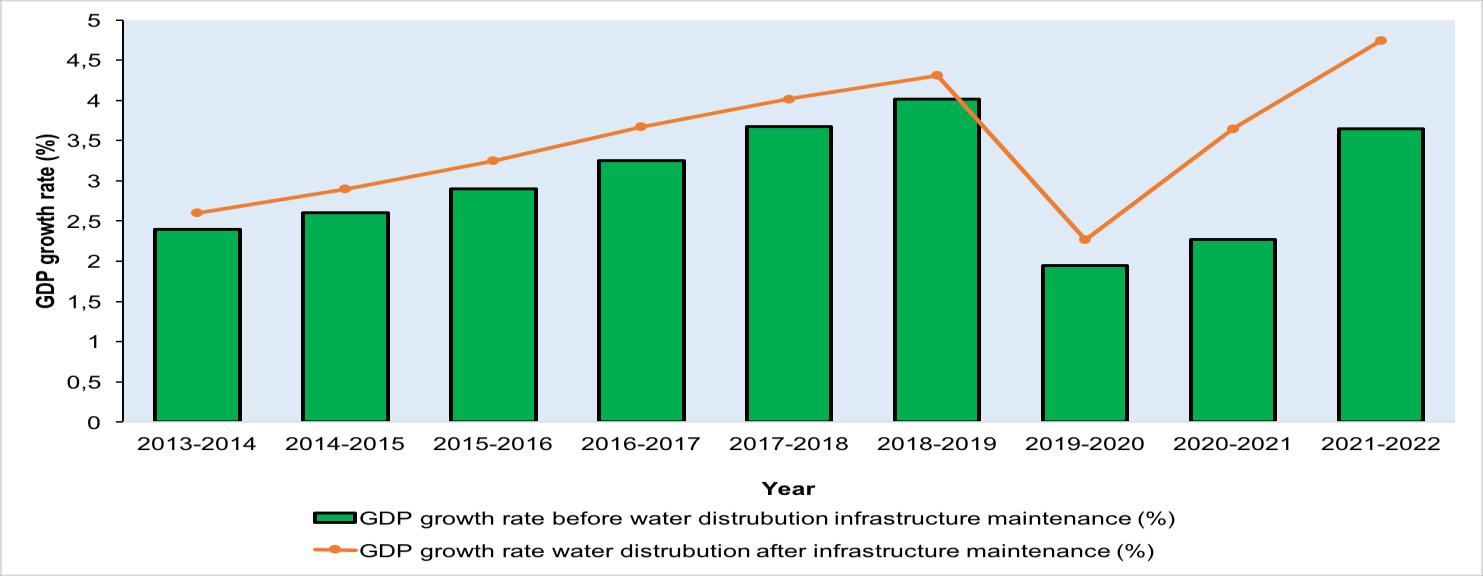
Figure 2: GDP growth rate over a period
Figure (2) presents the GDP growth rates before and after water distribution infrastructure maintenance over several years. The data exhibits a discernible pattern in GDP growth rates post-implementation of water distribution infrastructure maintenance, hinting at a link between enhanced water management and economic prosperity. Before infrastructuremaintenance, Antananarivo'sGDPgrowthratesgraduallyascendedfrom1.12%in2013-2014 to 5.02%in 2017-2018,although withvariationsinsomeyears.Nonetheless,growthrateswitnessedaminordecreaseinsucceeding years,reaching2.65%in2021-2022(WorldBank2017).Followingthemaintenanceofwaterdistributioninfrastructure, there emerged a striking alteration in GDP development rates. The development rates surpassed those of the premaintenance era, indicating a favorable impact of the infrastructure updates on economic growth. For example, the GDP growth rate escalated from 2.23% in 2013-2014 to 5.31% in 2018-2019 and advanced to 3.74% in 2021-2022 (Rakotoarimananaet al.,2022).
Some factors appear to explain the observed enhancement in GDP development rates following water distribution infrastructure maintenance. Improved access to clean water promotes public health, reduces waterborne diseases, and augments productivity, contributing to higher economic output. Effective water management can foster investment and economic activity by supplying a reliable water source for industries and agriculture (Nematchoua, 2021). Water infrastructure maintenance supports economic development via environmental sustainability and climate resilience, conserving resourcesandmitigating waterscarcity risks.Nevertheless,correlation does not necessarilyimplycausation; government policies and global economic conditions also affect GDP growth. Future research could employ econometric techniquestoexaminethecausalimpactofwaterconservationpoliciesonMadagascar'seconomy.
International Research Journal of Engineering and Technology (IRJET) e-ISSN:2395-0056
Volume: 11 Issue: 03 | Mar 2024 www.irjet.net p-ISSN:2395-0072
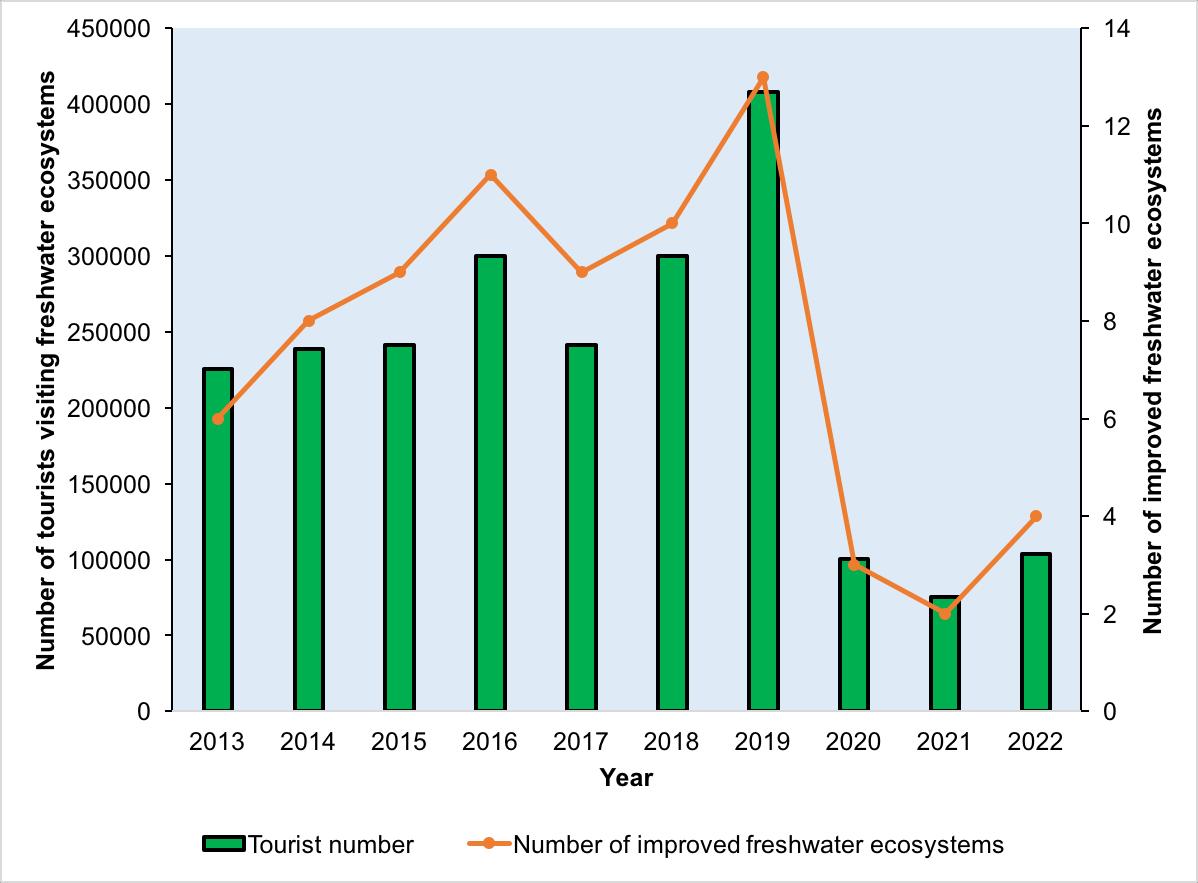
Figure 3: Number of tourists and the number of improved freshwater ecosystems as a function of year
Figure3providesinformationonthenumberoftouristsandthenumberof improvedfreshwaterecosystemsfor differentyears.Thegraphdisplaysfluctuationsinbothtouristnumbersandthecountofimprovedfreshwaterecosystems overtheyears.TheprogressiveriseintouristentriesinAntananarivofrom2013to2019showcases agrowinginterestin Madagascar's tourism sector, potentially influenced by factors such as marketing efforts, political stability, and environmental attractions. The peak in 2016 with 300,150 tourists underscores the sector's potential economic significance.However,thesignificantdropin2020and2021,attributedtotheCOVID-19pandemic,highlightsthesector's vulnerability to external shocks. Concurrently, the varying count of improved freshwater ecosystems suggests the government's endeavors to prioritize environmental conservation. The increase from 2013 to 2019 reflects proactive measurestoprotectnaturalresourcesandbiodiversity,whichareoftenessentialfortourismdevelopment.However,the declinein2020and2021raisesconcernsabouttheprogressionandeffectivenessofconservationpoliciesamidchallenges suchasresourceallocationandcompetingpriorities.
Variations seen in both visitor numbers and the count of improved freshwater ecosystems underscore the complex relationshipbetweenconservationpoliciesand economicgrowth.Costa Rica'ssuccessful implementationofPaymentfor Ecosystem Services (PES) programs gives valuable experiences. PES incentivizes landowners to preserve ecosystems, fosteringbiodiversityandeco-tourism,andsubsequentlysupportingeconomicgrowth(Castroet al.,2000).Thedeclinein visitor numbers amid the COVID-19 outbreak emphasizes the significance of diversifying the economy beyond tourism. Rwanda'sAgaciro DevelopmentFund, Water Collection, Storage, and Slope Protection (LWH) programoffers a pertinent example. LWH's focus on rural productivity and water management demonstrates how diversified economic initiatives canmoderatetheimpactsofexternalshockswhilepromotingsustainablegrowth(Austin,2013).
International Research Journal of Engineering and Technology (IRJET) e-ISSN:2395-0056
Volume: 11 Issue: 03 | Mar 2024 www.irjet.net p-ISSN:2395-0072
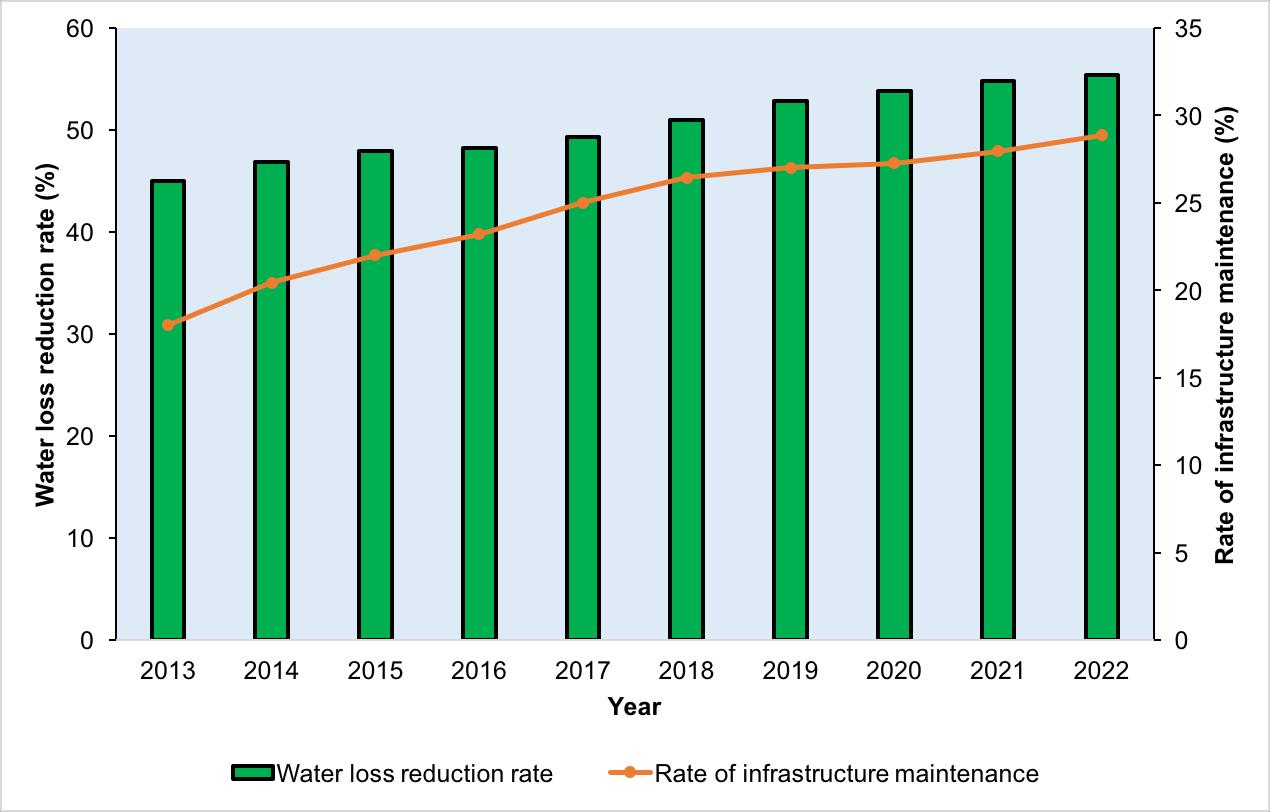
Figure4:Waterlossreductionrateandtherateofinfrastructuremaintenanceasafunctionofyear
The graph in Figure (4) provides information on the water loss reduction rate and the rate of infrastructure maintenancefordifferentyears.Thegraphindicatesanupwardtrendinboththewaterlossreductionrateandtherateof infrastructure maintenance over the years. This suggests efforts to improve water conservation and maintain infrastructureintegrity.Theincreasingvaluesindicateprogressandpotentiallymoreeffectivestrategiesimplementedto reducewaterlossandensureinfrastructureupkeep.
The information from Antananarivo, Madagascar, demonstrates a consistent upward trend in both the water loss reduction rate andthe rate ofinfrastructure maintenancefrom2013to2022. The waterloss reductionrateconsistently increased from 45% in 2013 to 55.37% in 2022, signifying critical changes in water usage efficiency and management practicesoveralongtime.Essentially,therateof infrastructuremaintenancerosefrom18%in2013to28.87% in2022, reflectingeffortstoupgradethereliabilityandlongevityofwatersupplysystems.
Thesetrendssuggesta proactiveapproachbythelocalauthorities,possiblyfacilitatedby water conservationpolicies,to addresswatermanagementchallengesandmaintainbasicfoundationsviably.Thereliableincreaseinboththewaterloss reduction rate and the rate of foundation maintenance highlights the interconnects of effective water management and infrastructureupkeepinfosteringsustainabledevelopmentandsupportingeconomicgrowthinAntananarivo.
The consistent upward trend within the water loss reduction rate reflects a commendable effort by the JIRAMA (Jiro sy Rano Malagasy) authorities in Antananarivo, Madagascar, to mitigate water losses through improved foundation andmanagementpractices.Aswaterisacrucialresourceforvarioussectors,includingagriculture,industry,anddomestic use, reducing losses can lead to more feasible water usage and contribute to economic growth (World Bank 2016). The progressiveincreaseinthe waterloss reductionrateimpliestheeffectiveimplementationof waterconservationpolicies and techniques aimed at minimizing leakages, unauthorized consumption, and inefficient distribution systems (Kabir et al., 2021). At the same time, the rising rate of infrastructure maintenance is crucial for ensuring the reliability and longevity of water supply frameworks. The consistent investment in infrastructure maintenance indicates a proactive approach by the authorities to address the challenges posed by aging infrastructure and guarantee continuous access to safe and clean water (Herrera, 2019). Satisfactory maintenance not only decreases the risk of system failures and disruptions but also improves the overall productivity of water conveyance, hence supporting economic activities and developmentinitiativesintheregion(Changet al.,2021).Thepositiverelationshipbetweenthewaterlossreductionrate and the rate of infrastructure maintenance underscores the interconnectedness of efficient water management and infrastructure upkeep. Effective arrangements and interventions aimed at reducing water losses must be complemented by investments in infrastructure support to achieve sustainable outcomes (He et al., 2021). By prioritizing both perspectives,thelocalexpertsinAntananarivoarelikelycultivatinganenvironmentconducivetoeconomicdevelopment, as solid access to water is fundamental for various sectors, including agriculture, manufacturing, and tourism (ESCAP, 2013).
International Research Journal of Engineering and Technology (IRJET) e-ISSN:2395-0056
Volume: 11 Issue: 03 | Mar 2024 www.irjet.net p-ISSN:2395-0072
rAgricutlure =0.8998*** p-value =0.0001
rIndustry =0.9109*** p-value =0.0001
rDomestic =0.9856*** p-value =0.0001
Figure5:PercentageofwaterdistributioninfrastructuremaintenanceVSPercentageofproductionprofit
Strong positive correlations have been established between water distribution infrastructure maintenance and production profit in agriculture, industry, and domestic sectors (Figure 5). Coefficients range from 0.8998 to 0.9856, indicating a substantial tendency for production profit to increase as the percentage of water distribution infrastructure maintenance rises. Low p-values (0.0001) confirm the statistical significance of these relationships, making them highly unlikely to occur by chance. Better upkeep of water distribution infrastructure is strongly associated with higher profits becauseitensuresefficientanduninterruptedwaterflowtofarms,industries,andhouseholds.Reliableaccesstowateris vital for crop growth, industrial processes, and daily activities, ultimately resulting in higher production and profitsdamaged or leaky infrastructure results in water waste, affecting resource availability and increasing pumping costs. Propermaintenancehelpsminimizetheselosses,ensuringefficientwaterutilizationandcostsavings,thuscontributingto improvedprofitability.
Well-maintained infrastructure also reduces contamination risks and guarantees the delivery of clean water. Enhanced productqualityinagricultureandindustry,alongwithhealthandhygienepromotionindomesticsettings,allcontributeto higherprofits.Thestrongpositivecorrelationsdemonstratethatmaintainingwaterdistributioninfrastructureisacritical factorinachievinghigherproductionprofitsacrossagriculture,industry,anddomesticsectors.Investingininfrastructure maintenancecanthereforebeconsideredastrategicmovetowardspromotingeconomicgrowthanddevelopment.
In summary, the strong positive correlations between water distribution infrastructure maintenance and production profit across different economic sectors highlight the importance of well-maintained infrastructure for achieving higher profitsandpromotingeconomicgrowthanddevelopment.
Themaintenanceofthewaterdistributionsystem,primarilyoverseenbyJIRAMA(JirosyRanoMalagasy),playsa crucial role in the bustling metropolis of Antananarivo, Madagascar. Effective water distribution systems are vital for Antananarivo'sagriculturesector,whichsignificantlycontributestothecity'sGDP(Aubry,et al.,2012).Wateravailability isindispensableforfoodproduction,livestockcare,andirrigationpractices(Raffoet al.,2020).Properinfrastructurefor water distribution is essential for enhancing agricultural output and ensuring food security in Madagascar, where agricultureplaysasubstantialroleintheGDP(Andriamahefazafy,2023).Watermanagementinagricultureholdscritical importance,ashighlightedbytheFoodandAgricultureOrganization(FAO)duetoitsimpactonsustainabledevelopment (Kirda, 1999). The industrial sector in Antananarivo significantly contributes to water consumption and can exacerbate waterscarcitywithoutadequateoversight.Solutionsforwaterconservationinthissectorinvolveadoptingwater-efficient
International Research Journal of Engineering and Technology (IRJET) e-ISSN:2395-0056
Volume: 11 Issue: 03 | Mar 2024 www.irjet.net p-ISSN:2395-0072
technologies, recycling treated water, and enforcing wastewater treatmentstandards.Stricter regulations and incentives promotingsustainablewaterpracticeswithinindustriesareessentialtomitigateenvironmentalimpactandreducewater usage (World Bank 1999). In Antananarivo, the expanding urban population strains water resources, particularly in the residentialsector.Sustainablewatermanagementsolutionsincludepublicawarenesscampaigns,promotingwater-saving appliances, efficientwater supplysystems, implementingwaterharvestingsystems, and enforcing wateruse restrictions duringshortages(Ortigara,2018;Rasolonjatovo,2021).Theinfrastructureforwaterdeliveryin Antananarivoisvitalfor sustaininghousehold,commercial,andagriculturalactivities.Thereferencesconsultedemphasizethecriticalroleofwater acrossvariousindustriesandunderscorethenecessityofcomprehensivewatermanagementplanstoaddress theregion's diversewater-relatedchallenges.
rAgriculture =0.9704*** p-value =0.0001
rIndustry =0.9541*** p-value =0.0001
rDomestic =0.9256*** p-value =0.0001
Across agriculture, industry, and domestic sectors, strong positive correlations exist between overall water production and production profit (coefficients ranging from 0.9256 to 0.9704 (Figure 6)). This suggests that increased water availability can significantly boost profits across various economic segments. Statistically significant p-values (0.0001)supporttheobservedconnections,indicatingagenuinelinkbetweenwaterproductionandprofitability.
Increased water enables agricultural expansion and higher yields, facilitates efficient industrial processes, and promotes health and hygiene in domestic settings, all contributing to economic gains. Additionally, it may encourage water-saving technologies,potentiallyleadingtohigherprofitsevenwithincreasedproduction.
While increased water availability can spur economic opportunities, it's crucial to acknowledge limitations and other factorsinwatermanagementstrategies.Whilestrongcorrelationssuggestboostingwaterproductioncandriveprofits,we mustprioritizesustainablepracticestoensurelong-termenvironmentalandeconomicbenefits.
In Antananarivo, households are major water users, driven by population growth and urbanization. Daily needs like drinking and sanitation put pressure on water resources. Conservation efforts focus on raising awareness, repairing leaks, and promoting water-saving devices. However, infrastructure limitations and affordability pose challenges. Continuousmonitoringiscrucialtoassesseffectiveness(Molden,2001;Weerasooriyaet al.,2021).
Antananarivo'sgrowingindustrieshaveincreasedwaterdemand,straininglocalsources.Conservationstrategies emphasizeoptimizingprocesses,recyclingwater,andusingefficienttechnologies.Regulatoryframeworksandincentives are essential for compliance. Collaboration between industries and environmental agencies can improve water management(Barringtonet al.,2013).
International Research Journal of Engineering and Technology (IRJET) e-ISSN:2395-0056
Volume: 11 Issue: 03 | Mar 2024 www.irjet.net p-ISSN:2395-0072
FarmingiscrucialtoMadagascar'seconomyandimpactswateruseinAntananarivo.Traditionalirrigationand expandingfarmlandconsumesignificantwater.Conservationeffortsinvolvepromotingefficientirrigation,selectingcrops basedonwateravailability,andmanagingwatersheds.Collaborationamongfarmers,agriculturalextensionservices,and governmentagenciesiskeytosustainablewateruse(Batalhãoet al.,2023).
Effective water conservation in Antananarivo requires integrated policies involving government, communities, and industries, addressing each sector's unique challenges. Continuous research, data collection, and international partnershipsarecrucialformonitoringprogressandadaptingstrategies(Hukkaet al.,2010;Liu,2018).
Water, essential for life and development, faces growing demand in Madagascar's capital, Antananarivo. This surge is driven by rapid population growth and urbanization, straining the city's ability to supply clean water to its residents (Howard et al., 2020). Access to basic amenities like tap water becomes increasingly urgent as the city's population landscaperapidlychanges.
The investigation of water distribution systems in Antananarivo, Madagascar underscores their vital role in agricultural,industrial,andresidentialsectors.Strongrelationshipcoefficients(rvalues)of0.8998,0.9109,and0.9856 for agriculture,industry,andhouseholduse,alongwithhighlysignificantp-valuesof0.0001,highlightthecriticaldependence ofthesesectorsonefficientwaterdeliverysystems.Noteworthyrelationshipcoefficientsof0.9704,0.9541,and0.9256for overall waterproduction withinagriculture,industry,andhouseholddomainsfurtheremphasizetheinterconnectedness betweenwaterinfrastructureandsustainedeconomicactivities.
These findings advocate for targeted investments and strategic interventions in water distribution systems to ensure resilienceandadequacyinmeetingAntananarivo'sdiverseneeds.Therelationshipbetweenpopulationsizeandtapwater access rate (r = 0.4219, p-value = 0.0048) underscores the importance of aligning infrastructure development with demographicchanges.Proactivemeasuresareessentialasthepopulationgrowstopreserveandenhancetapwateraccess ratesforareliablesupplyofcleanwatertotheexpandingcommunity
5-References
1 Saurí, D. Water conservation: Theory and evidence in urban areas of the developed world. Annual Review of EnvironmentandResources,2013.38:p.227-248.
2 Balasubramanian,A.Theworld’swater.UniversityofMysore,Mysore,2015.
3 Statista. Madagascar: Total population from 2018 to 2028. 2023; Available from: https://www.statista.com/statistics/460350/total-population-of-madagascar/
4 Bidaudetal VoluntarybiodiversityoffsetstrategiesinMadagascar.Ecosystemservices,2015.15:pp.181-189.
5 Bouëtet al. Africaagriculturetrademonitors2022.Vol.2022.2022:IntlFoodPolicyResInst.
6 CYCLE–VolII,H.andV.Babkin,OnMadagascar,1000mmarerecordedonaveragenorth of20oS,and1200 mm ontherestoftheisland.OnlandnexttotheMediterraneanSea(30to40oN),therainsdiminishfrom374mmin the westernmost part of this belt to 74 mm in the east. The northern and western slopes of the mountainous complexes(morethan800mm),andthesectionofshorebetween.HydrologicalCycleVolumeII,2009:p.29.
7 Weiskopfet al. ClimatechangerisksandadaptationoptionsforMadagascar.EcologyandSociety,2021.26(4).
8 Grönwall et al. Regarding groundwaterand drinking wateraccess through a humanrightslens: Self-supplyas a norm.Water,2020.12(2):p.419.
9 Suryanegara et al.. Women's Vulnerability to Household Water Management During COVID-19 Pandemic. Jurnal PenelitianPendidikanIPA,2023.9(7):p.4885-4893.
10 ZyHarifidy,R.,et al..ASystematicReviewofWaterResourcesAssessmentataLargeRiverBasinScale:Caseofthe MajorRiverBasinsinMadagascar.Sustainability,2022.14(19):p.12237.
International Research Journal of Engineering and Technology (IRJET) e-ISSN:2395-0056
Volume: 11 Issue: 03 | Mar 2024 www.irjet.net p-ISSN:2395-0072
11 Andey et al.. Influence of intermittent and continuous modes of water supply on domestic water consumption. WaterResourcesManagement,2009.23:p.2555-2566.
12 Bastaraud,Aet al. Theimpactofrainfallondrinkingwater qualityinAntananarivo, Madagascar.PloSone,2020. 15(6):p.e0218698.
13 Bank,W.Madagascar:$220MilliontoImproveBasicWaterandSanitationServicesandSupply.2022.
14 Vivek,Ket al. ReviewofSmartWaterManagementTechniquesacrosstheglobe.2020.
15 Hinz,Ret al..AgriculturaldevelopmentandlandusechangeinIndia:Ascenarioanalysisoftrade‐offsbetweenUN SustainableDevelopmentGoals(SDGs).Earth'sFuture,2020.8(2):p.e2019EF001287.
16 Rajaomahefasoa, R.E et al. Radium isotopes for groundwater age and sustainability in the highland of Antananarivo,Madagascar.JournalofAfricanEarthSciences,2019.156:p.94-107.
17 Castelli,F.Driversofmigration:whydopeoplemove?JournalofTravelMedicine,2018.25(1):p.tay040.
18 Miakatra,L.S.Communityparticipation,andwatersupplyindeprivedareasofMadagascar.FieldActionsScience Reports.Thejournaloffieldactions,2014(SpecialIssue11).
19 D’eau, P., Etudes De La Performance Des Ouvrages Pour Le Traitement d’eau Potable, Cas De La Jirama Mandroseza.
20 Ricci,P.Fet al. Globalwaterquality,supplyanddemand:implicationsformegacities. inInternationalSeminaron NuclearWarandPlanetaryEmergencies:25thSession:"E.Majorana"CentreforScientificCulture,Erice,Italy,1924August,2000.2001.WorldScientific.
21 Jay,G.andF.Giovannetti,Madagascar-IrrigationandWatershedManagementProject:resettlementplan(Vol.2): Etude d'impact environnemental et social (EIES) et elaboration d'un plan d'actions de réinstallation (PAR) au niveauapdpourlestravauxdecaptageetirrigationdupérimètred'Ankaibe.2013.
22 Nematchoua,M.K.Analysis,andcomparisonofpotentialresourcesandnewenergypolicyofMadagascarisland;A review.RenewableEnergy,2021.171:p.747-763.
23 Ramaharo,F.,et al..Theimpactofenergydemandoneconomicgrowth:AnewempiricalevidenceforMadagascar. 2024.
24 Ozcelik, N. et al. Indicating the wrong track? A critical appraisal of water productivity as an indicator to inform waterefficiencypolicies.Resources,ConservationandRecycling,2021.168:p.105452.
25 Han,Z.et al. Stakeholderengagementinnaturalresourcesmanagement:Wheregofromhere?JournalofCleaner Production,2024.435:p.140521.
26 Kesti,E.Domesticwatersupplypolicyevaluation:AcomparativecasestudyofUgandaandMadagascarbetween 1992and2016.2019.
27 Dasgupta, S et al. The impact of sea level rise on developing countries: a comparative analysis. Climatic change, 2009.93(3-4):p.379-388.
28 Bank,W.MadagascarWaterNationalProject.2021.
29 Jagger, P. and G. Shively, Landuse change, fuel useand respiratory healthinUganda.Energy policy, 2014. 67: p. 713-726.
30 Ashraf,M.S.,F.Ahmed,andS.Rehman,SustainableEconomicGrowthandSustainableDevelopmentGoals(SDGs): EmpiricalEvidencefromLow&LowerMiddle-IncomeCountries.JournalofSocialSciencesReview,2023.3(1):p. 824-832.
31 Bank,W.,MadagascarEconomicUpdate,October2017:CopingwithShocks.2017:WorldBank.
International Research Journal of Engineering and Technology (IRJET) e-ISSN:2395-0056
Volume: 11 Issue: 03 | Mar 2024 www.irjet.net p-ISSN:2395-0072
32 Harifidy,R.Z.andI.Hiroshi,AnalysisofRiverBasinManagementinMadagascarandLessonsLearnedfromJapan. Water,2022.14(3):p.449.
33 Castro, R., et al. The Costa Rican experience with market instruments to mitigate climate change and conserve biodiversity.Environmentalmonitoringandassessment,2000.61:p.75-92.
34 Austin,M.A.Rwanda-LandHusbandry,WaterHarvestingandHillsideIrrigation:P114931-ImplementationStatus ResultsReport:Sequence06.2013.
35 Bank,W.,Highanddry:Climatechange,water,andtheeconomy.2016:TheWorldBank.
36 KabirIbrahim,S.T.,B.Bakhtawar,andT.Zayed,Applicationoffiberopticsinwaterdistributionnetworksforleak detectionandlocalization:amixedmethodology-basedreview.2021.
37 Herrera,V.,Reconcilingglobalaspirationsandlocalrealities:ChallengesfacingtheSustainableDevelopmentGoals forwaterandsanitation.WorldDevelopment,2019.118:p.106-117.
38 Chang, H., et al. Understanding urban flood resilience in the anthropocene: a social–ecological–technological systems(SETS)learningframework,inTheAnthropocene.2021,Routledge.p.215-234.
39 He, S.-S., et al. Economic evaluation of water-saving irrigation practices for sustainable sugarcane production in GuangxiProvince,China.SugarTech,2021:p.1-7.
40 ESCAP,U.,Watersecurity&theglobalwateragenda:AUN-wateranalyticalbrief.2013:UnitedNationsUniversity (UNU).
41 Aubry, C., et al. Urban agriculture and land use in cities: An approach with the multi-functionality and sustainabilityconceptsinthecaseofAntananarivo(Madagascar).Landusepolicy,2012.29(2):p.429-439.
42 Raffo, A., et al. Effect of light intensity and water availability on plant growth, essential oil production and compositioninRosmarinusofficinalisL.EuropeanFoodResearchandTechnology,2020.246:p.167-177.
43 Andriamahefazafy, M., Governing Distant-Water Fishing within the Blue Economy in Madagascar: Policy Frameworks,ChallengesandPathways.Fishes,2023.8(7):p.361.
44 Kirda,C.,Cropyieldresponsetodeficitirrigation:reportofanFAO/IAEAco-ordinatedresearchprogrambyusing nucleartechniques:executedbytheSoilandWaterManagement&CropNutritionSectionoftheJointFAO/IAEA DivisionofNuclearTechniquesinFoodandAgriculture.Vol.84.1999:SpringerScience&BusinessMedia.
45 Bank,W.,Waterresourcesmanagement:AWorldBankpolicypaper.1993:TheWorldBank.
46 Ortigara, A.R.C., M. Kay, and S. Uhlenbrook, A review of the SDG 6 synthesis report 2018 from an education, training,andresearchperspective.Water,2018.10(10):p.1353.
47 Rasolonjatovo,F.andH.Huboyo.Proposinganewstrategytominimizedomesticwastewater undertheinfluence ofhumanfactorinAntananarivo,Madagascar.inIOPConferenceSeries:Earthand EnvironmentalScience.2021. IOPPublishing.
48 Molden,D.,Waterresponsestourbanization.2007,Springer.p.207-209.
49 Weerasooriya, R., et al. Industrial water conservation by water footprint and sustainable development goals: a review.Environment,DevelopmentandSustainability,2021:p.1-49.
50 Barrington, D.J. A. Prior, and G. Ho, The role of water auditing in achieving water conservation in the process industry.Journalofcleanerproduction,2013.52:p.356-361.
51 Batalhão, A.C., et al.. Integrated Water Resources Management and Urban Sustainability, in The Route Towards GlobalSustainability:ChallengesandManagementPractices.2023,Springer.p.289-312.
International Research Journal of Engineering and Technology (IRJET) e-ISSN:2395-0056
Volume: 11 Issue: 03 | Mar 2024 www.irjet.net p-ISSN:2395-0072
52 Hukka, J.J. J.E. Castro, and P.E. Pietilä, Water, policy and governance. Environment and History, 2010. 16(2): p. 235-251.
53 Liu,L.andM.B.Jensen,Greeninfrastructureforsustainableurbanwatermanagement:Practicesoffiveforerunner cities.Cities,2018.74:p.126-133.
54 Howard,G., et al. Securing 2020visionfor2030:climatechangeandensuringresiliencein waterandsanitation services.Journalofwaterandclimatechange,2010.1(1):p.2-16.
2024, IRJET | Impact Factor value: 8.226 | ISO 9001:2008 Certified Journal | Page13