
International Research Journal of Engineering and Technology (IRJET) e-ISSN: 2395-0056
Volume: 11 Issue: 02 | Mar 2024 www.irjet.net p-ISSN: 2395-0072
International Research Journal of Engineering and Technology (IRJET) e-ISSN: 2395-0056
Volume: 11 Issue: 02 | Mar 2024 www.irjet.net p-ISSN: 2395-0072
Tushar Surwade1 , Vrushali Wankhede2, Varun Singh3, Aishwarya Patil4, Mehbash Sande5 , Rajesh Pawar6
1,2,3,4,5,6Computer Engineering Department, Keystone School of Engineering, Pune, Maharashtra, India.
Abstract:
Thisarticleinvestigatestheuptakeofdronedelivery services in emerging economies, examining factors such as personal innovativeness, outcome expectancy, emotions, and perceived risk. Drone delivery offers advantagessuchasflexibility,accessibility,speed,safety, andenvironmentalbenefits.Itconductsacomprehensive reviewofexistingliterature,identifiescurrenttrendsand challenges, and proposes avenues for future research. Businesses are increasingly exploring autonomous solutionsforthelast-miledeliverytoremaincompetitive and fulfill rising delivery demands. Drones, especially unmanned aerial vehicles, emerge as a promising solution in the realm of logistics. Recent regulations introduced by the Flight World Organization support the operation of unmanned aerial systems, further facilitatingtheirintegrationintodeliveryoperations.The surge in online shopping has intensified the need for efficient delivery mechanisms, thus driving the adoption of drone technology. Quadcopters, equipped with stable flight capabilities, are employed for various purposes including surveillance, data gathering, and localized deliveries.Theintegrationofdeliverydronesintothelastmile shipping industry holds the promise of expedited deliveries,decreasedlabor expenses,and advantagesfor dronemanufacturers,signifyingatransformativeshiftin the realm of logistics and delivery services.
Key Words: Dronedeliveryservices,Emergingeconomies, Personal innovativeness, Outcome expectancy, Perceived risk,Flexibility,Quadcopters,Logistics.
The logistics and transportation industries are currently experiencingrapidgrowth,drivenbysignificantinnovations. The explosion of e-commerce, facilitated by widespread internet access, coupled with advancements in delivery methods, has led to a substantial surge in the volume of packageshandledbycorporationsworldwideeachyear.For example,in2019alone,Chinaprocessedanaverageof63.5 billionparcels,whileglobally,anaverageof3248packages were shipped every second. Projections indicate a further increasetobetween220to262billionpackagesby2026.[1] Regarding the use of drones in parcel delivery within the logistics industry, companies have increasingly turned to
drone technology. This innovation has notably impacted sectorssuchase-commerceandhealthcare.Amazon'sPrime Air,launched in2013,standsoutasoneofthepioneering automateddeliverysystems.Obtainingfederalapprovalin 2020markedasignificantmilestoneforAmazon,allowing for the efficient and secure implementation of its drone packagedeliveryproject.
Intherestaurantindustry,majorplayerslikeDomino'sPizza and McDonald's are exploring the feasibility of drone deliveryinurbanareas.Collaborationswithstartupssuchas FlytrexandFlirteyhaveledtoexperimentaltrialsformeal deliveryviadrones.
Drones are also proving to be invaluable in healthcare logistics. For example, Deutsche Post DHL's Parcelcopter successfullydeliveredmedicinetoanislandintheNorthSea, demonstratingthepracticalapplicationsofdronetechnology in the logistics sector. Moreover, African countries like Rwanda and Tanzania are leveraging drones to address challengesinvaccinedeliverytoremotevillages,effectively overcoming delays associated with traditional transportationmethods.
Ghana'sintroductionofadronedeliveryservicein2019in partnership with Zipline focuses on providing emergency on-demanddeliveriesofmedicalsupplies,includingvaccines and drugs. This initiative reflects a global trend towards embracinginnovativesolutionstologisticalchallengesand improvingaccesstocriticalresources.[2]
Drone delivery systems are pivotal components within a broadersystemarchitecture,characterizedbytheirintricate operational workflow and integration of advanced technologies. This section delineates the key stages and functionalities of drone delivery systems within the overarchingsystemframework:
OrderProcessingand Packaging:Attheoutset,ordersare received and processed within the system. Upon confirmation,itemsaremeticulouslypackagedatthenearest warehouse,ensuringsecuretransportationforsubsequent stages.
International Research Journal of Engineering and Technology (IRJET) e-ISSN: 2395-0056
Volume: 11 Issue: 02 | Mar 2024 www.irjet.net p-ISSN: 2395-0072
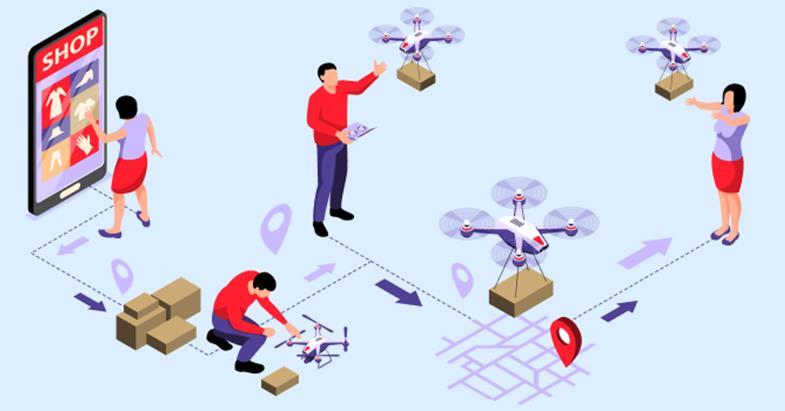
Departure Management: Followingpackaging,thesystem coordinates the departure of drones from the warehouse. This involves securely fastening packages to specialized carriersdesignedfordronetransportation.Notably,drones employa rangeofdeparturemechanisms,includingVTOL (Vertical Takeoff and Landing) processes or innovative designs like non-VTOL crafts, depending on the system configuration.
Navigation and Route Optimization: Centraltothesystem architectureisthenavigationmodule,whichutilizescuttingedgetechnologiestoguidedronesthroughvaryingterrains and obstacles. This includes GPS technology for location pinpointing,onboardcamerasforreal-timeenvironmental awareness, and SONAR/RADAR systems for obstacle detection and avoidance. The system optimizes routes to ensure efficient and timely deliveries while prioritizing safetyandprecision.
Delivery Execution: Uponreachingthedesignateddelivery location,thesystemorchestratestheexecutionofpackage deliverythroughdiversemethods.TheseincludetheChord and Packet System, Fly-By Method, or Complete Landing, each tailored to specific delivery scenarios and customer preferences.
Return Journey Management: Aftercompletingdeliveries, dronesautonomouslynavigatebacktotheoperationalbase, typicallythecentralwarehouse.Thisinvolvesrecalibration, systemresets,andbatteryassessmenttoensurereadiness forsubsequentmissions.
System Monitoring and Optimization: Throughout the delivery process, the system continuously monitors performancemetricsandoperationalparameters.Thisdata is analyzed to identify areas for optimization, enhance efficiency,andmitigateriskswithintheoverallarchitecture.
In essence, the system architecture of drone delivery encompasses a cohesive integration of processes, technologies, and functionalities. By leveraging advanced
algorithmsandreal-timedataanalytics,itenablesseamless andefficientdeliveryoperationswhileadaptingtoevolving requirementsandenvironmentalconditions.
3. LITEATURE SURVEY:
Title:TheFutureofDeliveryDrones:ALiteratureReview
Authors: Mohaneshwar S, Karthik R M, Rahul Batapagari, NingannaGangappaBani,VarunKumarReddy
Published:2021
Origin: School of Mechanical Engineering, REVA UNIVERSITY,Bangalore,Karnataka,India
Implementation of delivery drones offers benefits like reducingcarbonemissions,easingurbantrafficcongestion, and creating new business models and job markets. However,regulatoryandsafetyconcernsneedaddressing. Evolving drone technology enables larger payloads and longerdistances,expandingtheirapplicationsandleadingto transformativechangesintransportationandcommerce.[3]
Title:ModularDroneDeliveryOptimization
Author:JaihyunLee
Published:2017
Origin:DepartmentofMechanicalEngineering,Universityof Michigan,AnnArbor,MI,UnitedStates.
This paper examines modular drone delivery systems, showcasing enhanced delivery speed and efficiency. It suggestsexploringsemi-modularsystemswithreplaceable batteries for future research. An integrated framework evaluatestheprofitabilityofmodulardronedelivery.[4]
Title:DDAM:InnovativeDroneDeliverywithAutonomous Mobility
Authors:H.D.Yoo,S.M.Chankov
Published:2018
Origin: Department of Mathematics & Logistics, Jacobs UniversityBremen,Bremen,Germany
DDAMintroducesdronedeliverywithautonomousmobility, promising faster, more efficient delivery while reducing vehicleneeds.Conceptlimitationsincludesmall evaluator groupsandlackofnumericalcomparison.Futureresearch couldemploysimulationmodelsforcomparisons.Real-life implementationneedscollaborationbetweendeliveryand autonomous mobility companies, offering innovative solutionsforlast-miledeliveryandtrafficchallenges.[5]
International Research Journal of Engineering and Technology (IRJET) e-ISSN: 2395-0056
Volume: 11 Issue: 02 | Mar 2024 www.irjet.net p-ISSN: 2395-0072
Title:Service-BasedDroneDelivery
Author: Balsam Alkouz, Babar Shahzaad, Athman Bouguettaya
Published:2022
Origin: School of Computer Science, The University of Sydney,Australia
Thisstudyintroducesanovelservice-baseddronedelivery approach,emphasizingamulti-routeskywayinfrastructure for efficiency. It proposes a service-oriented framework utilizingsensor-cloudinfrastructuretooptimizeoperations insmartcities.Theauthorsreviewexistingsolutions,open challenges,andfutureresearchdirectionsinservice-based dronedeliveries.[6]
4. METHODOLOGY:
4.1 Algorithm:
Step1:OrderPlacement:
Userinputspickup(A)anddelivery(B)locations,package details.
Step2:Verification&Payment:
Systemvalidatespackagedetails,userconfirmsorderand pays.
Step3:DroneAssignment:
Systemassignssuitabledronebasedonpackage,proximity toA.
Step4:PackagePickup:
DronenavigatestoA,authenticates,retrieves,andconfirms pickup.
Step5:FlighttoDestination:
Drone follows designated path to B, monitored by the system.
Step6:PackageDelivery:
DronereachesB,authenticates,anddeliversthepackage.
Step7:UserNotification:
Userreceivesconfirmationofsuccessfuldelivery.
Step8:OrderUpdates:
Systemupdatesdeliverystatus,mayrequestuserfeedback.
Step9:DroneMaintenance:
Drone returns for maintenance, charging, or future assignments.
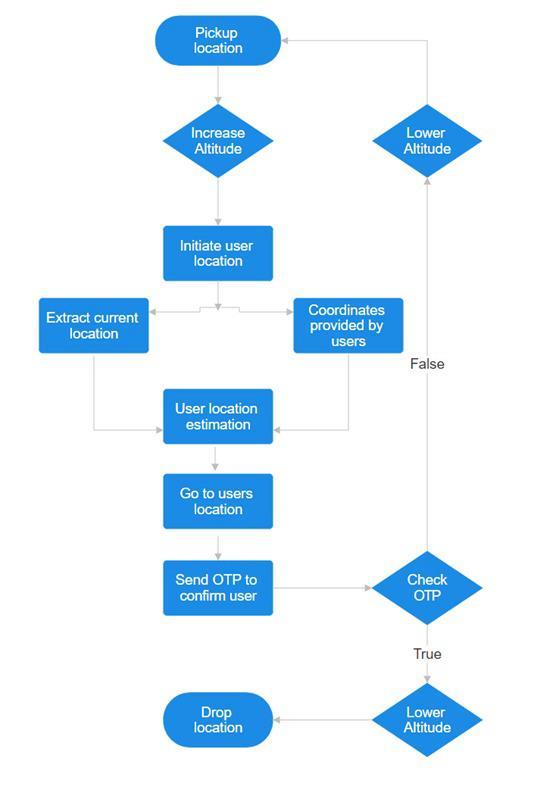
4.2 Flowchart:
5. REQUIREMENTS:
5.1 Hardware Requirements:
1. Quadcopter: A quadcopter, also called quadrocopter, or quadrotor is a type of helicopter thathas four rotors.They havetheabilitytohoverinplacewhereasfixedwingaerial dronesmustbeconstantlymoving
2.ProximitySensor:Aproximitysensorisadevicethatcan detectorsensetheapproachorpresenceofnearbyobjects andforthisitdoesnotneedphysicalcontact
3. GPS module: GPS module acts as a navigation and positioningsystem,providingcrucialinformationtothepilot orflightcontrolsoftware
4.ElectronicSpeedController:Electronicspeedcontrollers (ESCs) are devices that allow drone flight controllers to controlandadjustthespeedoftheaircraft’selectricmotors. AsignalfromtheflightcontrollercausestheESCtoraiseor lowerthevoltagetothemotorasrequired,thuschangingthe speedofthepropeller.
International Research Journal of Engineering and Technology (IRJET) e-ISSN: 2395-0056
Volume: 11 Issue: 02 | Mar 2024 www.irjet.net p-ISSN: 2395-0072
1.ReactNative:Thisframeworkallowsyoutobuildacrossplatformmobileapp(iOSandAndroid)forcontrollingthe drone.
2. JavaScript: The primary programming language for developingtheappusingReactNative.
3. Communication Protocol: Implement the MAVLink communicationprotocol,whichiscommonlyusedfordrone communicationandcontrol.Itprovides astandardwayto sendandreceivecommandsandtelemetrydata.
4.RemoteCameraControl:Includefeaturesforcontrolling thedrone’scamera, capturingphotos,recordingvideos,andlivestreamingfrom thedrone’scamera.
5. Node.js: It is a JavaScript runtime built on Chrome's V8 JavaScript engine. It is used for server-side programming, and primarily deployed for non-blocking, event-driven servers, such as traditional web sites and back-end API services.
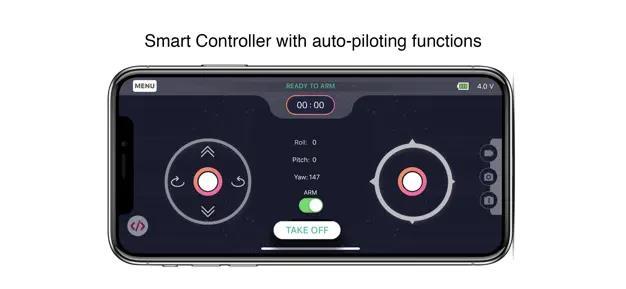
Drone delivery initiatives involve deploying unmanned aerialvehicles(UAVs)totransportgoodsbetweenlocations. The drone controller plays a pivotal role in this setup, overseeingthedrone'sflightpathandoperations.Consisting of hardware and software components, the controller enablesremotepiloting,navigation,obstacleavoidance,and payload management. Research in this field focuses on optimizing controller algorithms to ensure the safe and efficient operation of drones, considering factors such as flight dynamics, communication protocols, environmental conditions,andregulatorycompliance.
this process, the focus remains on maintaining a balance betweenrobustsecuritymeasuresandprovidingaseamless userexperience.

The signin page is where existing users authenticate themselves to access the app's features. It verifies user credentials, typically through a combination of email and password authentication, or more advanced methods like biometric recognition for enhanced security. Throughout
Thesign-uppageofthedronedeliverycustomerappserves astheentrypointfornewusers,allowingthemtoregister and create accounts. It prompts users to input necessary informationsuchastheirname,emailaddress,andasecure password. This process ensures that accurate data is collectedandstoredsecurely,safeguardinguserprivacyand accountintegrity.
International Research Journal of Engineering and Technology (IRJET) e-ISSN: 2395-0056
Volume: 11 Issue: 02 | Mar 2024 www.irjet.net p-ISSN: 2395-0072

7. CONCLUSION:
Dronedeliverysystemsarerevolutionizinglogistics,spurred by IoT advancements in transportation. Their adoption in emergingeconomiespromisestoreshapelast-miledelivery, offering unparalleled flexibility, speed, safety, and environmentalbenefits.Acrossindustries,frome-commerce to healthcare, they are transforming traditional delivery routes. At 40% completion, our project aims to enhance efficiency,reducedeliverytimes,andensureenvironmental sustainability.Withobjectivesfocusedonefficiency,reduced costs,andtechnologicalinnovation,we'repoisedtoredefine convenience and sustainability in logistics. This progress marks a significant milestone in reshaping the future of deliverysystems.
8. ACKNOWLEDGEMENT:
It gives us Great pleasure in presenting the preliminary projectreporton"DVD:deliveryviadrone".
Wewouldliketotakethisopportunitytothankourinternal guide Prof. Tushar Surwade and co-guide Prof. Vrushali Wankhedeforgivingusallthehelpandguidanceweneeded. Wereallyaregreatfultothem.Forthekindsupport.Their valuableinsightswereveryhelpful.
We are also grateful to Prof. Sagar Rajebhosale, Head of department,computerengineeringbranchattheKeystone School of Engineering, for his indispensable sup-port and suggestions
9. REFERENCES:
[1] Balsam Alkouz, Babar Shahzaad, and Athman Bouguettaya.“Service-BasedDrone Delivery”. In: (2021), pp. 68–76. doi: 10.1109/CIC52973.2021.00019.
[2] Taha Benarbia and Kyandoghere Kyamakya. “A LiteratureReviewofDroneBased Package Delivery Logistics Systems and Their ImplementationFeasibility”. In: Sustainability 14 (2022). issn: 2071-1050. doi: 10.3390/su14010360.url: https://www.mdpi.com/2071-1050/14/1/360
[3]JaihyunLee.“DesignofDeliveryDrone”.In:(2021),pp. 1–8.doi:10.1109/ SYSCON.2017.7934790.
[4]JaihyunLee.“Optimizationofamodulardronedelivery system”.In:(2017), pp.1–8.doi:10.1109/SYSCON.2017.7934790.
[5]IdeaUsher.HowDoesDroneDeliveryWork?Explorethe Future.Yearthearticle was published (if available). url: https://ideausher.com/blog/how-doesdronedelivery-work-explore-the-future/.
[6] H. D. Yoo and S. M. Chankov. “Drone-delivery Using AutonomousMobility: An Innovative Approach to Future Last-mile Delivery Problems”.In:(2018), pp.1216–1220.doi:10.1109/IEEM.2018.8607829.
[7]https://www.irjet.net/author-guidelines