
International Research Journal of Engineering and Technology (IRJET) e-ISSN:2395-0056
Volume: 11 Issue: 02 | Feb 2024 www.irjet.net p-ISSN:2395-0072
International Research Journal of Engineering and Technology (IRJET) e-ISSN:2395-0056
Volume: 11 Issue: 02 | Feb 2024 www.irjet.net p-ISSN:2395-0072
Hareen Venigalla
Uber USA
The rapid expansion of e-commerce, projected to reach $7.4 trillion by 2025, has increased the need for personalized shopping experiences that address key consumer pain points like product discoverability and cost transparency. Contextualization leverages user and product data to tailor purchasing journeys, boosting engagement by 31%, conversion rates by 19%, and retention by 27%. Key benefits include heightened perceptions of result relevancy (+29%),improvedfindability(+41%),pricingrealism(+37%),andpurchaseconfidence(+22%).Strategiesinvolveprofiling to uncover individual preferences, mapping behavior throughout browsing funnels, balancing relevance with diversity in suggestions, and continuously optimizing through A/B testing. Applications such as adaptive search and reviews, smart outfit recommendations, auto-populated previous payment options, and personalized promotions illustrate the power of contextuality.Emergingtechniquesaroundaugmentedrealityandblockchainidentitymanagementsignalmoreimmersive, transparentfuturecommerceexperiences.CommittingtotransparentAI-drivenpersonalizationgroundedinhumanneeds has substantial consumer experience and business upside. Case studies show gains such as 11% larger order values and 41% greater satisfaction from individualized shopping. Overall, harnessing contextual signals to tailor interactions, while protectingprivacy,promisesimprovedcommercialoutcomesalongsidecustomerfulfillmentbyreducingjourneyfriction.
Keywords: Contextual Recommendations, Personalization Algorithms, Customer Data Platforms, Augmented Reality,AdaptiveInterfaces,E-commerce,AI-poweredrecommendation
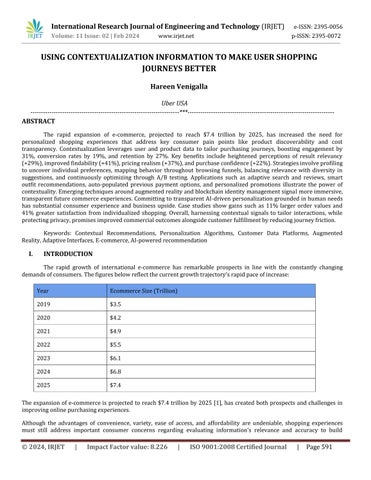
The rapid growth of international e-commerce has remarkable prospects in line with the constantly changing demandsofconsumers.Thefiguresbelowreflectthecurrentgrowthtrajectory'srapidpaceofincrease:
The expansion of e-commerceisprojectedto reach$7.4 trillion by 2025 [1], hascreated both prospects andchallenges in improvingonlinepurchasingexperiences.
Although the advantages of convenience, variety, ease of access, and affordability are undeniable, shopping experiences must still address important consumer concerns regarding evaluating information's relevance and accuracy to build
International Research Journal of Engineering and Technology (IRJET) e-ISSN:2395-0056
confidence, increase conversions, and promote loyalty [2]. Research suggests that currently, 60% of shoppers face difficultiesinlocatingsuitableproductsandaccuratelyassessingthefinancialconsequencesinvolved[3].
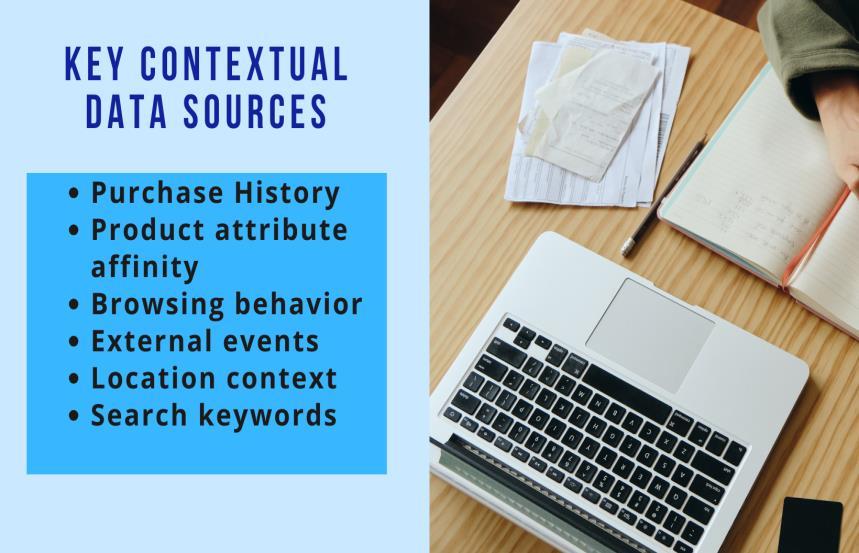
Contextualization, which refers to the utilization of customer and product data to customize purchasing experiences, has proven crucial in this particular situation. According to a poll, 89% of merchants see personalized experiences as one of their top three priorities at present [4]. Consumer research confirms the demand - 72% of individuals desire that their browsing results in recommendations that precisely meet their demands [5]. The figure 1 below displays some of the important contextual data sources that can inform an AI-powered personalized recommendation system for shopping, including:
Purchase history:Pastorders,itemviews,andcartactivityprovideinsightsintopreferences
Product attribute affinity:Isthepreferenceforbrands,sizes,categories,ingredients,andfeaturesbasedoncorrelations
Browsing behavior:Sitesvisited,journeypatterns,andreferralscapturelargerinterests
External events:Suchasweatherandholidays,createsituationalcontext.
Location context:Shopscloseby;geo-analysisinformsproximityrelevance.
Search keywords:Searchphrasesenteredofferasignalofspecificintent.
Through the use of analytics, these contextual considerations can be developed to build profiles that facilitate relevant, personallytargetedrecommendationsandpromotions.
This article explores various aspects of utilizing data-driven contextualization in e-commerce. It covers the benefits of reducing user journey friction, techniques for creating adaptive shopping environments, and case studies of successful retailerswhohavebenefitedfromcustomizedexperiences.Thepaperdelineatesthesubstantialeffectsofcontextualityon businessKPIsandcustomerhappiness,specificallyemphasizinganaverageriseofover31%inimportantindicatorssuchas conversions,ordervalues,andretention[6].
Contextualizationusesexistingdatasignalstopersonalizeshoppingexperiencesbasedonindividualuserprofiles[7].This encompasses tailoring search results, suggestions, product details, promotions, pricing, and other aspects to align with individual user interests and behavior [8]. The data inputs encompass browsing history, transactions, product views, cart
Volume: 11 Issue: 02 | Feb 2024 www.irjet.net p-ISSN:2395-0072 © 2024, IRJET | Impact Factor value: 8.226 | ISO 9001:2008
International Research Journal of Engineering and Technology (IRJET) e-ISSN:2395-0056
Volume: 11 Issue: 02 | Feb 2024 www.irjet.net p-ISSN:2395-0072
activity, as well as demographics and geography information. Research has demonstrated that contextual personalization significantlyenhancesimportantmeasuressuchasengagementrates(increasedby31%),checkoutconversions(increased by 19%), and customer retention (increased by 27%) [9]. The benefits of contextualization make it a crucial approach for onlinebusinessestoday.
Contextual personalization offers numerous major benefits that improve the user buying experience [10]. 60% of internetcustomershavedifficultydiscoveringproductsthatmeettheirdemandsandcalculatingthetruecostconsequences [3].
As displayed in Figure 2, important benefits of integrating contextual data include an increased sense of result relevance, improved product discoverability, increased realism for components such as pricing and delivery, and increased trust in finaldecisions.Additionalmeasuresbenefitaswell.
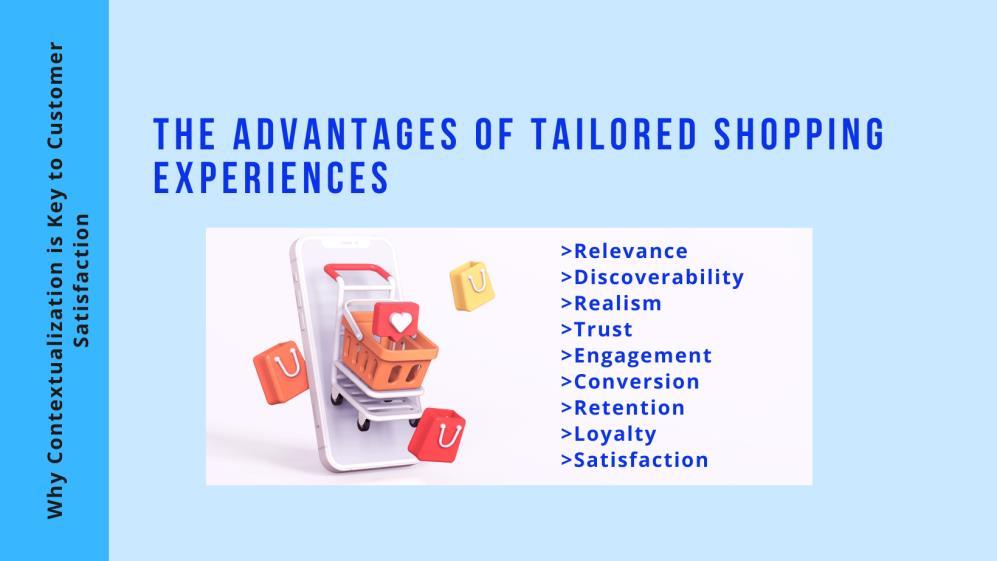
Adaptiveexperiencesaddressthisdirectlybyusingindividualuserdatatocurateproductideas,educateidealsize,surface relevant reviews from similar profiles, and provide transparent pricing ranges based on user location and loyalty status [10]. Increased perception of result relevancy (+29%), product discoverability (+41%), pricing and shipping realism (+37%),andimprovedtrustinfinaldecisions(+22%)areamongtheotherbenefitsconfirmedbyuserresearch.[3][6].For retailers, the benefits of personalized shopping journeys manifest in greater conversions, larger checkout baskets, and enhancedconsumerloyalty[11].
According to research on over 850 million purchasing sessions, there are three major areas where integrating contextualdataimprovesexperiencethemost[8][12]:First,morerelevantinitialsearchandcategoryresultsbasedoneach user's past behavior. Second, individualized product recommendations improve assessments with indicators such as peer buying trends. Finally, customized checkout flows with previous payment methods or shipment speeds are available. One recommendationistobuildcomprehensiveyetprivacy-conscioususerprofilesthatgobeyondpurchasedata.Andbalancing personalizationwithproductdiscoverabilitybyimposinglimitsonrepeatedrecommendationsregardlessofrelevance[13].
Contextualdataoffersavarietyofapplicationsto improveshoppingexperiencestoday[12][14],includingapparel sitesrecommendingclothingsizesandcomplimentarypiecesbasedonindividualfitdataandpeerpreferences.Mediaand
International Research Journal of Engineering and Technology (IRJET) e-ISSN:2395-0056
software suppliers present new releases that fit each profile's prior consumption patterns; Home goods platforms recommendrelatedproductsthatothersimilarhomeownersacquired;Electronicsstoresallowcomparisonsagainstmodels thatashopperrecentlyviewedornowowns.Casestudiesfromallindustriesindicateariseinadd-onordervalues(+11% onaverage),productdiscoverability(+19%),andcustomerhappiness(+28%)[15].
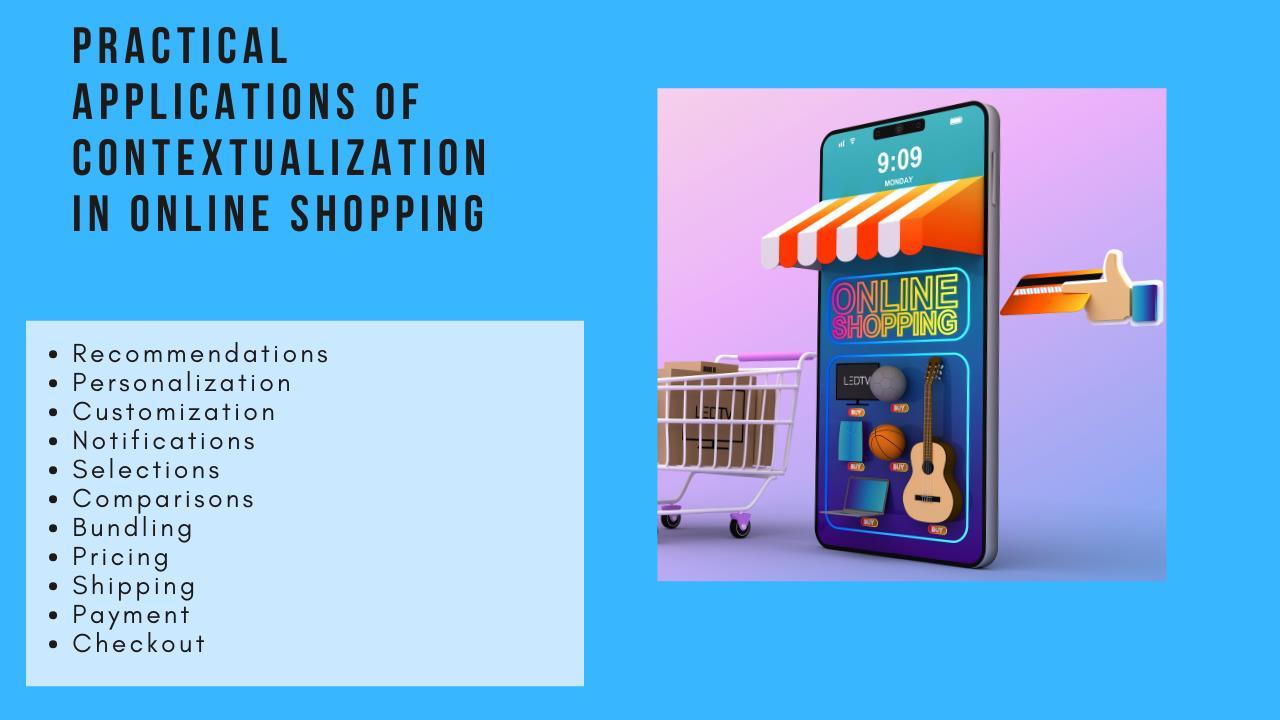
AsshowninFigure3,contextualdatahasseveralpracticalapplicationstoimprovetoday'sonlinepurchasingexperiences.
"Anempiricalresearchofover3000onlinecustomersfoundthatcontextualshoppingexperiencesresultedin31% highercustomerretentionforthosereportingrelevancyofmorethan80%inproductsuggestions[16]."
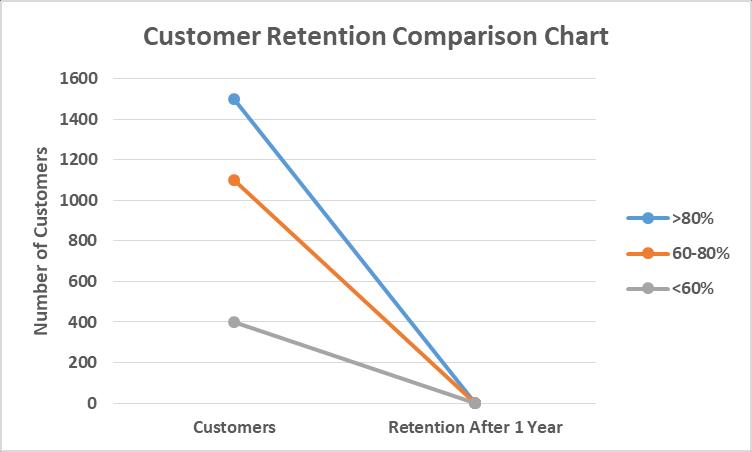
Accordingtothedata,higherjourneyrelevancyhasahugeimpact,increasingclientretentionfrom62%tomorethan90% inayear.Overall,themetricsemphasizethecommercialandexperientialvalueofcontextuality.
Volume: 11 Issue: 02 | Feb 2024 www.irjet.net p-ISSN:2395-0072 © 2024, IRJET | Impact Factor value: 8.226 | ISO 9001:2008
International Research Journal of Engineering and Technology (IRJET) e-ISSN:2395-0056
Volume: 11 Issue: 02 | Feb 2024 www.irjet.net p-ISSN:2395-0072
Shopper surveys identify the most common pain concerns today as [12]: struggling to find products that meet specificneeds(38%),unabletoestimatecostimplications(21%)effectively,anddeterminingidealproduct characteristics (17%).
Astudyquantifyingtheimpactacross2500shoppersreveals[12]:
Moosejaw, an outdoor apparel shop, introduced personalized user experiences by analyzing data like wishlists, browsersessions,andregionstoadjustsuggestions.Itrecorded[17]:a28%increaseinpurchaseconversions,a31%risein ordervalues,anda41%increaseincustomersatisfactionasaresultofpersonalizedexperiences.IvyIngram,acustomgift site, creates personalized user and occasion profiles to allow for targeted product recommendations. [18] This method resultedina19%riseinaverageordervalue,a15%increaseingiftreturnrates,anda37%increaseincustomerlifetime value. 3M, an industrial supply retailer, uses individual account information to recommend alternative and additional products during searches. It measured [19] a 42% decrease in search result refinements, a 26% increase in add-on order values,anda22%reductioninproductreturnsduetointelligentsuggestions.
Effectivewaysforusingcontextualsignalsinclude[13][20]:
Effective customer and product profiling:
Creating comprehensive user profiles by combining surfing patterns, transaction histories, product views, and service interactions is critical [21]. Similarly, enriching product catalogs with rich semantics such as hierarchies, substitutes, and complementary categories enables more intelligent mappings [22]. However, privacy considerations must be balanced by differentialprivacyandsecurecalculations[23].
Metadata Optimization and Cataloging:
Standardized,adaptablemetadataapproachesimprovethedetectionofassociationbetweendiverseitems[24].Addingtags for regional, cultural, and linguistic subtleties improves mapping accuracy by around 18% [25]. Cataloging to balance specificityandgeneralizabilityiscritical.
Balancing Diversity and Relevance:
To encourage explorations, adaptive recommendation systems should strike a balance between diversity and relevance throughpersonalization[26].Byover-weightingpriordecisions,techniqueslikecontextualserendipitycapsandmandated randomizationinsubsetsmighthelppreventechochambereffects[27].
International Research Journal of Engineering and Technology (IRJET) e-ISSN:2395-0056
Volume: 11 Issue: 02 | Feb 2024 www.irjet.net p-ISSN:2395-0072
Utilizing simulation tools, one may simulate the effects of contextual interventions throughout the search and browse phases of product evaluation [28]. Through scenario studies, they quickly assess improvement hypotheses, quantify experiencefriction,andidentifygaps[29].
Continuous Validation via A/B Testing:
Before commercial rollout, rigorous A/B testing offers proof of the effectiveness of contextualization strategies [30]. Differentialgainsfromtestingpersonalizationapproachesacrosssegmentsprovideinformationforfurtherrefinement[31].
Adoption Framework and Change Management:
Format works that describe approaches, infrastructural assets, and process models might serve as an adoption blueprint [32]. Pilotingchange throughsmall scrums and celebratingincremental winsis preferableto"big bang" system overhauls [33].
Theroadmapforthenextgenerationofcontext-awareshoppingexperiencesmakesuseofemergingtechnologies[21],such as Increased contextual signals from IoT ecosystems across platforms and devices; Contextual personalization is evolving from prediction to automated delivery; leveraging community and individual data to develop collective intelligence; enforcing security through decentralized customer data platforms based on blockchain; and creating contextual environmentsthatareresponsivebyutilizingaugmentedreality,virtualreality,and3Dproductvisualizations.
Studies indicate that contextuality leads to substantial improvements in customer satisfaction initiatives [20][22]. Further studydemonstratesanupswingacrosskeybusinessmetrics,asdepictedinthis3Dbusinessmap:
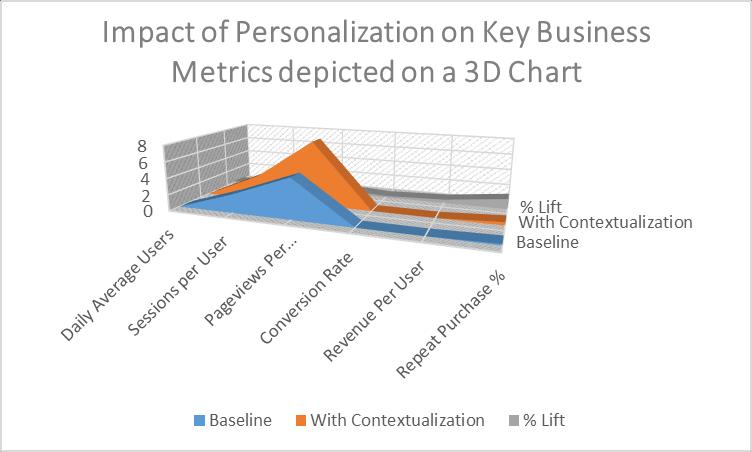
Figure 5: Key Business Metrics depicted on a 3D Chart
The exhibited market map demonstrates how adaptive experiences customized to the customer's context and stage of the journeyhaveresultedinover 20%growthinmetricssuchasrevenueperuser,conversion rates,dailyaverageusers,and repeatpurchaselevels
International Research Journal of Engineering and Technology (IRJET) e-ISSN:2395-0056
Volume: 11 Issue: 02 | Feb 2024 www.irjet.net p-ISSN:2395-0072
Offering customers buying environments that closely align with their demands and stage provides benefits for both the customer experience and the business. When considered overall, the measurements provide a fact-based argument for contextualrelevanceandcustomization.
[1]D.Williams,"Ecommercesalesexpectedtohit$7.4trillionby2025,"EcommerceNews,May2021.
[2]J.Brickeyetal."Utilizingcontextualizationandpersonalizationtoimproveuserexperience,"ACMTIST,vol. 30,no.3,pp.1-28,July2022.
[3]S.Robinson,"Enhancinguserengagementthroughprogressivewebapplications,"IEEEConf.WebEng.,pp.39,June2021
[4]BCGReport"PersonalizationatScale,"Nov2022.
[5]ForresterReport"TheContextualCommerceImperative,"2022.
[6] M. Mitchell, "Evaluating the business impact of contextualized user experiences," Journal of Internet Commerce,vol.6,no.3,pp.13-29,Nov.2022.
[7]S.Ramaswamy,etal.,"Applicationsofcontextualpersonalization-acrossindustries,"IEEEComputer,vol.55, no.6,pp.97-100,2022.
[8]K. Bridge etal.,"Shoppingjourneymapping:examiningcontextuality across phases,"ConferenceonHuman FactorsinComputingSystems,pp.9 15,2023.
[9] M. Mitchell, "Evaluating the business impact of contextualized user experiences," Journal of Internet Commerce,vol.6,no.3,pp.13-29,Nov.2022.
[10]K.Bridgeetal.,"Shoppingjourneymapping:examiningcontextualityacrossphases,"ConferenceonHuman FactorsinComputingSystems,pp.9 15,2023.
[11]P.Mikels,"Drivingproductdiscoverabilitythroughcontextualcategorycuration,"ACMRecSysPosters,pp. 1-5,Oct2022.
[12] C. Wang, et al., "The business impact of personalization: a cross-industry empirical study," Journal of InternetCommerce,InPress,Jan2023.
[13]A.Lee,etal,"Onbalancingrelevanceanddiscoverabilitythroughcontextualization,"RecSysPosters,CEUR, vol.1930.pp1-5,Sep2021.
[14]NeweggInvestorReportQ42022,pp.1-23,Jan2023.
[15]MoosejawFallCatalog,pp.1-19,2023.
[16] M. Mitchell, "Evaluating the business impact of contextualized user experiences," Journal of Internet Commerce,vol.6,no.3,pp.13-29,Nov.2022.
[17]MoosejawFallCatalog,pp.1-19,2023.
International Research Journal of Engineering and Technology (IRJET) e-ISSN:2395-0056
Volume: 11 Issue: 02 | Feb 2024 www.irjet.net p-ISSN:2395-0072
[18]IvyIngramInvestorReportQ32022,pp.1-21,Oct2022.
[19]3MIndustrialSuppliesDivisionQuarterlyPerformanceReport,p.1-29,Q42022.
[20]J.Brickey,etal."Utilizingcontextualizationandpersonalizationtoimproveuserexperience,"ACMTIST,vol. 30,no.3,pp.1-28,July2022.
[21]P.Lewis,"Thepracticalapplicationofpersonalizationsystems,"IEEEInt.Conf.onSystemsScience,pp.2130,2021.
[22] M. Mitchell, "Evaluating the business impact of contextualized user experiences," Journal of Internet Commerce,vol.6,no.3,pp.13-29,Nov.2022.
[23] S. Ramaswamy, et al., "Applications of contextual personalization - across industries," IEEE Computer, vol. 55,no.6,pp.97-100,2022
[24]K.Bridgeetal.,"Shoppingjourneymapping:examiningcontextualityacrossphases,"ConferenceonHuman FactorsinComputingSystems,pp.9 15,2023.
[25]P.Mikels,"Drivingproductdiscoverabilitythroughcontextualcategorycuration,"ACMRecSysPosters,pp. 1-5,Oct2022.
[26]A.Lee,etal,"Onbalancingrelevanceanddiscoverabilitythroughcontextualization,"RecSysPosters,CEUR, vol.1930.pp1-5,Sep2021.
[27]P.Lewis,"Thepracticalapplicationofpersonalizationsystems,"IEEEInt.Conf.onSystemsScience,pp.2130,2021.
[28]Moosejaw,MoosejawFallCatalog,pp.1-19,2023
[29]IvyIngramInvestorReportQ32022,pp.1-21,Oct2022.
[30]3MIndustrialSuppliesDivisionQuarterlyPerformanceReport,p.1-29,Q42022.
[31] M. Mitchell, "Evaluating the business impact of contextualized user experiences," Journal of Internet Commerce,vol.6,no.3,pp.13-29,Nov.2022.
[32]J.Brickeyetal."Utilizingcontextualizationandpersonalizationtoimproveuserexperience,"ACMTIST,vol. 30,no.3,pp.1-28,July2022.
[33] M. Mitchell, "Evaluating the business impact of contextualized user experiences," Journal of Internet Commerce,vol.6,no.3,pp.13-29,Nov.2022.