
International Research Journal of Engineering and Technology (IRJET) e-ISSN: 2395-0056
Volume: 11 Issue: 02 | Feb 2024 www.irjet.net p-ISSN: 2395-0072
International Research Journal of Engineering and Technology (IRJET) e-ISSN: 2395-0056
Volume: 11 Issue: 02 | Feb 2024 www.irjet.net p-ISSN: 2395-0072
Tula Kanta Deo1 , Rajesh Keshavrao Deshmukh2 , Gajendra Sharma3
1 Department of Computer Science and Engineering, Kalinga University, Naya Raipur, India
2Department of Computer Science and Engineering, Kalinga University, Naya Raipur, India
3 Department of Computer Science and Engineering, Kathmandu University, Kavre, Nepal
Abstract – Sentiment analysis is the most important branch of natural language processing. It deals with the classification of text. The class can be positive, negative or other. This study evaluate and compare the performance of K Nearest Neighbor (KNN) and Support Vector Machine (SVM) classifiers. The datasets used in this study are all_tweets dataset and financial phrase bank dataset. These datasets are preprocessed. The preprocessed datasets are split into 80% training and 20% testing subsets. The training dataset are used for feature extraction and training of the classifiers. The testing datasets are used for feature extraction and evaluation of the classifiers. The results and discussions of this study shows the performance of KNN and SVM is consistent with most of the studies. In this study, SVM outperform KNN.
Keywords: Sentiment Analysis, K Nearest Neighbor, Support Vector Machine, Precision, Recall, Accuracy, F1 score.
Sentimentanalysis(SA),alsoknownasopinionmining,is a subfield of natural language processing (NLP) that deals withautomaticallydeterminingtheemotionaltoneofapiece of text. It aims to understand whether the text expresses positive, negative, or neutral sentiment towards a topic, entity,orevent[1]
A comparative study between the KNN and SVM classifiers for sentiment analysis involves evaluating the performanceoftheseclassifiersonsentimentclassification tasks.The objectiveofthisstudyistoevaluateandcompare the performance of KNN and SVM classifiers on sentiment classification tasks. This includes assessing their accuracy, precision,recallandF1-scoremetricstounderstandhowwell eachclassifiersperformsinsentimentanalysis.
KNN classifier is renowned for its simplicity and effectivenessinclassificationtasks.Itbelongstothefamilyof instance-based algorithms, where predictions are made basedonthesimilarityofnewinstancestoknowninstances inthetrainingdata.KNNisanon-parametricalgorithm;that is, it makes no assumptions about the underlying data distribution.Thismakesitversatileandapplicabletoawide rangeofdatasets.KNNisalazylearningalgorithmbecauseit postponesthelearningprocessuntilthepredictionphase.It
storestheentiretrainingdatasetinmemoryandperforms computationonlywhenapredictionisrequired.Thechoice ofthehyper-parameterK(numberofneighbors)iscrucialin KNN.AsmallervalueofKleadstoamoreflexibledecision boundary,potentiallyresultinginoverfitting,whilealarger value of K may lead to under-fitting. KNN is easy to implement and understand, making it an ideal choice for beginnersandasabaselinemodelforcomparisonwithmore complexalgorithms[2]
KNN is intuitive and easy to understand, requiring minimal assumptions about the data. Since KNN does not buildanexplicitmodelduringtraining,thetrainingphaseis fastandcomputationallyinexpensive.KNNcanhandleboth binaryandmulti-classclassificationproblemsandisrobust tonoisydata[3]
KNN requires computing distances between the new instanceandallinstancesinthetrainingdataset,makingit computationally expensive for large datasets. KNN is sensitivetooutliersandnoiseinthedata,whichcanaffectthe accuracyofpredictions.KNN'sperformancedeterioratesin high-dimensional feature spaces due to the curse of dimensionality[3]
SVM is a widely used supervised learning algorithm known forits effectiveness in classificationand regression tasks. SVM has gained popularity for its ability to handle linearandnon-linearclassificationproblemsefficiently.SVM aimstofindthehyperplanewiththemaximummargin,which represents the distance between the support vectors of differentclasses.ThispropertymakesSVMlesssensitiveto outliersandimprovesitsgeneralizationability.SVMutilizes kernel functions such as linear, polynomial, radial basis function, and sigmoid to handle non-linear decision boundaries by implicitly mapping the input space into a higher-dimensional feature space. SVM introduces slack variablestohandlemisclassificationerrorsandsoft-margin classifiers,allowingforsomeinstancestobemisclassifiedto achievebetteroverallperformance.SVMoftenyieldssparse solutions,meaningthedecisionboundarydependsonlyona subsetofthetrainingdata,makingitmemory-efficientand suitableforlarge-scaledatasets[4].
SVM performs well even in high-dimensional feature spaces, making it suitable for complex classification tasks
International Research Journal of Engineering and Technology (IRJET) e-ISSN: 2395-0056
Volume: 11 Issue: 02 | Feb 2024 www.irjet.net p-ISSN: 2395-0072
such as image recognition and text classification. SVM's maximum margin property and ability to handle slack variablesmakeitrobusttooverfitting,especiallywhenusing regularizationtechniques.SVMcanbeappliedtobothlinear and non-linear classification problems by choosing appropriatekernelfunctions,providingflexibilityinmodel selection[5]
SVM's training time complexity is quadratic with the numberoftraininginstances,makingitlesssuitableforlargescaledatasets.SVMissensitivetonoiseandoutliers,which can affect the placement of the decision boundary and degrade performance. The selection of the kernel function and its hyper-parameters can significantly impact the performanceofSVM,requiringcarefultuning[5].
Thissectionsummarizesrelatedworksinthedomainof SArelatedtoKNNandSVMclassifiers.
MohamedA.E.haspresentedtheresultsofacomparative study of the four best-known machine learning and data miningtechniquesforclassification,suchasdecisiontrees, artificial-neuralnetwork,K-nearestneighbors,andsupport vectormachines.Researchshowsthateachtechniqueitsown advantages and disadvantages, it is difficult to find one classifiercanclassifyallthedatasetswiththesameaccuracy. Amongallthelearningalgorithmsonthisparticulardataset, the overall accuracy of the support vector machine is higher[6].
NawN.wereusedSVMandKNNclassificationstoclassify twitter data on education, business, crime and health. The aimistomeasuretheimpactofsocialmediausagebehavior among ASEAN citizens. In this research, both these classificationsareusedtocompareaccuracy,precision,recall andf1score.SVMoutperformsKNN[7]
HuqueAbuSayeedA.etal.Evaluatedandcomparedthe performance of KNN, SVM and Sparse Representation Classifier (SRC) in identifying characters written in Arabic handwrittencharacters.Themainpurposeofthisexperiment is to recognize the isolated Arabic characters. The performance of the method is evaluated on a separate Persian/Arabic character dataset, which is a large dataset containinggrayimages.ExperimentsshowthatSRCandSVM consistentlyoutperformKNN,withSVMachievingthehighest recognitionrate[8]
FikriM.andSarnoR.implementedtherulewiththehelp ofSentiWordNetandSVMalgorithmswiththehelpofTerm Frequency-Inverse Document Frequency (TF-IDF) as the feature extraction method. The data used to conduct the researchiswritteninIndonesian.Theoversamplingmethod isusedbecausethesentencesinthepositive,negativeand neutral classes are imbalanced. Balancing dataset can improvetheaccuracyandF-ScoreoftheSVMalgorithmby
usingTF-IDFasthefeatureextractionmethod;however,data balance reduces the accuracy and F-Score of rule-based SentiWordNet. Using TF-IDF as the extraction method, the SVMalgorithmachievesbetterresultsthantheSentiWordNet rule[9]
İrfanM,etal.ComparisonofKNNandSVMalgorithmsfor highschoolrecommendationselection.Themethodusedin thisstudyisdatamining.KNNandSVMarealgorithmswidely usedindatamininganddecisionsupport.Byexperimenting withmanytrainingandtestdata,theresultsshowthatSVMis betterthanKNN.TheaccuracyofSVMisabout97.1%,while the accuracy of KNN is about 88.5%. Moreover, the processingtimeofSVMisfasterthanKNN[10].
FawzyH.andMohamedA.aimsatunivariatetimeseries predictionusingSVMandKNN.Dataareused contain362 observations.SVMandKNNmodelsfit90%ofthetraining dataandtheiraccuracyisthencomparedbyRMSEtest.The resultsshowthatSVMisbetterthanKNNinpredictingthe futuregoldprice[11]
SudhirP.andSureshV.D.Reviewedvariousapplications, methods, and classification models used for sentiment analysis. Accuracy results of models based on the IMDB datasetshowthatmachinelearningsuchasSVM,GRU,and BERT show the most accuracy. More importantly, new models(e.g.,GRUandBERT)havebeenshowntobemore accuratethantraditionalclassificationmodels[12].
Nihalani R., et al. SVM and KNN algorithms were comparedagainstthetrainingdatarelatedtobrestcancer, andthemoreaccuratemethodwasusedtoevaluatethefinal model using a 10-fold cross-validation practice. The SVM modelachievedthehighestaccuracyduringtrainingandwas further improved during testing to achieve an accuracy of 96.93%[13]
UtamiL.D.andMasripahS.eagertoaddressandaddress public views on distance learning and online education, whicharesuretodrawpositiveandnegativeopinions.There are many classification algorithms, including Naive Bayes algorithm(NB),KNNalgorithmandSVMalgorithmwereused for text classification. After the calculation, the algorithm suitableforidentifyingreviewsoropinionsinthisstudyis theSVMclassificationalgorithm[14]
DesianiA.etal.comparedtheresultsof2methodsand2 training methods (e.g., cross-validation and percentile comparison), it was concluded that SVM and KNN classificationmodelsareeffectiveinclassifyingbreastcancer. Performance results show that SVM achieves a better accuracywhenusingthecompetitiveevaluationmethod.The KNNclassificationmodelachievedbetteraccuracythanSVM, whichwhenusingthepercentageevaluationmethod[15]
Sutriawan,etal.comparedtheperformanceofNB,SVM, KNN and DT classification method for classification of
International Research Journal of Engineering and Technology (IRJET) e-ISSN: 2395-0056
Volume: 11 Issue: 02 | Feb 2024 www.irjet.net p-ISSN: 2395-0072
positiveandnegativepolaritybehaviorinIndonesianvideo analysis.TestresultsshowthatSVMalgorithmtypeperforms best accuracy. Therefore, SVM performs better than other classificationmethods[16]
In this section, the general process of sentiment classificationisexplained.Thisresearchisanexperimental studyofsentimentanalysisusingKNNandSVMClassifier.
closest data points of different classes, known as support vectors.Inlinearlyseparablecases,SVMfindsahyperplane thatperfectlyseparatestheclasses.Innon-linearlyseparable cases,SVMuseskernelfunctionstomaptheinputspaceinto ahigher-dimensionalfeaturespacewheretheclassesbecome separable[18]
This section contains the details about the experimental setupforthestudy.Thissectioncontainsdetailsaboutthe datasetandmatricesassociatedwiththeperformance.The experimentshaveperformedonpythonlanguagewithScikit Learn,NLTK,andotherlibrarypackagesforimplementation.
Figure1:SchemaforperformanceevaluationofKNN andSVM
Thisresearchbeginswithdatacollectionthroughkaggle publicrepositoryandthenpreprocessingthedatathrough removalofretweets,removalofnon-Englishwords,removal of stop-words, removal of special characters, removal of digits, removal of unwanted words and removal of punctuationmarks.Tokenizing,POStagging,lemmatizationis done . Divide the training and testing data with the proportionof80%trainingdataand20%testingdataafter featureextractioncarriedoutusingtheTF-IDFmethod.The training and testing for classification process begins with preparingmodelssuchasKNNandSVMreadyforanalysis, and then the models are run to make the models for sentimentprediction.Theanalysisphaseofthemodelusedis toevaluatethef1-scoreorf-measure,precision,recall,and accuracy.Atthisstage,performancevisualizationsarealso madetodisplaygraphsanddiagramsofdata
KNNclassifiesanewinstancebyexaminingtheclassesof itsnearestneighborsinthefeaturespace.Duringthetraining phase,thealgorithmmemorizestheentiretrainingdataset withoutbuildinganexplicitmodel.Inthepredictionphase, when a new instance needs to be classified, the algorithm calculates the similarity (often using distance metrics like EuclideanorManhattandistance)betweenthenewinstance andall instancesinthetrainingdataset.Itthenselectsthe KNNbasedonthesesimilarities.Theclasslabelofthenew instanceisdeterminedbyamajorityvoteamongitsKNN[17]
SVM is a discriminative classifier that constructs a hyperplaneinahigh-dimensionalfeaturespacetoseparate instancesofdifferentclasses.ThegoalofSVMistofindthe optimalhyperplanethatmaximizesthemarginbetweenthe
Two datasets have used in this study. “all_tweets” dataset can be used for text analysis and analysis of sentiments and emotions through classification using machine learning or deep learning and natural language processing. “Financial Phrase Bank” dataset contains marketers' views on financial news. This file has two columns:"Sentiment"and"NewsHeadlines".Sentimentsare negative,neutralorpositive.
Table 1:Descriptionsofthedatasets
Algorithm: Performance Evaluation of KNN and SVM classifiers
Input: Sentimentlabeledtextdata
Output: Metricvaluesandgraphs
Process:
Step1:Importingsentimentlabeledtextdataset
Step2:Preprocessingthedata
Step3: Splitting the preprocessed dataset into training andtestingdataset
Step4:FeatureextractionusingTF-IDFvictimizer
Step5: Train the KNN and SVM classifiers with the
International Research Journal of Engineering and Technology (IRJET) e-ISSN: 2395-0056
Volume: 11 Issue: 02 | Feb 2024 www.irjet.net p-ISSN: 2395-0072
trainingdataset
Step6: Calculating predicted labeled dataset using the trainedKNNandSVMclassierandfeaturetestdataset
Step7:CalculatingMatrices
Step8:Plottingthegraphs
Performance measurements in sentiment analysis are crucialforevaluatingtheeffectivenessofthemodels.Some common performance metrics used in sentiment analysis include:
Precision:Theratioofthe truepositiveinstanceto all instancespredictedaspositive.Itmeasurestheaccuracyof positivepredictions.
Recall : The proportion of true positive instances that werecorrectlyidentifiedoutofallactualpositiveinstances. Itmeasuresthemodel'sabilitytoaccuratelyidentifypositive instances.
Accuracy:Theproportionofcorrectinstancesisclassified forallinstances.Itprovidesanoverallmeasurementofhow wellthemodelperformsacrossallclasses.
F1 Score: The F1 score is a commonly used metric in classification tasks, including sentiment analysis. It is the harmonicmeanofprecisionandrecallandprovidesasingle metricthatbalancesbothprecisionandrecall[21]
5. RESULTS AND DISCUSSIONS
This section contains the details about the results for sentimentclassificationofdatasets.Thissectioncontainsthe tables, charts obtained while performing the sentiment analysis onthedatausingKNNandSVMclassifiers.
Table 2: Performancemetricsforthedatasets
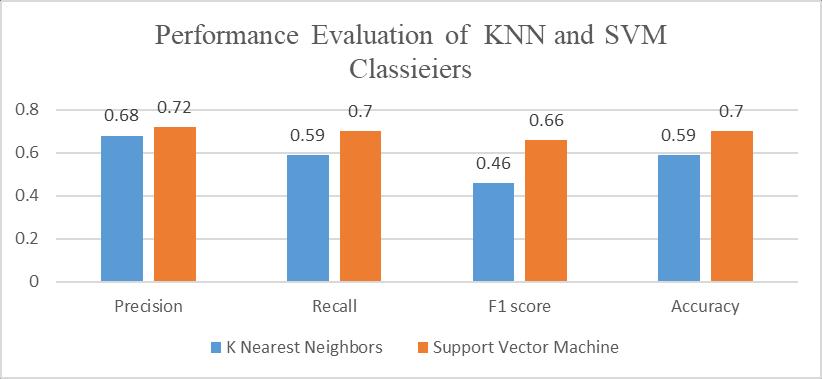
Figure2:PerformancecomparisonofKNNandSVMfor all_tweetsDataset
Figure 2 shows all the metric results for the all_tweets dataset. This bar chart shows an overall comparison between two models of this particular data. SVM outperformsKNNinallparameters.
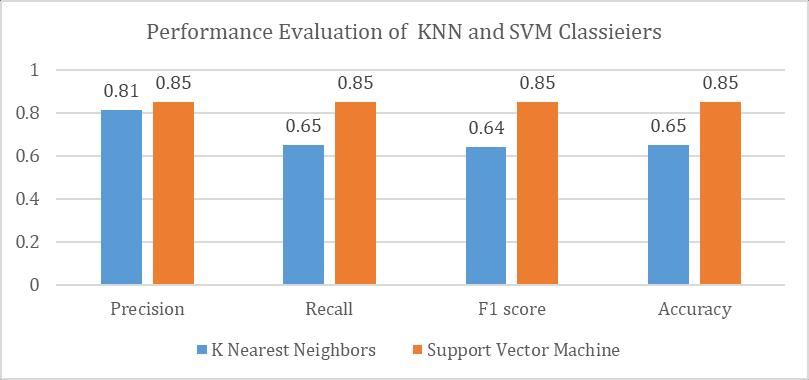
Figure3:PerformancecomparisonofKNNandSVMfor FinancialPhraseBankDataset
Figure3showsallthemetricresultsfortheFinancialPhrase Bankdataset.Thisbarchartshowsanoverallcomparison between two models of this particular data. SVM outperformsKNNinallparameters
Table 3: Averagevaluesofmetricsfortwodatasets
Metrics
Table2presentsatabularrepresentationoftheoutputs.It showsthemetricsforboththemethodswhenappliedover thetwodatasetsindividually.
International Research Journal of Engineering and Technology (IRJET) e-ISSN: 2395-0056
Volume: 11 Issue: 02 | Feb 2024 www.irjet.net p-ISSN: 2395-0072
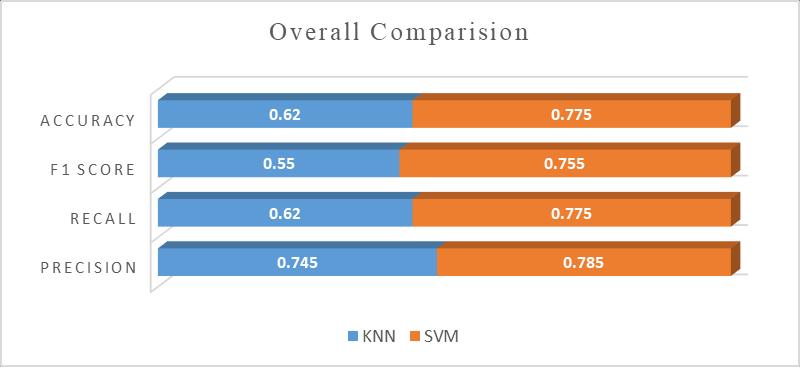
Figure4:VersatilityofKNNandSVM
TocomparetheversatilityofKNNandSVMinsentiment analysis,theaverageofallparametersofSVMishigherthan KNN in the two datasets. From table 3 and figure 4, SVM givesbetterresultsforallmeasurementscomparedtoKNN when determining the average performance on two data sets.
Thecurrentstudyfoundthataverageofprecision,recall, accuracyandf1scoreofKNNwere74.5%,62%,55%,625 respectively and SMV were 78.5%, 77.5%, 75.5%, 77.5% respectively.
MohamedA.E.usedWekasoftwareandGermanCredit data.HehasfoundanaccuracyofKNNas71.3% andSMVas 76.3%whichisconsistentwiththecurrentstudy[6].
Naw N. used tweets of education, business, crime and healthdata.Hehasfoundprecision,recall,accuracyandf1 scoreofKNNas77.8%,63.3%,69.5%,63.3%respectively and SVM as 71.3%, 70.8%, 74.4%, 70.8% respectively on Educationdata.Hehasfound precision,recall,accuracyand f1scoreofKNNas75.8%,59.6%,70.5%,68.1%respectively and SVM as 67.2%, 67.4%, 72.3%, 72.4% respectively on Businessdata.Hehasfoundprecision,recall,accuracyandf1 scoreofKNNas63%,58.9%,58.7%,59.9%respectivelyand SVMas69.4%,67.6%,72.1%,71.7%respectivelyonCrime data.Hehasfoundprecision,recall,accuracyandf1scoreof KNNas47%,40.2%,50.8%,59.2%respectivelyandSVMas 58.4%,57%,70.9%,64%respectivelyonhealthdata[7] on education,business,crimedata, NawN.studyisconsistent with the current study. On health data, Naw N. study is inconsistentwiththecurrentstudy.Thisinconsistencymay beduetothehealthdata.
Utami L.D. and Masripah S. used Rapid Miner 5.1 application with a dataset in the form of online learning reviews to carry out the analysis process. They found an accuracy of KNN as 86.33% and SVM as 87.67%[14]. This
accuracyisconsistentwithSVMbutinconsistentwithKNN. Thisinconsistencymaybeduetotheapplicationand data.
DesianiA.etal.usedbreastcancerdataset.They found precision,recall,accuracyandf1scoreofKNNas97%,98%, 97.85%,97%respectively andSVMas 95%,96%,95.7%, 95.5%respectively[15] This studyisinconsistentwiththe current study. This inconsistency may be due to breast cancerdataset.
Thisstudypresentstheresultsofacomparativestudyto investigatethetwowell-knownmachinelearningmethods forclassification. Classificationisimportantfororganizing datasothatitcanbeeasilyaccessed.Eachtechniquesisused in different areas and on different datasets. The performance of the learning algorithm depends on the natureofthedataset.Thisresearch comparestheresultsby analyzing sentiments of all_tweets dataset and financial phrasebankdatasetusingKNNclassifierandSVMclassifier. This study includes different metrics such as accuracy, precision, recall and f1 score, which help to clarify the comparison between the two methods. The results and discussions shows the performance of KNN and SVM on all_tweets dataset and financial phrase bank dataset is consistentwithmostoftheotherresearch Inthisresearch, SVMoutperformKNN..
Inthefuture,KNNandSVMcanalsobetestedonlarger, more detailed data sets, which will help make better decisions.AnensembleofKNNandSVMcouldbedeveloped thatcombinesthe resultsofthetwomethodsandtherefore improvesperformance.
[1] K. P. Gunasekaran, “Exploring Sentiment Analysis Techniques in Natural Language Processing: A ComprehensiveReview”.
[2]K.Taunk,S.De,S.Verma,andA.Swetapadma,“ABrief Review of Nearest Neighbor Algorithm for Learning and Classification,” in 2019 International Conference on IntelligentComputingandControlSystems(ICCS),Madurai, India: IEEE, May 2019, pp. 1255–1260. doi: 10.1109/ICCS45141.2019.9065747.
[3]S.B.ImandoustandM.Bolandraftar,“ApplicationofKNearestNeighbor(KNN)ApproachforPredictingEconomic Events:TheoreticalBackground,”vol.3,no.5,2013.
[4]M.AwadandR.Khanna,“SupportVectorMachinesfor Classification,”inEfficientLearningMachines,Berkeley,CA: Apress, 2015, pp. 39–66. doi: 10.1007/978-1-4302-59909_3.
International Research Journal of Engineering and Technology (IRJET) e-ISSN: 2395-0056
Volume: 11 Issue: 02 | Feb 2024 www.irjet.net p-ISSN: 2395-0072
[5] S. Amarappa and D. S. V. Sathyanarayana, “Data classification using Support vector Machine (SVM), a simplifiedapproach”.
[6]A.E.Mohamed,“ComparativeStudyofFourSupervised MachineLearningTechniquesforClassification,”vol.7,no.2, 2017.
[7] N. Naw, “Twitter Sentiment Analysis Using Support VectorMachineandK-NNClassifiers,”IJSRP,vol.8,no.10, Oct.2018,doi:10.29322/IJSRP.8.10.2018.p8252.
[8]A.S.A.Huque,M.Haque,H.A.Khan,A.AlHelal,andK.I. Ahmed,“ComparativeStudyofKNN,SVMandSRClassifiers in Recognizing Arabic Handwritten Characters Employing FeatureFusion,”Sig.Img.Proc.Lett,vol.1,no.2,pp.1–10,Jul. 2019,doi:10.31763/simple.v1i2.1.
[9]M.FikriandR.Sarno,“Acomparativestudyofsentiment analysisusingSVMandSentiWordNet,”IJEECS,vol.13,no.3, p.902,Mar.2019,doi:10.11591/ijeecs.v13.i3.pp902-909.
[10]M.Irfan,A.R.Nurhidayat,A.Wahana,D.S.Maylawati, andM.A.Ramdhani,“ComparisonofK-NearestNeighbour andsupportvectormachineforchoosingseniorhighschool,” J.Phys.:Conf.Ser.,vol.1280,no.2,p.022026,Nov.2019,doi: 10.1088/1742-6596/1280/2/022026.
[11] H. Fawzy and A. Mohamed, “Comparison between support vector machines and K-nearest neighbor for time seriesforecasting,”jmcs,2020,doi:10.28919/jmcs/4884.
[12] P. Sudhir and V. D. Suresh, “Comparative study of various approaches, applications and classifiers for sentimentanalysis,”GlobalTransitionsProceedings,vol.2, no. 2, pp. 205–211, Nov. 2021, doi: 10.1016/j.gltp.2021.08.004.
[13]R.Nihalaani,“ComparisonofKnearestNeighboursand SupportVectorMachinetoBuildaBreastCancerPrediction Model,”IJRASET,vol.9,no.5,pp.1435–1442,May2021,doi: 10.22214/ijraset.2021.34559.
[14] L.D. Utami .and S. .Masripah, “COMPARATION OF CLASSIFICATION ALGORITHM ON SENTIMENT ANALYSIS OF ONLINE LEARNING REVIEWS AND DISTANCE EDUCATION,”2021.
[15] A. Desiani, A. A. Lestari, M. Al-Ariq, A. Amran, and Y. Andriani, “Comparison of Support Vector Machine and KNearest Neighbors in Breast Cancer Classification,” PattimuraInt.J.Math.,vol.1,no.1,pp.33–42,May2022,doi: 10.30598/pijmathvol1iss1pp33-42.
[16] S. Sutriawan, P. N. Andono, M. Muljono, and R. A. Pramunendar, “Performance Evaluation of Classification AlgorithmforMovieReviewSentimentAnalysis,”IJC,pp.7–14,Mar.2023,doi:10.47839/ijc.22.1.2873.
[17] I. N. Chikalkar, “K -NEAREST NEIGHBORS MACHINE LEARNINGALGORITHM,”vol.8,no.12,2020.
[18] C. H. Miller, M. D. Sacchet, and I. H. Gotlib, “Support VectorMachinesandAffectiveScience,”EmotionReview,vol. 12, no. 4, pp. 297–308, Oct. 2020, doi: 10.1177/1754073920930784.
[19] “Tweet Sentiment and Emotion Analysis | Kaggle.” Accessed: Feb. 13, 2024. Available: https://www.kaggle.com/datasets/subhajournal/tweetsentiment-and-emotion-analysis
[20] “Sentiment Analysis for Financial News | Kaggle.” Accessed: Feb. 13, 2024. Available: https://www.kaggle.com/datasets/ankurzing/sentimentanalysis-for-financial-news
[21] D. P. Sengottuvelan and I. A. Regina, “Performance Evaluation of Machine Learning Models for Prediction of Sentiments in Movie Reviews,” JOURNAL OF CRITICAL REVIEWS,vol.7,no.08,2020.