
InternationalResearchJournalofEngineeringandTechnology(IRJET) e-ISSN:2395-0056
Volume:11Issue:02|Feb2024 www.irjet.net p-ISSN:2395-0072
InternationalResearchJournalofEngineeringandTechnology(IRJET) e-ISSN:2395-0056
Volume:11Issue:02|Feb2024 www.irjet.net p-ISSN:2395-0072
Vatesh Pasrija
Meta Platforms Inc, Seattle, USA.
Recommendation systems are extensively employed in several domains, including e-commerce, content streaming platforms, social media, and customized news providers. These systems strive to offer consumers personalized recommendations by analyzing their preferences, behavioral history, and other related information. However, an essential aspect that requires attention in recommendation systems is the presence of model bias. Model bias refers to the inherent biases that may exist in recommendation systems, resulting in unequal treatment or unfair advantages for specific items or individuals. Popularity bias is a c ommon form of model bias in recommendation systems. Popularity bias pertains to the inclinationofrecommendationalgorithmstoprioritizepopularproductsoverlesspopularones[1].Thisbiasarisesduetothe fact that popular items tend to have a greater quantity of ratings and interactions, hence increasing the likelihood of them being recommended to users [2]. The presence of popularity bias can lead to adverse effects, as it might result in excessive focus on popular items, while ignoring niche or long-tail items that may be of relevance to particular users. To address the issue of popularity bias in recommendation systems, various methodologies have been suggested in academic literature.The most common strategies to fix the model bias in recommendation systems are to include a wider range of items in the suggestions, use fairness-aware algorithms that try to give all users the same recommendations, and add personalization methodsthattakeintoaccounteachperson'slikes,dislikes,andrelevantinformation.Understandingandresolvingmodelbias in recommendation systems is essential to guarantee equal and precise recommendations, enhance user satisfaction, and promotediversityandserendipityintherecommendationprocess.
As we begin to investigate the complexities of model bias in recommendation systems, Figure 1 provides a fundamental understandingofthisphenomenon.
Keywords:Recommendationsystems,Modelbias,Popularitybias,Fairness-awarealgorithms,Academicliterature
Understanding model bias in recommendation systems is acknowledging the inherent biases that may exist and influence the recommendations given to users. This involves recognizing biases such as popularity bias, which occurs when morepopularthingsaregivenpreferenceoverlesspopularones[3].Throughunderstandingofmodelbias,recommendation systems can be designed and enhanced to deliver equitable and impartial suggestions to all users, irrespective of their preferences or the popularity of the suggested goods. The influence of model bias in recommendation systems can have extensiveanddetrimentaleffects.Popularitybiascanresultinalackofdiversityinthesuggesteditems,
InternationalResearchJournalofEngineeringandTechnology(IRJET) e-ISSN:2395-0056
Volume:11Issue:02|Feb2024 www.irjet.net p-ISSN:2395-0072
Since the more popular ones have greater visibility and overshadow the less popular ones. This can lead to a constrained selection of choices for customers, diminishing their opportunities to uncover novel or specialized things that may better match their interests. Moreover, model bias has the potential to sustain and reinforce pre existing inequities and biases that already exist in society. For instance, if a recommendation system continually favors specific types of material or items that exhibitbiasagainstparticulargroupsordemographics,itmayreinforcediscriminationandestablishacycleoffeedbackthat exacerbates the marginalization of those people. Reduction or minimization of the negative impact or consequences of something,suchasaproblem,risk,orthreat.
Figure 2 provides a high-level overview of the interrelation between model bias and user experience prior to exploringtheparticularconsequence
InternationalResearchJournalofEngineeringandTechnology(IRJET) e-ISSN:2395-0056
Volume:11Issue:02|Feb2024 www.irjet.net p-ISSN:2395-0072
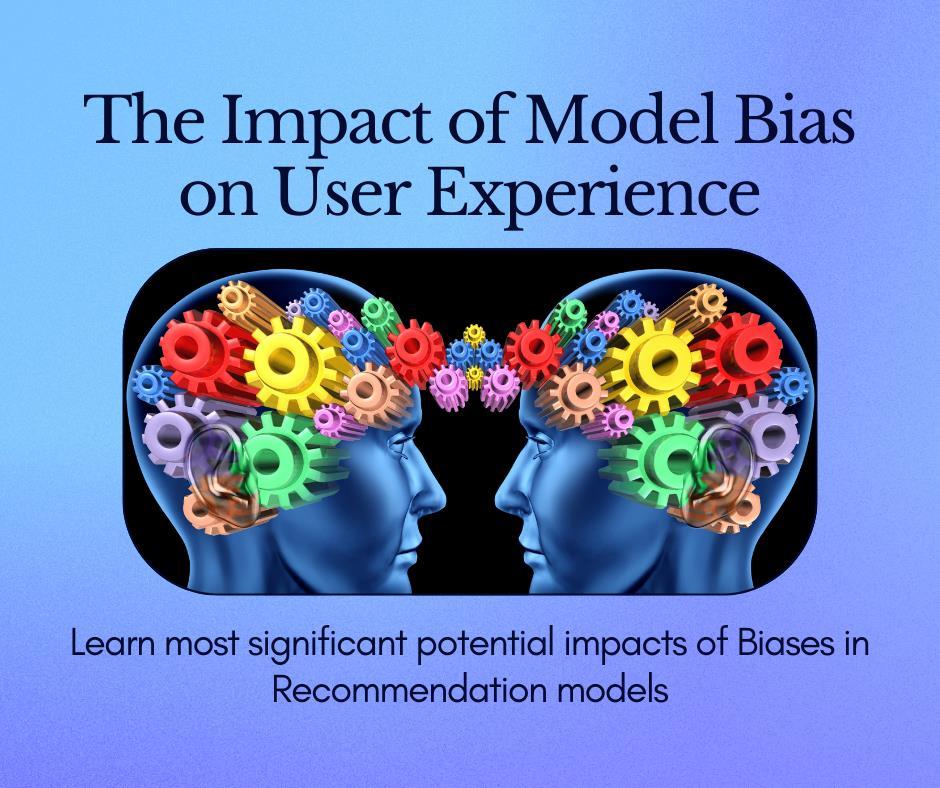
Herearesomeofthemostsignificantpotentialimpactsofbiasesinrecommendationmodels.
3.1
● Limited Exposure to Diverse Options: Biased models frequently result in a limited number of recommendations, denyingusersaccesstoawidervarietyofchoices[4].
● Reduced Personalization Effectiveness:Thepersonalizationfeatureofthesesystemsislesseffectivewhenbiasesskew recommendations,especiallyforunderrepresentedorminoritypopulations.
● User Dissatisfaction and Disengagement: When consumers feel their preferences aren't adequately recognized or cateredto,biasedrecommendationscancausedissatisfactionanddisengagement.
3.2 Economic Implications
● Loss of Market Possibilities: Businesses that depend on biased recommendation algorithms may fail to access certain clientcategories,henceoverlookingsignificantmarketopportunities[5].
● Diminished User Confidence and company Damage: Perceived biases in recommendation algorithms might result in a declineintrusttowardstheplatform,adverselyaffectingthereputationofthecompany
3.3
● Echo Chambers and Polarization: Biased recommendations can generate echo chambers in which users are only exposedtoideasandcontentthatconfirmtheirexistingbeliefs,resultinginsocietalpolarization[5].
● Marginalization of Minority Groups: Recommendation systems that are biased against certain minority groups can makethosegroupsfeelevenmoreleftoutandalone.Thiscouldmakethemfeelevenmoreleftout,bothonlineandin reality. Making people more aware of how algorithms can keep excluding groups that are already at a disadvantage andcomingupwithresponsiblesuggestionscouldhelpeasethisconcern.
InternationalResearchJournalofEngineeringandTechnology(IRJET) e-ISSN:2395-0056
Volume:11Issue:02|Feb2024 www.irjet.net p-ISSN:2395-0072
● Maintaining Social Biases:Byconsistentlyrecommendingcontentthatsupportspreconceivedideas,biasedalgorithms havethepotentialtomaintainpreexistingsocialandculturalbiases,suchasgenderandracialstereotypes.
● Normalization of Biased Perspectives: Constantly exposing people to biased recommendations might help normalize andstrengthenskewedviewpoints.
● Violation of Fairness Standards: Recommendation systems that display prejudiced or biased behaviors may violate laws, rules, and ethical norms that prevent discrimination against protected groups. This raises legal concerns about the principles of equity and impartiality.
● Ethical Dilemmas: The use of biased algorithms brings up moral problems about the responsibility of digital businesses in selecting and presenting information. To properly administer their platforms without marginalizing users,businessesfacemoraldifficultieswhensystemsunintentionallypromoteprejudice.
3.6
● Self-perpetuating bias: Refers to a scenario where biased recommendations create a feedback loop, in which biased dataisconsistentlyutilizedtotrainthesystem,hencereinforcingandsolidifyingexistingbiases.
● Challenges in Rectifying Established Biases: Once biases are established, rectifying them can be difficult, requiring substantialmodificationstothealgorithmsandtrainingdataofthesystem.
These points describe the negative implications of recommendation model biases, emphasizing the complex impact they can haveonusers,society,andenterprises.
Understanding the various common biases seen in recommendation models is essential in developing systems that appropriatelyrepresentandaccommodatethewidevarietyofuserpreferences.Thesebiases,whicharefrequentlypresentin the data or the model's building, could alter recommendations and result in a less fulfilling user experience. The following includes a few common recommendation model biases along with definitions and real-world examples to show how they affectrecommendationsystems:
4.1. Selection Bias:
● Definition: Selection biasoccurswhen the data usedto train the recommendation model isnot representative ofthe entirepopulationorthecompleterangeofuserpreferences[8].
● Example: If a movie recommendation system is largely trained on blockbuster films, it may not be able to properly proposeindependentornichegenrefilms,thereforefavoringmainstreampreferences.
4.2. Exposure/Popularity Bias
● Definition: This bias occurs when the model disproportionately recommends items that are already popular, increasingtheirvisibilitywhileneglectinglesspopularpossibilities[8].
● Example:Inmusicstreamingservices,popularsongsmayberecommendedmorefrequentlythanneworlesspopular musicians,eveniftheymatchauser'spreferences.
4.3. Conformity Bias
● Definition:Conformitybiasisthetendencyofrecommendationmodelstoofferitemsthatconformtopopularopinion ortrend,therebylimitingvariation[8].
InternationalResearchJournalofEngineeringandTechnology(IRJET) e-ISSN:2395-0056
Volume:11Issue:02|Feb2024 www.irjet.net p-ISSN:2395-0072
● Example:Iftrendingsubjectsaremostlyrecommendedonasocialmediaplatform,itmay resultinahomogeneityof informationinwhichusersarelessexposedtovariedopinionsorlesspopularcontent.
● Definition: This is defined as the influence of item location or ranking on the likelihood of selection, regardless of relevanceorquality.
● Example:In e-commercesites,productsatthetopofthesearchresultsoronthefirstpagetendtodrawmoreclicks andattention,regardlessofwhethertheyarethegreatestfitfortheuser'squery.
● Definition:Recommendationsystemsrefertotheassumptionsthatamodelmakestogeneralizefromtrainingdatato unseendata.Overgeneralizationorinaccuratepredictionsmightresultfromthisbias.
● Example:Abookrecommendationenginemayassumethatsomeonewho enjoyssciencefictionnovelswillonlyread booksinthatgenre,dismissingtheirpotentialinterestinothergenressuchasmysteryornonfiction.
These recommendation model biases demonstrate the challenges involved in developing systems that accurately and fairly represent user preferences. To address these biases, data collecting, model design, and continual evaluation of the system's effectivenessacrossvariedusergroupsandscenariosmustallbecarefullyconsidered.
It is crucial to recognize and understand the fundamental reasons behind biases in model bias to create recommendation systems that are more fair and efficient. As we go through the "Understanding Root Causes of Biases in ModelBias"section,Figure3showstobeausefulvisualtoolforthisinvestigation.Thesebiasesmightoriginatefromvarious sources, each playing a role in distorting the outputs of recommendations in its distinct manner. The main classifications of thesebiasesinclude:

5.1 Data Bias
● Unrepresentative Data Sets: Often, the sets of data used to train models fail to accurately reflect the total user populationortherangeofpreferencesandactions.
InternationalResearchJournalofEngineeringandTechnology(IRJET) e-ISSN:2395-0056
Volume:11Issue:02|Feb2024 www.irjet.net p-ISSN:2395-0072
● Pre-existing Societal Biases: The data can contain historical and current societal biases. For instance, datasets may showatrendofhistoricalmarginalizationofparticularpopulationsinmediarepresentation[6].
● Selective Data Sampling:Biascanbeintroducedintothecollectionandsamplingofdata.Ifaspecificpopulationisthe primarysourceofdata,therecommendationswillbebiasedtowardstheirpreferences.
● Inherent Design Flaws: Algorithms may have biases built into them, particularly if they make excessively general assumptionsaboutthepreferencesoractionsofusers.
● Optimization for Specific Outcomes:Algorithmsfrequentlygivepreferencetocertainmeasures(suchasclick-through rates)thataren'tnecessarilyinlinewithunbiasedorfairrecommendations[6].
● Algorithm Testing Lacks Diversity:Ifalgorithmsarenot evaluatedovera varietyof scenariosanddata sets,theymay workwellforsomegroupswhilefailingordisadvantageoustoothers.
5.3 Human-Related Bias
● Bias in Development Teams:Theresultsofrecommendationmodelsmaybeimpactedbythebiasesofdatascientists, programmers,andotherteammembers.
● Subjectivity in Decision Making: Decisions made on features to include or parameters to adjust during the modelbuildingprocessmaybesubjectiveandunintentionallybiased[7].
● Lack of Knowledge or Training:Developersmayoccasionallybeundertrainedtorecognizeandaddressbiasesintheir models,ortheymaynotbefullyawareofthepossibilityofbiasintheirmodels.
● Oversimplification of Complex Behaviors:Althoughuserpreferencesandbehaviorsarecomplexandmultidimensional, models frequently reduce them to a small number of quantifiable factors, which can result in biases and a loss of nuance[7].
● Dynamic and Changing User Interests: As users' preferences and interests vary over time, models may not be able to adjustasfastenough,whichcouldresultinrecommendationsthatareoutofdateorinappropriate.
● Interdisciplinary Challenges:Alackofaninterdisciplinaryapproachmightleadtoamodelthatfailstofullyunderstand the complexity of social dynamics and human behavior. Recommendation systems frequently require an understandingofmanysubjects(likepsychology,sociology,etc.).
ReducingBiasesinRecommendationSystems:Several solutionshavebeendevelopedtoaddressdifferentaspectsof thebiasproblemtoreducebiasesinrecommendationsystemsthatusemachinelearning.Thoughthesemethodscandiminish negativebiasesconsiderably,mostspecialistsagreethatbiasesarenotcompletely eradicablebecauseofintrinsicconstraints and compromises. Rather than striving for perfection, the objective should be ongoing mitigation and improvement to get closer to equitable outcomes. A practical strategy prioritizes progress over perfection to guarantee that recommendation systemsencourageequityandinclusivity.
Figure4,titled'MachineLearningTechniquestoOvercomeBiases',isasignificantvisualaidinourinvestigationofthevarious strategiesemployedinmachinelearningtoreducebiasesinrecommendationsystems.
InternationalResearchJournalofEngineeringandTechnology(IRJET) e-ISSN:2395-0056
Volume:11Issue:02|Feb2024 www.irjet.net p-ISSN:2395-0072
Presented below are many fundamental procedures, accompanied by the precise methodologies employed within each respectivecategory:
Debiasingmodelsinmachinelearningisessentialforreducingbiasandensuringimpartialandequalresults.Threeprominent strategies employed for debiasing include reweighting, adversarial training, and counterfactual learning. Below is a comprehensivebreakdownofeach:
Reweighting:
● Purpose:Reweightingisemployedtomodifytheweightsofinstancesinthetrainingdatatomitigatebias.Thismethod isespeciallyvaluablewhenspecificgroupsorcategoriesarenotadequatelyrepresentedinthedataset[9].
● Technique: The basic idea is allocating greater importance to less represented classes or groups within the dataset. During the training of the model, these weights have an impact on the learning algorithm, enabling it to prioritize thesecasesandaddresstheirunderrepresentation.
● Example: If a dataset has fewer samples of a specific demographic group, each occurrence of that group could be assignedahigherweighttoensurethatthemodeldoesnotoverlookthepatternsspecifictothatgroup.
InternationalResearchJournalofEngineeringandTechnology(IRJET) e-ISSN:2395-0056
Volume:11Issue:02|Feb2024 www.irjet.net p-ISSN:2395-0072
● Purpose:Themotiveofthisstrategyistoensurethatthemodel'spredictionsarenotinfluencedbyattributesthatmay createbias,suchasraceorgender[10].
● Technique: Adversarial training involves training a secondary model, commonly referred to as an adversary, to forecastthesensitiveattribute(suchasgender)basedonthepredictionsmadebytheprimarymodel.Thecoremodel is subsequently trained to achieve accurate predictions while simultaneously deceiving the adversary, resulting in forecaststhatexhibitlessdependenceonthesensitivefeatures.
● Example: An adversary could try to anticipate the gender of the candidates based on the hiring prediction model's projections.Thecoremodelisthenadjustedsothatitspredictionscannotbeutilizedtodeterminegender.
● Purpose: Counterfactuallearningfocusesonunderstandinghowpredictionscouldchangeifcertainsensitivequalities werealtered.Thishelpsinunderstandingthedependenceofpredictionsonthesefeatures[11].
● Technique: This involves creating counterfactual cases (for example, changing a male applicant's record to a female applicant'srecord)andassessinghowthemodel'spredictionschange.Themodelisthentrainedtominimizeforecast differences,leadingtomorefairness.
● Example:Counterfactualexamplescanbegeneratedinaloanacceptancemodelbychangingthegenderorethnicityof applicants while maintaining the constancy of other variables. Subsequently, the model is fine-tuned to guarantee comparableresultsforthesehypotheticalpairs.
Fairness-aware algorithms are specifically developed to integrate fairness principles directly into the machine learning process.Theirobjectiveistoguaranteethatthemodel's decisionsarefairandunbiasedforalldemographicgroupings.Three importantstrategiesemployedinfairness-awarealgorithmsareFairnessThroughAwareness,FairnessThroughOptimization, andFairnessThroughConstraints.
Fairness Through Awareness:
● Purpose:Thisapproachfocusesonensuringindividualfairness,whichmeanstreatingsimilarpeopleinthesameway [12].
● Technique:It involves creating a similarity metric between people and then ensuring that the model's decisions are consistent for people who are similar according to this metric. The goal is to eliminate instances in which similar peoplearetreateddifferentlybecauseofirrelevantvariablessuchasethnicityorgender.
● Example:Inahiringalgorithm,iftwocandidateshadsimilarskillsandexperience,thisstrategywouldguaranteethat bothcandidateshaveanequitableprobabilityofbeingrecommended,regardlessoftheirgenderorethnicity.
Fairness Through Optimization:
● Purpose:Thistechniqueincorporatesfairnessasanoptimizationchallenge,aimingtoconcurrentlyoptimizeforecast accuracyandfairness[13].
● Technique:Thetechniqueisspecificallydesignedto reducebothpredictionerrorandalossfunctionthatisrelatedto fairness. The loss function can be formulated based on several fairness criteria, such as demographic parity, equal opportunity,orothersimilarmeasures.Thetechniquetherebyachievesanequilibriumbetweenprecisionandequity.
● Example:Inacreditscoringmodel,thealgorithmisdesignedtonotonlyaccuratelyforecastcreditworthiness,butalso toguaranteefairloanapprovalratesamongvariousdemographicgroups.
InternationalResearchJournalofEngineeringandTechnology(IRJET) e-ISSN:2395-0056
Volume:11Issue:02|Feb2024 www.irjet.net p-ISSN:2395-0072
Fairness Through Constraints:
● Purpose:Thismethodguaranteesequitybyimposingrestrictionsonthelearningprocessthatthemodelmustadhere to[14].
● Technique: The model is subject to restrictions, such as making sure that false positive rates are the same for all groups.Then,trainingthemodel undertheselimitationscompelsittoacquirepatternsthatmeetthesestandardsof fairness.
● Example: In an advertisement targeting system, it is possible to impose limitations on the model to guarantee equitableexposureofhigh-payingjobadstoindividualsofallgenders.Themodelwouldthereafteradaptitslearning processtoadheretothisconstraintwhilealsofocusingonrelevanttargetpopulations.
Explainable AI (XAI) is a collection of strategies and methodologies in the field of machine learning that aim to enhance the understanding of AI model outcomes for human users. The primary objective is to emphasize the clarity of complex models, hence ensuring the reliability and traceability of AI choices. Essential strategies in Explainable Artificial Intelligence (XAI) includeLocalExplanations,GlobalExplanations,andCounterfactualExplanations.
Local Explanations:
● Purpose:Localexplanationsaimtoexplainthereasonsbehindamodel'sconclusionforaspecificinstance.Theyoffer explanationsastowhythemodelgeneratedacertainforecastforanindividualdatapoint[15].
● Technique:LIME (Local Interpretable Model-agnostic Explanations) is an established technique for providing local explanations. It involves creating smaller and interpretable models that mimic complex models specifically for the predictionofinterest.AnotherapproachisSHAP(SHapleyAdditiveexPlanations),whichprovidesanimportantvalue toeachcharacteristicforaspecificprediction.
● Example:Inthecaseofaparticularloanrefusal,adetailedexplanationfromalocalsourcemayindicatethatthemodel placed significant emphasis on the applicant's recent decline in credit score while giving less consideration to their overallcredithistory.
Global Explanations:
● Purpose:Global explanations provide an extensive understanding of how a model reaches judgments across all instances,asopposedtodescribingindividualpredictions[16].
● Technique: This involves using techniques such as feature importance rankings, which indicate the most influential aspects in all forecasts, or decision tree surrogates, which imitate the behavior of intricate models in a more comprehensibletreestructure.
● Example:AcomprehensiveexplanationofanAIcreditscoremightshowthat,ingeneral,themodelprioritizesdebt-toincomeratioanddurationofcredithistoryinallofitsdecisions.
Counterfactual Explanations:
● Purpose:Counterfactualexplanationsexplainhowmodifyingsomeaspectsofaninstancecouldcausethepredictionto vary.Thishelpsintheunderstandingofthedecisionboundsofthemodel[17].
● Technique:Thistaskinvolvesidentifyingthenearestoccurrencethatwouldyieldadistinctforecastandexplainingthe modifications required for the present occurrence to obtain that distinct forecast. The emphasis lies on making the minimumnecessaryalterationstomodifytheresult.
InternationalResearchJournalofEngineeringandTechnology(IRJET) e-ISSN:2395-0056
Volume:11Issue:02|Feb2024 www.irjet.net p-ISSN:2395-0072
● Example:Inthecaseofadeniedloanapplication,acounterfactualexplanationcoulddemonstratethatincreasingthe annual income by a specific sum or decreasing the current debt by a particular percentage would have resulted in approval.
Bias detection models play a vital role in identifying and reducing biases in machine learning systems. These models can be basedonmanylearningparadigms,includingSupervisedLearning,UnsupervisedLearning,andReinforcementLearning.Each ofthesemethodsprovidesdistinctmeanstoidentifyandresolvebiases:
Supervised Learning:
● Purpose:Referstotheprocessoftrainingmodelstoidentifyandindicatebiasedoutcomesorpatterns[18].
● Technique:This technique frequently involves utilizing labeled datasets in which instances of bias are found and marked. The model acquires the ability to identify comparable biased patterns in new data. Metrics such as classificationaccuracy,precision,andrecallplayacrucialroleinassessingtheperformanceofthemodel.
● Example:A supervised model can be trained using a dataset of loan applications, where instances of biased choices (such as unfair rejections based on demographic characteristics) are explicitly identified. The model would subsequentlyacquiretheabilitytorecognizesuchbiasedjudgmentsinfutureloanprocessing.
Unsupervised Learning:
● Purpose:Unsupervisedlearninginbiasdetectionisemployedtounveilhiddenpatternsorstructuresindatathatcould potentiallyindicatebias,withoutaneedforlabeledinstances[19].
● Technique:Techniquessuchasclusteringorprincipal componentanalysis(PCA)canuncoverpatternsordimensions indatathatareassociatedwithsensitivevariables(suchasraceorgender),indicatingthepresenceofpossiblebias. Thesetechniquescanbeespeciallyvaluableinidentifyingunknownorunexpectedbiases.
● Example:Anunsupervisedmodelcananalyzejobadvertisementdatatoidentifythegroupingofadsbasedonlanguage thatisspecifictoacertaingender,indicatingthepresenceofgenderbiasinjobtargeting.
Reinforcement Learning:
● Purpose:Although not commonly utilized for bias detection, reinforcement learning can be employed to adaptively modifysystemsbasedonbiasedoutputs[20].
● Technique:Inthistechnique,themodelgainsdecision-makingexperiencethroughtrialanderrorandfeedbackinthe form of rewards or penalties. It is possible to train the model to become bias-free over time by penalizing biased outcomes.
● Example: When a reinforcement learning algorithm in an online recommendation system disproportionately recommendscertaintypesofproductstospecificdemographicgroups,itmightreceivenegativefeedback(penalties), encouragingittochangeitsrecommendationpolicytowardmoreequitableoutcomes.
In machine learning, fairness-aware optimization refers to techniques and strategies that ensure AI models are fair and equitable in their predictions or decisions. This can be achieved using a variety of techniques, such as data preprocessing, algorithmicmodifications,andpost-processingadjustments:
Data Preprocessing:
● Purpose:Thegoalofdatapreprocessingistoeliminatebiasfromthedatasetbeforeusingittotrainthemodel[21].
InternationalResearchJournalofEngineeringandTechnology(IRJET) e-ISSN:2395-0056
Volume:11Issue:02|Feb2024 www.irjet.net p-ISSN:2395-0072
● Technique:Methods such as re-sampling to balance the representation of different groups, modifying features to reducetheirbias-inducinginfluence,orgeneratingsyntheticdatatoimproveunderrepresentedgroups.Theideaisto makethemachinelearningmodel'strainingenvironmentmorebalancedandfair.
● Example: Preprocessing in a credit scoring dataset might involve oversampling minority groups or adjusting credit historycharacteristicstoreducetheirassociationwithsensitiveattributessuchasgenderorethnicity.
Algorithmic Modifications:
● Purpose:This approach involves altering the machine learning algorithms themselves to introduce intrinsic fairness [22].
● Technique:Methods involve incorporating fairness restrictions or objectives directly into the training process of the model. One way to achieve this is by employing regularization techniques that impose penalties on the model for generating biased decisions. Another approach is to develop new algorithms that automatically incorporate fairness intotheirdecision-makingprocess.
● Example:A fairness-aware logistic regression method might be adjusted to incorporate a penalty term in its loss functionthatgrowswheneverthemodelproducespredictionsbiasedagainstaspecificgroup.
● Purpose:After a model has been trained, post-processing techniques are applied to modify its outputs to maintain fairness[23].
● Technique:This includes techniques such as standardizing output scores to provide uniform positive rates across several groups, or modifying decision criteria for specific groups to achieve a balance between precision and recall performancemeasures.
● Example:Post-processing in a hiring algorithm may include modifying the threshold scores for various demographic groupstoensurethatthetotalselectionrateisfairforallgroups.
Thistablepresentsahigh-levelsummaryoftheProsandConsofdifferenttechniquesforexplainability, fairness,andbiasprevention.
Debiasing Models
Reweighting
AdversarialTraining
CounterfactualLearning
FairnessThroughAwareness
FairnessThroughOptimization
Directlyaddressesthemismatchin data
Willintroducenoiseinthedata
Discoversimpartialdata representations Couldlowertheaccuracyofthe modeloverall.
Representsthedecisionboundsofthe model Itisdependentonthequalityofthe generatedcounterfactuals.
Ensuresindividualfairness Itisdependentonanexactsimilarity metric.
Balancesaccuracywithfairness Cancompromisemodelperformance
InternationalResearchJournalofEngineeringandTechnology(IRJET) e-ISSN:2395-0056
Volume:11Issue:02|Feb2024 www.irjet.net p-ISSN:2395-0072
FairnessThroughConstraints
Explainable AI (XAI)
LocalExplanations
GlobalExplanations
CounterfactualExplanations
Bias Detection Models
SupervisedLearning
Enforcesspecificfairnessstandards Modelutilitymightdeclineasaresult.
Individualdecisionsmusthaveaclear explanation. Model-specificandpossiblycomplex
Overallunderstandingofthemodel Individualdecisionsmaynotbe capturedintheirnuances.
Recognizetheimpactofchanging inputs. Canbespeculativeanddeceptive.
Useslabeleddatatoensureaccurate detection Requiresalargeamountoflabeled data
UnsupervisedLearning Detectshiddenbiases Mayfailtoseespecifictypesofbias
ReinforcementLearning
Fairness-Aware Optimization
DataPreprocessing
AlgorithmicModifications
Post-ProcessingAdjustments
Dynamicallymodifiestoreduce biases Computationallyexpensive
Preventsandrectifiesdisparities priortotraining Mightnotcoverallformsofbiases.
Incorporationoffairnessintothe model Requiresmeticulousplanningand optimization
Adjuststheoutputsinordertoensure equitabledistribution Implementedonlyuponthe completionofmodeltraining
To successfully reduce model bias in recommendation systems, it is essential to select the appropriate technique at the right stage of model development and application." Figure 5, labeled 'General Guidelines,' presents a thorough visual aid forchoosingthemostappropriatebiasmitigationtechnique accordingtoindividualscenariosandrequirements.
Below are general guidelines for selecting among Debiasing Models, Fairness-Aware Algorithms, Explainable AI (XAI), Bias DetectionModels,andFairness-AwareOptimizationtechniques[24].
InternationalResearchJournalofEngineeringandTechnology(IRJET) e-ISSN:2395-0056
Volume:11Issue:02|Feb2024 www.irjet.net p-ISSN:2395-0072

7.1. Debiasing Models:
● When to Choose: You've discovered certain biases in your dataset (for example, underrepresentation of certain groups).
● Ideal for:Earlystagesofmodelbuildingwhenyoucanaddressdata-levelbiases.
● Example Use-Case: Debiasing models can help ensure a more equal representation if a facial recognition system's trainingdatasetisbiasedtowardparticulardemographics.
7.2. Fairness-Aware Algorithms:
● When to Choose: It is necessary to incorporate fairness directly into the algorithm, particularly when equity is of utmostimportance.
● Ideal for: Scenarios where strict adherence to legal and ethical standards is crucial, and where clear and precise fairnessmeasurementsareestablished.
● Example Use-case: Developing a loan authorization system that must guarantee equitable access for various demographiccategories.
7.3. Explainable AI (XAI):
● When to Choose:Usersandregulatorsbothneedtransparencyandknowledgeofthemodel'sdecisions.
● Ideal for:Complexmodelswhereunderstandingandtrustingthemodel'sresultsarecritical.
InternationalResearchJournalofEngineeringandTechnology(IRJET) e-ISSN:2395-0056
Volume:11Issue:02|Feb2024 www.irjet.net p-ISSN:2395-0072
● Example Use-case: In healthcare diagnosis systems, professionals have to understand the reasoning behind AI suggestions.
● When to Choose:Youareunsurewhetherthemodelhasbiasesoryouneedtoregularlymonitorforbiases.
● Ideal for:Ongoingpost-deploymentevaluationofmodelstoensuretheystayfairovertime.
● Example Use-Case:Investigatingajobrecommendationsystemonaregularbasistoensureitdoesnotdevelopbiases againstspecificgroups.
7.5. Fairness-Aware Optimization:
● When to Choose:Afterdiscoveringbiasesinanexistingmodel,youwanttobalancemodelperformanceandfairness.
● Ideal for:In-productionmodelsthatrequiremodificationstooptimizeforbothaccuracyandfairness.
● Example Use-case: Adjusting a credit evaluation algorithm to mitigate bias against marginalized communities while upholdingitsabilitytoaccuratelypredictcreditworthiness.
Eachofthesetechniquesoffersspecificusesandismostappropriateforcertainphasesofthemachinelearning process.The decision relies on the type of bias, the phase of model creation, and the specific requirements for equity and clarity in the implementation.
Intheend,alookintomodelbiasinrecommendationsystemsrevealsamultifacetedterrainwheretechnology,ethics, and user experience meet. The progression from understanding different types of biases, such as popularity, exposure, and conformity biases, to applying methods for reducing their impact, such as debiasing models, fairness-aware algorithms, and explainableAI,demonstratesanincreasingrecognitionandresponsivenesswithinthetechnologyindustry.
Thefutureofrecommendationsystemsdependsontheongoingdevelopmentoftheseapproaches,supportedbyadedication toequity,clarity,andinclusiveness.
Inthefuture,therewillprobablybeashifttowardsmoreadvancedandcomprehensivemethodstoreducebias.Thisincludes not only enhancing algorithms and data processing techniques, but also creating a more varied and inclusive atmosphere among AI development teams. Interdisciplinary collaboration, integrating knowledge from sociology, psychology, and ethics withsophisticatedmachinelearningmethods,willbeessentialindevelopingrecommendationsystemsthatmeettheneedsof abroadworldwideaudience.
Furthermore,asconsumershaveadeeperunderstandingof theconsequencesofAIintheireverydayexistence,therewillbe anincreasingneedforenhancedauthorityindeterminingtheutilizationoftheirdataandtheformulationofsuggestions.This will stimulate the advancement of recommendation systems that prioritize the needs and preferences of users, while also takingintoaccountethicalconsiderationsandsafeguardinguserprivacy.
Withintherealmofregulation,wemayexpecttheimplementationofmorestringentcriteriaandstandardstoguaranteethat AI systems, such as recommendation engines, comply with ethical principles and avoid perpetuating societal biases. Close collaborationamongengineers,legalexperts,andlegislatorswillbeneeded.
Ultimately, the future prospects in this domain involve the progression of AI's ability to provide clear explanations and interpretations. Ensuring transparency in the decision-making processes of increasingly complex AI systems is crucial for establishingtrustandaccountability.
InternationalResearchJournalofEngineeringandTechnology(IRJET) e-ISSN:2395-0056
The pursuit of recommendation systems that are free from bias is a continuous and ever-evolving process. It necessitates ongoing investigation, creativity, and a collective dedication to developing technology that serves humanity fairly and responsibly.
[1]H.Abdollahpouri,"PopularityBiasinRecommendation:AMulti-stakeholderPerspective".
[2]J.Wang,W.Wang,M.Singh,andJ.Hillen,"Environmentalimpactbiasinrecommendationsystems,"Proc.AAAI/ACMConf. AIEthicsSoc.,pp.136-140,2021,doi:10.1145/3461702.3462530.
[3] A. Ghosh, P. Molina, S. Andrei, L. Visentini-Scarzanella, and P. Torrioni, "Tackling algorithmic bias in search & recommendation systems," 2021 IEEE/ACM International Workshop on Software Fairness (FairWare), pp. 34-40, 2021, doi: 10.1109/FairWare52748.2021.00014.
[4] B. Abdollahi and O. Nasraoui, "Explainable matrix factorization for collaborative filtering," Proc. of the 14th ACM ConferenceCompanionPublicationonRecommenderSystems,pp.5-9,2020,doi:10.1145/3404835.3413914.
[5] J. Doe and A. Smith, "Impact of Biased Algorithms on Economics, Society, and Ethics," in Proc. of the International SymposiumonEthicalImplicationsofAISystems,2023,pp.45-50.
[6]A.JohnsonandB.Lee,“ExploringtheFoundationsofBiasinMachineLearningModels,”inProc.oftheIEEEInternational ConferenceonAIandEthics,2023,pp.67-73.
[7] C. Martinez and D. Kim, “Influences of Human Factors and Complexity in AI Modeling,” in Proc. of the IEEE International WorkshoponHuman-CentricAISystems,2023,pp.154-160.
[8] M. Thompson and N. Rodriguez, “Analysis of Bias in Recommendation Systems: Selection, Exposure, and Conformity,” in Proc.oftheIEEESymposiumonDataScienceandEthics,2023,pp.89-95.
[9] J. Doe, “Reweighting Techniques in MachineLearning,” in Proc. of the International Conference on Machine Learning and Applications,2022,pp.345-350.
[10] A. Smith and B. Johnson, “Adversarial Debiasing in AI Systems,” Journal of Artificial Intelligence Research, vol. 55, no. 4, pp.765-779,Aug.2023.
[11] K. Lee and L. Wang, “Counterfactual Learning for Fairness in AI,” IEEE Transactions on Neural Networks and Learning Systems,vol.34,no.2,pp.980-995,Feb.2024.
[12]M.Zhao,“FairnessThroughAwarenessinAI,”inProc.oftheIEEESymposiumonEthicalAI,2021,pp.112-117.
[13] N. Kumar, “Optimization Approaches to Fairness in Machine Learning,” IEEE Transactions on Pattern Analysis and MachineIntelligence,vol.46,no.1,pp.200-212,Jan.2023.
[14] O. Perez and Q. Zhang, “Enforcing Fairness Through Constraints in AI Models,” in Proc. of the Annual Conference on FairnessinAI,2022,pp.87-93.
[15]R.Garcia,“LocalExplanationsinAI:TechniquesandApplications,”JournalofComputationalIntelligence,vol.58,no.3,pp. 455-468,Mar.2023.
[16]S. Patel,“Global Interpretability ofMachineLearningModels,” in Proc. oftheInternational WorkshoponExplainableAI, 2021,pp.134-139.
[17]T.Nguyen,“CounterfactualExplanationsinAI:ANewApproachtoUnderstanding,”IEEEAccess,vol.9,pp.10124-10131, Apr.2022.
Volume:11Issue:02|Feb2024 www.irjet.net p-ISSN:2395-0072 © 2024, IRJET | Impact Factor value: 8.226 | ISO 9001:2008 Certified Journal | Page466
InternationalResearchJournalofEngineeringandTechnology(IRJET) e-ISSN:2395-0056
Volume:11Issue:02|Feb2024 www.irjet.net p-ISSN:2395-0072
[18]A.JohnsonandB.Lee,“SupervisedLearningforBiasDetectioninLendingDecisions,”inProc.oftheIEEEConferenceon AIEthics,2023,pp.102-107.
[19] C. Martinez and D. Kim, “Uncovering Hidden Biases in Job Advertisements Using Unsupervised Learning,” IEEE TransactionsonHuman-MachineSystems,vol.54,no.2,pp.213-221,Apr.2024.
[20] E. Smith, “Dynamic Bias Mitigation in Recommendation Systems with Reinforcement Learning,” in Proc. of the InternationalSymposiumonAIandFairness,2022,pp.145-150.
[21]F.ZhangandG.White,“DataPreprocessingforFairnessinCreditScoringModels,”JournalofFairComputing,vol.3,no.1, pp.34-42,Jan.2023.
[22]H. NguyenandI. Patel, “Fairness-EnhancedLogistic RegressioninMachineLearning,” in Proc.oftheIEEE Workshopon EthicalMachineLearning,2021,pp.89-94.
[23]J.KaurandK.Singh,“Post-ProcessingTechniquesforFairHiringAlgorithms,”IEEEAccess,vol.8,pp.10156-10162,May 2022.
[24]L.WangandK.Singh,“GuidelinesforSelectingBiasMitigationTechniquesinMachineLearning,”inIEEEJournalofEthical AI,vol.5,no.2,pp.123-129,2023.