
International Research Journal of Engineering and Technology (IRJET) e-ISSN: 2395-0056
Volume: 11 Issue: 02 | Feb 2024 www.irjet.net p-ISSN: 2395-0072
International Research Journal of Engineering and Technology (IRJET) e-ISSN: 2395-0056
Volume: 11 Issue: 02 | Feb 2024 www.irjet.net p-ISSN: 2395-0072
Author: Arindam Mukherjee
Abstract
In a world where the dependency on digital connectivitytoolsforsocietaldevelopmentiscontinually becoming larger, the digital divide, the gap between those without and with access to modern information and communication technology becomes even wider. This paper studies the digital divide from multiple angles,emphasizingitsimportanceinthemodernworld full of many communication technologies. The digital dividedoesnotonlyreplicatetheongoingdisparitiesbut also restricts the utmost possibility of global interconnectedness. It impacts many aspects of life including education, healthcare and also economic opportunities and civic participation; this leads to a wave effect on both individual development as well as society's growth. This paper gives an overview of the digital divide and follows its roots, evolution, as well as the factors contributing to its persistence. It also talks about the outcome of this gap in the different demographic and geographical areas from a global perspective. The middle part of the discussion will be dedicated to naming some successful strategies regarding this specific gap. These approaches include policy reform, new developments in engineering, many educational programs and also public-private partnerships as well as technological innovations. This paperemphasizestheimportanceofamulti-stakeholder approach in dealing with the phenomenon of the digital divide by covering governmental organizations, private sectors and also non-profit institutions as well as the communities.Inthissearch, thepaperaimstoprovidea toolforcopingwiththedigitaldivideandalsoequalizing opportunitiesinthevirtualworld.
The digital divide, a term coined in the late twentieth century, indicates the difference between individuals, households, firms and also regions with varyingsocio-economiclevelsduetotheiropportunities to use Information and Communication Technologies (ICTs)andtheInternetforanarrayoffunctions (Hanna, 2021). This gap can take different forms - from the digitaldivideintermsofaccesstodigitalequipmentand high-speedinternet tothedifferencesincomputerskills and literacy. According to the International Telecommunication Union, in 2021, about 37% of the
global population oralmost 2.9billion peoplehad never used a computer; most of them live in developing countries (Measuring Digital Development: Facts and Figures2023,n.d.).Astheworldcontinuestogrowinits interdependence, so does the importance of the digital divide.Ahyperconnectedworldholdsgreatpotentialfor benefitssuchasbettercommunication,increasedaccess to information and education, economic development, andalsoimprovedhealthcare services.For example,the Global Economic Forum emphasized the importance of digital connectivity in supporting economic progress, whereby a 10% increase in internet penetration is estimated to result in an increased GDP of 1.35% for developing countries (Closing the Digital Divide, n.d.) Digital technologies have also played a very significant role in healthcare, as telemedicine and e-health services continue to grow more and more common, especially during COVID-19. On the other hand, a hyperconnected world is not beneficial to everyone, mainly because of thedigitaldivide.Thegapaggravatesthealreadypresent disparities and gives rise to the novel types of digital exclusion.Forinstance,inthefieldofeducation,UNESCO reported that during the school closures due to a pandemic around 500 million students especially from lowandmiddle-incomecountriesdidnothaveaccessto remote learning because they lacked the appropriate technologies and internet connectivity (Disruptions Due to School Closures – COVID-19 Response, n.d.). In the economic world, SMEs without digital access significantly suffer compared to those who have digital access hence affecting their growth and sustainability (Zhao, 2023). This article aims to examine the different aspects of the digital divide in a hyper connected world. It aims to get insight into the current state of digital disparity, its consequences, and also the various initiatives aimed at closing this gap around the world. Thepurposeofthispaperisnotonlytoofferacoherent analysisofthedigitaldividebutalsotopointoutthebest practices and innovative methods that help create equal opportunities in the digital world. In this way, it emphasizes the needtoclosethedigital gapnotonlyon technologicalgroundsbutalsobecausefillingthatgapis a very necessary step towards a fairer world. By analyzing the digital divide from different perspectives, this article contributes to the continued discussion on how best to manage and address the many problems associated with this gap. It highlights that the closing of
International Research Journal of Engineering and Technology (IRJET) e-ISSN: 2395-0056
Volume: 11 Issue: 02 | Feb 2024 www.irjet.net p-ISSN: 2395-0072
the digital gap is very essential for achieving a hyper connected world's full potential and also ensuring that everyone shares in the benefits of technological progress,promotinga more unifiedandimpartial global community.
The digital divide, a concept that has significantlychangedovertime,wascoinedinthe1990s during the rapid growth of the Internet and also digital technologies. First, the term was used to describe the divide between those who had access to the computers and Internet as well as those who did not. In its early phase,itwasmainlyanissueofthedevelopedcountries in which computers and the internet began to define socialandeconomicclass.Oneoftheearliestmentionsof the digital divide was by the National Telecommunications and Information Administration (NTIA) in the United States in its 1995 report, "Falling Through the Net: "A Survey of the 'Have nots' in Rural and Urban America". This report also drew attention to thecomputerownershipandinternetaccessinequalities among various demographic groups in the U.S. The role of income, educational level, and also geographical location in determining digital access was brought to lightbythisreport(Taylor,2023b)
With the development of the internet from a privilegetoanecessity,thedigitalgaphasexpandednot only in terms of basic access but also in quality such as broadbandspeedandeffectivenessonhowtousedigital technologies. In the Millennium Development Goals (MDGs), and subsequently in the Sustainable Development Goals (SDGs), the United Nations recognized bridging the digital divide as a fundamental element of global development (United Nations, n.d.) WSIS of the ITU in 2003 and 2005 also served to highlight the digital divide as a very fundamental problem for achieving an inclusive information society (WSIS:DeclarationofPrinciples,n.d.)
Worldwide, the digital gap also began to mirror a severe difference between developed and developing countries. For instance, whereas internet penetration in thedevelopedworldexceeded80%bytheearlytwentyfirst century, developing countries were far behind (Statista, 2023). Data from the ITU in 2019 revealed a significantdifference, withonly19%ofthepeopleusing internetservicesintheleastdevelopedcountriesversus 87% of those who are living in the developed countries (“Measuring Digital Development Facts and Figures 2019,”2019). The concept of the digital divide has been widened to incorporate in this century, literacy and usability skills or knowledge are needed for success in the digital world. The OECD noted in its reports that digital literacywasvery essential for individualstofully
benefitfromdigitalsociety.Thisdimensionofthedivide highlightsnotonlytheimportanceofprovidingaccessto technologybutalsotrainingindigitalskills.
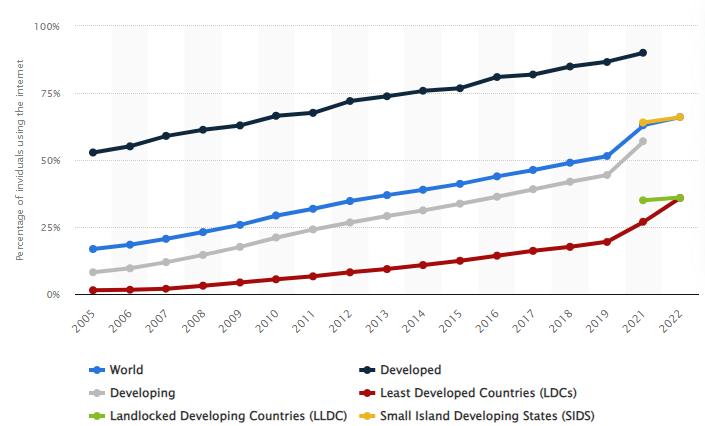
Figure 1Source: Market Maturity
3. Key Factors Contributing to the Digital Divide
3.1. Economic Factors
The major factor that determines the access to digital technologies is the economic status. The World Bankhaspointedtothecorrelationbetweenincomeand accesstotheinternet. In low-incomehouseholds, digital devices and internet services can be way too expensive to afford, thus limiting access (Swenson & Ghertner,2021). Furthermore, the digital gap also impacts the level of access more affluent people frequently have better internet speeds and superior technology.
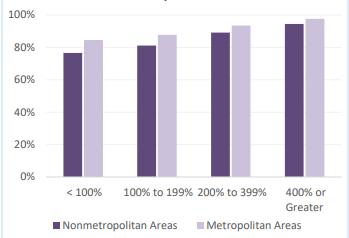
Figure 2 Source: Department of Health & Human Services
International Research Journal of Engineering and Technology (IRJET) e-ISSN: 2395-0056
Volume: 11 Issue: 02 | Feb 2024 www.irjet.net p-ISSN: 2395-0072
Locationisaveryimportantfactorinthedigital divide. In comparison to the rural areas, urban centres usually have a lot more efficient infrastructure and also higher-speed internet. The ITU reports high differences in the penetration of the internet between cities and villagesaroundtheworld.Inmostdevelopingcountries, remote and rural areas are usually not well-equipped with the infrastructure that is required for internet connection, therefore aggravating the chasm (Facts and Figures 2022 - Internet Use in Urban and Rural Areas, 2022).
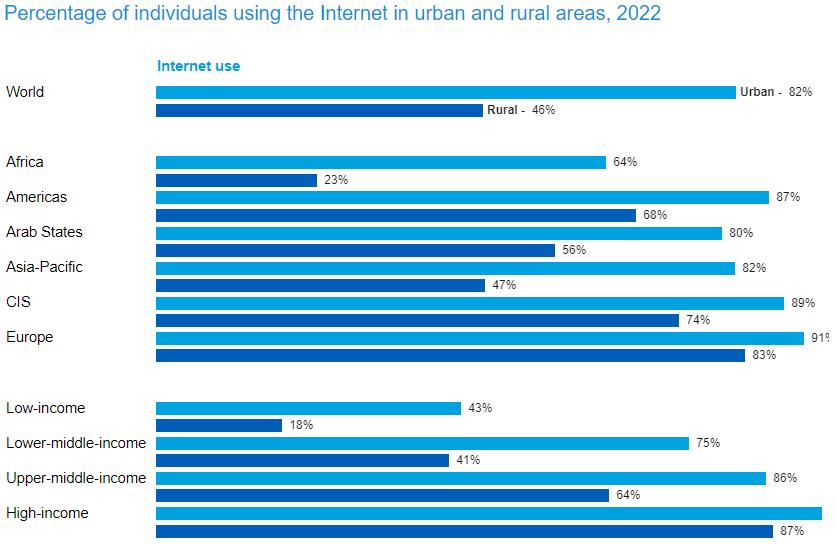

Figure 3 Internet is used widely around the world, the figure depicts the percentage of individuals who have access to the Internet in urban and rural areas Source (ITU facts and Figs 2022)
Other major socio-cultural factors also contribute to the digital divide. These consist of many differences in the availability of technology that are related to age, gender, and also level of education. UNESCO has stated that women are much less likely to accesstheInternetascomparedtomen,andthisiseven more pronounced in developing regions (Bridging the Gender Divide, n.d.).Also, digital literacy decreases with age and ultimately it affects the utilisation of digital technologiesbyolderpeople.
3.4.
Policy and governance are very critical to the development of the digital divide. The gap is either
bridgedbyoneorincreasedbygovernmentpoliciesand regulations. Good policy frameworks which support the investmentindigitalinfrastructure,subsidisetechnology costs for low-income groups and stress the importance of digital literacy have a great potential to narrow the digital gap.On theotherhand,a lack offocusorpolicies thataretoorestrictivecanmakeitmuchworse.
3.5.
The digital divide affects different groups of people in variousways.
Rural populations are significantly disadvantaged in terms of connectivity and digital services availability compared to the cities, as reported by the ITU. This difference affects not only individual connectivity but also restricts the prospects for rural economicgrowth.
3.7.
This gap has many far-reaching implications for education. According to UNESCO, those from the areas that have limited digital access experience a lack of learning resources and also e-learning opportunities. ThiswasmostclearduringtheCOVID-19outbreakwhen the education systems across the globe switched to onlineteaching.
3.8.
In the area of healthcare, the divide determines the availability and also quality of telemedicine and digital health services that are growing in importance. WHOhasalsopointedoutthepossibilityofusingdigital healthservicestoenhancehealthcareefficacy,especially inareasthatarefarfromurbancenters
3.9.
Economically,thedigitaldivideimpactspeople's capacitytoparticipateinthedigitaleconomy.AstheILO pointsout,peoplewhodonothaveaccesstodigitalskills are at a considerable disadvantage in seeking employment especiallyconsidering the growingnumber ofjobsthatrequiredigitalskills.
3.1.1.
Asa resultofglobal disparitiesindigital access, technological improvements, and different bridging-thegapinitiatives,thelandscapeofthedigitaldivideisbeing formed.
3.1.2.
International Research Journal of Engineering and Technology (IRJET) e-ISSN: 2395-0056
Volume: 11 Issue: 02 | Feb 2024 www.irjet.net p-ISSN: 2395-0072
The digital divide is very apparent in the different regions and also countries. Countries such as Norway,Swedenandalsothe Netherlandshaveinternet penetration rates exceeding 90%, according to the 2021 data by ITU (Facts and Figures 2022 - Internet Use, 2022). However, internet penetration in most of the developing nations, especially in regions such as subSaharan Africa and also parts of Asia is still low. For example, the ITU indicated that in many countries like Madagascar and Ethiopia, internet penetration rates are below15%.Thisgapisnotonlybetweenthenationsbut also within them, as urban centers typically enjoy much greateravailabilitythantherurallocales.
3.1.3.
Technology is both a part of the problem and also a part of the solution to the digital divide. On one hand, innovations such as 5G networks and satellite internet promise faster and also more stable connectivityeveninremotelocations.Forexample,firms such as Space X with its Star link project seek to deliver universal internet connectivity through satellite technology and thus revolutionise access in the underprivileged areas of our planet (Brown, 2020). Alternatively, as the World Economic Forum observes, thesedevelopmentscanalsoincreasethedividebecause those already in the areas with connections acquire faster and more advanced technologies while leaving othersevenfurtherbehind.
3.1.4.
Many programs have been implemented to bridge the digitalgap.
3.1.5.
Many governments across the world have implemented many policies aimed at improving digital connectivity. TheEuropean Union hasundertaken many initiatives such as the Digital Europe Program to invest in digital skills and also infrastructure (Populo, 2020) Countries such as South Korea and Singapore have reached high levels of connectivity with considerable investmentandalsofavorablepolicies.
3.1.6. NGO and Private Sector Initiatives
NGOs and private companies play a very important role in this process. For instance, Microsoft's Air band Initiative targets to provide internet access in rural areas within the United States (Microsoft Air band Initiative|MicrosoftCSR,n.d.) Organizationssuchasthe World Wide Web Foundation strive to promote affordableinternetaccessworldwide.
3.1.7.
Inthisglobalproblem,internationalcooperation isveryimportant.SustainableDevelopmentGoal9ofthe UNfocusesonbuildingresilientinfrastructure,including bridging the digital divide. The ITU's Connect 2030 Agenda is another global attempt at improving connectivity (Connect 2030 – an Agenda to Connect All toaBetterWorld,n.d.).However,theterrainisstillvery rough.TheCOVID-19pandemichasbroughttolightand also intensified the digital divide, making it very clear that in modern society digital connection is essential. According to a UNCTAD report, the pandemic sped up the adoption of digital technologies but it also left millions disconnected, hindering their ability to work, learnandcommunicate.
Itisarguedthatthepolicies areinstrumental in narrowingthedigitaldivide,andacombinationofpolicy measureshasalsobeenrecommended by pastresearch. Overall, policy initiatives may refer to the subsidies directed towards specific digitally underprivileged sections such as the rural population (Salemink et al., 2017). For example, governments can use powerful intervention policies to ensure the equal distribution of Information and communications technology even in remote areas (Davies, 2021). Additionally, the largescale implementation of policies geared at equipping underprivilegedgroupswithbettercommunicationskills (reading,writingandsoftware)facilitatesthebridgingof digital divides (Norman et al., 2022). The government policy-makers can therefore team up with the schools and provide home computers to the students from low catching areas so that they can reduce the impact of socioeconomic disparities among them (Van De Werfhorst et al., 2022). Such policies as increasing the importance of IT, securing property rights, and improving press freedom and transparency can stimulate educational improvements, and labor market participation rate increase to help in income growth progress in technological development. However, in the context of policy measures, there should be a space for local adaptations as it seems that contextual and local factors have an impact on technology users and might influence the policy's success. Proper evaluation mechanismsallowfortheformulationofnewpoliciesin response to the digital divides helping policy-makers focus on the particular segments of society, such as elderlypeopleandalsosocioeconomicallydisadvantaged groups(Yoonetal.,2020).
There should be a strategic focus on enhancing education,recognizingthatsecondaryandtertiarylevels
International Research Journal of Engineering and Technology (IRJET) e-ISSN: 2395-0056
Volume: 11 Issue: 02 | Feb 2024 www.irjet.net p-ISSN: 2395-0072
play a crucial role in fostering technological adaptation andinnovation(Qureshietal.,2021).Ratherthansolely prioritizing primary education, which yields high social returns, innovative policy measures are needed to encouragefurthereducationinrural areas.Additionally, promoting the right technologies for rural areas is vital. For instance, the rise of PC penetration together with mobile technology to solve the digital divide. Though mobile computers are much less expensive and also lighter, PCs have complete functionality. Government andtheprivateactorsshouldpartnertopromotemobile coverage in rural areas. It is very vital to overcome the psychological barrier of linking the ICT benefits with personal needs. It is possible, therefore, to widen the perception of ICTs for everyone through media productionslikeTVserialscaninspirepassivepeopleto accept the technology. In addition, plans should be formulated to deal with the constraints that women encounter in their efforts to use and benefit from ICTs, emphasizing the local languages. An important precondition for overcoming the urban-rural digital divide is to promote the telecommunication infrastructure in rural areas. Liu and Wang (2021), learningfromsuccessful international modelslikeChina that invested heavily in universal telecommunication access in rural and remote areas, argue that governments should set aside specific funds for this purpose.
In order to reduce the gulf between rural and remote areas for the digital divide, a reorientation of digital policy is very necessary. Rural communities do not respond passively but they respond innovatively in the establishment of hard and soft digital infrastructure through rural-urban linkages (Q. Zhang et al., 2023). Illustrations from different areas, however, point to the successful projects implemented by civic associations, agricultural organizations and also private companies (Ye & Yang, 2020). But these are anomalies and should be taken as a sign of the larger policy shortcomings. An integrated and efficient digital policy for rural areas should include a consolidated national plan that is responsive to the local realities going beyond the physical infrastructure Roberts et al. (2017). It is very critical toinvestinstrong andalsoextensive broadband connectivity. The government and private institutions should work together to deploy high-speed internet infrastructure in underserved areas using satellite, fixed wireless,andalsofibreopticstechnologyasasolutionto various geographical challenges (Ahmmed et al., 2022). Moreover, the community-based projects can be very catalytic. Creating telecommunication hubs and also digital community centres can also act as a point of connectivity,providingresourcesandtrainingprograms
for digital literacy (Prado, 2009). Such mobile connectivity solutions as the deployment of mobile towers or employing mesh networks could solve the specifics of remote regions and bring the connection much closer to the people (Y. Zhang et al., 2021). In addition, promoting private sector engagement through subsidies and regulatory mechanisms can expedite the infrastructure development in these areas (Ruimy, 2018). Governments may also look into public-private partnerships whereby some of the costs and risks involved in building the digital infrastructure can be shared. To fully benefit from the digital economy, residentsneedtobeempoweredwiththeskillsrequired as comprehensive digital literacy programs should accompany the infrastructure development so that the impactismaximized.
It is essential to make the technology accessible and also affordable in order to promote inclusivity and bridgethedigitaldivide(West,2015).Anapproachisto undertake targeted subsidy programmers that offer financial aid to the poor and marginalized communities (Bell et al., 2020). Governments can work with telecom companies to provide discounted or subsidized internet and device bundles, which would make the connectivity more affordable (Gallagher, 2021). The second strategic approach concentrates on encouraging the development and implementation of cheap entry-level devices. Promotingtheproductionofcheapsmartphones,tablets, and also computers might considerably reduce the barriers to entry for individuals living in low-income regions. This can be complemented by tax breaks or subsidies for companies that produce cost-effective technology solutions. Affordability can also be greatly facilitated through community-based programs. The creation of public technology centers and libraries that provide free or inexpensive computer and internet access enables people to use digital resources without the financial obligation of owning them (Comi et al., 2024). The utilisation of the current community infrastructurecanserveasamuchcheaperalternativeto the enhancement of technology access. Secondly, promotingdigitalliteracyisverynecessarytoensurethe best use of affordable technology access. It is very important to introduce educational programs that will enable people with the necessary skills required for the efficient use of technology. Through the integration of these approaches, governments, NGOs, and private sector actors can collaborate to ensure that the technology is not only accessible but also affordable for everyone which will in turn create an inclusive and fair digitalenvironment.
International Research Journal of Engineering and Technology (IRJET) e-ISSN: 2395-0056
Volume: 11 Issue: 02 | Feb 2024 www.irjet.net p-ISSN: 2395-0072
Digital literacy programs become one of the most essential tools for overcoming the digital divide (Radovanović et al., 2020). The changing nature of the digital divide highlights the importance of addressing social disparities in real life, moving away from technology as a savior to the issues of class and status Digitalliteracyisoneofthekeyenablersintheeducation sector, related to searching, processing, creating and sharing information skills with digital technology proficiency. To solve the digital divide, it is highly important to have robust digital literacy programs that incorporate all the people (Bravo et al., 2021). The programs should develop the formal skills of digital media navigation, information acquisition, analytical abilities, content creation and communication in the digital environment. Such programs can be easily implemented through community initiatives and collaborations between education institutions, public and also private organizations, as well as NGOs. Choudhury & Bansal (2022) point out that DLTPs emphasize the importance of targeted action, especially in developing countries. The marginalized groups like the aged, disabled, low-skill people and even the illiterate should be targeted by DLTPs (Choudhury & Bansal, 2022). DLTPs' curriculum should include a wide range of digital skills from simple operations to information and data literacy, with a focus on what Internet use can bring for health, leisure and selfactualization. However, in practice, DLTPs need to respond to the dynamic environment of the digital landscape and not only focus on basic skills but also advance competencies like safety skills and problemsolving.
The populations underserved are characterized by the individuals vulnerable to health care quality issues because of several factors such as financial situation, place of residence, health status; age; functional status; developmental stage; the ability to communicate properly and also race, ethnicity and gender (Eruchalu et al., 2021). Strategies for alleviating the digital policy, funding, research and also education/training. Policy-makers are encouraged to develop a comprehensive, lifelong health information technology policy with the accompanying funding; encouraging partnerships among organisations and involving significant community members as early collaborators. Further, business plans for informatics programs that target the underserved population with relevant marketing and dissemination strategies are recommended. Healthcare improvement requires many financial incentives for health education, collaboration between multiple parties, and also targeted funding for projects addressing the underserved needs. In future research, unique population characteristics, community representation, and alternative study designs are to be studied in greater detail such as those of the natural language processing and technical standards. Education and training programs should focus on health literacy, anticipatoryactionresearchprinciplesandalsoavariety of learning styles for underserved populations (Adriaenssensetal.,2022).Thesuggestionshighlightthe need to update the payment policies, harmonies healthcare standards, promote collaborations and ensure widespread adoption to tackle the issue of disparitiesadequately.
5.1. Sustainability and Scalability:
A key issue is the sustainability of the digital inclusion projects. Though short-term victories are very worthy of praise, the long-lasting impact is a much tougher challenge (Howard et al., 2021). Initiatives sometimes lose momentum through leadership, priorities shift, or due to the lack of resources. Sustainability strategies should include the implementation of strong frameworks that are not tied to individual leaders and have community ownership (Howard et al., 2019). Scalability, i.e., the ability to spread successful templates is also very critical. Widespreadimpactisonlypossiblewhenidentifyingthe key elements that contribute to success and adapting them to diverse contexts. Successful initiatives can be scaled with the help of many partnerships between governmental organizations, NGOs and also private businesses.
International Research Journal of Engineering and Technology (IRJET) e-ISSN: 2395-0056
Volume: 11 Issue: 02 | Feb 2024 www.irjet.net p-ISSN: 2395-0072
Hilbert (2010) identifies the resistance to technologicaladoptionduetoculturalandsocialbarriers asamajorchallenge.Communitiesmayhesitatetoadopt digital tools for various reasons, such as privacy issues, unfamiliarity and also displacement of old ways. This resistance needs a lot of culturally sensitive interventions. Trust may be built through the involvement of the community leaders, and awareness campaigns aimed at the target groups and local opinion makers. In addition, the initiatives should be adapted to the cultural practices, languages and values. It is very vital to acknowledge and respect the diversity in digital literacy levels and also preferences in developing inclusiveprograms.
The economic dimension of digital inclusion is very complex. Financing and resource allocation are the keyfactorsforsuccess(Tayetal.,2022).Inthisregard,it is necessary to develop sustainable funding models that would take into account the price of the technology implementationandalsotheneedtoensureavailability. To mobilise the resources effectively, public-private partnerships can be pursued. Moreover, the larger economic setting is very critical to address. For those in underserved communities, economic barriers may also include many issues such as the cost of internet connectivity and also devices (Philip & Williams, 2019). The initiatives should include strategies to eliminate economichurdles;these can be in the form ofsubsidies, community centers with free internet access or even partnershipsbetweenthetelecommunicationcompanies andcommunitiestoprovidecheapconnectivity.
While technological advances are very promising for progress, they also bring some uncertainties. The ever-changing rate of technological development necessitatesa lotofconstantadaptationin digital inclusion efforts (Esteban-Navarro et al., 2020). Future-proofing initiatives, therefore, encompass the predictionandpreparationforemergingtechnologiesto ensure that communities can remain competent in a dynamic digital environment. In addition, the interconnectionoftechnologytothesocialandeconomic backdrops defines many uncertainties. The transformation of the employment landscape, economic systems, and also cultural values can undermine digital inclusion strategies. Flexibility and adjustability in program planning are very necessary to handle unexpectedchallenges.
Information and communication technologies (ICTs) offer unprecedented opportunities but also bring about complex challenges, the digital divide are navigated in this hyper connected world and require a comprehensiveapproach.Thedevelopmentofthedigital divide from basic access problems to more generalized disparities in software literacy, broadband speed and technology use indicates that strategies must come as tactful.Thedigitaldivideisperpetuatedorminimizedby economic considerations, geographical differences, socio-cultural influence and policy governance. The worldembracesdifferentscenariosofdigitalaccesswith the developed countries having a very high penetration rate, and many developing states trailing behind. Collaborative efforts of the governments, NGOs as well and private entities in closing this gap can be witnessed through initiatives such Digital Europe Program and Microsoft's Airband Initiatives. However, the pandemic caused by COVID-19 has merely highlighted the great importance of this problem, making it visible the progress made and also continuing challenges in worldwide digital inclusion. Effective policies and governance, infrastructure development, affordable access, education and skill development appear as the top strategies for promoting inclusiveness. Policies would cover many strategic subsidies, infrastructure provisioning and also integrated digital literacy programs for universal accessibility along with affordability. Emphasizing the need for education and skill development gains importance in bridging the digital gap as opposed to varying literacy programs that address several various groups of people. However, the challenges persist because of sustainability issues scalability difficulties cultural and social barriers economic roadblocks that are associated with future uncertainties. To overcome these challenges, strategies must be very flexible, culturally sound and also financiallyfeasible.As the latter worldmoves towards a more balanced digital future, it is important to focus on theinitiativesthatnotonlyleadus intoshort-termwins butalsoensurealong-termimpactofinclusioneffortsto createaconnectedandfairglobalcommunity.
Adriaenssens,J.,Rondia,K.,VanDenBroucke,S.,&Kohn, L. (2022). Health literacy: What lessons can be learned from the experiences and policies of different countries? The International Journal of Health Planning and Management, 37(2), 886–901.https://doi.org/10.1002/hpm.3382
Ahmmed, T., Alidadi, A., Zhang, Z., Chaudhry, A. U., & Yanikomeroglu, H. (2022). The digital divide in
International Research Journal of Engineering and Technology (IRJET) e-ISSN: 2395-0056
Volume: 11 Issue: 02 | Feb 2024 www.irjet.net p-ISSN: 2395-0072
CanadaandtheroleofLEOsatellitesinbridging the gap. IEEE Communications Magazine, 60(6), 24–30.
Bell,O.N.,Hole,M.K.,Johnson,K.,Marcil,L.E.,Solomon, B.S.,&Schickedanz,A.(2020).Medical-financial partnerships: Cross-sector collaborations between medical and financial services to improvehealth. AcademicPediatrics, 20(2),166–174.
Ben, S., Bosc, R., Jiao, J., Li, W., Simonelli, F., & Zhang, R. (2017). Digital Infrastructure Overcoming the digital divide in China and the European Union. Centre for European Policy Studies https://www.researchgate.net/profile/WenweiLi5/publication/352422008_Digital_Infrastructur e_Overcoming_the_Digital_Divide_in_China_and_ the_European_Union/links/60c96c81a6fdcc0c5 c86730f/Digital-Infrastructure-Overcoming-theDigital-Divide-in-China-and-the-EuropeanUnion.pdf
Bravo, M. C. M., Chalezquer, C. S., & Serrano-Puche, J. (2021). Meta-framework of digital literacy: A comparative analysis of 21st-century skills frameworks. Revista Latina de Comunicacion Social, 79,76–109.
Bridging the gender divide. (n.d.). ITU. https://www.itu.int/en/mediacentre/backgrou nders/Pages/bridging-the-gender-divide.aspx
Brown, W., PhD. (2020, August 28). The digital divide. Pressbooks.
https://open.library.okstate.edu/learninginthed igitalage/chapter/the-digital-divide/
Choudhary, H., & Bansal, N. (2022a). Addressing Digital Divide through Digital Literacy Training Programs: A Systematic Literature Review. DigitalEducationReview, 41,224–248.
Choudhary, H., & Bansal, N. (2022b). Barriers Affecting the Effectiveness of Digital Literacy Training Programs(DLTPs)forMarginalisedPopulations: A Systematic Literature Review. Journal of Technical Education and Training, 14(1), 110–127.
Closing the digital divide. (n.d.). Wilson Center. https://www.wilsoncenter.org/article/closingdigital-divide
Closing the digital divide. (n.d.-b). Wilson Center. https://www.wilsoncenter.org/article/closingdigital-divide
Comi, M., Smith, S., Goettlich, W. A., Alexander, P., Davidson, D., & Staples, W. G. (2024). Digital home-lessness: Exploring the links between publicInternetaccess,technologicalcapital,and social inequality. Current Sociology, 72(1), 65–82.
https://doi.org/10.1177/00113921221111819
Connect 2030 – An agenda to connect all to a better world. (n.d.). ITU. https://www.itu.int/en/mediacentre/backgrou nders/Pages/connect-2030-agenda.aspx
Davies, A. (2021). COVID-19 and ICT-supported remote working: Opportunities for rural economies. World, 2(1),139–152.
Disruptionsduetoschoolclosures–COVID-19response. (n.d.). https://covid19.uis.unesco.org/disruptionsdue-to-school-closures/
Eruchalu,C.N.,Pichardo,M.S.,Bharadwaj,M.,Rodriguez, C. B., Rodriguez, J. A., Bergmark, R. W., Bates, D. W., & Ortega, G. (2021). The Expanding Digital Divide: Digital Health Access Inequities during the COVID-19 Pandemic in New York City. Journal of Urban Health, 98(2), 183–186. https://doi.org/10.1007/s11524-020-00508-9
Esteban-Navarro, M.-Á., García-Madurga, M.-Á., MorteNadal, T., & Nogales-Bocio, A.-I. (2020). The rural digital divide in the face of the COVID-19 pandemicinEurope Recommendationsfroma scoping review. Informatics, 7(4), 54. https://www.mdpi.com/2227-9709/7/4/54
Factsand Figures 2022 - Internet use. (2022, November 24). https://www.itu.int/itud/reports/statistics/2022/11/24/ff22-internetuse/
Gallagher, E. (2021). Expanding Broadband Access and Adoption in Rural and Unserved Communities https://jscholarship.library.jhu.edu/handle/177 4.2/66658
Hanna, K. T. (2021, August 11). digital divide. WhatIs. https://www.techtarget.com/whatis/definition /digital-divide
Hilbert, M. (2010). When is cheap, cheap enough to bridge the digital divide? Modelling incomerelated structural challenges of technology diffusion in Latin America. World Development, 38(5),756–770.
© 2024, IRJET | Impact Factor value: 8.226 | ISO 9001:2008
|
International Research Journal of Engineering and Technology (IRJET) e-ISSN: 2395-0056
Volume: 11 Issue: 02 | Feb 2024 www.irjet.net p-ISSN: 2395-0072
Howard, S. K., Schrum, L., Voogt, J., & Sligte, H. (2021). Designing research to inform sustainability and scalability of digital technology innovations. Educational Technology Research and Development, 69(4), 2309–2329. https://doi.org/10.1007/s11423-020-09913-y
Liu,C.,& Wang,L.(2021). Whoisleft behind? Exploring the characteristics of China’s broadband nonadopting families. Telecommunications Policy, 45(9), 102187. https://doi.org/10.1016/j.telpol.2021.102187
Measuring digital development Facts and figures 2019. (2019).ITUPublications.
Measuring digital development: Facts and Figures 2023. (n.d.). ITU. https://www.itu.int/en/ITUD/Statistics/Pages/facts/default.aspx
Microsoft Airband Initiative | Microsoft CSR. (n.d.). Microsoft. https://www.microsoft.com/enus/corporate-responsibility/airband-initiative
Most connected countries in the world: South Korea on top,HongKongrestsat9thplace,andSingapore ranks 19th. (2017, October 26). OpenGov Asia. https://opengovasia.com/most-connectedcountries-in-the-world-south-korea-on-tophong-kong-resting-at-9th-place-and-singaporeranks-19th/
Norman,H.,Adnan,N.H.,Nordin,N.,Ally,M.,&Tsinakos, A. (2022). The educational digital divide for vulnerable students in the pandemic: Towards the New Agenda 2030. Sustainability, 14(16), 10332.
Philip, L., & Williams, F. (2019). Remote rural homebased businesses and digital inequalities: Understanding needs and expectations in a digitally underserved community. Journal of RuralStudies, 68,306–318.
Populo, M. (2020, August 30). Digital Education in Europe - European Digital Learning Network. European Digital Learning Network. https://dlearn.eu/news/2020/01/digitaleducation-in-europe/
Prado, P. (2009). Bridging digital poverty: Adoption of information and communication technologies at community technology centers in the Dominican Republic. University of Miami. https://search.proquest.com/openview/38e6f1 9905863a588d6a88536a84788f/1?pqorigsite=gscholar&cbl=18750
Qureshi, M. I., Khan, N., Raza, H., Imran, A., & Ismail, F. (2021). Digital technologies in education 4.0. Does it enhance the effectiveness of learning? https://ir.unikl.edu.my/jspui/handle/12345678 9/25661
Radovanović, D., Holst, C., Belur, S. B., Srivastava, R., Houngbonon, G. V., Le Quentrec, E., Miliza, J., Winkler, A. S., & Noll, J. (2020). Digital literacy key performance indicators for sustainable development. SocialInclusion, 8(2),151–167.
Roberts, E., Anderson, B. A., Skerratt, S., & Farrington, J. (2017). A review of the rural-digital policy agenda from a community resilience perspective. Journal of Rural Studies, 54, 372–385.
Ruimy, D. (2018). Broadband connectivity in rural Canada: Overcoming the digital divide. House of Commons Canada. https://www.eorn.ca/en/eornresources/resources/Documents/BroadbandConnectivity-in-Rural-Canada Final-Report2018.pdf
Salemink, K., Strijker, D., & Bosworth, G. (2017). Rural development in the digital age: A systematic literature review on unequal ICT availability, adoption,anduseinruralareas. JournalofRural Studies, 54,360–371.
Siak, C. K. (2023, September 5). Bridging the digital divide:EmpoweringSMEstothriveinthedigital age. TNGlobal. https://technode.global/2023/09/05/bridgingthe-digital-divide-empowering-smes-to-thrivein-the-digital-age/
Statista. (2023, January 31). Global internet access rate 2005-2022, by market maturity. https://www.statista.com/statistics/209096/sh are-of-internet-users-worldwide-by-marketmaturity/
Swenson,K.,&Ghertner,R.(2021).Peopleinlow-income households have less access to internet services–2019update. USDepartment ofHealth & Human Services. Available online: https://aspe. hhs. gov/sites/default/files/private/pdf/263601/int ernet-access-among-low-income-2019.Pdf
Tay, L.-Y., Tai, H.-T., & Tan, G.-S. (2022). Digital financial inclusion: A gateway to sustainable development. Heliyon https://www.cell.com/heliyon/pdf/S24058440(22)01054-4.pdf
International Research Journal of Engineering and Technology (IRJET) e-ISSN: 2395-0056
Volume: 11 Issue: 02 | Feb 2024 www.irjet.net p-ISSN: 2395-0072
Taylor,K. (2023, August 17).The Digital Divide: WhatIt Is, and What's Being Done to Close It. Investopedia.
https://www.investopedia.com/the-digitaldivide-5116352
Taylor,K.(2023b,August17).TheDigitalDivide:WhatIt Is, and What's Being Done to Close It. Investopedia.
https://www.investopedia.com/the-digitaldivide-5116352
United Nations. (n.d.). Bridging the digital divide in health | United Nations. https://www.un.org/en/chronicle/article/bridg ing-digital-divide-health
Van De Werfhorst, H. G., Kessenich, E., & Geven, S. (2022). The digital divide in online education: Inequality in digital readiness of students and schools. Computers and Education Open, 3, 100100.
West, D. M. (2015). Digital divide: Improving Internet access in the developing world through affordable services and diverse content. Center forTechnologyInnovationatBrookings,1–30.
WSIS: Declaration of Principles. (n.d.). https://www.itu.int/net/wsis/docs/geneva/offi cial/dop.html
Ye, L., & Yang, H. (2020). From digital divide to social inclusion: A tale of mobile platform empowerment in rural areas. Sustainability, 12(6),2424.
Yoon, H., Jang, Y., Vaughan, P. W., & Garcia, M. (2020). Older Adults’ Internet Use for Health Information: Digital Divide by Race/Ethnicity and Socioeconomic Status. Journal of Applied Gerontology, 39(1), 105–110. https://doi.org/10.1177/0733464818770772
Zhang, Q., Webster, N. A., Han, S., & Ayele, W. Y. (2023). Contextualizing the rural in digital studies: A computational literature review of rural-digital relations. TechnologyinSociety,102373.
Zhang, Y., Love, D. J., Krogmeier, J. V., Anderson, C. R., Heath, R. W., & Buckmaster, D. R. (2021). Challenges and opportunities of future rural wireless communications. IEEE Communications Magazine, 59(12),16–22.
Zhao, L. (2023, September 7). How the Digital Divide Affects America’s Rural Small Businesses. https://www.clevelandfed.org/publications/not
es-from-the-field/2023/nftf-20230907-howthe-digital-divide-affects-americas-rural-smallbusinesses
© 2024, IRJET | Impact Factor value: 8.226 | ISO 9001:2008
| Page369