
International Research Journal of Engineering and Technology (IRJET) e-ISSN:2395-0056
Volume: 11 Issue: 02 | Feb 2024 www.irjet.net p-ISSN:2395-0072
BIOSENSORS
Dr. B. Rama Brahma Reddy 1 , K. Malleswari 2, V.Bindu Sree 3
Principal & Professor ,Department of Pharmaceutical chemistry, Nalanda Institute of Pharmaceutical Sciences, Kantepudi(v), Guntur(D)
Associate Professor , Department of Pharmaceutics, Nalanda Institute of Pharmaceutical Sciences, Kantepudi(v), Guntur(D).
Student in Nalanda Institute of Pharmaceutical Sciences, Kantepudi(v), Guntur(D) ***
Abstract:
Biosensors are one of the most important inventions in engineering history, and biosensors are one of them. Biosensors have been under development for over 35 years, becoming more prominent in the last 15 years. Silicon Nanowires, for example, has paved the way for a flood of new signal transduction methods in biosensors, illustrating the field's advancement. Recently, NASA has been developing better physiologic sensor and biotelemetry system technologies, to continuously assess basic physiological indicators in unrestrained space beings, such as heart rate, blood pH, and body temperature, which is a challenging problem to solve. Approximately 20 to 25 years ago, biosensors were one of the mysterious topics in engineering as they connected two different fields (electronic and biology). But now, from the detection of Covid-19 in medical science to the detection of microorganisms in space technology, biosensors are used on a large scale and have become the most popular choice for manufacturers. In this review, we will encounter every prospect, application, and type of biosensor.(1)
Key words: 1.Biosensors Introduction, 2.Elements of Biosensors, 3.Types of Biosensors, 4.Characteristics of Biosensors, 5.Application of Biosensors.
1.Introduction:
The history of biosensors started in the year 1962 with the development of enzyme electrodes by the scientist Leland C. Clark. Since then, research communities from various fields such as VLSI, Physics, Chemistry, and Material Science have come together to develop more sophisticated, reliable and mature biosensing devices for applications in the fields of medicine,agriculture,biotechnology,aswellasthemilitaryandbioterrorismdetectionandprevention.

Working:
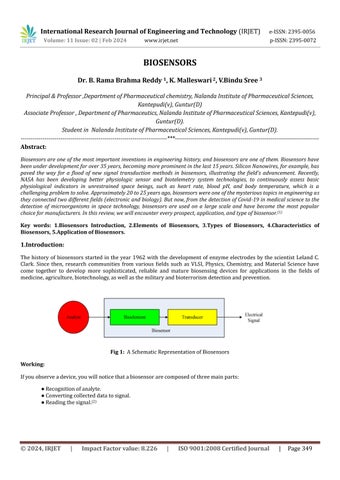
Ifyouobserveadevice,youwillnoticethatabiosensorarecomposedofthreemainparts:
● Recognitionofanalyte.
● Convertingcollecteddatatosignal.
● Readingthesignal (2)
International Research Journal of Engineering and Technology (IRJET) e-ISSN:2395-0056
Volume: 11 Issue: 02 | Feb 2024 www.irjet.net p-ISSN:2395-0072

Fig. 2: Illustrationofprincipalcomponentsofabiologicalsensordevice:(1)bioreceptor–detectorlayerofimmobilized biomaterial;(2)physicochemicaltransducer,(3)signal-conditioningandrecordingthesignalforhumaninterpretation
2.Elements of Biosensors:
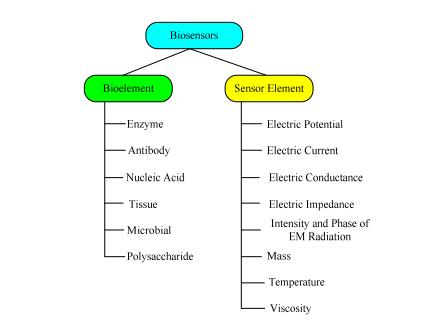
Theimportantcomponentsofabiosensorare:
(1)ABioreceptor(e.g.,enzymes,antibody,microorganism,orcells)
(2)ATransducerofthephysicochemicalsignal.
(3)ASignalprocessortointerprettheinformationthathasbeenconverted.
3.Types of Biosensors:
ElectrochemicalBiosensors
ConductimetricBiosensor
AmperometricBiosensor
PotentiometricBiosensor
ThermometricBiosensors
OpticalBiosensors
International Research Journal of Engineering and Technology (IRJET) e-ISSN:2395-0056
Volume: 11 Issue: 02 | Feb 2024 www.irjet.net p-ISSN:2395-0072
Piezoelectricsensors
Whole-CellBiosensors
Immuno-Biosensors
ResonantBiosensors
Ion-SensitiveBiosensor
3.1 Electrochemical Biosensors: Many electrochemical biosensors have been created and presented in recent years for the identification of multiple medical conditions based on specific indicators, utilizing their properties which were discussedintheprevioussection.
3.2 Amperometric Biosensor: As we have previously discussed the invention of "CLARK ELECTRODE'', in 1962 (nearly ten years later) he used the same glucose oxidized enzyme and reversed its polarity of the electrode to create the first AmperometricBiosensor.
3.3Potentiometric Biosensor: Potentiometric biosensor in simple terms converts mechanical displacement into voltage difference.
3.4 Conductive Biosensor: Whenaconstantpotentialissuppliedbetweenareferenceelectrodeandapolymer modified electrode,achangeinelectricalconductivityorresistivityisdetectedagainsttheanalyteconcentrationinconductometric conductingpolymer-basedbiosensors.
3.5Thermometric Biosensors:Thermalsensorsandcalorimetricbiosensorsareothernamesforthesebiosensors.
3.6 Optical Biosensor:Theopticalbiosensorworksonthepremiseoflightoutputduringareactionorlightabsorbedby thedifferenceinreactantandproductconcentration.Let'shavealookatanopticalbiosensorasanexample
3.7Piezoelectric sensors: Because they function with the idea of sound, piezoelectric biosensors are also known as acoustic sensors. Positive and negative charge crystals have a certain frequency of vibration. Electronic equipment can detecttheresonancefrequency.Therearecertaindisadvantagestousingapiezoelectricsensor. (3)
3.8 Ion-Sensitive Biosensors: These are semiconductor FETs having an ion-sensitive surface. The surface electrical potential changes when the ions and the semiconductor interact. This change in the potential can be subsequently measured. The Ion Sensitive Field Effect Transistor (ISFET) can be constructed by covering the sensor electrode with a polymerlayer.Thispolymerlayerisselectivelypermeableto4analyteions.
4.Characteristics of Biosensors:
4.1 Sensitivity: Sensitivity isthemostimportantcharacteristic of a sensor.It isthe detectionlimit, whichisthe minimal amount(orconcentration)ofanalytethatcanbedetected.
4.2 Selectivity: Selectivity means that the sensor detects a certain analyte and does not react with added mixtures and contaminants
4.3 Stability:Thestabilityofasensorreferstothesignaldriftingunderconstantconditions,whichcouldcauseerrors (4)
4.4 Reproducibility: Due to the delicate conditions under which biosensing is required, it is necessary that a biosensor producesconsistentoutputresults,underthesameorsimilarconditions,usingthesameanalyte.
4.5 Response Time: A biosensor’s response time is the amount of time it takes to read and produce a signal after its bioreceptor meets the specific analyte For example, glucose oxidase–based sensors have a response time between 5 and 30s.
4.6 Range of Linearity: Thelinearityofabiosensorisitsabilitytoexhibitvariationinitsoutputproportionaltodifferent analyteconcentrations. (5)
International Research Journal of Engineering and Technology (IRJET) e-ISSN:2395-0056
Volume: 11 Issue: 02 | Feb 2024 www.irjet.net p-ISSN:2395-0072
5.Applications of Biosensors:
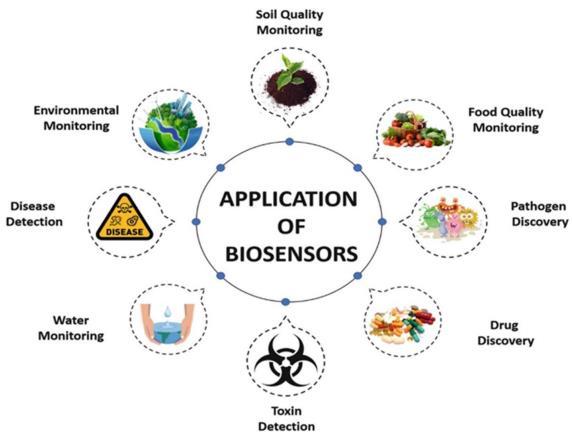
5.1 Environmental Science: Ourenvironmenthasacquireddifferentpollutantsasaresultofrecentindustrializationand modernization.Heavymetals,herbicides,complexhydrocarbons,andseveralothersubstancesareamongthem.However, numerousbiosensorshavebeendevelopedsolelytoaddressenvironmentalissues
5.2 Heavy metal Detection: Asweallknowtheenvironmentcontainsbothvitalandhazardousmetals.Toxicheavymetal accumulationinhumansmaycausearangeofmajorhealthproblems,includingdamagetotheliver,kidneys,brainsystem, andevenourreproductivesystem.Anenzymecanrespondtoavarietyofheavymetals,butitwon'tbeabletorespondto alloftheheavymetalsintheenvironment.
5.3 Pesticide Detection: Weallknowthedisadvantagesofusingpesticidesastheycanbedangeroustohumanhealth.If farmers are exposed to pesticides without using any suitable protective equipment, they may develop major long-term healthproblemssuchascancer. (6)
5.4 BOD (Biochemical oxygen demand) biosensors: BODisthequantityofoxygenrequiredbyaerobiclivingorganisms in water to break down organic molecules present in a particular water sample during a specific time and at a certain temperature. The elements utilized to determine BOD are primarily pure cultures of a combination of known microorganisms
5.5 Medical Science:
Cancer detection: Canceristhebiggestcauseofmortalityintheworld,anditsincidencehasincreased
Wearable Biosensors: Intheolddays,patientsusedtohavetogotothedoctortodiscusstheirsugarlevels,theirweightif theyhadheartfailure,ortheirbreathingiftheyhadCOPDorasthma.(7)
5.6 Food Technology:
Quality of Food: Food can degrade as a result of digestion in microbial development, and tracking such deviations over time might provide us with an overall estimate of food quality. Biosensors enable smart and responsive packing for food productfreshnessmonitoring,whichplaysasignificantroleinfoodscience.
Detection of allergen: Food allergies are becoming a serious public health and food safety problem worldwide. People whoareallergictocertainfoodshavenegativereactions.Becauseit'sincurable,thebestcourseofactionistoavoidit.
International Research Journal of Engineering and Technology (IRJET) e-ISSN:2395-0056
Volume: 11 Issue: 02 | Feb 2024 www.irjet.net p-ISSN:2395-0072
Market Analysis: From 2021 to 2030, the biosensors market is estimated to increase at a CAGR (Compound annual growthrate)ofapproximately8%,fromUSD25.5billionin2021toUSD36.7billion.Thedevelopmentofnanotechnologybasedbiosensors,considerabletechnologicaladvancesinrecentyears,growingneedforbiosensorsformonitoringglucose levelsindiabetespatients,surgingdemandforportableandeasytousedevicesintheCOVID-19pandemic,andincreasing social programs toward medical therapies are some of the important primary drivers in the biosensors business (Biosensorsbasedonnanotechnologyarecreatedofnanoparticleswithdiameterssizelessthan100nanometers (8)
Conclusion:
Biosensors are becoming increasingly popular as a result of their numerous uses. This technology is progressing at the samerateasdemand. According to me, the scientist mustconcentrateonthreemajor elementsto increase the qualityof biosensors:specificity,detectionlimit,anddetectiontime.Biosensorshaveabrightfutureaheadofthem,withwidespread applicationsinscreeningtests,foodanalysis,smartmanufacturing,andremotesensing.
Reference:
1. Vigneshvar, S., Sudhakumari,C.,Senthilkumaran,B.and Prakash,H.,RecentAdvancesinBiosensor Technology for PotentialApplications–AnOverview.FrontiersinBioengineeringandBiotechnology, 2019;4;41-50.
2. Grieshaber, D., MacKenzie, R., Voros, J. and Reimhult, E., Electrochemical Biosensors - Sensor Principles and Architectures.Sensors,InternationalResearchJournalofEngineeringandTechnology 2020;8(3);1400-1458.
3. Perumal, V. and Hashim, U., Advances in biosensors: Principle, architecture and applications. Journal of Applied Biomedicine,2019;12(1);1-15
4. Oubaha, M., Gorin, A., McDonagh, C., Duffy, B. and Copper white, R., Development of a multianalyte optical sol–gel biosensorformedicaldiagnostic.SensorsandActuatorsB:Chemical,2021;221;96-103.
5. Gopinath,P.,Anitha,V.andMastani,S.,MicrocantileverbasedBiosensorforDiseaseDetectionApplications.Journal ofMedicalandBioengineering,2018;4(4);307-311.
6. Radke,S.,Alocilja,E.,Radke,S.andAlocilja,E.,DesignandFabricationofaMicroimpedanceBiosensorforBacterial Detection.IEEESensorsJournal,2020;4(4);434-440.
7. N. V. Lavrik, M. J. Sepaniak and P. G. Datskos, “Cantilever Transducers as a Platform for Chemical and Biological Sensors”,ReviewofScientificInstruments,2018;75;2229-2253.
8. E. Alocilja and S. Radke, "Market analysis of biosensors for food safety", Biosensors and Bioelectronics, 2022;18;841-846