
International Research Journal of Engineering and Technology (IRJET) e-ISSN: 2395-0056
Volume: 11 Issue: 02 | Feb 2024 www.irjet.net p-ISSN: 2395-0072
International Research Journal of Engineering and Technology (IRJET) e-ISSN: 2395-0056
Volume: 11 Issue: 02 | Feb 2024 www.irjet.net p-ISSN: 2395-0072
Sindhu S
Assistant Professor, BMS College of Architecture, Bull Temple Road, Bengaluru
Abstract - Housing plays one of the most important role in the socio-economic development of a nation, yet the housing sector has frequently facedenormous drawbacks due to lackof equitable access, drastic growth of population, frequent development intrusions, lack of inclusiveness, unchecked and unplanned development etc., all of these have resulted in negative impacts on the urban areas such as land crunch, inadequate housing infrastructure facilities and most importantly shortage of housing.
Though, India has made considerable attempts for resolving the housing issues through various housing reforms, there has been few positive impact on the housing sector, resulting in increased housing provisions, increased access to housing amenities such as quality sanitation, safe drinking water and electricity. Housing provision to a great extent has only been set by state polies and few interventions.
In this regard the metropolitan cities are said to be dynamic, contributing a large amount of investments on the economic growth. Nevertheless, constantly changing spatial and demographic growth behaviors ofthese cities poses challenges to foster sustainability and inclusivity in these areas. This paper focuses on examining the challenges andsuccess storyof India’s oldest metropolitan city and administrative capital, Delhi in housing sector. Issues pertaining to Delhi’s urban expansion, various measures andinitiatives bythe government bodies and the city authorities to adapt to the dynamic nature of the city and its sustenance.
Key Words: Economic growth, Housing stocks, Inclusivity,Sustainability
Urbanization,oneofthemostimportant characteristics of the twentieth century, is an intense transformation in the processesofhumansettlementandtheirconsequence[1] Oftenleadingtochangingdynamicsofcities,urbanization largelycontributestonegativeimpactonurbanareassuch asenvironmentaldegradation,encroachment,vulnerability tocalamities,socioeconomicchange,climatechangeetc
Indiabeingoneofthemostrapidlyurbanizingnationisnow inlinewiththeglobaltrendtowardssurgingurbanization. TheCensusofIndia2011reportedthatabout31percentof the Indian population approximately 380 million people livesinurbanareas.Thisnumberisprojectedtoincreaseto about600millionby2030[2].
ThedynamicnatureofIndia’smetropolitancitiesactasbasis for examining metamorphosis of urban areas, socioeconomic and infrastructure development, land-use planning,civicamenities,andhousingsectors.
1.1 Delhi City: An Overview
International Research Journal of Engineering and Technology (IRJET) e-ISSN: 2395-0056
Volume: 11 Issue: 02 | Feb 2024 www.irjet.net p-ISSN: 2395-0072
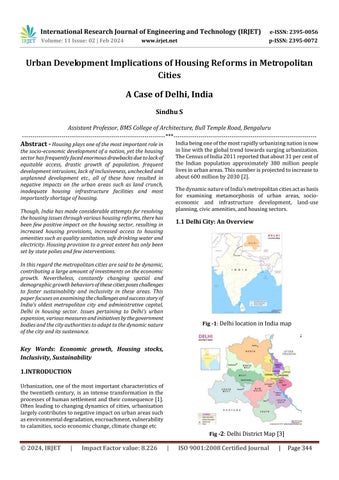
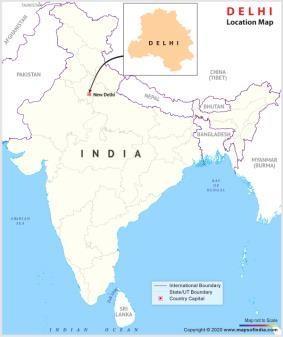
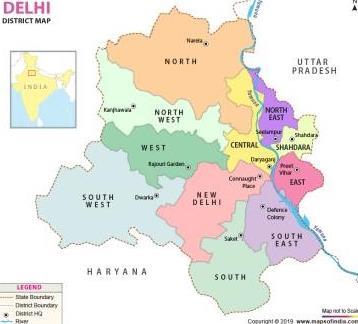
Delhi, the urban center and the capital territory of India. Consists of two components: Old Delhi, in the north, the historiccity;andNewDelhi,inthesouth[4].Delhitodayis emergingasoneofthelargestandmostpopulatedcitiesof theworld.Delhibeinglocatedincloseproximitytosatellite towns, constituting of economic and industrial hubs as a resultofwhichDelhiexperiencesalargeinfluxofmigration from various parts of the nation. According to the 2011 censusDelhicitypopulationwasaround16million[5]and thepresentestimatedpopulationisnearly29million[6].The majordrivingforcefortheurbanexpansionofDelhiisthis rapidlyincreasingpopulation.
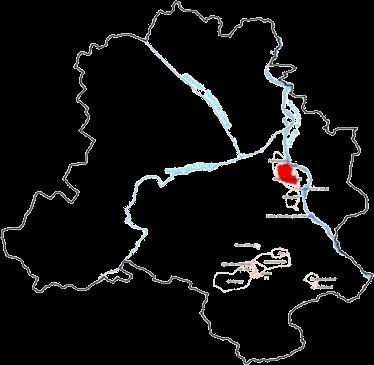
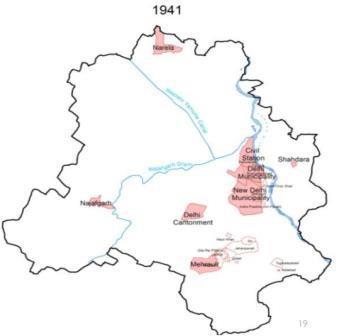
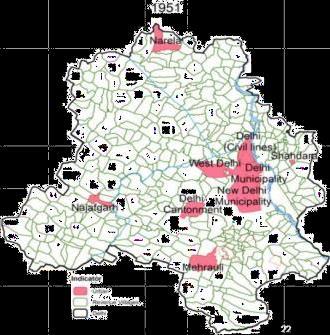
In the historic past, developments in Delhi took place in a triangularpatchoflandwithriverYamunaononesideand the northern range of Aravalli hills on the other two sides (UNESCO)
Delhi was once the capital of the Mughal Empire. In 1819, Delhi Territory divided city into Northern and Southern divisions(PoliticalandPlanningHistoryofDelhi)ledtothe acquisition of large parcels of land and establishment of residentialplotsonEastIndiaCompany’slands.
ColonialDelhi(Fig-3)in1912,TheColonialgovernmentset uptheTownPlanningCommittee,resultingintheemergence ofnewneighborhoodsinurbanfringe,latercalledas‘Greater Delhi. In 1936, Delhi Improvement Trust (DIT) was establishedfordecongestionofDelhi,todevelopindustrial colonyonoutskirtsfacilitatingthesegregationofresidential, commercialandindustrialareas
Post-ColonialDelhi(Fig-4)1947–1951,Duetothepartition post-Independence,thecityexperienced large intrusionof refugeesresultingintheformationofnewneighborhoodsin the urban fringe. During 1950s Delhi was affected by the Jaundiceepidemicwhichthenledtotheassessmentofthe city’s urban condition resulting in the need for the Master Plan for the city. Thus in 1957, the Delhi Development Authority (DDA) was set up to foster safe and secure development[8].
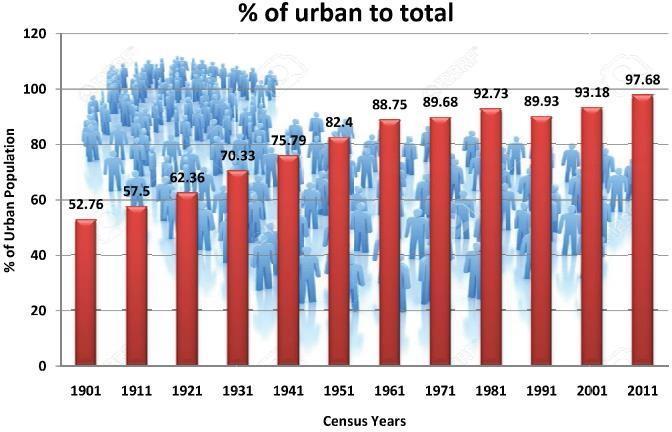
1: UrbanizationTrendofDelhiduring1901-2011[9]
Delhihasencounteredrapidurbanizationsince1900sfrom thetimewhenitbecamethecapitalofIndia,therateinflated drastically during the partition post Indian Independence which experienced a surge of refugee’s influx. 90% of the population was livinginurbanarea by 1991,comparedto 57.5%in1911(Chart1).
This swift in urbanization has resulted in the unique character of the city with discrete types of settlements, categorized by the civic infrastructure, types of houses, patternofsettlementetc.
Thetypesofsettlementsare-JJresettlementcolonies,Slum resettlement colonies, Refugee resettlement colonies,
International Research Journal of Engineering and Technology (IRJET) e-ISSN: 2395-0056
Volume: 11 Issue: 02 | Feb 2024 www.irjet.net p-ISSN: 2395-0072
Approved/planned colonies, unauthorized-regularized colonies,unauthorizedcolonies,urbanizedvillages,Notified slumareas,Ruralvillagesetc[10]
Theprimeconcernintheplanninganddevelopmentprocess of Delhi is laid on housing and urban Development. Since Delhihasbeenhasbeenthrivingoveraperiodoftimedating backtohistorictimeinspiteofthevariouschallengesfaced by the city such as population growth, migration and availabilityofland.HousingstockhasincreasedinDelhiover aperiodoftime.
According to 2011 Census estimates, there are 33.41 lakh households residing in 31.76 lakh houses which clearly indicatesthescarcityofhousing.Outofthehousesoccupied, about77.6%wereusedforresidentialpurposewhileothers wereusedforcommercialandfornon-residentialpurposes (CensusofIndia,2011).
There has been considerable housing reforms in Delhi to catertothehousingneedsofthecityintermsofpoliciesand housing development interventions. Few of the reforms include Jhuggi Jhopri Bastis/ Cluster development, Delhi UrbanShelterImprovementBoard(DUSIB)forimprovement oftheshelters,Delhidevelopmentauthorityresponsiblefor fostering housing development needs, Houses for weaker sectionbytheschemeJ.N.N.U.R.MandHousingforAll-PMAY etc.
InthisregardDelhiDevelopmentAuthority(DDA)isonethe important mile stone in housing reforms and has been a majordrivingforceinhousingsectorofDelhi,whichwasset up in 1957 under the Delhi Development Act to facilitate orderedurbandevelopmentandtocounterthehaphazard growthofDelhi.Thisincludedrecognizingofnewlandthat canbedevelopedintoresidentialpropertiesandmakeselfcontainedcoloniesbyprovidingamplecommercialofficeand retailcomplexesaswell.
DDA housing projects started off with the construction of houses, along with the provision of basic amenities from 1967onwards,itisalsoinchargeofMasterPlanpreparation andhasbeeninvolvedindevelopmentofvariousurbanareas such as Patpar Ganj (East Delhi), Sarita Vihar (South West Delhi) and Vasant Kunj (South Delhi). The development, construction and maintenance of housing and housing infrastructureistakencarebytheDDA.
There have been various schemes under this authority facilitating flats, awing to the land crunch multi storied development as a way forward it accommodates for the
differentgroupsofthesociety.Until2007,DDAhasallotteda total of 3,67,724 flats, comprising of almost half the allotments to weaker sections of society and to those belongingtolow-incomegroups[11].TillJan2013,DDAhad announced44housingregistrationschemesforthebenefitof thepeopleandhasbeensuccessfullyallottedthesame.The housingschemesundertheDDAinvolveconstructionofflats atvariouslocalitiesasperthelandacquiredtotheflatsare developedtocatertodifferentgroupsofthesociety
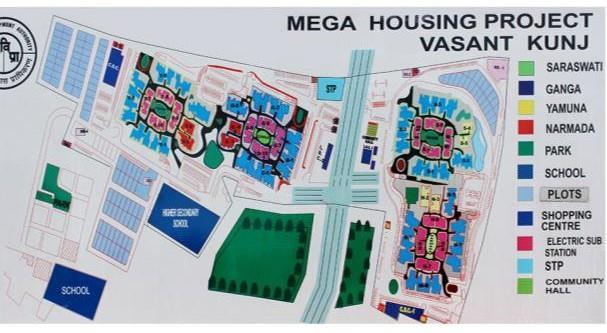
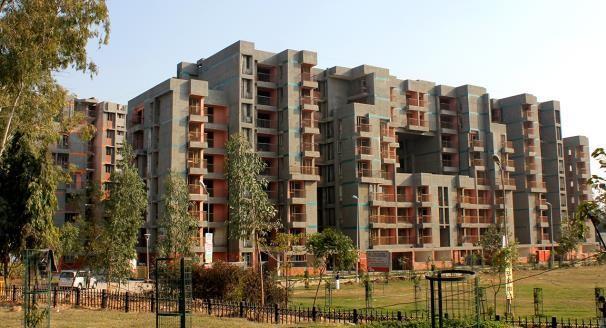
Mega housing project by the DDA is located in Sector E, Pocket 1 at Vasant Kunj, Multi storied Apartment with a mixed use housing project. Comprises of 10,370 houses coversanareaof61.75acres,itconsistsofLIGwith1bhk,MIG with2bhkandHIGwith3bhkapartments,anhousingproject initiativebytheDDA accommodatesvariousgroupsofthe societycoexistenceandadevelopmentthathasvariousother facilitiessuchasschool,shoppingcentres,parksandplaying area making it a self- sustaining community development. LikewisevariousotherprojectshavebeenexecutedbyDDA undervarious schemeswitha provisionofsubsidyforthe lowerincomegroupofthesociety.
International Research Journal of Engineering and Technology (IRJET) e-ISSN: 2395-0056
Volume: 11 Issue: 02 | Feb 2024 www.irjet.net p-ISSN: 2395-0072
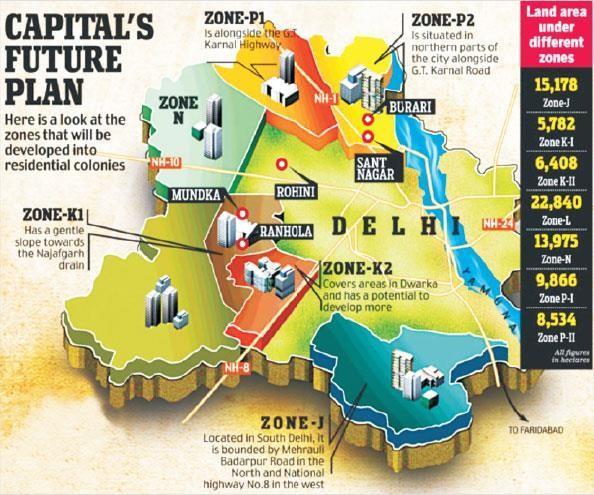
Fig -9:FuturedevelopmentalblueprintforDelhi illustratingthedesignatedzonesforfuturegrowth[13]
In accordance with the 2011 Census, the National Capital TerritoryofDelhirecordedatotalpopulationof167.9lakhs, andthisfigureisprojectedtosurgeto225lakhsbytheyear 2021[14].Inresponsetothisanticipatedpopulationgrowth, a strategic initiative has been devised to foster the development of five new sub-cities through a unique approachoflandpoolinginperipheralvillagesthathavebeen officially designated as urban areas. Unlike traditional methods of land acquisition, this innovative approach involves empowering landowners to take charge of the developmentprocess.
Under this framework, the Delhi Development Authority (DDA)willplayafacilitativerolebyprovidingcomprehensive guidelinesanddelineatingthepermissibleusesforvarious zoneswithinthesenewurbanareas.Essentially,theoutskirts ofDelhiareenvisionedtoevolveintoanurbanextensionof thecity,withthelandownersactivelysteeringthecourseof development. This approach not only accommodates the burgeoning housing needs but also ensures a more participatoryanddecentralizeddevelopmentmodel.
The proposed housing development project goes beyond mereresidentialstructures;itincorporatesaholisticvisionof infrastructuraldevelopment.Thisincludestheestablishment ofessentialamenitiessuchasschools,colleges,hospitals,and more, thereby shaping these new sub-cities into selfsufficienthubs.Bydoingso,theinitiativeaimstodiminish the reliance on the core areas of Delhi, fostering a more balancedanddistributedurbandevelopment.
Empowering landowners to actively contribute to the developmentprocess,coupledwithwell-definedguidelines, setsthestageforeffectivecityexpansionmanagement.The
envisioned sub-cities are not just intended to be housing solutions but rather integrated communities, equipped to meet the diverse needs of the growing population on the outskirtsofDelhi.Thisinnovativeapproachstrivestostrikea balancebetweenurbanexpansionandsustainable,inclusive development,heraldinganeweraintheevolutionofDelhi's urbanlandscape.
HousingisamajoreconomiccontributorinIndiawhichhas witnessedmanychangesduetothedynamicnatureofurban areas.Delhi,thecapitalofcountryisastrivingmetropolitan city which has transformed over a period of time due to variousdevelopmentfactorsthrustuponit.
ThedemandandsupplydynamicsofhousinginDelhihave been in a constant state of flux, encountering numerous challengesamidsttheurbandevelopmentprocess.Despite these challenges, the housing sector in Delhi has demonstrated resilience, experiencing continual growth facilitated by government reforms. A pivotal player in this scenarioistheDelhiDevelopmentAuthority(DDA),which hasplayedacrucialroleinadvancinghousingdevelopment.
TheDDA,operatingforoverfivedecades,hasemergedasa driving force in Delhi's housing sector, acting as a major game-changerinaddressingthecity'shousingneeds.Inthe faceofaburgeoningpopulationandlimitedlandavailability, theDDAhasplayedacrucialroleinfacilitatingcontrolledand orderlydevelopment.Ithasaddressedthehousingcrunchin thecitywithoutcompromisingtheinterestsofeconomically weaker sections, implementing various schemes and subsidies.
Efficientlynavigatingthechallengesposedbythescarcityof availableland,theDDAhasundertakentheconstructionof multi-storiedflatsunderhousingschemes.Theseinitiatives not only provide essential housing but also incorporate a rangeofamenitiesandinfrastructurefacilities,contributing tothecreationofself-sustainingcommunitydevelopments poisedtomeetthecity'sfutureneeds.
The DDA's multifaceted role as a Provider, Facilitator, and Enabler has been instrumental in meeting the evolving housing needs in Delhi. Its adaptability to changing circumstancesunderscoresitseffectiveness,positioningitas oneofthewell-functioningdevelopmentauthoritiesinthe country. The potentials exhibited by the DDA reflect a commitmenttoaddressingthecomplexchallengesofurban development and housing provision, making it an integral forceinshapingDelhi'surbanlandscapeovertheyears.
[1] Lawrence, R. J. (2002). Inequalities in urban areas: innovativeapproachestocomplexissues.Scandinavian JournalofPublicHealth,2002,30:34-40.
International Research Journal of Engineering and Technology (IRJET) e-ISSN: 2395-0056
[2] The Human Rights to Adequate Housing and Land in India:Report for the United Nations Human Rights CouncilonImplementationofUPRRecommendations.( September 2015). Housing and Land Rights Network, 10.
[3] Maps of India. (n.d.). Delhi Districts. Maps of India. https://www.mapsofindia.com/delhi/districts/
[4] Vaddiparti Lova Surya Prakasa Rao, V. R. (n.d.). Delhi, India. Encyclopedia Britannica.
[5] (2011).CensusofIndia.NewDelhi:Populationcensus.
[6] (2019). World Urbanization Prospects, The 2018 Revision. New York: United Nations, Department of EconomicandSocialAffairs.
[7] Joshi,V.(2013).DemographicsofaCapitalCity.Delhi: CensusofIndia.
[8] AboutUs.(2011). Delhi Development Authority
[9] Housing and Urban Development, Chapter 14, 20162017
[10] (1999-2000). Urbanization of Delhi, Chapter 14. Delhi: EconomicsurveyofDelhi.
[11] Mishra, S. (2019). 10 Things You Should Know About DelhiDevelopmentAuthority. MakaanIQ.
[12] MegaHousingProjectatVasanthKunj,2015
[13] Vikram,K.(2013,July28).Massivedevelopmentplans to get Delhi more than 10 lakhhouses by 2021. India Today
[14] Dixit,A.(2019,September19).TheTantalizingMirage Of Delhi’s Five New Sub-Cities-Dda’s Land Pooling. Ashutoshdixitblog.
BIOGRAPHIES

Volume: 11 Issue: 02 | Feb 2024 www.irjet.net p-ISSN: 2395-0072 © 2024, IRJET | Impact Factor value: 8.226 | ISO
Sindhu S, an Architect and Habitat Designer,presentlyholdstheposition ofAssistantProfessoratBMSCollege of Architecture Holds gold medal in M.Arch (Habitat Design) from Visvesvaraya Technological University,Belgaum.WithWithover 7yrs of Academia and Industrial Experience, Sheisanavidlearnerand holdskeyinterestinUrbanDesignand has participated and won awards in variousUrbanDesignCompetitions