
International Research Journal of Engineering and Technology (IRJET) e-ISSN: 2395-0056
Volume: 11 Issue: 02 | Feb 2024 www.irjet.net p-ISSN: 2395-0072
International Research Journal of Engineering and Technology (IRJET) e-ISSN: 2395-0056
Volume: 11 Issue: 02 | Feb 2024 www.irjet.net p-ISSN: 2395-0072
Nallathambi. S1, Dr.P.Sabarinath2, Ganeshbabu E V3, Samynathan T4
1,3,4Assitant Professor, 2Associate Professor, Dept. of Mechanical Engineering, KLN College of Engineering, Pottapalayam, Tamil Nadu, India ***
Abstract: Heat pipes are one of the most effective procedurestotransportthermalenergyfromonepointto another, mostly used for cooling on a combination of conduction and convective heat transfer. A typical heat pipeconsistsofanevaporator attachedtotheheatsource and the opposite end (a condenser) attached to the heat sink. The middle section (the adiabatic section) is insulated. In this paper, the design, fabrication and testing of heat pipe for transferring a heat load of 31.3 W isdiscussed.Inthisheatpipe,itconsistsof silveroxideas nano-fluids and mild steel wire mesh with cotton for making wick. Nano-fluids are prepared by the electrochemical synthesis method by selecting the appropriatetemperature,voltage,andcurrent.Theoverall length of the heat pipe is 100 mm, and the temperature difference in the heat pipe is 30⁰C. The temperature difference in each section, i.e., the evaporator, adiabatic, andcondenser sections oftheheatpipe, areshown in the graph,andtheresultsarediscussed.
Key Words: Nano fluid, Heat pipe, adiabatic, nano particles, Electrochemical, Silver Oxide.
The demand for faster and smaller micro-electronic systems continues to increase, and consequently, the amount of heat produced per volume increases. Therefore, the need for novel, efficient cooling devices is vast. Heat pipes are effective passive heat spreaders that can be used to solve this problem. Due to the combined convection and phase transition, high heat exchange efficiency can be achieved. Heat pipes are promising devicestoremovethermalenergyandkeeptheintegrated circuitsattheproperworkingtemperature.Theadvantage oftheheatpipeisthatitusesphasechangephenomenato remove thermal energy since the heat transfer coefficient of the phase change is normally 10 to 1000 times larger than typical heat transfer methods such as heat conduction,forcedvapororliquidconvection. Other applications of electronic cooling have included rectifiers,thyristors,transistors,travelingwavecollectors, audio and RF amplifiers, and high density-semiconductor packages.
A.Naveen(2018)etal studieda TiO2 nanofluidheatpipe designed for diameter and length of 31 mm and 500 mm respectively. It was tested by a container. The heat pipe was made of wick, copper, and stainless steel. The maximum heat load was 100W and the temperature was 373K in the maximum range. Swati Verma (2017) et al
International Research Journal of Engineering and Technology (IRJET) e-ISSN: 2395-0056
Volume: 11 Issue: 02 | Feb 2024 www.irjet.net p-ISSN: 2395-0072
studied Silver (Ag) nano particles based on the combination and concentration of base fluid, and their thermo-physicalproperties.Fromthesecombinations,the size of nano particles was 1 to 5% by volume, and the temperature at 270⁰C was selected and compared with benzene (C6H6) as base fluid. L. Karikalan (2022) et al Investigated shell and tube heat exchanger heat transfer rate with different volume of carbon nanotube nanofluid. The result of thermal conductivity, specific heat, and viscositywascomparedwiththeoreticalvalue.AbuRaihan Ibna Ali (2020) et al. reviewed the nano particles and their heat transfer applications and concluded that nano fluids had excellent thermal conductivity. B. Kirubadurai (2014) et al Investigated particles sizes, shapes and concentrations percent in the nano fluids. He concluded that the concentrations of nano fluid will vary up to a critical level and the thermal conductivity of fluid increasedbyphysicalpropertiesofnanoparticlespresent in the nano fluids. Mohammed Saad Kamel (2016) et al reported the enhancement of heat transfer using nano fluids as one of the passive heat transfer techniques in several heattransferapplications.Itisconsideredtohave great potential for heat transfer enhancement and is highlysuitedtoapplicationinheattransferprocesseslike microelectronics,fuelcells,pharmaceuticalprocesses,and hybrid-powered engines, engine cooling/vehicle thermal management, domestic refrigerator, chiller, heat exchanger, and in boiler flue gas temperature reduction. This review covers the enhancement of heat transfer by using nanofluids and potential applications of nanofluids. Saif Ullah Khalid (2020) et al reviewed the performance improvement of heat pipe, with different types of nano fluids, grooves, wicks and the orientation of heat pipe. Betterheat transfer heat pipe designis optimizedonly by economicalandfeasiblemethods
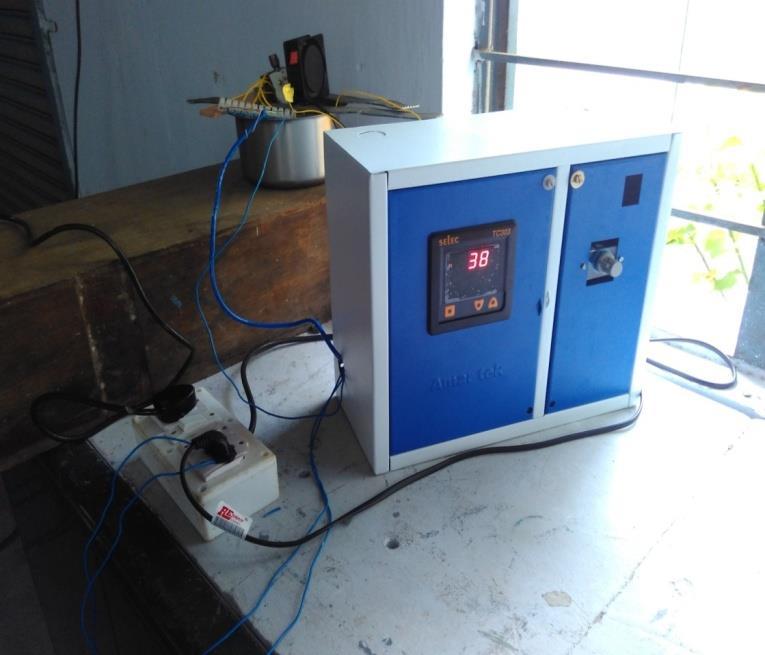
Theexperimentalsetupisbasedon
EvaporatorTube
CondenserTube
StainlessSteelMesh
PorousWick
ReservoirTank
Fan
HeatingSourcewithControlUnit
WorkingFluid
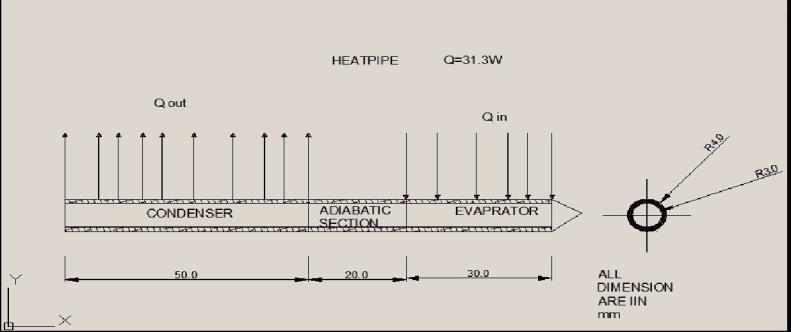
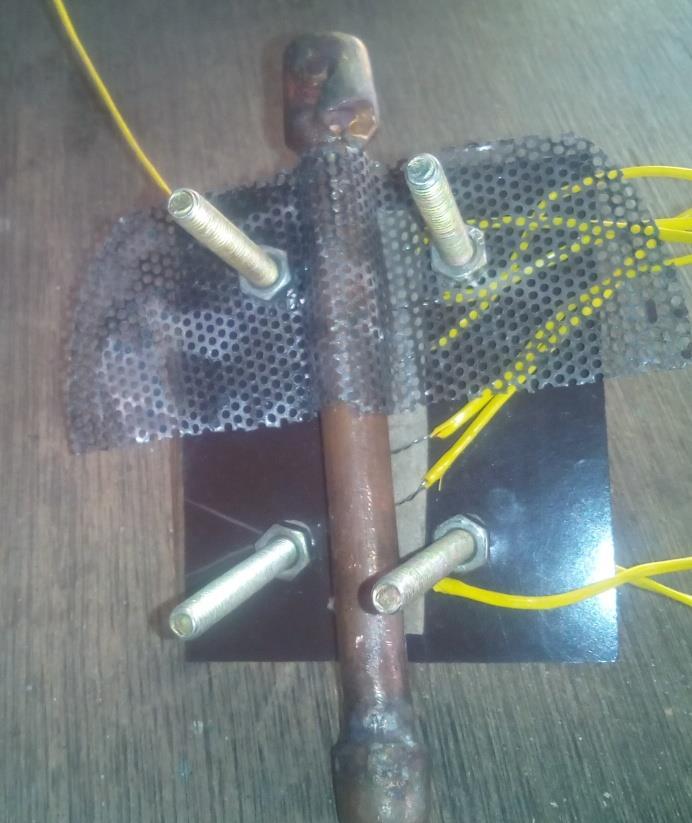
Heat pipe is made of copper tube and has three distinct sections namely the evaporator section, the adiabatic section and the condenser section. The lengths of each sectionare30,20,and50mm,respectively. Analuminum fin is fitted in the condenser section to increase the heat transfer rate. The heat load transfer capacity from the source to the sink is 31.3 W. Mild steel wire mesh with
cotton is used as a wick. The effective length of the heat pipeis100mm,whichisclosedonbothendswithacopper capoflength 5mm each.The wick isdrenched with silver oxide nano-fluid. The heat intake from the heat source by theevaporatorsectionistransferredthroughthewetwick andtakenintheformofvapourtotheadiabaticsection,it iscondensedinthewherecondensersectionbytheSMPS fan(Evaporator)
The condensed silver oxide nano-fluid goes to the evaporator section due to wicking by capillarity action. This process is repeated for the exchange of heat from heatsourcetothesink.
The wick type heat pipe is tested us consistsof (i)Silverbeakerwithhotwateroftemperature80⁰C (ii)Temperaturemeasuringunit (iii)Standforholdingheatpipe (iv)SMPSfan
The Prepared Heat pipe with silver oxide Nano fluid is tested by using heat source of immersion water heater withtemperature60,70,80oC.Thetemperatureatdifferent sectionofheatpipeismeasuredbyusingthermocouple(K -type). ing temperature measuringunit.Theexperimentsetup
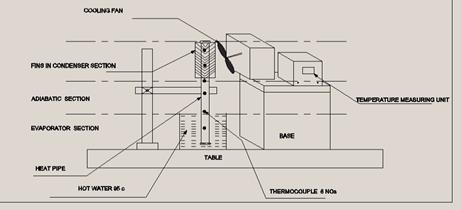
There are three sections based on eevaporator, adiabatic and Condenser section, on the experiment setup. In each section temperature was measured with two thermo couples at two different places. The Temperature sensed bythethermocouplewasmeasuredfromtheTemperature control unit.The Evaporator section (30mm) is immersed in the hot water (Heat source) . In the condensor section (50mm) , We fix the aluminium fin of 35mm width. The finned condensor section was cooled by SMPS fan. The resultsareanalysedwithdifferenttemperaturerangeand tabulated.
International Research Journal of Engineering and Technology (IRJET) e-ISSN: 2395-0056
Volume: 11 Issue: 02 | Feb 2024 www.irjet.net p-ISSN: 2395-0072
5. RESULTS AND DISCUSSION
The tested Temperature range are 60,70, 80oC . The Temperature Distribution along the heat pipe at the different sections is measured. The overall Temperature difference(drop)is30o andheatsourceinputis31.3W.
Case (i)
The heat source is 31.3 W and the hot water (source) temperature is 60oC.The temperature distribution along the evaporator sections are 60.59⋄ C and the temperature distribution along adiabatic section are 49.48oC. The temperature distribution along condenser section is 38.35oC.OverallTemperaturedropis25oC.
Case (ii)
The heat source is 31.3W and the hot water (source) temperature is 70oC. The temperature distribution along the evaporator sections are 69.5, 65oC and the temperature distribution along adiabatic section are 64.7, 40oC. The temperature distribution along condenser sectionis40,35.4oC.OverallTemperaturedropis34.6oC.
Case (iii)
The heat source is 31.3W and the hot water (source) temperature is 80oC.The temperature distribution along the evaporator sections are 78.9, 78oC and the temperature distribution along adiabatic section are 78, 78oC .The temperature distribution along condenser sectionare65,45oC.OverallTemperaturedropis35oC.
From the testing of Heat pipe with Effective length of 100mm and constant heat source of 31.3 W in different Temperature range, the average difference in Temperaturedropis31.5oC.

Chart -1:TemperatureDistributionChart
6. CONCLUSION
Experimental investigation of heat pipe preparation and Nano fluid preparation methods are studied and the wick type heat pipe with silver oxide Nano fluid tested successfully. In the condenser section, if the SMPS fan is not used the overall temperature drop is slightly decreased. To avoidthe decrease in temperature drop we use fin with SMPS fan. The Experimental heat pipe was used to transport of heat load of 31.3W under ambient working conditions. Heat pipe with Effective length of
International Research Journal of Engineering and Technology (IRJET) e-ISSN: 2395-0056
Volume: 11 Issue: 02 | Feb 2024 www.irjet.net p-ISSN: 2395-0072
100mm and constant heat source of 31.3 W and average differenceinTemperaturedropis31.5oC.Sothisheatpipe can be used in Electronic devices whose heat source 31.3 W or Temperature drop is in 31.5oC. The future development in this experiment pure silver as Nano fluid can be used instead of silver oxide Nano Fluid because of itshighthermalconductivity.
In the heat pipe the wick structure can be changed to improvethecapillarityactiontoincreasetheheattransfer rate.
ACKNOWLEDGEMENT
This project was funded by The Institution of Engineers (India)-R&DGrant-in-AidScheme
[1] A.Naveen1, R.Manohar Babu, “Enhancement of heat transfer in heat Pipe using water/Tio2 nanofluid” 2018JETIRJuly2018,Volume5,Issue 7
[2] Swati Verma1, A.S Verma2, Deepak Kumar Yadav3, “Enhancement of heat transfer in heat pipesusing Silver/Benzenebasednano-coolants” InternationalResearchJournalofEngineeringand Technology (IRJET) Volume: 04 Issue: 12 Dec2017
[3] Karikalan, S. Baskar , N. Poyyamozhi , and Kassu Negash, “Experimental analysis of heat transfer byusingnanofluidandImpactofthermophysical Properties” Hindawi Journal of Nanomaterials Volume2022,ArticleID5119797,8pages
[4] AbuRaihanIbnaAli, BodiusSalam, “Areviewon nanofluid: preparation, stability, thermo physical Properties, heat transfer characteristics and application”SpringerNatureSwitzerlandAG2020 publishedonline:5September2020
[5] B. Kirubadurai, P.Selvan, V.Vijayakumar, M.Karthik, “Heat transfer enhancement of nano fluids –a review” IJRET: International Journal of Research in Engineering and Technology eISSN: 2319-1163|pISSN:2321-7308
[6] Mohammed Saad Kamel, Raheem Abed Syeal, Ayad Abdulameer Abdulhussein, “Heat transfer enhancement using nanofluids: A Review of the recent literature” American Journal of Nano Research and Applications 2016; 4(1): 1-5
PublishedonlineFebruary13,2016
[7] SaifUllahKhalid, HamzaBabar Hafiz ,Muhammad Ali · Muhammad Mansoor Janjua · Muhammad
Aon Ali, “Heat pipes: progress in thermal performance enhancement for microelectronics” Journal of Thermal Analysis and Calorimetry (2021) 143:2227–2243