
International Research Journal of Engineering and Technology (IRJET) e-ISSN: 2395-0056
Volume: 11 Issue: 02 | Feb 2024 www.irjet.net p-ISSN: 2395-0072
International Research Journal of Engineering and Technology (IRJET) e-ISSN: 2395-0056
Volume: 11 Issue: 02 | Feb 2024 www.irjet.net p-ISSN: 2395-0072
K. M. Kiran1 , Madhushree K2
1Assistant Professor, Bangalore Institute of Technology, Bangalore, Karnataka, India. 2P.G Student, Bangalore Institute of Technology, Bangalore, Karnataka, India
Abstract - The commonly utilized general-purpose cement, despite its cost and energy intensity, is a key ingredient in concrete production. Concrete, though brittle, possesses strength, durability, and adaptability, making it moldableinto various shapes and sizes. However, it is prone to developing structural cracks even before loading, primarily due to drying shrinkage. To mitigate this, natural fibers such as jute can enhance material properties. A research study explored the mechanical characteristics of jute fiber concrete, demonstrating its sustainability and innovative construction material, combining concrete's strength and durability with the eco-friendliness of jute fibers. Jute fiber was chopped and blended into concrete at varying percentages (0.3%, 0.6%, & 0.9% in M30 concrete mixes), and the resulting specimens showed reduced workability with increased jute fibercontent. Nevertheless, the inclusion of jute fiber notably enhanced the compressive, tensile and flexural strength of each concrete mix. This study highlights the potentialofjuteasanadditiveto improve concrete's durability and strength.
Key Words: Portland cement, Jute fiber, Durability Compressive strength, Flexural strength and Tensile strength.
Concrete,anessentialconstructionmaterial,hasbeenwidely utilizedinbuildingssinceancienttimes.Itsassociationwith Portland cement and rapid increase in production due to urbanizationandindustrializationhaveledtoenvironmental concerns.ThesignificantCO2emissionsfromtheproduction of concrete and its environmental impact are urgent concerns that must be addressed to mitigate harm to the environment.
Naturalfibers,suchasjute,offeracost-effective,renewable, andbiodegradablealternative.Withuniquecharacteristics and widespread availability, natural fibers have been employed for diverse applications for thousands of years. Jute is recognized for its robustness, resilience, and ecofriendliness,findingapplicationsintextiles,packaging,home furnishings,andmore.Itsversatilityandsustainabilitymake itanattractiveoptionfordiverseindustries.
Research efforts focusing on incorporating jute fiber into concretehaveshownpromisingresults.Byaddingjutefibers
in varying percentages, the toughness and mechanical characteristicsofconcretecanbenotablyenhanced,leading toenhancedcompressive,flexuralandtensilestrength.The advancementofcompositeconstructionmaterialsusingjute fiberholdsthepotentialtoincreasestructuralstrengthand extend the lifespan of structures, offering a sustainable solutionwithapositiveenvironmentalimpact.
SauloRochaFerreiraandMarcoPepeSingetal.,This researchconductedexperimentsonnaturalfiberssuch as sisal, coconut, and jute to identify their adhesion propertiesincement.Thestudyanalyzedthedifferent characteristics of these fibers and their impact on bonding with cement. This inquiry offers valuable findings on the potential of these natural fibers to enhance the resilience of concrete and offers guidance for forthcoming research in this field. The results indicatedthatvariablesliketheroughnessofthefiber's surface,itsaspectratio,anditscompositionsignificantly influenceitsadhesiontocement.Specifically,fiberswith rough surfaces and longer lengths exhibited stronger adhesion, thereby improving the collective strength of the blend. The study recommends considering these inherentqualitiesoffiberstooptimizecementmixtures.
ArpithaM,Yashaswinietal.,Thisresearchconducted experiments on mechanical characteristics of concrete usingcoconutcoirfibers.FiberReinforcedConcreteisa materialsmixincludingcement,sand,stones,andfibers likenatural,steel,orglass.Thesefibersmakeconcrete stronger and can be eco-friendly and affordable. This study aimed to enhance concrete strength by utilizing cost-effective,sustainablecoconutcoirfibers,knownfor their heat resistance and renewability. They added coconutcoirtoM30concreteindifferentamountsand found that 2% coir gave the best strength, making it stronger than plain concrete. From the experiments conductedinthelab,thestudyconcludesthatusing2% incorporationofcoconutcoirfibersbasedontheweight of cement yielded the most favorable outcomes. The concrete'scompressivestrengthincreasedby22.4%at7 days, 30.37% at 14 days, and 27.18% for 28 days compared to no coir fibers. Similarly, the split tensile strength improved by 33.47% at 7 days, 34.70% at 14 days,and30.03%at 28 days.Coir fibers enhanced the
International Research Journal of Engineering and Technology (IRJET) e-ISSN: 2395-0056
Volume: 11 Issue: 02 | Feb 2024 www.irjet.net p-ISSN: 2395-0072
concrete'smechanicalpropertiesbyactingasbridgesfor cracks, although using more than 2% fibers caused a decreaseinstrengthduetoreducedcohesiveness.
GukendranRangasamyandSambathkumarManiet al., This research tested different angles of jute fibers (0°, 15°, 30°, 45°, 60°, and 75°) in epoxy materials to see how it affects strength and heat behavior. Themostfavorableoutcomeswereachieved when utilizing fibers at 30° angle. They also used specialmethodstostudyhowthematerialsreacttoheat, showing changes in their structure and composition. Theymadestrongjutefiberandepoxycompositesheets byarrangingthefibersdifferently.Thesheetswithfibers at30°heldthemostweightandbentwithoutbreaking becausethefiberssharedtheloadwell.Thesefibersalso handled impact the best, with 0.814 Joule of energy absorbed.Whentheylookedathowthematerialshandle heat,theydiscoveredthattheybehavedsimilarly,with slightdifferences.
D. P. Archana, H. N. Jagannatha Reddy et al., The studyfocusedonbiocompositespreparedfromnatural fibers, which are gaining more popularity for being environmentallyfriendly.Theresearchersusedsisaland jute fibers to create these biocomposites using a hand layup technique and studied their strength and water absorption properties. They also investigated the impacts of a 4% NaOH treatment on these properties. Theresultsshowsthattreatingthefibersimprovedthe strength and reduced water absorption in the biocomposites,makingthemadaptedforstrengthening civil structures. By using the hand layup method, the researcherssuccessfullymadenatural fiber-reinforced polymercomposites(SNFRCandJNFRC)andtestedtheir tensile, flexural, impact, and water consumption properties. They discovered that composites with 4% NaOH-treated sisal and jute fibers displayed better mechanicalcharacteristicsduetoimprovedfiber-matrix adhesion.Thesetreatedcompositesalsoshowedreduced water consumption and are promising for reinforcing epoxy-based matrix composites suitable for both domestic and industrial use under light to moderate loads.
Genbao Zhang and Jiaqing Wang et al., This study aimedtoimproveself-compactingconcrete(SCC),which typically relies heavily on cement, harming the environment. Researchers sought alternatives and discovered that incorporating special jute fibers and mineralpowdersinplaceofsomecementcanenhance theconcrete'sstrengthandworkability.Thisinnovation holdstheirpotentialitytoadvancebothqualityandecofriendlinessoffuturebuildings.Byexperimentingwith plantfibersandspecificminerals,scientistsdevelopeda more robust and environmentally sustainable selfcompactingconcrete.Thisnewconcretemixtureiseco-
friendlyasitreducespollutionandismorecost-effective thanconventionalconcrete.Theirobservationsindicated thatusingalesseramountoftreatedplantfibersanda specific mineral powder provides positive results, advising that this eco-friendly concrete could replace traditionaltypes,therebyreducingpollutionandwaste.
3.1 MATERIALS USED
a. Cement
The capacity of concrete determined by the grade of cementutilized.Thereare33grade,43grade,and53grade cementsavailable.Weusedgeneral-purposecementof53 grade,thismeansthatunderstandardconditions,asper Indian Standards, Portland cement has a 28-day compressivestrengthof53megapascals(MPa).
Table -1:CharacteristicsofCement
SlNo Properties Obtainedvalues
1 Color Gray
2 Specificgravity 3
3 Standardconsistency 27%
4 Initialsetting 25Mins
5 Finalsetting 400Mins
b. Fine aggregates
Manufacturedsand(M-Sand)isartificialsandmadeby crushing hard stones, offering consistent quality and reducing voids in concrete. It's free of impurities, has denserparticles,andaspecificgravityof2.61.Thesieve analysis confirms that it meets Zone II specifications accordingtoIS:383-1970
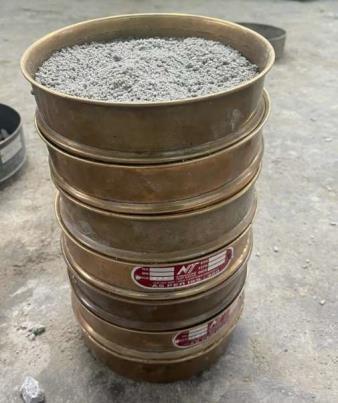
-1:Fineaggregates
International Research Journal of Engineering and Technology (IRJET) e-ISSN: 2395-0056
Volume: 11 Issue: 02 | Feb 2024 www.irjet.net p-ISSN: 2395-0072
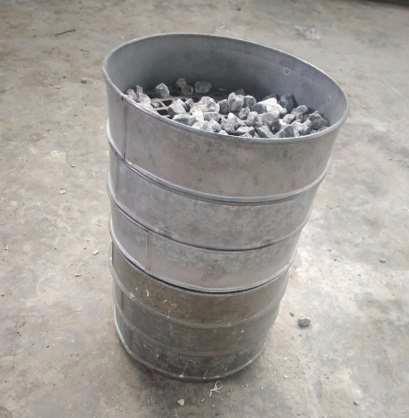
The coarse aggregates are particles greater than 4.75mmindiameter,suchasgravelorcrushedstone,used in construction. They contribute to the durability and firmnessoftheconcretemixture.Thesizeandqualityof coarseaggregatessignificantlyimpactthecharacteristics of concrete, and a specific gravity of 2.7. The combined aggregates meet IS: 383-1970 specifications for graded aggregatesaftersieveanalysis.
d.
The specimens in this experimental study are cast usingcleanandfreshwaterthatmeetsIndianstandards bydevoidoforganicmatter,oil,orsilt,chloride,sugar,and acidicmaterials.
e. Admixture
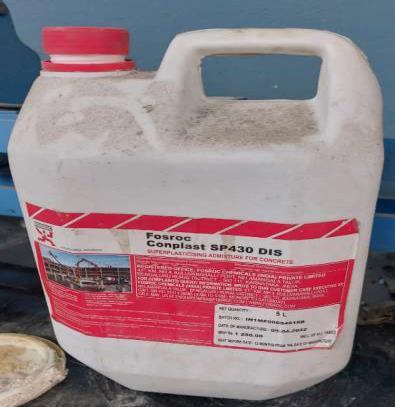
Superplasticizer (Conplast sp 430) by FOSROC chemicalshasbeenutilizedinthisparticularexperiment work to create high-quality concrete and achieve a significant water reduction of up to 25% without compromising workability. Typically, the usage range is between 0.5 to 2.0 liters per 100 kg of cement. The characteristicsofConplastsp430includeaspecificgravity ranging from 1.200 to 1.225 at 30°C, approximately 1% additionalairentrainment,andnochloridecontentasper IS:456andBS:5075standards.
Thejutefiberismakingwavesinconstructionforits eco-friendlyproperties.Withitsbiodegradabilityandhigh cellulosecontent,it'sgreatforstrengtheningconcreteand reducingcracking. Jute-reinforced concrete isespecially usefulinearthquake-proneareas,absorbingenergyand resistingseismicstress.Besidesconcrete,juteisutilizedin geotextiles for erosion control, stabilizing soil and promoting vegetation growth. Its biodegradability eliminatestheneedforremoval,reducingenvironmental impact.Overall,jutefiberoffersversatility,sustainability, and a positive impact on both construction and the environment.
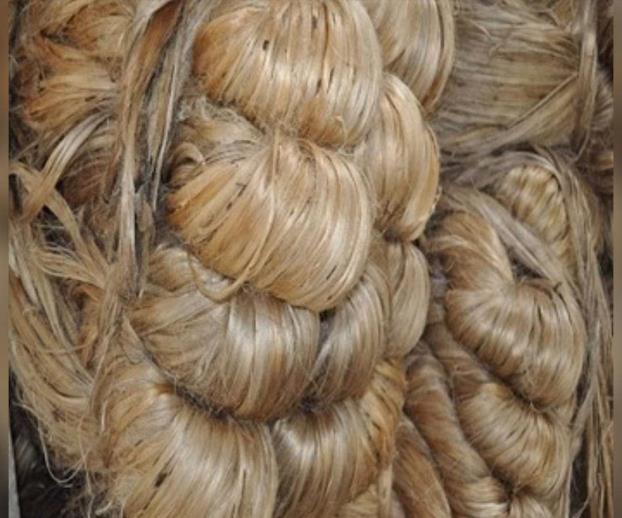
Thisresearchaimstodotheexperimentalinvestigation carried out on cubes, cylinders and Prism for 28 days respectivelytounderstandthestrengthcharacteristicsof varyingpercentagesofJutefiberby0%,0.3%,0.6%and 0.9%.
Thisresearchaimstoassessthecharacteristicssuchas
1. ThecompressivestrengthofJutefiberconcrete.
2. ThetensilestrengthofJutefiberconcrete.
3. TheflexuralstrengthofJutefiberconcrete.
A. Concrete Mix proportion Design
AConcretemixproportionguidelines(IS10262:2019) & Balanced concrete mix design process were used to createConcrete.Theproportionoffineaggregatetototal aggregate by volume is about 52–58% & remaining 4248% is the volume ratio of coarse aggregate to total aggregate.
International Research Journal of Engineering and Technology (IRJET) e-ISSN: 2395-0056
Volume: 11 Issue: 02 | Feb 2024 www.irjet.net p-ISSN: 2395-0072
Table -2: MixProportionRatio
Thecoarseaggregateswasaddedintoconcretemixer,and fineaggregateswasaddedalongwithcementformixing. Duringthedrymix,variouspercentagesofJutefiberwas added. 0.7% Superplasticizerwasmixedwithwater. At first, a portion of water was added during the mixing process,andtherestwasincorporatedtoensureproper blendingofthematerials.
Then 4 Cubes of size 150mm x 150mm x 150mm werecasted by adding Jute fibre of 0%, 0.3%, 0.6% and 0.9%and 0.7%ofsuperplasticizerConplast-SP430based ontheweightofcement anddemoulded24hours later, thenthespecimensunderwenta28-dayscuringperiod.
Then 4 Prism of 500mm x 100mm x 100mm sizes werecasted by adding Jute fibre of 0%, 0.3%, 0.6% and 0.9%and0.7%ofsuperplasticizerConplast-SP430bythe weightofcementanddemoulded24hourslater, thenthe specimensunderwenta28-dayscuringperiod.
Then 4 Cylinder of 150mm ϕ & 300mm height sizes werecasted by adding Jute fibre of 0%, 0.3%, 0.6% and 0.9%and0.7%ofsuperplasticizerConplast-SP430bythe weightofcementanddemoulded24hourslater,thenthe specimensunderwenta28-dayscuringperiod.
Results presented in Figure 5 indicate that the incorporation of varying proportions of jute fiber into M30-gradeconcreteledtoanenhancementinitsflexural strength following 28 days of standard curing. The research showed that the most substantial increase in strength,amountingto13.03%,wasattainedwitha0.9% jutefibercontent,attributedtotheuniformdispersionof the fiber within the concrete. Conversely, the fewest compressivestrengthwasobservedwitha0.3%jutefiber content. Specifically, the utilization of 0.3%, 0.6%, and 0.9%jutefiberresultedinstrengthenhancementsof4.7%, 7.97%,and13.03%,respectively.
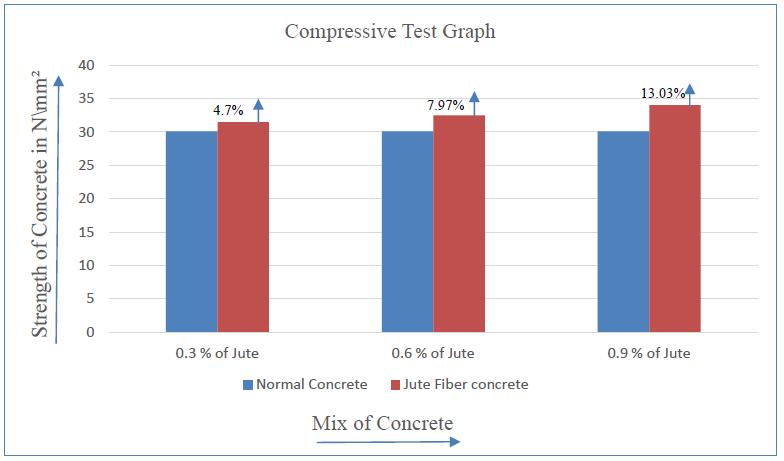
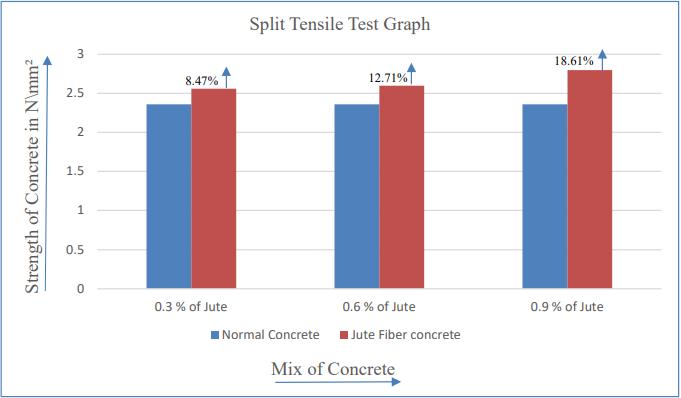
Figure6illustratesthesplittensilestrengthoutcomes of cylindrical specimens when different percentages of jutefiberweremixedtoM30-gradeconcreteafter28days ofregularcuring.Theinclusionofjutefiberresultedinan increasedsplittensilestrength,showingthattheinherent brittleness of M30-grade concrete can be addressed through this addition. The study uncovered that the highest split tensile strength, experiencing an 18.64% increase,wasaccomplishedbyincorporating0.9%ofjute fiber into the concrete mix after the prescribed 28 days curing period, attributed to the proper and even dispersion of fiber throughout the concrete mixture Conversely,theminimumsplittensilestrengthwasnoted ata0.3%additionofjutefiber.
3.
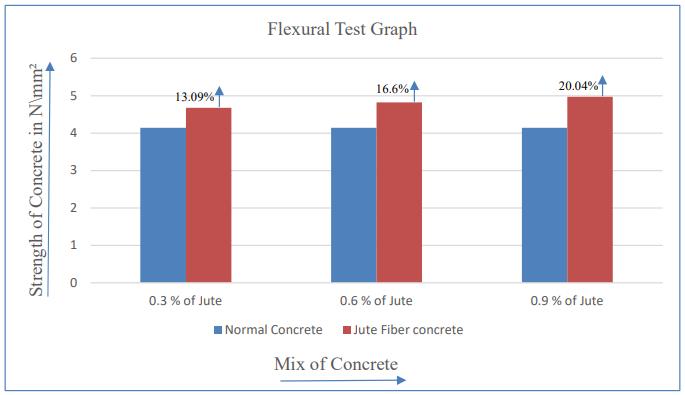
The flexural strength outcomes of prism specimens, incorporating varying percentages of jute fiber in M30grade concrete after 28 days of standard curing, are depicted in Figure 7. The study demonstrates an enhancement in flexural strength, reaching a maximum increase of 20.04% with the incorporation of 0.9% jute fiberintotheconcretematrixforM30gradeafterthe28daycuringperiod.
International Research Journal of Engineering and Technology (IRJET) e-ISSN: 2395-0056
Volume: 11 Issue: 02 | Feb 2024 www.irjet.net p-ISSN: 2395-0072
Jute fiber was incorporated into M30 grade concrete at threedifferentpercentages:0.3%,0.6%,and0.9%,Striving toimprovethemechanical characteristicsoftheconcrete Additionally, the study delved into the durability of the concrete,examiningtheinfluenceofJutefiberonstrength. Throughouttheinvestigation,eachaspectwasthoroughly examined,resultingtothefollowingconclusions.
The introduction of jute fiber to the concrete mix resulted in a reduction in the workability of Jute fiber concrete.Thehighestworkabilitywasattainedwhenno jute fiber was added, across all concrete grades. Conversely,thelowestworkabilitywasattained withthe additionof0.9%jutefiber.Thisdeclineinworkabilityis attributed to the hydrophilic nature of jute fiber, as it takes in water from the concrete mixture crucial for strength, workability and heat of hydration Consequently, the Jute fiber concrete mix had reduced watercontent,leadingtodiminishedworkability.
Incorporatingjutefiberintotheconcreteresultedin a rise in compressive strength. The peak compressive strengthwasachievedwiththeadditionof0.9%ofjute fiber, while the minimum compressive strength was observed with the addition of 0.3% jute fiber. The improvementsincompressivestrengthweremeasured as 4.7%, 7.97%, and 13.03% when integrating 0.3%, 0.6%,and0.9%ofjutefiber,respectively.
The flexural and split tensile strength outcomes mirrored the compressive strength of the concrete specimens.Thehigheststrengthwas attainedwiththe additionof0.9%jutefiber,whiletheloweststrengthwas observed at a 0.3% jute fiber addition. Increased split tensile strength was noted as 8.47%, 12.70%, and 18.64% with the help of 0.3%, 0.6%, and 0.9% of jute fiber, respectively. Additionally, there was an enhancementinflexuralstrength,withimprovementsof 13.09%,16.6%,and20.04%observedwiththeaddition of0.3%,0.6%,and0.9%ofjutefiber,respectively.
Theinclusionofjutefiberintotheconcretematrix leadstotheattachmentofmaterials,therebyimproving thecompressive,flexural,andsplittensilestrengthofthe concrete.
[1] D.P.Archana,H.N.Jagannatha ReddyandBasavaraju Paruti,“MechanicalCharacterizationofBiocomposites ReinforcedwithUntreatedand4%NaOH-TreatedSisal andJuteFibres,”,Article–2022.
[2] GenbaoZhang,JiaqingWang,ZhiweiJiang,ChengPeng, Junbo Sun,Yufei Wang , Changfu Chen , Amr M. Morsy and Xiangyu Wang , “Properties of sustainable selfcompactingconcretecontainingactivatedjutefiberand wastemineralpowders”,Article–2022
[3] GukendranRangasamy,SambathkumarMani,Sasikumar KondayampalayamSenathipathygoundarKolandavelu andMohammadS.Alsoufib,“Anextensiveanalysisof mechanical,thermalandphysicalpropertiesofjutefiber compositeswithdifferentfiberorientations”(Article2021)
[4] Arpitha M, Yashaswini C, Vinay Venkatesh and ManjuanthB,“Experimentalstudiesonthemechanical propertiesofconcreteusingcoconutcoirfibers”(Article -2019).
[5] Marco Pepe, Saulo Rocha Ferreira, Enzo Martinelli, FlaviodeAndradeSilvaandRomildoDiasToledoFilho, “Influence of natural fibers characteristics on the interface mechanics with cement-based matrices” (Article-2017).
[6] Tarasen,H.N.JagannathaReddy,Internationaljournal ofInnovation,ManagementandTechnology“Application of Sisal, Bamboo, Coir and Jute Natural Composites in StructuralUpgradation”(Article-2011)
[7] MdNuruzzamanKhan,JugantaK.Roy,HaydarU.Zaman, Tuhidul Islam and Ruhul A. Khan“Production and Properties of Short Jute and Short E-Glass Fiber ReinforcedPolypropylene-BasedComposites”(Article2011)