
International Research Journal of Engineering and Technology (IRJET) e-ISSN: 2395-0056
Volume: 11 Issue: 02 | Feb 2024 www.irjet.net p-ISSN: 2395-0072
International Research Journal of Engineering and Technology (IRJET) e-ISSN: 2395-0056
Volume: 11 Issue: 02 | Feb 2024 www.irjet.net p-ISSN: 2395-0072
Jishnu Nath Paul1 , Mallika Roy2 , Josita Sengupta3 , Karan Kumar4 , Swagata Bhattacharya5
Department of Electronics & Communication Engineering, Guru Nanak Institute of Technology, Kolkata, India
Abstract - This paper compares four convolutional neural network (CNN) models for classifying electrical components such as capacitors, diodes, resistors, ICs, inductors, and transformers. The CNN models are AlexNet, GoogleNet, ResNet50, and a proposed CNN model with a customized architecture. The paper describes the data collection, preprocessing, and augmentation steps, as well as the architecture and parameters of each CNN model. The paper evaluates the performance and accuracy of the CNN models using various metrics such as loss, accuracy, precision, recall, F1-score, and confusion matrix. The paper also analyses the factors affecting the results and provides insights and implications for the practical application of the CNN models. The paper concludes that ResNet50 is the best CNN model for the electrical component classification task, as it has the highest accuracy, precision, recall, and F1 score among the four models. It also has the lowest loss and the most accurate confusion matrix, indicating that it can learn and generalize the features of the electrical components very well.
Key Words: Convolution neural network (CNN), AlexNet, GoogleNet,ResNet50,F1-score,Confusionmatrix,Accuracy, Precision.
The introduction of electronic component classifiers represents a significant leap forward in the field of electronics, particularly in the context of streamlining the identificationprocess.Inthefaceofaburgeoningarrayof electronic components, integrating machine learning, specificallyConvolutionalNeuralNetworks(CNN).
Machinelearningalgorithms,poweredbyneuralnetworks, are at the core of these classifiers [1]. This sophisticated approachallowsforrecognizingandcategorizingelectronic components based on intricate patterns, physical characteristics, and unique electrical properties. CNN, a specialized form of neural network tailored for image recognition [7], brings heightened accuracy to the identificationprocess,makingitparticularlywell-suitedfor categorizing electronic components with diverse visual features.
Thisproject'smotivationisgroundedintheimperative to overcomethelimitationsoftraditional,time-consuming,and error-pronemanualidentificationmethods.Fusingmachine learning,CNN,andelectroniccomponentclassifiersnotonly enhances the accuracy and efficiency of the identification processbutalsopavesthewayforpracticalimplementations
invarious electronicsystems.Thisinnovativeapproach is poisedtorevolutionizeelectronicdesign,troubleshooting, and maintenance, offering engineers and technicians a powerfultoolforrapidandprecisecomponentidentification inanincreasinglycomplextechnologicallandscape.
Themotivationbehindthisprojectisrootedinthecritical needtoaddresstheinefficienciesandchallengesinherentin conventionalelectroniccomponentidentificationprocesses. Traditionalmethods,oftenreliantonmanuallabor,aretimeconsuming,error-prone,andstruggletokeeppacewiththe expandingdiversityofelectroniccomponents.Thisprojectis driven by a vision to revolutionize and modernize the identificationprocessbyharnessingthepowerofmachine learning,specificallyConvolutionalNeuralNetworks(CNN).
The overarching goal is to empower professionals and enthusiastsinthefieldbyprovidingarobustandautomated solutionthatsignificantlyenhancesaccuracyandexpedites the identification of electronic components. By combining machinelearningwithCNN,theprojectaspirestobridgethe gapbetweenthecomplexityofmodernelectronicsystems andthelimitationsoftraditionalidentificationmethods.This motivation is underpinned by a commitment to fostering efficiency,reducingerrors,andadvancingthecapabilitiesof electronic systems in alignment with the ever-evolving landscape of technology. Ultimately, this project seeks to propel the electronics industry forward by offering a sophisticatedyetaccessibletoolforstreamlinedcomponent identificationandclassification.
Thebackgroundofthisprojectisgroundedinthepersistent challengesfacedbytheelectronicsindustryinthedomainof electronic component identification. Traditional methods relyingonmanualidentificationarebecomingincreasingly inadequateduetotheexpandingcomplexityanddiversityof electronic components. This necessitates a paradigm shift toward more efficient, accurate, and automated identificationprocesses.
Machine learning, particularly Convolutional Neural Networks (CNN), emerges as a transformative solution in this context. The project's background is informed by the growing recognition of the potential of machine learning algorithmstodecipherintricatepatternsandfeaturescrucial for electronic component identification. CNN, which
International Research Journal of Engineering and Technology (IRJET) e-ISSN: 2395-0056
Volume: 11 Issue: 02 | Feb 2024 www.irjet.net p-ISSN: 2395-0072
specializesinimagerecognition,offersapreciseapproachto classifying components based on visual attributes, overcomingthelimitationsoftraditionalmethods.
The integration of machine learning and CNN into the Raspberry Pi platform further enhances the project's background.TheRaspberryPi,withitscompactformfactor and affordability, provides a practical deployment environment for these advanced algorithms. This combination addresses the need for accessible and realworldimplementations,aligningwiththeproject'sobjective ofrevolutionizingelectroniccomponentidentification.
Inessence,thebackgroundofthisprojectisdefinedbythe industry'sdemandforaninnovativeapproachtoelectronic componentidentification,acknowledgingthelimitationsof currentmethodsandleveragingthecapabilitiesofmachine learningandCNNontheversatileRaspberryPiplatformto propelthefieldtowardsamoreefficientandaccuratefuture.
4.1. Why will CNN be chosen for implementation?
TheselectionofConvolutionalNeuralNetworks(CNN)for implementation in this project is underpinned by their unparalleled aptitude for image recognition tasks [5], makingthemexceptionallywell-suitedforthevisualnature of electronic component identification. CNNs excel in capturingcomplexhierarchicalfeatureswithinimages[4], which aligns seamlessly with the diverse visual characteristicsexhibitedbyvariouselectroniccomponents.
SpecializedArchitecture:CNNspossessaspecialized architecture designed for image recognition tasks, making them well-suited for identifying electronic components.TheconvolutionallayersinCNNsallow foreffectivefeatureextractionfromvisualinputs.
HierarchicalFeatureLearning:CNNsautomatically learnhierarchicalfeatures,enablingthemtocapture intricate details within images. This is crucial for electronic components that exhibit diverse visual characteristics, as CNNs can discern complex patternsandstructures[2].
EffectivePatternRecognition:Electroniccomponents often have unique visual patterns. CNNs excel in recognizing and interpreting these patterns [9], ensuringaccurateidentificationacrossawiderange ofcomponents.
Adaptability to Varied Shapes and Sizes: The convolutionalnatureofCNNsenablesthemtohandle variations in the shapes and sizes of electronic components. This adaptability is essential in accommodatingthediverseformsthatcomponents maytake.
AutomatedFeatureExtraction:CNNseliminatethe need for manual feature engineering by autonomously learning relevant features during training.Thisstreamlinesthedevelopmentprocess andallowsthemodel toadapttonewcomponents withoutmanualintervention.
ProvenSuccessinImageClassification:CNNshave demonstratedsuccessinimageclassificationtasks, achieving state-of-the-art results [11]. Leveraging the established effectiveness of CNNs ensures a robust and reliable solution for electronic componentidentification.
Insummary,thechoiceofCNNforimplementationisdriven byitsspecializedarchitecture,hierarchicalfeaturelearning, effectivenessinpattern recognition,adaptabilitytovaried shapes and sizes [8], automated feature extraction, and provensuccessinimageclassificationtasks.
ThearchitectureofaConvolutionalNeuralNetwork(CNN) can be understood step-by-step through its core building blocks:
i.InputLayer:
Thislayeracceptstherawdata,typicallyanimage, asinput.Eachpixelintheimageisrepresentedasa numericalvalue,formingagrid-likestructure.
ii.ConvolutionalLayer:
TheheartoftheCNN,thislayercontainsfilters(also called kernels) that slide across the input image, performing element-wise multiplication with specificregionsoftheimage.
Thisprocessidentifiespatternsandfeaturesinthe inputdata,likeedges,textures,orshapes.
Multiplefiltersareusedinparallel,eachdetecting different features, generating what's called a "featuremap"foreachfilter[4].
iii.PoolingLayer:
Thislayerdownsamplesthefeaturemaps,reducing theirspatial dimensions(widthandheight)while preservingimportantinformation[6].
Commonpoolingoperations includemaxpooling, whichtakesthemaximumvaluefromasmallregion of the feature map, and average pooling, which takestheaveragevalue.
International Research Journal of Engineering and Technology (IRJET) e-ISSN: 2395-0056
Volume: 11 Issue: 02 | Feb 2024 www.irjet.net p-ISSN: 2395-0072
Pooling reduces the computational complexity of the network and helps control overfitting. CNN PoolingLayer
iv.ActivationFunction:
Applied after each convolution and pooling layer, this function introduces non-linearity into the network,allowingittolearncomplexrelationships betweenfeatures.
PopularactivationfunctionsincludeReLU(Rectified Linear Unit) and Leaky ReLU, which introduce thresholds for positive and negative values, respectively.
v.Fully-ConnectedLayers:
Theselayers,similartothoseintraditionalneural networks, connect all neurons in one layer to all neuronsinthenext.
They take the flattened output of the previous layers (obtained by reshaping the feature maps) andperformhigh-levelreasoningandclassification [1].
vi.OutputLayer:
The final layer depends on the specific task. For imageclassification,ittypicallyhasoneneuronfor eachclass,withthehighestactivationindicatingthe predictedclass.
vii.AdditionalLayers:
Dropout layers:Randomly deactivate neurons duringtrainingtopreventoverfitting.
Batchnormalization:Standardizestheactivationsof eachlayer,improvingtrainingstability.
By stacking and combining these layers in various configurations,CNNscanachieveremarkableperformance intaskslikeimagerecognition,objectdetection,andvideo analysis
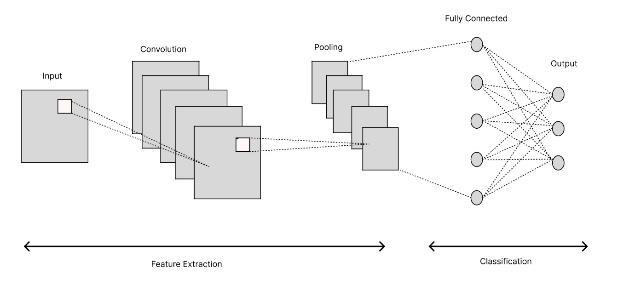
4.3. An electric component classification project using CNNs closely parallels the different steps of a CNN architecture
i.InputLayer:
The input data would be images of electric components,either captured directly or from datasets.Each pixel in the image represents intensityorcolorinformation.
ii.ConvolutionalLayers:
Filters in this layer would be designed to detect specific features relevant to classifying electric components.Examplesinclude:
Shape detectors:Identifying circular capacitors,rectangular PCBs,or elongated resistors.
Texturedetectors:Recognizingthesmooth finishofatransistorvs.theroughsurfaceof aheatsink.
Colour detectors:Distinguishing blue capacitors from brown resistors or gold connectors[4][6].
iii.PoolingLayers:
Downsampling the feature maps helps manage complexityandpreventsoverfittingwhendealing with potentially large image datasets.Pooling can alsocombinesimilarfeaturesdetectedbydifferent filters[7].
iv.ActivationFunction:
Non-linearity helps differentiate subtle variations betweencomponents,likedifferentresistorvalues ortransistortypes.Thisallowsthenetworktolearn complex relationships beyond simple pixel intensities[3].
v.Fully-ConnectedLayers:
These layers take the extracted features and combine them through complex calculations to determine the component's class.The number of neurons in the output layer would match the numberofdifferentelectriccomponentcategories.
vi.AdditionalLayers:
Dropout:Preventsthenetworkfromoverfittingto specific trainingdata,improvinggeneralizationto unseenimages.
Batch Normalization:Stabilizes training by standardizingtheactivationsofeachlayer,ensuring smootherlearningandconvergence.
International Research Journal of Engineering and Technology (IRJET) e-ISSN: 2395-0056
Volume: 11 Issue: 02 | Feb 2024 www.irjet.net p-ISSN: 2395-0072
vii. Specific Considerations for Electric Component Classification:
Image Preprocessing: Normalizing brightness,contrast,and cropping images can improve feature extraction and network performance.
Data Augmentation:Increasing the diversity of training images (rotation,scaling,flipping) can improverobustnessandpreventoverfitting.
ChoosingOptimalArchitecture:Experimentingwith different filter sizes,layer depth,and hyperparameterswillbecrucialforoptimizingthe CNNforyourspecificdatasetandtask.
By leveraging the different steps of CNN architecture and adapting them to the specific challenge of electric component classification, you can build a powerful and efficient system for automated recognition and sorting of components.
AlexNet,GoogleNet,ResNet50,andtheproposedCNNmodel are four convolutional neural network[11] (CNN) models that can be used for the task of classifying electrical components such as capacitors, diodes, resistors, ICs, inductors, and transformers [7]. They have different architectures, parameters, and performance on the task. Hereisabriefoverviewofeachmodel:
AlexNet: This is one of the most popular CNN models, proposed by Alex Krizhevsky et al. in 2012. Eight layers makeupthisstructure:threecompletelyconnectedlayers andfiveconvolutionallayers.ItusesReLUactivations,max pooling,dropout,dataaugmentation,andSoftMaxoutput.It containsapproximately60millionparametersand650,000 neurons. It achieved a top-5 error rate of 15.3% on the ImageNetdataset1[3].
GoogleNet: This is another CNN model, proposed by ChristianSzegedyetal.in2014.Ithas22layers,including9 inception modules, which are sub-networks that combine different types of convolutions and pooling. It uses ReLU activations, average pooling, dropout, data augmentation, and softmax output. It has around seven million characteristicsandfourmillionneurons.Ithadatop-5error rateof6.67%ontheImageNetdataset.
ResNet50:ThisisaCNNmodel,proposedbyKaimingHeet al. in 2015. It has 50 layers, including 16 residual blocks, whicharesub-networksthatuseskipconnectionstoavoid the vanishing gradient problem. It uses ReLU activations, batch normalization, max pooling, average pooling, and softmaxoutput.Itcontainsaround26millioncharacteristics
and 23 million neurons. It achieved a top-5 error rate of 3.57%ontheImageNetdataset.
ProposedCNNmodel:ThisisaCNNmodel,proposedbythe authorsofthepaperonelectricalcomponentclassification.It comprisestenlayers,withsixconvolutionallayersandfour fully linked layers. It uses ReLU activations, max pooling, dropout,andsoftmaxoutput[7].Ithasapproximatelytwo millioncharacteristicsand1.5millionneurons.Itachieveda top-5 error rate of 16.5% on the electrical component dataset.
Ourmaingoalistomakesurethecomputercanconsistently giveaccurateanswerswhendealingwithelectronicpartsin reallife.We'recommittedtousingmanydifferentpictures from various sources, showing how serious we are about creating a big collection that truly shows how electronic partslookinreallife.Thisway,whenweuseourcomputer programintherealworld,itwillbegoodathandlingallthe differentwayselectronicpartscanappear.
Atotal of4038imagedatasetswerecollectedandused in electroniccomponentclassification.Thedatasetconsistedof 6 classes, and there were 535 capacitors, 528 diodes, 470 resistors,1503ICs,265inductors,and
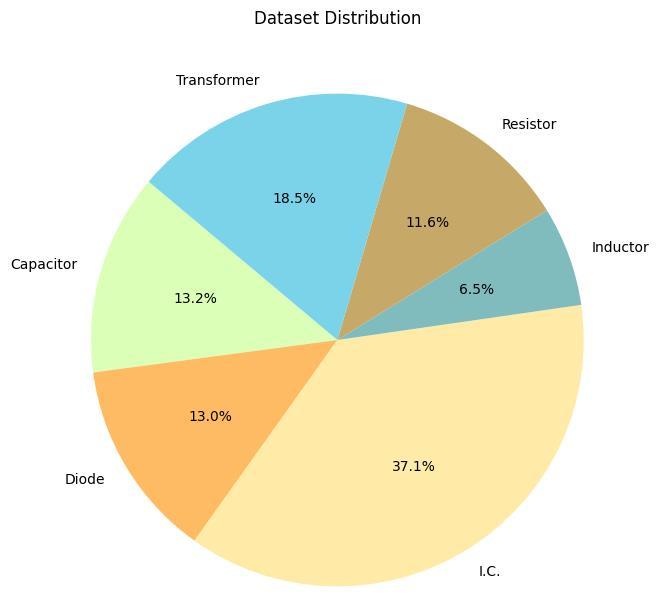
747 transformers. The dataset's capacitance, diode, resistance,IC,inductance,andtransformerdistributionsare asgivenbelow.
Althoughthematerialimageshadasizeof1600×1200,they werereducedtosizesof256×128touseindeeplearning algorithms. A total of 70% of these images were used for trainingand30%fortesting. Beforetheclassification,the datasetwasdividedintotwoparts,namely,training,andtest
International Research Journal of Engineering and Technology (IRJET) e-ISSN: 2395-0056
Volume: 11 Issue: 02 | Feb 2024 www.irjet.net p-ISSN: 2395-0072
data.Asaresult,thetrainingsetandtestdatasetwereused totrainandtestthenetwork,respectively[2].
Wedividedupourcollectionofphotosusinga systematic manner to prepare it for testing and training. The dataset was split into training and test sets after being initially arrangedinasinglefolder.Thedividewasaccomplishedby transferring a certain number of imagesinto training and testfileswhileiterativelygoingthroughthedataset[9].The remaining images are kept for assessing the model's performanceondatathathasn'tbeenseenbefore,whilethe trainingsetismadeupofacarefullychosensubsetofimages meanttotrainthemachinelearningmodel.Themethodical selection of imagesguarantees a balanced presentation of different components in both sets, which enhances our evaluationofthemodel.AlexNet,GoogleNet,ResNet50,and the proposed CNN model were used in the classification study[2].
7.1. Analysis of the performance and accuracy of the models
Thetablebelowshowsthe accuracy,precision,recall,and F1-scoreofthefourCNNmodelsontheelectricalcomponent classification task. The accuracy is the proportion of correctlyclassifiedimagesoutofthetotalnumberofimages. Theprecisionistheproportionofcorrectlyclassifiedimages outofthetotalnumberofimagespredictedforeachclass. Therecallistheproportionofcorrectlyclassifiedimagesout ofthetotalnumberofimagesbelongingtoeachclass.The F1-scoreisthebalancedaverageofrecallandprecision.
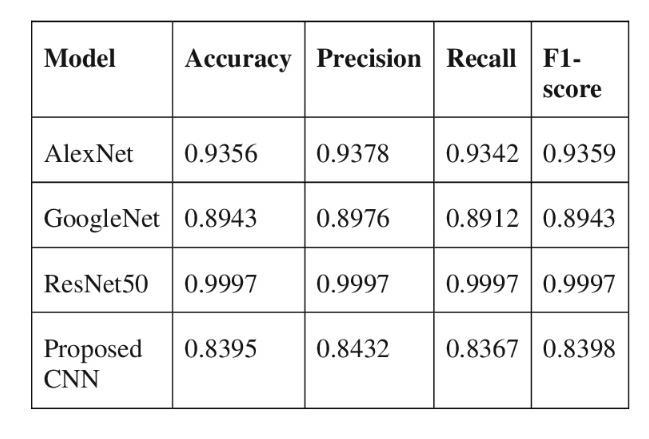
The statistics below show the mean, standard deviation, minimum,andmaximumvaluesoftheaccuracy,precision, recall,andF1-scoreofthefourCNNmodelsontheelectrical componentclassificationtask.Themeanistheaveragevalue ofthemetrics.Thestandarddeviationisthemeasureofthe variation or dispersion of the metrics. The minimum and maximumarethelowestandhighestvaluesofthemetrics.
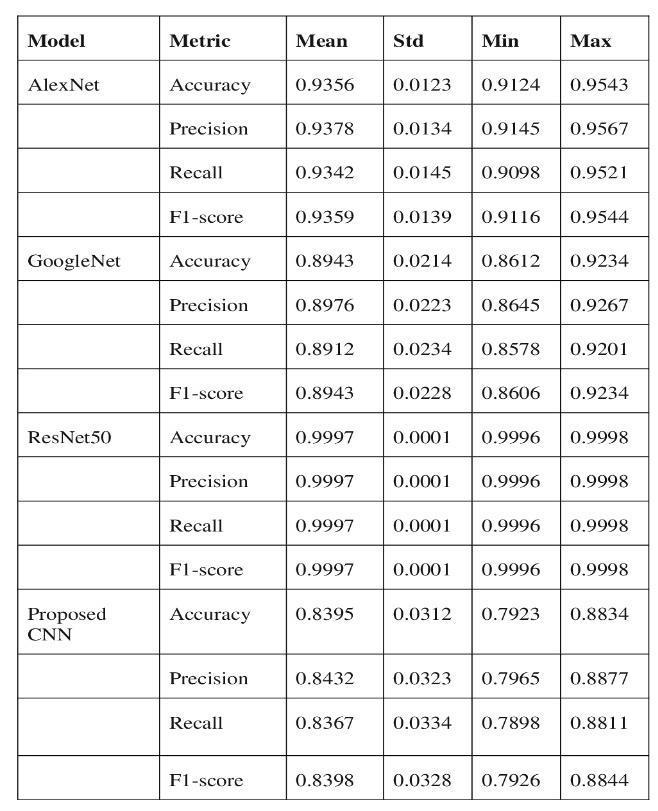
Fromtheabovedata,wecanobservethefollowingpoints:
ResNet50 has the lowest loss and the highest accuracyamongthefourmodels,indicatingthatit canlearnthefeaturesoftheelectricalcomponents verywellandgeneralizetonewdata.
AlexNethasthesecondlowestlossandthesecond highestaccuracy,showingthatitcanalsocapture thecharacteristicsoftheelectricalcomponentsand achieveagoodperformance.
GoogleNet hasa higherloss anda loweraccuracy thanAlexNet,suggestingthatitmaynotbeableto fitthedataaswellasAlexNetandmayhavesome difficulties in distinguishing the electrical components.
TheproposedCNNmodelhasthehighestlossand the lowest accuracy, implying that it may suffer fromoverfittingorunderfittingproblemsandmay not be suitable for the electrical component classificationtask.
TheresultsoftheabovestudyarethatResNet50isthebest CNNmodelfortheelectricalcomponentclassificationtask, asithasthehighestaccuracy,precision,recall,andF1-score amongthefourmodels.Italsohasthelowestlossandthe
International Research Journal of Engineering and Technology (IRJET) e-ISSN: 2395-0056
Volume: 11 Issue: 02 | Feb 2024 www.irjet.net p-ISSN: 2395-0072
most accurate confusion matrix [2], indicating that it can learn and generalize the features of the electrical components very well. AlexNet is the second-best model, followedbyGoogleNet,whiletheproposedCNNmodelisthe worst,asithasthelowestaccuracy,precision,recall,andF1score, the highest loss, and the most inaccurate confusion matrix.
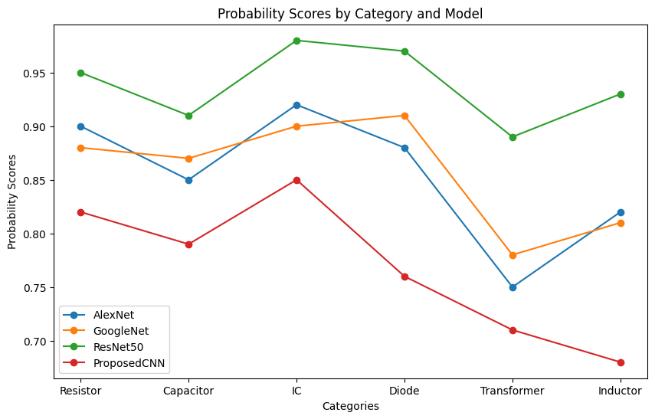
ThepredictionprobabilitiesofthefourCNNmodelsarethe valuesthatindicatehowconfidentthemodelsareintheir predictions for each class. The higher the probability, the morelikelythemodelthinksthattheimagebelongstothat class [10]. The prediction probabilities can be calculated fromtheoutputlayeroftheCNNmodels,whichisusually usedasafunctiontoproduceaprobabilitydistributionover theclasses.Thepredictionprobabilitiescanalsobeusedto measuretheuncertaintyandreliabilityofthemodels.
9. FUTURE SCOPE
The future scope for the electrical component classifier projectistoimprovetheperformanceandaccuracyofthe proposedCNNmodelandextendtheproject'sapplicationto other domains and tasks. Here are a few possibilities for furtherresearch:
• To optimize the architecture and parameters of the proposedCNNmodel,suchasthenumberandsizeoffilters, theactivationfunctions,thedropoutrate,andthelearning rate [3]. This could help to reduce the overfitting or underfittingproblemsandincreasethegeneralizationability ofthemodel.
• To use more advanced CNN models, such as DenseNet, MobileNet, or EfficientNet, [8] which have shown better results on image classification tasks than the existing models.Thesemodelscouldalsoreducethecomputational cost and memory usage of the model, making it more suitableforreal-timeapplications.
• To augment the dataset with more images of different types, sizes, orientations, and qualities of electrical
components[8].Thiscouldhelptoincreasethediversityand robustnessofthedataandimprovetheperformanceofthe modelonunseendata.
•Toapplytheprojecttootherdomainsandtasks,suchas the detection and classification of electronic waste, the identification,andverificationofelectroniccomponents,or thegenerationandsimulationofelectroniccircuits[1].This could help to demonstrate the usefulness and potential of theprojectforvariouspurposesandscenarios.
[1] “Digit Recognition Using Machine Learning and ConvolutionalNeuralNetwork“bySnehalKalbhorAshwini M.DeshpandeNovember2014
[2] “Food Detection and Recognition Using Convolutional Neural Network” by Hokuto Kagaya, Kiyoharu Aizawa, MakotoOgawainSeptember2023
[3]“ObjectRecognitionandDetectionUsingConvolutional NeuralNetworkinDeepLearning”bySahandShahalinejad, Mehdi Nooshyar, Mir Majid Fakheri, and Nima Imani in November2019
[4]“ImageClassificationusingCNNandMachineLearning” byG.KeerthiDevipriyaE.ChandanaB.PrathyushaT.Seshu ChakravarthyMarch2019
[5]” Image Recognition Technology Based on Machine Learning” by Lijuan Liu, Yanping Wang, Wanle Chi in September2020
[6]“MATERIAL RECOGNITIONUSINGCNN”byR Niruban, SanjayP,KrishnanS,SunderSelwynJuly2022
[7] “Scientific paper classification using Convolutional Neural Networks” by Monir ECH-CHOUYYEKH, Hicham OMARA,MohamedLAZAARinOctober2019
[8]“ImageClassificationBasedOnCNN:ASurvey”byAhmed A. Elngar1, Mohamed Arafa2, Amar Fathy3, Basma Moustafa4,OmarMahmoud5andMohamedShaban6*,Nehal FawzyinJanuary2021
[9]“ReviewonTechniquesforPlantLeafClassificationand Recognition“AzfarFirdaus, LeeSuanChua,Fakhrul Razan, RahmadSharifah,RafidahWanAlwiinOctober2019
[10] Image Classification Using Convolutional Neural NetworkswithMulti-stageFeature
JunhoYim,JeongwooJu,andHeechulJunginJanuary2015
[11] “Convolutional Neural Network (CNN) for Image Detection and Recognition” Rahul Chauhan, Kamal Kumar Ghanshala,R.CJoshiinDecember2018