
International Research Journal of Engineering and Technology (IRJET) e-ISSN: 2395-0056
Volume: 11 Issue: 02 | Feb 2024 www.irjet.net p-ISSN: 2395-0072
International Research Journal of Engineering and Technology (IRJET) e-ISSN: 2395-0056
Volume: 11 Issue: 02 | Feb 2024 www.irjet.net p-ISSN: 2395-0072
Revuri Priyanka1, Prasad Gowda C2
1PG student, Dept. of civil engineering, BIT, Karnataka, India
2Assistant professor, Dept. of civil engineering, BIT, Karnataka, India
Abstract- Earthquake, characterized by the rapid release of energyintheearth’slithosphere,posesasignificantthreat to buildings and infrastructure. To mitigate earthquake effects on buildings, seismic design methods such as seismic dampers and base isolation devices are used. Base isolation, in particular, is examined as a strategy to separate structures from the ground motion, thus safeguarding them from destructive consequences. This study explores the influence of different types of base isolators andtheirimpactin minimizing seismic effects on structures and, emphasizing theadvantages over the conventional structures. In the present research a numerical investigation on RC buildings with different base isolators using finite element analysis. Parameters such as storey displacement, storey shear, time period and storey drift are analyzed and compared. The findings reveal that base isolation significantly extends the structure’s duration, reducing base shear values. Rubber isolators emerge as a preferred choice in terms of seismic performance
Key Words: Earthquake, Base isolators, time history analysis, storey shear, storey displacement, time period.
AnearthquakeistheshakingoftheEarth'ssurfacecausedby arapidreleaseofenergyintheEarth'slithosphere,which generates seismic waves. It is also referred to as a quake, tremor,ortemblor.Earthquakescanrangeinstrengthfrom thosethataresolittlethatnoonecanfeelthemtothosethat arepowerfulenoughtothrowthingsandpeopleintotheair, destroyvitalinfrastructure,anddevastateentirecities.The number,kind,andsizeofearthquakesthatoccurinaregion during a specific period of time is known as its seismic activity.
While the goal of conventional seismic design is to build structures that can endure strong earthquake shaking without collapsing, certain structural elements and nonstructural elements (such glass facades) may sustain damage.Therearetwofundamentalmethodsemployedto protect structures against the damaging effects of earthquakes. These are devices for base isolation and seismicdamping.Removingthestructurefromthegroundin awaythatreduces,ifnottotallyeradicatesthepropagation
of seismic waves through the structure is the aim of base isolation. Seismic dampers are unique equipment that are putinthestructuretotakeintheenergyofferedtoitbythe earthmotion.Theyworksimilarlytospringsincars,which absorbshocksgeneratedbyshiftingroads.
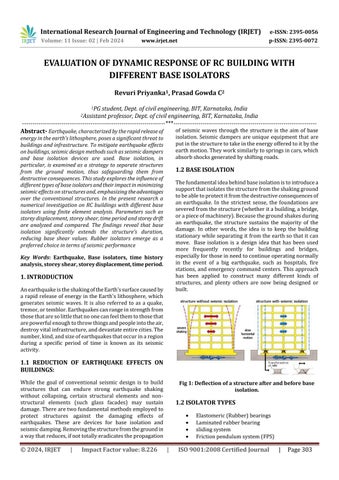
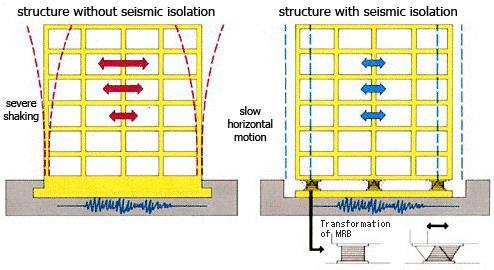
Thefundamentalideabehindbaseisolationistointroducea supportthatisolatesthestructurefromtheshakingground tobeabletoprotectitfromthedestructiveconsequencesof an earthquake. In the strictest sense, the foundations are severedfromthestructure(whetheritabuilding,abridge, orapieceofmachinery).Becausethegroundshakesduring an earthquake, the structure sustains the majority of the damage. In other words, the idea is to keep the building stationarywhileseparatingitfromtheearthsothatitcan move. Base isolation is a design idea that has been used more frequently recently for buildings and bridges, especiallyforthoseinneedtocontinueoperatingnormally in the event of a big earthquake, such as hospitals, fire stations,andemergencycommandcenters. Thisapproach has been applied to construct many different kinds of structures, and plenty others are now being designed or built.
Elastomeric(Rubber)bearings
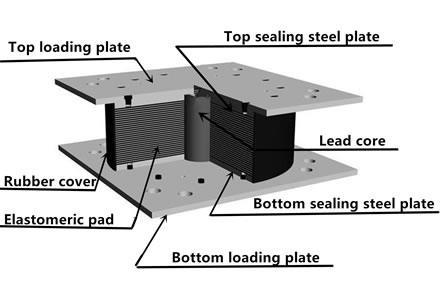
Laminatedrubberbearing
slidingsystem
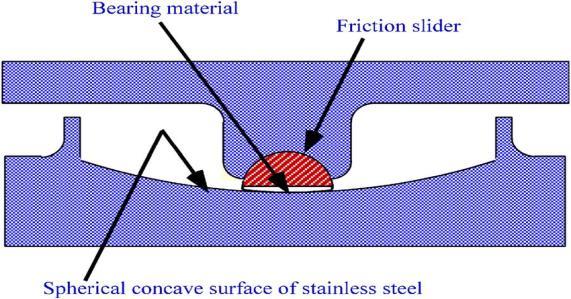
Frictionpendulumsystem(FPS)
International Research Journal of Engineering and Technology (IRJET) e-ISSN: 2395-0056
Volume: 11 Issue: 02 | Feb 2024 www.irjet.net p-ISSN: 2395-0072
Themainobjectivesofthisprojectare:
To perform time history analysis of 15 storey RC buildingprovidedwithdifferentbaseisolators.
To compare the dynamic parameters like time period, storey shear, storey drift, storey displacement and storey stiffness when different base isolators are introduced to the conventional structure
Building Details
Locationofthesite : Chikmagalur
Plandimensions : 35m×28m
Totalnumberofstories:15(G+14)
Typeofbuilding :Residential
Structuretype :Planregulartype
Heightofeachstorey :3m
Totalheightofstructure:(3×14+2)=44m
Section properties:
Wallthickness :230mm,200mm,100mm
Beamsizes :230×450mm,300×600mm, 300×650mm
Columnsizes :450×750mm,450×900mm
Modeling in ETABS
Theanalysisanddesignofthe‘fixedbase’and‘baseisolated structureshavebeendevelopedadoptingETABS18.1.1.The variousanalysisanddesignfeaturesofETABSsoftwareused inthisprojectare:
TimehistoryAnalysis
CodeProvisions
IS456-2000
IS875-2015(Part1,2,3)
IS1893-2016
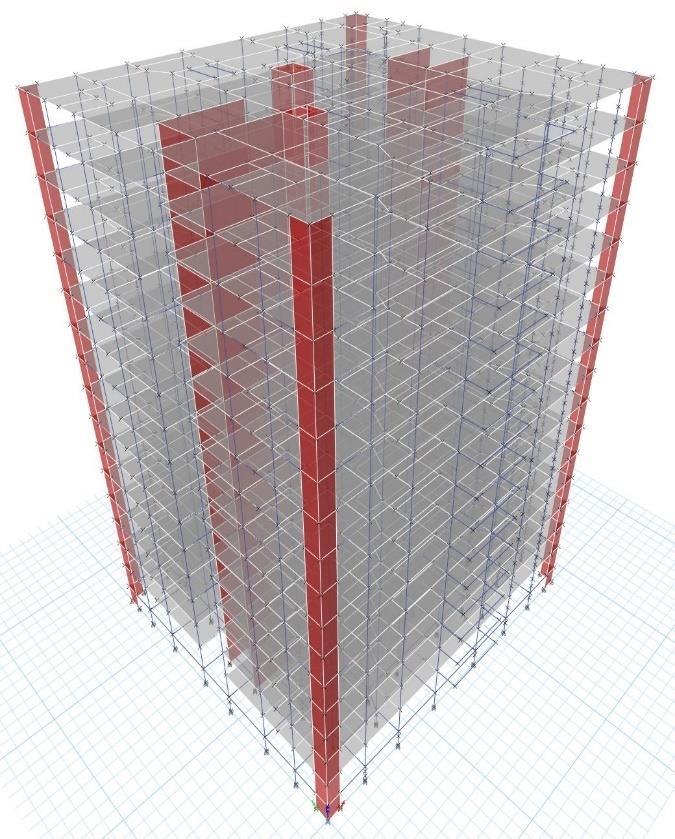
Fig 4: 3D view of the Conventional Structure
Loads
Liveload =1.5KN/m2
Superdeadload=2,3KN/m2
Floorfinishload=1KN/m2
Parapetload =5.35KN/m2
Wallload =12.05KN/m2
POSITION OF ISOLATORS:
1. Baseisolatorsareplacedat0.67mabovebase level
2. Isolatorsareprovidedaboveeverycolumn.
International Research Journal of Engineering and Technology (IRJET) e-ISSN: 2395-0056
Volume: 11 Issue: 02 | Feb 2024 www.irjet.net p-ISSN: 2395-0072
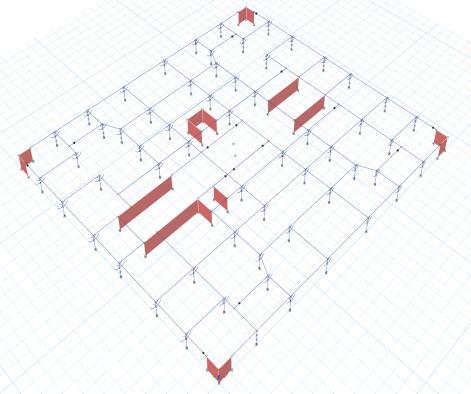
Time history analysis:
Time history analysis, a key component of structural engineering,isessentialtounderstandinghowbuildingsand structures respond dynamically to their environment. Particularly in earthquake-prone areas, this study is essential for guaranteeing the safety and integrity of structuresandishelpfulindeterminingwhethertomodify the design. Fundamentally, time history analysis is an essential technique for engineers to correctly analyze and createstructuresthatareresilienttodynamicstressesand satisfy safety criteria, hence improving the resilience and dependabilityofinfrastructureprojects.
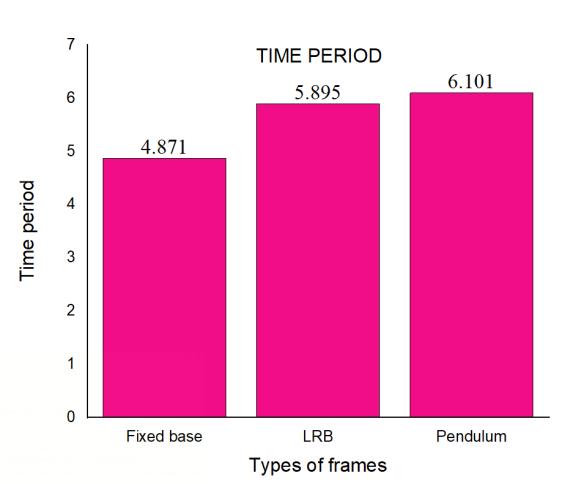
7: Fundamental time period for 3 different structures
Resultsobtainedforthecurrentinvestigationaccomplished with ETABS for time period clearly shows that the time period is being magnified up to 1.3 times while going for uniformlypendulumbearingframe(T=6.101Sec.)fromthe fixedone(T=4.87Sec.).Thisdemonstratestheefficiencyof seismicisolationbecausethespectralaccelerationandbase shear will likewise decrease in a proportional manner. Regarding the isolated situations, the employment of isolators with varying degrees of stiffness results in the highestmagnificationovertime.Comparingthefundamental timeperiodswhichisobtainedfrommodalanalysis,forthe3 casesunderconsideration((ResultsareconsideredforPeak accelerationlevel,(0.289)).
8: Displacements of the 3 different structures
Theresultsshowthatabsolutedisplacementsareincreased whilemovingfromfixedtotheisolatedframe.
International Research Journal of Engineering and Technology (IRJET) e-ISSN: 2395-0056
Volume: 11 Issue: 02 | Feb 2024 www.irjet.net p-ISSN: 2395-0072
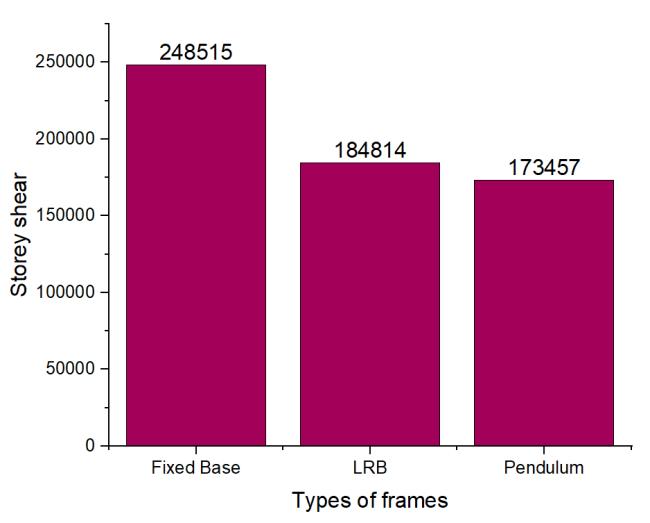
structures
Fortotalbaseshearshowthatonintroductionofisolatorsto thefixedbaseframethevalueofbaseshearisreduceupto 1.46timesofthefixedone.Forisolatedcasesthemaximum reduction in base shear is observed in case III (friction isolatorwithuniformstiffness)andalmostequalreduction isthereforbothcase2-uniformrubberisolatorstiffness& case3pendulumisolatorstiffness.
CONCLUSION
Baseisolationsignificantlyextendsthestructure'sduration and,asaresult,lowersbaseshear.whenseeninthecurrent Study,thebaseshearisdecreasedto1.46timesofthatofthe fixedonewhenthetimeperiodisraisedupto1.3times.
Thebaseshearvaluewill decreaseinaccordancewiththe prolongedtimeperiodofthestructure,andthedisplacement for fixed and isolated examples clearly demonstrates the reductionincaseofisolatedframe.
Accordingtothisstudy'sfindingsandrecommendations,the structure resting on rubber isolators is preferable to that restingonotherisolators.
[1]S.W.Duan,X.W.Tao,andH.K.Liu,“TheIsolationEffect Analysis of Base and Story Isolation System in Vertical SeismicAction,”AdvancedMaterialsResearch,vol.163–167. Trans Tech Publications, Ltd., pp. 3893–3898,Dec.2010.doi:10.4028/www.scientific.net/amr.163167.3893.
[2]C.J.R.J.Et.al.,“InfluenceatMassoftheBaseIsolation SysteminAffectingtheHigherModesofVibration,”Turkish Journal of Computer and Mathematics Education (TURCOMAT), vol. 12, no. 2. Ninety-Nine Publication, pp. 1809–1815, Apr. 10, 2021. doi: 10.17762/turcomat. v12i2.1518.
[3]M.A.AmirandN.H.Hamid,“HysteresisLoopsofBase IsolationSystem-AnOverview,”KeyEngineeringMaterials, vol. 879. Trans Tech Publications, Ltd., pp. 189–201, Mar. 2021.doi:10.4028/www.scientific.net/kem.879.189.
[4] A. SHARMA and R. S. JANGID, “INFLUENCE OF HIGH INITIALISOLATORSTIFFNESSONTHESEISMICRESPONSE OF A BASE-ISOLATED BENCHMARK BUILDING,” InternationalJournalofStructuralStabilityandDynamics, vol. 11, no. 06. World Scientific Pub Co Pte Lt, pp. 1201–1228,Nov.21,2011.doi:10.1142/s0219455411004543.
[5] J. Pérez-Aracil, E. Pereira, I. M. Díaz, and P. Reynolds, “Passive and active vibration isolation under isolatorstructure interaction: application to vertical excitations,” Meccanica, vol. 56, no. 8. Springer Science and Business Media LLC, pp. 1921–1935, Mar. 25, 2021. doi: 10.1007/s11012-021-01342-2.
[6]S.KumarandG.Jaiswal,“EffectofBaseIsolationusing LRBonSteppedBuilding,”InternationalJournalforResearch inAppliedScienceandEngineeringTechnology,vol.10,no. 7.InternationalJournalforResearchinAppliedScienceand EngineeringTechnology(IJRASET),pp.4324–4330,Jul.31, 2022.doi:10.22214/ijraset.2022.45990.
[7]S.KumarandG.Jaiswal,“EffectofBaseIsolationusing LRBonSteppedBuilding,”InternationalJournalforResearch inAppliedScienceandEngineeringTechnology,vol.10,no. 7.InternationalJournalforResearchinAppliedScienceand EngineeringTechnology(IJRASET),pp.4324–4330,Jul.31, 2022.doi:10.22214/ijraset.2022.45990.
[8]B.BalarajuandA.Manchalwar,“Performanceofelevated watertankstagingwithbaseisolationunderblastloading,” E3SWebofConferences,vol.309.EDPSciences,p.01134, 2021.doi:10.1051/e3sconf/202130901134.
[9] K. T. Htun and K. K. Cho, “Experimental in Structural DynamicsBaseIsolationSystem:Modelling,”International JournalofTrendinScientificResearchandDevelopment,vol. Volume-3,no.Issue-3.SouthAsiaManagementAssociation, pp.326–335,Apr.30,2019.doi:10.31142/ijtsrd21704.
[10] N. Karimi and R. Sarem, “Seismic response of multistorey building using different vibration technique-A review,” International Journal of Innovative Research and Scientific Studies, vol. 4, no. 1. International Journal of InnovativeResearchandScientificStudies,pp.1–13,Feb.08, 2021.doi:10.53894/ijirss.v4i1.49.
© 2024, IRJET | Impact Factor value: 8.226 | ISO 9001:2008 Certified Journal | Page306