
International Research Journal of Engineering and Technology (IRJET) e-ISSN:2395-0056
Volume: 11 Issue: 02 | Feb 2024 www.irjet.net p-ISSN:2395-0072
International Research Journal of Engineering and Technology (IRJET) e-ISSN:2395-0056
Volume: 11 Issue: 02 | Feb 2024 www.irjet.net p-ISSN:2395-0072
Shaymaa Shawkat Al-shakarchi
Department of Mathematics, College of Basic Education, University of Kufa, Najaf, Iraq
Abstract: This article presents a new category of operators called ��(����) operators, which operate on a complex Hilbert space H. An operator �� ∈��(��) is considered a ��(����) operators if the equation (��∗ �� )���� =��(��∗��)�� holds, where �� is a positive integer greater than 1, and ��∗ is the adjoint of the operator ��, We will explore the fundamental characteristics of these operators and provide examples for better understanding
Keywords: Hilbert space, normal operators, ��(��) operators, adjoint operators, bounded linear operators.
In this article, ��(��) refers to the algebra consisting of all bounded linear operators on a complex Hilbert space ��. A Hilbertspaceisamathematicalspacethathasaninnerproductandisalsocharacterizedbyitscompletenesswithrespect tothe norm induced by this inner product An operator ��∗ is definedas the adjoint of ��ifand onlyif the inner product (����,��)is equivalent to (��,��∗��) for all ��and �� belonging to the set �� A normal operator , which maps from a Hilbert space �� to itself, is defined by the equation ��∗�� =����∗ The theory of operators in Hilbert space has been thoroughly analysedbyseveralauthors,asseenbythereferences[1,2,3].In2021,Elaf.S.A. conductedanexaminationoftheclassof operators ��(��) as described in [4], and presented the fundamental characteristics of this class in a Hilbert space. An operator�� ∈��(��)isreferredtoasa��(��) operatorsifthereexists�� ∈��(��)suchthat�� , and��∗���� =����∗��
This article presents the class ��(����) operators as an extension of the class ��(��) operators and examines its essential characteristics.WeshallestablishtheconditionsunderwhichanoperatorTisconsideredtobe ��(����).Tobeclassifiedin thiscategory,theadditionandmultiplicationoftwooperators��(����)mustmeetcertainconditions,whichwewillexamine
The representation of any operator �� in cartesian form is �� =��+����, where �� and �� represent the real and imaginary components of ��, respectively. The real component of ��, represented as ������, is calculated as the average of ��and its complex conjugate, which is ��+��∗ 2 .On the other hand, the imaginary component of ��, written as ����, is determined by takingthedifferencesbetween��anditscomplexconjugate,dividedby2��,resultingin �� ��∗ 2�� .
Theobjectiveoftheworkistointroduceanewcategoryofoperatorsknownas��(����) operatorsandanalyze fundamentalpropertiesofthiscategory.
2-1 Definition:
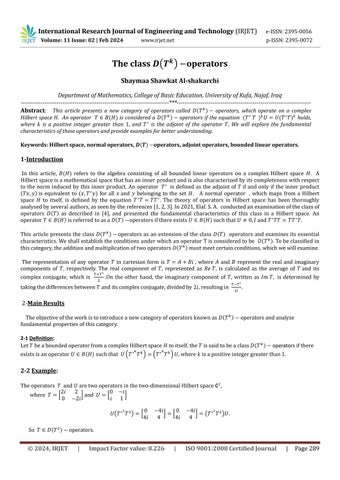
Let��beaboundedoperatorfromacomplexHilbertspace��toitself,the��issaidtobeaclass��(����) operators ifthere existsisanoperator�� ∈��(��)suchthat ��(��∗������)=(��
��
)��,where��isapositiveintegergreaterthan1.
2-2 Example:
Theoperators �� and��aretwooperatorsinthetwo-dimensionalHilbertspace₵2 , where �� =*2�� 22��+and �� =* �� �� 1+
So �� ∈��(��2) operators
International Research Journal of Engineering and Technology (IRJET) e-ISSN:2395-0056
Volume: 11 Issue: 02 | Feb 2024 www.irjet.net p-ISSN:2395-0072
If ��isequalto3,then ��(��∗3 ��3)=*
Therefore,��isnota��(��3)operator.
Iftheoperator�� ∈ ��(����) operators,itisnotnecessarilyanoperatorin��(����+1)for�� >1
Thefollowingstatementsmaybededucedfromthedefinitionsofthenormaloperatorandthe��(����) operators.
2-3 Remarks:
1. Whenthevalueof��=1,itfollowsthat��isa��(��) operator.
2. ��������������������������������������,��ℎ����������ℎ����������
Thesubsequenttheoremshowsalinkbetweenthe��(��) ��������(����) operatorsofthetwoclasses.
2-3 Theorem:
If�� ∈��(��) operators,then�� ∈ ��(����) operatorsforeach�� >1.
Proof:
since�� ∈��(��)
Therefore,weconcludethat��isanoperatorbelongingtothe��(����)class.
The example below demonstrates that theconverseoftheaboveclaimisnottrue.
2-4 Example:
Considertheoperators ��
inthetwo-dimensionalHilbertspace₵2 . Theoperator��belongstotheclass��(����)where��(��
but��(��
��)��. Thus,��isnotamemberofclass��(��)
Theoperator�� canbeclassifiedasamemberofclassD(����)bysatisfyingparticular conditions,asprovenbythe followingtheorem.
2-5 Theorem:
Anoperator ��belongstotheclass��(����)ifandonlyif��∗��commuteswith������and ����
Proof:
Suppose ��isanelementof ��(����),i.e.,��(��∗��)��=(��∗��)����,then��
Ontheotherhand,theequation��
and
��holdtrue. Hence,��
International Research Journal of Engineering and Technology (IRJET) e
Volume: 11 Issue: 02 | Feb 2024 www.irjet.net
2-6 Propositions:
Let��:�� →��bea��(����) operator,then
1. ���� alsobelongstotheclassof��(����) operators,where�� >1
2. ����belongstotheclass��(����) operatorswith��∈��.
3. If�� 1 exists,then�� 1 belongstotheclass��(����) operators.
Proof:
1-Todemonstratethat���� isanoperatorinsidetheclassof��(����) operators.Wewillnowproceedwiththeinduction onthevariable��.If�� =1,thentheresultistrue,somoreproofisunnecessary. Letusassumethattheoutcome‘’true’’isvalidfor�� =��
Followingthat,wewillprovethatitholdstruewhen�� =��+1
Theinductionproofisnowcompleted. Therefore,���� ∈��(����) operators.
Thesubsequentassertionsinthisstatementmaybedemonstratedstraightforwardlybasedonthedefinitionofthe ��(����) operatorsasfollows:
2-7 Theorem:
If��and��areinvertibleoperatorsand
operators,
alsobelongstotheclass
) operators. Proof:
International Research Journal of Engineering and
Volume:
Therefore, �� 1∗ belongstotheclassof��(����) operators
3-Properties of ��(����) operators.
Thissectionfocusesonanalyzingalgebraiccharacteristicsthatareassociatedwithourclassof��(����) operators.
3-1 Remark:
If��1,��2 and��areoperatorsbelongingtotheclassof��(����) operators,itisnotcertainthat ��1 +��2 willalsobelongto be��(����) Thefollowingexamplescanhelptoillustratethis.
3-2 Example:
Let��1 =* 1 1 1 1+,��2 =*1 2 2 +aretwooperatorsofclass��(��2)and�� =*1 1 1+∈��(��).
3-3 Example:
Theoperators��1 =[1 �� 1 �� 1]and��2 =[1
aretwoHilbertspace₵ 3 whichareintheclass ��(����) operatorswithaboundedlinearoperator��
Now,thefollowingtheoremholdstrueiftheconditionsnecessaryforremark(3-1)aresatisfied.
3-6 Theorem:
Let��1 and��2 betwo��(����) operatorsonaHilbertspace��suchthat��1��
Since
operators.
Moreover,itisimportanttomentionthattheproductof
Therefore,itcanbeproventhatbyexaminingtheexampleof(3
International Research Journal of Engineering and Technology (IRJET) e-ISSN:2395-0056
Volume: 11 Issue: 02 | Feb 2024 www.irjet.net p-ISSN:2395-0072
Thesubsequenttheoremestablishesthat,undercertainconditions,themultiplicationoftwooperatorsinsidethe specifiedclassislikewiseamemberofthisclass.
3-7 Theorem:
Consider��1 and��2 astwo��(����) operatorsonaHilbertspace��,where
and
2 Inthiscase,it canbeconcludedthat��1��2 isalsoa��(����)operator Proof
Thus,��1��2 isa��(����) operator.
4- Conclusion:
This paper introduces a new class of operators known as ��(����) operators and examines its features through illustrative examples The paper presents the primary findings, which are:
1. If�� ∈��(��) operators,then�� ∈ ��(����) operatorsforevery�� >1
2. Consider��1 and��2 betwo��(����) operatorsonaHilbertspace��.
alsoa��(����) operator.
3. Consider��1 and��2 betwo��(����) operatorsonaHilbertspace��.If ��
alsoa��(����) operator.
:References-4
1. A. Brown, on a Class of Operator, Proce. Amer. Math.Soc,4(1953), 723-728.
2. Berberian, S.K., Introduction to Hilbert space. Chelsea Publishing Company, New Yourk, (1976)
3. Conway,J.,ACourseinFunctionalAnalysis,SpringerVerlag.NewYork,(1985)
4 Elaf,S.A.,TheClassof��(��) operatorsonHilbertSpaces,Int.J.NonlinearAnal.Appl,12(2021),1293-1298.