
International Research Journal of Engineering and Technology (IRJET) e-ISSN:2395-0056
Volume:11Issue:02|Feb2024 www.irjet.net p-ISSN:2395-0072
International Research Journal of Engineering and Technology (IRJET) e-ISSN:2395-0056
Volume:11Issue:02|Feb2024 www.irjet.net p-ISSN:2395-0072
Ms. M. Aruna1, Mr. G. Jaya suriya2, Mr. Naveen Kumar3, Ms. Shamili4, Ms. M. sowbarnicka5
1Assistant professor, Department of Biomedical Engineering, Sri Shakthi Institute of Engineering and Technology, Tamilnadu, India.
2,3,4,5Second year students, Department of Biomedical Engineering, Sri Shakhti Institute of Engineering and Technology, Tamilnadu, India
Abstract- Theneedfororganrepairs,tissueregeneration, and replacement is growing among individuals with diseasesordamagedbones,suchasthoseexperiencinghip pain. The hip replacement procedure depends on the implant, which might not always be suitable because of problems with biocompatibility and mechanics, which couldmakethediscomfortworse.Inanefforttoovercome these restrictions, scientists are looking into using scaffolds as an alternative implant method. Since threedimensional (3D) printing can bio-imitate the complex patterns present in nature, it holds great promise as an effective fabrication method for customized organs. The paper covers the various manufacturing techniques, includingdirect3Dprinting,andthedeterminingvariables for hip replacement. For hip replacement, stereo lithography (SLA), selective laser sintering (SLS), and fused deposition modeling (FDM) are employed. The article gives an overview of 3D tissue regeneration and discusses surface alterations of 3D printed implants. The traditionalmetallicandceramicmaterialsarediscussedin ordertounderstandthepresentstandardhipreplacement procedures and to emphasize their justification as the preferred material. Conclusions are then made after discussing the difficulties, moral issues, and current developmentsinthe3Dprintingofimplants.Herearealso the views and challenges. Based on the information presented in this analysis, 3D printing appears to hold great promise for opening up new avenues for the developmentofsustainablehipreplacements.
Keywords: 3D printing; biocompatibility; biomaterials; celladhesion;hipreplacement;tissueregeneration
1.INTRODUCTION
The use of 3D-printed hip bracing in orthopaedic rehabilitation:thefuture?Recentdevelopmentsinadditive manufacturing technology have completely changed the medical industry by presenting previously unheard-of possibilities for the creation of customised orthotic
devices. The creation of custom-made hip braces that are 3D printed to improve patient comfort, support, and mobility is one amazing use of this state-of-the-art technology. The one-size-fits-all nature of traditional hip braces frequently reduces their usefulness and comfort. But with 3D printing, the options are virtually limitless. A patient's hip can be digitally mapped using accurate scanning and modelling techniques, enabling the construction of a brace that precisely fits their individual anatomy.Thiscustomised methodmaximisessupport and stability while encouraging natural mobility, guaranteeing a snug and comfortable fit. Beyond personalisation, 3D printing has several benefits. The technique makes it possibletocreaterobustbutlightweightstructures,which lessen the strain on patients and permit continuous mobility. Utilising sophisticated geometry and cuttingedge materials, 3D-printed .Hip braces help patients restore theirrange ofmotionbystrikinga careful balance betweenofferingthesupporttheyneedandallowingthem complete range of motion. freedom and agility. Furthermore,therehabilitationprocessitselfcanbemade more personalised with the use of 3D printing. Because everypatienthasadifferentconditionandsetofgoals,3Dprintedhipbracescanbemadetocomplementcustomised rehabilitation programmes and address particular problems. These braces can adjust to the patient's needs, improving treatment outcomes and speeding recovery, whether the patient is recuperating from hip injuries, managingchronicillnesses,orgettingreadyforsurgery.In addition to offering unmatched personalisation and customisation, 3D printing may also result in more affordableoptions.Itcanbe costlyandtime-consumingto manufactureorthoticdevicesusingtraditionalprocedures, especially when making unique designs. But 3D printing simplifies the manufacturing process and makes accurate and efficient manufacture possible, which could lower costsandmakethesesophisticatedhipbracesmorewidely available.Asorthopaedicsdevelopsfurther,3D-printedhip braces offer an amazing example of how technology and medicinemaycoexist.Theyprovideawindowintoafuture
International Research Journal of Engineering and Technology (IRJET) e-ISSN:2395-0056
Volume:11Issue:02|Feb2024 www.irjet.net
in which personalised orthotic devices maximize comfort, support, and mobility. These braces have the potential to revolutionise hip rehabilitation with continued breakthroughs in 3D printing technology, enabling patients on their path to better health and a higher standard of living. The largest ball and socket synovial joint in the body is this one. The femur head, or rounded edge of the femur, is this ball, and the socket, or acetabulum, is a curved dip around the lower area of the pelvis. The hip is shaped by the femur headsets located in the pelvic. The hip common can afflict anyone of any age, although it is most prevalent in the elderly. According to statistics,76millionAmericans,orasizableportionofthe population, suffer from pain of some kind. Although the precisecausesoftheseachesaredifficulttodetermine,the kind and location of the pain provide some indications. The majority of hip problems are related to issues originating in the lower back or buttocks. However, because other hip innervation occurs when the nerve is stimulated, the hip issues are related to the source of the pain in the groyne, thigh, and occasionally the knee. Furthermore,theNationalJointRegistry(NJR)foralltypes ofhipproceduresinEngland,Wales,NorthernIreland,and the Isle of Man has been overseen by the National Health Services (NHS) in the United Kingdom. According to the NJR analysis from 2016, there were around 101,651 replacements performed in a single year, representing a 3.5%risefromtheyearbefore.Hippaincanbecausedbya number of illnesses, including arthritis, trauma, pinched wounds,cancer,andotherissuesrelatedtolifestyle.
2.1. Biomechanical Analysis of Hip Braces after Hip Arthroscopic Surgery for Femroacetabular Impingement Syndrome: An Observational Study Kai Hirata, Yoichi Murata, Akihisa Hatakeyama, Makoto Takahashi, Patrick M. Quinn and Sushi Uchida. Hip bracescanlessenthegreatertrochanter'saccelerationand stop an excessive hip flexion angle. Individuals having arthroscopic repairofFAIOne wouldbenefitfromusing a hipbraceaftersurgery.
2.2.3D printed zirconia ceramic hip joint with precise structure and broad- spectrum antibacterial properties: Yang long Zhu, Kuna Liu, Jian Jian Deng, JingYe,Fanrong Ai,Huan Ouyang,TianlongWu,Jingly Jian. The perfect implant material with exact structure, wear resistance, and potent antibacterial properties may be swiftly customized using ceramic 3D printing technology in conjunction with antibacterial nano modification.
p-ISSN:2395-0072
2.3.Applicationof3Dscannertomeasurephysicalsize and improvement of hip brace manufacturing technologyinseverecerebralpalsypatients.Jung-Min Kim, Ji-Woon Lim, Sun-Young Choi, Sung-Han Rhim, Jaewon Beom, Ju-Seok Ryu. According to the findings of this pilot study, children with hip subluxation can benefit from quick hip correction using a customized hip brace made with a 3D scanner. cerebral palsy. By lessening discomfort, the adoption of a tailored brace is also anticipatedtoincreasepatientcompliance.
2.4Effects of a hip brace on biomechanics and pain in people with femoroacetabular impingement Authors Nicolas R a Newcomba, Tim V Wrigleya, Rana S Hinmana, Jessica Kaszac, Libby Spiersa, John O’Donnellb, Kim L Bennella Hip bracing was found to significantly but slightly minimize hip impinging movements in a group of young individuals with ongoing functional amputation symptoms. These motions Limitationsdidnottransferintoclinicaladvantagesaftera four-week period of daily brace use or soon thereafter. Thesefindingscastdoubtontheusefulnessofhipbracing fortreatingpatientswhosesymptomsofFAIarepersistent andunresponsivetoconventionaltherapy.
2.5Three-dimensionalPrintinginOrthopedicSurgery: Current Applications and Future Developments Wixted, Colleen M. BS; Peterson, Jonathan R. MD; Kadakia, Rishin J. MD; Adams, Samuel B. MD: Every significantbusinessusesthisfascinatingtechnology,which is widely used in three dimensions. This quickly developing field has made practically infinite 3D constructions made from an expanding a range of substances,suchaspolymers,metals,andevenlivingcells. The ability to modify shapes to an extreme degree, the complexity and intricacy of made goods, the removal of assembly procedures, and the decrease of waste and inventoryarealladvantagesof3Dprinting.
2.63DPrintingforHipImplantApplications:AReview Yang long Zhu, Kuna Liu, Jian Jian Deng, Jing Ye, Fanrong Ai, Huan Ouyang, Tianlong Wu, Jingly Jian: Scaffold3Dprintingtechnologyisanarea ofresearchthat is expanding quickly. Any scaffold that is 3D printed aims to resemble the hip area as closely as possible. It includes the mechanical strength (load carrying and stressshielding), appropriate pore size for nutrient transport, and ECM characteristics. Hip bio implants will become more sophisticated and efficient as a result of the development of novel materials, bioinks, and effective printingmethods
International Research Journal of Engineering and Technology (IRJET) e-ISSN:2395-0056
Volume:11Issue:02|Feb2024 www.irjet.net
2.7 of a Passive Orthosis for Reducing the Load Transfer in the Hip Joint: The purpose of this work was to develop an exoskeleton model for hip joint load transmission. In this way, a mathematical analysis of the model's dual behavior served as the foundation for its development. dependence on the relevant factors were examined. In addition, a 3D CAD model, a computational model, and a prototype exoskeleton were created. Studies using numbers demonstrated the model's sustainability for a 20% decrease in the force placed on the hip joint duringthestanceportionofthegaitcycle.
2.8 3D-Printed Regenerative Magnesium Phosphate Implant Ensures Stability and Restoration of Hip DysplasiaNasim Golafshan, Koen Willemsen, Firoz Babu Kadumudi, Elke Vorndran, Alireza DolatshahiPirouz, Harrie Weinans, Bart C. H. van der Wal, Jos Malda, Miguel Castilho: Using printed (sacrificial) supporting structures, a flexible biomaterial that induces bone was carefully used to build the patient-specific design. Additionally, the implant was sturdy and It can induce in vitro bone development, is cytocompatible, resilientenoughtowithstand physiologicalpressures,and hasthecapacityto resorbinvivo. This novel regenerative implantoffersafreshapproachtotreatinghipdysplasiain patients,bothcanineandmaybehuman.
2.9 Automatic Annotation of Hip Anatomy in Fluoroscopy for Robust and Efficient 2D/3D Registration: Robert Grupp, MathiasUnberath, CongGao, RachelHegeman, Ryan Murphy, Clayton Alexander,YoshitoOtake,BenjaminMcArthur,Mehran Armand, Russell Taylor: Any benefits from navigation are lessened by this manual initiation, which impedes the surgical workflow. We suggest a technique for completely automated registration using neural network-generated annotations.Neuronal
2.10 3D-Printed Personalized Scoliosis Brace: Networks are trained to recognize landmarks in fluoroscopy and segment anatomy simultaneously. An intraoperatively incompatible 2D/3D registration of the hipanatomyisusedtogettrainingdata.GroundProjected 3D annotations are utilized to establish true 2D labels. Intraoperative registration eliminates the need for human intervention by combining an intensity-based approach with network-inferred annotations. Across 6 cadaveric specimens, 366 fluoroscopic pictures have ground truth labeling.Networksobtainedmeandicecoefficientsof0.86, 0.87, 0.90, and 0.84 for left and right hemi elves and femursinaleave-one-subject-outexperiment.5.0mmwas theaverage2Dlandmarkerror.
3.HARDWARE DESCRIPTION
3.1PLAMATERIAL
p-ISSN:2395-0072
PLA is made from sustainable resources like sugarcane or maize starch. Lactic acid is created by fermenting plant sugars, and after that acid is polymerized, PLA is created. Poly Lactic acid, or PLA for short, is a thermoplastic polymer that is derived from biomass and degrades naturally. The biodegradability of PLA is one of its main benefits. Under the correct environmental circumstances, PLA may be broken down by microorganisms in the environment, making it a more environmentally friendly plastic than typical petroleum-based ones. Because of its adaptability,lowmeltingtemperature,andconvenienceof usage, PLA is frequently utilized as a filament in 3D printing. It comes in a range of hues and compositions, some of which include other ingredients like metallic or woodfibers.PLAisutilizedinmanydifferentapplications, suchasmedicalimplants,packagingmaterials,3Dprinting, and disposable tableware. Its application is especially prevalent in sectors and uses where the significance of a material'sregenerativenatureandbiodegradability
4. SOFTWARE DESCRIPTION
THESOFTWAREWEUSEDHERE:
Sketchupsoftware
Meshmixer
Slicingsoftware
Thingiverse
4.1SKETCHUPSOFTWARE:
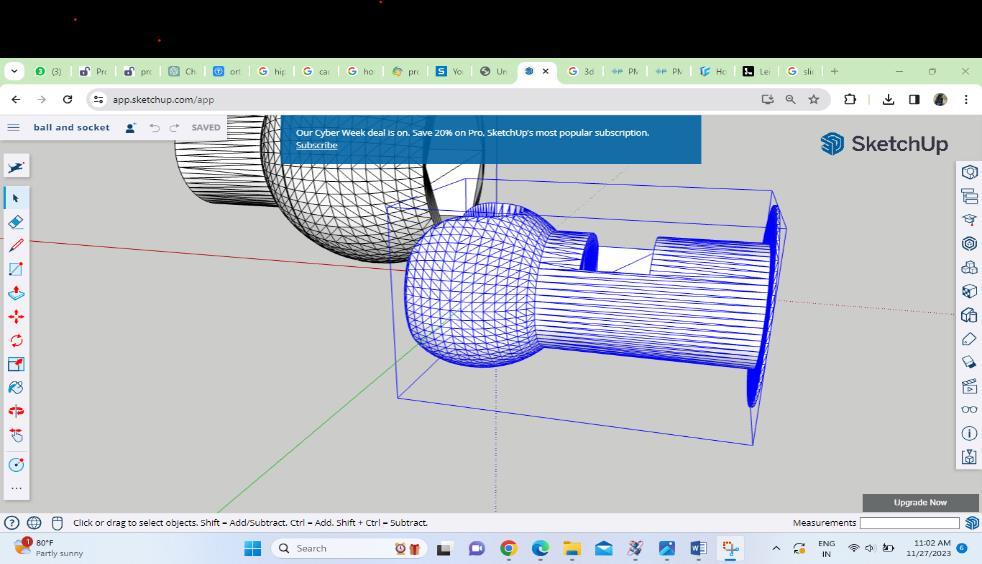
Sketch Up is a multipurpose 3D modeling program for designandvisualization.Itiswell-likedandeasytouseby hobbyists,interiordesigners,andarchitects.Youcanmake 3D models of landscapes, buildings, interiors, and more with Sketch Up. It provides a straightforward drawing interface with fundamental tools for surfaces, lines, and forms. Models can also be imported and exported in a variety of formats. Sketch Up is available to a variety of userswithbothfreeandpaideditions.
4.2MESHMIXER:
Autodesk created the potent 3D modeling program Mesh Mixer. It is renowned for having an easy-to-use interface and powerful editing and working with 3D meshes. Because it allows users to sculpt, texture, polish, and analyze 3D models, it is widely used by designers,
International Research Journal of Engineering and Technology (IRJET) e-ISSN:2395-0056
Volume:11Issue:02|Feb2024 www.irjet.net
enthusiasts, and professionals in industries such as game development, animation, and 3D printing. A mesh mixer can be used to combine different meshes, fix models, providesupportsfor3Dprinting,andmuchmore.
An important part of 3D printing is slicing software. It transforms a 3D model usually in the OBJ or STL format into a collection of G-code is a set of instructions that a 3D printer can read. This G-code sets print speed, temperature, and other print settings in addition to directing the printer's movements. Users of slicing program can import 3D models in OBJ and STL file formats,amongothers.Thesemodelscanbeacquiredfrom internet sources or made with 3D design tools. The 3D model is divided into layers using slicing software, which also specifies how each layer will be printed. The layer height, whichinfluences the print resolution, isfrequently selectablebytheuser.
4.4THINGIVERSE:
The website Thingiverse is devoted to the community sharing of digital design files made by users. mainly offering open-source, free hardware designs Contributors canchooseauserlicensetypeforthedesignstheyposton thesite,whichislicensedundertheCreativeCommonsor GNU General Public Licenses. The files published by users onThingiversecanbephysicallycreatedusingavarietyof technologies, including 3D printers, laser cutters, milling machines, and many more. Thingiverse is widely utilized by 3D printer and Maker Bot operators, the RepRap Project,andDIYtechandMakergroups.
1. Establish the Goal: Determine the precise ailment or medicalconditionthatthehipbraceisintendedtotreat.
2.CompiletheNeeds:Enumeratethefunctionalanddesign specifications, including such as adjustability, size, comfort,anddegreeofsupport.
3. Investigate PLA Material: Find out about PLA's advantages and disadvantages as a material for medical device3Dprinting.
4. 3D Model Design: Using the relevant design program, createa3Dmodelofthehipbrace.
5.TestandIterate:Afterprintingaprototypein3D,check thatitfitsandworksasintended.
p-ISSN:2395-0072
Maketherequiredchangestothedesign.
6. Certification and Compliance: Verify that the hip brace complies with all applicable safety requirements and medicaldevicelaws
7.Manufacturing:Use3Dprintingtechnologytostartmass manufacturing as soon as the design is approved and finalized.
8.Post-Production:Checkeachbrace,putthefinaltouches on,andPuttheminapackagetogiveout.
9. Distribution and Monitoring: Create a distribution strategyandkeepaneyeoncustomerfeedbacksothatthe productmaybeimprovedasneeded.
Patient Specific Measurement
Sketch up Software
Design and Modeling the hip Brace
Slicing Software
Material Selection
Post-Processing
Testing and Validation
Finished 3d printing hip Brace
Fig1BLOCKDIAGRAM
International Research Journal of Engineering and Technology (IRJET) e-ISSN:2395-0056
Volume:11Issue:02|Feb2024 www.irjet.net p-ISSN:2395-0072
The outcomes of numerical and experimental models: crucial patient data, such as the person's name, age, gender, and any other pertinent medical data that could haveimpactthehipbrace'sdesign.
PatientDemographics Measures
Name Shamili.M
HipMeasurement 36^2=72cm
RightLegMeasurement 20cm
Thigh 22cm
2. The Editors of Encyclopaedia Britannica. Pelvis, Encyclopædia Britannica. Encyclopædia Britannica, Inc. Available online: https://www.britannica.com/science/pelvis (accessed on 11November2020).
3. Rodriguez, D. The Basics of Hip Pain, Everyday Health 2009. Available online: https://www.everydayhealth.com/painmanagement/Hippain/understanding/index.aspx (accessedon11November2020).
4.Committee,N.S.NationalJointRegistryforEnglandand Wales: 14th Annual Report; Northern Ireland and the Isle of Man (NJR): Hemel Hempstead, UK, 2018. 5. Jain, A.; Clamp,K.AdultHipPain.InnovAiT2019,13,21–27.
8. CONCLUSION
3D-printed hip braces offer a specialized and tailored solution,whichisa novelapproachtoorthopedictherapy. Making use of the these braces offer a customized fit and functionality thanks to the advantages of 3D printing technology. 3D hip braces are a potential option for improved orthopedic support because of its lightweight construction and capacity to cater to particular patient needs. However, it is advised to contact contemporary scientific literature, medical practitioners, or manufacturers with expertise in this sector for the most up-to-date and accurate information on outcomes and improvements.
1.Do, A.V.; Khorsand, B.; Geary, S.M.; Salem, A.K. 3D printing of scaffolds for tissue regeneration applications. Adv.Healthc.Mater.2015,4,1742–1762.
6.Older,J.Charnleylow-frictionarthroplasty:Aworldwide retrospectivereviewat15to20years.J.Arthroplast.2002, 17,675–680
7. Furnes, O.; Lie, S.A.; Espehaug, B.; Vollset, S.E.; Engesaeter,L.B.;Havelin,L.I.Hipdiseaseandtheprognosis oftotalHipreplacements:Areviewof53,698primarytotal Hip replacements reported to the Norwegian arthroplasty register 1987–1999. J. Bone Joint Surg. Br. Vol. 2001, 83,
8. Hughes, A.J.; DeBuitleir, C.; Soden, P.; O’Donnchadha, B.; Tansey, A.; Abdulkarim, A.; McMahon, C.; Hurson, C.J. 3D printing aids acetabular reconstruction in complex revisionHiparthroplasty.Adv.Orthop.2017,8925050[
9. Gabriel, L.; Casey, J.; Gee, M.; Palmer, C.; Sinha, J.; Moxham, J.; Colegate-Stone, T.J. Value-based healthcare analysis of joint replacement surgery for patients with primary Hip osteoarthritis. BMJ Open Qual. 2019, 8, e000549
10. Hart, A.J.; Hart, A.; Panagiotopoulou, V.; Henckel, J. Personalised orthopedics–using 3D printing for tailormade technical teaching, preoperative planning and precise placement of implants. Orthop Prod. News 2017, 178,22–26.