
International Research Journal of Engineering and Technology (IRJET) e-ISSN: 2395-0056
Volume: 11 Issue: 02 | Feb 2024 www.irjet.net p-ISSN: 2395-0072
International Research Journal of Engineering and Technology (IRJET) e-ISSN: 2395-0056
Volume: 11 Issue: 02 | Feb 2024 www.irjet.net p-ISSN: 2395-0072
1st Dr Fatima Mahmood Jibirilla Department of Community Medicine, Baze University, Abuja: Plot 686, Cadastral Zone C00, Jabi, Abuja Nigeria: Lecturer 1
2nd Dr Victor Omeiza Peter Department of Community Medicine, Baze University, Abuja Plot 686, Cadastral Zone C00, Jabi, Abuja Nigeria, Lecturer 11 3rd Stephanie Iwunze, Baze University Alumni Department of Public Health, Baze University, Abuja PMB 3454, Zaria Road, Kano Nigeria
4th Dr Amatu Babakura Imam : Department of Family Medicine, Aminu Kano Teaching Hospital : PMB 3454, Zaria Road, Kano Nigeria Senior Registrar ***
Abstract - The study assessed the Knowledge and attitude towardsCOVID-19vaccinesamongundergraduatestudentsin a private tertiary institution. The study sample was 335 students. Data was analyzed using descriptive statistics, findings were illustrated using textual descriptions, and graphs, with frequencies and percentages. From the results, Gender distribution revealed that 254 (75.8%), of the participants were females, while the remaining 81 ( 24.2%) were males. The students' awareness and sources of information on COVID-19 vaccines show that, 98.5% of participantsareawareofthevaccines.Out ofwhichmajority, 64.2%,wereinformedthroughsocial mediaplatforms. While 35.2%throughofficialgovernmentchannelsandnewspapers. Personalinteractions werealsoinfluential, as 38.2%credited family and friends for enlightening them about the vaccines. When examining the student's attitude towards the vaccine, those who said they hadn’t any of the COVID-19vaccineswere asked to give the reasons for not receiving the vaccine were Concerns about vaccine safety 109(41.9%), Lack of information about vaccines 51 (19.6%) Personal beliefs or values 42 (16.2%), Medical reasons 22 (8.5%) Lack of access to vaccines 36(13.8%), Age-related reasons 8 (3.1%) and Other unique reasons 7 (2.7%). Thereasons influencingtheir stance were Vaccine efficacy accounted for 100 (35.5%), Vaccine safety was 142(50.4%), Trust in healthcare authorities was 128(45.4%), Trust in vaccine manufacturers had 88(31.2%), Recommendations from family and friends were 81(28.7%), Media coverage stood at 74(26.2%), and Personal beliefs or values at 76(26.6%).
Key Words: Students, knowledge, attitude, Covid-19
TheWorldHealthOrganization(WHO)declaredthenovel Coronavirusaglobalpandemiconthe11thofMarch,2020. (Cucinotta&Vanelli,2020)Thiswasafteraseriesofacute
respiratory diseases were reported in Wuhan China in December2019.Theseoutbreakswereeventuallytracedto be caused by the severe acute respiratory syndrome coronavirus-2(SARS-CoV-2,2019-nCoV)christened‘COVID19’.(Yukietal.,2020)Intheabsenceofvaccinesorcurative drugs, public health measures were quickly adopted and tweakeddailytoaccommodatetherapidchangeswewere faced with across the globe. Countries adopted the swift implementation of lockdowns, use of personal protective equipment, border closures, contact tracings, quarantine, andisolationtomanagethespreadandattempttoflattenthe curve.(Mudendaetal.,2022b).
In Nigeria, the National Center for Disease Control and Prevention under the Ministry of Health issued a communique indicating the first confirmed case found in Lagoswasreportedonthe28thofFebruary2020(Jacobs& Okeke, 2022). Infection rates apparently remained on a steady increase for about a month. A steep rise in cases beganinmid-Aprilandcontinuedovertimewithoccasional declines.Atthebeginningofthepandemic,anearlyCOVID19modellingreportidentifiedNigeriaasacountrywithhigh importationriskandsusceptibilitytothevirus(Gilbertetal., 2020). University campuses can be attributed to certain characteristics that raise the risk of COVID-19 spreading. Fromovercrowdedclassroomsandhostelstopoor health behaviours among young people and unavoidable regular interactionsamongstudents,staffandothermembersofthe universitycommunity.
On the 2nd of March, 2021, Nigeria received its first shipmentofnearly4milliondosesofAstraZeneca/Oxford vaccineviatheCOVAXfacilityfromMumbai.(Unicef,2021) Sincethen,otherbrands(Moderna,Johnson&Johnsonand Pfizer vaccines) have been shipped in from the COVAX FacilityandtheAfricanUnion(UNICEF,n.d.)tostrengthen theimmunityofthepopulationagainsttheCOVID-19virus. Theinfluxofthesevaccineswasindeedastepintheright
International Research Journal of Engineering and Technology (IRJET) e-ISSN: 2395-0056
Volume: 11 Issue: 02 | Feb 2024 www.irjet.net p-ISSN: 2395-0072
directiontoreleasingtheburdensofthevirusonthealready flawed healthcare system in the country, however, the different demographic, socio-cultural, and psychological factors peculiar to different individuals threatened the acceptabilityofCOVID-19vaccinesworldwideandofcourse among students. Students in tertiary institutions are expected to be more knowledgeable and logical about general health issues which should influence their healthseeking behaviours. As a result, they are more likely to contributetopublicaccesstocredibleandevidence-based health information about the COVID-19 virus. Comprehensive evaluations of university students’ knowledgeandattitudearenecessarytoserveasessential data to stakeholders for identifying field gaps and developing initiatives to better motivate communities to adhere to health standards. Additionally, educational institutions,healthprogrammersandgovernmentagencies mayusethisinformationtoinformhowtoengageuniversity studentsonthesubjectofvaccinehesitancy.Thepurposeof thisstudywastoassessstudents’knowledgeandattitudes towardCOVID-19vaccinesandanalyzethedifferentfactors thataffectthesevariables.
1.1 Problem statement
The Knowledge and Attitude towards COVID-19 vaccines among students in a tertiary institution have become a criticalconcernduetotheneedforwidespreadvaccination to mitigate the impact of the pandemic. Despite the availabilityofvaccines,thereexistsagapinunderstanding the level of knowledge and the attitudes held by students towardsCOVID-19vaccines.Thisknowledgegaphindersthe effectiveimplementationofvaccinationcampaignsandmay posechallengesinachievingthedesiredvaccinationratesa mongthestudentpopulation.Therefore,acomprehensive investigation is necessary to assess the knowledge and attitudes towards COVID-19 vaccines among students in tertiary institutions, identifying potential barriers and formulating strategies to enhance vaccine acceptance and uptake.
1. What is the level of knowledge of the students about COVID-19vaccines?
2. What is the attitude of students towards COVID-19 vaccines?
3. Is there any correlation between the knowledge and attitudeamongthestudentstowardsCOVID-19vaccines?
4. Is there a relationship between the socio-demographic characteristicsandtheKnowledgeofCOVID-19vaccines?
5. Is there a relationship between the socio-demographic characteristicsandtheattitudeofCOVID-19vaccines?
1. To assess the level of knowledge and attitude towards COVID-19 vaccines among students in a tertiaryinstitution.
2. To establish the relationship between the knowledge and attitude among the students, towardsCOVID-19vaccines.
3. Todetermine the relationship betweenthe sociodemographic characteristics of students and the knowledge and attitude of study of COVID-19 vaccines.
2.1
The World Health Organization (WHO) has defined COVID-19 as an infectious disease caused by a newly discovered coronavirus. (Cucinotta & Vanelli, 2020) Specifically, COVID-19 is caused by the Severe Acute Respiratory Syndrome Coronavirus 2 (SARS-CoV-2). The initialcasesofSARSwerereportedinAsiainFebruary2003 and subsequently spread to multiple countries in North America,SouthAmerica,Europe,andAsiabeforetheglobal outbreakwascontained.Duetothehighcontagiousnessand rapidspreadofthecoronavirus,theglobalimpactofCOVID19 has been devastating, affecting nearly all countries worldwide.Concealedtransmissionoftheviruswithinand among communities has been difficult to curtail since detectingmildandasymptomaticcasesischallenging.Itis arguedthatthevirushasnowtransitionedintoaseasonal, low-level epidemic and so more and more individuals and communities have developed an underestimated risk perceptionofthevirus. Also,aCOVID-19vaccinehasbeen developedbutdespitetheestablishedhistoryofvaccinesasa medicalinterventioninNigeria,thereremainsaconcerning disregard for the urgent and indispensable necessity of COVID-19vaccinationamongthepopulation.Theprevailing issueofCOVID-19vaccineapathyandentrenchedhesitancy withincommunitiesmaybeattributedtothedissemination of misinformation and disinformation about the nature of COVID-19vaccines.
The knowledge about COVID-19 vaccines encompasses factors such as vaccine awareness among individuals and communities,awarenessofvariousapprovedbrandsofthe COVID-19vaccine,andtherationalebehindthenecessityof vaccination.Furthermore,itincludesawarenessofpotential side effects as outlined by the World Health Organization (WHO),aswellasinformationregardingtheavailabilityand administrationproceduresofthevaccine.
Adane,Ademas,andKloos(Adaneetal.,2022)conducted a cross-sectional study in northeastern Ethiopia using the Snowball technique to evaluate knowledge, attitudes, and practicesamonghealthcareworkers(HCWs)relatedtothe COVID-19 vaccine. Results obtained demonstrated overall knowledgeofCOVID-19vaccines.Themeanknowledgescore ofhealthcareworkers(HCWs)regardingCOVID-19andits
International Research Journal of Engineering and Technology (IRJET) e-ISSN: 2395-0056
Volume: 11 Issue: 02 | Feb 2024 www.irjet.net p-ISSN: 2395-0072
vaccinewas14.97,withastandarddeviationof1.881.The overall rate of good knowledge among HCWs was 62.5%, witha95%confidenceintervalof57.4-66.8%.Amongthose withgoodknowledge,69.79%expressedtheirintentionto getvaccinatedassoonasavaccinebecomesavailable.
In terms of gender distribution, a higher proportion of males(64.65%)hadgoodknowledgecomparedtofemales (60.3%),whilealargerpercentageoffemales(39.69%)had poor knowledge about COVID-19 and its vaccines. Among different HCW categories, laboratory technicians had the highestrateofgoodknowledge(67.4%),followedbynurses and midwives (64.6%) and non-medical auxiliary staff (54.38%).Regardingchronicdiseasestatus,64.7%ofthose withachronicdiseasehadgoodknowledge.Themajorityof HCWs (86.7%) acknowledged that COVID-19 is a serious disease,and83.9%believeditcouldleadtovarioushealth complications. Additionally, 38.3% of HCWs perceived significant differences in effectiveness among the Pfizer, Moderna,andAstraZenecaCOVID-19vaccines.
Asimilarstudywasconductedtoassesstheknowledge, attitude, and acceptance of students in three tertiary institutionsinOgunstate,NigeriatotheCOVID-19vaccine. The findings from the analysis indicate that a significant proportionofrespondentsknowabouttheapprovedCOVID19vaccines,withJohnson&Johnson'sJanssenbeingthemost recognized (70.8%), followed by Moderna (61.4%), AstraZeneca-Oxford(57.2%),andPfizer-BioNTech(51.8%). However,itisconcerningthatonlyaminorityofrespondents correctly identified that certain vaccines, such as K-BCG (44.9%)andK-Anthrax(42.0%),arenotintendedforCOVID19.(Mudendaetal.,2022a)
Furthermore, the study revealed that a majority of respondents were aware that COVID-19 vaccination can protect against falling ill with COVID-19 (77.4%). Additionally,asignificantpercentageunderstoodthateven afterreceivingtheCOVID-19vaccine,itisstillpossibletotest positive for COVID-19 on a viral test (58.0%). However, a smallerproportionofstudentsheldmisconceptions,suchas the beliefthattheCOVID-19vaccinecouldalter theirDNA (29.0%), the assumption that prior COVID-19 infection eliminates the need for vaccination (36.7%), and the misconceptionthatthevaccinecancauseillnesswithCOVID19(31.1%).
Incontrast,astudycarriedoutinSeptember2022among medicalstudentsataNigerianUniversityrevealsthatoverall, a small proportion of respondents (2.6%) demonstrated excellentknowledge,whileasignificantmajority(76.8%)had poor knowledge regardingCOVID-19andits vaccines.The meanknowledgescorewas4.30withastandarddeviationof 2.746,indicatingarelativelylowlevelofknowledgeamong theparticipants.
When comparing the mean knowledge scores between maleandfemaleparticipants,females(mean:4.46,SD:2.732) exhibitedslightlyhigherknowledgelevelsthanmales(mean: 4.16, SD: 2.762). A notable finding is that 11.59% of the respondentswerenotawarethatvaccineswereavailablein
Nigeria, and 43.78% were unsure about which specific vaccineswerebeingused.(Oroketal.,2022)
towards COVID-19 Vaccines
In South-eastern Nigeria, a cross-sectional study was conducted among adults to assess their attitudes towards COVID-19 vaccines. The findings revealed that 60.2% of respondents (n = 201) exhibited positive attitudes, with a meanscoreof13.96±2.97.Theseresultsindicateagenerally favorabledispositiontowardsCOVID-19vaccinationamong the adult population in the studied region. (James et al., 2022). A2022study inZambia conductedto evaluatethe knowledge,attitudes,andacceptanceofCOVID-19vaccines amongsecondaryschoolstudentsrevealedthatonly12.7% ofthesurveyedstudentswerewillingtoreceivethevaccineif it became available. Interestingly, students who indicated their willingness to be vaccinated had better knowledge about the vaccine compared to those who were hesitant, consistent with studies conducted in Canada, China (including Hong Kong), and Sweden. , (Afifi et al., 2021), (Nilsson et al., 2021), (Rehati et al., 2022) , (Wong et al., 2022).
2.4 Relationship between the socio-demographic characteristics and the Knowledge of COVID-19 vaccines.
InadescriptivestudycarriedoutbyAdedeji-Adenolaet al. (2022) to assess Nigerian adults' understanding of the COVID-19 vaccine, it was found that health workers were moreknowledgeableaboutCOVID-19-relatedmattersthan non-health workers. They were approximately 1.87 times morelikelytohavethisawareness. Thestudyalsorevealed that individuals who had previously been diagnosed with COVID-19demonstratedgreaterknowledgethanthosewho hadn'tbeeninfected,withthelatterbeingonly56%aslikely toexhibitthesamelevelofawareness.
Asenvisaged,thosewithadiploma-leveleducationhada markedlyhigherlevelofawareness-theywere2.24times more likely to be aware compared to those with lower educationlevels.Thestudyalsoconsideredtheinfluenceof religious beliefs on the vaccine knowledge level, with ChristiansandMuslimsdemonstratingasignificantlyhigher level of awareness than followers of other religions. ChristiansandMuslimswere6.36and7.55timesmorelikely tobeaware,respectively.
2.4 Relationship between the socio-demographic characteristics and the Attitude towards COVID-19 vaccines.
Astudyconductedby(Al-Mustaphaetal.,2022),provides interestinginsightsabouttherelationshipbetweenCOVID-19 vaccine recipients in Kwara state and their unique sociodemographic characteristics. The study showed vaccine recipientswerefromallagegroups,eventhoughupto74% were over 40 years old. This could be due to a variety of reasonssuchasolderagegroupsbeingmoresusceptibleto severeillnessandthusprioritisedforvaccinations,oritmay reflecthighervaccineacceptanceinthisagegroup.Another study amongst patients attending the general outpatient
International Research Journal of Engineering and Technology (IRJET) e-ISSN: 2395-0056
Volume: 11 Issue: 02 | Feb 2024 www.irjet.net p-ISSN: 2395-0072
clinicinatertiaryhospitalinsouthernNigeriabyIlikannuet al.,(2022)alsoreinforcesthisfinding.
Notably, the research reveals that Less than a third (28.8%) of the people who got the shot work in healthrelatedfields.Accordingto(Chutiyamietal.,2022),therewas aclearindicationthathealthprofessionalsweremorelikely to accept the COVID-19 vaccine which could be a direct implication of their professional understanding of how vaccinesworkandtheirawarenessofthehealthbenefitsthey provide. In terms of gender, more men got the vaccine compared to women, who made up only 40% of the total vaccinated population. The analysis done on the gender distributionofvaccinerecipientsnotedthatmenreceivedthe vaccinesatahigherratethanwomen,whocomprised40%of the vaccinated group. One possible explanation for this genderdisparityinvaccinationratescouldbeduetovarying levels of vaccine acceptance, accessibility, or prioritisation betweenmenandwomen.Anothersignificantfactoristhe unique reproductive functions of females, as pregnant womenandnursingmotherswereinitiallyexemptedfrom vaccineuptakeduetoconcernsaboutpotentialharmtothese groups.TemitopeOlumuyiwaOjoetal.,(2023)conducteda cross-sectionalnationalsurveyinNigeriawithatotalof2370 respondents, it revealed that only 32.8% had received the COVID-19vaccine,adultswhowere60yearsorolderwere 2.2 times more likely to get vaccinated than the younger adultstherebycorroboratingthefindingsof(Al-Mustaphaet al.,2022).
The cross-sectional survey also analysed the effect of educationontheattitudetowardsthevaccine.Asexpected, therewasadirectcorrelationbetweenthelevelofeducation and the likelihood of receiving the vaccination, those with tertiary education were the most likely to get vaccinated, witha3.03timeshigherlikelihood.Meanwhile,thosewith secondaryeducationwere1.77timesmorelikely,andthose with primary education were 1.72 times more likely to be vaccinated.Thispatternseemstoindicatethatthelevelof education plays a significant role in shaping one's understanding and acceptance of the vaccine. (Temitope OlumuyiwaOjoetal.,2023)
TheCOVID-19virusisstillathreatasmanyvariantscan still emerge. As transmission remains prevalent within communities,thepotentialfortheemergenceofnewvariants andsubsequentsurgesincasenumbers,aswellasfatalities, persists. Thus, without continuous surveillance, improved herdimmunitythroughvaccination,theperilposedbythe virus persists with a particular emphasis on high-risk populations.Thereappearstobeadearthofrecentstudies specifically assessing the knowledge, attitude, and relationship between these factors regarding COVID-19 vaccinesamongstudentsandalsoadultsinNigeria,butthere seems to be a gap in the literature regarding the current situationandtrendsamongstudentsinNigeria,specificallyin Abuja.Thisobservationreinforcestheneedforconducting thisresearch,asitwillhelppolicymakerstoobtainvaluable insightsintotheeffectivenessofpasteducationalcampaigns and identify any areas that require additional attention or improvement.
Baze University is a private institution with its main Campus6kmfromAbujaCentralArea,onJabiAirportRoad Bypass Ring Road. It was founded by Senator Datti BABAAhmed in 2011 to provide university education up to International standards inNigeria atabout halfthecostof sendingastudenttostudyoutsidethecountry.
This research is a descriptive study where the target population’s features are elaborately discussed and predictions are made according to the trends set by the survey data.. The Study Population included all the undergraduatestudentsintheuniversityregardlessoftheir choiceofaccommodation.
n=Z²*P(1-P)/E²
where:
-nisthesamplesize,
-ZistheZ-value(fromthestandardnormaldistribution) forthedesiredconfidencelevel,
-Pistheestimatedproportionofthepopulationthathas thecharacteristicofinterest,and
-Eisthemarginoferror.
Thecorrectedsamplesize(n')willbecalculatedusingthe followingformulasincetheestimatedpopulationislessthan 5,000:
n'=n/(1+(n-1)/N)
WhereNisthepopulationsize.
UsingFisher'sformula:
n=(1.96)²*0.5(1-0.5)/(0.05)²
=3.8416*0.25/0.0025
=384.16
=385(roundedup).
Applying the finite population correction (FPC) as the populationsizeis2,000:
n'=385/(1+(385-1)/2000)
=385/1.192
=323.15
=323(roundeduptothenearestwholenumber).
All enrolled undergraduate students of the University includingstudentslivingoff-campusareincludedwhilethose who weren’t enrolled undergraduate student in Baze Universitywasexcluded
International Research Journal of Engineering and Technology (IRJET) e-ISSN: 2395-0056
Volume: 11 Issue: 02 | Feb 2024 www.irjet.net p-ISSN: 2395-0072
ConvenienceandSnowballSampling:Theonlinesurvey was administered to participants at their convenience, allowingthemtofilloutthesurveyatatimethatsuitedthem best.
DisseminationofanOnlinesurveyonGoogleforms.Data analysiswasdoneusingspreadsheetpackagesandSPSS.
The questionnaire was developed and adapted from a similar study done in Ogun state Nigeria. (Adetayo et al., 2021).Theconstructsof"knowledge"and"attitude"towards COVID-19 vaccines were explicitly defined and operationalized. The study design minimises potential confounding variables and biases. Data was collected anonymouslytoreducesocialdesirabilitybias,andstatistical analysescontrolledfordemographicfactorslikeage,gender, and field ofstudy to ensure that observed patternscanbe attributedtoknowledgeandattitudestowardsthevaccine.
3.8
Astructuredquestionnairetitled“KnowledgeandAttitude” wasadoptedforthestudy.Furthermore,evenassomeitems inthequestionnairewereadaptedastheyhavebeenusedin othernationsandcontexts,certaininstrumentsectionswere self-developed.
Descriptive statistics were presented in a frequency distribution table to encapsulate results related to sociodemographic characteristics, knowledge and attitude. Subsequently, the findings were illustrated using textual descriptions, graphs, and tables, and detailed with frequenciesandpercentages.
Participantswereproperlyinformedabouttheresearch purpose,potentialrisks,andbenefits.Theywereassuredthat theirparticipationwasvoluntary,andtheycouldopt-outat any time without consequences. This information was providedviaaconsentformwhichtheysignedpriortotheir involvement. The privacy of participants was rigorously protected. Any identifiable information was eliminated or disguisedtomaintainanonymity,andtheseprecautionswere communicatedtoallparticipants.
Data was stored securely with access limited to the researchteam.Tominimisepotentialdiscomfortduetothe sensitivenatureofCOVID-19vaccines,thequestionnairewas carefullystructuredtopreventdistressoranxiety.Thestudy was conducted with cultural sensitivity to the norms and beliefs of Nigerian students regarding public health and vaccinations. Before initiating the study, approval was obtained from the Institution’s ethics committee, ensuring that the research adhered to necessary ethical standards. These ethical guidelines ensured that the study respected participantrightsandwasconductedresponsibly.
Given that online survey participation is usually voluntary, there exists a potential for self-selection bias; individualswhoopttorespond couldfundamentallydiffer from those who abstain. Also, in the absence of an interviewertoofferclarityoradditionalinsights,participants mightmisconstruequestions,resultinginimpreciseanswers online questionnaires, especially those employing closedendedqueries,mightnotfullyencompasstheintricatedetails and depths of respondents' emotions, convictions, or experiences. Finally, distributing online surveys to a vast group resulted in reduced response rates, challenging the generalizabilityofthefindings.
Thestudysuccessfullyengageda total of335students. Genderdistributionrevealedthatasignificantportion,254 (75.8%),werefemales,whiletheremaining81(24.2%)were males.
Intermsoffacultyaffiliation,theFacultyofMedicaland HealthScienceshadthehighestparticipationwith134(40%) of the total. Then the Faculty of Law with 67 (20%) the FacultyofManagementandSocialScienceswith64(19.1%), andtheFacultyofComputingandAppliedScienceswith38 (11.3%). The Faculty of Environmental Sciences and the FacultyofEngineeringhadtheleastrepresentationwith17 (5.1%) and 15 (4.5%) students respectively. The majority werefromthethirdyear,totalling127(37.9%).Thesecondyear students made up 92 (27.5%) of the participants. Fourth-year students counted 52 (15.5% ). First-year and fifth-yearstudentswerelesserinnumber,with36(10.7%) and 28 (8.4%) respectively.A segment of the students, 56 (16.7%),werebelowtheageof18.Themajority,191(57%), fell within the 18-20 age bracket. Meanwhile, 76 (22.7%) were aged between 21 and 24. Only a small fraction, 12 (3.6%), were aged 25 and above. In relation to religious affiliations,themajorityidentifiedasChristians,accounting for 199(59.4%) and Muslims 131 ( 39.1%). Those who identified with religions other than Christianity and Islam wereminimal,numbering5(1.5%)oftherespondents.
In Table 2, the students' awareness and sources of informationregardingtheCOVID-19vaccinesareoutlined. Impressively, 98.5% of participants acknowledged their awareness of the vaccines. Out of which majority, 64.2%, wereinformedthroughsocialmediaplatforms.Concurrently, official government channels and newspapers or news websites each played a role for 35.2% of the students. Personalinteractionswerealsoinfluential,as38.2%credited familyandfriendsforenlighteningthemaboutthevaccines. Health professionals proved pivotal for 28.4% of the participants. Additionally, a minor proportion identified marketsastheirpointofdiscoveryforsuchinformation.The barchartbelowgivesavisualrepresentationoftheresults.
International Research Journal of Engineering and Technology (IRJET) e-ISSN: 2395-0056
Volume: 11 Issue: 02 | Feb 2024 www.irjet.net p-ISSN: 2395-0072
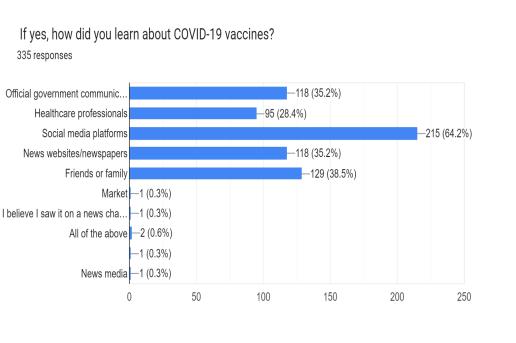
6.2a Sources of Information about COVID-19 Vaccines.
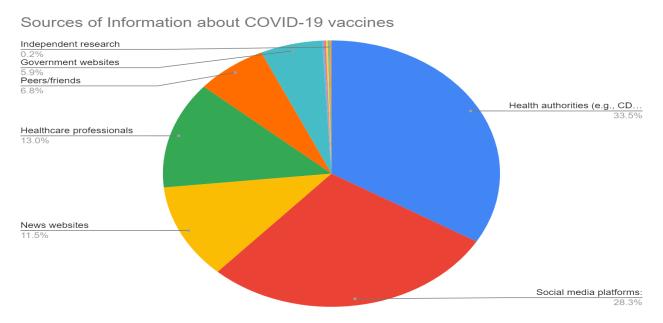
When examining additional sources that participants referredtoforinformationonCOVID-19vaccines,thedata revealedthathealthauthoritiessuchasCDCandWHOwere citedby186participants(33.5%),socialmediaplatformsby 157 (28.3%), news websites by 64 (11.5%), healthcare professionalsby72(13.0%),peersorfriendsby38(6.8%), government websites by 33 (5.9%). Less frequently mentioned were the market, a parent, health-centric websites, medical professionals on social media, and independent research, each with 1 mention, representing 0.2%to0.3%oftheresponses.Thepiechartbelowgivesa visualrepresentationoftheresults.
:
6.2b Level of Knowledge of COVID-19 vaccines
When participants assessed their understanding of the vaccines, a select 9 (2.7%) individuals, ranked their knowledge as ‘very high’. Following this, 39 (11.6%) participants considered their insight to be ‘high’. The majority, constituting 213 (63.6%) respondents, deemed their knowledge as ‘moderate’. On the lower end of the spectrum,63(18.8%)participantsratedtheirunderstanding as ‘low’, and a small subset of 11 (3.3% ), placed their awarenessas‘verylow’.Thebarchartbelowgivesavisual representationoftheresults.
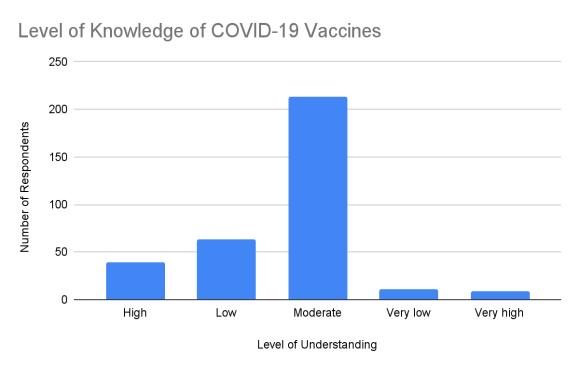
Figure -3:LevelofknowledgeofCOVID-19vaccines
6.3Knowledge of COVID-19 Vaccine Brands
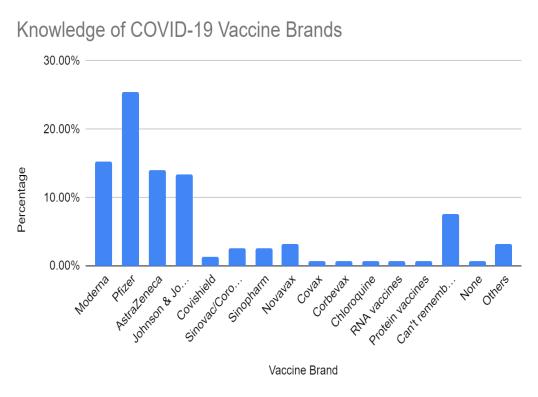
Figure -4:KnowledgeofCOVID-19VaccineBrands
Of the 335 participants in the survey, 203, (60.6%), acknowledged being informed about COVID-19 vaccines. Whenpromptedtoenumeratethevaccinestheywereaware of,despitevariationsinspelling,asubstantialportionofthe 157whorespondedcouldrecognizespecificvaccinebrands. ThepredominantlymentionedbrandswerePfizer,with40 responses(25.48%),followedbyModernaat24(15.27%), AstraZeneca with 22 (14.01%), and Johnson & Johnson securing21mentions(13.38%).Somerespondentswerealso aware of Covishield 2 (1.27%), Sinovac/CoronaVac 4 (2.55%),Sinopharm4(2.55%),andNovavax 5(3.18%).
On the other hand, a few respondents listed what appeared to be incorrect or less conventional responses: Covax,Corbevax,andChloroquineeachhad1(0.64%),and therewas1mentioneach(1(0.64%))forthecategoriesRNA vaccines and Protein vaccines. 12 (7.64%), either couldn't recall the names or were unsure of their responses. Additionally,6(3.82%)eitherprovidedambiguousanswers ordidn'tspecifyanyvaccineatall.Thebarchartabovegives abreakdownoftheseresults.
6.3a Assessing the in-depth knowledge of COVID-19 vaccines
1.20.3%(68participants)believethatoncevaccinated, one doesn't need to follow preventive measures against COVID-19. In contrast, 79.9% (267 participants) disagree withthisnotion.
International Research Journal of Engineering and Technology (IRJET) e-ISSN: 2395-0056
Volume: 11 Issue: 02 | Feb 2024 www.irjet.net p-ISSN: 2395-0072
2.52.2%(175participants)agreethatCOVID-19vaccines canprotectagainstsevereillnessandhospitalisation,while 47.8%(160participants)believetheopposite.
205(61.2%) feel that the COVID-19 vaccines were developedtooquickly,potentiallycompromisingsafety.On theotherhand,130(38.8%)holdtheoppositeview.
253(75.5%)thinkthattheCOVID-19vaccinescanleadto severesideeffects.However,82(24.5%)donotsharethis belief.
217(64.8%)haveconfidencethattheCOVID-19vaccines underwentrigoroussafetyandefficacytests,whereas1118 (35.2%)questionthis.
6. 74(22.1%) think thatCOVID-19 vaccinescan modify DNA.Conversely,261(77.9%)don'tbelievethisclaim.
7.216(64.5%)opinethatCOVID-19vaccinescanreduce thevirus'stransmissiontoothers,but119(35.5%)havea differingviewpoint.
8.90(26.9%)suspectthattheCOVID-19vaccinescould cause fertility issues. Meanwhile, 245 (73.1%) refute this idea.
6.3b Have you received any COVID-19 Vaccine?
Tofurtherassesstheparticipants'familiaritywiththeir vaccinations,thosewhohadbeenvaccinatedwereinquired about the specific vaccine(s) they received. The majority identified Moderna as the vaccines they took, with 36 (32.4%). This was followed by Pfizer-BioNTech with 31 (27.68%), AstraZeneca with 17 (15.18%), and Johnson & Johnson with 12 (10.71%). Sinopharm was received by 3 (2.68%),Sinovac/CoronaVacby6(5.36%),andCovishieldby 2 (1.79%). Additionally, 5 participants (4.46%) were uncertainaboutthevaccinetheyreceived,while1(0.89%) incorrectlyidentifieditasCovlran.Thebarchartabovegives avisualrepresentationoftheresults.
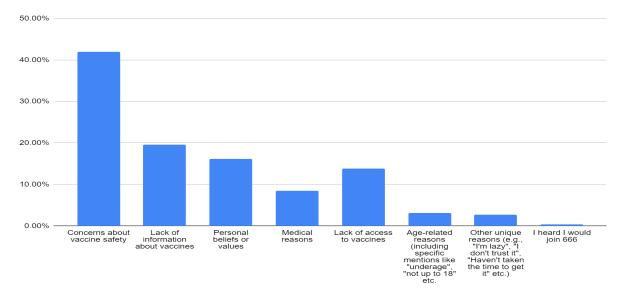
Figure -7: Reasonsfornotbeingvaccinated
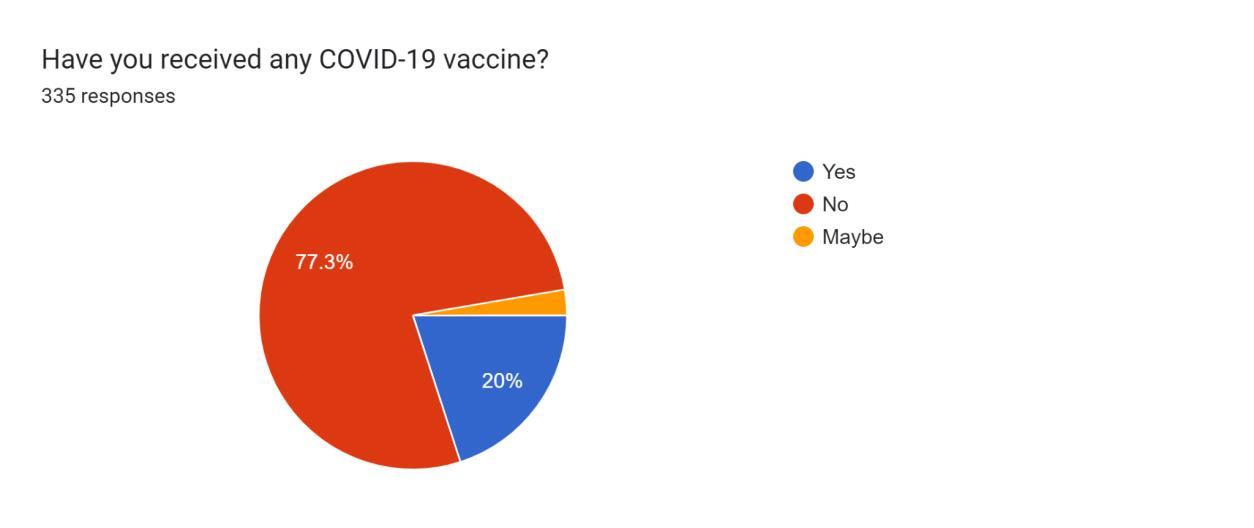
Figure -5:NumberofVaccinatedRespondents
Therespondentswerethenaskedonwhethertheyhad received any COVID-19 vaccine. 20% (67 participants) affirmedwhile259(77.3%)saidnoand9(2.7%)confirmed not being sure. The pie chart above gives a visual representationoftheresults.
6.3a Specific Vaccines Received
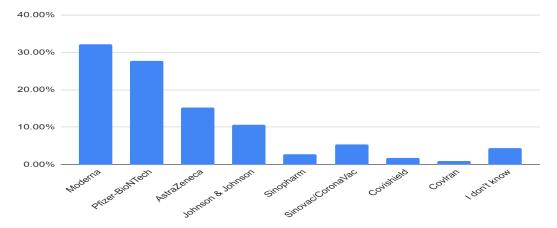
Figure -6:VaccineBrandsRecievedbyRespondents
Thosewhosaidtheyhadn’treceivedanyoftheCOVID-19 vaccines were asked to gives reasons which were were summarised into the following contexts; Concerns about vaccine safety 109(41.9%), Lack of information about vaccines51(19.6%)Personalbeliefsorvalues42(16.2%), Medical reasons 22 (8.5%) Lack of access to vaccines 36(13.8%)Age-relatedreasons(includingspecificmentions like"underage","notupto18"etc.)8(3.1%) Otherunique reasons7(2.7%),andfinallyasinglementionaboutthefear of joining the ‘666’1 1(0.4%). The bar chart above gives a visualrepresentationoftheresults.Attitudeofrespondents towardsCOVID-19Vaccines
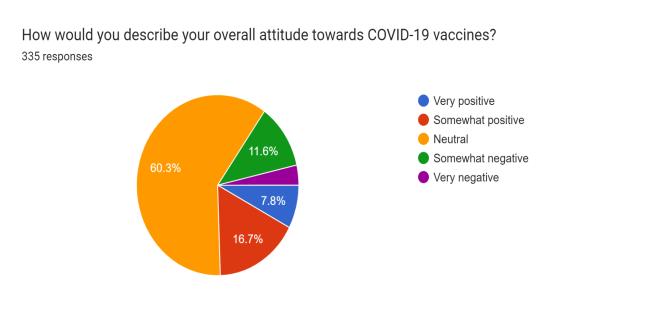
Figure -8:OverallAttitudeTowardsCOVID-19Vaccines
TherespondentsratedtheirattitudetowardsCOVID-19 vaccines from ‘very positive’ as the highest rank to ‘very negative’asthelowest.26(7.8%)ratedtheirattitudeas‘Very positive’, 56(16.7%) rated their attitude as ‘Somewhat
International Research Journal of Engineering and Technology (IRJET) e-ISSN: 2395-0056
positive’ , 202(60.3%) rated their attitude as ‘Neutral’, 39(11.6%)ratedtheirattitudeas‘somewhatnegative’and 12(3.6%)ratedtheirattitudeas‘Verynegative’.Thepiechart belowgivesavisualrepresentationoftheresults.
7.1 Factors that shape respondents attitude towards COVID-19 vaccines
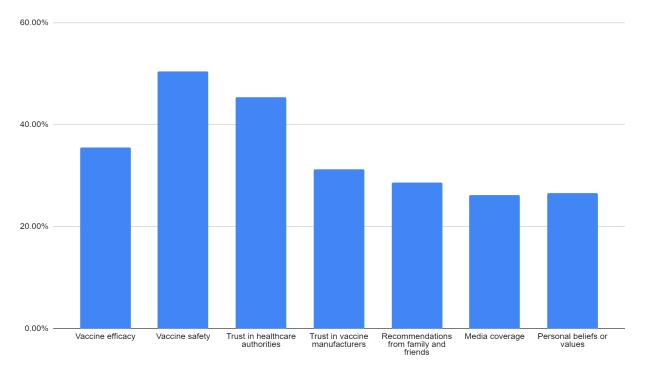
Figure -9: Factorsthatshaperespondents’attitude towardsCOVID-19vaccines
Concerningthefactorsthatshapeparticipants'viewson COVID-19 vaccines, respondents highlighted the reasons influencingtheirstance.Thebreakdownisasfollows:Vaccine efficacy accounted for 100 (35.5%), Vaccine safety was 142(50.4%),Trustinhealthcareauthoritieswas128(45.4%), Trust in vaccine manufacturers had 88(31.2%), Recommendationsfromfamilyandfriendswere81(28.7%), Mediacoveragestoodat74(26.2%),andPersonalbeliefsor valuesat76(26.6%).Theresultsarevisuallyrepresentedin thebarchartabove.
NB:Thepercentagescanadduptomorethan100%since respondents could select more than one way of handling misinformation.
7.1a Vaccine-related Misinformation or conspiracy theories regarding COVID-19 Vaccines
Respondentswerealsoaskediftheyhaveencountered anyvaccine-relatedmisinformationorconspiracytheories regardingCOVID-19vaccines.224(66.9%)hadencountered onewhile111(33.1%)hadn’texperiencedany.
7.1b. How participants handle conspiracy theories/misinformation regarding COVID-19 Vaccines
:
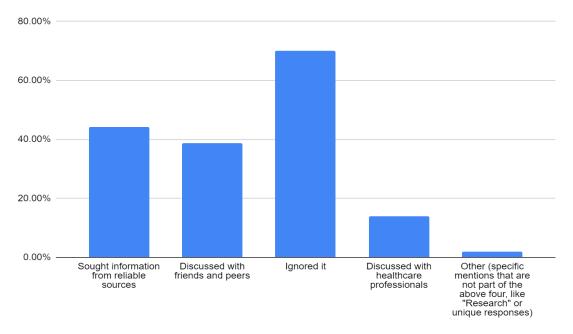
Movingfurtheronhowtheyhandledconspiracytheories, participants who had encountered one gave the following methods; Sought information from reliable sources 118(44.19%), Discussed with friends and peers 103(38.58%), Ignored it 187(70.04%), Discussed with healthcare professionals 37(13.86%), Other (specific mentionsthatarenotpartoftheabovefour,like"Research" or unique responses) 5(1.87%). The results are visually representedinthepiechartabove.
NB:Thepercentagescanadduptomorethan100%since respondents could select more than one way of handling misinformation.
7.1c. Willingness to receive COVID-19 vaccines based on recommendations from medical authorities.
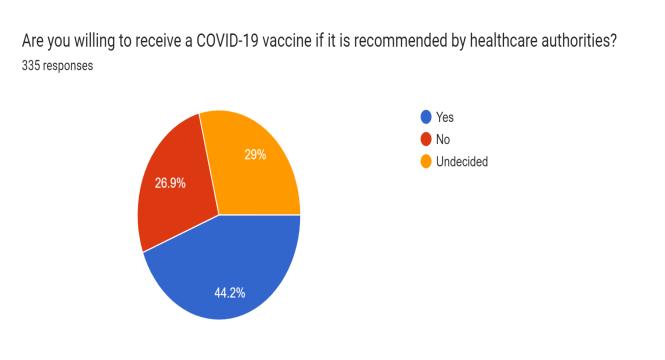
Figure-11:WillingnesstoreceiveCOVID-19vaccines basedonrecommendationsfrommedicalauthorities.
OntheirwillingnesstoreceiveaCOVID-19vaccineifitis recommended by healthcare authorities, the participants answeredthus;Yes148(44.2%),No90(26.9%),Undecided 97(29%).Theresultsarevisuallyrepresentedinthepiechart above.
7.1d. Reasons fornot Taking the COVID-19Vaccines or being undecided towards it.
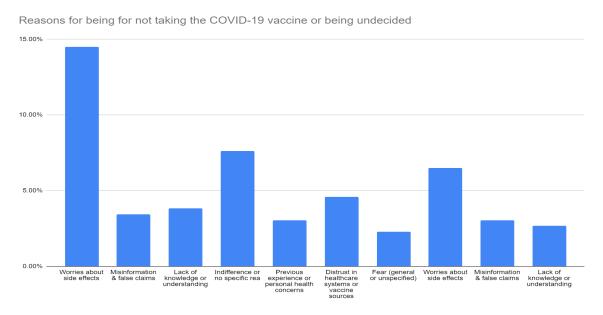
Figure 12: ReasonsfornotTakingtheCOVID-19 Vaccinesorbeingundecidedtowardsit.
For participants who refused the vaccine or were undecidedaboutit,anopen-endedquestionwasprovidedfor them to express their reasons. The major reasons were categorized under the following variables; Concernsabout theefficacy&safetyofthevaccine7(2.67%),Worriesabout side effects 38(14.5%), Misinformation & false claims 9(3.44%),Lackofknowledgeorunderstanding10(3.8.2%), Indifferenceornospecificreasongiven20(7.63%),Previous
Volume: 11 Issue: 02 | Feb 2024 www.irjet.net p-ISSN: 2395-0072 © 2024, IRJET | Impact Factor value: 8.226 | ISO 9001:2008 Certified Journal | Page262
International Research Journal of Engineering and Technology (IRJET) e-ISSN: 2395-0056
Volume: 11 Issue: 02 | Feb 2024 www.irjet.net p-ISSN: 2395-0072
experienceorpersonalhealthconcerns8(3.05%),Distrustin healthcare systems or vaccine sources 12(4.58%), Fear (general or unspecified) 6(2.29%), Personal beliefs or feelings 17(6.49%), Other specific or unique reasons 8(3.05%). The results are visually represented in the bar chartabove.
NB:Thepercentagescanadduptomorethan100%since respondents could select more than one way of handling misinformation.
InNigeria,COVID-19vaccinesweremadeavailableatno costtotherecipientonMarch2nd,2021(Unicef,2021).By theendofApril2021,only1milliondosesweregiven,mainly tohealthcareandfrontlineworkers.ByFebruary2022,even thoughalladultsover18wereeligible,only20milliondoses had been administered, covering roughly 5% of the populationwithtwodoses.Thislowcoverageregardlessof the relative availability and accessibility to the vaccines raisedconcernsaboutthefactorsleadingtovaccinehesitancy acrossthepopulation.Thisstudyaimstoprovideevidence about the knowledge and attitude towards COVID-19 vacanciesamongundergraduatestudentsinBazeUniversity, Abuja. Thestudysuccessfullysubmitsthat215participants listed social media as one of the first avenues where they learnedabouttheCOVID-19vaccines.186(33.5%)lookedto officialWHO/CDCwebsitesforfurtherinformationaboutthe vaccines.Thisiscontrarytothefindingsof(Olawadeetal., 2022) conducted among students in southwestern Nigeria wheremorestudentssoughtinformationaboutthevaccines onSocialMediaandseldomvisitedofficialWHO/CDCoreven governmentwebsites.Regardlessoftheiraccesstocredible information on WHO/CDC websites as 33.5% of the participants claim, only 9 (2.7%) individuals ranked their knowledge as ‘very high’. Following this, 39 (11.6%) participantsconsideredtheirinsighttobe‘high’.Whilethe majority,constituting213(63.6%)respondentsdeemedtheir knowledgeas‘moderate’.Thiscouldbebecauserespondents maynotfeelfullyconfidentintheirknowledgeaboutCOVID19 vaccines. This could also stem from the overwhelming amount of available information, making it challenging to discern what's essential. Additionally, even if they consult crediblewebsites,thesestudentsaresimultaneouslyexposed tomisinformationorcontrastingviewsonotherplatforms, leadingthemtoquestiontheirunderstanding.Thisisinline withaqualitativeanalysisofCOVID-19hesitancyconducted byFieselmannetal.,2022inGermany.
Themajorityoftheuniversitystudentswhohaveheardof the COVID-19 vaccine (98.5%) have a decent level of awarenessregardingthedifferentbrandsofvaccines.Pfizer, Moderna,AstraZeneca,andJohnson&Johnsonarethemost recognized and commonly listed vaccines among the students, indicating that these brands may have higher visibility or prominence in the region or the media they consume. On the other hand, a minority of students 23 (14.66%)eitherprovidedincorrectinformationorcouldn't specify a vaccine brand. This suggests a potential gap in accurateknowledge dissemination evenamong those who claim to be aware of the vaccine. The finding aligns with
Adetayoetal.'s2021studyconductedintwouniversitiesin thesouthwestregionofNigeria,implyingaconsistentpattern of vaccine brand awareness and misinformation among university students in different parts of the country. It’s important to note that the majority of respondents who received the vaccine are well-informed about the specific brandortypeofvaccinetheyweregiven.Thissuggestsahigh level of awareness and attention to detail among the vaccinatedrespondentsconcerningthevaccinetheyreceived. It could also indicate that the vaccination process and communication at vaccination centres are effective in informing individuals about the vaccine brand they are administered.
Acompelling22.1%ofBazeUniversityscholarsdebunk themyththatvaccinescanalterDNA,asentimentsharedby 29%ofZambianpupilsinasimilarstudy.Yet,whenitcomes to the vaccine's efficacy to protect against the virus and severeillness,theviewsdiverge.77.4%ofZambianstudents championthevaccine'sprotectivepotentialalongsideonly 52.2%of respondentsBazeUniversitystudents.
Overall, while there is a clear sense of understanding about the benefits and safety of the COVID-19 vaccines among the majority of the participants, there exists a significantminoritythatholdsmisconceptionsorconcerns about the vaccines. This underscores the importance of continuedvaccineeducationandaddressingspecificworries thatmaybehinderingamoreunanimousacceptanceofthe vaccine. In terms of the study subjects' attitude towards vaccines,awhopping55.8%areeithernotwillingtotakethe vaccines or undecided even if a healthcare professional recommendsit.Thisisinspiteofthefactthat46.5%ofthe participants seek health authorities and professionals for informationonCOVID-19vaccines.Thissolidifiesevidence that beyond mere information seeking, there are deeper factors or concerns influencing the decisions of study participants.
When delving deeper into the reasons, the prevalent factorsincludedaminimalsenseofpersonalrisk,perceived limitedadvantages,apprehensionsrelatedtohealth,gapsin information,andaninherent distrust inthesystem.These observationsresonatewiththefindingsfromaparallelstudy conductedinGermany,asdocumentedbyFieselmannetal.. Thisconsistencyunderscorestheimportanceofaddressing theseconcernstoenhanceunderstandingandtrust.
A chi-square test was adopted in analyzing the factors influencingknowledgeandattitudetowardstheCOVID-19 vaccines,at95%confidencelevelandstatisticalsignificance set at p<0.05. From our chi-square analysis assessing the relationship between knowledge and students' attitudes towards COVID-19 vaccines, (p=0.011). Consequently, this suggests a significant association between the level of knowledgeandtheattitudestudentsholdaboutthevaccine. Shermanetal.,2020andAbebeetal.,2021corroboratethese findings in Ethiopia and England. Data from this study highlightsanintriguingparadoxinthestudents'knowledge andactionsregardingCOVID-19vaccines.Whilethemajority recognize and acknowledge the benefits of the vaccine particularlyitsabilitytoprotectagainstsevereoutcomesand
International Research Journal of Engineering and Technology (IRJET) e-ISSN: 2395-0056
Volume: 11 Issue: 02 | Feb 2024 www.irjet.net p-ISSN: 2395-0072
limitthevirus'sspread only20%oftheparticipantshave acted upon this knowledge by getting vaccinated. Such a disconnectbetweenunderstandingandactionsuggeststhat thereareunderlyingbarriersorconcernsnotdirectlyrelated tothevaccine'sefficacyorpurpose.Thesecouldrangefrom practicalchallenges,suchasaccesstovaccinationcentres,to deeper psychological or socio-cultural factors, including vaccinemistrust,influenceofmisinformation,peerpressure, orpersonalbeliefsabouthealthandmedicine.Itisasimilar scenarioamong vaccinerefusersinNorthernNigeria who also have a common distrust in the vaccines. (Sato & Takasaki, 2021) This suggests a pervasive challenge in translatingknowledgeintoaction,pointingtotheimportance of addressing not just the informational but also the emotionalandsocialbarrierstovaccination.
Thisresearchsuggeststhatthesocio-demographicfactors do not have a significant association with knowledge regardingCOVID-19vaccinations,asallthechi-squarevalues derived in our study were below their respective critical thresholds.Nevertheless,a contrastingstudyconductedin Bangladesh indicated that a myriad of socio-demographic factors played a significant role in influencing awareness about COVID-19 vaccinations. This divergence in findings highlights the importance of this study, particularly when crafting awareness campaigns and health education programstailoredtodifferentdemographiccontexts.(Islam etal.,2021)
In terms of the association between sociodemographic factorsandattitudetowardsCOVID-19vaccinesthisstudy submitsthatgenderistheonlysocio-demographicfactorthat has a significant effect on the attitude of study subjects towards COVID-19 vaccinations. Islam et al. ’s findings corroboratethis,byreportingnumeroussociodemographic factorsincludinggenderandpriorexperiencewithvaccines were highlighted as significantly associated with shaping attitudes and perceptions towards the COVID-19 vaccinations.
DimiterToshkov,2023submitsthatgenderdisparitiesin attitude towards COVID-19 vaccines are a result of higher perceivedriskbywomenthanmen.Thisimpliesthatthere aredifferencesinhowmenandwomenperceiveorrespond tovaccines,andthesedifferencesarestatisticallysignificant. Furtheranalysiswouldbeneededtounderstandthespecific natureofthisgender-basedeffectanditsimplications.
Thestudysubmitsthatrespondentshaveagoodlevelof knowledgewhichhasa significanceonattitudelevel yetit doesn’t connote vaccine acceptance. The study also establishes that socio-demographic factors have no significance on the knowledge of COVID-19 vaccines however,genderwasfoundtohaveasignificanteffectonthe ofrespondents’attitudetowardsCOVID-19vaccines.Inlight ofthis,furtherinvestigationiswarrantedintootherelements hindering full vaccine adoption within the university population.
DrawingfromaVaccineMessagingguidepresentedbythe YaleInstituteforGlobalHealth,it'sessentialthatnarratives advocatingforvaccinesandthemessageswithinthemare crafted based on behavioural and social research. Such messagesshouldundergorigoroustestingforeffectiveness andpotentialrisksbeforebeingrolledout.(YaleInstitutefor GlobalHealth,2020)
The Yale Institute for Global Health highlights that the reasons behind vaccine hesitancy are multifaceted and varied. When those already sceptical about vaccines encounter pro-vaccine messages, it often reinforces their apprehensions, leading to a counterproductive outcome which is known as the ‘backfire effect’ according to psychologists.Consequently,evidenceindicatesthatageneric communicationapproach,althougheffectiveinsimplertasks like curbing the spread of misinformation, might not successfully address vaccine hesitancy. In fact, it might amplifytheconcernsofthosealreadydubiousaboutvaccines. Hence communication strategies channelled towards reducingvaccinehesitancyforstudentsinBazeUniversity should ensure the aforementioned factors are duly put in consideration.Basedonfindingsthatgenderhasasignificant association with the attitude of students, public health campaignsorinterventionsshouldbetailoredtoapproach differently for both genders to address these varying attitudes.
[1] Abebe,H.,Shitu,S.,&Mose,A.(2021).Understandingof COVID-19VaccineKnowledge,Attitude,Acceptance,and DeterminatesofCOVID-19VaccineAcceptanceAmong AdultPopulationinEthiopia.TaylorandFrancisOnline, Volume 14, 2015–2025. https://doi.org/10.2147/idr.s312116
[2] Adane,M.,Ademas,A.,&Kloos,H.(2022).Knowledge, attitudes, and perceptions of COVID-19 vaccine and refusaltoreceiveCOVID-19vaccineamonghealthcare workers in northeastern Ethiopia. BMC Public Health, 22(1), 4–6. https://doi.org/10.1186/s12889-02112362-8
[3] Adedeji-Adenola, H., Olugbake, O. A., & Adeosun, S. A. (2022). Factors influencing COVID-19 vaccine uptake amongadultsinNigeria.PLOSONE,17(2), e0264371. https://doi.org/10.1371/journal.pone.0264371
[4] Adegboye,O.A.,Adekunle,A.I.,&Gayawan,E.(2020). Early Transmission Dynamics of Novel Coronavirus (COVID-19) in Nigeria. International Journal of EnvironmentalResearchandPublicHealth,17(9),3054. https://doi.org/10.3390/ijerph17093054
[5] Adetayo,A.J.,&Adetayo,A. J.(1C.E.,January1).Fake News and Social Media Censorship: Examining the Librarian Role. Https://Services.igiGlobal.com/Resolvedoi/Resolve.aspx?Doi=10.4018/978
International Research Journal of Engineering and Technology (IRJET) e-ISSN: 2395-0056
Volume: 11 Issue: 02 | Feb 2024 www.irjet.net p-ISSN: 2395-0072
-1-7998-6474-5.Ch004. https://www.igiglobal.com/gateway/chapter/285056
[6] Adetayo, A. J., Sanni, B. A., & Aborisade, M. O. (2021). COVID-19VaccineKnowledge,Attitude,andAcceptance amongStudentsinSelectedUniversitiesinNigeria.Dr. Sulaiman al Habib Medical Journal, 4(3). https://doi.org/10.2991/dsahmj.k.211014.001
[7] Afifi, T. O., Salmon, S., Taillieu, T., Stewart-Tufescu, A., Fortier, J., & Driedger, S. M. (2021). Older adolescents andyoungadultswillingnesstoreceivetheCOVID-19 vaccine: Implications for informing public health strategies. Science Direct, 39(26), 3473–3479. https://doi.org/10.1016/j.vaccine.2021.05.026
[8] Al-Mustapha,A.I.,Abubakar,M.I.,Oyewo,M.,Esighetti, R. E., Ogundijo, O. A., Bolanle, L. D., Fakayode, O. E., Olugbon,A.S.,Oguntoye,M.,&Elelu,N.(2022).SocioDemographic Characteristics of COVID-19 Vaccine Recipients in Kwara State, North Central Nigeria. Frontiers in Public Health, 9(PMC8766999). https://doi.org/10.3389/fpubh.2021.773998
[9] Amaruchechukwu, O., Kapiriri, L., & Essue, B. (2022). OUP accepted manuscript. International Journal of Pharmacy Practice, 30(3). https://doi.org/10.1093/ijpp/riac028
[10] Chutiyami, M., Bello, U. M., Salihu, D., Kolo, M. A., Alsharari,A.F.,Sabo,H.,Bukar,M.,Shehu,U.,Adamu,H., Alkali,H.I.,Gambo,A.A.,Mahmud,F.A.,Muhammad,A. S.,&Bukar,I.A.(2022).SubjectiveReasonsforCOVID19VaccineHesitancyandSociodemographicPredictors of Vaccination in Nigeria: An Online Survey. COVID, 2(10), 1329–1340. https://doi.org/10.3390/covid2100097
[11] Cucinotta, D., & Vanelli, M. (2020). WHO Declares COVID-19 a Pandemic. Acta Bio-Medica: Atenei Parmensis, 91(1), 157–160. https://doi.org/10.23750/abm.v91i1.9397
[12] DimiterToshkov.(2023).Explainingthegendergapin COVID-19 vaccination attitudes. National Institute of Health, 33(3), 490–495. https://doi.org/10.1093/eurpub/ckad052
[13] Erciyes Medical Journal . (2020). EBSCOhost Login. Search.ebscohost.com.
[14] https://search.ebscohost.com/login.aspx?direct=true&p rofile=ehost&scope=site&authtype=crawler&jrnl=2149 2247&AN=144488885&h=ZiFUEzswi6kdnQorQTfm7o2 BcAt6y8CuL939xtYMDDQ%2BdnAZgFT5VHMr1kFTsx9 BG4YsNzfynCi%2Bb%2FtpnTJCYQ%3D%3D&crl=c
[15] Fieselmann,J.,Annac,K.,Erdsiek,F.,Yilmaz-Aslan,Y.,& Brzoska,P.(2022).Whatarethereasonsforrefusinga COVID-19vaccine?Aqualitativeanalysisofsocialmedia in Germany. BMC Public Health, 22(1). https://doi.org/10.1186/s12889-022-13265-y
[16] Gilbert,M.,Pullano,G.,Pinotti,F.,Valdano,E.,Poletto,C., Boëlle,P.-Y.,D’Ortenzio,E.,Yazdanpanah,Y.,Eholie,S.P., Altmann,M.,Gutierrez,B.,Kraemer,M.U.G.,&Colizza,V. (2020). Preparedness and vulnerability of African countriesagainstimportationsofCOVID-19:amodelling study. The Lancet, 395(10227), 871–877. https://doi.org/10.1016/S0140-6736(20)30411-6
[17] Han, X., Xu, P., & Ye, Q. (2021). Analysis of COVID‐19 vaccines: Types, thoughts, and application. Journal of Clinical Laboratory Analysis, 35(9), 1–2. https://doi.org/10.1002/jcla.23937
[18] Ilikannu,S.O.,Uwadia,O.M.,Enyi,I.,Idama,V.E.,Adugo, C.C.,Yusuf,C.,Urhi,A.,Ochuba,C.,Akinade,O.,&Alugba, G.(2022).COVID-19VaccineHesitancyAmongPatients Attending the General Outpatient Clinic in a Tertiary Hospital in Southern Nigeria. Cureus, 14(9). https://doi.org/10.7759/cureus.29352
[19] Islam,Md.S.,Siddique,A.B.,Akter,R.,Tasnim,R.,Sujan, Md. S. H., Ward, P. R., & Sikder, Md. T. (2021). Knowledge,attitudesandperceptionstowardsCOVID19vaccinations:across-sectionalcommunitysurveyin Bangladesh. BMC Public Health, 21(1). https://doi.org/10.1186/s12889-021-11880-9
[20] Jacobs,E.D.,&Okeke,M.I.(2022).Acriticalevaluation of Nigeria’s response to the first wave of COVID-19. Bulletin of the National Research Centre, 46(1). https://doi.org/10.1186/s42269-022-00729-9
[21] James,B.C.,Ede,S.S.,Aroh,C.M.,Okoh,C.F.,Kanokwan, C., Rasip, M. L., & Enbeyle, W. (2022). Attitudes and perceptionsofNigeriansregardingreceivingCOVID-19 vaccines: an online cross-sectional study. The Pan African Medical Journal, 41, 247. https://doi.org/10.11604/pamj.2022.41.247.33286
[22] Li, F. (2005). Structure of SARS Coronavirus Spike Receptor-Binding Domain Complexed with Receptor. Science, 309(5742), 1864–1868. https://doi.org/10.1126/science.1116480
[23] Li, W., Moore, M. J., Vasilieva, N., Sui, J., Wong, S. K., Berne,M.A.,Somasundaran,M.,Sullivan,J.L.,Luzuriaga, K., Greenough, T. C., Choe, H., & Farzan, M. (2003). Angiotensin-converting enzyme 2 is a functional receptorfortheSARScoronavirus.Nature,426(6965), 450–454.https://doi.org/10.1038/nature02145
[24] Lurie, N., Saville, M., Hatchett, R., & Halton, J. (2020). DevelopingCovid-19VaccinesatPandemicSpeed.New England Journal of Medicine, 382(21), 1969–1973. https://doi.org/10.1056/nejmp2005630
[25] Mudenda, S., Mukosha, M., Godman, B., Fadare, J. O., Ogunleye,O.O.,Meyer,J.C.,Skosana,P.,Chama,J.,Daka, V., Matafwali, S. K., Chabalenge, B., & Witika, B. A. (2022a). Knowledge, Attitudes, and Acceptance of COVID-19VaccinesamongSecondarySchoolPupilsin
© 2024, IRJET | Impact Factor value: 8.226 | ISO 9001:2008 Certified Journal | Page265
International Research Journal of Engineering and Technology (IRJET) e-ISSN: 2395-0056
Zambia: Implications for Future Educational and Sensitisation Programmes. MDPI, 10(12), 1–8. https://doi.org/10.3390/vaccines10122141
[26] Mudenda, S., Mukosha, M., Godman, B., Fadare, J. O., Ogunleye,O.O.,Meyer,J.C.,Skosana,P.,Chama,J.,Daka, V., Matafwali, S. K., Chabalenge, B., & Witika, B. A. (2022b). Knowledge, Attitudes, and Acceptance of COVID-19VaccinesamongSecondarySchoolPupilsin Zambia: Implications for Future Educational and Sensitisation Programmes. MDPI, 10(12), 6–8. https://doi.org/10.3390/vaccines10122141
[27] Nigeria Centre for Disease Control and Prevention. (2023,May7).NigeriaCentreforDiseaseControland Prevention. Ncdc.gov.ng. https://ncdc.gov.ng/news/237/update-on-covid-19-innigeria#:~:text=Official%20Statement%20following%2 0the%20Declaration
[28] Nilsson,S.,Mattson,J.,Berghammer,M.,Brorsson,A-L., Forsner, M., Jenholt Nolbris, M., Kull, I., Lindholm Olinder,A.,Ragnarsson,S.,Rullander,A-C.,Rydström,LL., Andréia Garcia de Avila, M., & Olaya-Contreras, P. (2021).TobeornottobevaccinatedagainstCOVID-19 –Theadolescents’perspective–Amixed-methodsstudy in Sweden. Vaccine: X, 9(100117), 100117. https://doi.org/10.1016/j.jvacx.2021.100117
[29] Olawade,D.,Wada,O.,Odetayo,A.,Akeju,O.,Asaolu,F.,& Owojori,G.(2022).COVID-19vaccinehesitancyamong Nigerianyouths:CasestudyofstudentsinSouthwestern Nigeria. Journal of Education and Health Promotion, 11(1),244.https://doi.org/10.4103/jehp.jehp_1756_21
[30] Orok, E., Ndem, E., & Daniel, E. (2022). Knowledge, attitudeandperceptionofmedicalstudentsonCOVID19vaccines:AstudycarriedoutinaNigerianUniversity. Frontiers in Public Health, 10, 4–5. https://doi.org/10.3389/fpubh.2022.942283
[31] Palamenghi, L., Barello, S., Boccia, S., & Graffigna, G. (2020). Mistrust in biomedical research and vaccine hesitancy:theforefrontchallengeinthebattleagainst COVID-19 in Italy. European Journal of Epidemiology, 35(8),785–788.https://doi.org/10.1007/s10654-02000675-8
[32] Ramadan,N.,&Shaib,H.(2019).MiddleEastrespiratory syndrome coronavirus (MERS-CoV): A review. Germs, 9(1), 35–42. https://doi.org/10.18683/germs.2019.1155
[33] Rehati, P., Amaerjiang, N., Yang, L., Xiao, H., Li, M., Zunong, J., Wang, L., Vermund, S. H., & Hu, Y. (2022). COVID-19VaccineHesitancyamongAdolescents:CrossSectionalSchoolSurveyinFourChineseCitiesPriorto Vaccine Availability. MDPI, 10(3), 452. https://doi.org/10.3390/vaccines10030452
[34] Sato, R., & Takasaki, Y. (2021). Vaccine Hesitancy and Refusal: Behavioral Evidence from Rural Northern Nigeria. Vaccines, 9(9), 1023. https://doi.org/10.3390/vaccines9091023
[35] Sherman,S.M.,Smith,L.E.,Sim,J.,Amlôt,R.,Cutts,M., Dasch,H.,Rubin,G.J.,&Sevdalis,N.(2020).COVID-19 Vaccination Intention in the UK: Results from the COVID-19VaccinationAcceptabilityStudy(CoVAccS),a Nationally Representative cross-sectional Survey. Human Vaccines & Immunotherapeutics, 17(6), 1–10. https://doi.org/10.1080/21645515.2020.1846397
[36] Sun,S.,Lin,D.,&Operario,D.(2021).InterestinCOVID19 vaccine trials participation among young adults in China: Willingness, reasons for hesitancy, and demographicandpsychosocialdeterminants.Preventive Medicine Reports, 22(101350), 101350. https://doi.org/10.1016/j.pmedr.2021.101350
[37] Temitope Olumuyiwa Ojo, Ayodeji Oluwole Ojo, Olajumoke Elizabeth Ojo, Bosede Olufunmilayo Akinwalere, & Adebowale Femi Akinwumi. (2023). Determinants of COVID-19 vaccine uptake among Nigerians: evidence from a cross-sectional national survey. Archives of Public Health, 81(1). https://doi.org/10.1186/s13690-023-01107-1
[38] UNICEF.(n.d.).Frequentlyaskedquestionsandanswers onCOVID-19vaccination.UNICEF.RetrievedMarch4, 2023,fromhttps://www.unicef.org/nigeria/frequentlyasked-questions-and-answers-covid-19-vaccination
[39] Wang,Q.,Zhang,Y.,Wu,L.,Niu,S.,Song,C.,Zhang,Z.,Lu, G.,Qiao,C.,Hu,Y.,Yuen,K.-Y.,Wang,Q.,Zhou,H.,Yan,J., &Qi,J.(2020).StructuralandFunctionalBasisofSARSCoV-2 Entry by Using Human ACE2. Cell, 181(4). https://doi.org/10.1016/j.cell.2020.03.045
[40] Wong, W. H. S., Leung, D., Chua, G. T., Duque, J. S. R., Peare,S.,So,H.K.,Chan,S.M.,Kwan,M.Y.W.,Ip,P.,& Lau,Y.L.(2022).Adolescents’attitudestotheCOVID-19 vaccination. Science Direct, 40(7), 967–969. https://doi.org/10.1016/j.vaccine.2022.01.010
[41] WorldHealthOrganization(WHO).(n.d.).Nigeria:WHO Coronavirus Disease (COVID-19) Dashboard. Covid19.Who.int. Retrieved June 9, 2023, from https://covid19.who.int/region/afro/country/ng
[42] Yale Institute for Global Health. (2020). Vaccine MessagingGuide(p.1).UNICEF.
[43] Yuki,K.,Fujiogi,M.,&Koutsogiannaki,S.(2020).COVID19 pathophysiology: A review. Clinical Immunology, 215(1), 108427. https://doi.org/10.1016/j.clim.2020.108427
Volume: 11 Issue: 02 | Feb 2024 www.irjet.net p-ISSN: 2395-0072 © 2024, IRJET | Impact Factor value: 8.226 | ISO 9001:2008
International Research Journal of Engineering and Technology (IRJET) e-ISSN: 2395-0056
Volume: 11 Issue: 02 | Feb 2024 www.irjet.net p-ISSN: 2395-0072
Name: DrFatimaMahmood Jibirilla
Affiliation: Departmentof CommunityMedicine,Baze University,Abuja, Address: Plot686,Cadastral ZoneC00,Jabi,AbujaNigeria Designation: Lecturer1
Email: fatima.jibirilla@bazeuniversit y.edu.ng
Name: DrVictorOmeizaPeter
Affiliation: Departmentof CommunityMedicine,Baze University,Abuja, Address: Plot686,Cadastral ZoneC00,Jabi,AbujaNigeria Designation: Lecturer11
Email: victorpeter@bazeuniversity.e du.ng
Name: StephanieIwunze
Affiliation: Departmentof PublicHealth,BazeUniversity, Abuja
Address: PMB3454,Zaria Road,KanoNigeria
Designation: Alumni
Email:stephanie4523@ bazeuniversity.edu.ng
Name: DrAmatuBabakura Imam
Affiliation: Departmentof FamilyMedicine,AminuKano TeachingHospital Address: PMB3454,Zaria Road,KanoNigeria
Designation: SeniorRegistrar
Email:amatubk@gmail.com