
International Research Journal of Engineering and Technology (IRJET) e-ISSN:2395-0056
Volume: 11 Issue: 02 | Feb 2024 www.irjet.net p-ISSN:2395-0072

International Research Journal of Engineering and Technology (IRJET) e-ISSN:2395-0056
Volume: 11 Issue: 02 | Feb 2024 www.irjet.net p-ISSN:2395-0072
Sanjana Agarwal1, Dhruv R Jain2 , Gourav Agarwal3 , Tanishq M4, Hrishikesh5 , Siddharth6
12345Students- Jain (Deemed to be university) - Center for Management Studies
Dr. Priya Makhija Assistant professor- Jain (Deemed to be university) - Center for Management Studies
ABSTRACT:
The influence on gender gaps varies by nation, despite the fact that digital financial services have made access to money easier, quicker, and less expensive, contributing to the spread of digital financial inclusion. Fintech, or financial technology, has become a significant driver in the global transformation of the financial services industry. This abstract focuses on how Fintech is affecting women's financial inclusion, which is important for achieving gender equality and economic empowerment. By giving women more access to financial resources and services, fintech technologies like mobile banking, digital payments, and peer-to-peer lending have the potential to close the gender financial gap.
The results suggest that having a more gender diverse executive board is advantageous. Fintech businesses' performance is connected with improved performance. Fintech has the potential to increase financial inclusion and close the gender gap in financial service access. This research discovers a significant "Fintech gender gap" using data from 28 countries: Men use Fintech products and services at a rate of 29%. Among women, only 21% do. Almost all of the countries in our study had the gap. About a third of the difference is explained by national variables and a number of personal factors. The report offers potential explanations for in its conclusion, the problems of promoting financial inclusion with the gender gap and its ramifications modern technologies. This research paper examines how improved financial services accessibility, cost, and convenience might improve women's financial inclusion. It looks at the difficulties and possibilities of women adopting fintech, as well as concerns about digital literacy, privacy, and security. It also covers the function of legislative efforts and regulatory frameworks in fostering a gender-inclusive Fintech sector.
KEYWORDS: Fintech, Gender Gap, Innovation, Digital Literacy, Women’s Financial Inclusion, and Economic Empowerment.
INTRODUCTION:
The development of Fintech in recent years has given us a game-changing chance to solve the enduring problem of gender inequality in financial inclusion. This study intends to examine how Fintech may help close the gender pay gap by providing creativefixesthatgivewomenmorecontrolinthefinancialindustry.
We will explore the numerous Fintech efforts created to improve women's financial inclusion through this research. This entails assessing digital lending platforms that employ alternative data sources to measure creditworthiness in addition to standard metrics and mobile banking apps that provide tailored financial education and user-friendly interfaces. We'll also look into how block chain technology might increase financial transaction security and transparency, helping to build confidenceamongwomenwhofrequentlyexperienceprejudiceandexclusion.
Thisstudyaimstoidentifytheadvantagesanddisadvantagesofutilizingtechnologyforwomen'sfinancialempowermentby throwinglightoncutting-edgeFintechpractices.OurgoalistoadvanceknowledgeofthepossibleeffectsofFintech onclosing thegendergapinfinancialaccessandpower.
Womenstillencounterunequalimpedimentstousingformalfinancialservices,despitegreatprogresstowardglobalfinancial inclusion. Economic inequality has been sustained by these obstacles, which range from restricted access to financing, knowledge, and technology to cultural norms and prejudices. By offering specialized solutions that address the particular requirementsofwomen,Fintech,whichencompassestechnologieslikemobilebanking,digitalpayments,andblockchain,has
International Research Journal of Engineering and Technology (IRJET) e-ISSN:2395-0056
Volume: 11 Issue: 02 | Feb 2024 www.irjet.net p-ISSN:2395-0072
the potential to completely transform the financial environment, eventually encouraging global economic development and equality.
On the other hand, gender discrepancies in financial inclusion continue. In the world, 65% of women and 72% of men have accounts, respectively (Demirgüç-Kunt et al., 2018). Barriers include the distance to the closest bank, the complexity of the paperworkrequiredtocreateabankaccount,andsocialandculturalfactors.
According to Murata and Sioson (2018), women's access to financial institutions has been restricted. Due to its accessibility and ease of use, financial technology has the potential to help women overcome some of these obstacles and gain financial independence.SiosonandKim(2019)predictanexpansion.Indeed,financialinclusionindexescreatedbySahayetal.(2020) indicate that DFSs have helped narrow gender imbalances in numerous countries, but there are regional and national discrepancies Countries continue to be huge. Investigating why such differences exist is important not only for closing the gendergapinfinancialinclusion,butalsofromamacroeconomicstandpoint,becausemoreinclusivedigitalfinanceisproving positivelyassociatedwitheconomicgrowth,bringingbenefitstosociety(Kheraetal.,2021).
InadditiontothegendergapintheuseofDFS,theeconomicrelevanceofwomen'sleadershiprolesin Thefinancialsectoris also very strong. Women hold less than 25% of bank and bank board seats supervisory bodies and represent approximately 5%ofbankCEOsworldwide(Sahayetal.,2022).
In the typically male-dominated field of fintech, women have made notable advancements. Diversity and inclusion have received increasing attention in recent years, which has increased the chances for women to succeed in FinTech positions. Many women have attained executive roles in FinTech businesses, fostering innovation and promoting development in the sector. However, therearestill issueswith gender bias andunequal representation, and work isstill beingdoneto closethe gendergapinfintech.
1. "Financial inclusion through FinTech and women's financial empowerment," International Journal of Social Economics, 2023, by Moghadam, H. and Karami, A. The paper examines the effect of financial inclusion through FinTech on women’s financial empowerment at the international level. The authors analyze data from the Global Findex (2017) and World Bank databases to investigate the relationship between FinTech and women’s financial empowerment.
2. Tripathi S, Rjeev M, 2023 Gender inclusive development through Fintech: Studying Gender- based digital financial inclusion in a cross-economy setting. Research methods in economics to evaluate the role of energy efficiency and financialinclusion.
(Tripathi&Rajeev,2023)
3. Determinants of financial inclusion gender gap in Ethiopia: Evidence from decomposition analysis, Hundie and TadesseTulu,2023.
UsingFairliedecompositiontechnique,wefindstatisticallysignificantgendergapinallindicatorsoffinancialinclusionunder study in Ethiopia. The result shows that the highest financial inclusion gender gap is observed in formal saving followed by formalaccountholding.
4. Siason and Kim,2017 Financial inclusion and women's empowerment are closely related, according to studies from emergingnations.Financialinclusionandwomen’sempowermentareindeedcloselyrelated,assuggestedbystudies conducted in emerging nations. Financial inclusion refers to the accessibility and usage of financial services by individuals and businesses. It plays a crucial role in promoting economic growth, reducing poverty, and fostering genderequality.
(PaulaSioson&JuKim,2017)
5. Khera P, Financial Inclusion for the Empowerment of Women in South Asian Countries, 2022. This paper aims to address the issues of Asian countries toward why females are discouraged and more likely to be removed from the
International Research Journal of Engineering and Technology (IRJET) e-ISSN:2395-0056
Volume: 11 Issue: 02 | Feb 2024 www.irjet.net
p-ISSN:2395-0072
formalfinancialsystemthanmales.Further,whetherthereisanyconnectionbetweenreligionandwomen’sfinancial inclusionisalsoaddressed.
(Kheraetal.,2022)
6. Ranabahu,willfinancialtechnologyaddresstheburdenofpovertyin2022,aclassificationofFinTechcompanies. This paper explores how financial technology (FinTech) organisations address poverty-related challenges when providing digitalfinancialservices.Employingtheconceptualfoundationoftheliabilityofpoorness(i.e.literacygaps,ascarcity mindset, intensenon-businesspressuresandalackoffinancialslack),thispaperexplorestheinnovativestrategiesthatFinTechsuse toaddresstheseliabilitiesandpromoteentrepreneurship.
7. Patel,2022Thegenderpaygapinmedicineisstillastarkexampleofubiquitousinequity.
(Pateletal.,2018)
Thegenderpaygapinmedicineisawell-documentedissuethathighlightsthepresenceofinequity.Itisanareawherewomen areoftenpaidlessthantheirmalecounterparts.Thegenderpaygapisacomplex probleminfluencedbyvariousfactorssuch asoccupationalsegregation,discrimination,andwork-lifebalance.
8. Binagwaho,2021commitmenttogenderequalitythroughfinancingthattakesthatintoaccount. Theauthorssuggest that all funding and research institutions should establish guidelines to devote 50% of health research funding to supportprojectsandinnovationsthatfocusonwomen’shealthneedsandpriorities
(Binagwahoetal.,2021)
9. Anik, 2021 Relationship between women's empowerment and the use of maternity healthcare: data from a crosssectionalstudythatwasnationallyrepresentativeMishra2019.
It explores the association between women’s decision-making autonomy and utilization of maternal healthcare services among currently married women in India. The study found that women with high decision-making autonomy had a significantly higher likelihood of receiving antenatal care (ANC) and postnatal care (PNC) compared to those with low autonomy However,nosignificantassociationwasobservedbetweenwomen’sautonomyandinstitutionaldelivery
Research on FinTech for women's financial inclusion has gained momentum in recent years, shedding light on various dimensionsofthiscomplexissue.However,withinthisrapidlyevolvingfield,severalcriticalresearchgapspersist,limitinga comprehensive understanding of the challenges and opportunities for enhancing women's economic empowerment through FinTech.
While overall, more women are being financially included through having accounts at financial institutions, the gender gap persists. Given the complicated roles many women continue to play in their households, opening an account and managing their finances at a financial institution may not be a priority. Especially for women living in rural areas in developing economies,anumberofbarriersmayhinderthemfromaccessingservicesatfinancialinstitutions:thedistancefromthebank, havinginsufficientdocumentstoopenabankaccount,familyorworkresponsibilities.
One significant research gap pertains to the lack of comprehensive and disaggregated data on women's financial behaviors, needs, and preferences. Robust data is essential for tailoring FinTech solutions that effectively address the unique financial circumstances of women. Collecting gender-specific data is crucial for evaluating the impact of FinTech interventions and designingstrategiesthatresonatewithwomen'sdiversesocioeconomicbackgrounds.
Furthermore,agapexistsinassessingtheactualimpactofFinTechsolutionsonwomen'sfinancialinclusion.Whilenumerous FinTechinitiativeshavebeenlaunchedwiththegoalofimprovingwomen'saccesstofinancialservices,theireffectivenessin
International Research Journal of Engineering and Technology (IRJET) e-ISSN:2395-0056
Volume: 11 Issue: 02 | Feb 2024 www.irjet.net p-ISSN:2395-0072
empowering womenfinanciallyremainsunclear.Rigorous evaluationsare needed todetermine whether these interventions genuinelyenhancewomen'sfinancialresilience,incomegeneration,andcontroloverresources.
As of September 2020, the share of women executives in all FinTech firms in the sample was around 7 percent. Women’s representation on executive boards in FinTech firms is comparatively low both relative to the share of women in executive boards of technology firms which is around 14.5 percent and in banks and banking supervision agencies which is 23 percentand33 percent respectively.Theshareofwomenonthe executive boardis slightlyhigheratmorerecentlyfounded firms. Looking at the moving average of the share of women on executive boards based on the year in which the firm was founded, the share increases to 7 percent on average for all firms cumulatively that are established until 2020, compared to less than 6 percent on average for only the firms that were established before 2000. This increase, while welcome, is slowmovingandnotlarge.
1. Access to financial Services: Due to reasons including restricted mobility, a lack of proper documentation, and cultural constraints,womenhavehistoricallyhaddifficultyaccessingtraditionalfinancialinstitutionslikebanks.Digitaltechnologyhas beenusedbyFintechbusinessestooffermoreconvenient,economical,andaccessiblefinancialservices.
2. Digital Payments: Fintech has made peer-to-peer payment applications and mobile wallets increasingly common. By allowing people to send and receive money, conduct transactions, and pay bills without a traditional bank account, these technologieshavegivenwomenmoreinfluence.
3. Microfinance and Lending: Through the use of Fintech platforms, women entrepreneurs and small company owners now have more access to credit and microloan options. They frequently analyze creditworthiness using various data sources and cutting-edgecreditscoringalgorithms,whichmakesiteasierforwomentosecurefunding.
4.Financial Education:Numerous Fintechbusinessesprovidetoolsforfinancial literacyandeducationvia onlineand mobile platforms.Withtheinformationandabilitiesprovidedbythesetools,womenarebetterequippedtohandletheirfinances.
5.Savingsandinvesting:Fintechinnovations,suchasrobo-advisorsanddigitalinvestingplatforms,letwomenhaveaccessto savingsandinvestmentoptions.Womenmayincreasetheirmoneyandmakefutureplansthankstotheseinstruments.
6.Insurance:BecauseoftheincreasedaccessibilityofinsuranceproductsthankstoFintech,womenmaynowbettersafeguard theirfamilyandthemselvesfromunforeseeabledisasters.Thisiscrucialinareaswithpooraccesstoconventionalinsurance services.
7.ReducingGenderprejudice:Data-drivendecision-makingisfrequentlyusedbyFintechplatforms,whichmightassistlessen genderprejudiceinfinancialservices.Creditriskandinvestmentopportunityevaluationalgorithmsplacemoreemphasison objectivecriteriathanonsubjectiveopinions.
8. Initiatives for Financial Inclusion: Governments and organizations from all over the globe are aware of the potential of Fintech to encourage women's financial inclusion. Programs and collaborations have been started to encourage the creation anduptakeofFintechsolutionsthatareespeciallytailoredtotherequirementsofwomen.
9. Despite these developments, there are still difficulties, such as problems with cybersecurity, data privacy, and digital literacy.ForFintechtoreallypromotewomen'sfinancialinclusion,theseissuesmustbeaddressed.
1.FinancialEducationApps
2.CollaborationwithWomen'sOrganizations
3 Equalopportunityforwomen's
International Research Journal of Engineering and Technology (IRJET) e-ISSN:2395-0056
Volume: 11 Issue: 02 | Feb 2024 www.irjet.net p-ISSN:2395-0072
1. Gender Disparities Exist: Studies show that women often have limited access to formal financial services, hindering their economicempowerment.
2.Digital Gender Divide: There's a digital gender divide, with fewer women having access to smartphones and the internet, whichareessentialforFintechadoption.
3. Lack of Financial Literacy: Many women lack financial literacy, making it challenging for them to make informed financial decisionsanduseFintechtoolseffectively.
4. Biases in Credit Scoring: Traditional credit scoring models may exhibit gender biases, excluding women from credit opportunities.
5. Informal Financial Networks: Women often rely on informal financial networks, which may not provide the security and growthpotentialofferedbyformalFintechsolutions.
1.PartnershipswithNGOs:Workwithwomen'sorganizationsandNGOstoreachunderservedcommunitiesandprovidethem withFintechsolutionsandfinancialliteracyprograms.
2 Government Support: Collaborate with governments to establish supportive regulatory environments that encourage the developmentandadoptionofinnovativeFintechsolutionsforwomen.
3.FinancialLiteracyApps:Createinnovativemobileappsthatoffer engagingandtailoredfinancialeducation,helpingwomen understandandnavigatefinancialservices.
3. Digital Skills Training: Provide training programs that teach women digital skills, including smart phone usage, internetnavigation,andFintechappproficiency.
OVERALL ANALYSIS:
It highlights the critical role of Financial Technology, or Fintech, in addressing gender disparities in financial inclusion and leadership within the financial industry. Fintech has emerged as a powerful tool for bridging the gender gap in access to financial services, offering solutions tailored to women's needs and empowering them economically. However, despite progress,challengespersist,andthisanalysisaimstoprovideacomprehensiveoverviewofthesubject.
Fintech'sImpactonGenderFinancialInclusion:
Fintechhasrevolutionizedthefinancialservicessector,offeringwomeneasier,faster,andmoreaffordableaccesstofinancial resources.Mobilebanking,digitalpayments,andpeer-to-peerlendinghavebecomekeyinstrumentsinnarrowingthegender financial gap. Studies indicate that Fintech's role in promoting women's financial inclusion is vital for achieving gender equalityandeconomicempowerment.
LeadershipGenderDisparitiesinFintech:
Despite Fintech's transformative potential, there remains a lack of women in leadership positions within the industry. ResearchdemonstratesthatgenderdiversityattheexecutivelevelpositivelycorrelateswithFintechbusinesses'performance, emphasizingtheadvantagesofagender-balancedworkforce.
Cross-NationalDiscrepanciesinGender-BasedDigitalServiceUptake:
Thestudydelvesintothefactorscontributingtocross-nationalvariationsinwomen'sadoptionofdigitalfinancialservices.It reveals a significant "Fintech gender gap," with men using Fintech products at a rate higher than women in many countries. Nationalvariablesandpersonalfactorscontributetothisgap,whichwarrantsfurtherinvestigation.
International Research Journal of Engineering and Technology (IRJET) e-ISSN:2395-0056
Volume: 11 Issue: 02 | Feb 2024 www.irjet.net p-ISSN:2395-0072
Fintech'sPotentialtoClosetheGenderFinancialGap:
Fintech'simpact extendsbeyondconvenience;itholdsthepotential todrive economicdevelopmentand equalitybyoffering specialized solutions that address women's unique requirements. It can boost financial literacy, improve credit access, and enhancefinancialdecision-makingforwomen.
RoleofFemaleCEOsandWomen'sLeadership:
The study underscores the importance of women's leadership roles in the financial sector and the need for increased representation. While progress has been made, women's presence on executive boards and as bank CEOs remains limited. EffortstoaddressgenderbiasesandpromotediversityinFintechareongoing.
ResearchGapsandChallenges:
Despite advancements, research gaps persist, hindering a complete understanding of the complexities surrounding women's financial inclusion through Fintech. Data on women's financial behaviors and the actual impact of Fintech interventions are lacking. Addressing issues like cyber security, data privacy, and digital literacy is crucial for Fintech to fulfill its potential in promotingwomen'sfinancialinclusion.
NeedandObjectivesoftheStudy:
Thestudy'simportanceliesinitspotential toadvancefinancial inclusion,reducepoverty,andempower women. Fintech has already made a significant impact, but the gender gap in financial services access remains. The objectives include examining theadvantagesanddisadvantagesoftechnologyforwomen'sfinancialempowermentandfosteringamoreinclusivefinancial environment.
FindingsandSuggestions:
Thestudyhighlightsthesignificanceofuser-friendlyFintechappsandfinancialliteracyprogramstailoredtowomen'sneeds. Collaboration between Fintech companies, financial institutions, and women's empowerment organizations is crucial. The findings emphasize that Fintech can enhance financial inclusion and empower women, ultimately contributing to socioeconomicdevelopment.
Fintech offers promising solutions to address gender disparities in financial inclusion and leadership. However, challenges persist, and comprehensive research is essential to harness the full potential of Fintech in promoting gender equality and women's economic empowerment. The ongoing efforts to bridge these gaps are vital for creating a more inclusive and equitablefinanciallandscape.
Financial inclusion is regarded as a crucial tool for reducing extreme poverty, increasing an individual's economic and productive ability, and improving their quality of life. A metamorphosis that has the potential to further improve financial inclusion has been sparked by an increase in digital innovation. Financial inclusion and digital solutions have the power to changepeople'slives,especiallyforthosewhoareshutoutoftraditionalfinancialinstitutions,accordingtoastudyconducted bymembersoftheGrameenFoundationIndia.
The study found that only a small number of families, like Rampati and her husband's, were able to support their children's education after receiving loans from a microfinance organisation, while the majority of villagers in Jhusi, a village on the outskirtsofAllahabad,were strugglingto makeendsmeet.Over200,000underprivileged womenwerehelped bythegroup, whichoperatedthroughoutthestateofUttarPradesh.Rampatiandherfamilywereabletobeginsmall-scalegoathusbandry becausetoaccesstomicrofinance.DigitaltechnologiesgaveRampatiaccesstocreditintheabsenceofbankinginfrastructure. Rampatiwasabletotrackherincomeandexpensesasaresult,andshewasalsoabletostopfrequentingthebank,waitingin queueandworryingaboutcarryingcash.
International Research Journal of Engineering and Technology (IRJET) e-ISSN:2395-0056
Volume: 11 Issue: 02 | Feb 2024 www.irjet.net p-ISSN:2395-0072
Methodology:
Data Collection: Describe the methods you used to gather relevant data for your research. This might include surveys, interviews,financialdatafromFintechplatforms,orothersources.
Data Analysis: Explain how you processed and analyzed the collected data. This could involve statistical analysis, qualitative coding,oranyothertechniquesyouemployed.
EthicalConsideration:Discusstheethicalaspectsofyourresearch.Addresshowyouensuredtheprivacyandconfidentiality of participants'informationandanystepstakentoobtaininformedconsent.
Limitations: Identify the limitations of your research methodology. These could include sample size, data availability, or potentialbiases.
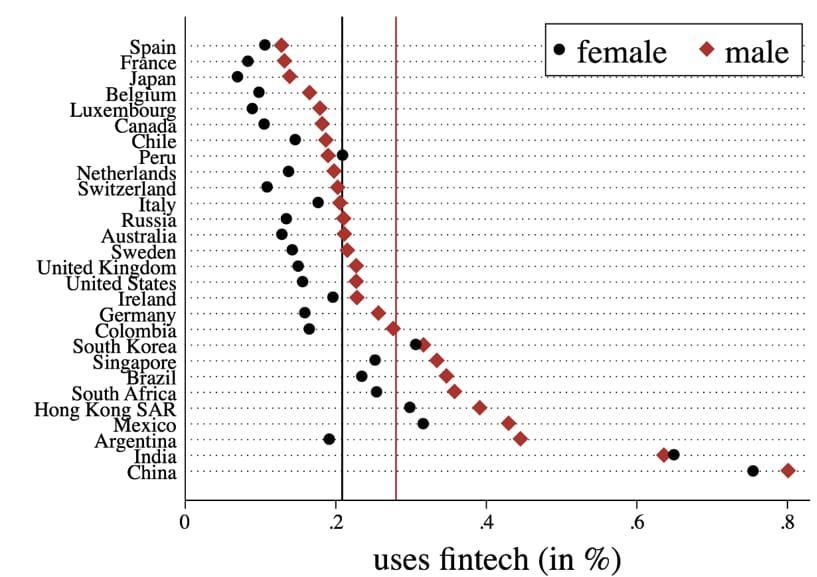
Source:chenetal.(2021).
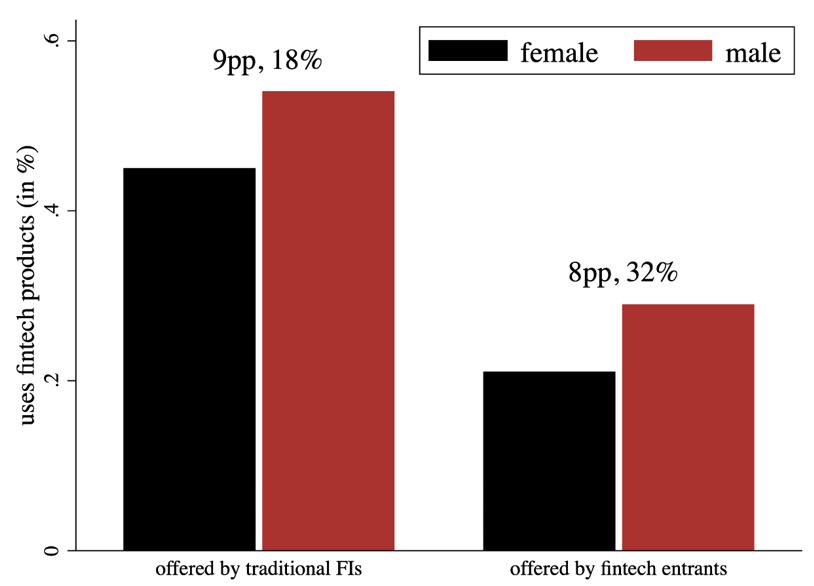
49% of the respondents use novel financial products and services that are offered by traditional financial institutions, comparedwith25% for Fintech entrants. Still,menare morelikelyto use Fintech productsirrespective ofthe provider.The gender gap averages 8 pp (32% of the average adoption rate) among services provided by entrants and 9 pp (18%) among those provided by incumbents (graph 2). The difference across providers is statistically insignificant, which implies that the gendergapisnotinfluencedbywhoprovidesFintechproductsorservices,butrathertheproductsthemselves.
International Research Journal of Engineering and Technology (IRJET) e-ISSN:2395-0056
Volume: 11 Issue: 02 | Feb 2024 www.irjet.net p-ISSN:2395-0072
Graph 2: The Fintech gender gap is similar among traditional financial institutions and entrants.
source:chenetal.(2021).
REFERENCES:
Binagwaho, A., Mathewos, K., Bayingana, A. U., & Yohannes, T. (2021). Commitment to gender equality through gender sensitive financing. In BMJ Global Health (Vol. 6, Issue 7). BMJ Publishing Group. https://doi.org/10.1136/bmjgh-2021006747
Khera,P.,Ogawa,S.,Sahay,R.,&Vasishth,M.(2022). Women in Fintech: As Leaders and Users. Patel, V., Burns, J. K., Dhingra, M., Tarver, L., Kohrt, B. A., & Lund, C. (2018). Income inequality and depression: a systematic review and meta-analysis of the association and a scoping review of mechanisms. In World Psychiatry (Vol. 17, Issue 1, pp.76–89).BlackwellPublishingLtd.https://doi.org/10.1002/wps.20492
PaulaSioson,E.,&JuKim,C.(2017). Closing the Gender Gap in Financial Inclusion through Fintech
Tripathi, S., & Rajeev, M. (2023). Gender-Inclusive Development through Fintech: Studying Gender-Based Digital Financial Inclusion in a Cross-Economy Setting.https://doi.org/10.56506/ZWGS6876
Aziz, F., Sheikh, S. M., & Shah, I. H. (2022). Financial inclusion for women empowerment in South Asian countries. Journal of Financial Regulation and Compliance, 30(4),489-502.
© 2024, IRJET | Impact Factor value: 8.226 | ISO 9001:2008 Certified Journal | Page254