
International Research Journal of Engineering and Technology (IRJET) e-ISSN: 2395-0056
Volume: 11 Issue: 02 | Feb 2024 www.irjet.net p-ISSN: 2395-0072
International Research Journal of Engineering and Technology (IRJET) e-ISSN: 2395-0056
Volume: 11 Issue: 02 | Feb 2024 www.irjet.net p-ISSN: 2395-0072
Ayush Tripathi
1Master of Technology Structural Engineering, Department of Civil Engineering, Integral University, Lucknow, Uttar-Pradesh, India
Abstract - Water-Tanks are structures used for storing water for supplying it to various household, commercial buildings through Water-Pipeline, thus forming an integral partoftheWaterDistributionSystem.Water-Tankconsistsof a storage tank called as Reservoir made of either Steel shells orReinforcedCementConcreteRCCorcompositematerial.To meet the water requirements for the exponential growing population of India we need to build more Water-tanks in a more efficient and optimal way. The construction of Watertankis a mammothtaskwhichrequires largeamount ofsteel and concrete. The reduction of the amount of steel and concrete to be used in construction of water-tank poses a major challenge for the researchers. This study presents Design Optimization of Reinforced Concrete Circular WaterTankusingArtificialIntelligence.TheWater-Tankisdesigned using IS 3370 which is Indian Standard Code for Design of Liquid Storage Structures. The Concrete and Steel used in DesignofWaterTankistakenasM30andFe500respectively. The Seismic Design of the Water-Tank is done using IS 1893 which is Indian Standard Code for Seismic Design of Structures. The Wind Loads on Water-Tank are calculated using IS 875 Part 3 which is the Indian Standard Code for DesignofStructuresagainstWindLoads.ThiscompleteDesign ofWater-TankagainsttheSeismicandWindLoadsiscodedin Python language. TheTotalCost ofsteelandconcrete used in constructionofWater-TankiscalculatedusingtheDSR(Delhi Schedule of Rates) 2021. Then we apply the Artificial Intelligence technique using a Meta-Heuristic Algorithm named Simulated Annealing to our program on Design of Water-TankandOptimizedifferentParameterssuchasRatio ofDepthtoDiameter of Water-Tank, Thickness ofTop-Dome, Thickness of Water-TankWall, Thickness of Base-Slab, Depth of Bottom Ring Beam, Width of Bottom Ring Beam, Diameter of Column, Depth of Bracing and Width of Bracing. This reduces the overall Material Cost of Reinforced Concrete Water-Tank which is calculatedand presented in theResults.
Key Words: Water-Tank, Optimization, Artificial Intelligence, Simulated Annealing, Design Parameters, MaterialCost
1.INTRODUCTION
Water-Tanks are structures used for storing water for supplying it to various households, and commercial buildings through Water-Pipeline. Analysis and design of such tanks are independent of the chemical nature of the product. They are designed as crack-free structures to
eliminate any leakage. While designing liquid retaining structuresrecommendationsofthe“CodeofPracticeforthe storage of Liquids- IS3370 (Part I to IV)” should be considered.
2. LITERATURE REVIEW:
: 2.1Martínez-Martínetal.(2022): Thisstudyemphasizesthe optimization of the design of reinforced concrete elevated watertanksunderseismicloads,highlightingthesignificance ofstructuralresilienceinearthquake-proneregions.
2.2 Zulfiqar et al. (2022): Theinvestigationintoanoptimum ring baffle design for enhancing the structural strength of tankssubjectedtoresonantseismicsloshingcontributesto theseismicoptimizationofwatertanks.
2.3 Saghiet al.(2020): Thisstudydiscussestheoptimization ofbaffledrectangularandprismaticstoragetanksagainstthe sloshingphenomenon,providinginsightsintothemitigation ofseismic-inducedsloshing.
3. Volume Minimization and Efficiency: 3.1 Nakic et al. (2022): Introducing a novel procedure for minimizing the volumeofwatertanksinwatersupplysystems,thisstudy addressestheoptimizationofwaterstoragecapacitywhile maintainingefficiency.
3.2 Younis et al. (2020): The evaluation of the costeffectivenessofreinforcementalternativesforconcretewater chlorinationtankscontributestotheoptimizationofmaterial usageandstructuralperformance.
4. Baffle Design Optimization: 4.1 Jiang et al. (2020): The explorationofoptimaldesignbasedonanalyticalsolutions forstoragetankswithinerterisolationsystemsshowcases advancements in baffle design optimization for improved structuralperformance.
4.2 Zhao et al. (2017): Thediscussiononseismicmitigation performanceandoptimizationdesignofnuclearpowerplant water tanks with internal ring baffles offers insights into baffleoptimizationstrategies.
5. Cost Optimization and Material Selection: 5.1 Elansary et al. (2018): The presentation of the optimum design of composite conical tanks under hydrostatic pressure contributestounderstandingcost-effectivematerialselection inwatertankconstruction.
International Research Journal of Engineering and Technology (IRJET) e-ISSN: 2395-0056
Volume: 11 Issue: 02 | Feb 2024 www.irjet.net p-ISSN: 2395-0072
5.2 Hallmann et al. (2018): Thediscussiononheuristicsand simulationforwatertankoptimizationprovidesinsightsinto cost-effective design approaches through computational methodologies.
3. Objectives-Theaimofthisworkistooptimizethecost ofcircularoverheadwater tank duringdesign stageusing meta-heuristic optimization considering the following parameters:1.CostofConcreteasperDSRof20212.Costof ReinforcementbarsasperDSRof20213.Consideringthe seismic effect on water tank as per IS 1893:2016 4. DesigningasperIS3370:2009guidelines
4. Methodology- The following Design Constraints have beenconsideredwhiledesigningofWater-Tank:
1. GradeofSteel=Fe500
2. GradeofConcrete=M30
3. Water-Tankisassumedtobeflatbase
4. ImportanceFactorforWater-Tankis1.5
The entire Design of Water-Tank is based on IS 3370 guidelines. This design is coded into Python language. Different inputs have been taken from users which are as follows:
1. CapacityofWater-TankinLitres
2. StagingHeightinmeters
3. SeismicZone
4. TypeofSoil
5. TypeofTerrain
6. Windspeedinmetres/second
ThedifferentpartsoftheWater-Tankthataredesigned areasfollows:
1. DesignofTop-Dome:
(i) MeridionalForce(T1)inkN
(ii)HoopTension(T2)inKN
2. DesignofTop-RingBeam
3. DesignofWater-TankWall
4. DesignofBase-Slab
5. DesignofBottom-RingBeam
6. DesignofStaging:
(i) WindLoads
The Water-Tank has been optimized using a MetaheuristicAlgorithmnamedSimulatedAnnealing.
The different parameters that are optimized are as follows:
1. RatioofDepthofreservoirofWater-TanktoDiameter ofTank(h/DRatio)
2. ThicknessofTop-Dome
3. ThicknessofWater-TankWall
4. ThicknessofBaseSlab
5. DepthofBottomRingBeam
6. WidthofBottomRingBeam
7. DiameterofColumn
8. DepthofBracing
9. WidthofBracing
5. PYTHON CODES FOR INPUT PARAMETERS:
CASE 1:
CapacityofWater-Tank=5LakhLitres
Stagingheight=16m
CODE:
sl,bf=cirtank_opti(500000,16,"3","hard","ter3",47)
minC=min(bf)
loc=bf.index(minC)locsl=loc*9
data=sl[locsl:locsl]
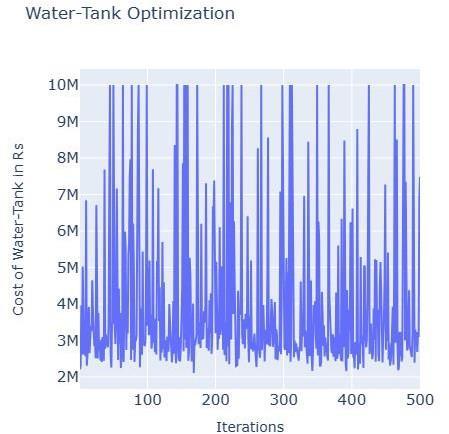
COST:
International Research Journal of Engineering and Technology (IRJET) e-ISSN: 2395-0056
Volume: 11 Issue: 02 | Feb 2024 www.irjet.net p-ISSN: 2395-0072
OriginalCost=Rs2939936
CostafterOptimization=Rs2105094
ReductioninCost=28.39%
CASE 2:
CapacityofWater-Tank=5LakhLitres
Stagingheight=18m
CODE:
sl,bf=cirtank_opti(500000,18,"3","hard","ter3",47)
minC=min(bf)
loc=bf.index(minC)locsl=loc*9
data=sl[locsl:locsl+9]
COST:
OriginalCost=Rs3007124
ReductioninCost=29.06%
CostafterOptimization=Rs2133034
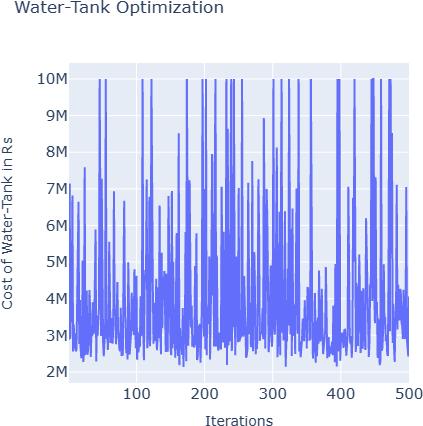
The Cost Optimization performed on the Circular WaterTank using Simulated Annealing Algorithm shows an average reduction in Material Cost of Water-Tanks of differentCapacityandStagingHeightby28.34%.
TheOptimizedvaluesofRatioofDepthtoDiameterofTank of reservoir of Water-Tank (h/D Ratio) increases with increase in Water-Tank Capacity by 12.21 % and Staging Heightby2.89%ofWater-Tanks.TheOptimizedvaluesof Thickness of Top-Dome increases with increase in WaterTankCapacityby19.745%andStagingHeightby6.22%of Water-Tanks.TheOptimizedvaluesofThicknessofWaterTankwallincreaseswithincreaseinWater-TankCapacityby 11.19%andStagingHeightby4.03%ofWater-Tanks.
TheOptimizedvaluesofThicknessBase-Slabincreaseswith increase in Water-Tank Capacity by 19.96 % and Staging Heightby5.64%ofWater-Tanks.TheOptimizedvaluesof Depth of Bottom Ring Beam increases with increase in Water-TankCapacityby23.47%andStagingHeightby5.91 %ofWater-Tanks.TheOptimizedvaluesofWidthofBottom RingBeamincreaseswithincreaseinWater-TankCapacity by12.20%andStagingHeightby3.35%ofWater-Tanks.
TheOptimizedvaluesofDiameterofColumnincreaseswith increase in Water-Tank Capacity by 22.35 % and Staging Heightby4.51%ofWater-Tanks.TheOptimizedvaluesof Depth of Bracings increases with increase in Water-Tank Capacity by 13.235 % and Staging Height by 3.56 % of Water-Tanks. The Optimized values of Width of Bracings increaseswithincreaseinWater-TankCapacityby18.77% andStagingHeightby5.85%ofWater-Tanks.
The values of Material Cost of Water-Tank before Optimization increases with increase in Water-Tank Capacityby15.99%andStagingHeightby2.10%ofWaterTanks. The values of Material Cost of Water-Tank after Optimization increases with increase in Water-Tank Capacityby18.13%andStagingHeightby1.23%ofWaterTanks. The Results show that the increase in Water-Tank CapacityhasgreaterroleinincreasingtheOptimizedvalues and Material Cost of Water-Tank before and after OptimizationascomparedtoStagingHeight.
Onexecutingtheprogramagainandagainforsamecase,we getdifferentvaluesofOptimizedMaterialCostoftheWaterTank because during each execution, the program selects anyrandomvalueofeachOptimizingParameterfromrange specifiedintheprogramandcalculatestheMaterialCostfor thatcombination.
[1] Martínez-Martín, F. J., Yepes, V., González-Vidosa, F., Hospitaler, A., & Alcalá, J. (2022). Optimization Design of RC Elevated Water Tanks under Seismic Loads. Applied Sciences (Switzerland), 12(11). https://doi.org/10.3390/app12115635
[2]Nakic,D.,Djurin,B.,Hunt,J.,&Dadar,S.(2022).ANovel Procedure for Minimizing the Volume of Water Tanks in WaterSupplySystems. Water (Switzerland), 14(11),1–16. https://doi.org/10.3390/w14111731
[3] Zulfiqar, Y., Hyder, M. J., Jehanzeb, A., Ahmad, H. W., Zulfiqar, A., Masood Chaudry, U., & Jun, T. S. (2022). NumericalInvestigationofanOptimumRingBaffleDesignto Optimize the Structural Strength of a Tank Subjected to Resonant Seismic Sloshing. Structural Engineering International https://doi.org/10.1080/10168664.2022.2029690
[4]Saghi,H.,Ning,D.zhi,Cong,P.wen,&Zhao,M.(2020). OptimizationofBaffledRectangularandPrismaticStorage Tank Against the Sloshing Phenomenon. China Ocean
International Research Journal of Engineering and Technology (IRJET) e-ISSN: 2395-0056
Volume: 11 Issue: 02 | Feb 2024 www.irjet.net p-ISSN: 2395-0072
ngineering, 34(5), 664–676. https://doi.org/10.1007/s13344-020-0059-8
[5] Younis, A., Ebead, U., Suraneni, P., & Nanni, A. (2020). Cost effectiveness of reinforcement alternatives for a concrete water chlorination tank. Journal of Building Engineering, 27(October 2019). https://doi.org/10.1016/j.jobe.2019.100992
[6]Jiang,Y.,Zhao,Z.,Zhang,R.,DeDomenico,D.,&Pan,C. (2020). Optimal design based on analytical solution for storagetankwithinerterisolationsystem. SoilDynamicsand Earthquake Engineering, 129(October 2019), 105924. https://doi.org/10.1016/j.soildyn.2019.105924
[7] Topology, S., Of, O., Tanks, W., & Genetic, U. (2019).
IMECE2003-4 3925 SURFACE TOPOLOGY OPTIMIZATION OF WATER TANKS USING GENETIC.1–7.
[8] Shaikh, H. M., & Kulkarni, N. R. (2018). SWOT on Execution of Optimization Techniques for Liquid Level Control in a Tank. 3rd International Conference and Workshops on Recent Advances and Innovations in Engineering, ICRAIE 2018, 2018(November), 1–4. https://doi.org/10.1109/ICRAIE.2018.8710418
[9] Hallmann, C., Burmeister, S., Wissing, M., & Suhl, L. (2018). Heuristics and simulation for water tank optimization. In Communications in Computer and Information Science (Vol. 889). Springer International Publishing.https://doi.org/10.1007/978-3-319-96271-9_5
[10]Elansary,A.A.,Nassef,A.O.,&Damatty,A.A.E.(2018). Optimum design of composite conical tanks under hydrostatic pressure. Advances in Structural Engineering, 21(13), 2030–2044. https://doi.org/10.1177/1369433218764976
[11] Zhao, C., Chen, J., Wang, J., Yu, N., & Xu, Q. (2017). Seismicmitigationperformanceandoptimizationdesignof NPPwatertankwithinternalringbafflesunderearthquake loads. Nuclear Engineering and Design, 318, 182–201. https://doi.org/10.1016/j.nucengdes.2017.04.023
[12]Azabi,T.M.,ElAnsary,A.M.,&ElDamatty,A.A.(2016). Cost analysis of conical tanks; Comparison between reinforced concrete and steel. Proceedings, Annual Conference - Canadian Society for Civil Engineering, 4(June), 2841–2850.
[13]Sanjuan-Delmás,D.,Hernando-Canovas,E.,Pujadas,P., delaFuente,A.,Gabarrell,X.,Rieradevall,J.,&Josa,A.(2015).
Environmental and geometric optimisation of cylindrical drinking water storage tanks. International Journal of Life Cycle Assessment, 20(12), 1612–1624. https://doi.org/10.1007/s11367-015-0963-y
2024, IRJET | Impact Factor value: 8.226 |
[14]Elkholy,S.A.,Elsayed,A.A.,El-Ariss,B.,&Sadek,S.A. (2015). Towards optimal finite element modeling for the analysis of liquid storage tanks. Civil-Comp Proceedings, September https://doi.org/10.4203/ccp.108.104
[15]Okoye,C. O., Solyali,O., &Akintuʇ,B.(2015).Optimal sizing of storage tanks in domestic rainwater harvesting systems: A linear programming approach. Resources, Conservation and Recycling, 104, 131–140. https://doi.org/10.1016/j.resconrec.2015.08.015
[16]ElAnsary,A.M.,Nassef,A.O.,&ElDamatty,A.A.(2013). Optimumdesignofstiffenedliquid-filledsteelconicaltanks. Proceedings, Annual Conference - Canadian Society for Civil Engineering, 3(January),2810–2819.
[17] Hilo, S. J., & Wan Badaruzzaman, W. H. (2011). Cost Optimisation of Water Tanks Designed According To the Aci and Euro Codes. September 2015. https://doi.org/10.13140/RG.2.1.2102.8329
[18] Barakat, S. A., & Altoubat, S. (2009). Application of evolutionaryglobaloptimizationtechniquesinthedesignof RC water tanks. Engineering Structures, 31(2), 332–344. https://doi.org/10.1016/j.engstruct.2008.09.006
[19] Basile, N., Fuamba, M., & Barbeau, B. (2009). Optimization of water tank design and location in water distributionsystems. Proceedings of the 10th Annual Water Distribution Systems Analysis Conference, WDSA 2008,361–373.https://doi.org/10.1061/41024(340)32
[20] Tan, G. H., Thevendran, V., Das Gupta, N. C., & Thambiratnam,D.P.(1993).Designofreinforcedconcrete cylindrical water tanks for minimum material cost. Computers and Structures, 48(5), 803–810. https://doi.org/10.1016/0045-7949(93)90501-4
[21] Thevendran, V., & Thambiratnam, D. P. (1988). Minimum weight design of conical concrete water tanks. Computers and Structures, 29(4), 699–704. https://doi.org/10.1016/0045-7949(88)90382-3
[22]Mohan,C.,&Sharma,S.P.(1987).Costoptimizationof intze tanks on shafts using nonlinear programming. Engineering Optimization, 10(4), 279–288. https://doi.org/10.1080/03052158708902543
[23]Thevendran,V.,&Thambiratnam,D.P.(1987).Optimal shapesofcylindrical concretewatertanks. Computers and Structures, 26(5),805–810.https://doi.org/10.1016/00457949(87)90029-0
[24] Thevendran, V., & Thambiratnam, D. P. (1986). Minimum weight design of cylindrical water tanks. International Journal for Numerical Methods in Engineering, 23(9), 1679– 1691. https://doi.org/10.1002/nme.1620230908
International Research Journal of Engineering and Technology (IRJET) e-ISSN: 2395-0056
Volume: 11 Issue: 02 | Feb 2024 www.irjet.net p-ISSN: 2395-0072
[25] Mohan, C., & Sharma, S. P. (1985). Use of nonlinear optimizationtechniquesindeterminingtheoptimaldesign ofintzetanksonshafts. EngineeringOptimization, 9(2),143–153.https://doi.org/10.1080/03052158508902510
[26]IS3370(Part2):2009:IndianStandardCodeforDesign ofReinforcedConcreteStructuresforLiquidStorage.
[27]IS3370(Part4):1967:IndianStandardCodeofDesign TablesforLiquidStorageStructures.
[28] IS 1893 (Part 1): 2016: Indian Standard Code for Earthquake Resistant Design of Structures for general provisions.
[29] IS 1893 (Part 2): 2014: Indian Standard Code for Earthquake Resistant Design of Structures for Liquid RetainingTanks.
[30]IS875(Part3):2015:IndianStandardCodeforDesign LoadsotherthanEarthquakeLoadswhichareWindLoads forBuildingsandStructures.
[31]DSR2021:DelhiScheduleofRates2021Volume1.