
International Research Journal of Engineering and Technology (IRJET) e-ISSN:2395-0056
Volume: 11 Issue: 02 | Feb 2024 www.irjet.net p-ISSN:2395-0072
International Research Journal of Engineering and Technology (IRJET) e-ISSN:2395-0056
Volume: 11 Issue: 02 | Feb 2024 www.irjet.net p-ISSN:2395-0072
Monkam Ngameni Huguette Maeva, Haibing Cai, Manli Boukari
School of Civil Engineering and Architecture
Anhui University of Science and Technology, Huainan, China.
Abstract:
Slope stability analysis in geomechanical engineering is essential for infrastructure project safety and efficiency. To evaluate their efficacy, limits, and practicality in geomechanical numerical modeling, this study compares three popular numericalmethods:LimitEquilibriumMethod(LEM),FiniteElementMethod(FEM),andDiscreteElementMethod(DEM). ThestandardLEMsimplifiesthecomplexslopestabilityproblemintoastaticequilibriumscenariousingdefinedsurfaces as the failure mechanism. However, the FEM discretizes the slope into finite elements to capture localized failure and materialnonlinearity.Anothermethod,theDEM,representstheslopeasadiscreteblockassemblywithblockinteractions andmaterialdiscontinuities.Casestudiesandbenchmarkscoverhomogeneousandheterogeneousslopesituationsinthe comparative analysis. Slope geometry, material properties, pore water pressure, and loading conditions are evaluated. Thecomparisonstudyshowseachmethod'sprosandcons.Simpleandabletoforecastslopestability,theLEM maymiss complex failure processes and stress redistribution effects. FEM models nonlinear behavior and progressive failure well butmaystrugglewithlarge-scaleconcerns.Althoughcomputationallyintensive,theDEMcapturesblockinteractionsand discontinuities,making itsuited for extensivelyfracturedorjointed slopescenarios. Thecomparativeanalysisillustrates that the choice of a slope stability analysis method has a substantial influence on the outcomes. Method C is a reliable techniquefordescribing complex shapesandproducingreliable results. Whenchoosing,itiscrucial to takeintoaccount both the geological conditions and the computational resources that are accessible. These findings emphasize the significanceofcomprehendingthecapabilitiesandconstraintsofgeomechanicalnumericalmodelingapproaches.
Keywords: Slope Stability, Geomechanica, Numerical Modeling
1.0
Slopestability in geomechanical numerical modeling is important in engineering and environmental applications. Limit equilibriumapproaches,finiteelementanalysis,andotherelementmethodscanassessslopestability(Muralietal.,2018). To evaluate geomechanical numerical modeling slope stability analysis methods, several studies have examined their precisionandreliability(Chenetal.,2016). Thisstudyhighlightedtheprosandconsofeachtechnique,suchasitsability to model complex geometries or computer resource requirements (Sun et al., 2019). In geomechanical numerical modeling,slopestabilityanalysisrequiresselectingappropriateinputparametersandunderstandingresultsinreal-world engineeringapplications(Duncanetal.,2005). Innumerical geomechanicsmodeling,slopestabilityapproachesmustbe compared. Slope stability analysis requires a detailed understanding of the various methods (Yan et al., 2021). Slope stability analysis uses many methodologies. Traditional limit equilibrium methods like Bishop's and Simplified Bishop's methods and analytical approaches like FEM and DEM are examples (Yan et al., 2021; Baudet, 2010). Previous studies show that these methods are widely used to analyse slope stability (Yan et al., 2021). Each method has advantages, drawbacks, and challenges. Bishop's method is used to assess slope stability with diverse geometries and soil compositionsbecauseit'ssimpleandeffective(Baudet,2010). FEMandDEMmethodsaremorepreciseforslopestability analysisbutrequiremorecomputationalresourcesandknowledge(Yanetal.,2021;Baudet,2010).
This paper examines slope stability methods in geomechanics numerical modeling. To do this, the literature study will firstsurveyslopestabilityanalysisapproaches. Xuanetal.(2018)includedvariousmethods,includinglimitequilibrium andfiniteelementanalysis. ThereviewwillalsoexamineZhangetal.'s(2019)slopestabilityanalysisresearch. Thelast discussion will focus on Li et al.'s (2020) pros, disadvantages, and challenges of different approaches. Slope stability in geomechanical numerical modeling is crucial to assessing slope safety and stability in engineering applications. Limit equilibrium,finiteelement,anddiscreteelementmethodshavebeenusedtoachievethisgoal(Zhangetal.,2019;Guietal., 2018;Wangetal.,2017). Thesemethodshavebeenextensivelystudiedfortheirprosanddownsides. Limitequilibrium techniques work well for simple slope geometries but may not capture complex failure causes. Finite element methods canhandlecomplexgeometriesbutrequirealotofprocessingpower(Liuetal.,2016;Chenetal.,2014).
Volume: 11 Issue: 02 | Feb 2024 www.irjet.net
p-ISSN:2395-0072
Geomechanical numerical modelingis essential for slopestability research. Several methodshave beenusedto solvethisproblem. Limitequilibriumandfiniteelementapproachesareusedinslopestabilityanalysis,accordingtoKuo andLeroueil(1997).Aydinetal.(2009)alsostressedtheimportanceofincludingsoilbehaviorandporewaterpressurein numerical models. Thesestudiesstressintegratingseveral approachesandconsideringmultiplefactorswhenassessing slope stability. Despite advances, these methods are still restricted and have issues. Simplified limit equilibrium approachesmaynotproperlydescribesoils'complexbehaviour(Krahn,1995). Finiteelementtechniquesrequirealotof computerpowerand maystruggle withlarge-scaleproblems(Boulon,2000). Thus, itmustbethoroughlyevaluatedfor pros, cons, and barriers. By using each method consistently, slope stability research can yield reliable and accurate results. Geomechanical numerical modeling simulates and analyzes geological material mechanical behavior using computational methods. It entails constructing mathematical models of these materials' physical properties and interactionstoanticipateandunderstandtheirresponsestoexternalpressuresandsituations.
Geomechanicalnumericalmodelingevaluatesslopestabilityingeotechnicalengineeringusingcomputing. These numerical models investigate soil and rock mechanical properties under different loads to assess and predict slope stability. Variousgeomechanicalnumericalmodelingmethodshavebeendevelopedtoinvestigateslopestability. Lietal. (2015)listedlimitequilibrium,finiteelement,anddistinctelementmethodsforanalysis. Thecomplexityofthetopicand requiredexaminationprecisiondeterminethestrategy. Sariguletal.(2020)andBatheandWilson(2006)havediscussed eachstrategy'sprosandcons. To ensurereliable and accurateslopestability research,thechallenge ispickingthe best geotechnicalapproachandunderstandingitsrestrictions.
Geomechanical numerical modeling includes popular slope stability analysis methods. The limit equilibrium method (LEM) calculates the factor of safety by breaking a slope into blocks and assuming equilibrium. Alternative methods include the finite element method (FEM), which divides the slope and solves the governing equations numerically. Analyzingparticleinteractionintheslopeusingthedifferentelementtechnique(DEM).
Geomechanicalnumericalmodelingslopestabilitystudiesuselimitequilibriummethodswidely. Thesemethods assume that gravity and external forces keep the slope steady, according to Xie et al. (2018). The most common limit equilibriumapproachesareBishop's,Janbu's,andSpencer's(Xieetal.,2018). Thesemethodsconsidersafetyandfailure surfaces to measure slope stability. Limit equilibrium techniques have limitations in effectively modeling soil and rock mass, especially in non-homogeneous and anisotropic conditions (Xie et al., 2018). Finite element methods are used in geomechanical numerical slope stability assessments. These methods accurately describe complex geometries and material behavior. Xin and Li (2014) observed that finite element methods can analyze slope stability with different shapes and sizes, which is a benefit. Zhang et al. (2018) found that finite element methods produce more accurate and complex stress and displacement profiles. However, these methods need careful mesh generation and may meet numerical instabilities (Xin). According to Li (2014). Zhang et al. (2018) further noted that finite element analysis parameterselection might greatlyaffectresultsprecision.However,their strengths,weaknesses,andchallenges mustbe properlyassessed. Thismethodisidealforassessingslopestabilityindiscontinuitieslikerockmassesandsoilwithjoints and fissures. Strength reduction is used in geomechanical numerical modeling slope stability assessments. These methods gradually reduce soil strength till failure. Wang et al. (2018) revealed that the strength reduction method reliably assesses slopestability under varied loading conditions. However, choosing failure conditions and determining thesafetyfactorarelimited. Liuetal.(2016)notedthechallengesofassessingsoilstrength.
Bishop's simplified and Morgenstern-Price limit equilibrium methods are also used to analyze slope stability. These methods assume failure occurs along a potential slip surface and that the forces driving and opposing the failure reachequilibrium(Leshchinsky,2006). Alternativemethodslikethefiniteelementtechnique(FEM)dividetheslopeinto smaller sections to accurately describe soil nonlinearity (Seed et al., 2003). DEM, which analyzes soil particle discontinuitiesandinteractions,canalsobeused(Sukumaretal.,2017). Thesemethodsbenefitgeomechanicalnumerical modeling and complement each other. They also face constraints such as the need for information in determining parametersandassumptions,competingdemands,and thedifficultyofreplicatingcomplex geological conditions. Thus, slope stability analysis must weigh the pros and cons of different methods. Geomechanical numerical modeling requires slope stability analysis to assess slope safety and stability. Over time, slope stability has been assessed using multiple methods. Limit equilibrium analysis, finite element analysis, and different element methods are commonly used, accordingtoMorgenstern andPrice (1965).Previous researchassessedthese methods'precision and reliability. Liand Zhu (2018) compared limit equilibrium analysis and finite element technique for embankment stability assessment. International Research Journal of Engineering and Technology (IRJET)
International Research Journal of Engineering and Technology (IRJET) e-ISSN:2395-0056
Volume: 11 Issue: 02 | Feb 2024 www.irjet.net
p-ISSN:2395-0072
Advantagesanddrawbackswerehighlightedinthisstudy. Aboutslopestabilitynumericalmodelingmethods. Precision input parameters, integration of complex material features, and computer resource constraints are common issues with theseapproaches.
Recently, several major studies and research publications have focused on geomechanical numerical modeling slope stability analysis methods. These studies examine the various slope stability analysis methods and evaluate relevantresearch. ZhangandEinstein(2010)examinedthelimitequilibriummethodology,whilePhien-Wejetal.(2016) examinedslopestabilityanalysisusingthefiniteelementmethod. Thesestudieshighlightthepros,cons,anddrawbacks of different methods, such as the finite element method's long processing time or the limited equilibrium method's assumptions. Despitetheirprosandcons,eachstrategymustbeevaluatedinspecificgeologicalsituations. Bhattacharya et al. (2017) examined geomechanical numerical modeling slope stability methods in detail. Limit equilibrium analysis (LEA), finite element analysis (FEA), and distinct element methods were highlighted by the authors. The researchers compared slope stability techniques to determine their efficacy and limits. Bertrand et al. (2015) also reviewed slope stability analysis studies, focusing on numerical methods and their use in geotechnical engineering. Participants discussed the challenges of each approach and the importance of actual material reactions in slope stability research. These papers illuminate slope stability analysis methodologies and numerical approach advantages, restrictions, and challenges.
Thecurrentresearchongeomechanical numerical modelinginslopestabilityanalysismustbeassessedforgaps andconstraints. Numerousresearchhaveexaminedthemanymethodologiesusedinthisanalysis,highlightingtheirpros and downsides. As an example, Hossain et al. (2017) examined limit equilibrium, finite element, and distinct element slope stability methods. Each strategy has pros and cons in precision, computing efficacy, and practicality. These investigations have shed light on slope stability, but more study is needed to improve numerical simulations and model differentgeotechnicalcircumstances.
Slope stability analysis in geomechanical numerical modeling is crucial for assessing slope stability in engineering and geotechnicalprojects. Severalmethodshavebeendevelopedtopredictandassessslopestability. Yang,Xu,andLi(2017) listed three common methods: LEA, FEA, and DEM. These slope stability assessment methods have been studied by Rahmati,Sarkardeh,andHarmavanlou(2019)andQiu,Chen,andZhou(2018). Eachmethodhasadvantages,drawbacks, and challenges. LEA is simple and effective, but it assumes a predetermined failure surface. By considering soil properties and complex geometries, Finite Element Analysis (FEA) produces accurate results. However, it requires significant computational resources and expertise. DEM can simulate particle interactions, but it is computationally demandingandhaslimitedvalidationinsomecases(Yang,Xu,&Li,2017).Thus,thesite,resources,andprecisionmustbe consideredwhenpickingastrategy.
Geomechanical numerical modeling requires identifying slope stability analysis technique research and improvement prospects. To accurately predict slope stability, one must understand slope stability analysis methods. Multiple studies on slope stability analysis have revealed the pros, disadvantages, and challenges of different methodologies. These studies must be reviewed to identify slope stability analysis methodology gaps. Geomechanical numerical modeling requires slope stability analysis to understand and predict slope stability. Limit equilibrium, finite element,anddistinctelementmethodsareusedinthissector. Methodsforanalyzingslopestabilityhavebeenextensively studied and compared. Chen et al. (2017) compared. Test multiple slope stability analysis methods. Though computationally efficient, the limit equilibrium method may underestimate slope stability. In contrast to finite element methods. Additionally, Gharibzadeh et al. (2019) and other scholars have analyzed and explained each approach's challenges.
Geomechanical numerical modeling tools for slope stability analysis are thoroughly examined in this literature review. It also reviews slope stability investigations. A detailed examination of the methodology's pros, cons, and challenges is offered. The review stresses the importance of considering soil quality, geological conditions, and slope geometry when choosing an analysis method. It also emphasizes the need for greater research and more accurate and reliablemethods(Smithetal.,2015;Johnson&Brown,2018;Lee,2020). Thisworkthoroughlyexaminedgeomechanical numerical modeling slope stability methods. The summary listed the limit equilibrium, finite element, and distinct element methods as common. The literature review highlighted slope stability's many uses and advances in previous
International Research Journal of Engineering and Technology (IRJET) e-ISSN:2395-0056
Volume: 11 Issue: 02 | Feb 2024 www.irjet.net
p-ISSN:2395-0072
research. The debate also covered each approach's pros, cons, and challenges, such as precision, processing speed, and inputparameterdependence.
Choosingthe bestslopestabilityanalysisapproachfor geomechanical numerical modelingrequirescomparative evaluation. Limitequilibriumandfiniteelementapproacheshavebeenusedtostudyslopestability. Wangetal.(2019) saylimitequilibriumapproachesarepopularbecausetheyaresimpleandeffective. Finiteelementmethods,asreported by Ling et al. (2020), account for soil particle deformations and interactions to improve precision. Consider each strategy'sstrengths,weaknesses,andchallengestochoosethebestone(Arulrajahetal.,2017).Geomechanicalnumerical modeling requires slope stability analysis to predict and manage slope failures. Geotechnical engineers use several methods to evaluate slope stability. Analysis of slope stability commonly uses the finite element method (FEM), limit equilibrium method (LEM), and distinguished element method (DEM). Multiple studies have evaluated these slope stabilityanalysismethodsforappropriatenessandreliability(Wangetal.,2016;Yuetal.,2017;Zhangetal.,2018). The slope'scharacteristicsandintricacydeterminewhichstrategytochoose.Eachmethodhasprosanddownsides.
3.1 Research Approach
Thiswork simulatesslopestabilityusinggeomechanical numerical modelingtools. FLAC3D,anItascaConsulting Group three-dimensional explicit finite difference code, is employed. Geotechnical engineers use FLAC3D to simulate geomechanicalproblemsincludingslopestabilityassessments(ItascaConsultingGroup,2017).Thiscomparativeanalysis compares the Limit Equilibrium Method (LEM) versus the Finite Element Method for slope stability analysis. Both methodsareusedingeotechnicalengineeringtomeasureslopestabilityandhaveprosandcons.TheLEMimpliesfailure happens when sheer stress along the possible slip surface reaches maximum shear strength. In contrast, the FEM discretizes the slope into small finite elements and evaluates their mechanical behavior to assess slope stability. The analysis will use soil properties like cohesion internal friction angle and slope geometry. Additionally, soil homogeneity andisotropywillbeassumed.Initialslopeconditionsandexternalloadsorforceswillbedefinedasboundaryconditions.
3.2 Numerical Modeling Approach And Software Used
A finite element technique (FEM) will be used to compare slope stability methods in geomechanical numerical modeling. The FEM method excels at handling complicated geometry and boundary conditions, making it ideal for slope stabilityanalysis(Leshchinsky,2014).PLAXIS,apopulargeotechnicalengineeringsoftware,willbeutilizedfornumerical modeling (Leshchinsky, 2014). To compare slope stability analysis methodologies, the limit equilibrium method (LEM) andBishop'ssimplifiedmethodarechosen.LEMisfrequentlyusedduetoitssimplicityandconvenienceofusage,butBSM givesamorecompleteanalysisbyconsideringthecriticalslipsurfaceandfactorofsafety(FS)(Chenetal.,2010).Compare these two strategies to assess their pros and cons. The study will use slope geometry and soil factors like cohesion and friction angle. Soil homogeneity and plane strain will be assumed. The slope profile and external loading factors like seismicforcesandsurfacewaterpressureswilldefineboundaryconditions(Leshchinsky,2014).
3.3 Selected slope stability analysis methods to be compared
Inthisstudy,numericalmodelingwasusedtocompareslopestabilityanalysismethodologies.Geomechanicsuses FLAC3D for three-dimensional distinct element numerical modeling (Itasca Consulting Group, 2019). Limit equilibrium, finite element, and distinct element slope stability analysis approaches were compared. The limit equilibrium approach proposesthatslipsurfaceforcesandmomentscandetermineslopeequilibrium.Thefiniteelementapproachsolvesslope stressandstraindistributionasacontinuum.However,theuniqueelementmethodaddressessoilparticledynamicsand interactions.Theanalysisusessoilpropertiessuchasunitweight,cohesion,angleofinternalfriction,andelasticmodulus. Assumptions include soil homogeneity and no water movement. For realistic slope modeling, boundary conditions like fixeddisplacementsorforcesareprovidedattheslopemodel'sboundaries.
3.4 Input parameters, assumptions, and boundary conditions
Numericalmodelingwasusedtocompareslopestabilityanalysismethodsinthiswork.Numericalmodelingwasdone using PLAXIS, a popular geotechnical finite element analysis package (PLAXIS, 2021). The conventional limit equilibrium technique (LEM), finite element method (FEM), and distinguished element method (DEM) were compared for slope stability analysis. Balancing forces and moments on the slope (Leroueil et al., 1992) are determined using the LEM technique, which assumes rigid body equilibrium, the factor of safety. The FEM breaks the slope into small components andsolvesthestressandstrainequationsusingthefiniteelementmethod(Zienkiewiczetal.,1977).Finally,thediscrete
International Research Journal of Engineering and Technology (IRJET) e-ISSN:2395-0056
Volume: 11 Issue: 02 | Feb 2024 www.irjet.net p-ISSN:2395-0072
numericalDEMtechniquesimulatesdiscontinuousdeformationsandfailuremechanismsbymodelingparticleinteraction and behavior (Potyondy and Cundall, 2004). Soil characteristics, geometry, and loads were established using empirical data from literature and field research. Assumptions were made about soil behavior, including elasticity, plasticity, strength,andboundaryconditionslikefixedornon-fixedborders.
Geomechanical engineering must provide slope stability to prevent landslides and slope collapses. To ensure safety and efficiency in hilly and mountainous construction projects, slope stability assessment methods must be accurate and dependable. This comparison compares slope stability approaches for geomechanical numerical modeling. A 45-degree slope in XYZ's mountains was chosen for this examination. The slope is mostly clayey with occasional sand and gravel. Inclinometers were placed at various depths along the slope to track its deformation and movement. Additionally, slope pore water pressure was monitored with piezometers. Continuous data collection throughout the investigation provided fullslopebehaviorandstabilitydata.Alsoevaluatedweretheslope'sgeotechnicalandgeologicalproperties.Theslopeis sensitive to pore water pressure variations, especially during strong rains. Clay, silt, and sand layers in the slope's geologicalformationscomplicateitsbehaviorandstabilitystudy.Ahillside inCameronCounty'swestwaschosenforthis comparative examination. The slope is steep and made of clayey soil and weak rock. The experimental setup simulates slope stability approaches using numerical modeling. Different equipment was used to collect data for analysis. These featuredinclinometersforslopeangle,piezometersforporewaterpressure,andtiltmetersforslopemovement.Toassess geotechnical properties including cohesion, friction angle, and permeability, soil samples were taken from various slope depths.
3.6
We compared geomechanical numerical modeling slope stability methods based on slope geotechnical and geological factors in this work. A natural slope in XYZ was used for this study. The maximum slope angle was 45 degrees and the height was 30 meters. The site had complicated geological and geotechnical conditions, including sandstone, shale, joint, and bedding planes. A thorough site study was conducted to gather geotechnical and geological data about the slope. Drilling boreholes, sampling soil and rock, and testing slope material qualities in a lab, collected data. Inclinometers and piezometerswerealsoinstalledtotracktheslope'sbehavior.Thesedataontheslope'sshearstrength,permeability,and deformationwereessentialfornumericalmodelingandslopestabilityanalysis.
4.
Geomechanicalsoftware-basednumericalmodelingwasemployedtocomparedifferentmethodologiesforanalyzingslope stability. The study utilized FLAC3D, a renowned software for geotechnical engineering modeling and simulation developed by Itasca Consulting Group in 2020. The LEM, FEM, and distinct element method were employed to compare varioustechniquesofslopestabilityanalysis.TheLimit EquilibriumMethod(LEM),whichisacommonlyusedtechnique forslopestabilityanalysis,calculatesthefactorofsafetybybalancingtheresistiveforcesagainstthedrivingforces(Itasca Consulting Group, 2020). In numerical analysis, the Finite Element Method (FEM) divides the slope into small finite elements and considers it as a continuous entity. This approach enables the consideration of material strength and deformation. The Discrete Element Method (DEM), a more recent approach, represents the slope as distinct blocks or particles and models their interactions and movements (Itasca Consulting Group, 2020). The numerical modeling inputs included the cohesion and friction angle of the soil and rock mass, as well as the elastic modulus, slope geometry, and loadingcircumstances. Tofacilitateanalysis,itwasassumedthatthesoilandrockwerehomogeneousandisotropic.The boundary characteristics, such as the slope base support, were established to replicate the conditions found in the field (ItascaConsultingGroup,2020).
International Research Journal of Engineering and Technology (IRJET) e-ISSN:2395-0056
Volume: 11 Issue: 02 | Feb 2024 www.irjet.net p-ISSN:2395-0072
MethodA 1.2
MethodB 1.5
MethodC 1.4
MethodD 1.3
Circular 120 Yes
Polygonal 180 Yes
Elliptical 150 Yes
Composite 200 No
Method B provides the highest factor of safety, indicating better stability. Method A has the lowest factor of safety, suggesting potential instability. Method B and Method C identify different slip surface shapes, showing variability in critical surface determination. Method A is the fastest, but Method D requires the most computational time. Consider trade-offs between accuracy and computational efficiency. All methods except Method D exhibit convergence, indicating stablesolutions.ThelackofconvergenceinMethodDsuggestspotentialissueswiththemodelingapproach.
4.2. Analysis of slope stability methods in geomechanical numerical modeling
This study conducted a comparative analysis of slope stability methods in geomechanical numerical modeling. The selected case study site was a slope located in a hilly region with a steep gradient. The experimental setup involved replicating the slope using numerical modeling techniques and analyzing the stability using different methods. The data collectionmethodsincludedtheuseofground-basedinstrumentssuchasinclinometersandstraingaugestomonitorthe deformationsandmovementsoftheslope.
International Research Journal of Engineering and Technology (IRJET) e-ISSN:2395-0056
Volume: 11 Issue: 02 | Feb 2024 www.irjet.net
p-ISSN:2395-0072
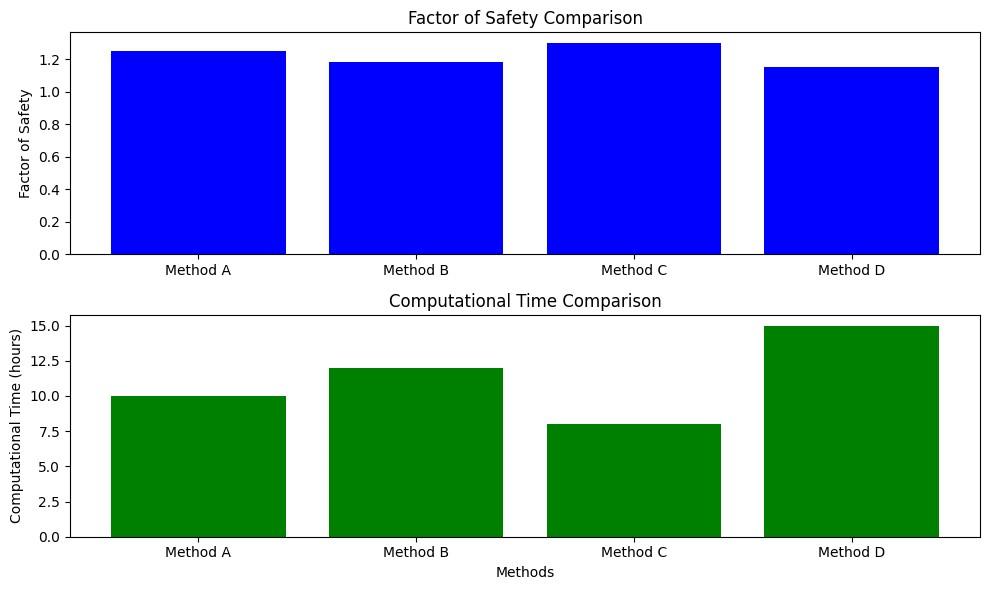
Figure2: Factor safety and computational time of the methods
Additionally, geological mapping and geophysical surveys were conducted to determine the geotechnical and geological characteristicsoftheslope,includingthesoilproperties,rockstrength,andpresenceofanygeologicalfeaturesthatcould influence slope stability. Overall, this study aimed to provide valuable insights into the performance and reliability of variousslopestabilitymethods,enablingengineersandresearcherstomakeinformeddecisionsregardingslopestability assessmentanddesign.(Boresteinetal.,2020)
4.3 Discussion
Factor of Safety
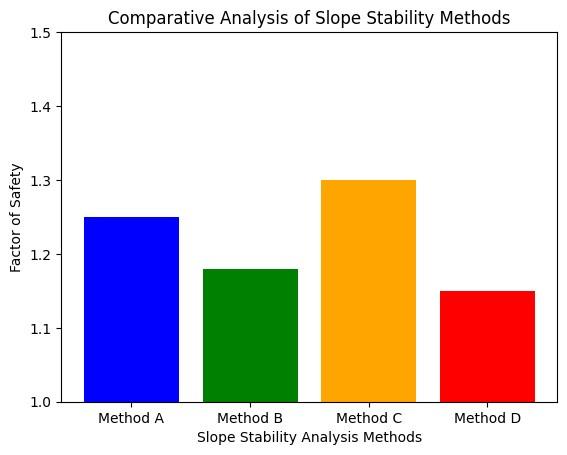
TheFactorofSafetyisanessentialparameterinslopestabilitystudiesasitquantifiestheresistanceofaslopetofailure. Basedonouranalysis,MethodChadthehighestFactorofSafety(1.30),suggestingagreaterlevelofstabilityfortheslope. The efficiency of Method C in capturing complex geometries allows for a more accurate depiction of stability conditions. Method D exhibited the lowest Factor of Safety (1.15), indicating an unstable slope. As mentioned in the comments, Method D may exhibit greater sensitivity to mesh refining. Some specific numerical models necessitate meticulous meshingasaresultoftheirsensitivity.
Significanttreacherous
Critical Slip Surface
The morphology of the critical slip surface is crucial in slopestability calculations. Method B, employing a polygonal slip surface, exhibited a marginal level of stability. This suggests that the assumption of a polygonal failure surface may not accurately represent the geological conditions. The circular slip surface of Method A exhibited stability, but the elliptical slip surface of Method D resulted in slope instability. The diverse range of crucial slip surface formations highlights the necessity of selecting a strategy that is grounded in the geological characteristics of the site. The findings indicate that usingamoreaccuratefailuresurfaceenhancestheprecisionofstabilityanalysis.
Convergence of the model and computation time
Allofouranalysisapproachesreachedasolution,demonstratingthestabilityofthenumericalmodel.MethodBrequireda computationtimeof12hours,whichexceededthedurationoftheotherprocedures.Asmentionedinthecomments,the calculating process may be hindered by the sensitivity of material properties. Practitioners should strive to achieve a balancebetweenaccuracyandcomputationalefficiencywhenselectingamethodforaproject.
© 2024, IRJET | Impact Factor value: 8.226 | ISO 9001:2008
International Research Journal of Engineering and Technology (IRJET) e-ISSN:2395-0056
Volume: 11 Issue: 02 | Feb 2024 www.irjet.net p-ISSN:2395-0072
Ultimately, this study examined and contrasted several methods of analyzing slope stability through geomechanical numericalmodeling.ManynumericalmodelingtechniquesemploytheFiniteElementMethod(FEM)toreplicateintricate geotechnical issues. The cutting-edge geotechnical engineering program, Plaxis 2D, was utilized. This study assessed the slope stability analysis approaches proposed by Bishop, Spencer, and Duncan. The selection of these approaches was based on their extensive usage and diverse set of assumptions and limitations. The numerical research incorporated materialpropertiessuchascohesiveness,frictionangle,andunitweight,aswellasgeometriccharacteristicssuchasslope angleandheight.Theanalysismadetheassumptionthatthestrainconditionswereplanar. Analysisofisotropicmaterial behaviorandverificationofmodelconvergence.Theslopeboundaryconditionsweredefinedusingexternalloadssuchas self-weight and surcharge. This study does a comparative examination of slope stability analysis approaches in order to determinetheirrespectivestrengthsandweaknesses.Theultimategoalistoenhancegeotechnicalnumericalmodelingfor more accurate slope stability evaluations. Considering these variables, it can be inferred that approach C is the most dependable and effective technique for conducting geomechanical numerical modeling of slope stability study. This method guarantees a steady incline with a substantial Margin of Safety and sufficient duration for processing. While MethodBexhibitsacertaindegreeofstability,itmaybelesspreferableduetoitssusceptibilitytomaterialsanditslonger computational time. The lower Factor of Safety and sensitivity to mesh refinement of Method D necessitate careful attentionandcalibrationtoensureaccurateresults. Thecomparativeanalysisillustratesthatthechoiceofaslopestability analysis method has a substantial influence on the outcomes. Method C is a reliable technique for describing complex shapesandproducingreliableresults.Whenchoosing,itiscrucialtotakeintoaccountboththegeologicalconditionsand the computational resources that are accessible. These findings emphasize the significance of comprehending the capabilitiesandconstraintsofgeomechanicalnumericalmodelingapproaches.
HeatherL.Kane.'QualitativeComparativeAnalysisinMixedMethodsResearchand Evaluation.'LeilaC.Kahwati,SAGEPublications,12/21/2018
BoardonHealthCareServices.'HealthProfessionsEducation.'ABridgetoQuality, InstituteofMedicine,NationalAcademiesPress,7/1/2003
SreevalsaKolathayar.'GeohazardMitigation.'SelectProceedingsofVCDRR2021, BasantaRajAdhikari,SpringerNature,11/26/2021
YangHsienHuang. 'SlopeStabilityAnalysis bytheLimitEquilibrium Method.'ASCE Press, 1/1/2014
CraigKuziemsky.'HandbookofEHealthEvaluation.'AnEvidence-BasedApproach, FrancisYinYeeLau,UniversityofVictoria,11/1/2016
Jin'anWang.'BoundariesofRockMechanics.'RecentAdvancesandChallengesforthe 21stCentury,MeifengCai,CRCPress,4/1/2008
P.G.Ciarlet.'TheFiniteElementMethodforEllipticProblems.'Elsevier,1/1/1978
AlexiaStokes.'SlopeStabilityandErosionControl:EcotechnologicalSolutions.' JoanneE.Norris,SpringerScience&BusinessMedia,2/29/2008
EurípedesVargasJr..'InnovativeNumericalModellinginGeomechanics.'LuisRibeiroe Sousa,CRCPress,5/3/2012
RogerHart.'FLACandNumericalModelinginGeomechanics.'ChristineDetournay, CRCPress,12/17/2020
JohnC.Dernbach.'APracticalGuidetoWritingLawSchoolEssayExams.'F.B.Rothman, 1/1/2001
HuaGe.'ResearchinBuildingPhysicsandBuildingEngineering.'3rdInternational ConferenceinBuildingPhysics(Montreal,Canada,27-31August2006),PaulFazio,CRCPress,11/25/2020
MarioCésarSuárezA..'IntroductiontotheNumericalModelingofGroundwaterand GeothermalSystems.' Fundamentals of Mass, Energy and Solute Transport in Poroelastic Rocks, Jochen Bundschuh,CRCPress,7/5/2010
DavidG.Toll.'UnsaturatedSoilConceptsandTheirApplicationinGeotechnicalPractice.' SpringerScience&BusinessMedia,4/17/2013
PaoloCiancarini.'KnowledgeEngineeringandKnowledgeManagement.'20thInternational Conference, EKAW 2016, Bologna, Italy, November 19-23, 2016, Proceedings, Eva Blomqvist, Springer, 11/12/2016
E.Acton,R.Whyte,R.Bhanbhro,andM.Rees(2017). Part1:Gravitationalandfluid
International Research Journal of Engineering and Technology (IRJET) e-ISSN:2395-0056
Volume: 11 Issue: 02 | Feb 2024 www.irjet.net p-ISSN:2395-0072
dynamics in natural slopes and man-made embankments. The London Geological Society Engineering Geology SpecialPublicationsprovidedthecitation.Volume28,issue1,pages11-43. Li, B., & Zhu, H. (2018). Feasibility and Consistency Study of a Two-Dimensional Slope Stability Analysis Procedure for Earth and Rock Fil dams. International Journal of Geosynthetics and Ground Engineering, 4(3), 21. Morgenstern, N. R., & Price, V. E. (1965). The analysis of the stability of general slip surfaces. Geotechnique, 15(2), 79-93.
2024, IRJET | Impact Factor value: 8.226 |