
International Research Journal of Engineering and Technology (IRJET)
Volume: 11 Issue: 02 | Feb 2024 www.irjet.net p-ISSN:2395-0072
International Research Journal of Engineering and Technology (IRJET)
Volume: 11 Issue: 02 | Feb 2024 www.irjet.net p-ISSN:2395-0072
Adel Mirza Kashkool, Mohammad Mamon Hamdan
Abstract
The economic growth of any country relies on many factors, such as natural resources, technology, manpower, regulations, and infrastructure. Infrastructure is essential for country development. Road networks are part of the infrastructure of any country. The presence of a reliable road network will facilitatetheshippingofgoods,whichwillsavetimeand money and contribute to economic growth. A road network is considered reliable when it reduces the journeytime,providesthebestroutes,properlycoversa country or area, reduces the delay of public transportation, contributes to economic growth, and ensures a smooth ride. Building a high-quality road pavement that meets the needs of road users and ensures smooth riding requires good planning, design, andconstructionofthepavement.
The construction of durable pavement can be attained through the collaboration of reliable design, selecting high-quality and suitable raw materials, appropriate asphalt mix design, and the implementation of proper construction methods in compliance with local and internationalstandards.Theneedforapavementwitha longer service life that can bear high traffic loads with fewer repair requirements has become essential nowadays. Therefore, polymer-modified bitumen has been used to improve the asphalt mix properties and produce a pavement with a higher service load and higher durability. This paper will briefly review flexible pavementandfocusonreviewingthedifferentaspectsof polymer-modified bitumen (PMB). Moreover, this paper will compare the properties of PMB with ordinary bitumen. The properties of the bitumen and asphalt mixes furnished in this paper have been determined by conducting the required tests at qualified labs. All test procedures and methods are in compliance with internationalstandards.
Keywords: modified bitumen, Conventional bitumen, durability, PMB, traffic loads
1. Introduction
Asphalt pavement, or flexible pavement, is widely used in the construction of roads. Flexible pavement dominates the road construction industry. The wide use of asphalt pavement is a result of the unique characteristics of the pavement that can’t be found in rigid pavements. Well-constructed asphalt pavements offer road users smooth riding. Furthermore, asphalt pavements are cheaper than concrete pavements.
However, asphalt pavements are deteriorating faster than concrete pavement, which prompts the need for periodic maintenance to avoid expensive repairs of the pavement.Thenatureandfeaturesofasphaltpavement, combined with weather conditions and trafficloads,can result in asphalt pavement deterioration. Asphalt pavement can be subjected to various defects such as cracks, rutting, aging, fatigue, asphalt bleeding, and pot holes. The periodic repair and maintenance of roads, especially main roads, can result in traffic jams and inconvenience for road users in the event of the closure ofa roadorpartofit.Moreover, thecostof repairingor replacing defective roads burdens governments around the world. Therefore, the use of polymer-modified bitumenhasincreasedrecentlyinanattempttoincrease the service life of roads and reduce maintenance and repairrequirements.
This paper will briefly study the asphalt mixtures producedby theuseofpolymer modifiedbitumen.Also, this paper will discuss the properties of polymer modified bitumen and what distinguishes PMB from ordinary bitumen. The following points will be discussed:
Bitumenmodifiedasphalt:ashortintroduction ofPMB
Gradesofbitumenmodifiedasphalt
Usesofbitumenmodifiedasphalt
Properties of bitumen modified asphalt and ordinarybitumen
Mixingandlayingofbitumenmodifiedasphalt
Marshall method of mix design: Marshall properties for bitumen modified asphalt and ordinarybitumen
The PMB has been used to improve the durability of asphalt pavement, increase its service life, and reduce the need for maintenance and repair [8] The main application of PMP asphalt mixes are roads subjected to hightrafficloadsandhighrateofbreakingforcesuchas Roundabout, bends and intersections. The PMB is a bituminous binder mixed with a specific amount of polymer.Thepolymerisaddedtothebitumenbinderto enhance its properties. The addition of polymers can improve bitumen elastic recovery, increase softening points,increasecohesivestrength,andimproveductility. Furthermore, modifying bitumen reduces the temperaturesusceptibilityofbitumenbinder[5].Adding polymers to bitumen binder increases the bitumen
International Research Journal of Engineering and Technology (IRJET) e-ISSN:2395-0056
Volume: 11 Issue: 02 | Feb 2024 www.irjet.net p-ISSN:2395-0072
stiffness at high temperatures, thus reducing the rutting ordeformationathightemperatures.Ontheotherhand, the resistance of bitumen binder to low temperatures also improved, which prevented excessive deformation of the pavement [5]. In general, PMB will improve the performance of asphalt mixtures, which will reduce the needformaintenanceandrepairofasphaltroads.
Bitumen is modified by the blending of bitumen binder withapredeterminedamountofpolymer.Elastomers,or plastomers,arethepolymericadditivesusedtoproduce PMB. Studies and practical experience have proved that styrenic block copolymers greatly improve the performance of bitumen binder. Styrenic block copolymer is a thermoplastic rubber or elastomer. Therefore, styrene-butadiene-styrene (SBS) has been widely used to improve the properties of bitumen binder. Commonly, the amount of polymeric additive added to bitumen binder varies from 3% to 4% of the bitumen weight [5]. In this paper, performance-grade bitumen PG82-22 has been tested, and results are presented. The polymer used to modify the bitumen binder studied in this paper is SBS. PMB has various grades for different applications. The PMP grades are defined by two numbers. For example, PG82-22 and 82 represent the highest design temperature for the pavement in Celsius. While -22 represents the lowest designtemperatureforthepavementinCelsius.
3. Grades of bitumen modified asphalt
Penetration and viscosity are the two properties that have been used to classify the bitumen. The penetration property of bitumen measures the hardness of bitumen, while the viscosity determines the consistency of bitumen.ThePGgradingsystemisacompletelydifferent classification system. The PG system classifies the bitumen based on performance at different temperatures.Forexample,PG82-22canperformwellat temperatureslessthan82°Candgreaterthan-22°C.82 °C represents the average highest temperature of pavement for 7 consecutive days. The second number expresses the average lowest temperature of pavement for 7 consecutive days [2]. PG82-22 is suitable for UAE weatherasitcanperformwellinhotandcoldweather.
The PG grading system is not limited to PMB but is also used to classify unmodified bitumen binder. The distinguishingofPMB canbedonebysummingthehigh and low-performing temperatures of the grades. For PMB, the total will be greater than 92. The total for PG82-22is104,whichmeansitisamodifiedbitumen.
The PMB has primarily been used in road construction. Also, it has been found to be good as a waterproofing materialandcorrosionresistance materialofsteelpipes coated with PMB. Bitumen binder is a temperature-
sensitive material that softens at high temperatures and stiffens at low temperatures. Therefore, the correct use of polymers will enhance the bitumen properties and reduce the temperature sensitivity. However, the use of PMBforalltypesofpavementmaynot becost-effective. The engineer should balance between the cost and benefits of using PMB. It is feasible to use ordinary bitumenbinderforroadssubjectedtolowtrafficvolume. These roads will not be subjected to excessive loading cycles; thus, an asphalt mixture made with unmodified bitumen will be enough. Despite the importance of bitumeninpavementmixtures,theproperselectionand proportioning of asphalt mixture ingredients such as bitumen, aggregate, etc. is a very important factor in producingdurablepavement.
Table No. 01 contains the properties test results for different grades of bitumen binders. Penetration is a property that determines the consistency and hardness of bitumen. The penetration for the modified bitumen PG82-22 is less than that of bitumen (40/50) and bitumen(60/70),whichindicatesthatmodifiedbitumen possesses a higher consistency and hardness. The softeningpointisanotherpropertytestedinthelab.The softening point property defines the temperature at whichbitumensoftensand flows.Themodifiedbitumen softening point is 88 °C, while the bitumen 40/50 and bitumen 60/70 softening points are 53.40 °C and 49 °C, respectively. The higher softening point reflects the higher resistance to bitumen softening and flow, which meanshigherresistancetodeformationandrutting.The softening point of PG82-22 confirms the ability of pavement to perform at temperatures equal to or less than 82 °C. The flash point defines the lowest bitumen temperature that causes the bitumen vapor to ignite for 5secondswhenanignitionsourceisintroduced[1].The flash point for PG82-22 and bitumen 40/50 is approximatelyequal.
Table1
(C°)
Table No. 02 displays the test results of various propertiesforthreesamplesofmodifiedbitumen,PG8222.Therotational viscosityofPMB isusedtodetermine
International Research Journal of Engineering and Technology (IRJET)
Volume: 11 Issue: 02 | Feb 2024 www.irjet.net p-ISSN:2395-0072
the bitumen viscosity and ability to flow by rotating the material at a specific temperature [6]. The rotational viscosity is important for choosing the mixing and compactiontemperaturesofasphaltmixes,whichensure appropriatecoatingofbitumenonaggregatesandbetter performance of the asphalt mixture. The result of the testing of all samples lies within the required value (maximum3PaaccordingtoASTMD6373).
The dynamic shear rheometer test was conducted to determinethedynamicmodulusGandthephasingangle �� for PG82-22 binder samples. The test is performed on threetypesofsamplesunconditionedbinder,RTFOTand PAV-conditioned binder. The RTFOT condition the bitumen sample to replicate the short-term again, while the PAV stimulates the long-term aging of asphalt [1]
The complex shear modulus evaluates the stiffness and resistance of asphalt binder to deformation. It is also used to determine the elasticity and stiffness of asphalt binder, which is an important factor in assessing the performance of asphalt pavements. The test conducted at a temperature of 82 °C and a frequency of 10 rad/s The results of the DSR presented in Table No. 02 are within the specified limits according to ASTM D6373 The creep stiffness property was determined by the use of the bending beam rheometer test. The cracking of asphalt at low-term pavement is related to creep stiffness. The obtained test results evaluate the performance of asphalt pavement at low temperatures. All tests conducted on modified bitumen (PG82-22) and listed in Table No. 02 confirm the compliance of the testedmodifiedbitumenwithASTMD6373[1].
Rotatio nal viscosit y @135 C°
Dynami c Shear Ratio, G*/sin at
Dynami c Shear Ratio, G*/sin (after
) at 82°C at 10 rad/s, Dynami c Shear Ratio, G*sinsin (After PAV2)at 34°C at 10 rad/s,
Mass loss
Elastic recover y @25 C° , 10 cmafter RTFOT 80 90 89
Kpa AASH TO T315
AASH TO T240
AASH TO T301
1RTFOT:RollingThin-FilmOvenTest.
2PAV:PressureAgingVessel
6. Mixing and compaction temperatures of bitumen modified asphalt
The mixing of asphalt should be performed at a specific temperature known as the mixing temperature. The use of the correct temperature significantly impacts the properties of the asphalt mixture. Likewise, the asphalt mixture should be laid and compacted at a predetermined temperature. The unmodified bitumen equiviscous method has been used to determine the mixing and compaction temperatures. In this method, the viscosity is determined at two test temperatures to createarelationshipbetweentemperatureandviscosity. For unmodified binder, the mixing temperature correspondstoaviscosityrangeof0.17±0.02pa.s,while the compaction temperature corresponds to a viscosity range of 0.28±0.03 pa.s [3]. The mixing and compaction temperatures have been determined through lab testing for unmodified bitumen grades 40/50 and 60/70. The mixingandcompactiontemperaturesforbitumengrades 40/50 were 150 to 156 °C and 140 to 145 °C, respectively.
Theuseoftheequiviscousmethodtofindoutthemixing and compaction temperatures of modified bitumen may result in high temperatures. High temperatures may adversely affect the quality of the asphalt mixture. The
International Research Journal of Engineering and Technology (IRJET)
Volume: 11 Issue: 02 | Feb 2024 www.irjet.net p-ISSN:2395-0072
Asphalt Institute recommends the use of mixing and compactiontemperaturesrecommendedbythemodified bitumen supplier. In our case, the modified bitumen (PG82-22)supplierrecommendsmixingandcompaction temperatures of 160 to 170 °C and 150 to 160 °C, respectively. Clearly, the mixing and compaction temperatures for PG82-22 are higher. NCHRP Report 648 recommends the use of DSR Phase Angle or DSR Steady Shear Flow tests to determine the mixing and compaction temperatures for modified binder. The selected mixing and compaction temperatures shall be suitable; using lower or higher temperatures may adversely impact the asphalt mixture and result in low workability, increase stiffness, aging of asphalt, lower performance, and reduce the durability of road pavement.
The Marshall method of mix design is a common laboratory method used to obtain theoptimum bitumen content for a predetermined aggregate gradation. The optimum bitumen content is acquired through conducting various tests to determine the volumetric andstrengthpropertiesof testedsamples.Fivedifferent bitumen contents will be tested for the selected aggregate gradation. Three identical samples will be prepared for each bitumen content, and the test results for each bitumen content will be the average of three samples[3]
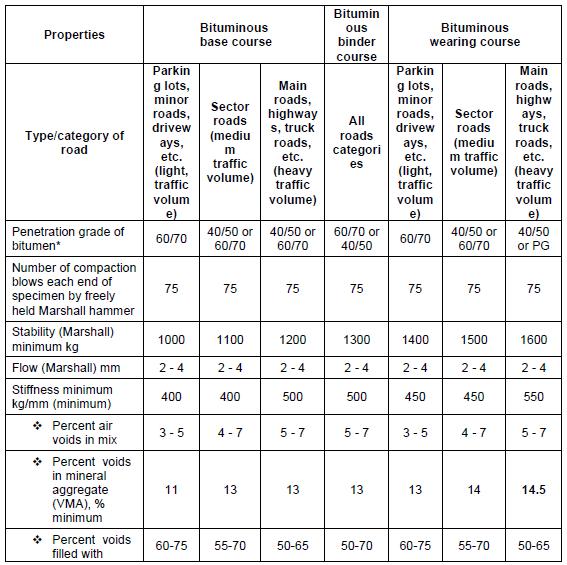
The preparation of Marshall samples includes the preparation of aggregates, mixing the aggregates and bitumen, and the compaction of specimens at Marshall mold. The aggregates should be dried and combined to conform to the required grade. Abu Dhabi specification (ADQCC) furnishes the suitable aggregate gradation in tablesfor differentasphalticconcretemixes. Themixing of aggregate and bitumen in the lab should proceed when the mixing temperature is achieved. Appropriate mixing, whether by mechanical mixer or manually, is essential to producing a homogenous mixture. The specimenwillbecompactedbythecompactionhammer; the number of blows is determined by the type of road andtraffic,accordingtotheAsphaltInstitute.AbuDhabi specification (ADQCC) fixes the number of blows at 75 forallroadtypesanddifferentasphalticconcretemixes, asfurnishedinTableNo.3.
Table3[9]
To investigate the impact of using modified bitumen on Marshall properties. Marshall samples have been preparedforconventionalbitumengrades40/50andfor modified bitumen grades PG82-22. Similar aggregate gradationhasbeenusedtopreparetheMarshallsamples tostudythechangesinMarshalproperties.
Table4
Seivesize Combined Grading Inc mm
¾’’ 19 100
½’’ 12.5 81
3/8’’ 9.5 73
No4 4.75 54
No8 2.36 36
No16 1.18 25
No30 0.60 17
No50 0.30 12
No100 0.15 18
No200 0.072 3.8
8. Marshal properties of bitumen modified asphalt
PreparedMarshallsamplesweretestedtodeterminethe volumetric and stability properties of the prepared
International Research Journal of Engineering and Technology (IRJET) e-ISSN:2395-0056
Volume: 11 Issue: 02 | Feb 2024 www.irjet.net
specimens.Thestabilitypropertiesofthespecimenwere determinedbyconductingstabilityandflowtests.While volumetrictestingandanalysisaimtodetermineasetof important properties such as voids in mix, void-filled bitumen (VFB), and voids in mineral aggregate (VMA), TheMarshallintentistodeterminethebitumencontent thatachievesspecificstrengthandvolumetricfeaturesof anasphaltmix.
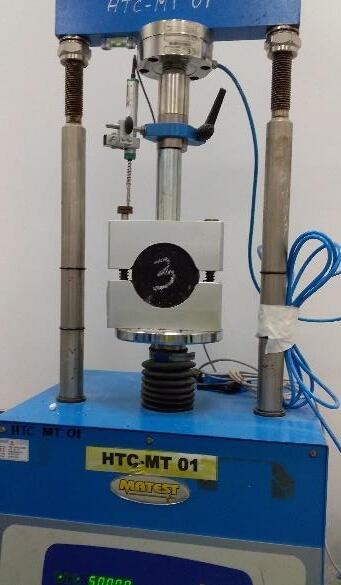
Stabilitytestsmeasurethemaximumloadresistedbythe Marshall specimen. The stability test was conducted by subjecting the asphalt specimen to a constant loading rate of 51 mm per minute. The maximum load or stabilityisobtainedwhentheasphaltspecimenfails.The flow of an asphalt mix is the deformation of the asphalt specimen measured during the stability test [3]. The maximum flow or deformation occurs at peak load. Abu Dhabi specification (ADQCC) specifies the minimum requirementsofstabilityandflowfordifferentasphaltic concretemixes,aspresentedinTableNo.3.
For our study case, Marshal stability and flow determined for asphalt mixes made from Two different bitumen types (PG82-22, unmodified bitumen 40/50). Table no:05 list results for stability and flow tests. The bitumen content for both mixes is 3.80%. we can notice thatthestabilityishigherby9.0%forasphaltmixmade with modified bitumen PG82-22 according to conducted tests
p-ISSN:2395-0072
The conducted test report shows an increase in the stability of asphalt mixtures made with modified bitumen (PG82-22), which supports the anticipated improvement in performance and strength for asphalt mixesmadewithmodifiedbitumen.
Table5
Wearing coursePG82-22
The compaction of asphalt mixes in the field is essential for producing a smooth surface, proper compaction determines the reliability of constructed roads. Furthermore, sufficient compaction will play a pivotal role in producing a durable pavement that can sustain traffic loads without excessive deformation or cracking. Another important volumetric property is the in-place air. The designer of pavement should address the inplace air void requirement in asphalt mix design. The presence of optimum air content in asphalt mixes is essentialforthebetterperformanceofasphaltmixes.Inplace air voids allow for a slight compaction of asphalt pavement under traffic loads, which ensures the flexibility of the pavement and improves the performanceofconstructedroads.
The bulk density (Gmb) for a Marshall specimen was determined according to ASTM D2726. Determining the asphalt bulk density in the lab under ideal compaction effort is essential to extracting the reference Marshall density. The measured lab density is the reference for determining the degree of compaction at the site. Therefore, the determination of Gmb for asphalt mixtures under controlled conditions is crucial for measuring the effectiveness of field compaction. Furthermore, the determination of Gmb is important to determinethein-placeairvoidforasphaltmixes.
International Research Journal of Engineering and Technology (IRJET)
Volume: 11 Issue: 02 | Feb 2024 www.irjet.net
The bulk density for prepared asphalt mixes is listed in TableNo.6.Itisobviousthatthetypeofbitumendoesn’t significantlyimpactthebulkdensityofasphaltmixes.
Table6
9.2.2 Maximum theoretical specific gravity of asphalt mixture (Gmm)
The Gmm represents the density of an asphalt mixture, excluding the air voids. ASTM D2041 provides the procedure for determining the Gmm for a loose asphalt mixture. The determination of Gmm is essential for determining the air voids in a compacted asphalt mixture.Moreover,itisusedtodeterminetheamountof bitumen absorbed by the aggregates in the asphalt mixture.
TableNo.7displaysthemaximumspecificgravityofthe studied asphalt mixture. We can notice that the value of Gmm is similar, with a minor difference. This finding confirms that the use of modified bitumen doesn’t impact the volumetric characteristics of asphalt mixtures.
Voids in mix
Voids in mix (VIM) are the air pockets between the mixture-coated aggregates in the compacted asphalt mixture. VIM can be determined by using the following equation:
Abu Dhabi specification (ADQCC) specifies the range of air voids for different asphaltic concrete mixes, as displayed in Table No. 3. The air void requirement is mandatory.Thecompactedasphaltmixesmustcontaina specific amount of air voids as specified in the specification.Airvoidsareimportanttoallowforfurther compaction of compacted asphalt mixtures under traffic loads,whichensurestheflexibilityofroadpavementand positively impacts the performance and durability of asphalt pavements. Therefore, some specifications limit
the degree of compaction to 101.50% of the marshal density to ensure the formation of air voids in compacted mixes. The amount of air voids should be controlled; a higher amount of air voids can result in a permeable road pavement, which can result in the ingressofharmfulwaterandair.TheVIMforasphaltmix made with modified bitumen can be calculated by using equation no. 1, the result of which is presented in table no.7.TheVIMforwearingcoursemadewithunmodified bitumen is 5.5%, while the VIM for asphalt made with modifiedbitumenis6.10%.
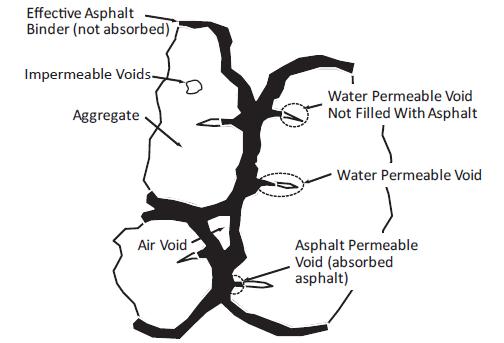
Voids in mineral aggregates are the voids between aggregates, including the air pockets and the effective asphalt content. The amount of voids in mineral aggregates should be sufficient to accommodate asphalt binder and the specified in-place-air voids. Low VMA values will result in reduced VFA and VIM, which will negativelyimpacttheasphaltmixture'sperformanceand durability. Asphalt bleeding may happen for mixtures withlowVMA.ComputingtheVMAcanbeperformedby simplysubtractingthevolumeofaggregatesdetermined by bulk specific gravity from the bulk volume of compacted asphalt mixes [3]. Table No. 03 specifies the minimum requirement for VMA for different asphaltic concrete courses according to the Abu Dhabi specification (ADQCC). We can notice that the requirement as per Table No. 03 for VMA is more for wearing courses and for asphalt courses subjected to high volumes of traffic. The increase in VMA due to trafficvolumecanbeinterpretedastheneedforahigher volume of voids to accommodate bitumen and the compaction due to traffic load. The values of VMA presented in Table No. 07 are similar, with a slight difference.
The voids filled with bitumen in a specific asphalt mix should be balanced. Voids filled with bitumen represent the portion of voids between aggregates that are filled with bitumen binder. Low VFB can significantly reduce the bonding between aggregates. Furthermore, the
International Research Journal of Engineering and Technology (IRJET) e-ISSN:2395-0056
Volume: 11 Issue: 02 | Feb 2024 www.irjet.net p-ISSN:2395-0072
harmful weather and moisture effects may cause the stripping of binder films from aggregates [8]. The low VFBwillreduceasphaltpavementperformanceandmay causeprematureagingofasphaltpavement.Ontheother hand, high VFB will result in a tender mixture with low stability.Therefore,theengineershouldensurethatVFB is within the acceptable limit to prevent any adverse effectsontheconstructedpavement.
Table7
Asphalt mix Property Sample01
9. Conclusion
In this paper, the strength and volumetric properties of asphalt mixes made with modified and unmodified bitumen are tested to verify the changes that occur due to incorporating modified bitumen into the asphalt mix. Thetestresulthasshowna considerableincreaseinthe modified bitumen softening temperature. Furthermore, the marshal stability test of asphalt mixes made with modified bitumen has shown an increase of almost 9%. Theuseofmodifiedbitumen(PG82-22inthisstudy)has shown a considerable improvement in the strength propertiesofasphaltmixes.Thevolumetricpropertiesof tested asphalt mixes have shown no significant difference. The volumetric properties will be significantly impacted by aggregate gradation and bitumen content. The tested asphalt mixes have similar aggregate gradation and bitumen content, which explainsthesimilartestresults.
However, the use of PMB alone is not sufficient to produce a high-performance and durable mix. The production of durable asphalt mixes will depend on many factors, such as careful selection of aggregate grades, bitumen content, volumetric properties, proper manufacturing of asphalt mixes, and the proper laying andcompactingofasphaltmixes.
References
1. administration, F. H. (2017). Asphalt Binder PG Tests. USA:FedralHighwayadministration.
2. Darbandizadeh, M. (2019, August 1). performance grade bitumen . Retrieved from Infinity Galaxy: https://infinitygalaxy.org/performance-gradebitumen/
3. Institute, A. (2014). MS-2 Asphalt Mix Design Methods. USA:AsphaltInstitute.
4. Isooba John, M. R. (2021). Effect of Filler and BinderContentsonAirVoidsinHot-MixAsphalt for Road Pavement Construction. Scientific research ,255-289.
5. KLNeaylon,L.v.(2019). Performancebenefitsof polymer modified bitumen binders for thin surfacings. Wellington 6141, New Zealand: UniversityofAuckland.
6. MATERIALS,A.S.(1999). StandardSpecification for Performance Graded Asphalt Binder. Washington, DC: AMERICAN SOCIETY FOR TESTINGANDMATERIALS.
7. Materials,A.S.(2003). StandardTestMethodfor Theoretical Maximum Specific Gravity and Density of Bituminous Paving Mixtures. West Conshohocken: American Society for Testing andMaterials.
8. Nalini Thakre, D. M. (2016). Polymer Modified Bitumen. Journal of Mechanical and Civil Engineering,120-128.
9. Transport, D. o. (2020). STANDARD CONSTRUCTION SPECIFICATIONS. Abu Dhabi: DepartmentofMunicipalitiesandTransport.
BIOGRAPHY


AdelMirzaKahskool
Email:adel_mirza2003@yahoo.com
SeniorMaterialEngineer
M.Sc civil Engineering, University of Strathclyde,UK
MohammadMamonFayizHamdan Civil/StructuralEngineer,Authorand onlineinstructor
Email:mhamdan4842@gmail.com
Bachelor degree in Civil Engineering fromBirzeituniversity
MemberofSocietyofEngineers/UAE
Vast Experience in construction and consultancyworksforinfrastructure projects