
Volume: 11 Issue: 02 | Feb 2024 www.irjet.net
e-ISSN:2395-0056
p-ISSN:2395-0072

Volume: 11 Issue: 02 | Feb 2024 www.irjet.net
e-ISSN:2395-0056
p-ISSN:2395-0072
Elsayed A. M. BaBars1 , Saber M. Abdraboo2 , Mohamed El-sayed M. Essa3*
, and Shady Y. El-Mashad4
1Department of Mechanical Engineering, Faculty of Engineering, Sinai University Campus, Arish, North Sinai, Egypt.
2Department of Mechanical Engineering, Faculty of Engineering at Shoubra , Benha University, Cairo, Egypt.
3Department of Electrical Power and Machines Engineering, Institute of Aviation Engineering and Technology, Egyptian Aviation Academy Imbaba Airport, Giza, Egypt.
4Department of Computer Systems Engineering, Faculty of Engineering at Shoubra, Benha University, Egypt.
ABSTRACT
This paper aims to model and control of an experimental dual axis solar tracking system utilizing a Field Programmable Gate Array (FPGA) based on intelligent control system design The proposed system is a real-time solar tracking system which capable of precisely aligning with the sun's position to maximize solar energy harvesting efficiency. Solar energy playsadistinctiveroleasaprimarysourceofnewandrenewableenergyduetoitscleanenergyanddoesnotpollutethe environment. Asa result,thisresearchpresentsanadvanceinoneoftheimportantwaystoincreaseenergyproductivity from solar cells such as dual axis solar tracker system. The proposed system is controlled through Fuzzy Logic Control (FLC) based on FPGA platform. To prove the efficiency of applying the dual-axis solar tracker based on fuzzy control, its results were compared to the fixed system of solar panel, and the two-axis solar tracker proved its distinction and efficiencyinraisingsolarproductionby21%,whichgivespreferenceinitsapplicationandexploitationinsolarsystems.
Keywords: Solar Tracker; FPGA; FLC; Dual Axis Linear Actuator; Sinai University Campus, Arish, North Sinai, Egypt. 1. Introduction
Solar energy has emerged as a crucial renewable energy source, offering a sustainable and eco-friendly alternative to conventional fossil fuels [1]. To optimize solar energy harvesting efficiency, solar tracking systems have been extensively researched and implemented. These systems dynamically adjust the orientation of solar panels to continuously face the sun, maximizing energy capture throughout the day [1-6]. In this literature review, we explore relevant research on the modelling and control of dual-axis solar tracking systems based on FPGAs. Numerousstudieshaveshowcasedtheadvantagesofsolar trackingsystemsoverfixedsolarinstallations.Algarniand Al-Maashri [1] conducted a comparative analysis between static and dual-axis tracking systems, revealing that the latter could improve energy generation by up to 35% in certain geographic locations. This emphasizes the potentialofdual-axissolartrackingsystemsinmaximizing energy output, particularly in regions with significant variationinsolarincidenceanglesthroughouttheday.
The ever-increasing demand for clean and sustainable energysourceshasfueledextensiveresearchinthefieldof renewable energysystems. Amongthese,solarenergy has emerged as a promising and environmentally friendly
solutiontoaddress the global energy crisis. Solartracking systems, which dynamically adjust solar panel orientation to align with the sun's position, have garnered significant attention due to their ability to enhance solar energy harvestingefficiency[1].
In their study, Atas and Bayhan [7] developed a mathematical model and control system for a two-axis solartracker,validatingitseffectivenessthroughreal-time laboratory experiments. This research demonstrated the feasibilityandefficiencyoftheproposedcontrolalgorithm for precise sun tracking. Accurate modelling of the solar tracking system is crucial for effective dual-axis solar tracking. Pohl and Fathabadi [8] presented a comprehensive kinematic and dynamic model of a dualaxissolartracker,consideringfactorssuchassunposition, panel orientation, and tracking errors. Such mathematical modelsserveasafoundationfordevelopingrobustcontrol algorithms and predicting solar tracker behavior in realtime. Forachieving precise suntracking, the selectionand design of appropriate control algorithms play a pivotal role.Whileclassical control techniqueslikePIDhavebeen widely employed for solar tracking, fractional-order PID (FOPID) controllers have shown superiority in handling system nonlinearity and disturbances. Hassan et al. [9] proposedanoptimalFOPIDcontrollerdesignfordual-axis
International Research Journal of Engineering and Technology (IRJET) e-ISSN:2395-0056
Volume: 11 Issue: 02 | Feb 2024 www.irjet.net
solartrackingusingageneticalgorithm,demonstratingits effectiveness in mitigating nonlinearity and disturbances, leading to enhanced energy harvesting efficiency. Additionally, FLC has gained popularity for its ability to handle uncertainty and adapt to changing environmental conditions [10]. Esen and Inalli [11] compared the performance of different fuzzy logic controllers for dualaxis solar tracking systems, highlighting the adaptability and robustness of fuzzy logic controllers in ensuring accurate sun tracking and increased energy harvesting efficiency.
TheadoptionofFPGA technologyinsolartrackingcontrol has gained momentum due to its re-configurability and parallel processing capabilities. Kar et al. [12] demonstrated FPGA's efficiency in implementing complex control algorithms, ensuring real-time performance and low-latency responses for the solar tracking system. The FPGA-based approach allows for flexible implementation and adaptation of control algorithms, making it a suitable choiceforreal-worldapplications.
In conclusion, the literature review highlights the significance of modelling and control in dual-axis solar trackingsystemsbasedonFPGAs.Pastresearchhasshown the potential of dual-axis tracking to enhance energy capture, and various control algorithms, such as PID, FOPID and FLC, have been explored for their efficacy. The integrationofFPGAtechnologyintosolartrackingsystems provides a promising avenue for real-time control and opens new possibilities for improving solar energy harvesting efficiency in practical applications. This literature review provides valuable insights for the proposed research paper, aiming to further advance solar tracking technologies and improve renewable energy systems'overallperformance.
This research paper introduces a comprehensive investigation on the modelling and control of an experimental FLC for dual-axis solar tracking system (DASTS) based on FPGA. The primary objective of this study is to design and implement an advanced solar tracking system that can accurately follow the sun's path in both azimuth and elevation angles, thereby maximizing solar energy capture throughout the day. The motivation behind this research stems from the potential of solar tracking systems to significantly boost energy yields compared to static solar installations. Traditional fixed solar panels only operate optimally when the sun is perpendicular to their surface, resulting in suboptimal energy generation during other periods of the day. In contrast, dual-axis solar tracking systems continuously
reposition solar panels to maintain an optimal angle with the sun, ensuring higher energy output and improved overallsystemefficiency.
Thisresearchpaperaimstocontributetotheadvancement of solar tracking technologies by combining sophisticated control algorithm with FPGA-based real-time processing. The outcomes of this study will provide valuable insights into improving solar energy harvesting efficiency, ultimately fostering the adoption of dual-axis solar trackingsystemsforagreenerandsustainablefuture.
Theproposedresearchisstructuredbasedonafoundation of mathematical modelling and control algorithm development. The dual-axis solar tracker's kinematic and dynamicmodelling will be carriedout to preciselypredict the sun's position at any given time, allowing for accurate positioningofthesolarpanels[7]
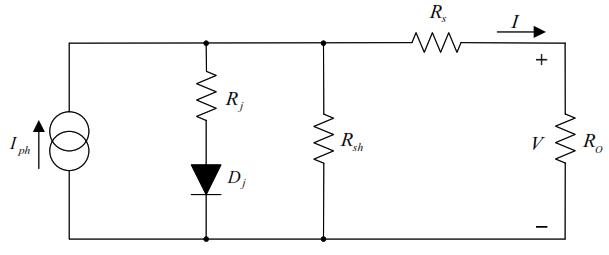
The equivalent circuit for photovoltaic panels is shown in Figure 1. The analysis of the circuit is described in below Equations. The system is modeled as explained in Equations1-11
Volume: 11 Issue: 02 | Feb 2024 www.irjet.net
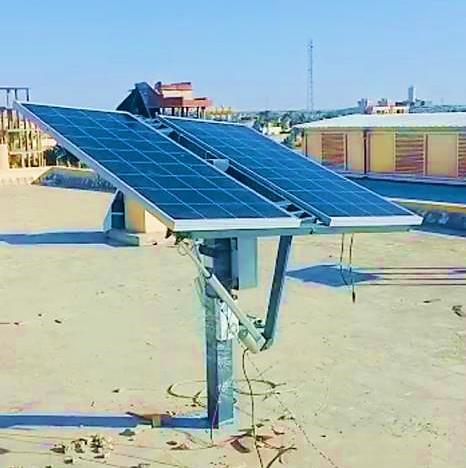
The experimental system is built based on different components and equipment (see Figure 3). The experimentalset-upincludesonetestrigofDASTSanditis described as following: Closed Loop, Sensor Based, Dual Axis, Azimuth – Altitude, Microprocessor & Elecro-Optical Sensor,SolarTracker.
The sensors used in this study is the Light Dependent Resistor (LDR). It is used to measure the incident light to obtaintheoptimumangleof rotation[4] Therelationship between the input and outputof LDR can be expressed as follows:
(�������� ) (12)
To determine the effective light intensity value obtained over the course of one day, we can calculate it using the following formula, where ��������represents the intensity of solar light, R is the electrical resistance, �� is the maximumintensityvalueforeachLDR,and ������ istheangle ofincidenceofsolarradiationthatdeterminestheeffective lightintensity:
(13)
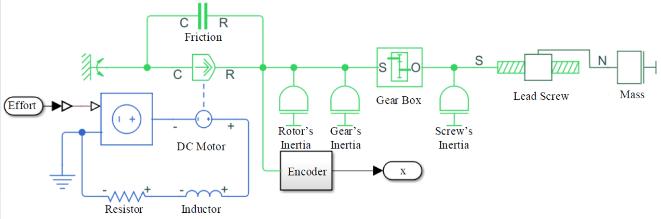
The Linear Actuator is used to move the panels for up or down and right to lift [6]. The linear actuator is modelled mathematically as given in Equation (14). Besides, the Matlab/SimscapemodeloftheactuatorisshowninFigure (2).
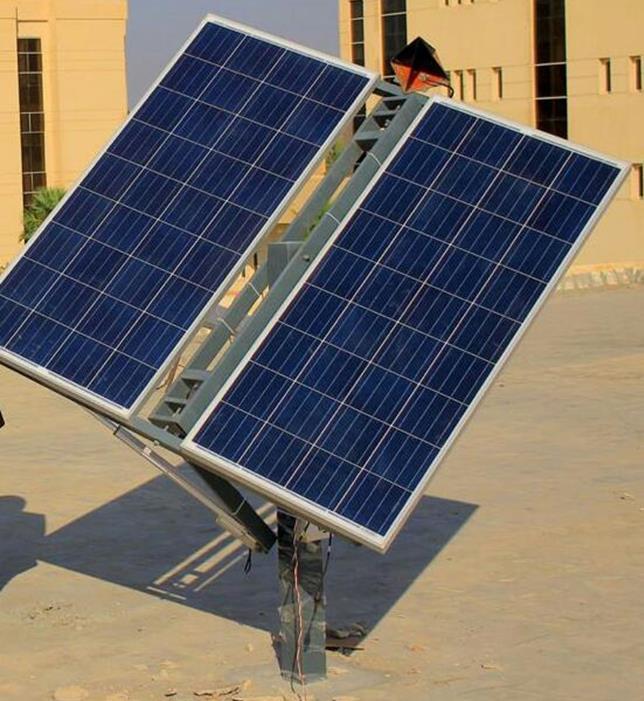
The experimental setup will be deployed in Sinai University Campus, Arish, North Sinai, Egypt, has coordinates of +31.13 (31°07'48"N), +33.8 (33°48'00"E) [13]. The research was conducted on November 2021 whereitconsistof4mmironbasewith1.45mwidthand 1.65 m height metal frame, two 150 watt polycrystalline PVpanels,two1,780Newton,0.76mstroke,7.62mm/sec linearactuatorDCmotors,SignalConditionerArduinoUno R3 Board, and four light-dependent resistors. The performance evaluation of the FPGA-based control algorithm will be carried out under real-world solar conditions, and the results will be compared against fixed solar systems. The chosen FPGA platform, featuring the Xilinx Spartan-7 XC7S15 chip,will serveasthe coreofthe controlsystem.FPGAtechnologyoffershighflexibilityand real-timeprocessingcapabilities, makingitwell-suited for the implementation of sophisticated control algorithms. This will enable the tracking system to adapt to varying environmental conditions and ensure seamless operation underdifferentscenarios.
Volume: 11 Issue: 02 | Feb 2024 www.irjet.net
4. Tracking Approach
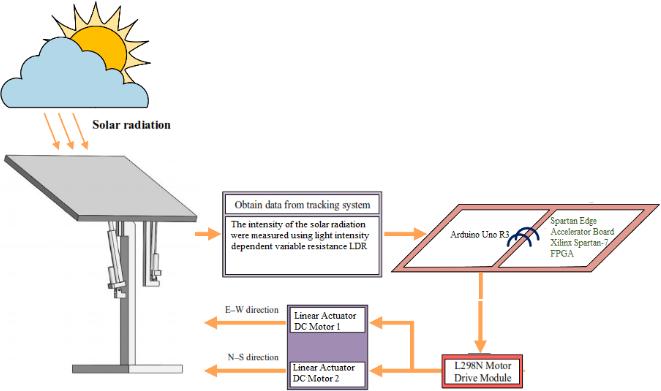
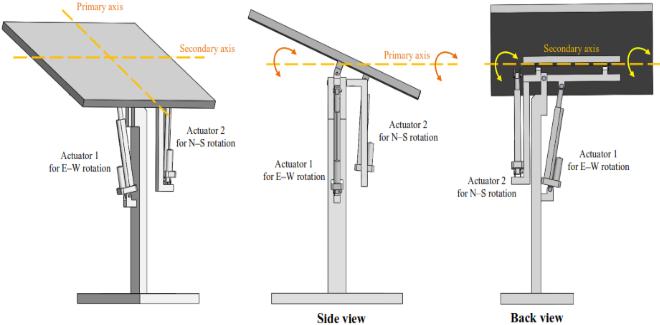
The description of tracking system is demonstrated in Figure4.Thetrackingapproachreliesoncomparingpairs ofLDRsensorspositionedaroundtheaxesofrotation(See Figure 4.). Specifically, LDR sensors 1 and 2, denoted as VE_1andVW_2,respectively,areresponsibleformanaging the rotation of the primary axis (Zenith angle) through PitchMotor1.Conversely,LDRsensors3and4,labeledas VN_3andVS_4,respectively,areutilizedforcontrollingthe rotation of the secondary axis (Azimuth angle) via Yaw Motor 2. When assessing each pair of LDR sensors, the actuatorisengagedupondetectingadiscernibledifference in solar radiation intensities. Conversely, rotation halts when there's no appreciable variance in solar radiation intensities
Importantly, a safety margin is incorporated into the trackingdecisionprocess,designedtopreventoscillations around the sun's position [2]. As a result, this study establishes a predefined threshold for the difference between intensities registered by the LDR sensors, set at 10forbothaxesofrotation.Whenthedisparityfallsbelow this established threshold, the system maintains its current position [14]. However, if the difference equals or surpasses the defined threshold, the system then aligns itself with the sun's position based on the tracking strategy. This strategy triggers tracking signals, enabling the operation of motorized linear actuators via an L298N motor drive board. It's worth noting that while the tracking strategy activates the axes of rotation, the solar tracking system has built-in limitations, and it cannot exceed the designated angular fields, as constrained by limitswitches.
e-ISSN:2395-0056
p-ISSN:2395-0072
It's very important to know that the solar radiation intensity data obtained from measurements may occasionallycontainnoiseorerrorsstemmingfromdevice malfunctions or environmental factors. In this research, the gathered data is subjected to preprocessing before applying the tracking strategy to eliminate any noise caused by electronic devices or environmental conditions [4]. Following this preprocessing step, the refined data is then provided to the tracking strategy for the purpose of accuratelytrackingthesun'sposition
Fuzzylogiccontrolisatypeofcontrolsystemthatemploys fuzzy logic to make decisions based on imprecise or uncertain data [15]. It finds particular utility in scenarios where traditional control systems may prove ineffective, particularly in managing complex or nonlinear systems. FLC operates by utilizing linguistic variables, which facilitate more natural and intuitive control of the system [16]. This mathematical system evaluates analog input values in terms of logical variables that can assume continuousvaluesbetween0and1,incontrasttoclassical or digital logic, which operates with discrete values of either1or0(trueorfalse,respectively)[17].
TheimplementationofFLCs canbeaccomplishedthrough a range of programming languages, including MATLAB, Python, and C++. Additionally, there are various libraries and frameworks available for the development of FLCs, such as the Fuzzy LogicToolbox designed for MATLAB [5, 18] Figure 5 demonstrates the structure of FLC with the system including sensors. Besides, block diagram of solar tracker system that controlled by FLC is given in Figure 6 [8,10,11].
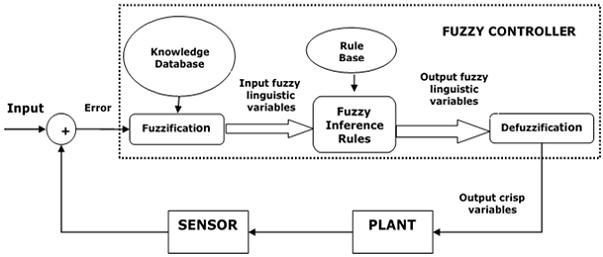
TheexplanationofthecomponentsofFLCisdemonstrated inthefollowingpoints[14-16,18]:
Input: Thisphaseinvolvesparameterssuchasthecountof input signals, the number of derivatives for each input signal,andthescalingoftheseinputsignals.
Volume: 11 Issue: 02 | Feb 2024 www.irjet.net
Fuzzification: This step encompasses aspects like the types of membership functions employed, characteristics like mean, distribution, and peak values of these membership functions, symmetry considerations, intersection points, and the total count of membership functions
Rules: Inthisstage,oneneedstodeterminethenumberof rulesinthesystem,definethestructureoftheserules,and assignappropriateweightstotheserules
Rule evaluation: This part encompasses the selection of aggregate operators and conclusion operators for evaluatingtherules
Aggregation: Aggregation entails the process of combining operators with the outcomes of each rule and theconclusionsdrawnfromeachrule.
Defuzzification: Duringthisphase,aprocedureisutilized totransformfuzzyvaluesintodefinitive,assertivevalues.
Output: This section pertains to the specification of the numberofoutputsignals.
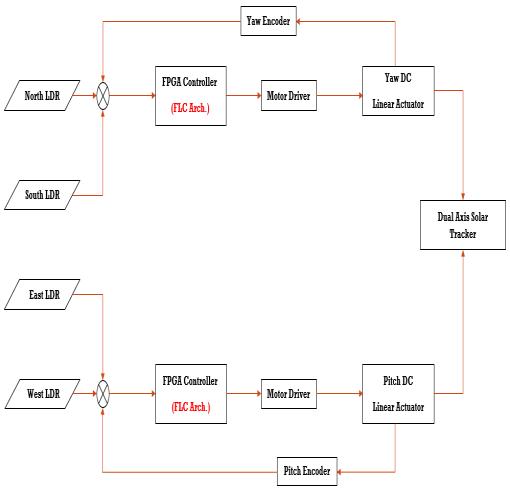
Figure6.BlockdiagramofsolarsystemwithFLC
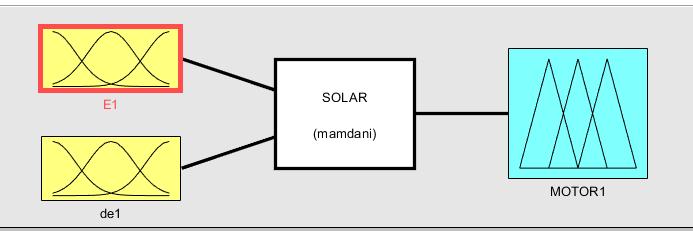
(a) FLCsystemforthetrackerbasedonMamdani inferencesystem.
e-ISSN:2395-0056
p-ISSN:2395-0072
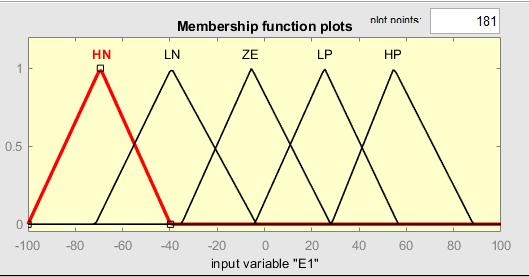
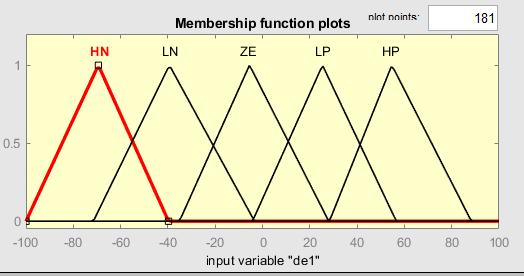
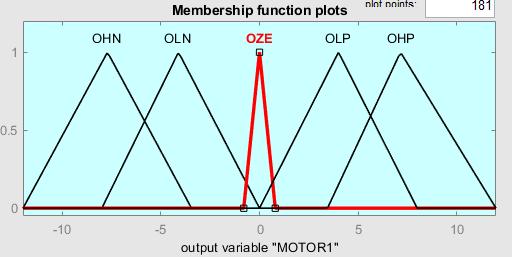
(b)TriangleMFsforinputsandoutputs
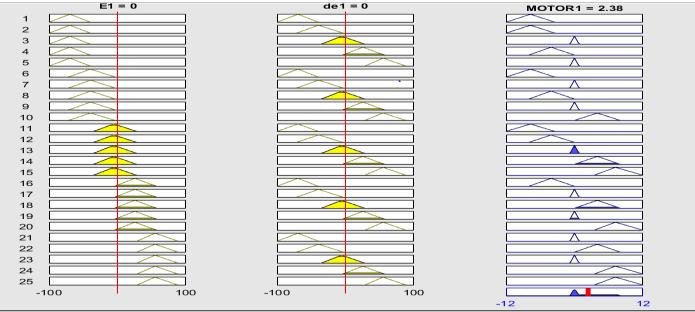
(c)Ruleviewerfortheinputsandoutputs
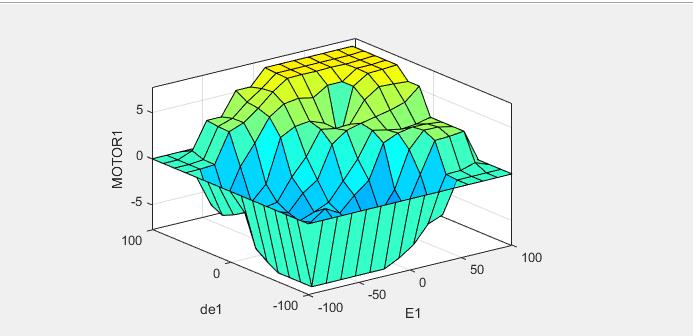
(d)Surfacevieweroferrorandchangeoferror
Figure7DetailsofFLC
Based on different trails and tests, the used type of membership functions for both inputs and outputs are triangle membership functions (see Figure 7). The inputs oftheFLCarechosentobetheerrorandchangeoferrors.
Four LDR sensors are strategically placed corresponding to the axes of rotation. The analog data collected by these LDR sensors is then sent to an Arduino UNO R3 microcontroller board, serving as a signal conditioning unit. Subsequently, this analog LDR sensor data is subjected to processing and analysis to facilitate decisionmaking for the solar tracking system, guided by the tracking strategy explained later in this document. This data is transmitted via the Spartan Edge Accelerator Board,whichisequippedwiththeXilinxSpartan-7XC7S15 FPGAmicrocontrollerboard Theproposedsystemconsist of two PV panel have the same power (150 watt for each other), mechanical and electrical characteristics (See Figure8).
In this article, different measuring devices are used to measure various quantity to help us to evaluate the performance of the suggested system in PV systems. The used measuring devices are solar power meter (TM-206) and multi meter device (DT-9205B). The solar power meter is a device employed for quantifying the power per unit area of incoming solar radiation that reaches the meter's sensing region. In addition, the multi-meter is a versatile tool commonly utilized in electronic hardware workshops and electronics laboratories. It serves the purpose of measuring various electrical properties, encompassing voltage, resistance, and current, making it an essential instrument for a wide range of electronic applications.
2395-0056
p-ISSN:2395-0072
Theprocedureofobtainingtheresults,makesurethatthe devices are calibrated and ready to be used. Then, make surethatadualaxistrackerisworkcorrectly.Thedataare collected from 08:20 AM to 16:22 PM. The collected data includethemeasuringofintensity ofsolarradiation,open circuit voltage and short circuit current for both moving and fixed PV-Panel at the same time and the same condition. After that, the maximum power is calculated basedonthefollowingequation,
Pmax =Voc*Isc. (15)
The majority of photovoltaic (PV) power plants are traditionally designed with fixed installations. However, it's worth considering that it's feasible to generate a greater amount of energy using the same number of PV panels and inverters. Therefore, we conducted a comparison between a stationary PV panel setup and a mobile PV panel setup mounted on a dual-axis tracker, which is governed by a combination of FPGA and Fuzzy Logiccontrol.
This section present a discussion and analysis of the outcomes derived from experimental test rig system. The resultsarevisuallyrepresentedthroughgraphs,enablinga clear comparison between stationary and mobile PV panels(seeFigures9,10,11,12) . Figure9showstheopen circuit voltage for fixed and movable panels, while Figure 10 demonstrates the results of short circuit currents for twotypes.Besides,Figure11depictstheintensityforsolar radiation for fixed and dual axis solar system. In addition, the output PV power for fixed and movable panels is
shown in Figure 12. Table 1. provided illustrates the correlations among voltage, current, power, and solar radiationconcerningboththeMovingandFixedPVPanels, all observed at the specified time intervals detailed in the schedule. The units of time, power, current, voltage and solarradiationinthispaperarehour(h),watt(w),ampere (A),voltage(v)andW/m2respectively.
Table1.Measureddataofmovableandfixedpanels
Monday 15. Nov. 2021 FLC
05215 :1.0 :1.. 1.97 8.50 99.897 07:.75. 587 0111 062:: 09.59 09.89 ..66 6.65 70.6991 0.:.:685 .51 8.7
Figure10 Comparisonbetweenfixedandmovableshort circuitcurrents.
Figure9.Comparisonbetweenfixedandmovableopen circuitvoltages.
Figure11 Comparisonbetweenfixedandmovable intensityofsolarradiation(W/m2).
Figure12 ComparisonbetweenfixedandmovablePV outputpower
Volume: 11 Issue: 02 | Feb 2024 www.irjet.net
Considering results in Table 1 and Figures 9-12, it is very clear that trackers generate more electricity power than their fixed counterparts due to increased direct solar radiation. Besides, voltage and current are affected by the intensity of solar radiation, there is a direct relationship between them. The maximum power reached at 12:01 in the two systems. In addition, the two systems were close toeachotherintheperiodfrom11:27to12:44.Thisisdue to the perpendicularity of the solar radiation and the convergence of the angles of inclination of the two systems.
ThedualaxistrackerforPVsystemisimplementedinthis paper.Theexperimentalsystemisstructuredbasedonthe interface of FPGA board as the core of control system which collect the signals from sensors then processing them to give a suitable control signal to the actuators of the system. The intelligent FLC approach is applied to the system for dual axis solar tracker system. In addition, a deep scenario is carried out in this paper to produce a comparison study between fixed and movable tracker PV system. The comparison is introduced to check the effectivenessoftheFLCbaseddualaxissystem.Theresults show that the FLC based dual axis system produced greaterPVpowerthanthecaseoffixedsystem.
[1]Algarni,A.,&Al-Maashri,F.(2018).Comparativestudy between fixed and two-axis tracking systems under arid climaticconditions.RenewableEnergy,116,40-49.
[2] Jafarkarimi, H., Suh, C. Y., & Seyedmahmoudian, M. (2020). A review of PID tuning methods for PV tracking systems.SolarEnergy,201,906-924.
[3]Ran,Y.,etal.(2020).Solartrackingcontrolforbuilding integrated photovoltaic systems using artificial neural network. Energy Conversion and Management, 211, 112710.
[4] Reddy, K. S., Gollapalli, V., & Rama, S. S. V. (2016). Design of a solar tracking system using closed-loop control. In Proceedings of the 2016 IEEE Region 10 Conference(TENCON)(pp.394-398).
[5] Subramaniam, K. A., & Venkataraman, K. (2020). Comparative analysis of dual-axis solar tracking systems using various control algorithms. Renewable Energy, 147, 2489-2501.
e-ISSN:2395-0056
p-ISSN:2395-0072
[6] Yang, S., Xu, Y., & Xiao, X. (2019). Dual-axis solar tracking system based on optimized control and heuristic algorithms. Journal of Renewable and Sustainable Energy, 11(3),033701.
[7]Atas,F.,&Bayhan,S.(2015).Modellingandcontrolofa two-axis solar tracking system with real-time laboratory verification.SolarEnergy,122,1204-1218.
[8]Pohl,S.,&Fathabadi,H.(2017).Designandmodelingof atwo-axissolartrackingsystemusinganoptimizedfuzzyPIDcontroller.RenewableEnergy,101,649-663
[9] Hassan, E., Gaafar, M., & Hafez, A. (2019). Optimal FOPID controller design for a dual-axis solar tracking system using genetic algorithm. Energy Conversion and Management,185,331-341.
[10]Gholizadeh,S.,Mottaghi,A.,&Nikdel,A.(2021).Fuzzy control of solar tracking system for maximum power generationofsolarpanels.SolarEnergy,216,271-280.
[11] Esen, H., & Inalli, M. (2021). Comparative analysis of fuzzylogiccontrollersfordual-axissolartrackingsystems. JournalofCleanerProduction,285,124885.
[12] Kar, B. K., Saha, H., & Konar, A. (2019). Design and implementation of a high-performance solar tracking system using FPGA. IEEE Transactions on Industrial Electronics,66(1),103-113.
[13] Trabea, A.. (2000). Analysis of solar radiation measurements at Al-Arish area, North Sinai, Egypt. Renewable Energy. 20. 109-125. 10.1016/S09601481(99)00070-1.
[14]Sivasangari,S.,&Thirumalai,K.S.(2016).Designand controlofdual-axissolartrackingsystemusingfuzzylogic controller.ProcediaTechnology,24,1535-1543.
[15] Li, Q., Wang, Y., & Ge, Y. (2018). Adaptive fuzzy sliding-mode control of dual-axis solar tracking system. IEEE Transactions on Industrial Electronics, 65(3), 26182627.
[16] Rafi, K. M., & Siddiqui, A. S. (2018). Design and analysis of PID, fuzzy, and neural network-based controllersforadual-axissolartrackingsystem.Journalof RenewableandSustainableEnergy,10(2),023703.
[17] Sun, Y., et al. (2017). Hybrid predictive control based on fuzzy reasoning and optimization for dual-axis solar
Volume: 11 Issue: 02 | Feb 2024 www.irjet.net
trackingsystem.IEEETransactionsonEnergyConversion, 32(3),1212-1221.
[18] Srivastava, A., et al. (2020). Comparison and analysis of solar tracking system using FLC and MPC. In Proceedings of the 2020 IEEE PES/IAS PowerAfrica (PESIAS)(pp.601-606).
[19]Iqbal,T.,etal.(2021).Fuzzylogic-basedsolartracking systemusingArduino.International Journal ofScientific & EngineeringResearch,12(4),443-449
e-ISSN:2395-0056
p-ISSN:2395-0072