
International Research Journal of Engineering and Technology (IRJET) e-ISSN: 2395-0056
Volume: 11 Issue: 02 | Feb 2024 www.irjet.net p-ISSN: 2395-0072
International Research Journal of Engineering and Technology (IRJET) e-ISSN: 2395-0056
Volume: 11 Issue: 02 | Feb 2024 www.irjet.net p-ISSN: 2395-0072
Munaf
Mohamed Salem Hasson 1 , Mohammed Saleh Nusari 2
1 Faculty of Engineering, Department of Civil Engineering, Lincoln University College, Petaling Jaya 47301, Malaysia
2 Department of civil engineering, Faculty of Engineering, University of Aden, Aden, Yemen ***
Abstract - This research conducts an in-depth bibliometric analysis of 689 papers focusing on the use of concrete-filled steel tubes (CFST) in composite structures. Utilizing Web of Science andScopus databases, the studyemploys Bibliometrix within the R software for systematic data gathering and analysis. Citation analysis identifies influential publications, authors, and institutions, evaluating scholarly impact and trends in CFST research from 2019 to 2023. The study identifies four research clusters, including Digital TransformationandCFST Applications,throughbibliographic coupling. Findings reveal a fluctuating growth trend in cited publications, with a notablepeakin2022, emphasizingefforts to enhance CFST performance. Eminent contributors such as Dr. CHEN M, Prof. LIU Y, and Prof. ZHANG J are highlighted, and science mapping illustrates keyword evolution and collaboration networks, providingaholisticperspectiveonthe CFST research landscape.
Key Words: Web of Science, Scopus, Bibliometric analysis, RStudio, Compositestructure,and Structural Behaviour.
Concrete-filled steel tubes (CFST) stand as prominent components in structural engineering, acclaimed for their heightenedload-bearingcapacity,durability,remarkablefire resistance, and seismic stability, as attested by[1]. The amalgamation of steel tubes and concrete cores not only mitigates inherent concrete brittleness but also augments damping resistance, as elucidated by [2] CFSTs find extensive application as load-bearing columns in tall structures,showcasingexceptionalresiliencetocompressive stressesandductility.Thenuancedinteractionbetweensteel tubesandconcrete,especiallyduringpost-bucklingphases, necessitatesadeparturefrompresumptionsofhomogenous cross-sections,promptingamoreaccurateconceptualization ofCFSTascompositeentitiesratherthanuniformstructures, an assertion supported by [3]. Local buckling intricacies, influencedbyconcreteconstraints,significantlyimpactCFST behaviorundercompression,revealingacomplexinterplay between buckling strain, residual strength, and steel tube deformation properties [4]Disparities arising from the differentialPoisson’sratiobetweensteeltubesandconcrete withintheelasticrangeleadtogradualcompressivestress growth,delayingtheemergenceofconfiningstressinCFST steel tubes, particularly evident in thin-walled and high-
strengthconcreteconfigurations[5].Manystudiesshowed that the stiffness of CFST columns made of high-strength concreterapidlydecreasedduringtheinitialpost-buckling period[6] ThelimitationsofmodelingCFSTconcretecores using the constrained mechanical model of steel tube confined concrete stub columns (STCCs) are underscored. Eurocode 4's composite element theory, explored by scholarslike[7],emergesasapivotalframework,demanding theamalgamationofindividualaxialcapacitiesofsteeltubes and concrete cores to ascertain the axial load-bearing capability of CFST columns. This study addresses the qualitativeandsubjectivenatureofmanual-basedreviews byemployingbibliometricandqualitativeanalyses,ensuring anobjectiveandaccurateexaminationofresearcharticlesin theCFSTfieldfrom2019to2023.Theensuingsectionsdelve intotheintricaciesofbibliometricmethodologies,offeringa comprehensive exploration of academic contributions, discernibleresearchtrajectories,andprevailingtrendsinthe specializeddomainofstiffenedCFSTstudcolumns,fostering anuancedunderstandingofinformationdynamics,research impacts,andbroaderinfluencesshapingthefield.
The bibliometric analysis method under consideration involvesacomprehensivescrutinyandinterpretationofdata acquiredthroughbibliometrictechniques,surpassingmere numerical analysis to unveil profound insights into underlying patterns, relationships, and trends within the researchlandscape.Inadditiontonumericalassessments, qualitative analysis is applied, wherein researchers meticulously examine and interpret qualitative facets of bibliometric data, including publication content, citation context,andemergentthemesandconceptsintheliterature. Thisqualitativeanalysisemploysresearchmethodssuchas contentanalysis,thematicanalysis,anddiscourseanalysisto reveallatentmeaningsandnuancesinthedata.Conductinga qualitativeanalysisofbibliometricdataallowsresearchers togaininsightsintoresearchtopics,theoreticalframeworks, methodologicalapproaches,andconceptualdevelopments within a specific field. It facilitates the identification of emergingresearchtrends,explorationofinterconnections between different studies, and comprehension of the intellectual structure of a research domain. Moreover, qualitative analysis of bibliometric methods aids in identifying research gaps, challenges, and opportunities, providing a nuanced understanding of the research landscapeandpavingthewayfortheidentificationofnew
International Research Journal of Engineering and Technology (IRJET) e-ISSN: 2395-0056
Volume: 11 Issue: 02 | Feb 2024 www.irjet.net p-ISSN: 2395-0072
research directions and potential areas for collaboration.This method is specifically applied to assess thebehavioranddesignofconcrete-filledsteeltube(CFST) stub columns under axial compression, employing bibliometric techniques for quantitative analysis of publications,citationpatterns,andresearchtrends.Recent studies in structural engineering, exemplified by[8]and[9]haveutilizedbibliometricmethodstoinvestigate variousfacetsofthefield.Dingetal.'sanalysishighlightskey research clusters, subject categories, and knowledge structures related to concrete-filled steel tube structures, providing a comprehensive overview of the field. Similarly,[9]conductedabibliometricanalysistoassessthe currentresearchstatus instructural engineering,utilizing co-word analysis and co-cited analysis for an in-depth examination of the research dataset. Co-word analysis enabledtheinvestigationofterminologyusageandwordcooccurrence patterns, while co-cited analysis aimed to identify frequently cited authors, articles, and journals. Additional analytical approaches, such as cluster analysis andtimelineanalysis,wereemployedtouncoversignificant clustersofrelatedresearchandtemporalpatternsorshifts inscholarlydiscourse.Thesesupplementaryanalysesserved toidentifytrendsandspikesinpublicationactivity,offering a more comprehensive understanding of the research landscape.
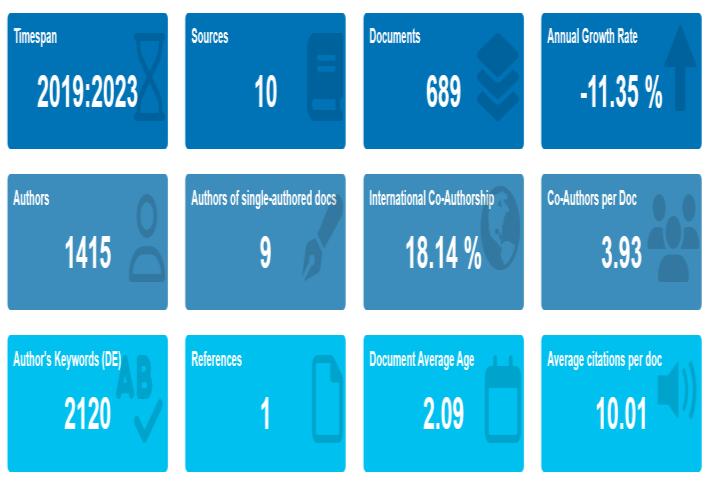
Bibliometricperformanceanalysisprovidesinsightsintothe scholarlyimpactandresearchtrendsinthefieldofconcretefilled steel tube (CFST) stub columns under axial loading. Recent studies have employed bibliometric methods to assess publication productivity, citation impact, and collaborationpatternswithinthisdomain.Forexample,[10] conducted a comprehensive bibliometric analysis of CFST structures,while[11]focusedonsteel-concretecomposite structures, including CFST columns. Such analyses help identify influential publications, leading researchers, and
emerging research topics. By examining bibliometric indicatorsandutilizingmappingtechniques,researcherscan gainadeeperunderstandingoftheresearchlandscapeand addressknowledgegapsinCFSTstubcolumnsunderaxial loading.
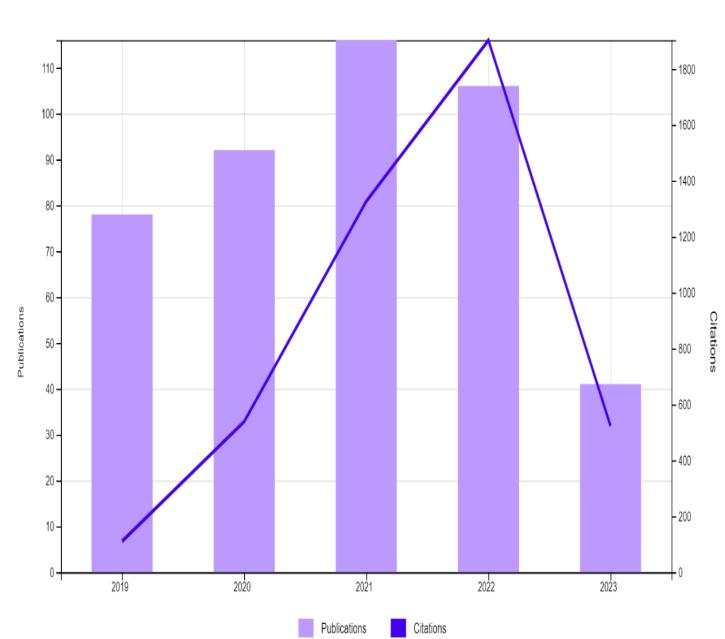
Acriticalaspectofassessingresearchtrendsandrecognizing influentialcontributionsliesinunderstandingthestructure of publications and citations. Recent inquiries into this domain, such as the bibliometric analysis conducted by [12]on Concrete-Filled Steel Tube (CFST) structures, have illuminated publication productivity and citation impact, identifyingkeycontributorsattheauthor,institutional,and nationallevels.Similarly,[13]delvedintocitationpatternsof CFST stub columns, discerning highly cited articles and influentialresearchgroups.Byscrutinizingpublicationand citationstructures,researcherscangleaninsightsintothe intellectual framework of the field, emerging research trends, and collaborative endeavors. This analysis aids in recognizingseminalworks,influentialauthors,andresearch clusters, thereby fostering knowledge dissemination and advancingunderstandinginCFSTstubcolumnsunderaxial loading. Figure 2 visually represents the distribution of publications and citations up to April 2023, offering a graphicalportrayaloftheirevolutionovertime.Toenhance the overview's comprehensiveness, various citation thresholds have been incorporated, enabling a detailed analysisofcitationpatternswithinthespecifiedtimeframe (2019 to 2023). The records reveal a fluctuating growth trendincitedpublications,withanotablepeakobservedin 2022.Thissurgeisattributedtoongoingeffortsfocusedon improvingtheperformanceofCFSTsthroughdiversesteel stiffeningschemes,aimedatenhancingbondbehaviorand concreteconfinementstrengthprovidedbythesteeltube.
International Research Journal of Engineering and Technology (IRJET) e-ISSN: 2395-0056
Volume: 11 Issue: 02 | Feb 2024 www.irjet.net p-ISSN: 2395-0072
Table 1. Most cited papers
R Title Paper/Aut hors/year
1 A pathdepende nt stressstrain model for concrete -filledsteeltube column Copy
2 Experim ental and numeric al investiga tioninto the behavio ur of face-toface built-up coldformed steel channel sections under compres sion
LAI MH, 2020, ENG STRUCT
ROY K, 2019,THINWALLED STRUCT
3 Static behavior of large stud shear connect ors in steelUHPC composi te structur es WANG JQ, 2019, 10.1016/j.engstru
4 Experim ental and numeric al investiga ROY K, 2019, J CONSTR STEELRES
tions on theaxial capacity of coldformed steel built-up box sections
5 Uni-axial behavio ur of externall y confined UHSCFS T columns LAI MH, 2019,THINWALLED STRUCT
6 Numeric al study on the axial compres sive behavior of builtup CFT columns consider ing different welding lines SHARIATI M, 2020, STEEL COMPOS STRUCT
7 Stressstrain modelof an FRPconfined concrete -filled steel tube under axial compres sion ZHANG Y, 2019,THINWALLED STRUCT 10.1016/j.tws.201
8 Seismic design andsubassembl agetests of bucklingrestrain ed braced RC frames with BAI JL, 2021, 10.1016/j.engstru ct.2021.112018
International Research Journal of Engineering and Technology (IRJET) e-ISSN: 2395-0056
Volume: 11 Issue: 02 | Feb 2024 www.irjet.net p-ISSN: 2395-0072
shear connect or gusset connecti ons
9 Experim ental studyon axial compres sive behavior of welded built-up CFTstub columns madeby coldformed sections with different welding lines
1 0 Confine ment effective ness of circular concrete -filled steel tubular columns under axial compres sion
1 1 Monoton ic axial compres sive behavio ur and confine ment mechani sm of square CFRPsteel tube confined concrete
NAGHIPOU R M, 2020, STEEL COMPOS STRUCT
WEI Y, 2019, J CONSTR STEELRES
WANG Y, 2020, ENG STRUCT
1 2 Advance s in the Direct Strength Method SCHAFER BW, 2019, THINWALLED STRUCT
© 2024, IRJET | Impact
of coldformed steel design
1 3 Deep learningbased procedu re for structur aldesign of coldformed steel channel sections with edgestiffened and unstiffened holes under axial compres sion FANG Z, 2021,THINWALLED STRUCT
1 4 Experim ental investiga tion on coldformed steel stiffened lipped channel columns undergoi nglocaldistortio nal interacti on
1 5 Simulati on of screw connecte d builtup coldformed steel back-toback lipped channels under axial compres sion
CHEN M-T, 2020,THINWALLED STRUCT
KECHIDI S, 2020, ENG STRUCT 10.1016/j.engstru ct.2019.110109
1 6 Paramet ricstudy CHEN B, 2020, J 10.1016/j.jcsr.202
International Research Journal of Engineering and Technology (IRJET) e-ISSN: 2395-0056
Volume: 11 Issue: 02 | Feb 2024 www.irjet.net p-ISSN: 2395-0072
and simplifie ddesign equation s for coldformed steel channels with edgestiffened holes under axial compres sion
1 7 Analysis of uniaxiall yloaded short roundended concrete -filled steel tubular beamcolumns
1 8 Experim ental investiga tion on coldformed steel lipped channel beams affected bylocaldistortio nal interacti onunder nonuniform bending
PATEL VI, 2020, ENG STRUCT
CHEN M-T, 2021,THINWALLED STRUCT
1 9 Design of coldformed steel built-up columns subjecte d to localglobal interacti ve SELVARAJS, 2021,THINWALLED STRUCT
buckling using direct strength method
2 0 Uniaxial behavio ur of expansiv e CFST and DSCFST stub columns HO JCM, 2021, ENG STRUCT 10.1016/j.engstru ct.2021.112193
2 1 Design of concrete -filled coldformed steel elliptical stub columns YI S, 2023, ENG STRUCT 10.1016/j.engstru ct.2022.115269
Theidentificationofleadingcontributorsinconcrete-filled steeltube(CFST)stubcolumns,particularlyinthecontextof axial loading, yields valuable insights into the research landscape. Recent studies, exemplified by [14]and[9],conductedcomprehensivebibliometricanalyses to discern influential authors, institutions, and countries. Hossain et al. focused on leading authors, employing publication productivity and citation impact as criteria, highlighting the significant contributions of influential researchers.Similarly,[9],concentratedoninstitutionsand countries, employing quantitative analysis of publication data.Noteworthyamongthehighlyproductiveauthorsare Dr.CHENM,Prof.LIUY,Prof.ZHANGJ,andDr.WANGJ.Dr. CHEN M's substantial contribution includes 14 scholarly papers spanning CFST and additive manufacturing applications,whileProf.WANGYhasprimarilyinvestigated the behavior of normal-strength recycled aggregate concrete-filled steel tubes, documented in the work by[15].Thecomprehensiveoverview,presentedinTable1, integrates various bibliometric indicators, such as author WoSandScopus,countries/regions,numberofcitations,and cites per paper ratio, ranked based on the number of publications and resolved ties by considering citation numbers.
Volume: 11 Issue: 02 | Feb 2024 www.irjet.net
Table2.Mostproductiveauthors.
Author
Table 3.MostAffiliations'ProductionoverTime
Prof.LIUYandProf.ZHANGJreceivedawardsforsignificant contributions to "circular concrete-filled steel tube stub columns" (2020-2022). Prof. WANG X and Dr. ZHOU X transitionedtopublishingonsteelconcretecompositestub columns under axial compression.Table 2 provides an insightfulanalysisofaffiliations'productivityinthejournal, presenting Affiliations Production over Timeand relevant indicators.BeijingUniversityofTechnologyleadswith104 articles(2019-2023).ChongqingUniversityandtheSchool of Civil Engineering follow closely, with the latter, despite fewerarticles,demonstratingnoteworthyproductivity withinthejournal.
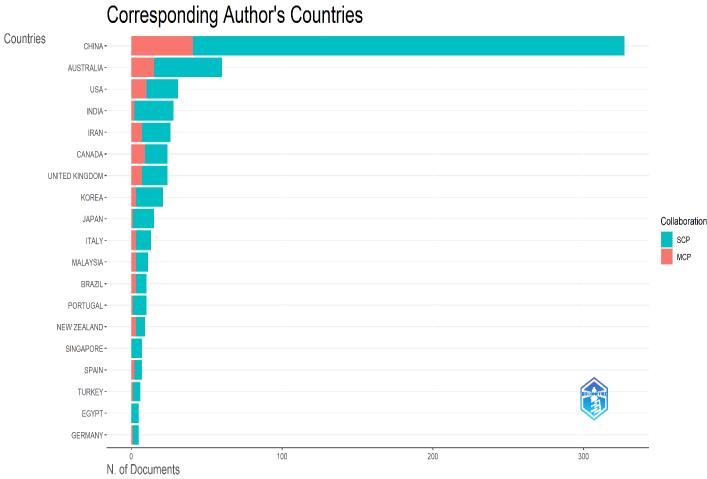
Table3offersanoverview ofcountries/regions'scholarly productivity.Chinadominatesglobally,surpassingAustralia and the United States. Notably, China stands alone in publishing over 300 articles and accumulating 3000 citations.Tables2and3underscoreChinaandAustralia's substantialrepresentation,affirmingtheirhighstanding.The MCP indicator suggests strong collaborative inclinations amongChina,Australia,theUnitedStates,andCanada.
Table 4.Mostproductivecountries/regions.
Inthissection,asciencemappingapproachwasemployed, incorporating key factors such as keywords, citation/cocitation analysis, and collaboration patterns. By utilizing these factors, a comprehensive analysis was conducted to revealtheinterrelationshipsandtrendswithinthescientific domainunderinvestigation.
4.1.
Theanalysiscommencedwithanexaminationofprevalent author keywords in the journal, covering frequency, thematicmapping,growthpatterns,andthematicevolution.
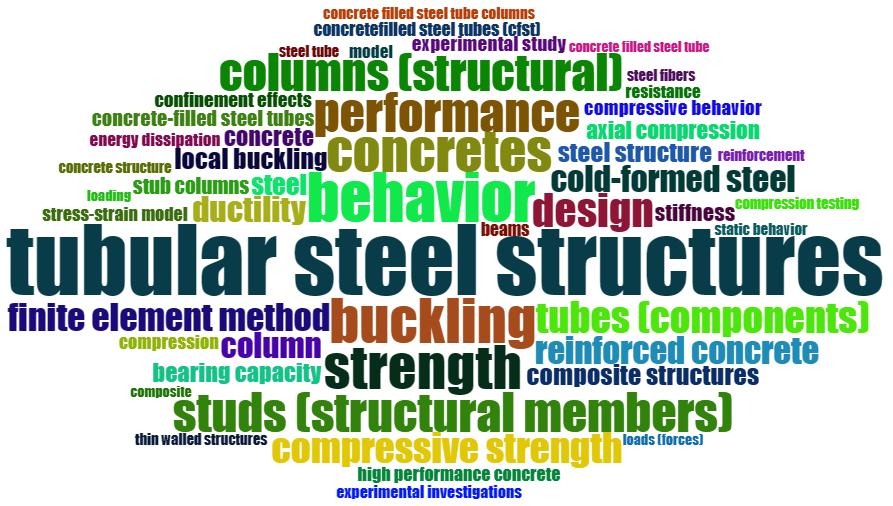
Author keywords serve as concise representations of scholarly article themes, providing insights into authors' preferencesandfocalareas[9].Figure4.illustratesaword cloudofthe50mostfrequentauthorkeywordsinpaperson circularconcrete-filledsteeltubestubcolumnsunderaxial compression.Notably,"tubularsteelstructures"iscentral, with "buckling" and "strength" following. Terms like "behavior," "concrete," "performance" (specifically in structural aspects), and "studs structural members" also hold significance. "Compressive strength" prominently emerges,especiallyinconcrete-filledsteeltubecolumnsand high-performance concrete domains. Performance parameters like "local buckling," "static behavior," and "ductility" are frequently employed for investigating structuralelementbehavior.
The paragraph introduces a thematic mapFigure 5. as a visual representation of the research landscape, utilizing author-defined keywords [16]. Employing two key dimensions, density and centrality, the thematic map elucidates internal connections and external associations amongresearchthemes.Theupper-rightquadrant,denoted asmotorthemes,emphasizesclusterspivotaltoconcretefilledsteeltubestubcolumns,withCluster1incorporating keywordslike "Tubularsteel structures,""concretes,"and "buckling," indicating high density and significance. The upper-leftquadrant,termednichethemes,includesclusters withnotabledevelopmentbutlesscrucialimportance,such as"staticbehavior"and"shearconnectors"inCluster1and "behavior" and "performance" in Cluster 2. The lower-left quadrant,denotingemergingordecliningthemes,exhibits lowercentralityanddensitywithkeywordslike"strength" and "corrosion." The lower-right quadrant, representing basic themes, comprises fundamental but less developed clusters, including "design," "steel," and "concrete." This analysis offers insights into interrelationships and the significance of research themes within the concrete-filled steeltubestubcolumnsdomain.
International Research Journal of Engineering and Technology (IRJET) e-ISSN: 2395-0056
Volume: 11 Issue: 02 | Feb 2024 www.irjet.net p-ISSN: 2395-0072
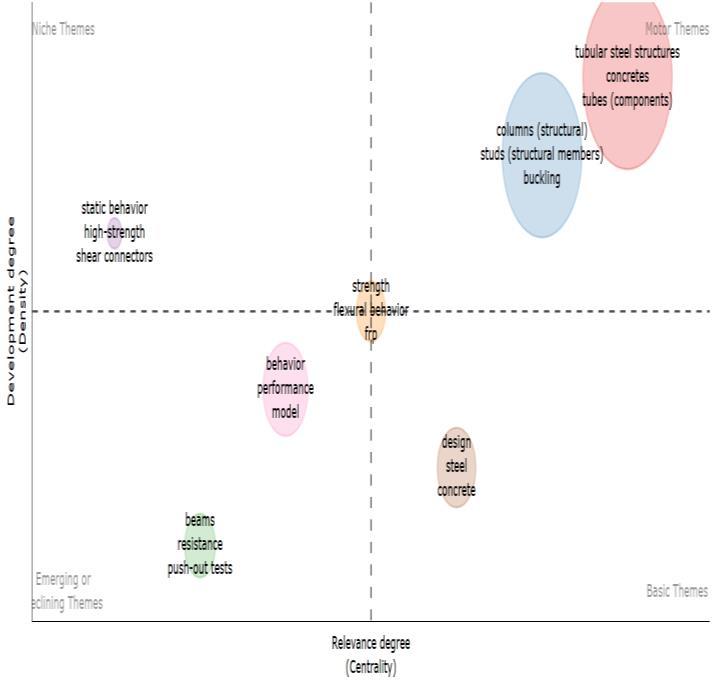
Figure5.Thematicmapofkeywords.
Thisparagraphexplorestheannualgrowthpatternsofthe top10keywords,depictedinFigure6.from2019to2023. The visualization reveals a consistent annual increase in eachkeyword,reflectingthestrengtheninganddevelopment ofconcrete-filledsteeltubestubcolumnsunderaxialload. Notably, "performance," "buckling," and "strength" consistently rank among the top three, with "composite structures"showingapronouncedupwardtrajectorysince 2021."Circularconcrete-filledsteeltubestubcolumnsunder axialcompression"hasexperiencedrapidgrowth,becoming thesixthmostcommonkeywordin2021.Despitehavingthe fewest occurrences, "performance" has witnessed a significant increase post-2020, suggesting its anticipated continuedrelevanceinfuturestudies.
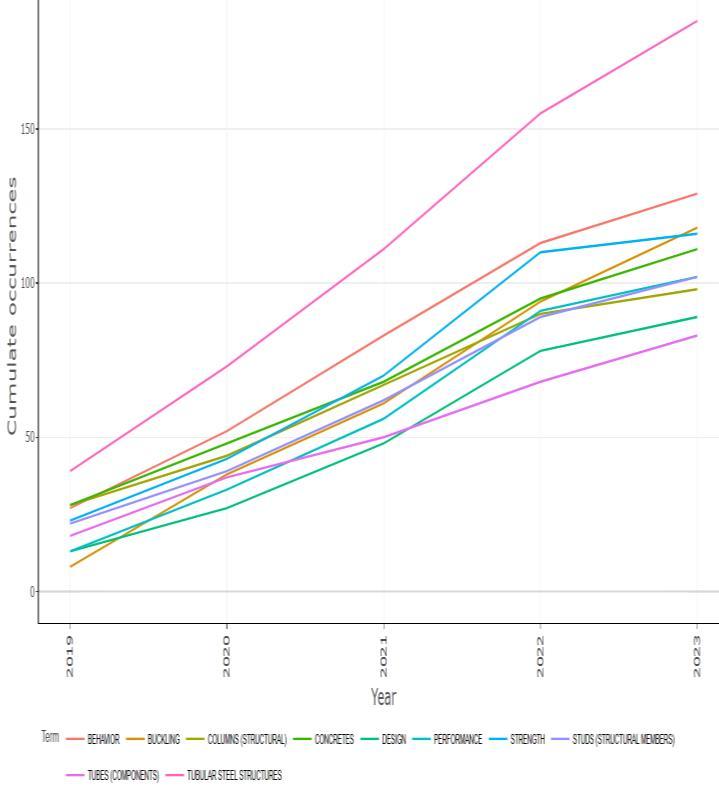
Figure6.Growthofthetop10keywords.
Theparagraphdelvesintotrendingtopicswithinconcretefilled steel tube stub columns under axial load. Figure 7. illustratesthefrequencyofkeywordoccurrencessince2019, withlargerblue-filledcirclesindicatinghigherfrequencies (ranging from 10 to 50). In 2019, "bolted connections," "micro-alloyedsteel,"and"concrete-filledsteeltube"were prominent.In2020,"experimentalinvestigation,""concretefilled steel tube," and "composite structures" gained attention.In2021,"buckling,""behavior,"and"tubularsteel structures"werenotable,continuingin2022with"concretefilledsteeltube(CFST),""compression,"and"localbuckling." From2022to2023,"ductilefracture,""shortcolumn,"and "confinedconcrete"emerged.Thesetopicsareanticipatedto sustainincreasedscholarlyinterestinconcrete-filledsteel tubestubcolumns.
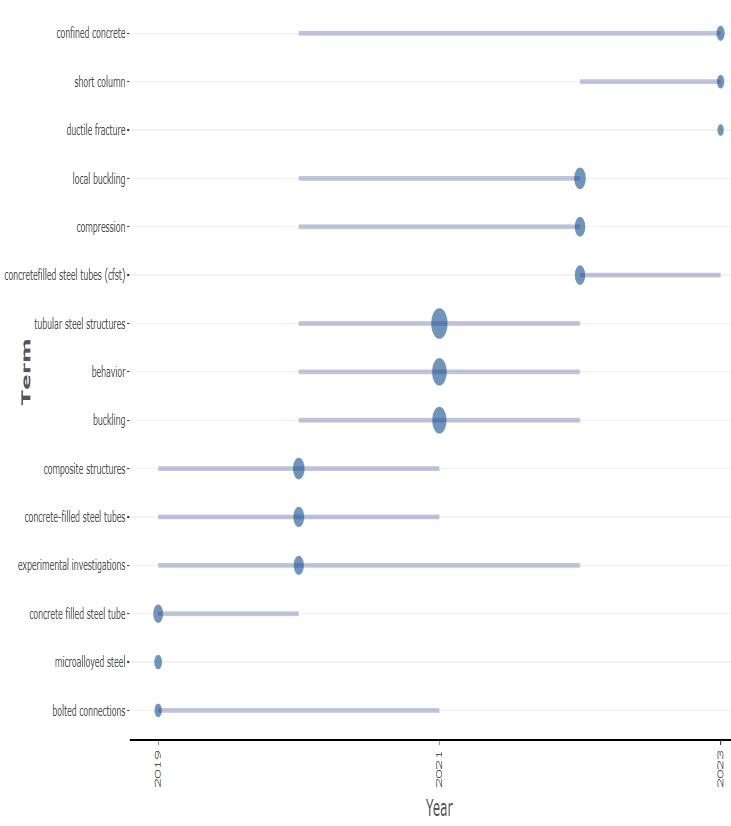
7.Latesttrendingtopics.
The paragraph employs a Sankey diagram (Figure 8) to comprehensively analyze the thematic evolution of the journal over time[17].This visualization method reveals interconnectionsanddevelopmentaltrajectoriesofvarious themes[18].Eachboxinthe diagramrepresentsa distinct theme,withboxsizereflectingthefrequencyofoccurrences. Thickerconnectinglinesindicatestrongerthematiclinkage. Aholisticexaminationindicatesincreasingdiversificationof themesincircularconcrete-filledsteel tubestubcolumns, potentiallyduetoscholarsfromdiversefields."Cold-formed steel" showed sustained attention from 2019 to 2023, emerging as the most popular theme in 2022-2023. Conversely, indicators like "seismic behavior," "local buckling," and "axial compression" have recently gained prominence, indicating ongoing research efforts in these aspects.
International Research Journal of Engineering and Technology (IRJET) e-ISSN: 2395-0056
Volume: 11 Issue: 02 | Feb 2024 www.irjet.net p-ISSN: 2395-0072
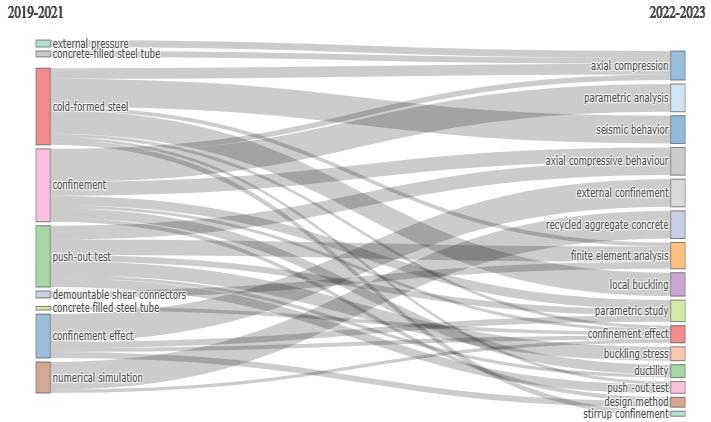
8.Thematicevolution.
The three-field plot within the Bibliometrix tool is instrumental for a comprehensive understanding of bibliometricresearch,encapsulatingmultipledimensionsin a single figure[16]. Figure 9 effectively depicts three key aspects: the most active 15 countries/regions in the concrete-filled steel tube stub columns field on the left, correspondingkeywordsinthemiddle,andprimarysources on the right. Scholars focus on "push-out test," "finite elementanalysis,""cold-formedsteel,""confinement,"and "localbuckling,"indicatingcurrenthottopics.Engineering structures, thin-walled structures, and construction and buildingmaterialsprominentlycontributetothefield.China, Australia,andtheUSAleadinpublications,coveringdiverse researchareas,aligningwithpreviousanalyses.
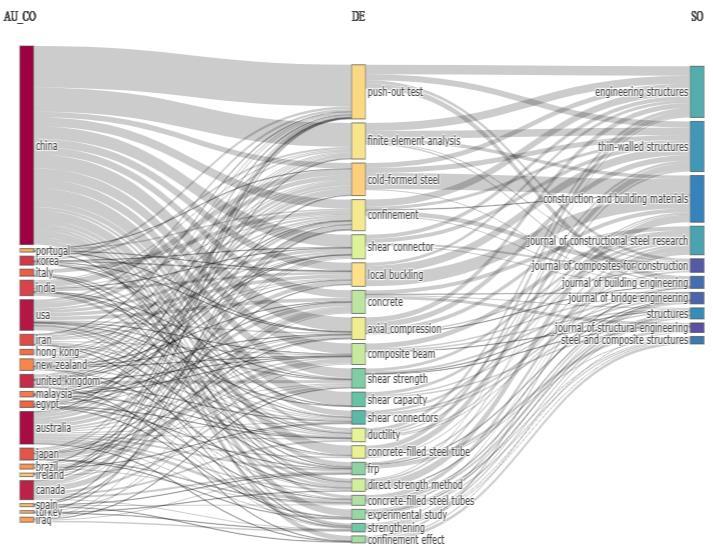
9.Three-fieldsplot.
The historiography of concrete-filled steel tube stub columns,depictedinFigure10a,aimstotracethehistorical developmentofthisfieldthroughachronologicalmapbased on significant citations. Each flow, color-coded for clarity, represents a direct citation, indicating the evolution of concepts over time. Nodes within the flows highlight core documents with high citations, considering both local and global citations. The largest citation stream in purple, stemming from [19]. research, provides insights into the ultimate bearing capacity of joints stiffened with external ringstiffeners.Notably,themostcitedauthor,Qu,markedin purple, contributed novel methods in 2021 and 2022, enhancingcolumnloadcapacitythroughtubestiffeners.The second-largestcitationstreaminred,beginningin2019and evolving in 2021, delves into the role of stiffeners and optimal design parameters for seismic performance improvement[20];[21].
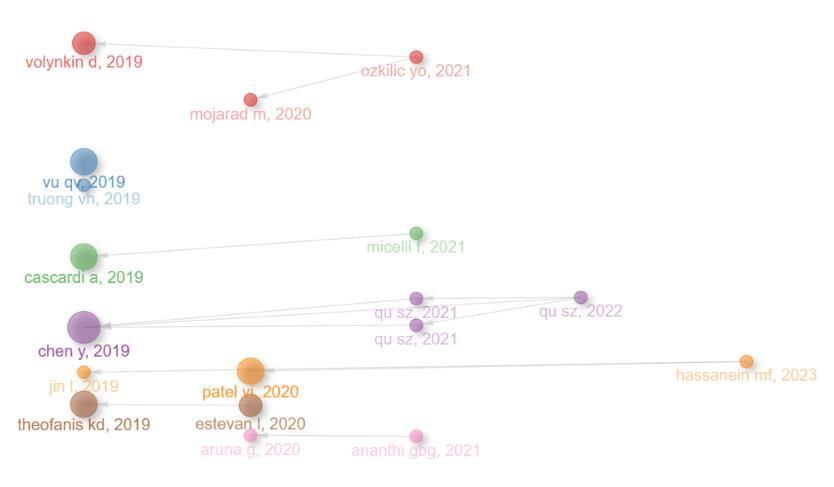
The analysis of co-citations among journals about publicationsonconcrete-filledsteeltubestubcolumnswas conductedinthisstudy.Co-citationreferstotheoccurrence whentwodocumentsfromdistinctjournalsreceivecitations from a common third document. Figure 10 b presents a visual representation of fifty journals involved in cocitations.Thejournalsaredepictedascoloredcircles,and thelinesconnectingthemrepresenttheco-linkagesbetween journals.Furthermore,thesizeofeachcirclecorrespondsto thecitationweight,indicatingtherelativesignificanceofthe journal intheco-citationnetwork [22].Theresultingmap
International Research Journal of Engineering and Technology (IRJET) e-ISSN: 2395-0056
Volume: 11 Issue: 02 | Feb 2024 www.irjet.net p-ISSN: 2395-0072
exhibits a clear division into three distinct clusters, distinguishedbydifferentcolors.Notably,thelargestcircles inthisnetworkareassociatedwiththefieldsofcomposite structures (represented in red), steel structures (represented in green), and advancedd structure engineering(representedinblue).
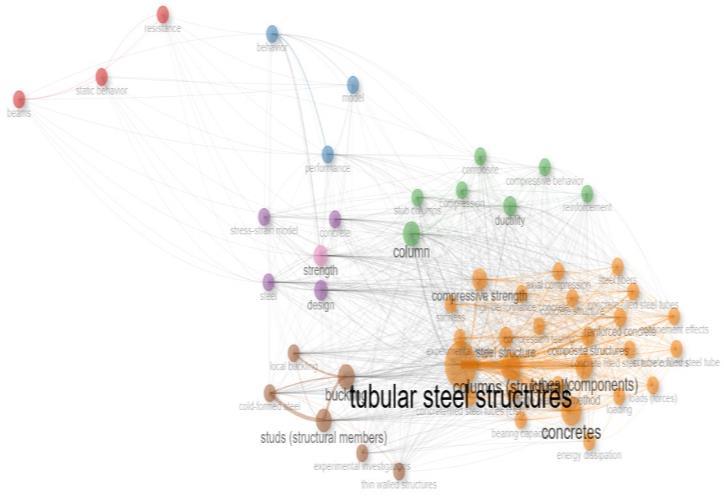
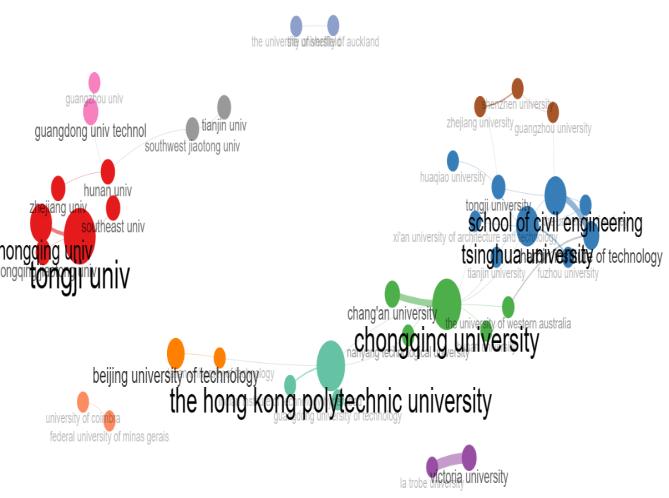
Figure 11 presents a collaboration network among institutions in the concrete-filled steel tube stub columns field.Institutionsaredepictedascoloredcircles,andtheir collaborations are represented by lines. The network is dividedintosevenclusters,eachassignedadifferentcolor. Analysisrevealsthatinstitutionswithinthesameclusterare predominantly from the same country or region. Notably, severalChineseinstitutionsformacluster,includingHunan University, Southeast University, Zhejiang University, and others. Australian institutions, such as The University of Sydney and La Trobe University, are also grouped. Noteworthysimilaritiesincumulativedegreeareobserved between the School of Civil Engineering and Tsinghua University,aswellasChongqingJiaotongUniversity.
Concrete-filled steel tube stub columns demonstrate substantial international collaboration, facilitating global academic exchange and knowledge dissemination. The international collaboration network illuminates interrelationships among countries and regions in this specialized field. Figure 12 provides a geographic-level overview,withshadingandlinethicknessrepresentingthe number and proportion of collaborations, respectively. Unsurprisingly, China emerges as the most active region, displaying robust collaboration with Australia. Figure 13 detailscountries/regionsbycollaborationsize,denotedby circle size, and line thickness reflects collaboration closeness. China leads in collaborations, followed by the UnitedKingdomandtheUSA,highlightingtheirsignificant contributions to research output. Notably, China and Australia exhibit a strong connection, emphasizing their willingnesstoengageincollaborativeresearcheffortswithin concrete-filledsteeltubestubcolumns.
International Research Journal of Engineering and Technology (IRJET) e-ISSN: 2395-0056
Volume: 11 Issue: 02 | Feb 2024 www.irjet.net p-ISSN: 2395-0072
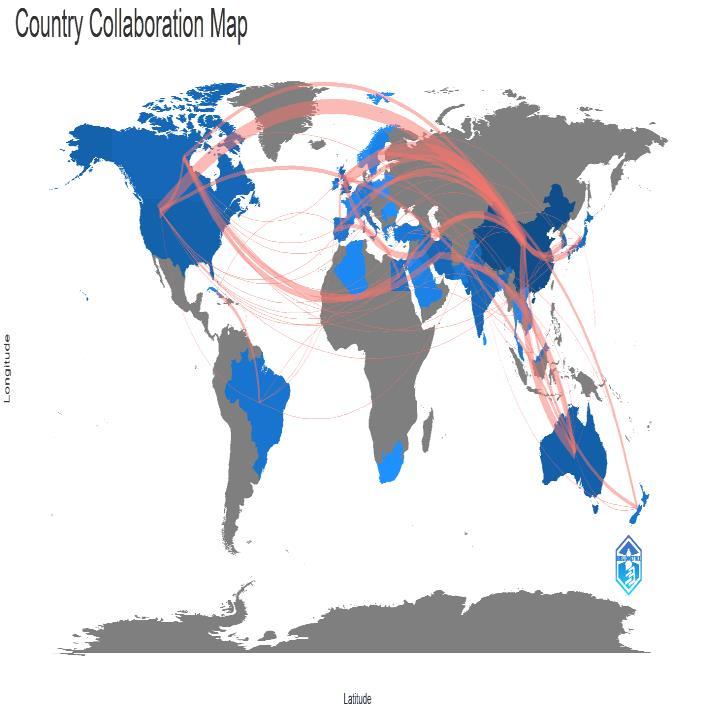
Figure12.Anoverviewofcooperationbetween countries/regions.
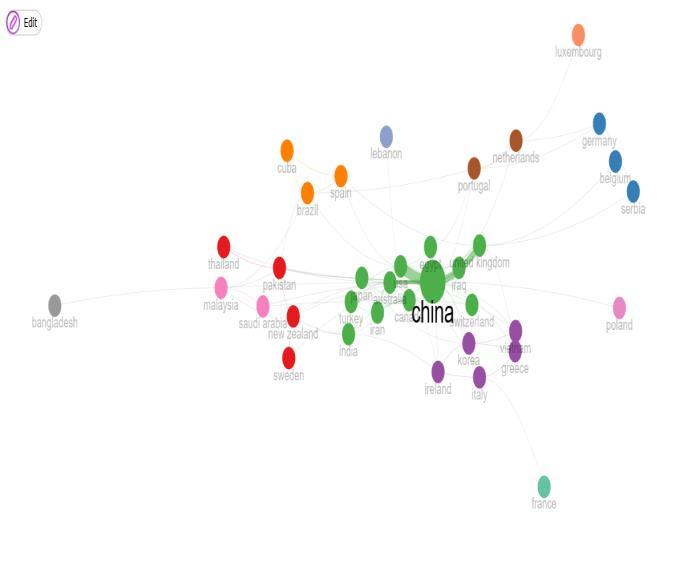
13.Collaborationnetworkofcountries/regions.
Thisstudyconductsacomprehensivebibliometricanalysis of journal publications on concrete-filled steel tubes from 2019to2023.Initiallyfocusingonthejournal'spublishing andcitationstructureregardingperformanceanalysis,the findingsrevealtherobustexpansionofcompositestructures overtime,withover600publications.Themost-citedwork, a path-dependent stress-strain model for concrete-filled
steel tube columns authored in 2020, emphasizes the journal'sglobalacademicrecognition.Chinaemergesasthe leader in research output, contributing 327 articles and receiving3065citations,surpassingAustraliainthesecond position. Eminent contributors such as Professor CHEN M andProfessorZHANGJfromChinaarehighlighted.
The examination encompasses author-defined keywords, institutional analyses, citation patterns, co-citations, and collaborativeresearchprojects.Notablekeywordsinclude "Tubular steel structures" and "concretes," reflecting a preference for simulation techniques and structural behavioranalysis.Thecollaborationnetworkrevealsseven clusters, indicating regional research collaboration, particularlyamongChineseandAustralianinstitutions.
Despitethestudy'sin-depthanalysis,certainweaknessesare acknowledged, including the need for a balance between quantity and quality in publications, as the increasing number of subfields requires careful consideration. The study'slimitations,stemmingfromtheScopusandWebof Sciencedatabases,arerecognized,with23documentsbeing disregardedasduplicates.Futureresearchshouldaddress theseissuesto enhancedata qualityandcontributetothe advancement of knowledge in the field of concrete-filled steeltubes.
[1] H. Dong, X. Liang, W. Cao, L. Zhao, and J. Zhang, “CyclicbehaviorofcircularCFSTstubcolumnswith differentinnerconstructions,” J. Build. Eng.,vol.53, no. April, p. 104549, 2022, doi: 10.1016/j.jobe.2022.104549.
[2] X. Wang, J. Lai, J. Qiu, W. Xu, L. Wang, and Y. Luo, “Geohazards,reflectionandchallengesinMountain tunnelconstructionofChina:adatacollectionfrom 2002to2018,” Geomatics, Nat. Hazards Risk,vol.11, no. 1, pp. 766–784, 2020, doi: 10.1080/19475705.2020.1747554.
[3] C.Yang,Z.X.Yu,Y.P.Sun,L.Zhao,andH.Zhao,“Axial residualcapacityofcircularconcrete-filledsteeltube stubcolumnsconsideringlocalbuckling,” Adv. Steel Constr., vol. 14, no. 3, pp. 496–513, 2018, doi: 10.18057/IJASC.2018.14.3.11.
[4] C.Yang,H.Zhao,Y.Sun,andS.Zhao,“Compressive stress-strain model of cold-formed circular hollow section stub columns considering local buckling,” Thin-WalledStruct.,vol.120,no.March,pp.495–505, 2017,doi:10.1016/j.tws.2017.09.017.
[5] M. Su, Y. Cai, X. Chen, and B. Young, “Behaviour of concrete-filled cold-formed high strength steel circularstubcolumns,” Thin-WalledStruct.,vol.157, no. April, p. 107078, 2020, doi:
International Research Journal of Engineering and Technology (IRJET) e-ISSN: 2395-0056
Volume: 11 Issue: 02 | Feb 2024 www.irjet.net p-ISSN: 2395-0072
10.1016/j.tws.2020.107078.
[6] G.Du,Z.Liu,W.Jiao,H.Yuan,andT.Zhang,“Behavior of embedded steel profile ultra-high performance concrete-filledstainlesssteeltubularshortcolumns under axial compression,” Structures, vol. 54, no. May, pp. 183–197, 2023, doi: 10.1016/j.istruc.2023.05.006.
[7] Y.Wang,L.Yang,H.Yang,andC.Liu,“Behaviourof concrete-filled corrugated steel tubes under axial compression,” Eng. Struct., vol. 183, pp. 475–495, 2019, doi: https://doi.org/10.1016/j.engstruct.2018.12.093.
[8] Z.Ding,K.Zheng,andY.Tan,“BIMresearchvsBIM practice: a bibliometric-qualitative analysis from China,” Eng. Constr. Archit. Manag.,vol.29,no.9,pp. 3520–3546, 2022, doi: 10.1108/ECAM-01-20210071.
[9] Z. Xiao, Y. Qin, Z. Xu, J. Antucheviciene, and E. K. Zavadskas, “The Journal Buildings: A Bibliometric Analysis (2011–2021),” Buildings, vol. 12, no. 1, 2022,doi:10.3390/buildings12010037.
[10] F. Alatshan, S. A. Osman, R. Hamid, and F. Mashiri, “Stiffened concrete-filled steel tubes: A systematic review,” Thin-Walled Struct.,vol.148,no.January,p. 106590,2020,doi:10.1016/j.tws.2019.106590.
[11] J. Thomas and T. N. Sandeep, “Capacity of short circular CFST columns with inner vertical plates weldedintermittently,” J. Constr. Steel Res.,vol.165, p.105840,2020,doi:10.1016/j.jcsr.2019.105840.
[12] Y.Zhang,M.Deng,R.Li,Z.Dong,andH.Sun,“Axial behavior of engineered cementitious composites confined by circular steel tubes,” Eng. Struct., vol. 224, no. August, p. 111216, 2020, doi: 10.1016/j.engstruct.2020.111216.
[13] J.X.Li,J.T.Wang,Q.Sun,Y.R.Wu,S.M.Zhou,andF. C. Wang, “Axial Compression Behavior of Circular Concrete-Filled High-Strength Thin-Walled Steel TubularColumnswithOut-of-CodeD/tRatios,” Adv. Mater. Sci. Eng., vol. 2021, 2021, doi: 10.1155/2021/9081566.
[14] M.U.Hossain,J.C.Liu,D.Xuan,S.T.Ng,H.Ye,andS.J. Abdulla,“Designingsustainableconcretemixeswith potentiallyalternativebindersystems:Multicriteria decisionmakingprocess,” J. Build. Eng.,vol.45,no. September 2021, p. 103587, 2022, doi: 10.1016/j.jobe.2021.103587.
[15] J.Chen,Y.Wang,C.W.Roeder,andJ.Ma,“Behaviorof normal-strength recycled aggregate concrete filled steel tubes under combined loading,” Eng. Struct.,
vol. 130, pp. 23–40, 2017, doi: 10.1016/j.engstruct.2016.09.046.
[16] J. R. Mumu, T. Tahmid, and M. A. K. Azad, “Job satisfaction and intention to quit: A bibliometric reviewofwork-familyconflictandresearchagenda,” Appl. Nurs. Res., vol. 59, p. 151334, 2021, doi: 10.1016/j.apnr.2020.151334.
[17] M. Aria, M. Misuraca, and M. Spano, “Mapping the Evolution of Social Research and Data Science on 30Years of Social Indicators Research,” Soc. Indic. Res., vol. 149, no. 3, pp. 803–831, 2020, doi: 10.1007/s11205-020-02281-3.
[18] AbhishekandM.Srivastava,“Mappingtheinfluence of influencer marketing: a bibliometric analysis,” Mark. Intell. Plan.,vol.39,no.7,pp.979–1003,2021, doi:10.1108/MIP-03-2021-0085.
[19] Y.Chen et al.,“Ultimate bearingcapacityofCHS Xjoints stiffened with external ring stiffeners and gussetplatessubjectedtobracecompression,” Eng. Struct., vol. 181, no. December 2018, pp. 76–88, 2019,doi:10.1016/j.engstruct.2018.12.005.
[20] S. Qu, S. Wei, J. Yuan, and Q. Sun, “Tension and compressionstiffnessofringstiffenerintube–gusset plateconnections,” Thin-Walled Struct.,vol.166,no. June, p. 108067, 2021, doi: 10.1016/j.tws.2021.108067.
[21] S. Qu, Q. Li, Y. Wang, J. Yuan, and Q. Sun, “Failure pattern and load distribution mechanism of stiffeners in the tube–gusset plate connection: Testing, numerical modelling and theoretical analysis,” Structures,vol.36, no. October 2021, pp. 951–978,2022,doi:10.1016/j.istruc.2021.12.049.
[22] D. Guleria and G. Kaur, “Bibliometric analysis of ecopreneurship using VOSviewer and RStudio Bibliometrix,1989–2019,” Libr. Hi Tech,vol.39,no. 4,pp.1001–1024,2021,doi:10.1108/LHT-09-20200218.