
Smart Electronic Voting Machine
Sneha Vilasrao Pujari
Student of Government College of Engineering,Yavatmal
Abstract –
Electronic Voting Machines (EVMs) have emerged as a key technology in modern electoral systems, transforming the way citizens cast their votes and elections are conducted. Thisresearchpaperprovidesacomprehensivereviewofthe evolution, functioning, challenges, and future prospects of Electronic Voting Machines. The paper explores the historicaldevelopmentofEVMs,theircurrentstatusglobally, and the critical issues surrounding their implementation. Additionally, the research examines potential advancements and innovations that could shape the future of electronic voting.
1.INTRODUCTION
Electronic Voting Machines (EVMs) are electronic devices used for casting and counting votes in elections. These machines have replaced traditional paper ballots in many countries around the world. EVMs were first introduced in the United States in the 1960s and have since gained widespread use due to their convenience, accuracy, and efficiency.Inthispaper,wewillexplorethehistory,working, and controversies surrounding EVMs. Security is a paramountconcerninelections,andEVMsaredesignedwith multiple layers of security features. They are tamperevident, and their software is encrypted to prevent any unauthorizedaccessormanipulation.
1.1 History of EVMs
The concept of EVMs was first introduced in the United States in the 1960s by JosephHarris, who patented the first electronic voting machine. However, it was not until the 1980s that EVMs gained popularity and were used in a few states during the presidential elections. In the 1990s, India became the first country to adopt EVMs for its national elections. Since then, many countries, including Brazil, Venezuela, and Belgium, have also switched to EVMs for conducting their elections. Voters need to press a button next to the symbol of their chosen candidate, and the machine records their vote electronically. This not only reduces the chances of invalid votes but also speeds up the entire voting process. While EVMs have significantly improved the efficiency and accuracy of elections, they are not without controversy. Some critics raise concerns about thepotentialforelectronicmanipulationandlackofapaper trailforauditing.However,electionauthoritiescontinuously work to enhance the security and transparency of EVMs to ensure the integrity of the democratic process. One of the keyadvantagesofEVMsistheirsimplicity.
1.1960s-1970s: The concept of electronic voting started gaining traction in the 1960s and 1970s. The initial prototypes were developed, experimenting with various technologiestocreateareliableandsecureelectronicvoting system.
2.1980s: The first large-scale deployment of EVMs took placeinthe1980s,primarilyinindustrializedcountries like the United States and some European nations. These early versions were often standalone devices with limited functionality.
3.India's Introduction (1982): India became one of the early adopters of EVMs on a large scale. The Election Commission of India introduced EVMs in a limited capacity for the first time during the Kerala Assembly elections in 1982.Thesuccessofthistrialledtothegradualexpansionof EVMusageacrossthecountry.
4.Global Adoption (1990s): Throughout the 1990s, more countries embraced EVMs as a way to streamline the election process, reduce counting errors, and enhance the overall efficiency of elections.LatinAmerican and European countries,inparticular,sawincreasedadoption. International Research Journal of Engineering and Technology (IRJET)
International Research Journal of Engineering and Technology (IRJET) e-ISSN: 2395-0056 Volume: 11 Issue: 02 | Feb 2024 www.irjet.net p-ISSN: 2395-0072
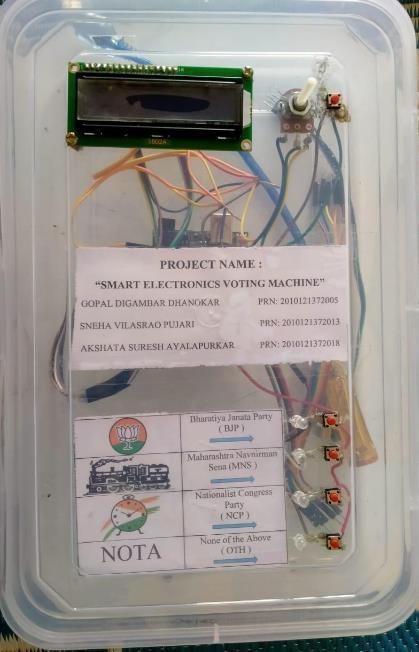
1.2 Components required
1.ArduinoUNOBoard
2.16×2LCDDisplay
3.Potentiometer10k
4.PushButtonSwitch
5.ConnectingWires
6.Breadboard
1.3 Block Diagram

1.4 Circuit Diagram

1.5 Working
EVMs are standalone electronic devices that are battery operatedandcanfunctionwithouttheneedforanyexternal power source. The machine has two units - the control unit and the balloting unit. The control unit is kept with the election officer, while the balloting unit is placed inside a voting compartment, where voters can cast their vote by
pressing a button against the candidate of their choice. The machine incorporates advanced security features, such as one-time programmable (OTP) microcontrollers and dynamic coding, to prevent tampering and ensure the integrityofthevotingprocess.
1.Voter Authentication:
UseRFIDcardsorbiometricsensorsforvoteridentification. Verifyvotereligibilityandpreventduplicatevoting.
2.Candidate Selection:
Displaycandidatenamesonascreen. Useakeypadorbuttonsforvoterstoinputtheirchoices.
3.Vote Casting:
Recordthevotesinasecurememorymodule. Ensure that the vote is anonymous and cannot be traced backtothevoter.
4.Security Measures:
Implementencryptiontosecurethevotingdata. Include tamper-evident features to detect any physical tampering.
5.Verification and Confirmation:
Displayasummaryoftheselectedcandidatesforthevoterto confirm.
Addaconfirmationsteptoavoidaccidentalvotes.
6.Results Display:
Oncevotingiscomplete,displaytheresultssecurely. Ensure that the results are accurate and cannot be manipulated.
7.Audit Trail :
Includeapapertrailordigitalauditlogfortransparency. This could be a printed receipt or a digital record that the votercanreview.
8.Legal and Ethical Considerations:
Ensurecompliancewithlocalelectionlawsandregulations. Consultwithrelevantauthoritiestomeetsecuritystandards.

2. Controversies surrounding EVMs
Despite the advantages of EVMs, they have faced criticism andcontroversies.Oneofthemajorconcernsisthesecurity of the machines. There have been allegations of tampering withEVMstomanipulateelectionresults.In2019,agroupof researchers claimed to have hacked an EVM in under 4 minutes, raising concerns about the vulnerability of the machines. Moreover, the lack of a paper trail in EVMs has also been a cause of concern. In case of any dispute or recount, there is no way to verify the accuracy of the votes castonanEVM.Thishasledtodemandsfortheintroduction of Voter Verifiable Paper Audit Trail (VVPAT) machines, whichprovideaprintedrecordofthevotecastbythevoter.
3. Advantages and Disadvantages
Advantages of EVMs:
1.Speed and Efficiency:
One of the biggest advantages of EVMs is their speed and efficiency. With the use of EVMs, the process of casting and counting votes is much faster and more accurate compared to the traditional paper ballot system. This eliminates the long wait for results and reducesthechancesofhumanerrorinvotecounting.
2.Cost-effective:
EVMsarecost-effectiveinthelongrunastheyeliminate theneedforprintingandtransportingmillionsofpaper ballots. This not only saves money but also reduces the environmentalimpactofpaperproductionanddisposal.
3.Accessibility:
EVMsaredesignedtobeuser-friendlyandaccessibleto all voters, including those with disabilities. The machineshavefeaturessuchasBraillelabelsandaudio
instructions, making it easier for visually impaired individualstocasttheirvotesindependently.
4.Reduced chances of fraud:
EVMs have been praised for their ability to reduce the chances of electoral fraud. With the use of electronic machines, it is nearly impossible to tamper with votes or altertheresults.Thisensuresafairandtransparentelection process.
5.Multiple language options:
EVMs can be programmed to display voting options in multiple languages, making it easier for voters from diverse backgroundstounderstandandcasttheirvotesaccurately.
6.Easy to transport and store:
EVMs are compact and lightweight, making them easy to transportandstore.Thisisespeciallybeneficialforcountries with difficult terrains or remote areas, where traditional ballotboxesmaybechallengingtotransport.
Disadvantages of EVMs:
1.Vulnerable to hacking:
EVMs are electronic devices and are vulnerable to hacking. There have been cases where EVMs have been tampered with, raising concerns about the security of the voting process.
2.Lack of transparency:
Unlike paper ballots, where voters can physically see their vote being cast, EVMs do not provide the same level of transparency. This can lead to doubts and suspicions about theaccuracyofthevotingprocess.
3.Technical glitches:
EVMs are machines, and like any other technology, they are prone to technical glitchesand malfunctions. This cancause delays in the voting process and raise questions about the credibilityoftheresults.
4.Cost of maintenance and training:
EVMs require regular maintenance and training for election officials to operate them effectively. This can be costly for governments,especiallyindevelopingcountrieswithlimited resources.
International Research Journal of Engineering and Technology (IRJET) e-ISSN: 2395-0056
Volume: 11 Issue: 02 | Feb 2024 www.irjet.net p-ISSN: 2395-0072
5.Digital divide:
EVMsrelyontechnology,whichmeanstheycanonlybeused bythosewhoarefamiliarwithtechnology.Thiscancreatea digital divide, where certain demographics may not be able toexercisetheirrighttovote.
6.Lack of paper trail:
Unlike paper ballots, EVMs do not provide a paper trail, makingitdifficulttoconductmanualrecountsincaseofany discrepanciesorallegationsoffraud.
4.Evolution of Electronic Voting Machines:
1.Early Innovations : This subsection delves into the early developments and prototypes of electronic voting systems, highlighting key milestones that led to the creation of the modernEVM.
2.Advancements in Technology : Discuss the technological advancementsthathaveshapedthedesignandfunctionality of EVMs over the years, including improvements in hardware,softwareandsecurityfeatures.
3.Mechanical Voting Machines:
Before the advent of electronic systems, mechanical voting machines were used in some regions. These machines typically involved levers or buttons for voters to indicate theirchoices,withmechanicalcountersfortallyingvotes.
4.Introduction of Electronic Voting Machines (1970s1980s):
The first generation of electronic voting machines emerged in the 1970s and 1980s. These machines replaced the mechanical componentswithelectroniccircuits,providinga moreefficientandreliablewaytoconductelections.
5.India's Pioneering Efforts (1980s):
Indiaplayedapioneeringroleinthewidespreadadoptionof EVMs.TheElectionCommissionofIndiaintroducedEVMsin a limited capacity during the Kerala Assembly elections in 1982.Thesuccessofthistrial ledtothegradual nationwide implementationofEVMs.
6.Advancements in Technology (1990s):
Throughout the 1990s, EVMs underwent technological improvements. Enhanced security features, tamper-evident mechanisms, and more user-friendly interfaces were introduced.
7.Direct Recording Electronic (DRE) Systems:
The late 1990s and early 2000s saw the rise of Direct RecordingElectronic(DRE)systems.Thesesystemsallowed voterstointeractdirectlywithadigitalinterface,oftenusing touchscreen technology. DREs offered a more intuitive experienceandreducedthechancesofvotingerrors.
8.Voter-Verified Paper Audit Trail (VVPAT):
Responding to concerns about the lack of a paper trail in electronic voting, many EVMs incorporated Voter-Verified Paper Audit Trail (VVPAT) systems. VVPAT allows voters to review a paper receipt of their vote before it is cast electronically, providing an additional layer of transparency andverification.
9.Remote and Internet Voting Experiments:
Some regions explored remote and internet voting systems, allowingvoterstocasttheir ballotsfromtheconvenienceof their homes. However, these systems pose significant securitychallengesandhavenotbeenwidelyadopteddueto concernsabouttamperingandprivacy.
10.Continuous Security Enhancements:
EVMscontinuetoundergosecurityenhancementstoaddress emerging threats. Encryption, secure boot processes, and comprehensivetestingprotocolsareemployedtoensurethe integrityofthevotingprocess.
11.Global Standardization Efforts:
International organizations and election commissions collaborate on standardizing EVM technology to ensure compatibility, reliability, and security across different systems.
5. Current Global Status of EVM Implementation:
India:
India has extensively adopted EVMs since the 2000s. The Election Commission of India has been using EVMs in national andstateelections,andthe technologyhasbecome astandardpartoftheelectoralprocess.
United States:
The use of electronic voting systems varies across states in the U.S. Some states use paper ballots, while others use different types of electronic systems, including Direct Recording Electronic (DRE) machines. However, concerns aboutthesecurityandintegrityofelectronicvotinghaveled
-0056
Volume: 11 Issue: 02 | Feb 2024 www.irjet.net p-ISSN: 2395-0072
some regions to revert to or introduce paper trails for verification.
European Union:
European countries have diverse approaches to electronic voting. Some countries, like Estonia, have implemented evoting systems, allowing citizens to vote online. However, othercountrieshavebeenmorecautiousduetosecurityand transparencyconcerns.
Latin America:
Several countries in Latin America have adopted EVMs to varying degrees. Brazil, for example, has been using electronic voting machines for its national elections. However,therehavebeendiscussionsanddebatesaboutthe securityandreliabilityofthesesystems.
Africa:
Some African countries have adopted electronic voting technology, while others continue to use traditional paper ballots. The adoption rate varies, and concerns about the reliability andsecurity of electronicvotinghave beenraised insomeregions.
Asia-Pacific:
BesidesIndia,othercountriesintheAsia-Pacificregionhave explored or implemented electronic voting to different extents. Australia, for instance, uses paper-based ballots, whilecountrieslikethePhilippineshaveexperimented with automatedsystems.
Middle East:
Some Middle Eastern countries have introduced electronic voting systems, while others continue to rely on traditional methods.Theuseof technologyin electionsvariesbasedon thecountry'sinfrastructureandpoliticalconsiderations.
Global Concerns:
Regardlessof regional differences,thereare global concerns about the security and transparency of electronic voting systems.Manycountriescontinuetograpplewithfindingthe right balance between embracing technology for efficiency andensuringtheintegrityofthedemocraticprocess.
6.Challenges Associated with EVM Usage:
1.Security Concerns:
Explore issuesrelated tothesecurityofEVMs,includingthe potential for tampering, hacking and other malicious activities.
2.Accessibility and Usability :
Examine challenges associated with the usability of EVMs, especially for voters with disabilities or those unfamiliar withtechnology.
3.Public Trust and Transparency:
DiscusstheconcernsrelatedtopublictrustinEVMsandthe transparency of the electoral process when using electronic votingsystems.
4.Technological Failures:
Like any electronic device, EVMs can experience technical glitches or malfunctions. Software bugs, hardware failures, orothertechnicalissuesmaydisruptthevotingprocessand leadtoconcernsabouttheaccuracyoftheresults.
5.Accessibility and Inclusivity:
Some argue that EVMs may not be accessible to all voters, especially those with disabilities. Ensuring that electronic voting systems are inclusive and accommodate a diverse rangeofvotersisachallengethatneedstobeaddressed.
6.Cost of Implementation:
Implementing and maintaining EVMs can be costly for election authorities. The initial investment, as well as ongoing expenses for training, maintenance, and updates, canposefinancialchallengesforsomecountriesorregions.
7.Political Controversies:
EVMs are sometimes at the center of political controversies, with allegations of manipulation or rigging. Accusations of bias in the programming or deployment of EVMs can underminepublicconfidenceinelectionoutcomes.
8.Cybersecurity Threats:
Withtheincreasingsophisticationofcyberthreats,concerns about the vulnerability of electronic voting systems to hacking and cyber attacks have grown. Safeguarding EVMs
International Research Journal of Engineering and Technology (IRJET) e-ISSN: 2395-0056
Volume: 11 Issue: 02 | Feb 2024 www.irjet.net p-ISSN: 2395-0072
against cyber threats is a continuous challenge for election authorities.
9.Resistance to Change:
Traditionalists may resist the shift from paper-based voting to electronic systems. Overcoming resistance to change and ensuringthatallstakeholders,includingpoliticalpartiesand the public, are comfortable with the technology can be challenging.
7.Future
Prospects and
Innovations:
1.Blockchain Technology:
Explore the potential integration of blockchain Technologytoenhancethesecurityandtransparencyof EVMs.
2.Biometric Authentication:
Discussthefeasibilityandimplicationsof incorporating biometric authentication methods into EVMs for improvedvoterverification.
4.Enhanced Security Measures:
FutureEVMsarelikelytoincorporateevenmorerobust security features to address concerns about hacking, tampering, and cyber threats. Advances in encryption, secure hardware, and software integrity checks could strengthen the overall security posture of electronic votingsystems.
5.Risk Mitigation Strategies:
Electionauthoritiesmayimplementcomprehensiverisk mitigation strategies, including regular security audits, penetration testing, and collaboration with cybersecurity experts. Proactive measures to identify and address vulnerabilities could become standard practice.
6.Voter-Verified Paper Audit Trail (VVPAT) Standardization:
The adoption and standardization of Voter-Verified Paper Audit Trail (VVPAT) systems may become more widespread. VVPAT provides a physical record of each vote, allowing voters to verify their choices and adding an additional layer of transparency to the voting process.
7.Accessible and Inclusive Design:
Future EVMs are likely to focus on improving accessibility and inclusivity. Designs that accommodate voters with disabilities, language preferences, and diverse needs could become standard to ensure a more inclusiveelectoralprocess.
8.Hybrid Systems:
Some regions may adopt hybrid voting systems that combine electronic and paper-based methods. This approach aims to leverage the efficiency of EVMs while maintaining a physical paper trail for auditability and voterconfidence.
9.Remote and Online Voting Experiments:
Ongoing advancements in technology might lead to further experimentation with remote and online voting systems. However, addressing the associated cybersecurity challenges and ensuring the integrity of remotevotingwillbecritical
8. CONCLUSIONS:
EVMs have both advantages and disadvantages. They have undoubtedly increased the disefficiency and accuracy of the voting process, but they also have their share of flaws. It is essential to address the concerns surroundingEVMsandtakenecessarymeasurestoensure thesecurityandtransparencyofthevotingprocess.EVMs shouldbeusedasatooltoenhancedemocracy,notreplace it. A transparent and well-regulated electoral process is crucial for a fair and democratic society, and the use of EVMsshouldbecarefullyconsideredtoachievethisgoal.
REFERENCES
[1]BenjaminB.,Bederson,BongshinLee.,RobertM. Sherman.,PaulS.,Herrnson,RichardG.Niemi.,“Electronic Voting System Usability Issues”, In Proceedings of the SIGCHI conference on Human factors in computing systems,2003.
[2]Ashok Kumar D., Ummal Sariba Begum T., “A Novel design of Electronic Voting System Using Fingerprint”, International Journal of Innovative Technology & Creative Engineering(ISSN:2045-8711),Vol.1,No.1.pp:12-19,January 2011.
[3]R. Agrawal and E. L. Wimmers. A Framework for Expressing and Combining Preferences”In SIGMOD ’00: Procs of the 2000 ACM SIGMOD international conference on
International Research Journal of Engineering and Technology (IRJET) e-ISSN: 2395-0056
Volume: 11 Issue: 02 | Feb 2024 www.irjet.net p-ISSN: 2395-0072
Management of data, pages 297–306, New York, NY, USA, 2000.ACM.
[4]Andreadis. Voting advice applications: a successful nexus between informatics and political science. In Proceedings of the 6th Balkan Conference in Informatics, pages 251–258. ACM,2013.
[5]S. Borzsony , D. Kossmann, and K. Stocker. The skyline operator. In Procs of the 17th International Conference on DataEngineering(ICDE’2001),pages421–430.IEEE,2001.
[6]E. G. Carmines and J. A. Stimson. The two faces of issue voting. The American Political Science Review, pages 78–91, 1980.
[7]Z. Enyedi. The influence of voting advice applications on preferences, loyalties and turnout: An experimental study. PoliticalStudies,pages1467–9248,2015.
[8]L. Faulkner. Beyond the five-user assumption: Benefits of increased sample sizes in usability testing. Research Methods,Instruments,&Computers,35(3):379–383,2003.
[9]The Semantic Web–ISWC 2014, pages 438–453. Springer, 2014.
[10].P.Fishburn.”UtilityTheoryforDecisionMaking”.Wiley, NewYork,1970.
[11] P. C.Fishburn ,Utility theory for decision making. Technicalreport,DTICDocument,1970.
[12]M. German , F. Mendez, J. Wheatley, and U. Serd¨ult. Spatial maps in voting advice applications: The case for dynamicscalevalidation.ActaPolitica,50(2):214–238,2015.
BIOGRAPHIES

SnehaVilasraoPujari StudentofGovernment collegeof Engineering Yavatmal
2024, IRJET | Impact Factor value: 8.226 | ISO 9001:2008