
International Research Journal of Engineering and Technology (IRJET) e-ISSN: 2395-0056
Volume: 11 Issue: 02 | Feb 2024 www.irjet.net p-ISSN: 2395-0072
International Research Journal of Engineering and Technology (IRJET) e-ISSN: 2395-0056
Volume: 11 Issue: 02 | Feb 2024 www.irjet.net p-ISSN: 2395-0072
Vishakha Mistry
Head of Department, Department of Information Technology, 360 Research Foundation, Tumkaria, Bihar, India
Abstract - Agriculture is an essential means of earning income for a significant percentage of the worldwide population. As a result, the productivity of crops has become crucial all over the world. Farmers will get more benefitsfrom using modern digital tools for autonomous disease detection. Because agriculture is a complex field, it is particularly essential to improve the interpretability of agricultural ML models. First, the article proposes to identify leaf disease in Mango plants via pre-trained deep-learning architecture. Secondly, for the purposeofdemonstratingthe interpretability of my model's choice, I made use of Local InterpretableModelAgnostic Explanations (LIME), an explainable AI (XAI) tool.
Key Words: leaf disease detection, Transfer learning, explainableArtificialIntelligence(XAI),LocalInterpretable Model-agnosticExplanations(LIME)
Artificialintelligenceandmachinelearningarenowusedin diverseagriculturalapplications.Themangofruittreeisa highlycultivatedcropthatiseconomicallyimportantacross the majority of the world. In general, it is highly prized becauseofitsbeneficialnutrientcontentandmouthwatering taste,anditplaysanimportantpartinthelivesofmillionsof farmers. However, this crop is susceptible to a variety of illnesses,whichcanreducetheyieldandoverallqualityof the plants. The quick identification of these diseases in mangoplantsisneededtopreventthespreadofdisease.The original method for identifying mango leaf disease was visualexaminationbyagriculturalprofessionals. Whichhas time commitment and knowledge-dependent limitations. Automaticleafdiseaseidentificationisaccomplishedviathe useofmachinelearningandcomputervisiondisciplines.
The goal of this research is to identify mango leaf disease usingapre-trainedtransferlearning-basedmachinelearning system.Model interpretabilitymustalsobe researched as thenumberofconvolutionneuralnetworksgrowsandthe framework black box interpretability problem becomes more relevant. In order to make the models more transparent and interpretable, explanatory artificial intelligence (XAI) reveals its importance, which is considered to be at the highest level of explainability, accuracy,andperformance[1].Researchersarebetterable tocomprehendthereasoningbehindtheoutcomesofdeep
learningframeworkswhentheoutputoftheLIMEmodelis visuallyrepresented.
Severalacademicsofferednumerousmachinelearning(ML) anddeeplearning(DL)methodologiesfordetectingvarious diseasesinplantleaves.
AdiDwifanaSaputra,DjarotHindarto,HandriSantoso[2] havepresented riceleaves diseaseclassification using the Convolutional Neural Network algorithm with DenseNet architecture.TheaccuracyofDenseNet211was91.67%,that of DenseNet169 was 90%, and that of DenseNet201 was 88.33%.Thetrainingdurationofthemodelwas24seconds.
Authorsin[3]haveusedPlantVillageandPlantDocdataset to identify leaf disease in the corn plant. EfficientNetB0 architecture was used in this research article. The performanceoftheproposedarchitectureiscomparedwith Inception V3, VGG16, Resnet50, Resnet101, and Densenet121.Theproposedapproachachievedanaccuracy of 98.85% and a precision of 88% and it is more computationallyefficient.
H. Amin et al. [4] have used two pre-trained CNN architecturesnamelyEfficientNetB0andDenseNet121.The Authors have applied feature fusion techniques features extractedfromtwomodels.Theproposedmodelachieved 98.56%accuracywhichisthehighestamongstResnet152, InceptionV3,andDensenet121.
Authorsin[5]haveperformedclassificationofleafdisease on different fruit leaves. The average accuracy of VGG, GoogLeNet and ResNet are compared and ResNet have shown best accuracy amongst all. Explainability testing is doneusingGradCAM,LIME,andSmoothGradtechniqueson convolution-basedneuralnetworks.
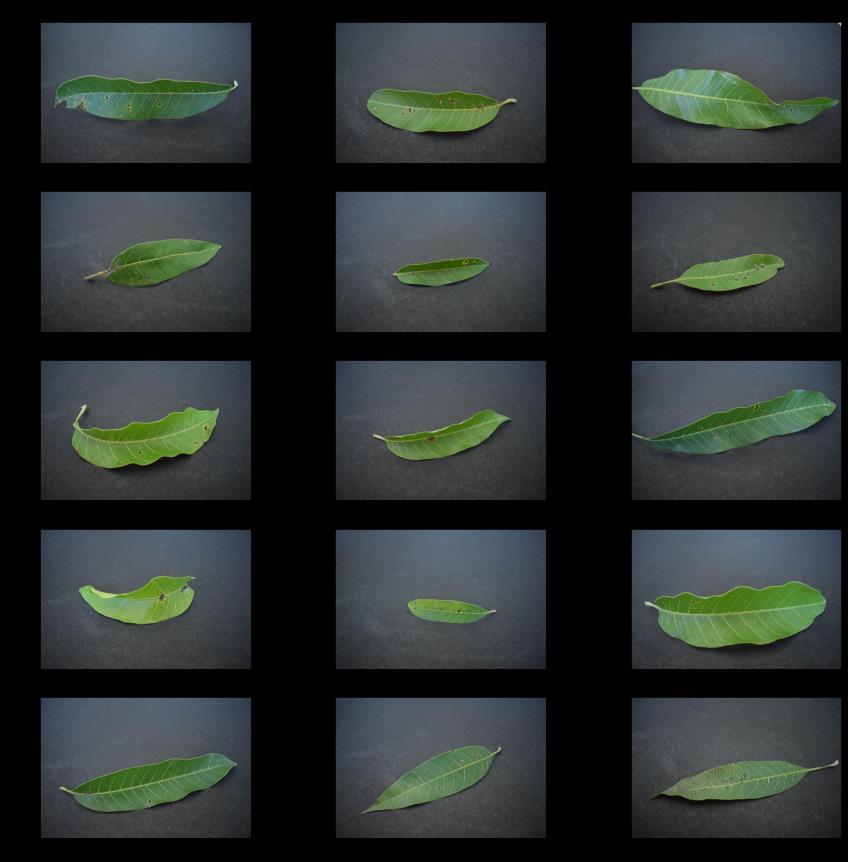
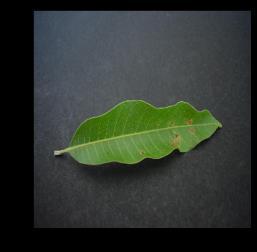
MydatasetwasgatheredfromKaggle.Thedatasetincludes picturesof32 differenttypesofIndianmangoleaves. The collection includes 768 photos of 32 Indian mango leaf species, with 24 photos of each species taken at various orientations and angles. The dataset's sample images are seeninFigure1.
Research
Volume: 11 Issue: 02 | Feb 2024 www.irjet.net p-ISSN: 2395-0072
Witharatioof70:20:10,Ibrokedownthedataintotrain, validation, and test sets. My model has been trained and validatedusingthetraining andvalidationset.Toachieve pixel normalization, I divide each image pixel by 255. In ordertomakesurethatmynetwork,oncetrained,seesnew variantsofdataateachandeveryepoch,Iappliedon-the-fly dataaugmentationoverthetrainingsamples.
For image detection, one of the recent developments in neuralnetworksistheDenseNetarchitecture.ResNetand DenseNet are fairly similar, yet there are several key distinctions. WhileDenseNetconcatenates(.)theoutputof
thepreviouslayerwiththefuturelayer,ResNetemploysan additive approach (+) to combine the previous layer (identity) with the future layer [2]. There are various variants of DenseNet, including DenseNet-121, DenseNet169,andDenseNet-201.ThenumberofDensenetrepresents the neural network's layer count. The convolution layer, poolinglayer,andfullylinkedlayerarethethreelayersthat make up the DenseNet-169 Architecture. By applying the convolution layer, pooling layer, batch normalization, and nonlinearactivationlayer,anoutputfromthepreviouslayer serves as an input for the second layer. DenseNet (Dense Convolutional Network) has several advantages: they alleviatethevanishing-gradient,problem,strengthenfeature propagation, encourage feature reuse, and substantially reducethenumberofparameters[2].
International Research Journal of Engineering and Technology (IRJET) e-ISSN: 2395-0056
Volume: 11 Issue: 02 | Feb 2024 www.irjet.net p-ISSN: 2395-0072
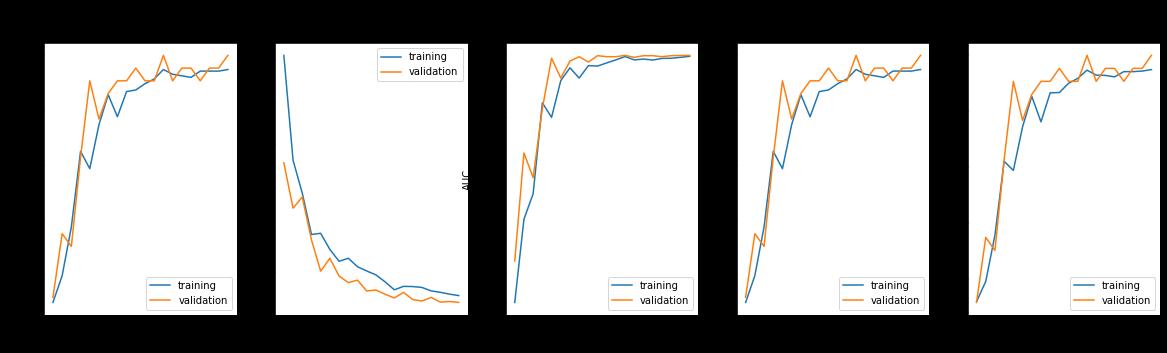
Performance analysis of the proposed architecture is presentedinFigure2.Lineplotsoftheaccuracyoftrainand testsetsandlossoftrainandtestsetsshowthatthereisno signofunderfittingoroverfitting.Researchersnowchoose toassesstheirmodelsinconjunctionwithaccuracyusingthe
F1 score, which combines precision and recall using their harmonicmean.Asaresult,IalsocomputedtheF1scoreasa performance metric. My model has a good separability as seenbytheAUCof0.9984inFigure2.
Shapley and gradient-based explainability are two alternative approaches to black box explanation. These techniques explain individual input samples by taking the partial derivatives of a model's output with regard to its inputs[7].Suchgradient-basedtechniquesofferasignificant amount of output features, which contributes to the highdimensionalityissue.Inadditiontobeingcomputationally expensive,Shapleyvaluesproducealargenumberofoutput features with complex explanations [8]. LIME is more focusedonprovidingindividualizedpredictedexplanations than these two approaches, and it is also easier to understandwhilerequiringlesscomputingpowerandeffort.
ExplainableAIisacollectionofproceduresandtechniques designed to make judgments made by AI and machine learning models intelligible to humans [6]. There are numerous methodsfor interpretingthe machineLearning results. Here, Local Interpretable Model-agnostic Explanations (LIME) a tool for interpreting machine learningmodels havebeenutilized.Thispaperexamines the classification of mango leaf diseases with further
justifications based onLocal InterpretableModel-agnostic Explanations(LIME).
LIME's main concept is to divide the input image into superpixels,whichcanbeconsideredasnewexamples.We generated these superpixels by applying the Quickshift method [9]. Perturbations are produced by randomly sampling the superpixels and the prediction for each perturbation is computed. To ensure explainability, weights ameasureofthecosinedistance arecalculated between each randomly generated perturbation and the inputimagethatisgiventotheLIME.Theweightedlinear regressionmodelisfittedwiththeseweights,perturbations, and predictions and the model yields interpretable coefficients.Finally,LIMEoutputgivessuperpixelsthathave agreaterinfluenceonthelabelprediction.
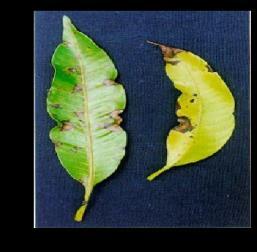
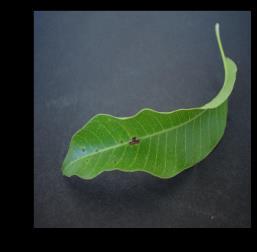
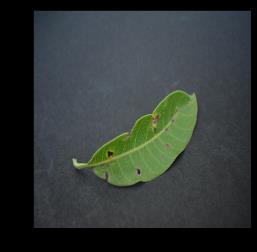
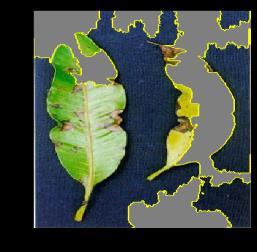
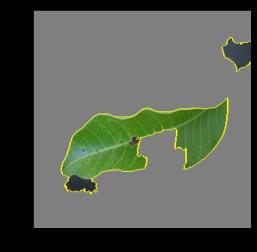
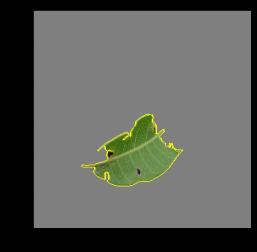
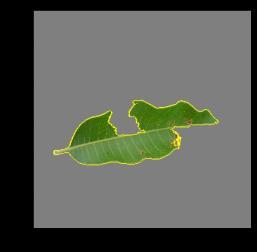
Table1displaystheoutputthatLIMEgeneratedtoexplain the predictions made by the Machine Learning Model. Imagesin the firstcolumnaretheoriginal image withthe disease in Mango leaves. The features that enable the DenseNet model to predict diseased mango leaves are visualizedinthesecondcolumnofTable1.Thesefeatures contributepositiveresultstotheprediction.Wecanobserve from the predictioninterpretationsthatthe model mostly focusesontheleafregionsthatareimpactedwhenmaking predictions.
International Research Journal of Engineering and Technology (IRJET) e-ISSN: 2395-0056
Volume: 11 Issue: 02 | Feb 2024 www.irjet.net p-ISSN: 2395-0072
Table -1: LIMEinterpretationofDenseNet169ondiseasedMangoleaves
OriginalImage LIMEoutput
International Research Journal of Engineering and Technology (IRJET) e-ISSN: 2395-0056
Volume: 11 Issue: 02 | Feb 2024 www.irjet.net p-ISSN: 2395-0072
In this paper, I implemented a pre-trained Deep learning modelDenseNet169forMangoleafDiseasedetection.Ihave evaluatedthemodelbasedonAccuracy,Precision,AUC,and F1 score. The model had the best performance, with a 97.41% accuracy rate. In the future to improve the generalizationofmymodel,Iwilltrytoincreasemydataset tocoveralargerspectrumofplantleafdiseases.
[1] Daglarli,Evren,“ExplainableArtificialIntelligence(xAI) ApproachesandDeepMeta-LearningModelsforCyberPhysicalSystems”, Artificial Intelligence Paradigms for Smart Cyber-Physical Systems, editedbyAshishKumar LuhachandAtillaElçi,IGIGlobal,2021,pp.42-67.
[2] AdiDwifanaSaputra,DjarotHindarto,HandriSantoso, “Disease Classification on Rice Leaves using DenseNet121, DenseNet169, DenseNet201”, Sinkron : Jurnal dan Penelitian TeknikInformatika Volume8,Issue 1, January 2023, DOI : https://doi.org/10.33395/sinkron.v8i1.11906
[3] FathimathulRajeena,AswathyS,MohamedA.Moustafa andMonaA.S.Ali,“DetectingPlantDiseaseinCornLeaf Using EfficientNet Architecture An Analytical Approach”, Electronics 2023,https://doi.org/10.3390/ electronics12081938
[4] HASSAN AMIN, ASHRAF DARWISH (Member, IEEE), ABOULELLAHASSANIENANDMONASOLIMAN.“Endto-End Deep Learning Model for Corn Leaf Disease Classification”, IEEE Access,“,Volume10,2022,Digital ObjectIdentifier10.1109/ACCESS.2022.3159678
[5] KaihuaWei,BojianChen,JingchengZhang,ShanhuiFan, Kaihua Wu, Guangyu Liu and Dongmei Chen, “Explainable Deep Learning Study for Leaf Disease Classification”, Agronomy 2022, 12, 1035, https://doi.org/10.3390/agronomy12051035
[6] E.TjoaandC.Guan,“ASurveyonExplainableArtificial Intelligence (XAI): Toward Medical XAI,” IEEE Trans. Neural Networks Learn. Syst.,vol.32,no.11,pp.4793–4813,2021
[7] D.Baehrens,T.Schroeter,S.Harmeling,M.Kawanabe,K. Hansen, and K. R. Müller, “How to explain individual classificationdecisions,” J. Mach. Learn. Res.,vol.11,pp. 1803–1831,2010
[8] S. M. Lundberg and S. I. Lee, “A unified approach to interpretingmodelpredictions,” Adv. NeuralInf. Process. Syst., vol. 2017-Decem, no. Section 2, pp. 4766–4775, 2017
[9] A. Vedaldi and S. Soatto, “Quick Shift and Kernel MethodsforModeSeeking”, Lecture Notes in Computer Science, pp. 705–718, 2008, https://link.springer.com/chapter/10.1007%2F978-3540-88693-8_52.
BIOGRAPHY

Vishakha is working as a HOD of the Department of IT at 360 Research Foundation, she establishes a research agendain AI/ML,helpsresearchersinthe fieldofempowermentandlivelihood,and guidesresearchworktoengineeringand computer science students. She earned her M.Tech. from (NIT), Surat, Gujarat. SheisanexperiencedAssistantProfessor withavarietyofengineeringeducationalinstitutesincluding NIT-SuratandRVCollegeofEngineering,Bangalore.Sheis passionateaboutAI/ML,speechandaudiosignalprocessing, andDigitalSignalProcessing.