
International Research Journal of Engineering and Technology (IRJET) e-ISSN:2395-0056
Volume: 11 Issue: 02 | Feb 2024 www.irjet.net p-ISSN:2395-0072
International Research Journal of Engineering and Technology (IRJET) e-ISSN:2395-0056
Volume: 11 Issue: 02 | Feb 2024 www.irjet.net p-ISSN:2395-0072
Moundekar
, Harshal
Kishor
1234 Undergraduate Student, Department of Information Technology, Priyadarshini College of Engineering Nagpur, Maharashtra India
56 Professor, Department of Information Technology, Priyadarshini College of Engineering Nagpur, Maharashtra India
Abstract - The foundation of our nation is the agricultural sector. In order to make farming simpler and to increase productivity, several new technologies are being incorporated into the field, including Deep Learning and Machine Learning. Farmers often choose the wrong crops, planting them in the wrong season or choosing ones that wouldn't produce much for the specific soil. A reduced yield will always be the consequence of improper crop selection. We created a machine learning recommendation model that describes the ideal crop to grow and the seed fertilizer depending on the weather & Soil conditions. Third-party apps that service APIs for climate and temperature, soil category, soil nutritious content, quantity of rainfall in that zone, and soil configuration are connected with location. It also kinds use of nutrient percentages for nitrogen (N), phosphorus (P), and potassium (K). When creating a model from the data, all of these features will be looked at utilizing a varietyoflegitimate machine learning approaches.
Intoday's complex environment, accurate andeffective plant disease control starts with accurate diagnosis. As smart farming has expanded, plant disease diagnosis has gone digital and data-driven, enabling sophisticated decision support, astute analysis, and strategic planning. This work presents a deep learning based mathematical model for plant disease diagnosis and recognition that improves training efficiency, accuracy, and generality. Our assignment suggests a deep learning-based model that will be developed using a dataset including images of crop leaves in both good and unhealthy conditions. All algorithms' impacts are quantified using a range of metrics, such as measure, precision, and accuracy. By comparing events that were properly and erroneously predicted, accuracy is determined. The findings demonstrate that the Decision Tree algorithm achieves the other approaches in terms of presentation, with the greatest precision of 86%, and requires less time to construct the model. Thus, by employing our method, farmers may produce new crops at different times of the year, increase their profits, and avoid contaminating the land.
Keywords - Machine Learning, Crop & Fertilizer Recommendation & Plant Disease Detection, Decision Trees & XG Boost Algorithm
Approximately 58% of the workers in our nation is working in farming, making it one of the most important foundations of income. The majority of India's 1.2 billion workers work in agriculture. India is the world's secondlargest producer of fruits and vegetables; nevertheless, crop loss puts farmers in jeopardy, according to the MinistryofAgriculture,Co-operationandFarmerWelfare's annualreport.
Modernagriculturaltechniquesarebeingimplementedfor the benefit of farmers. To greatly rise productivity and value, Deep learning, machine learning, and data mining methods are now being used by a few researchers. The stateofthesoil,whichinturndependsonthenutrientsin the soil, is the primary factor influencing agricultural production. Farmers should be advised on crops based on soil analysis in order to boost agricultural yield and, in turn,improvetheirfinancialstatus.Fertilizermisusecosts farmersagreatdealofmoneyaswell.
Crop selection errors are common among farmers; examplesincludeplantinginthewrongseasonorchoosing a crop that would not yield much on a given soil. A decreased yield is always the result of improper crop selection. Farmers have uncertainty over which crop to plant during a given season due to the unpredictable natureoftheenvironment.Theuseofdistinctfertilizersis also subject to seasonal fluctuations in the surrounding environmentandtheaccessibilityofvitalcomponentslike as air, water, and soil. To get a larger yield, we need to consider not only rainfall, which is one of the key components,butalsosoiltypeandfertilitycharacteristics. While dry land is better fit for cash crops, wetland is outstanding for wheat and sugarcane. fifteen regions of agro weather India's regions are divided based on the
International Research Journal of Engineering and Technology (IRJET) e-ISSN:2395-0056
Volume: 11 Issue: 02 | Feb 2024 www.irjet.net p-ISSN:2395-0072
types ofstructurefound in eachplace.Everyagroclimatic zone may support the growth of some crops. We must recommend the farmer on the best crop among those natural to those specific climatic zones based on it. The ultimategoaloftheprojectistodeliverthelargestharvest atthelowestpossibleyield.
Offering farmers a user-friendly The solution to the problem is the recommender system. The project's objective is to create a system that would help farmers choicethebestcropbasedonthepropertiesofthesoiland outside fundamentals including moisture, temperature, precipitation, and soil PH value. our method would assist farmersinplantingtheappropriateseedsaccordingtothe needsofthelandinordertoboostoutputand profit. This enablesfarmerstogrowtheappropriatecrop,raisingboth theyieldandthecountry'stotalproduction.DecisionTrees and the XG Boost Algorithm are two machine learning prediction models that employ all of the input data to classify shapes in the data before evaluating it based on inputparameters.
The technique recommends a crop to the farmer together with the amount of fertilizer to be used in preparation for the crop. We present a model in this study that tackles these issues. The recommended approach enables crop selection according to financial and environmental elements, with the goal of increasingagricultural yields to meetthe nation'srising fooddemand. To assistfarmers in selecting the appropriate fertilizer, we are developing technologies that propose fertilizer. In order to assist farmersinpreventingillness,wearealsodevelopingplant diseasedetectiontechnologies.
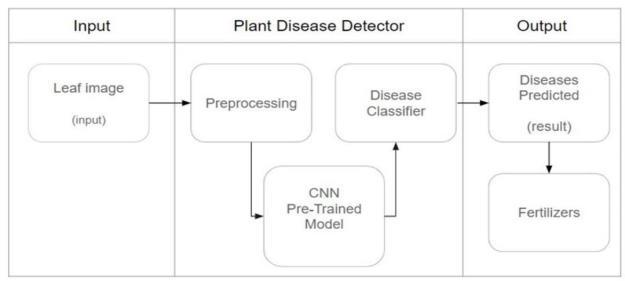
The fundamental process for diagnosing plant diseases involvesuploadingaphotographofaleafwithaconsistent backdropusinga websitethatwehaveintegratedintoour model. Next, the picture will undergo preprocessing. The model itself extracts features in order to classify the appropriate illness. After the illness has been classified, it is mapped together with the appropriate treatment or fertilizerneededtoeradicatetheissueandpreventitfrom coming again. This study investigated and employed several Deep Learning models and ways to accurately identifyandcategorizeplantillnessesusingimageanalysis ofplantleave.
The project model involves Crop Recommendation using RandomForest,FertilizerRecommendationusingDecision Tree and Plant Disease Detection using Convolutional NeuralNetwork.
In the work” Crop Recommendation System and Plant Disease Classification using Machine Learning,” [1] Choudhary and associates introduce a novel approach to agriculture management that leverages machine learning techniques. The study addresses the major difficulties farmers encounter in crop selection and disease detection by proposing an integrated approach that recommends suitable crops based on soil characteristics and environmentalparameters.Toassistfarmersinidentifying and effectively managing crop illnesses, the authors also lookattheuseofmachinelearningalgorithmsforaccurate plant disease classification. The research provides a general framework for mixing cutting-edge technologies withagriculturalmethodstomaximizeyield.
Intheirpublication,"SmartCropRecommendationSystem UsingMachineLearning,"[2],authoredbyCH.Rajeshetal, the researchers provide a unique approach to crop recommendation utilizing machine learning technology. The challenges farmers have when determined which crops are most suitable for cultivation are covered in this essay. The recommended method uses machine learning algorithmstoevaluatearangeoffactors,suchassoiltype, climate, and past crop data, in order to deliver farmers optimal crop choices. The project aims to assist farmers makeconfidentcropchoicesandboostagriculturaloutput by implementing state-of-the-art machine learning algorithms.
Taranjeet Singh et al.'s study, "Crop and Fertilizer Recommendation and Disease Diagnosis System Using MachineLearning,"[3],presentsanintegratedsystemthat leverages machine learning to tackle significant problems in agriculture. The system provides crop selection and fertilizer recommendations based on a variety of factors, suchassoiltype,climate,andnutrientlevels.Furthermore, by utilizing machine learning techniques, the system provides a mechanism for the early diagnosis and treatment of plant illnesses. Using this comprehensive strategy, the research aims to increaseagricultural output and decrease crop losses caused by diseases and poor practices.
Aditya Motwani et al.'s study, "Soil Analysis and Crop RecommendationUsingMachineLearning,"[4],presentsa novel method for agricultural making choices. The system analyzescriticalsoilpropertiesbydoingsoilanalysisusing machine learning techniques. The method suggests appropriate crops for cultivation based on the findings of the soil study, taking into consideration elements like soil type, moisture content, and nutrient composition. The objectives of this integrated system are to improve
International Research Journal of Engineering and Technology (IRJET) e-ISSN:2395-0056
Volume: 11 Issue: 02 | Feb 2024 www.irjet.net p-ISSN:2395-0072
agricultural production, optimize crop selection procedures,andsupportsustainablefarmingmethods.
Suresh et al. present a novel approach to crop yield optimizationinthecontextofdigitalfarmingintheirstudy "Efficient Crop Yield Recommendation System Using Machine Learning for Digital Farming," [5]. The authors present a machine learning-based recommendation systemdesignedtoassistfarmersinmakinginformedcrop selections. The technology generates personalized crop recommendations based on a variety of agricultural variables, including weather patterns, soil composition, and historical crop productivity data. By incorporating state-of-the-art machine learning algorithms, this innovative approach aims to boost agricultural output in the era of digital agriculture, lower risks, and support sustainablefarmingpractices.
Amachinelearningframeworkforrecommendingsuitable crops to farmers is presented by Pande et al. [7] in their publication, "Crop Recommendation using Machine Learning Approach." The technology examines a number of agricultural parameters, including soil properties, climate,and geographiclocation,togeneratepersonalized crop suggestions. It uses complex algorithms and data analytic methods to dothis.Theplanmakesuseofmachinelearningmodelsto increase agricultural output, support sustainable farming practices, and assist farmers in making decisions. This work contributes to precision agriculture by offering a data-driven technique to enhance crop selectionandyield results.
Asshowninfigure,therecommendedsystem'sapproach consistsofmanyblocks.
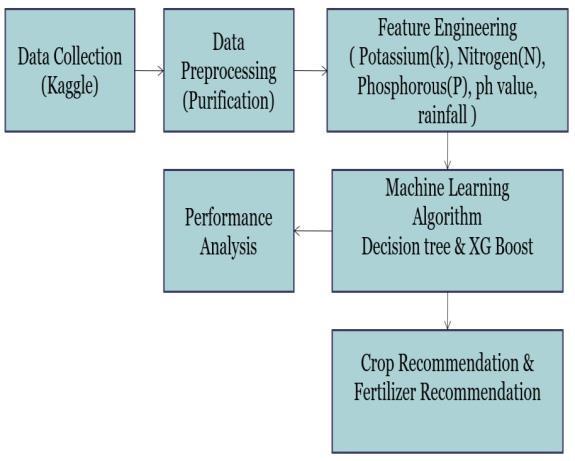
Data Collection -Themostcommonmethodforcollecting and evaluating data from many sources is information collecting. For the dataset to give the system an estimated dataset,ithastocontainthefollowingcharacteristics.The following factors will be taken into account while recommending crops and fertilizer: PH value, humidity, NPKlevels,rainfall,andstatearethefirstfivefactors.
Data Pre-Processing - After the data is collected from several sources, pre-processing is required so that the modelmaybeskilled.Datapre-processingcanbedoneina variationofmethods,beginningwithreadingtheobtained dataset and proceeding through data purification. Certain dataset properties are redundant when data is cleansed, andtheyarenottakenintoconsiderationwhileharvesting. Consequently, we have to eliminate undesirable attributes anddatasetsthathavesomemissingdata.Torecoverthem, weneedtomorepreciselydroporfillthesemissingvalues withundesirablenonvalues.
Feature Engineering -Featureengineeringtakesrawdata and uses domain expertise to extract features (characteristics, traits, and attributes). The goal is to leverage these additional characteristics to raise the caliberofmachinelearningoutput.
Training set - A data set that has been categorized is calledatrainingset.Includedarethevectorsfortheinput and output. The prototypical is trained using supervised machinelearningpracticesonthisdataset.
Testing set -Adatasetwithoutanymarkeddataiscalleda testingset. Withthehelpof thetraining data set,it makes forecastsabouttheresult.Itisindependentofthetraining set.
Machine Learning Algorithm -Highly precise estimation based on previously learnt data is required by machine learning prediction algorithms. The application of data, statistical techniques, and machine learning methods to predict future outcomes is known as predictive analytics historical information. This model makes use of the DecisionTree,XGBoost,andGradientBoostingtechniques.
International Research Journal of Engineering and Technology (IRJET) e-ISSN:2395-0056
Volume: 11 Issue: 02 | Feb 2024 www.irjet.net p-ISSN:2395-0072
Crop Recommendation - Based on the soil's pH, rainfall, andNPKcontent,themodelwillrecommendtheidealcrop togrowonthegivensoil.
Fertilizer Recommendation - The program will suggest howmuchsoilnutrientsyourfarmneedsbasedontheNP Kvalueandthecropyousowed.
Plant Disease Detection - The model will identify the right illness based on the leaf picture. Following classification, the sickness is mapped using the appropriate fertilizer needed to eradicate the issue and fendofftheillness.
Performance Analysis - A professional field known as presentationanalysisemployssystematicgoalstoenhance routineanddecision-making.
4. Conclusion
As is well known, the primary aims of a large amount of farming research have been and continue to be increasing efficiency, boosting the Indian budget, and, most importantly, helping farmers become more profitable. The suggested method would help farmers do this by advising them on what kind of crop to plant on their land so they mayprofitfromit.
This study brought to light the shortcomings of the methods in use today and how useful they are for yield prediction. Users may choose a crop using a number of tools available in the online application. A prediction mechanismincludedintothesystemhelpsfarmerspredict theproductionoftheircrops.
Cropyieldpredictionandeffectivefertilizerapplicationare both successfully anticipated. The most effective yield is attained by identifying the efficient method from both algorithms. Future online applications should be developed with this philosophy in mind, made simple to use, and designed to assist users understand the desired crop'syieldwhenplantedduringthatparticularseason.
5. References
[1] Mahendra Choudhary, Rohit Sartandel, Anish Arun, Leena Ladge,” Crop Recommendation System and Plant DiseaseClassificationusingMachineLearning”,2023.
[2] C.H. Rajesh, V.H. Praveen, G.Sai Deepak, K. Harshith, M. Vikram Sai Reddy,” Smart Crop Recommendation System UsingMachineLearning”,June2023
[3] Taranjeet Singh, Saurabh Anand, Anmol Sehgal, Siddhesh Mahajan, Prof. Pranoti Kavimandan,” Crop and
Fertilizer Recommendation and Disease diagnosis system usingMachineLearning”,July2022.
[4] Aditya Motwani, Param Patil, Vatsa Nagaria, Shobhit Verma, Sunil Ghane, “Soil Analysis and Crop Recommendation using Machine Learning”, IEEE Conference,2022.
[5] Suresh, Senthil Kumar, S. Lekashri, and R. Manikandan,"EfficientCropYieldRecommendationSystem UsingMachineLearningForDigitalFarming."International JournalofModernAgriculture,(2021).
[6] Shilpa Mangesh Pande, DR. prem Kumar Ramesh, Anmol, B.R Aishwarya, Karuna Rohilla, Kumar Shaurya, “Crop Recommender System Using Machine Learning Approach”,IEEEConference2021.
[7]ShilpaMangeshPande,PremKumarRamesh,Anmol,B R Aishwarya, Karuna Rohilla and Kumar Shaurya, “Crop Recommendation using Machine Learning Approach”, (ICCMC2021).
[8] A Priyadharshini, Swapneel Chakraborty, Aayush Kumar, and Omen Rajendra Pooniwala. Intelligent crop recommendation system using machine learning. IEEE, 2021.
[9] S.M. pande, p. K. Ramesh, Anmol, Aishwarya, Rohilla andk.Shaurya,"croprecommendersystemusingmachine learningapproach"2021.
[10]Aryamol,Raji,Sam Benjamin,“asurveypaperoncrop predictionusingmachinelearning”2021.
[11]Nischitha,DhanushVishwakarma,Mahendra,Ashwini, Manju Raju, “crop prediction using machine learning approaches”2020.
[12] S. Yegneshwar Yadhav, T. Senthilkumar, S. Jayanthy, J. Judeson Antony Kovilpillai Plant Disease Detection and ClassificationusingCNNModelJuly2020.
[13] Nischitha K, Dhanush Vishwakarma, Mahendra N, Ashwini, Manjuraju M R, “Crop Prediction using Machine LearningApproaches”,August2020.
[14] Kamatchi, S. Bangaru, and R. Parvathi. "Improvement of Crop Production Using Recommender System by WeatherForecasts."(2019).
[15] Bondre, Devdatta, and Santosh Mahagaonkar. "Prediction of Crop Yield and Fertilizer Recommendation UsingMachineLearningAlgorithms.",(2019).
International Research Journal of Engineering and Technology (IRJET) e-ISSN:2395-0056
Volume: 11 Issue: 02 | Feb 2024 www.irjet.net p-ISSN:2395-0072
[17] BK Singh, RP Singh, Tejasvee Bisen, and Shweta Kharayat. Disease manifestation prediction from weather datausingextremelearningmachine.IEEE,2018.
[18] Melike Sardogan, Adem Tuncer, Yunus Ozen “Plant Leaf Disease Detection and Classification Based on CNN” withLVQAlgorithm,December-2018
[19] Bhosale, S. V., Thombare, R. A., Dhemey, P. G., & Chaudhari, A. N. (2018, August). Crop Yield Prediction UsingMachineLearning.IEEE.
[20] S Pudumalar, E Ramanujam, R Harine Rajashree, C Kavya, T Kiruthika, and J Nisha. Crop recommendation systemforprecisionagriculture.IEEE,2017.