
International Research Journal of Engineering and Technology (IRJET) e-ISSN: 2395-0056
Volume: 11 Issue: 02 | Feb 2024 www.irjet.net p-ISSN: 2395-0072
International Research Journal of Engineering and Technology (IRJET) e-ISSN: 2395-0056
Volume: 11 Issue: 02 | Feb 2024 www.irjet.net p-ISSN: 2395-0072
Chetan Likhitkar, Yash Kohinkar, Aniket Patil, Shubham Pawar
Chetan Likhitkar, D.Y. Patil University
Yash Kohinkar, D.Y. Patil University
Aniket Patil, D.Y. Patil University
Shubham Pawar, D.Y. Patil University
Professor Madhavi Patil, Dept. of Information Technology Engineering, D.Y. Patil University, Maharashtra, India
Abstract – Water quality management is an important aspect of environmental sustainability that affects ecosystems, public health, and community well-being. Conventional water quality prediction methods often struggle to capture the dynamic temporal patterns inherent in environmental data. This project uses advanced deep learning models, especially Long Short-Term Memory (LSTM) and Gated Recurrent Segmentation (GRU), to solve timepredictionproblemsinwaterqualitymonitoring.
The project began by collecting comprehensive water quality data from a variety of sources, from sensors to satellite imagery. These data, including parameters such as pH levels, temperature, and dissolved oxygen, form the basis for the training and validation of LSTM and GRU models. Data processing techniques used to handle missing values, scalenormalization,andbuildtemporalseriesarenecessary foreffectivedeeplearning.
The LSTM and GRU models were chosen for their ability to capture long-term dependencies, which are important for understanding the changing nature of water quality parameters. The architecture of the model is carefully designed, considering the input layer that accounts for temporal aspects, the hidden layer that captures complex patterns, and the output layer that produces predictions for waterqualityparameters.
Key Words: Water Quality, Deep Learning, Long ShortTerm Memory (LSTM), Gated recurrent Unit (GRU), Prediction model
This Water exceptional evaluation is a vital thing of environmental tracking, affecting public fitness, atmosphere stability, and aid management. Conventional water quality prediction techniques frequently depend upon empirical fashions and statistical evaluation, which may additionally have boundaries in capturing the complicated temporal dependence and nonlinear relationshipsinherentinwaterexceptionalfacts.Inrecent years, deep gaining knowledge of strategies have shown promisingcapacityinsolvingsuchcomplexities,offeringa
new paradigm for accurate and green water nice prediction.
Long quick time period memory (LSTM) and Gated RecurrentUnit(GRU)areexcessive-stagerecurrentneural community (RNN) architectures for modelling continuous records and handling long-term dependencies. These models have proven extensive fulfillment in numerous periodic forecasting troubles, making them suitable applicants for solving emerging water fine records challenges.
This paper offers a comprehensive analysis of the use of LSTM and GRU models for water high-quality prediction. Through leveraging deep mastering capabilities, our researchobjectivestoenhancetheaccuracyandreliability of predictive fashions, thereby contributing to more powerful water quality tracking and management. The followingsectiondescribesthedatabaseused,themethod used, and the experimental results acquired, and affords informationonthecapabilityofLSTMandGRUfashionsto developwaterfinepredictionmethodologies.
Water quality prediction is a critical aspect of environmentalmonitoring,essentialforensuringthesafety and sustainability of water resources. Conventional methods forpredicting water qualityoften face challenges incapturingthecomplextemporal dependenciesandnonlinear patterns inherent in water quality data. To address thesechallengesandenhancetheaccuracyofwaterquality predictions, there is a need to leverage advanced machine learningtechniques,particularlyLongShort-TermMemory (LSTM) and Gated Recurrent Unit (GRU) architectures in deeplearning.
Identify the challenges in accurately predicting water quality over time. Emphasize the need for advanced predictive models to address the dynamic natureof water qualityparameters.
International Research Journal of Engineering and Technology (IRJET) e-ISSN: 2395-0056
Volume: 11 Issue: 02 | Feb 2024 www.irjet.net p-ISSN: 2395-0072
Inthefieldofdeeplearningforwaterqualityprediction, Long Short-Term Memory (LSTM) and Gated Recurrent Unit(GRU) modelshavegarneredsignificantattentionfor their effectiveness in capturing temporal dependencies. Various studieshaveinvestigatedtheapplication ofLSTM and GRU models across different domains, demonstrating theirsuperiorperformanceinpredictiontasks.
Barzegar et al. (2020) proposed a hybrid CNN-LSTM model for short-term water quality variable prediction, illustrating the efficacy of deep learning in this context. Similarly, Zhang et al. (2019) conducted a study comparing LSTM, GRU, and standard RNN for water saturation prediction, highlighting the competitive performance of LSTM and GRU models. Additionally, Pan et al. (2020) developed a water level prediction model basedonGRUandCNN,showingthattheCNN-GRUmodel outperformed traditional methods like ARIMA and LSTM intermsofaccuracy.
Furthermore, Haq & Harigovindan (2022) emphasized the importance of GRU and LSTM in predicting water quality for smart aquaculture. In their study, CNN was used for feature extraction, while GRU and LSTM were employed for learning temporal dependencies, underscoring the significance of these models in water qualitypredictiontasks.
In conclusion, the existing literature highlights the increasing interest in utilizing LSTM and GRU models for water quality prediction. These models have proven effective in capturing intricate temporal patterns and enhancing prediction accuracy compared to conventional methods.
4. Proposed System
Thestandardsusedtoassessthesustainabilityofwater resources are constantly evaluated as new factors are found.Standardsandguidelinesforcontaminationlevelsin drinkingwaterarebeingdevelopedbyregulatoryagencies. In response to the changing criteria, the water supply sector is creating new and improved operating and treatment procedures. All elements that affect water quality, as well as the public health relevance of components and available treatment technology, must be considered when developing drinking water quality guidelines.
Theinitialtaskwastofindoutwhichfactorwouldgive a good indication of the quality of the water. Water parametersdelveintothelogicbehindthesechoices.These measurements provide very little information about how dirtythewaterisonitsown.Asaresult,thestudywilltake into account the collective behavior of the parameters to produce a legitimate output, which will determine if the waterispotableornot.
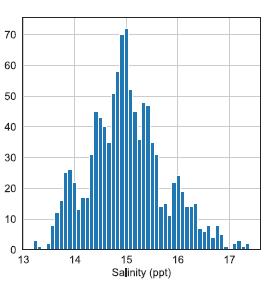
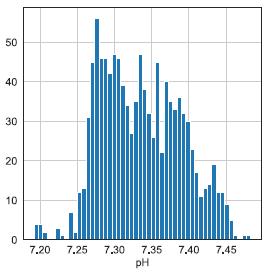
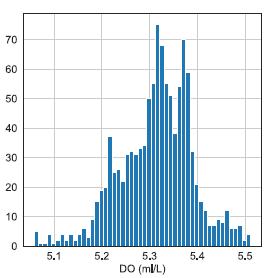
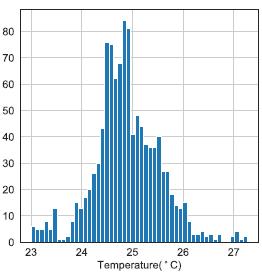
The second task was to deal with the dataset’s missing values. The value of some factors may not be specified while defining the models, and the output may differ as a result. To solve this problem, we have included the mean value of the factor for which data is absent. To train the model efficiently, we first focus on data normalization using LSTM & GRU, which is a technique of data analysis. To achieve our goal, we appropriately calculate the Water Quality Index (WQI) to analyze water quality. For better representation,weprovideahistogramofthedataset.
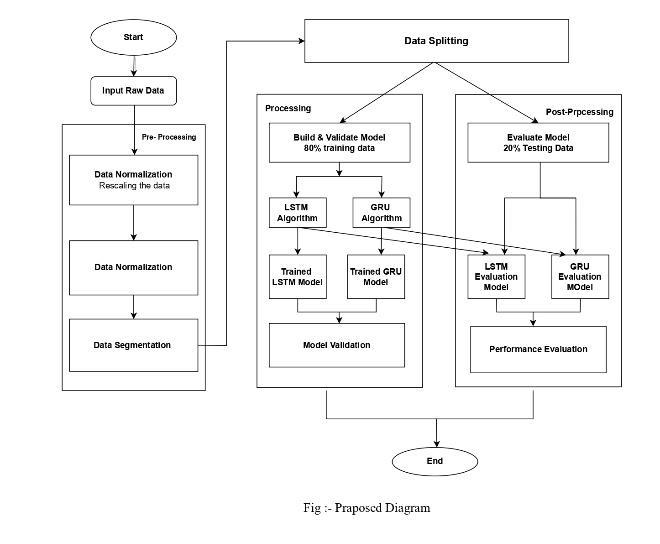
This facilitates for us to observe how our entire dataset is distributed. Then we have applied a correlation technique to determine the ability of two features to change at a constant rate. After that, we have split the entire dataset intotwosections:trainingdataandtestingdata.Weuseda varietyofmachinelearningalgorithmstotrainthedataset and then compare the models’ accuracy. Following the applicationofthosestrategies,weemployhyperparameter tuning to evaluate and receive outcomes from our desired model. Finally, we use the accuracy of our suggested modelstocomparealloftheresults.Asaresult,thevalidity and reliability of our entire study are guaranteed by this approach.Figure1showstheflowdiagramoftheproposed model.
International Research Journal of Engineering and Technology (IRJET) e-ISSN: 2395-0056
Volume: 11 Issue: 02 | Feb 2024 www.irjet.net p-ISSN: 2395-0072
5. Helpful Hints
5.1 Figures and Tables
International Research Journal of Engineering and Technology (IRJET) e-ISSN: 2395-0056
Volume: 11 Issue: 02 | Feb 2024 www.irjet.net p-ISSN: 2395-0072
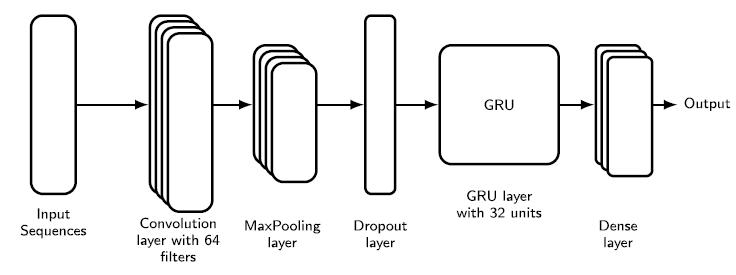
Fig -6: Proposed Hybrid CNN-GRU DL neural network model structure
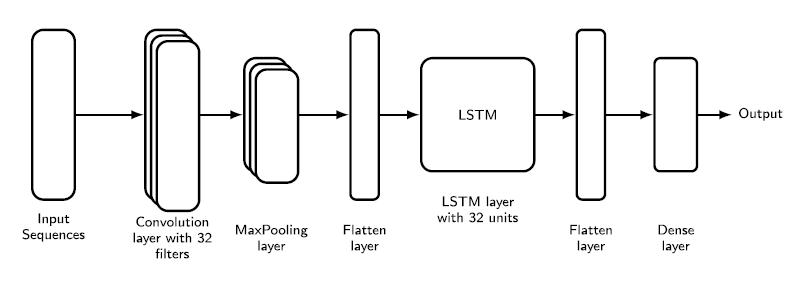
Table -1: TheStructureofproposedhybridCNN-LSTM andCNN-GRUDLmodels.
Structure of CNN-LSTM and CNN-GRU DL models
CNN-LSTM
CNN-GRU
ConvlDLayer(32filters +3filtersizes,ReLU activation)Maxpooling (2poolingsize)
Flatten()
LSTMlayer(32units, ReLUactivation)
Flatten()
Denselayer(1neuron)
Compile(MSEloss, Adamoptimizer,lr= 0.0008)
ConvlDlayer(64filters+ 5filtersizes,ReLU activation)
Maxpooling(4pooling size)
Dropoutlayer(0.2)
GRUlayer(32units, ReLUactivation)
Denselayer(30neuron, ReLUactivation)
Denselayer(10neuron, ReLUactivation)
Denselayer(1neuron)
Compile(MSEloss, Adamoptimizer,lr= 0.0008)
The resultofchoosingdifferent periods {10,50,100,150, 200, 300, 400, 500} were investigated for each DL model. Figure 6 shows RMSE vs time for various water quality parameters; they use the ADAK water quality database being proposed hybrid DL model and LSTM, GRU as well as CNN DL model. The hybrid DL model proposed here is CNN-LSTM and CNN-GRU maintains a better performance than the beginning DL models are LSTM, GRU and CNN. Hybridmodelgoodperformanceandgeneration-Alization was achieved in 100 eons. Prediction accuracy performance is maintained for all four types of waterPeriod from 10 to 500. Also, prediction performance Our hybrid DL model is superior compared to our base model DL model. Like the base DL model at least 400 periods to achieve generalization and understanding the study data is less than 400 periods. Basic DL model is close to the performance of the proposed model 500 in the period. basic models require more computational resources to achieve similar results. Hybrid model For ADAK water, start a little after 150 cycles quality data set. However, accuracy is maintained, indicating- Another adaptation of theproposedDLmodeldatabase.
Theeffectofchoosingadifferentwindowsize{10,20,30, 40,50,60,70, 80} for each DL model isanalyzed.Giant. 8 shows RMSE vs window size for different waters quality parametersontheADAKwaterqualitydatasetsproposed hybrid DL models and basic DL models. The designed hybrid DL models perform better than the basic ones DL models. When the window size increases from 10 to 80, for hybrid DL models, the error remains constant. In this experiment, we see that these basic models are comparable in performance with hybrid DL models for some windows sizes for each water quality parameter. However, no baseline the models perform consistently well for all four waters qualitative parameters. For example, the performance of LSTM is slightly better than CNN-LSTMatwindowsize40and80forpH.However,for theotherthreewaterqualityparameterstheperformance of LSTM is not good. In comparison designed the hybrid models consistently perform well for the four parameters of water quality and window size that we have experimentedwith.
Study level effect {0.01, 0.001, 0.0009, 0.0008, 0.0007, 0.0001} in performance for each DL model is analysed. In Figure10,wecompareRMSE vs.learn- performancelevel of the proposed hybrid DL model with the basic model
Volume: 11 Issue: 02 | Feb 2024 www.irjet.net p-ISSN: 2395-0072
using the ADAK water quality database. The proposed hybrid DL model consistently performs better basic DL model. However, the main indicator is performance DL model is not suitable for different training levels and various water quality parameters. Therefore, using the foundationoftheDLmodelisnotpracticalforWQP.
5.2.4
In this test, we analyse the performance of each DL different models and batch sizes {16, 32, 64, 128, 256, 512}. RMSE vs batch size for different watersheds quality parametersintheADAKwaterqualitydatabaseforhybrid DLmodelandbasicDLmodel.Theproposedhybridcanbe compared to the DL model monitored the performance of themainDL model inconsistentandinferior.Also,wecan seethatCNNperformancedecreaseswithincreasingparty size.
5.2.5
In the four tests above, it's time to count measured and saved at the same time. Figure 14 and Figure 15 set the calculationtimefor eachhyperparameterforADAKwater quality set and MAC water quality set, each other. Calculation time required by each DL model is different. Here we can observe some general trends from his place. One of them is calculation time increases with increasing period and window. But as the batch increases, the computation time decreases in size. We won't see much change in computing time for different study levels since we choose to study Estimated interval limits for two databasesforallmodels.
5.2.6
In this test, we analyze the performance of each {2,4,6,8,10,12} of the DL model for different step sizes. RMSE vs step size for different watersheds quality parametersintheADAKwaterqualitydatabaseforHybrid DL model and basic DL models. The results show the proposedhybridDLmodelperformsbetterthanthebasic DL model. enhancements, moreover, the performance of CNN-LSTM and CNN-GRU decreases with increasing step size. RMSE vs step size for different Water quality parameters in the MAC water quality database with the proposed hybrid DL model and base DL model. From the results, better performance of the proposed hybrid CNNLSTM model compared to other mainstream and hybrid models CNN-GRU model. Compared to the proposed hybrid DL model for two databases, the basic DL model notenough
Abbreviations
1. WQP WaterQualityPrediction 2. GRU GatedRecurrentUnit 3. LSTM LongShort-TermMemory 4. CNN ConvolutionalNeuralNetwork
5. DL DeepLearning
6. RNN RecurrentNeuralNetwork
7. ReLU RectifiedLinearUnit
8. ConvlD ConvolutionalLayer
9. MaxpoolinglD PoolingLayer
10. IoT InternetOfThings
11. RMSE RootMeanSquareError
12. MAE MeanAbsoluteError
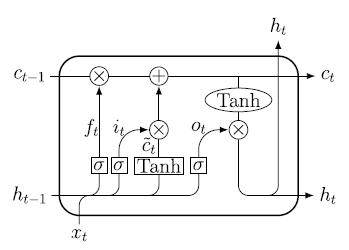
TheLSTMarchitectureisshowninFig. andmemoryunits aredefinedasfollows: [ ] [ ] [ ] [ ]
Inthisarchitecture , ,and areforget,inputand outputgatelayerrespectively. and
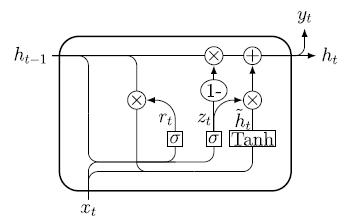
GRU has fewer tensor operations than LSTM and runs typicallyfasterthanLSTM.TheGRUarchitectureisshown inFig. andmemoryunitsaredefinedasfollows: [ ] [ ] ̃ [ ] are new and final memorycell, isweightmatrices, isbiasvectors, isthe sigmoidactivationfunction.
International Research Journal of Engineering and Technology (IRJET) e-ISSN: 2395-0056
Volume: 11 Issue: 02 | Feb 2024 www.irjet.net p-ISSN: 2395-0072
In this architecture is the reset and is the update gate, ̃ isprocessinput,and ishiddenstateupdate, is weightmatricesand isthesigmoidactivationfunction.
Theperformanceofthepredictionmodelsisevaluated using mean absolute error (MAE), mean square error (MSE), root mean squared error (RMSE) and mean absolute percent-age error (MAPE), computed by the set ofequationsgivenbelow:
presented in this research paper. This work would not havebeenpossiblewithouttheirdedicationandexpertise. Feel free to personalize and expand on this acknowledgment as per your specific situation and the contributionsyou'dliketorecognize.
[1] Short-term water quality variable prediction using a hybrid CNN–LSTM deep learning model Rahim Barzegar1, Mohammad Taghi Aalami2, Jan Adamowski32020StochEnvironResRiskAssess
[2] Potential for Prediction of Water Saturation Distribution in Reservoirs Utilizing Machine Learning MethodsQitaoZhang1,ChenjiWei2,YuheWang3etal. 2019Energies
[3] WaterLevelPredictionModelBasedonGRUandCNN Mingyang Pan1, Hongzhan Zhou2, Cao Jun3 et al. 2020IEEEAccess
[4] WaterQualityPredictionforSmartAquacultureUsing Hybrid Deep Learning Models K. P. Rasheed Abdul Haq1,V.P.Harigovindan22022IEEEAccess
Where istheactualvalueof sample, isthe predictedvalueof sampleand isthenumberof samples.
Inthisresearchwork,weproposeaDLmodel,CNN-LSTM and CNN-GRU for WQP. The prediction model was developed and tested in two separate databases. We also analyze the impact comprehensively horsepower conversion. Productivity ratio and beyond analysis HP is optimally used. We compare the performance of this means that DL models (CNN-LSTM and CNN-GRU) with basicDLmodels(LSTM,GRUandCNN)andfocusedbased DL model (similarity-based LSTM and GRU based focus) MAE, MSE, RMSE, and card. The results of CNN- LSTM hybrid model shows a significant improvement in prediction accuracy as the computational time compared to the basic DL models. The hybrid model has similar performance compared to the focus-based model. However,thecomputationaltimeishigherthanthefocusbasedmodel anditoffera realistic solutionforpredicting waterqualityparameters.
We extend our heartfelt gratitude to the research community, colleagues, and organizations that have contributed to the development of the Water Quality Prediction Using LSTM and GRU models in Deep Learning
[5] PCRWR.WaterQualityofFiltrationPlants,Monitoring Report; PCRWR: Islamabad, Pakistan, 2010. Available online: http://www.pcrwr.gov.pk/Publications/Water%20Q uality%20Reports/FILTRTAION%20PLANTS%20REP OT-CDA.pdf(accessedon23August2019).
[6] Ahmad,Z.;Rahim,N.;Bahadori,A.;Zhang,J.Improving water quality index prediction in Perak River basin Malaysia through a combination of multiple neural networks.Int.J.RiverBasinManag.2017
[7] Thukral, A.; Bhardwaj, R.; Kaur, R. Water quality indices.Sat2005,1,99.[GoogleScholar]
[8] Amral, N.; Ozveren, C.; King, D. Short term load forecasting using multiple linear regression. In Proceedings of the 2007 42 nd International Universities Power Engineering Conference, Brighton, UK,4–6September2007
[9] LeCun,Y.;Bengio,Y.;Hinton,G.Deeplearning.Nature 2015
[10] Zhao, Y.; Li, J.; Yu, L. A deep learning ensemble approachforcrudeoilprice forecasting.EnergyEcon. 2017
[11] Le, X.H.; Ho, H.V.; Lee, G.; Jung, S. Application of long short-term memory (LSTM) neural network for flood forecasting. Water 2019
International Research Journal of Engineering and Technology (IRJET) e-ISSN: 2395-0056
Volume: 11 Issue: 02 | Feb 2024 www.irjet.net p-ISSN: 2395-0072
[12] Gao, S.; Huang, Y.; Zhang, S.; Han, J.; Wang, G.; Zhang, M.;Lin,Q. Short-termrunoff predictionwithGRUand LSTM networks without requiring time step optimization during sample generation. J. Hydrol. 2020
[13] W. Zheng, P. Zhao, K. Huang, and G. Chen, ``Understandingthepropertyoflongtermmemoryfor the LSTM with attention mechanism,'' in Proc.30th ACMInt.Conf.Inf.Knowl.Manage.,Oct.2021
2024, IRJET | Impact Factor value: 8.226 | ISO 9001:2008