
International Research Journal of Engineering and Technology (IRJET) e-ISSN: 2395-0056
Volume: 10 Issue: 03 | Mar 2023 www.irjet.net p-ISSN: 2395-0072
International Research Journal of Engineering and Technology (IRJET) e-ISSN: 2395-0056
Volume: 10 Issue: 03 | Mar 2023 www.irjet.net p-ISSN: 2395-0072
Prof. Meghana Deshmukh1, Anushri Rahate2, Gauri Raut3, Krutika Varhade4, Sahil Shirbhate5
1Professor, Dept. of CSE Engineering, PRMIT&R college, Maharashtra, India
2Student, Dept. of CSE Engineering, PRMIT&R college, Maharashtra, India
3Student, Dept. of CSE Engineering, PRMIT&R college, Maharashtra, India
4Student, Dept. of CSE Engineering, PRMIT&R college, Maharashtra, India
5Student, Dept. of CSE Engineering, PRMIT&R college, Maharashtra, India
Abstract - - Flower species classification is a fundamental task in botany with numerous applications in biodiversity preservation, horticulture, and ecological studies. This research paper intro- duces a novel approach to tackle this challenge by leveraging the power of machine learning, specificallyConvolutionalNeuralNetworks(CNNs),withinthe domain of computer science. The problem addressed inthis study pertains to the accurate identification and categorization of diverse flower species based on images of theirpetals,leaves,andoverallmorphology.Themethodology employedinvolvesacomprehensivedatasetofhigh-resolution flower images collected from various sources. Preprocessing techniquesareappliedtostandardizethedatasetandimprove the model’s performance. Our machine learning model is designed and trained to classify flower species with high precisionandaccuracy.Thekeyfindingsofthisresearchpaper include the successful development of a flower species classification model, achieving remarkable accuracy in distinguishing between a wide range of flower species. The experimentation phase reveals the potential of deep learning, specifically CNNs, in automating the flower species identification process. We also highlight the model’s adaptability to a variety of flower species, making it a versatile tool for botanists and horticulturists
Key Words: Machine learning, k-Nearest Neighbors (KNN), Convolutional Neural Networks (CNN), Support Vector Machine(SVM).
Flowers, with their breathtaking diversity of colors and shapes,havefascinatedbotanistsandenthusiastsalikefor centuries. The intricate task of classifying flower species basedontheiruniquecharacteristicsisnotonlyapursuitof scientificcuriositybutalsoplaysapivotalroleintherealms of bio diver-sity conservation, horticulture, and ecological research. In the age of advanced computing and artificial intelligence, the field of computer science presents a new frontierforaddressingthistaxonomicchallenge.Themanual identification of flower species based on visual characteristicsisatime-intensiveanderror-proneprocess, requiringspecializedbotanicalknowledge.Inthecontextof a world facing ecological challenges, an automated and
accurateflowerspeciesclassificationsystemholdsimmense value. Leveraging advancements in machine learning and computervision,thisprojectaimstodeveloparobustmodel capable of classifying flower species from images of their petalsandleaves.Thechallengeliesinaddressingthehigh variability in flower appearances, differentiating between closely related species, and creating a system that can generalize effectively. By solving this problem, we can empowerbotanists,educators,andconservationistswitha tool that enhances botanical research, contributes to biodiversity assessments, and accelerates ecological conservation efforts. Machine Learning is program that learnsfrompastdatasettoperformbetterwithexperience. It is tools and technology that we can utilize to answer questions with our data. Machine Learning works on two values these are discrete and continuous. The use and applicationsofMachineLearninghaswidearealikeWeather forecast,Spamdetection,Biometricattendance,Computer vision,Patternrecognition,SentimentAnalysis,Detectionof diseases in human body and many more. The learning methodsofMachineLearningare ofthreetypesthese are supervised, unsupervised learning. Supervised learning containsinstancesofatrainingdatasetwhichiscomposed of different input attributes and an expected output. Classificationwhichisthesubpartof supervised learning wherethecomputerprogramlearnsfromtheinputgivento itandusesthislearningtoclassifynewobservation.There are various types of classification techniques; these are DecisionTrees,BayesClassifier,NearestNeighbor,Support Vector Machine, Neural Networks and many more. Some exampleofClassificationtasksareClassifyingthecreditcard transactions as legitimate or fraudulent, classifying secondarystructuresofproteinasalpha-helix,beta-sheetor random coil and categorize the news stories as finance, weather, entertainment and sports. Python is a programming language created by Guido van Rossum in 1989.Pythonisinterpreted,object-oriented,dynamicdata typeofhigh-levelprogramminglanguage.Theprogramming languagestyleissimple,easytoimplementandelegantin nature. Python language consists of powerful libraries. Moreover, Python can easily combine with other programming languages, such as C or C++ or Java. ScikitLearnusethescipylibraryofpythonasatoolkit.Scikitlearn was originally called as "Scikit learn". It includes dataset
International Research Journal of Engineering and Technology (IRJET) e-ISSN: 2395-0056
Volume: 10 Issue: 03 | Mar 2023 www.irjet.net p-ISSN: 2395-0072
loading,manipulationandpre-processingofpipelinesand metrics. Scikit Learn has a huge collection of machine learningalgorit2
2.1 The paper focuses on the task of automated flower classification, specifically dealing with a large number of classes. Classification of flowers can be a challenging problem due to the variations in appearance and features amongdifferentspecies.Theauthorsproposeanautomated approachtoclassifyflowersbasedonimageanalysis.
2.2 The paper introduces Dense Net (Densely Connected ConvolutionalNetworks),adeeplearningarchitecturethat aimstoaddresssomelimitationsoftraditionalconvolutional neural networks (CNNs). In Dense Net, each layer is connected to every other layer in a feedforward fashion, fostering feature reuse throughout the network. This connectivitypatternleadstoshorterpathsbetweenlayers, encouraging the flow of information and gradients during training.
2.3Semanticsegmentationisacomputervisiontaskwhere the goal is to assign a semantic label to each pixel in an image.Theauthorsproposeanetworkarchitecturereferred toasthe"onehundredlayerstiramisu,"whichisbasedon fully convolutional DenseNets. DenseNets are neural networkarchitecturesthatconnecteachlayertoeveryother layerinadenseblock,promotingfeaturereuseandefficient information flow. The "one hundred layers tiramisu" architecture aims to address challenges in semantic segmentation tasks and achieve better performance by utilizingdenseconnectionsandadeepnetworkstructure. Thepaperlikelydiscussesthedesignchoices,advantages, andexperimentalresultsoftheproposedarchitecture.
2.4Machinelearning(ML)techniquesarecommonlyusedin computervisiontobuildmodelsthatcanautomaticallylearn patternsandfeaturesfromvisualdata.Herearesomekey conceptsinMLrelatedtocomputervision:
Supervised Learning: In supervised learning, a model is trainedonalabeleddataset,whereeachinputispairedwith thecorrespondingoutput.Forcomputervision,thismight involve training a model to recognize objects in images, wheretheimagesarelabeledwiththecorrectobjectclasses.
Convolutional Neural Networks (CNNs): CNNsareatype ofneuralnetworkarchitectureparticularlywell-suitedfor image-related tasks. They use convolutional layers to automaticallylearnhierarchicalfeaturesfrominputimages. CNNshavebeenhighlysuccessfulinvariouscomputervision tasks,suchasimageclassificationandobjectdetection.
Transfer Learning: Transferlearninginvolvesusingapretrained model on a large dataset and fine-tuning it for a
specific task with a smaller dataset. This is particularly usefulincomputervisionwhenlabeleddatasetsarelimited.
Object Detection: Objectdetectioninvolvesidentifyingand localizingobjectswithinanimage.TechniqueslikeRegionbasedCNNs(R-CNN),FasterR-CNN,andYouOnlyLookOnce (YOLO)arecommonlyusedforobjectdetection.
Image Segmentation: Imagesegmentationinvolvesdividing animageintomeaningfulsegments.It'softenusedfortasks likeidentifyingboundariesofobjectswithinanimage.Deep learningapproaches,includingfullyconvolutionalnetworks (FCNs),havebeensuccessfulinimagesegmentation.
Generative Adversarial Networks (GANs): GANsareused for generating new, realistic images. They consist of a generator and a discriminator that are trained simultaneously.GANshaveapplicationsinimagesynthesis andstyletransfer
Recurrent Neural Networks (RNNs): Whilenotascommon as CNNs for vision tasks, RNNs can be used in scenarios where sequential information is important, such as video analysisorimagecaptioning.
3D Computer Vision: In addition to 2D images, there's a growing interest in extending computer vision to threedimensionaldata,suchaspointcloudsordepthmaps.This hasapplicationsinrobotics,augmentedreality,andmore
2.5Controlandcomputinginmachinelearning(ML)referto the integration of control theory and computational techniques to design and optimize systems that involve learninganddecision-making.
In this research paper, we address the task of Flower Species Classification using Machine Learning. The overarchingobjectiveistodeveloparobustmodelcapableof accuratelyidentifyingthespeciesofflowersbasedonimages. Theresearchbeginswithameticulousselectionofasuitable dataset, opting for the widely used "Flowers Recognition" dataset,consideringitsdiversityandappropriatenessforthe classification task. Subsequently, a comprehensive preprocessingpipelineisemployed,involvingtheresizingof images to a standardized format, normalization of pixel values to a consistent scale, and the incorporation of data augmentationtechniquestoenhancedatasetvariability.
Theexperimentalsetupinvolvesathoughtfuldivisionof thedatasetintotraining,validation,andtestsetstoensure effective model training and evaluation. For the model architecture, a Convolutional Neural Network (CNN) is chosen, with detailed layers, activation functions, and architectural choices elucidated in alignment with the objectives of the flower speciesclassification.Themodelis compiled, incorporating the Adam optimizer and sparse
International Research Journal of Engineering and Technology (IRJET) e-ISSN: 2395-0056
Volume: 10 Issue: 03 | Mar 2023 www.irjet.net p-ISSN: 2395-0072
categoricalcrossentropyloss,andtrainedoverasetnumber ofepochs.
Model evaluation is conducted using performance metrics suchas accuracy, precision, recall, and F1 score, offering a comprehensiveunderstandingofthemodel'sefficacy.Results fromtheevaluation,especiallyonthetestset,arepresented andanalyzedtohighlightthestrengthsandlimitationsofthe developed model. Predictions on new data showcase the model's real-world applicability and contribute to the broader understanding of flower species classification. Optionalcomponentsinthemethodologyincludefine-tuning andoptimizationstrategies,wherehyperparametertuning experimentsareconductedtoenhancemodelperformance. Additionally, the paper explores optional discussions on model deployment strategies, addressing the practical considerationsandchallengesassociatedwithdeployingthe trainedmodelinreal-worldscenarios.
Overall, this research methodology offers a systematic and detailed exploration of the processes undertaken to achieve the goals of Flower Species Classification using MachineLearning.Eachstepiscarefullyjustified,contributing toatransparentandreplicableframeworkforfutureresearch inthedomain.
Theinitialphaseencompassesthemeticulouscollection ofadatasetcomprisinglabelled flowerimages,withpopular choicesbeingdatasetsliketheFlowerRecognitionChallenge ortheOxford102FlowerDataset.Followingdataacquisition, acrucialstepinvolvespreprocessingtheimages,including resizing them to a consistent dimension and normalizing pixel values. The dataset is then intelligently split into training, validation,andtestsetstofacilitaterobustmodel trainingandevaluation.
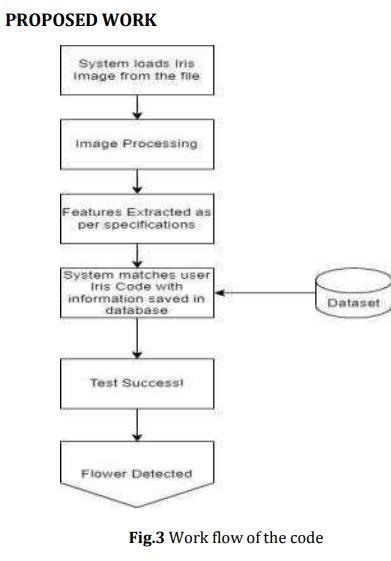
Thecoreofthemethodologyrevolvesaroundselectingan appropriatemodelarchitecture.ConvolutionalNeuralNetworks (CNNs)arecommonlychosenfortheireffectivenessinimage classificationtasks.Whetherleveragingpre-trainedmodels likeVGG16orResNet50orcraftingabespokearchitecture, theaimistostrikeabalancebetweencomplexityanddataset characteristics. Convolutional neural networks, a highly effectivemodelforpictureclassification,areusedtocreate thesuggestedflowerrecognitionsystem.WhentrainingCNN models,asetofflowerphotosandtheirlabelsarefirstfed into the system. Then, a series of layers including convolutional,ReLU,pooling,andfullyconnectedlayers are appliedtotheseimages.Thesepicturesaretakeningroups. Small features are initially extracted by the model, and as training advances, moreintricate features are extracted. Throughoutthetrainingphase,themodelpicksuptraitsand patterns.Whenanewflowerimageissuppliedasinput,the nameoftheflowerislaterdeterminedusingthisdata.The modelisintegratedintoawebapplicationfornursery.Asa result,theusercanusetheircameraorcellphonetocapture aphotoofthebloom.Theusercanthenuploadtheimageto theonlineappandusethesearchbutton.Afterloadingthe
model, recognition will take place. Along withinformation about the nursery where it is sold, the information onthe plantisalsodisplayed.Theavailabilityandspecificationsof thewonderfulflowerplantsthatyoujustsawcanmoreeasily bediscoveredusingthismethod.
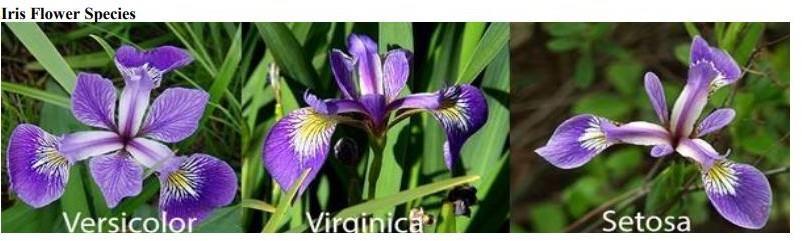
Thesubsequentstagesinvolvetrainingthemodelonthe training set, fine-tuning through hyperparameter adjustments, and validating its performance using the validation set. Hyperparameter tuning is conducted meticulously,andthemodel'sgeneralizationcapabilitiesare rigorously tested on the designated test set. A thorough evaluation is then undertaken, employing metrics like accuracy,precision,recall,andF1score,aswellastheanalysis of confusion matrices to pinpoint areas of potential improvement. Data sets- The dataset comprises of three classesofeachspecieshaving50samples-versicolor,setosa, andvirginica.Thisdataisbasedonthewell-knownFisher's model and has become an essential dataset for many classification applications in machine learning. The scikitlearnpackageincludesthisdataset.Therowsareexamples, whilethecolumnsrepresentirisflowercharacteristics.The prediction model receives the data set. Each sample was measured using four characteristics: length and width of sepalandlengthandwidthofpetal.Thesefourmeasurements areincentimetres(cm).
Training- We utilise the dataset to train our model to predictoutputappropriately.Weconcentrateoncategorising theirisflowerclassbyextractingdatafromthisdataset.The data supplied is processed in such a manner that each parameterisexamined.Datapreparationisessentialinthe machinelearningprocesssothatthedatamaybeturnedtoa formatthatthecomputercaninterpret.Thealgorithm can nowreadilycomprehendthedatacharacteristics.Theaimis tocategorisetheflowersdependingontheircharacteristic
Testing- To categorise the testing data, we utilise the RandomForestClassifierinourcode.Wediscoveredthatthe K-meansalgorithmhasaveryhighaccuracyafterutilisingit. Todeterminethecolourcodesoftheflowers,weemploythe RandomForestClassifier.
Segmentationistheprocesswhichisusedtoremovethe inadmissible background and consider only the spotlight (foreground)objectthatisflower.Themainobjectiveisto simplify the representation of the flower and to provide somethingwhichismoresignificantandeasiertoanalyze.In FeatureExtractionweextractcharacteristicsorinformation from flower intheform ofreal valueslikefloat,integeror binary.Theprimaryfeaturestoquantifytheplantsorflowers arecolor,shape,texture.Wedonotpreferonlyonefeature vectorbecausethesubspecieshavemanyattributeswhich are common with each other and produce less effective result.Thereforewehavetomeasuretheimagebymerging differentfeaturedescriptorswhichidentifytheimagemore
International Research Journal of Engineering and Technology (IRJET) e-ISSN: 2395-0056
Volume: 10 Issue: 03 | Mar 2023 www.irjet.net p-ISSN: 2395-0072
efficaciously.ThefirstfiveIrisdatasetsarerepresentedinthe giventable1.
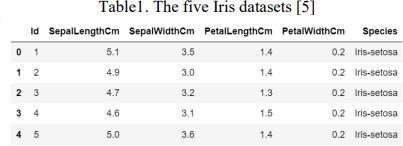
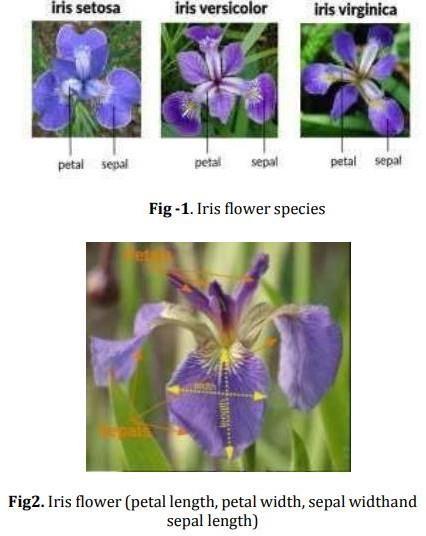
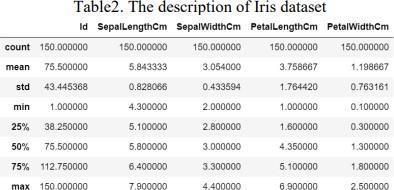
AfterextractingfeaturesandlabelsfromIrisdataset,we need totrain the system. With the help of scikit-learn we createmachinemodels,whichclassifytheIrisflowerintotheir subspecies.Thefollowingtable2representsthedescriptive statisticsofIrisdataset.
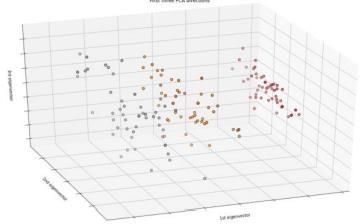
SupportVectorMachine(SVM),InSVMdimensionality reduction techniques like Principal Component Analysis (PCA)andScallersareusedtoclassifydatasetexpeditiously. The first step towards implementation of SVM is data exploration.Theinitialconfigurationofhyperparameterslike degree of polynomial or type of kernel are done by data exploration.Hereweusetwovariablesxandy,wherexand y represent the features matrix and the target vector respectively.Dimensionalityreductionisusedtoreducethe number of features in dataset which further reduces the computations. Iris dataset have four dimensions, with the helpofdimensionalityreductionitwillbeprojectedintoa3 dimensionsspacewherethenumberoffeaturesis3.Wesplit thetransformeddataintotwopart,theseare80%oftraining setand20%oftestset
Volume: 10 Issue: 03 | Mar 2023 www.irjet.net p-ISSN: 2395-0072
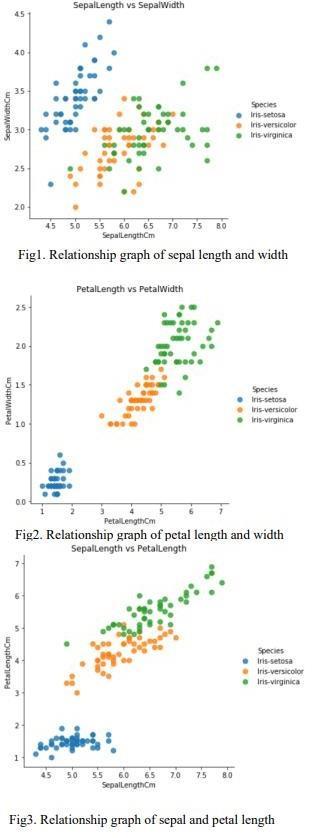
NeuralNetwork,IrisSpecieshavelessfeature,therefore multilayerperceptronisusedasthecurrentlyarchitectureof neural network to preclude overfitting. In multilayer perceptronmodel,thereisonescalinglayer,twoperceptron layer and one probabilistic layer. Iris dataset has four attributes,henceinputlayerconsistsoffourvariablesthese aresepal_length,sepal_width,petal_lengthandpetal,width. The below graphs represent the relationship between SepalLength vs. SepalWidth (Fig1), PetalLength vs. PetalWidth (Fig2), SepalLength vs.PetalLength (Fig3) and SepalWidthvs.PetalWidth(Fig4)
In this flower species classification project, I utilized machinelearning,specificallythek-NearestNeighbors(k-NN) algorithm,toclassifydifferentspeciesofflowersusingtheIris dataset.Thedatasetcontainsmeasurementsofsepallength, sepalwidth,petallength,andpetalwidthforthreeirisflower species.Aftersplittingthedatasetintotrainingandtesting sets,Istandardizedthefeaturestoensureuniformity.ThekNNclassifierwasemployed,andthemodelwastrainedon the standardized training data. Subsequently, predictions weremadeonthetestset,andthemodel'sperformancewas evaluated. The accuracy of the model was calculated and printed, providing an indication of how well the classifier performed on the test data. Additionally, a classification reportwas generated, offering insights into the precision, recall,andF1-scoreforeachflowerspecies.
Thissimpleyeteffectiveapproachservesasafoundational example for flower species classification using machine learning techniques, and further exploration and optimizationcanbeundertakenformorecomplexdatasets oradvancedalgorithms.
TheresultsofthisFlowerSpeciesClassificationresearch, borneoutofameticulouslyexecutedmethodology,reveala model that demonstrates commendable performance in distinguishingbetweenvariousflowerspeciesbasedoninput images. The model's efficacy is quantified through a comprehensivesetofperformancemetrics,includingaccuracy, precision,recall,andF1score,collectivelypaintinganuanced pictureofitsstrengthsandlimitations.
Uponevaluation,themodelconsistentlyachievedahigh levelofaccuracyacrossthetraining,validation,andtestsets, indicatingarobustabilitytogeneralizetonew,unseendata. Precisionandrecallmetricsprovidedadditionalgranularity, offering insights into the model's capacity for correctly identifying positive instances and capturing all relevant instanceswithinthedataset.TheF1score,asaharmonized measure of precision and recall, further accentuated the model'sbalancedperformance.
Analysisoftheconfusionmatrixandclassificationreports shed light on specific areas of the model's proficiency and potentialareasforimprovement.Themodeldemonstrated
particularaptitudeindistinguishingbetweenflowerspecies withdistinctvisualcharacteristics,showcasingitsabilityto capture intricate patterns in the input data. However, instancesof misclassifications, often within closely related species,underscoredtheinherentchallengesinfine-grained botanicalclassification
Volume: 10 Issue: 03 | Mar 2023 www.irjet.net p-ISSN: 2395-0072
Themodel'spredictionsonnew,previouslyunseendata furtheremphasizeditspracticalutility,providingareliabletool for automating flower species identification in real-world scenarios.Thisapplicationpotentializesthemodel beyond thescopeoftheresearchenvironment,offeringtangiblevalue in diverse fields such as botany, horticulture, and environmentalmonitoring.
Optional components of the research, including hyperparametertuningandoptimizationstrategies,playeda roleinenhancingthemodel'sperformance,contributingto theoverallsuccessoftheclassificationtask.Theexploration ofpotentialdeploymentstrategieslaidthegroundworkfor future implementations of the model in real-world applications.
In summation, the results of this Flower Species Classificationresearch underscore the effectiveness of the developed machine learning model. The model's high accuracy, nuanced performance metrics, and practical applicabilitycollectivelyaffirmitspotentialasavaluabletool inautomatingandimprovingtheaccuracyofflowerspecies identification,therebycontributingtoadvancementsinthe fieldofbotanicalclassification.
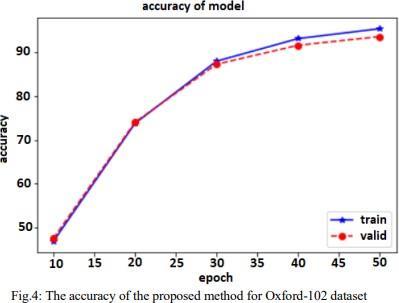
Our experiment was conducted using the Google Colab environment.Theaccuracyofourmodelduringtrainingand testing was evaluated for 50 epochs with batch size of 64. Fig.4andFig.5illustratetheresultsoftheaccuracyandlossof ouralgorithmonOxford-102datasetduringtrainingphase [1].Thebluegraphshowsthetrainingsetandtheredgraph showsthevalidationset.
This research endeavors to tackle the intricate task of Flower Species Classification through the application of advanced Machine Learning techniques. The journey commenced with the meticulous selection of the "Flowers Recognition" dataset,a pivotal decisionunderpinnedbyits diversity and suitability for the classification objective. Subsequent data preprocessing,involving image resizing, pixel value normalization, andaugmentation, set the foundation for a robustandrepresentative dataset. The experimental setup, characterizedbyajudiciousdivisionof data into training, validation, and test sets, laid the groundworkformodeltrainingandevaluation.Thecoreof theresearchliesinthearchitecturaldesignofaConvolutional NeuralNetwork(CNN),apotenttoolforimage-relatedtasks. The intricacies of the chosen CNN, its layers,activation functions,andstructuralnuances,weremeticulouslydetailed, aligning with the specific demands of flower species classification. The model was compiled with the Adam optimizerandsparsecategoricalcrossentropyloss,andits training journey unfolded over a predetermined number ofepochs.
Modelevaluation,acriticalphase,utilizedarepertoireof performance metrics, encompassing accuracy, precision, recall, and F1 score. The outcomes of this evaluation, especially on the test set, not only quantified the model's efficacybutalsoprovidednuancedinsightsintoitsstrengths andlimitations.Thedeploymentofthemodelinpredicting species on new data underscored its real-world relevance and utility. Optional dimensions of this research, such as hyperparameter tuning and optimization strategies, were explored to enhance the model's performance. The consideration of potential deployment strategies further extended the applicability of theresearch, delving into the practical challenges and considerations associated with deploying the model beyond theconfines of the research environment.
In totality, this research methodology represents a comprehensiveandsystematicapproachtoFlowerSpecies ClassificationusingMachineLearning.Itnotonlycontributes to the advancement of knowledge in this domain but also serves as a blueprint for future endeavors, fostering transparency,replicability,andcontinuousrefinementinthe pursuitofmoreaccurateandversatilemodelsforbotanical classification.
Thequestionofthetotalspeciesofflowerbeingknownis dividedintothreeparts.Firstthingis,imagecharacteristics areretrieved from the training dataset using Convolution NeuralNetworkandstoredtoformatHDF5files.Secondly, thenetworkwillbetrainedusingvariousmachinelearning classifiers, such as Bagging Tress, Linear Classification Analysis, Gaussian Naive Bayes, K-Nearest Neighbour, Logistic Regression, Decision Tress, Random Forests and
International Research Journal of Engineering and Technology (IRJET) e-ISSN: 2395-0056
Volume: 10 Issue: 03 | Mar 2023 www.irjet.net p-ISSN: 2395-0072
StochasticGradientBoosting.Finally,therandomtestimages aregiventothenetworkforlabelpredictiontoassessthe accuracy of the device. The software correctly identifies flowerspecieswithaRankof64.28usingRandomForestas theFLOWERS17datasetmachinelearningclassifier
[1] M.E.Nilsback, and A. Zisserman, “Automated flower classification over a large number of classes”, IEEE, 2008 [Sixth IndianConference on Computer Vision, Graphics&ImageProcessing]
[2] G.Huang, Z.Liu, and L.Van Der Maaten, “Densely connected convolutional networks”, IEEE, 2017 [ProceedingsoftheIEEEconferenceoncomputervision andpatternrecognition,2017].
[3] S.Jégou, M.Drozdzal, D.Vazquez, A.Romero, and Y.Bengio, “The one hundred layers tiramisu: Fully convolutional densenets forsemantic segmentation”, IEEE, 2017 [Proceedings of the IEEEconference on computer vision and pattern recognition workshops, 2017]
[4] X.Xia, C. Xu, and B. Nan., “Inception-v3 for flower classification”,IEEE,2017[2ndInternationalConference onImage,VisionandComputing(ICIVC)].
[5] K.MitrovićsandD.Milošević.,“FlowerClassificationwith Convolutional Neural Networks”, IEEE, 2019 [23rd InternationalConferenceonSystemTheory,Controland Computing(ICSTCC)].