
International Research Journal of Engineering and Technology (IRJET) e-ISSN: 2395-0056
Volume: 11 Issue: 02 | Feb 2024 www.irjet.net p-ISSN: 2395-0072
International Research Journal of Engineering and Technology (IRJET) e-ISSN: 2395-0056
Volume: 11 Issue: 02 | Feb 2024 www.irjet.net p-ISSN: 2395-0072
Dr Bhramaramba Ravi1 , Jai Surya Abhishek2 , E Harika3 , Trinadh N4 and Sai Kumar5
1Professor, Dept. of CSE, GITAM (Deemed to be University), Visakhapatnam, Andhra Pradesh, India 2,3,4,5Student, GITAM (Deemed to be University), Visakhapatnam, Andhra Pradesh, India.
Abstract - Our project’s main objective was to serve as a pivotal step to address the pervasive health concern that is predominant in numerous households: diabetes. Within the context of this prevalent condition, we have stressed on the critical issue of Diabetic Retinopathy, which is a common occurrencethatultimatelyresultsfromdiabetes.Ourprimary objective lies in the development and implementation of a unique and advanced predictive method that leverages sophisticatedfeatureextractiontechniquesfromanextensive imagedataset.Byemployinganinnovativeapproachrootedin Neural Network processing, we seek to establish a robust framework for accurately detecting and categorizing the severity of Diabetic Retinopathy through efficient classificationmechanisms.Thecoreessenceofourprojectlies in its potential to transform the early prediction and classification of diabetic retinopathy severity, thereby facilitating timely and targeted medical intervention. By harnessingthepowerofdeeplearningtechniques,weaspireto equipmedicalpractitionersandhealthcareprofessionalswith an intuitive tool that not only streamlines the diagnostic process but also enhances the overall effectiveness of patient care. Our project's overarching goal is to contribute to the broader mission of improving healthcare outcomes by enablingtimely interventions, therebyreducingthe potential risksandcomplicationsassociatedwithDiabeticRetinopathy. Through the integration of cutting-edge technology and medicalexpertise,weaimtopavethewayforamorepractical and responsive approach to diabetic retinopathy management.
Key Words: Capsule Network (Capsnet), Convolutional Neural Network (CNN), Diabetic Retinopathy (DR), K –Nearest Neighbors (KNN), Machine Learning (ML), NonProliferativeDiabeticRetinopathy(NPDR),NeuralNetwork (NN), Proliferative Diabetic Retinopathy (PDR), Random Forest(RF),SupportVectorMachine(SVM).
1.INTRODUCTION
Inthisprojectwehaveidentifiedamajorproblemwhichis retinopathyitaconditionpresentineyesofthepatientthat is caused by diabetes. To better understand this medical condition,wecansaythatinsimpletermssuchas,patients withdiabetescouldpossiblytendtodisplayabnormalitiesin theeyesthatareaffectedduetotheextensivefluidleakage
might even cause loss of vision due to the blood vessel damage inside the eye, so it is create an awareness and ensure that people are cautious about this, and we are aimingtodevelopamodelwhichmakesthistaskeasyforthe patients in doubt to easily asses themselves by using this architecture for premature detection of the disease condition.Themajorconcerninidentificationofthisdisease isthattherenoawarenessfromthepatient’ssideregarding this condition until the vision is completely gone and the retinaiscompletelydamage’sitstissues.Bythistime,when thepatientwouldhaveconsultedthedoctor,itwouldhave always been too late to treat him/her for the cure as the conditionwouldhaveworsentoaverycriticalstatewhere diseasetreatmentwillbeofnobettermentofthecondition. If a patient is aware of this condition, then they would consult the doctor immediately after noticing the initial changes in the vision, which are classified as NPDR, otherwisetheconditionoftheeyegetsworseandveinsget cloggedcausingblockageofcirculationofbloodintheveins oftheeyes.Inthismodeldevelopmentprocess,wewillbe using the eye’s retina images which are required as the dataset to extract necessary features using several processing methods. The dataset of images is given to the model for training, testing purposes and the final model mustbecapableofdeterminingthelevel oftheseverityin thepatient.
Theinvaluableinsightsgainedbyunderstandingtheworkof theauthorsMrs.TNAnithaandBrunda,whicharefollowed[1] The progression of technology has suggestively impacted numerouscharacteristicsofourlives,ithasalsosimplified complex tasks for humans and have been extensively improvingefficiency.However,certainsegmentsofsociety still face challenges, particularly in healthcare. Among the visualimpairmentsassociatedwithvariousdiseases,Diabetic Retinopathystandsout,posingasignificantthreattovision duetoretinalvasculardamagecausedbyprolongeddiabetes. Thiscondition,fueledbyelevatedglucoselevelsintheblood, often goes unnoticed until vision changes occur, primarily affectingmiddle-agedandolderindividuals.Addressingthis issue requires early detection and treatment to mitigate vision loss effectively. Utilizing Fundus eye images and employingImageProcessingtechniques,thisstudyaimsto extract features and assess disease severity using the K- fromtheeyeretinawhichimpactsandhighlydamagesthe lightsensitivetissueoftheeye,toavoidthisconditionwhich
International Research Journal of Engineering and Technology (IRJET) e-ISSN: 2395-0056
Volume: 11 Issue: 02 | Feb 2024 www.irjet.net p-ISSN: 2395-0072
NearestNeighboralgorithm,offeringapotentialsolutionfor timelydiagnosisandintervention.Vision,beingfundamental to daily activities, underscores the importance of such advancements in ensuring a better quality of life for individuals affected by diabetic complications. The development of predictive models not only streamlines healthcareprocessesbutalsolaysthegroundworkforfuture enhancements in accuracy and classification, ultimately striving towards more precise diagnosis and treatment strategies
[2] Diabetic Retinopathy (DR) presents a significant challengeforindividualslivingwithdiabetesforovertwo decades, often leading to blindness due to elevated blood glucose levels. Early diagnosis is crucial for effective treatment, yet current methods like Fluorescein Angiographyareslowandinaccessibletomany.Thisstudy offers a pioneering approach by integrating CNN, for detecting DR using RGB retina images, achieving a remarkable accuracy of 90.32%. The dataset utilized, sourcedhasbeenobtainedfromKagglewebsite,contained approximately 3.6k RGB retina images, laying a solid foundationforaccuratediagnosisandintervention.
The introduction delineates the severity of Diabetic Retinopathy, emphasizing the detrimental effects of prolongedhighglucoselevelsonretinalbloodvessels.While Fluorescein Angiography remains a gold standard for diagnosis, its complexity and cost hinder widespread accessibility. In contrast, Convolutional Neural Networks offer a promising alternative, leveraging their capacity in obtainingvariousfeaturesfromdataset,therebyenhancing accuracythusadvancingdiagnosis.ThistransitiontoCNNs marks a significant advancement in image processing, surpassing traditional methodologies and facilitating quicker,moreefficientdiagnosisofDR.
Theconclusionunderscoresthesuccessfulimplementation ofCNNsforDRclassificationbasedonfunduscolorimages, highlighting their efficacy despite slower training times. Moreover,itpointstoavenuesforfutureresearch,including the integration of pre-trained models to enhance performanceandthepotentialdeploymentofthemodelin web-based architectures to improve accessibility in underserved regions. This research not onlyadvances the field of medical imaging but also holds promise for early disease detection and personalized treatment strategies, ultimately improving patient outcomes and healthcare accessibilityworldwide.
[3] Diabetic retinopathy which is a foremost reason for losing of eye sight among individuals with diabetes, underscores the critical need for early detection and intervention.Thisstudyaddressesthisurgencybyproposing atransformedcapsulenetworkthatismainlyknownforits ability in generating a model with accurate detection and classification of DR’s lesions in fundus images. They have
utilized the convolution layer for the network extracts feature from retinal image dataset and then the primary capsulelayerstoestimatethepossibilityoftheimageclass using their class capsule in a combination with (the multi classclassifier) SoftMax layers.Remarkably,the projected networkachieveshighaccuracyratesofaround97percent to 98 percent on the retinal/fundus images, respectively, whichareobtainedusingtheMessidordataset.
Theintroductionhighlightstheescalatingglobalprevalence ofdiabetes,withprojectionsestimatingariseto693million individuals by 2045. Diabetes poses a myriad of complications,includingdiabeticretinopathy,whichaffects individuals irrespective of age, leading to vision-related issues.Theseverityofdiabeticretinopathyunderscoresthe importance of early detection to mitigate vision loss. Traditional diagnostic methods often lack efficiency and accuracy, necessitating the exploration of advanced technologieslikedeeplearning.Capsulenetworks,arecent development in deep learning, offer promising results for diabetic retinopathy diagnosis by circumventing issues encounteredwithtraditionalCNNs.
In conclusion, diabetic retinopathy remains a significant challenge for individuals with diabetes, emphasizing the imperative for early detection to prevent vision loss. The proposed Capsule Network presents a viable solution, demonstratingsuperiorperformancecomparedtoexisting CNNapproaches.Byaccuratelyidentifyingretinalproblems across all stages, the Capsule Network offers a promising avenueforearlydiagnosisandintervention.Futureresearch endeavors aim to extend the model's capabilities to encompass a broader spectrum of diabetic retinopathy classes, ultimately enhancing diagnostic precision and patientoutcomes.
[4]The escalatingglobal prevalenceofdiabetes,currently affecting over 470 million individuals worldwide and projected to reach 700 million by 2050, underscores the urgent need for effective detection and management strategies. While Type 1 diabetes remains chronic and incurable,earlyidentificationofType2diabetesholds the potential for successful treatment. However, detecting anomalies in retinal images, indicative of diabetic complications,presentsaformidablechallengeduetotheir subtle nature. This necessitates the development of noninvasive techniques for uncovering these abnormalities, facilitatingtimelyintervention.
The introduction delves into the multifaceted challenges posedbydiabetes,citinga5%increaseindiabetes-related deathsfrom2000to2016,with1.6milliondeathsannually. ParticularlyinIndia,diabetesemergesasasignificantpublic health concern, exacerbated by indistinct symptoms and lifestyle factors. The disparity between ophthalmology trained professionals and patients further complicate the diagnosisandtreatmentofdiabeticretinopathy,propelled
International Research Journal of Engineering and Technology (IRJET) e-ISSN: 2395-0056
Volume: 11 Issue: 02 | Feb 2024 www.irjet.net p-ISSN: 2395-0072
bytheglobalsurgeindiabetescases.Addressingissuessuch as screening time and device sensitivity, the introduction advocates for automated detection systems based on standalone algorithms, leveraging advancements in image processingandclassificationtechniques.
Inconclusion,theproposedapproachsuccessfullyidentifies exudatesandmicro-aneurysms,crucialindicatorsofdiabetic retinopathy.Morphologicaloperations,includingclosureand erosion, facilitate accurate detection and classification of these anomalies, enhancing the efficiency of screening processes. By also comparing with the SVM and KNN classifiers, the system effectively grades disease severity, offering valuable insights for treatment decision-making. Whiletheproposedmethodologyexhibitspromise,ongoing research endeavors aim to refine existing algorithms and improve the overall effectiveness and complexity of automateddetectionsystemsfordiabeticretinopathy.
3. Project Goal
Tobesuccessfulincreatingasystemwhichmakesuseofthe mostsuitableDeepLearningAlgorithmthatultimatelyaids in the early detection and can classify multiple stages of diabetic retinopathy accurately and efficiently, which commonpeoplewithoutanypriorknowledgeofthisspecific system or any working architecture can use and obtain accurateresulteasily.
4. Problem Identification
Traditionally,thediagnosisofdiabeticretinopathyhasrelied on manual assessment of retinal images by trained Eye Specialists. This procedure is highly time taking, laborintensive,andissubjectivetosimpleerrorwhichmightlead toaverywrongdiagnosis.Withtheadvancementofartificial intelligence and deep learning techniques, there's a remarkable opportunity to automate and enhance the detectionandclassificationobjectivewhichwehavetakenin thecaseofdiabeticretinopathy.Thus,introducingamodern NNarchitecture,whichhasthepotentialtoaddresssomeof thelimitationsfacedbytraditionalmethodswhilehandling complexspatialrelationshipsandvariationsinpose.Itaims tocapturehierarchicalfeaturesandpart-wholerelationships inimages,whichisparticularlyrelevantfordetectingsubtle changes in retinal structures indicative of diabetic retinopathy.
5. Dataset Description
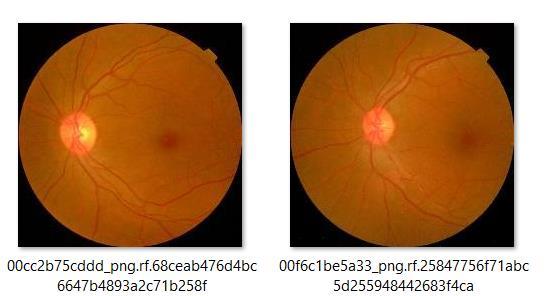
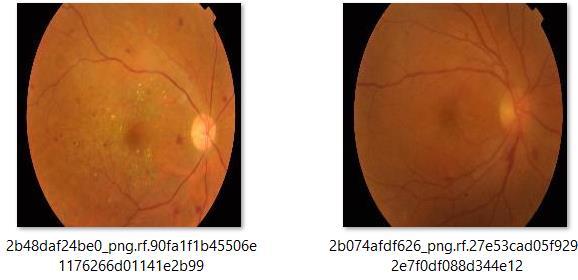
Thedatasetselectedforthisspecifictaskwasextractedfrom online source named as Kaggle, in which the entire folder wasapproximately16mbwithroughly2500imagesthatare splitintotwo,theyaretrainingandtestinginapproximately 9:1proportionforbettertrainingofthemodel,wherethey are sub categorized into DR and No-DR fundus images of RGBformat,witheachimagerangingfrom2.5kbto6kbof size.
TheimagesareofFundustyperetina images,duetotheir RGBformatitincreasedthecomplexity,duetothepresence of3dimensionsthatisvariables,sowehavealsostressed moreonthepreprocessingpartoftheexecutiontoreduce thecomplexitywithoutcompromisingimagequalityorthe featureextractionpropertyforourmodel.
The images have to be classified into 5 different classes whicharefollows: Mild NPDR whichistheearlieststageof thisdiseaseadvancement, Moderate NPDR atthisstagea specialistisadvisedtogenerallytakecertainstepstoensure thattheconditionstaysundercontrol, Severe NPDR atthis stage the retina specialist is recommended, PDR is a very advancedstageofthediseasewhichcanresultinvisionloss orblindnessand No DR inpatient.
6.i.InputDataset:
The input dataset for this study comprises retinal images obtained from diabetic patients, with each image labeled accordingtotheseverityofDR.Theseimagesserveasthe primary data source for training and evaluating the deep learning algorithms employed in this specific detection of this disease with multi classification ability of DR. The dataset includes retinal images captured through various imagingmodalities,suchasfundusphotography,ensuring diversity and representativeness in the data. Additionally, the dataset may be augmented with metadata providing patient demographics and clinical information, enhancing thecontextualunderstandingoftheimages.
Volume: 11 Issue: 02 | Feb 2024 www.irjet.net p-ISSN: 2395-0072
6ii.Preprocessing:
Priortomodeltraining,inputisthedatasetfundusimages which undergoes the preprocessing stage which tries to boostthequalityandmakesiteasyto extractappropriate features from the dataset. This preprocessing pipeline typically includes resizing the images to a standard resolution, normalization to scale pixel values within a uniformrange,andapplicationofmorphologicaloperations toremoveartifactsandnoise.Additionally,techniquessuch ashistogramequalizationandmedianfilteringareemployed to enhance contrast and reduce image noise, respectively. Thesepreprocessingstepsarecrucialforstandardizingthe inputdataandfacilitatingeffectivefeatureextractionbythe deeplearningmodels.
6.iii.ConvolutionalNeuralNetwork(CNN):
Thecoreoftheproposedmethodologyliesintheutilization ofCNNstobeusedforthistask,thatisdiseasedetectionand multi-class classification of DR. CNNs are well-suited for image-based tasks due to its innate ability in learning the hierarchicalwayofrepresentingfeaturesdirectlyfromthe data. The architecture of the CNN typically comprises convolutionallayersfollowedbypoolinglayers,enablingthe networktoextractspatialhierarchiesoffeaturesfromthe inputimages.
Subsequentfullyconnectedlayersandactivationfunctions facilitate the integration of extracted features for classification. The CNN is trained using labeled retinal images, optimizing model parameters through backpropagation and gradient descent to minimize classificationerrors.
6iv.ModelEvaluation:
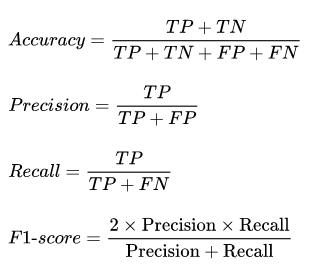
ThetrainedCNNmodelhastobeevaluatedthroughvarious performance metrics, which mainly include the most prominently used ones that are listed in the below figure. Through the usage of these specific metric’ s, we obtain insights of the model's capability to correctly classify the dataset’simages.
Additionally, the model may undergo validation using an independent test dataset to assess its generalization capabilities and mitigate overfitting. Cross-validation techniques may also be employed to further validate the robustnessofthemodelacrossdifferentsubsetsofthedata.
Theevaluationprocessservestovalidatetheefficacyofthe proposed methodology in accurately detecting and classifyingdiabeticretinopathy.
6
In addition to CNNs, the proposed methodology may includethe exploration and comparison of several other traditional ML classifiers which are as follows Support Vector Machines that is widely known for its ability to provide a solution to the classification limitations by determiningappropriateboundaries,K-NearestNeighbors thisalgorithmfollowstheideathatsimilarunitsinadataset willtendtopossessthesamelabel,andRandomForestsfor itsdecision-makingabilityfrommultiplepossibilities.These classifiersare trainedand evaluatedusing the same input dataandperformancemetricsastheCNNmodel,enablinga comparative analysis of their effectiveness in diabetic retinopathydetectionandclassification.Suchcomparisons provide remarkable insights of the strengths and weaknessesofdeeplearningalgorithmsversustraditional machinelearningapproachesinthecontextofmedicalimage analysis.
Overall,theproposedmethodologyintegrates thepopular state-of-the-art technique of deep learning with rigorous preprocessing and assessment approaches to develop an effective architecture for our DR task of disease detection andmulticlassclassification.
By leveraging the inherent capabilities of CNNs and exploringalternativeclassifierparadigms,themethodology aimstoadvance the medical fieldof retina imageanalysis and contribute to a better disease diagnosis in diabetic retinopathymanagement.
The provided code encompasses various stages, each contributingtotheoverallefficacyofthemodel.Initially,the codeimportsnecessarylibrariesand defineslists tostore processeddata.The`preprocess_test_image`functionplaysa pivotalroleinimagepreprocessing,whereimagesundergo resizing,normalization,morphologicaloperationsforblood vessel removal, median filtering for noise reduction, and histogramequalizationforcontrastenhancement.
International Research Journal of Engineering and Technology (IRJET) e-ISSN: 2395-0056
Volume: 11 Issue: 02 | Feb 2024 www.irjet.net p-ISSN: 2395-0072
Thesepreprocessingstepsarecrucialforenhancingimage qualityandextractingrelevantfeatures,therebyimproving the model's accuracy. Furthermore, the code utilizes label mapping to assign numerical labels to different classes of diabeticretinopathy,streamliningtheclassificationprocess. The preprocessing of test images involves applying the `preprocess_test_image` function iteratively, ensuring consistencyandstandardizationinimagepreparation.
Moreover,thecodeemploysthe`ImageDataGenerator`class for data augmentation and normalization during model training, facilitating robustness and generalization. The convolutionalneuralnetwork(CNN)architectureisdefined usingthe`Sequential`model,comprisingconvolutionalwith pooling layers to extract features and minimizing the complexity, which is followed by dense layers that are equippedwithdropoutregularizationtopreventoverfitting. The model is compiled with appropriate loss and optimizationfunctions,settingthestagefortraining.
Duringmodeltraining,thecodeleveragesthe`fit`methodto train the CNN on the training data while validating its performanceonthevalidationdata.Thisiterativeprocess iteratively optimizes the model parameters, enhancing its abilitytogeneralizetounseendata.
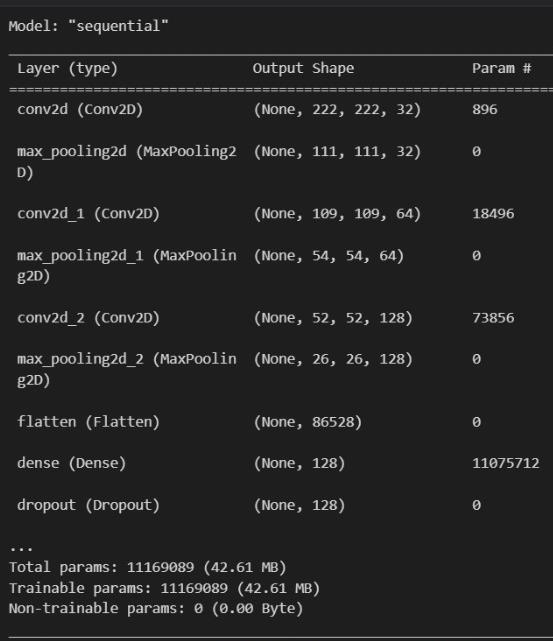
Additionally, the code explores the use of the previously mentionedtraditionalMLclassifiersforcomparisonwiththe CNN model. These classifiers undergo training and evaluation using the same training and validation data generators, enabling a comparative analysis of their performancemetrics,includingaccuracy.
Overall, the code meticulously orchestrates various preprocessingtechniques,modelarchitectures,andclassifier implementationstoconstructarobustdiabeticretinopathy detection system. Each component synergistically contributes to the model's accuracy and reliability, ultimately facilitating early diagnosis and intervention in diabeticpatients.
Table-1: Comparisionofmetricsinatabularformat.
In conclusion, the provided methodology implements a comprehensive approach in detecting and classifying diabeticretinopathyconditioninpatientsbyleveragingboth deep learning and the traditional techniques of machine learning. By including several meticulous preprocessing steps,includingimageresizing,grayscaleconversion,noise reduction, and contrast enhancement, the quality of input data is significantly improved, ensuring better model performance,thisalsogivesusauniqueapproachinsolving theproblem.TheuseofTensorFlowandKeraslibrarieshave given us the ability to develop and training a model, ultimately reflecting a deep learning model, comprising convolutional and pooling layers, finishing it with dense layers which are specifically used for the classification purpose. Dropout layers are incorporated to mitigate overfitting whichisa major limitation ofmultiple models, thusenhancingourmodel'sgeneralizationcapability.
Moreover, we have stressed in utilising conventional ML classifiers like SVM, KNN, and Random Forest to compare andevaluatetheireffectiveness.Wehaveemployedseveral evaluationmetricstoverifytheabilityandperformanceof each model variation. Overall, the code demonstrates a robust methodology for diabetic retinopathy detection, showcasing the synergy between advanced deep learning techniques and classical machine learning approaches to reportacriticalhealthcarechallenge.
International Research Journal of Engineering and Technology (IRJET) e-ISSN: 2395-0056
Volume: 11 Issue: 02 | Feb 2024 www.irjet.net p-ISSN: 2395-0072
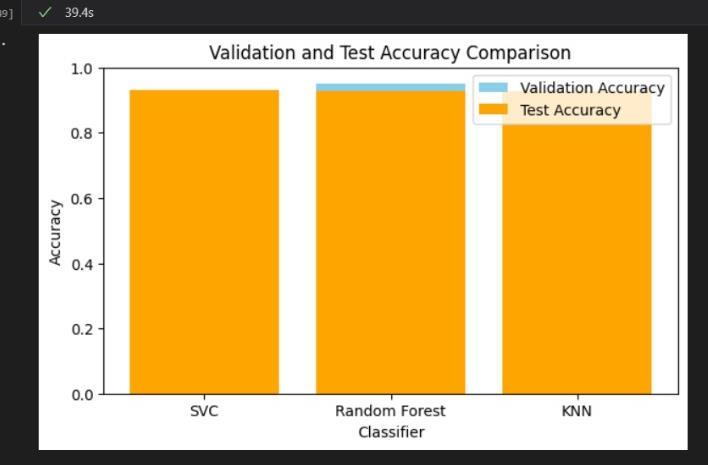
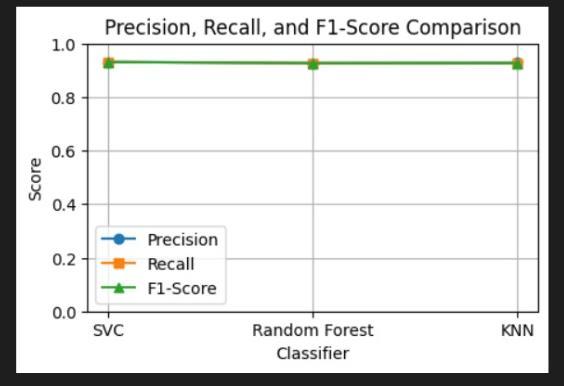
Fig -5,6: PerformancecomparisionofClassifiers.
9. Future scope
Inthenextphase,weprimarilyaimtoaugmentthemodel’s accuracy of DR disease detection through fine-tuning the CapsuleNetworkalgorithmandalsoaimtoimplementour project through various and updated deep learning techniques to compare and contrast, to finally select the suitablealgorithm.Ultimately,ourgoalistomakethismodel morereliableandefficientindetectingandpreventingvision lossindiabeticpatients.
[1] Dr. TN Anitha, Brunda K and Jhalkee, “Diabetic RetinopathyDetectionandClassificationVol.11,Issue5, May 2022, DOI: 10.17148/IJARCCE.2022.115197
[2] Rajesh N, Durga Devi, Mari Kirthima and Ambika G, Diabetic Retinopathy Detection using Deep Learning, International Journal of Advanced Research in EngineeringandTechnology,11(7),2020,pp.208-216.
[3] G.Kalyani,Janakiramaiah,A.KarunaandL.V.Narasimha Prasad, “Diabetic retinopathy detection and classification using capsule networks”, 14 November 2020,KACST,Springer
[4] AnmolRatan&SonyTirkey,BinodAdhikariandCazal Tirkey,“DiabeticRetinopathydetectionusingMachine learning,”Volume:10Issue:06|Jun2023,IRJET
[5] SafeelaandDeepa,“DiabeticRetinopathyClassification UsingDeepLearningArchitectures”,IRJPMS,Volume5, Issue5,pp.17-19,2022.
[6] Vedant Narendra, Mehul Rajendra, Siddhant Rahul, Sanat Pradeep, Jagruti Wagh, “Diabetic Retinopathy Detection using Convolutional Neural Networks”, Volume10IssueVMay2022-IJRASET.
[7] TiwaladeModupeUsman,YakubKayodeSaheed,Djitog IgnaceandAugustine,“Diabeticretinopathydetection usingprincipalcomponentanalysismulti-labelfeature extraction and classification”, International Journal of CognitiveComputinginEngineering
[8] Mrs.VishakhaShelke,Mr.VinayManishShah,Mr.Harsh RatnaniandMr.Rahul,”DiabeticRetinopathyDetection UsingSVM”,Volume10IssueIVApr2022-IJRASET.
[9] Md.Shaban,Zeliha,AhmedShalaby,AliMahmoud,Md Ghazal and Ayman El-Baz, “Automated Staging of DiabeticRetinopathyUsinga2DConvolutionalNeural Network”,inIEEEAccess,2018.
[10] KaranBhatia,ShikharAroraandRaviTomar,“Diagnosis of Diabetic Retinopathy using Machine Learning Classificationalgorithm”,inIEEEAccess,2016.
[11] National Eye Institute, National Institutes of Health, “DiabeticRetinopathy:Whatyoushouldknow,”Booklet, NIHPublication,no:06-2171,2003.
[12] A. D. Fleming, Goatman, and J. A. Olson, “The role of haemorrhage and exudate detection in automated grading of diabetic retinopathy,” British Journal of Ophthalmology,vol94,no.6,pp.706-711,2010.
2024, IRJET | Impact Factor value: 8.226 | ISO 9001:2008