
International Research Journal of Engineering and Technology (IRJET) e-ISSN: 2395-0056
Volume: 11 Issue: 02 | Feb 2024 www.irjet.net p-ISSN: 2395-0072
International Research Journal of Engineering and Technology (IRJET) e-ISSN: 2395-0056
Volume: 11 Issue: 02 | Feb 2024 www.irjet.net p-ISSN: 2395-0072
Yashas R1 , Ilakkiya R1 , Arathi R Shankar2
1Student & BMS college of engineering Dept. of Electronics and communication Engineering, BMS college of engineering, Karnataka, India
1Technical Leader & Nokia, Karnataka, India
2Associate Professor, Dept. of Electronics and communication Engineering, BMS college of engineering, Karnataka, India ***
Abstract - The transmission of data through the air interface using both Physical Random Access channels (PRACH) andPhysical Uplink Sharedchannels (PUSCH) in an Orthogonal Frequency Division Multiplexing (OFDM) system ThedatarateatinstancesofPRACHsubcarrierfrequenciesis smaller than that of PUSCH subcarriers. To achieve seamless data transmission, sampling rate conversion is employed to match the varying subcarrier spacings and channel bandwidths. Sampling rate conversion involves adding or removingsampleswhilepreservingthe durationandshapeof the signal. This process introduces variations in the power spectral density in the frequency domain, necessitating filtering techniques to retain the original power spectral density. Specifically, inNR PRACH processing, the IFFT sizeat thetransmitterandFFTsizeatthereceiverarefixedbasedon the PRACH sequence length, requiring sampling rate conversion to align with the IFFT and FFT processing. This paper discusses and compares the characteristics and performance results of the digital Finite Impulse Response (FIR)-based sampling rate conversion filter, the Cascaded IntegratorComb(CIC)Filter,whichisusedwithinterpolation and decimation filters at the transmitter and receiver, respectively. The study provides insights into selecting the most suitable sampling rate conversion filter for OFDM systems, ensuringefficient data transmission, andoptimizing spectral efficiency.
Key Words: OFDM, PRACH, PUSCH, sampling rate conversion,interpolation,decimation,FIRfilter,CICFilter, spectralefficiency,wirelesscommunication
Samplingrateconversionisafundamentalprocessinsignal processing that allows for the addition or removal of sampleswhilepreservingthesignal'sdurationandshape.Its significance spans various industries, including wireless communications, where precise sampling rate conversion plays a vital role. An example is in Orthogonal Frequency Division Multiplexing (OFDM) systems, where accurate conversionensurescompatibilitybetweenthefixedInverse Fast Fourier Transform (IFFT) at the transmitter and the Fast Fourier Transform (FFT) at the receiver. This compatibilityiscriticalforefficientNewRadio(NR)Physical
Random-Access Channel (PRACH) processing, where the IFFT and FFT sizes are determined based on the PRACH sequencelength.
Inthisresearchpaper,theCascadedIntegratorComb(CIC) filter,recognizedasadigitalFiniteImpulseResponse(FIR) filter, is thoroughly examined for its ability to achieve precise and distortion-free sampling rate conversion in communication systems based on Orthogonal Frequency Division Multiplexing (OFDM). The CIC filter is highly favored for such applications due to its straightforward operationandminimalcomputationalcomplexity.
ToalignthesamplingratewiththesetIFFTFFTprocessing requirementsinthecontextofOFDMsystems,samplingrate conversionisrequired.Thesamplingrateisdeterminedby subcarrier spacing and channel bandwidth; any deviation from these parameters necessitates conversion of the samplingratetoOFDM. TheIFFTsizeatthetransmitterand FFTsizeatthereceiverarepredefinedbasedonthelengthof the PRACH sequence, which further emphasizes the significance of sampling rate conversion in NR PRACH processing.
The proposed technique converts sampling rates using decimationfiltersatthereceiverandinterpolationfiltersat the transmitter. These filters effectively increase or decrease the number of samples to achieve the desired samplingratewhilepreservingtheoriginalsignal'sduration andshape.Theprimarygoalofthispaperistoevaluatethe CICFilter'scapabilitiesandcharacteristicsinthecontextof samplingrateconversioninOFDMsystems.
The paper's structure is as follows: Section 2 provides a comprehensive literature review of sampling rate conversionmethodsandfiltersutilizedinOFDMsystems.In Section3,themethodologyispresented,whichincludesan overview of digital FIR-based filters and the specific requirementsforsamplingrateconversioninOFDMsystems andsection4ishavingresults.Finally,Section5concludes thepaperbysummarizingthekeyfindingsandproposing potentialavenuesforfutureresearch.
International Research Journal of Engineering and Technology (IRJET) e-ISSN: 2395-0056
Volume: 11 Issue: 02 | Feb 2024 www.irjet.net p-ISSN: 2395-0072
In his article titled "CIC Filter Introduction," Matthew P. Donadio[3]highlightstheincreasingimportanceofcascaded integrator-combfiltersinmodernDigitalSignalProcessing (DSP) systems. As data converters continue to advance in speed,theneedfornarrow-bandextractionfromwideband sourcesandnarrow-bandconstructionofwidebandsignals becomes critical. Accomplishing these tasks relies on fundamental signal processing techniques like decimation and interpolation. Despite the advancement in digital hardwarespeed,thedemandforefficientsolutionspersists.It wasHogenauer[1]whodevelopedtheCICfilterstoaddress thischallenge.Theseversatileandmultiplier-freefiltersare well-suited for hardware implementation and can handle arbitraryandsignificantratechangeseffectively.
TheCICfiltercanbeefficientlyimplementedusingamoving averagefilterwithNRtaps,followedbyoutputdecimationby afactorofR.Similarly,aninterpolatingCICfilterutilizesan NRtapmovingaveragefilteroperatingattheoutputsample rate, with R-1 zero samples inserted between each input sample[2].ThebeautyofCICfiltersliesintheirsimplicity,as theyexclusivelyemployadditionsandsubtractionsfortheir arithmeticoperations.Asdescribedbytheauthors,CICfilters aretechnicallylean,mean,andefficientfilteringmachines, makingthemhighlyeffectiveintheirfunctionality.
Researchers have optimized the hardware required for implementing CIC decimator and interpolator structures. Through a combination of modal analysis, MATLAB simulations, and FPGA synthesis using Xilinx ISE, they validate their results while exploring different rate factors andstageconfigurations.Thedeviceutilizationsummaryfor decimators and interpolators with varying stages is presentedusingtheXilinxSpartan3FPGA[4].
The challenge of handling high-frequency transmission signalsandimplementingdecimationwithFIRorIIRfilters arisesduetothesignificantcostassociatedwithpurchasing numerous multipliers. In response to this challenge, a practicalsolutionhasbeendevisedintheformofafive-stage CIC filter that eliminates the need for multipliers. This innovativestructurefindsitsprimaryapplicationinDigital Signal Processing (DSP) applications [5]. By using the CIC filter without multipliers, the cost and complexity of the implementationaresignificantlyreducedwhilemaintaining effectivedecimationofhigh-frequencysignals.
The efficiency of conversions by odd factors compared to evenfactorsintheclassoflinear-phaseFIRMth-bandfilters has been demonstrated. For odd factors, the proposed structures are more efficient and can be derived from conventional two-stage structures. In contrast, recently createdadd-equalizestructures,whicharealsocapableof arbitrary-integerconversion,exhibitcomparablecomplexity to conventional multi-stage converters (when applicable),
butarenotmoreeffectiveforoddMcomparedtoevenM[6]. The findings indicate that the proposed structures outperformtheseadd-equalizestructures,especiallyforodd conversion factors, offering improved efficiency in the contextoflinear-phaseFIRMth-bandfilters.
JunWooKimetal.[7]introducedareliablePRACHdetection method that remains dependable regardless of the search timeoffset.Whilethismethodtakestwiceaslongtosearch for PRACH, the latency of PRACH detection is not a significant concern in modem design since the detection process occurs only once per frame. Despite the longer search time, the PRACH detector proposed in the study accuratelyidentifiestheoptimalUL(Uplink)startpointfor the anticipated channel model in the intended service, as confirmed by simulation results. This highlights the effectivenessandprecisionoftheproposedPRACHdetection method.
Tuan Anh Pham and Bang Thanh Le present an enhanced algorithmintheirwork[8],aimedateffectivelymitigating falsealarmpeakscausedby variousfactors,suchasnoise and adverse channel conditions like multipath fading, Doppler shift, frequency offset, and timing offset. The proposed method employs multiple detection steps to achievethisobjective.Byoptimizingdetectionthresholds, the algorithm fulfills the system's specific requirements concerningdetectionprobabilityandfalsealarmprobability, especiallyunderdifferentSignal-to-NoiseRatio(SNR)levels andvaryingpropagationconditions.Throughthisapproach, the authors successfully address the challenges posed by noisy and dynamic channel environments, enhancing the overallperformanceofthesystem.
A continuous-time signal is a signal that is present at all pointsintimebecausethereareaninfinitenumberoftime instancesseparatinganytwopointsinspace.Acontinuoustime signal is sampled at specific, predetermined time instantstoproduceadiscrete-timesignal,incontrast. The corresponding samples represent the values of the signal, andthesampletimesindicatewhenthesignalisdefined. The Nyquist-Shannon sampling theorem mathematically limits the sampling rate by stating that the minimum sampling rate should be at least twice the maximum frequency of the signal being sampled. As a result, it is possibletosuccessfullyrecovertheoriginalcontinuous-time signal.
Consider,forinstance,asignalthatcontinuouslychangesin frequencyfromf1tof2,withf1beingthelowestfrequency andf2beingthehighest.Theminimumsamplingfrequency neededtoaccuratelyrecovertheoriginalcontinuous-time signalis2*f2.
Withtheaidofvarioussignalprocessingtechniques,suchas sample and hold circuits and low-pass filters, the original continuous-timesignalcanberecoveredfromitssamples.
International Research Journal of Engineering and Technology (IRJET) e-ISSN: 2395-0056
Volume: 11 Issue: 02 | Feb 2024 www.irjet.net p-ISSN: 2395-0072
Theparticularsofthesemethodsareoutsidethepurviewof thisdiscussion.
Handling high-rate samples requires more hardware memoryandprocessingpower. Modifyingthesamplerate becomes a crucial technique in signal processing systems, depending on the hardware resources available. When operating with constrained hardware, lower sample rates are preferred. This method is useful in fields like image scalingandaudio/visualsystems,wherevarioussampling ratesmaybeusedfortechnical,practical,orevenhistorical reasons.
Theprocessofchangingadiscretesignal'ssamplingrateor frequencytoproduceanewdiscreterepresentationofthe underlying continuous signal is known as sample-rate conversion. Interpolation, or upsampling, refers to the processofgoingfromalowerratetoahigherratebyadding more samples to guarantee better signal quality. On the other hand, decimation or downsampling refers to the removalofsampleswhengoingfromahigherratetoalower ratetosavememory,processingpower,andtimeresources.
2.1 Sampling rate conversion's effects on signal's time-frequency characteristics
Sampling rate conversion has a significant impact on a signal'stimeandfrequencydomains. Tobesuccessful,the original signal's desired properties must always be maintained.
Interpolation:
Timedomainimpacts:
When interpolation is done, extra samples are addedtotheoriginalsampleset,increasingtheinformation contentandpossiblyraisingthesignal'squality.However, because there are more samples, this also results in more storagespacebeingneededandslowerprocessing.
Frequencydomainimpacts:
Thefrequency-domaincharacteristicsofthesignal can be significantly altered by interpolation as well as decimation. Asmoresamplesareadded,theinterpolation process introduces amplitude variations in the newly inserted samples. At integer multiples of the original samplingrate,copiesoftheoriginalspectrumstarttoappear asaresult.
Zero-valued samples are first added between the original samples to begin the interpolation process. The original spectrumisreproducedatintegermultiplesoftheoriginal sampling rate as a result of these abrupt amplitude variations.Thisphenomenoncanbeseenintheupsampled signal's spectral features, where the original spectrum's copiesattheseintegermultiplesbecomeveryobvious.
Decimation:
Timedomainimpacts:
Decimation involves removing samples from the originalsampleset,whichcouldleadtoadecreaseinsignal qualityandinformationcontent. However, ithas benefits likelessstoragespaceandquickerprocessing.
Frequencydomainimpacts:
Decimation also affects the signal's spectral characteristics. Making sure that the newly reduced sampling rate can faithfully capture all of the spectral propertiesoftheoriginalsignalpresentsachallengeduring decimation. Aliasing can happen if the original signal contains frequency components that are higher than the rangethatcanberepresentedbytheslowersamplingrate. Aliasingistheprocessoffoldingfrequencycomponentsback intotherelevantband,whichcanleadtodistortionsinthe signal'sspectralproperties.
For example, when downsampling a signal by a factor of four,iftheoriginalsignalcontainsafrequencycomponent (CIC)filter,TheCICfiltercandeal withindeterminateand largeratechangeseffectively.
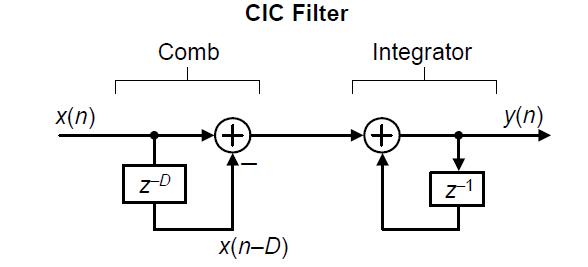
Fig -1:ACascadedintegrator-combimplementationofa D-pointrecursiverunningsumfilter.
The comb section and the integrator are the two fundamentalbuildingblocksthatmakeuptheCICfilter. The feedforwardportion,alsoreferredtoasthecombsection, includes a differential delay denoted by the letter D. The integrator,ontheotherhand,referstothefeedbacksection. Thecurrentinputsampleissubtractedfromadelayedinput sample in the comb stage. The integrator functions as an accumulator.
The difference equation representing the time-domain behavioroftheCICfilterisgivenby: y(n)=x(n)–x(n–D)+y(n–1) (1)
Mathematically,theintegratorandcombcircuitscanbeas follows,wherex[n]istheinputandy[n]istheoutput,with adifferentialdelayofD:
Integrator:y[n]=y[n-1]+x[n] (2)
Comb:y[n]=x[n]-x[n-D] (3)
International Research Journal of Engineering and Technology (IRJET) e-ISSN: 2395-0056
Volume: 11 Issue: 02 | Feb 2024 www.irjet.net p-ISSN: 2395-0072
TheCICfilterprovidesaflexiblesolutionforrateconversion inDSPsystemswhensignificantratechangesarenecessary. Due to its hardware compatibility and multiplier-free implementation, it is a desirable choice for efficient and effectivesignalprocessing.
CICfiltersservetwomainpurposes:anti-imagingfiltering for interpolated signals and anti-aliasing filtering for decimatedsignals.Inthedecimationprocess,denotedasR, thesampleratefs,outbecomesfs,in/Rafterkeepingonly everyRthsample.Whenusedforinterpolation,theCICfilter performsupsamplingbyinsertingR-1zerosbetweeneach x(n)sample,resultinginanoutputsamplerateoffs,out= Rfs, in. This interpolation involves inserting zeros, often termed"zerostuffing,"followedbylow-passfilteringusinga CICfilter.
Thefigurebelowillustratesasingle-stageCICfiltercapable of performing interpolation or decimation. Notably, the combsectiononthelowersampleratesideofthefilterhasa reduceddelaylength(differentialdelay)ofN=D/R.Thisis becauseamulti-stagecombdelaybeforeRdownsamplingis equivalent to an N-sample comb delay after R downsampling. Similarly, an N-sample comb delay before upsampling by R is equivalent to a D-sample comb delay after upsampling by R for the interpolation filter. This configurationenablesefficientandaccurateCICfilteringfor bothinterpolationanddecimationoperations.
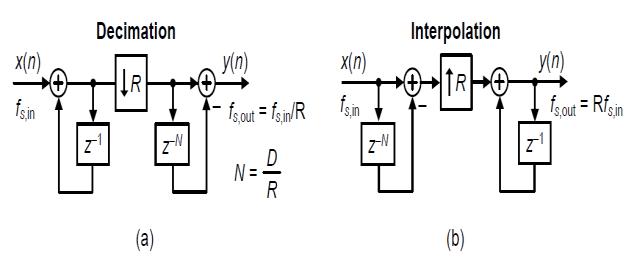
Fig 2:Asingle-stageCICfilterfordecimationandan interpolationfilter.
ThemostpopularmethodistocascademultipleCICfiltersto improvetheanti-aliasingandimage-rejectattenuationofCIC filters. Thecombinedtransferfunctioninthez-domainofan Mth-orderCICfilterwithMstagesofcombandintegratoris obtainedbymultiplyingtheirtransferfunctions. HCIC,Mth-order (Z)= = (4)

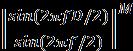
Whenusingthex(n)inputtothew(n)sequence,thefilter's frequencymagnituderesponseisasfollows:
TohandlethechangeinsamplingratebetweenthePRACH andUL(Uplink)datachannels,interpolationisrequiredin the 5G NR PRACH (Physical Random Access Channel) transmission chain. While it would be ideal, due to complexityandmemoryconstraints,tohaveanIFFTorFFT size that corresponds to the number of IQ (In-phase and Quadrature) samples to be processed, It is therefore necessarytouseaninterpolatorordecimator.
Forinstance,theinterpolationfactorisdeterminedusingthe data channel's subcarrier spacing of 15 kHz in the case of long PRACH Format 0, where the subcarrier spacing is defined as 1.25 kHz. For PRACH, the IFFT size and the number of IQ samples can change depending on the bandwidth or sampling rate, and this can affect the interpolation factor. Given that PRACH transmission and receptionoccuratthesamesamplingrate,thereciprocalof the interpolation factor must be used as the decimation factoratthePRACHreceiver.

The NR PRACH TX (transmit) flow is shown in the flow diagram,alongwiththeinterpolationfiltersthatareused. CIC (Cascaded Integrator Comb) interpolators have advantages over other interpolation methods, such as polyphase filtering, in terms of complexity and memory requirements.ACICfilterhasafixednumberofstagesand taps, typically five stages, which enables efficient implementationwithouttheneedtostorefiltercoefficients for various scenarios. Furthermore, CIC filters do not requirethecomplexmultiplicationsnecessaryforpolyphase filtering; instead, they only use fixed-point addition and subtraction. CIC filters are therefore highly suggested for DSP (Digital Signal Processing) systems because they provide computational efficiency and equivalent performance to polyphase filtering with lower complexity andmemoryrequirements.
Table -1: SimulationParameters

|HCIC,Mth-order ( )|= (5)
International Research Journal of Engineering and Technology (IRJET) e-ISSN: 2395-0056
IFFT size
No. of IQ samples after Up-sampling
No.of CP samples
2048
24576 (as per 3GPP 38.211)
3168 (as per 3GPP 38.211)
Interpolation factor (R) 12
InfigurethefrequencyresponseofCICfilterissharpandthe phaseislinercomparedtopolyphasefilter.Bythiswecan saythattheCICfilterhasthebetterfrequencyresponsethan polyphasefilter.
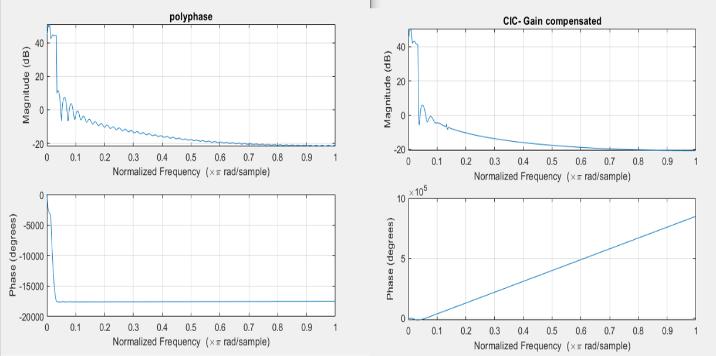
Fig 4:Frequencyresponseplotcomparisonbetween PolyphaseandCIC
3. CONCLUSIONS
ByincorporatingtheCICUp-samplingfilterinPRACH,the problemoffrequencymismatchbetweenPRACHandPUSCH subcarriers is resolved. The up-sampling process enables synchronization,alignsthefrequencies,andmaintainsthe integrity of the PRACH signal in the time domain. This ensures reliable transmission of data through the air interfaceusingbothPRACHandPUSCHchannelsatthesame datarate.
HeartfullthankstoMs.IlakkiyaR,TechnicalLeader,Mobile Networks,Nokia,fortheirguidanceandsupport.
[1] E.B.Hogenauer,“Aneconomicalclassofdigitalfilters fordecimationandinterpolation.”IEEETransactionson Acoustics, Speech, and Signal Processing, ASSP29(2):155–162,1981
[2] Lyons,R.,"ABeginner'sGuidetoCascadedIntegratorComb (CIC) Filters". Available online at: https://mycourses.aalto.fi/pluginfile.php/1588221/mo d_folder/intro/CIC_digital_filters-Lyons.pdf
[3] MatthewP.Donadio,CICFilterIntroduction,July18, 2000. ForfreepublicationbytheIowan.
[4] R. Bhakthavatchalu, V. S. Karthika, L. Ramesh, and B. Aamani, "Design of optimized CIC decimator and interpolator in FPGA," 2013 International MultiConferenceonAutomation,Computing,Communication, Control,andCompressedSensing(iMac4s),Kottayam, India, 2013, pp. 812–817, doi: 10.1109/iMac4s.2013.6526518
[5] Sabitha,D.,andHariharan,K.(2014).“Designofafivestage CIC decimation filter for signal processing applications”. 2014 , pp. 7–3566, doi:10.129888/ces.2014.4213.
[6] H. Johansson and H. Göckler, "Two-Stage-Based Polyphase Structures for Arbitrary-Integer Sampling RateConversion,"inIEEETransactionsonCircuitsand Systems II: Express Briefs, vol. 62, no. 5, pp. 486-490, May2015,doi:10.1109/TCSII.2015.2389291.
[7] J.W.Kim,Y.S.Lee,M.Y.Jin,B.Seungjae,J.-w.Moon,and H.Lee,"AMethodofPRACHDetectioninmmWave5G Communications Systems," 2022 13th International Conference on Information and Communication Technology Convergence (ICTC), Jeju Island, Korea, Republic of, 2022, pp. 718–720, doi: 10.1109/ICTC55196.2022.9952541.
[8] TuanAnhPham,BangThanhLe,"Aproposedpreamble detection algorithm for 5G-PRA," 2019 International Conference on Advanced Technologies for Communications(ATC),Hanoi,Vietnam,2019,p.210–21444,doi:10.1109/ATC.2019.8924502.
Volume: 11 Issue: 02 | Feb 2024 www.irjet.net p-ISSN: 2395-0072 © 2023, IRJET | Impact Factor value: 8.226 | ISO 9001:2008 Certified Journal | Page62