

Wireless Arduino Control via Mobile: Eliminating the Need for a Dedicated Wireless Communicator, Leveraging Laptop Connectivity
Sumit Chowdhury1
1Student, Department of Electronics & Tele-Communication Engineering, National Institute of Electronics & Information Technology Agartala, Tripura, India
Abstract – Inthispaper wewillstudyhowwecan establish wi-ficonnectivity withArduinotocontrolitsbehaviorwithout using the dedicated hardware module like (ESP8266, ESP32) The aim of this project is to create a bridge between the Arduino and smart phone over wi-fi for triggering the Arduino pins. The bridge will be the combination of software and hardware (laptop for this case), the software is a simple python script acts as a communication bridge between a mobiledeviceandanArduinoviaalaptop,facilitatingwireless control of the Arduino through the mobile device by relaying commands and responses over a serial connection.
Key Words: Wi-fi, Arduino, Python, Script, Serial connection
1.INTRODUCTION
The Arduino Uno, built around the ATmega328P microcontroller,isawidelyadoptedopen-sourceplatform recognized for its simplicity, versatility, and robustness. WithanaccessibleuserinterfaceprovidedbytheArduino IDEandarichsetofI/Opins,itservesasafoundationaltool forprototypinganddevelopingdiverseembeddedsystems and IoT applications. Its popularity stems from its ease of use, making it a cornerstone in microcontroller-based development for both educational and professional purposes.
The ESP8266 was introduced in 2014, and the ESP32 followed later in 2016. Despite their advanced features, these modules may have cost disadvantages and be unsuitable for simple prototypes due to additional expenses andspacerequirements.However,thesechallengescanbe addressed by utilizing software-based wireless control, offering a cost-effective and space-efficient alternative for basicArduinoprojects.
Nowinordertoimplementsoftwarebasedwirelesscontrol we used a python script which will plays a pivotal role in implementingasoftware-basedwirelesscontrolsystemfor Arduinoprojects.Ratherthanrelyingondedicatedwireless hardware modulessuch as theESP8266 or ESP32, thescript leverages the laptop's connectivity to establish a communication link with a mobile device. Operating as a bridge, the script facilitates the seamless exchange of commands and responses between the mobile device and
theArduinothroughaserialconnection.Thisapproachnot onlyreducescostsassociatedwithadditionalhardwarebut
also circumvents potential space constraints, making it a practicalandefficientsolutionforenablingwirelesscontrol inArduinoprototypes.Thescript'sabilitytounifysoftware and hardware components underscores its significance in simplifying and optimizing the wireless communication aspectofArduinoprojects,particularlyinscenarioswherea lightweightandeconomicalsolutionisdesirable.
2. THE PYTHON SCRIPT
TheprovidedPythonscript orchestratesa comprehensive communicationframework,establishingabridgebetweena mobiledeviceandanArduinothroughtheintermediaryofa laptop.Atitscore,thescriptleveragesthe`serial`moduleto initialize a serial connection with the Arduino, thereby establishing a conduit for two-way data exchange. Concurrently, a socket server is instantiated utilizing the `socket` module, with an assigned IP address and port, fosteringaplatformforwirelesscommunicationbetweenthe laptopandthemobiledevice.
Thescriptunfoldswithinanestedloopstructure,withthe outer loop persistently awaitingincoming connections. Upon connectionestablishment,thescriptseamlesslytransitions into an inner loop designed to continuously manage the exchange of data. Incoming data from the mobile device undergoes processing within the script before being dispatched to the Arduino through the established serial connection. The reciprocal journey of data involves the Arduino generating a response, which is subsequently transmittedbacktothemobiledevice.
Apivotalfeatureofthescriptliesinitsadeptmanagementof connections.Theinnerloopgracefullyterminateswhenno furtherdataisreceived,effectivelysignalingthecompletion of a data exchange cycle. Subsequently, the connection is closed,andtheouterlooprecommencesitsvigilantstance, anticipatingnewincomingconnections.
Inessence,thisscriptembodiesasophisticatedyetaccessible framework, enabling seamless and wireless control of the Arduinofromamobiledevicethroughtheintermediationofa laptop.Theconvergenceofserialcommunicationwiththe ArduinoandsocketnetworkingwithinaPythonenvironment underscores the script's capacity to harmonize hardware International
International Research Journal of Engineering and Technology (IRJET) e-ISSN: 2395-0056 p-ISSN: 2395-0072
Volume: 11 Issue: 02 | Feb 2024 www.irjet.net
interactions and networking functionalities, thereby encapsulatingaversatileandintegrativesolution.

2.1 Serial and Socket modules
Inthe presented Pythonscript,the`serial` moduleisutilized to establish a serial connection with an Arduino microcontroller,enablingbidirectionalcommunication.This connection is essential for transmitting data between the PythonscriptandtheArduino.ThecodespecifiestheCOM port(`COM3`)andsetsabaudrate(`9600`)todeterminethe speedofdataexchange.
Concurrently, the `socket` module is employed to create a socket server, establishing a network communication channel for wireless interaction. The server is bound to a specific IP address (`192.168.1.4`) and port (`8080`), facilitatingcommunicationwithamobiledevice.Theserver isconfiguredtolistenforincomingconnectionswithaqueue sizeof5.
Theprimaryserverloopcontinuouslyacceptsconnections, anduponconnectionestablishment,aninnerloopmanages the reception of data from the mobile device. This data is thenprocessedandsenttotheArduinothroughtheserial connection. The Arduino's response is subsequently transmittedbacktothemobiledeviceovertheestablished socket connection. This orchestration of the `serial` and `socket`modulesformsthefoundationforwirelesscontrolof the Arduino via a laptop, providing a seamless bridge betweenthemobiledeviceandthemicrocontroller.
2.2 Display of the received data
ThePythonscriptcreatesaconnectionbetweenalaptop,a mobile device, and an Arduino. As data flows in from the mobiledevice,thescriptdisplaysitonthecommandprompt screen, making it easy to see what the mobile device is sending.Simultaneously,thescriptcommunicatesthisdata
to the Arduino and shows the Arduino's response on the screen. This real-time display helps monitor the wireless communication,aidinginunderstandinganddebuggingthe process.


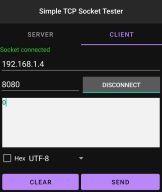
Figure1:PythonScriptOverview
Figure2:DisplayingofDatagettingreceived(1-0-1010101).
Figure3:Sendingdata(1)frommobilethrough[Simple TCPSockettesterApp]overwifi.
Figure4:Sendingdata(0)frommobilethrough[Simple TCPSockettesterApp]overwifi.

3. INTERFACING ARDUINO WITH MOBILE
Here in this section, we will demonstrate the setup of Arduino with mobile via laptop we consider connecting Arduino with a mobile device to control a LED on pin 7 introduces a practical and hands-on dimension to the interface.ThissetupallowsuserstoremotelyturntheLEDon oroffusingtheirmobiledevice,providingatangibleexample ofthewirelesscontrolcapability.
ByleveragingtheArduinoandmobileinterface,individuals canmanipulatetheLEDstatethroughauser-friendlymobile application or a simple communication protocol. This interactionnotonlyshowcasestheimmediatecontrolofa physical device but also serves as a foundational step for more complex projects. The blend of Arduino's hardware capabilitiesandmobiledeviceinteractivityempowersusers to extend control beyond traditional physical interfaces, offeringaglimpseintotheexcitingpossibilitiesofcombining microcontrollerswithmobiletechnology.
3.1 Connection of Arduino with Laptop
Connecting an Arduino to a laptop via USB is a straightforward process. Using a USB cable, we physically linktheArduinoboardtooneofthelaptop'sUSB ports. This establishesadirectcommunicationchannelbetweenthetwo devices,enablingthelaptoptosendandreceivedatatoand fromtheArduino.
Once connected, the laptop recognizes the Arduino as a USB device,andwecanprogramtheArduino,uploadcode,and even communicate with it using the Arduino IDE or other programmingenvironments.TheUSBconnectionservesas both a power source for the Arduino and a data link, facilitatingseamlessinteractionbetweenthelaptopandthe microcontrollerforvariousprojectsandprogrammingtasks.
e-ISSN: 2395-0056 p-ISSN: 2395-0072

The Arduino IDE is a user-friendly software tool for programmingArduinomicrocontrollers.Itincludesacode editor, compiler, and uploader, simplifying the process of writing and uploading code to Arduino boards. The IDE supportsCandC++languages,anditsfeaturesliketheSerial Monitor and Library Manager enhance the development experience.Itssimplicitymakesitaccessibleforbeginners, while its versatility caters to experienced developers for prototypingvariouselectronicprojects.
This Arduino code enables wireless control of an LED connected to pin 7. It utilizes serial communication to receivecommands.When'1'isreceived,theLEDturnson, andacorrespondingmessageissent.Conversely,'0'turns offtheLED,accompaniedbyaconfirmation message.This simple yet effective code forms the basis for wirelessly managingtheLED,providingaconcisesolutionforremote controlapplications.

Figure6:SettingupArduinoandconnectingitwithlaptop viaUSB.
3.2 Setting up the Arduino IDE
Figure7:OverviewofArduinocodeinIDE
Figure5:Sendingdata(1010101)frommobile through[SimpleTCPSockettesterApp]overwifi.
3.3 Controlling Arduino though mobile APP
ControllingtheArduinowithmobiledevicesinvolvesusing wi-fi and TCP Tester app. For this case we will consider a LEDconnectedtotheDigital pin7ofArduinoand wewill triggerthisusingtheTCPTesterAppwirelessly. Here, the server is configured to listen on port 8080 for incoming TCP connections. The choice of port 8080 is a commonpracticeforcustomoralternativewebservices.In this context, it serves as the communication gateway betweenthePythonscriptandanyconnectingclients.The servercontinuouslylistensforincoming dataonthisspecific port, and upon establishing a connection, it processes the data,communicateswithanArduinomicrocontrollerviaa serialconnection,andsendsbackresponses.Port8080acts asthedesignatedchannelthroughwhichtheserverinteracts withexternalclients,facilitatingtheexchangeofinformation and control commands in the project. This specific port assignment aligns with conventions for web services and ensuresastandardizedpointofaccessforcommunication betweendeviceswithinthelocalnetwork.
IntegratingasimpleTCPsocketappwithanArduinoforLED control involves enhancing the Python script to interpret commandssentfromtheclient.Theclient,representedby theTCPsocketapp,canbedesignedwithastraightforward interfaceallowinguserstosendcommandslike'0'toturn the LED off and '1' to turn it on. Upon receiving these commands,thePythonscriptontheserversideprocesses thedatawithinitscontinuousloop.Dependingonwhether '0' or '1' is received, the script triggers the corresponding action to turn the LED off or on, respectively. This integrationestablishesaseamlesscommunicationchannel between the app and the Arduino, enabling users to wirelesslycontrol theLEDbysendingcommandsthrough the TCP socket connection. It provides a tangible example of how simple user inputs from the app can translate into physicalactionsontheArduino-controlledhardware.

2395-0056 p-ISSN: 2395-0072
Asitreceivedstatement1fromthemobileapp(simple TCPsockettester)theLEDisONasshowninthefigure9.
Alsofigure8showstheresponseofArduinodisplaying LEDONstateintheredhighlightedbox.


Similarly,asitreceivedstatement0fromthemobileapp (simpleTCPsockettester)theLEDisOFFasshowninthe figure11.
Alsofigure10showstheresponseofArduinodisplaying LEDOFFstateintheredhighlightedbox.
Figure8:Sendingstatement1toturnontheLEDatpin7.
Figure10:Sendingstatement0toturnofftheledatpin7
Figure9:LEDisturnedONuponreceivingstatement 1 frommobileAPP.
International Research
of Engineering and Technology (IRJET) e-ISSN: 2395-0056 p-ISSN: 2395-0072 Volume: 11 Issue: 02 | Feb 2024 www.irjet.net

4. CONCLUSIONS
In conclusion, the project "Wireless Arduino Control via Mobile" presents a streamlined and cost-effective IoT solutionbyutilizinglaptopconnectivity.Byeliminatingthe need for a dedicated wireless communicator, the project showcases a practical approach to wireless Arduino control. The integration of a simple TCP socket app facilitates seamless communication, making it a versatile and accessiblesolutionforvariousIoTapplications.Thisproject notonlydemonstratestheefficiencyofleveraging existing resources but also underscores the potential for widespread adoptionofsuchsolutionsintheevolvinglandscapeofIoT implementations. Asofthispaperwehavetestedtheproject with led but we can also extend this and it can be used to trigger various devices like relay modules , actuators and variousdevicesaspertherequirements.
REFERENCES
[1] Exploring Arduino: Tools and Techniques for EngineeringWizardryPublishedbyJohnWiley&Sons, Inc. 10475 Crosspoint Boulevard Indiananolis. IN 46956|.
[2] ProgrammingIoTProjectswithESP32andESP8266"by NeilKolban.
[3] Make: Getting Started WithArduino - The Open SourceElectronics PrototypingPlatform Massimo Banziand Michael ShilohShroff/Maker Media; Third edition(27December2014).
[4] K Building Smart Homes with Raspberry Pi Zero, ESP8266,andArduino"byMarcoSchwartz.
BIOGRAPHIES

Sumit Chowdhury is a student of National InstituteofElectronics& Information Technology Agartala, Tripura, India Currently he is pursuingfinalyearUGDiplomain Electronics&Tele-communication Engineering Department. He’s Research Interests are Electrical circuit Design, Embedded System Design & Optimization and ElectronicDevice(study).
Figure 11: LED is turned OFF upon receiving statement 0 frommobileAPP