
International Research Journal of Engineering and Technology (IRJET) e-ISSN: 2395-0056
Volume: 11 Issue: 01 | Jan 2024 www.irjet.net p-ISSN: 2395-0072
International Research Journal of Engineering and Technology (IRJET) e-ISSN: 2395-0056
Volume: 11 Issue: 01 | Jan 2024 www.irjet.net p-ISSN: 2395-0072
Prof. Ms. Pooja Pandit Kadam1 , Prof. Swati Appasaheb Patil2, Prof. Akshata Jaydeep Chavan3
Assistant Professor, Dept. Of Sciences & Humanities, Rajarambapu institute of Technology, Maharashtra, India
Assistant Professor, Dept. Of Sciences & Humanities, Rajarambapu institute of Technology, Maharashtra, India
Assistant Professor, Dept. Of Engineering Sciences , SKN Sinhgad Institute of Technology & Science, Kusgoan India
Abstract - In this paper, we are discussing about the different method of finding the solution of the linear differential equations with constant coefficient. For more understandingofdifferentmethodwehaveincludeddifferent examples to find Particular solution of function of linear differential equations with constant coefficient. Particular solution is combination of complementary function and particular integral.
Key Words: ParticularIntegral,ComplementaryFunction, Auxiliaryequation
Thispaperincludesoverviewofthedefinitionanddifferent typesoffindingsolutionofthelineardifferentialequations withconstantcoefficient.Herewementioneddifferentrules for finding particular solution. We applied the linear differentialequationinvariousscienceandengineeringfield. It is applied to electrical circuit, chemical kinetics, Heat transfer, control system, mechanical systems etc. First we see the definitions of linear differential equation with constant coefficient then we see general solution with complementaryfunctionandparticularintegral.
Definition:
A general linear differential equation of nth order with constantcoefficientsis givenby:
WhereK‘sareconstantandF(x)isfunctionof x aloneor constant.
Or
1.2 Solving Linear Differential Equations with Constant Coefficients:
Complete solution of equation f(D)y=F(x) is given by C.F+P.I. WhereC.F.denotescomplementary functionand P.I.isparticularintegral.WhenF(x)=0,thenthesolutionof equationF(D)y=0isgivenbyy=C.F.
Otherwise the solution of the F(D)y=X is satisfies the particularintegral.
Thecompletesolutionofthedifferentialequationis
Y=C.F.+P.I.
i.e.Y=ComplementaryFunction+Particularintegral
ConsidertheequationF(D)y=F(x)
Step1:PutD=m,Auxiliaryequationisgivenbyf(m)=0
Step2:Solvetheauxiliaryequationandfindtherootsof theequation.Letsrootsare m1,m2,m3….mn .
Step3:After wegetcomplementaryfunctionaccordingto givenrulesbelow:
Table -1: Methods of finding C.F.
MethodsoffindingC.F RootsofA.E. Complementaryfunction (C.F.)
IfthenrootsofA.E.are realanddistinctsay

Iftwoormorerootsare equal.i.e. .


Ifrootsareimaginary m1=α+iβ,m2=α-iβ
Ifrootsareimaginary andrepeatedtwice m1=m2= α+iβ, m3=m4= α-iβ,

+
+
Exaple1]Solvethedifferentialequation:
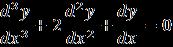
Ans : The given differential equation is

Now put D=m then auxiliary equation is




Here roots are 0,-1,-1 then C.F. is
SinceF(x)=0thensolutionisgivenbyY=C.F.
Y =

Exaple2]Solvethedifferentialequation
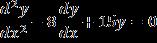
Ans:
Thegivendifferentialequationis
NowputD=mthenauxiliaryequationis



Hererootsare3&5thenwehaveC.F.is C.F.=

SinceF(x)=0thensolutionisgivenbyY=C.F. Y=
3 Short Methods for Finding Particular integral
IfX≠0,inequation(1)then

ClearlyP.I.=0ifF(x)=0
Followingarethemethodsforfindingparticularintegral:
Table-2: Rules for finding P.I.
Typesof function Whattodo Corresponding P.I.

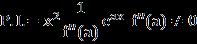
Incaseoffailure,i.e.f(a)=0
X=(sinax+b) or(cosax+b)
Andsoon
PutD2=-a2
D3=D.D2 =-a.D
D4=(D2)2 =a4
…soon inf(D)
This will form a linear expression in the denominator. Now rationalize the denominator to substitute. Operate on the numerator term by termbytaking

If case fail ,then do as type1
X=xn Take [F(D)]-1
xm
X=eax
PutD=a inf(D)

Iff’(a)=0
X=eaxg(x) Whereg(x) isany functionofx
Makef(D)is f(D+a)
3.1 Solved Example
Expand[F(D)]-1using binomialexpansionsandif (D-a)remainsinthe denominatorthentake rationalizationof denominator.TreatDin thenumeratoras derivativeofthe correspondingfunction
Wehavetoneed

Example 1] Solve the differential equation
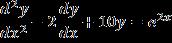
Solution:
The given differential equation is

The auxiliary equation is


Here roots are 1+3i and 1-3i Then
Now we see P.I.
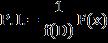



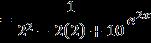

ThencompletesolutionisY=C.F.+P.I.

Ex.2]Solvethedifferentialequation
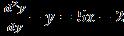
Solution:
Thedifferentialequationis (D2-1)y=5x-2
Theauxiliaryequationis m2-1=0
m=±1
Therootsare+1,-1
ThentheC.F.is C.F.=

Then

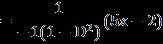

=

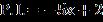
ThencompletesolutionisY=C.F.+P.I.
ThusY

In this paper we conclude that the solution of the differential equation is linear combination of the homogenousandparticularsolutions.Thebriefstudyofthe linear differential equation with constant coefficient providesstudentsunderstandabledatainsummariesform to apply this data in the field of physics, biology, and engineering. They also used into the electric circuits, mechanical vibrations, population growths and chemical reactions.
[1] B.S. Grewal “Advanced Engineering Mathematics” by KhannaPublishers,44th Edition.
[2] “Higher Engineering Mathematics” by B.V.raamna,Tata McGraw-HillPublication,NewDelhi.
[3]“AppliedEngineeringMathematics”byH.K.Dass,Dr.Rama Verma byS.Chand.
[4]“HigherEngineeringMathematics”byB.V.raamna,Tata McGraw-HillPublication,NewDelhi.