


Prof. Dr. S.
Joshi1 , Uday Dileep Kene2
1Head Of Department of Civil and Environmental Engineering, KIT’s College of Engineering (Autonomous), Kolhapur, Maharashtra, India.
2MTech Scholar, Department of Civil and Environmental Engineering, KIT’s College of Engineering(Autonomous), Kolhapur, Maharashtra, India.
Abstract - Reducing or eliminating the amount of contaminants in sewage water is the main objective of treatment. This investigation was required to evaluate how well a sewage treatment facility reduced pollution levels in order to meet regulatory environmental requirements. In order to safeguard public health, land and water supplies, and irrigation techniques, wastewater re-use must adhere to regulations and indicators must be regularly monitored and impended. For this reason, requirements must be given high priority during the evaluation and development stages. The removal efficiency of treatment facilities was regulated using chemical and biological methods. This paper assesses and examines the effectiveness and performance of the Vidyaranyapuram sewage treatment plant (STP) in Mysore. Regular monitoring of water quality is necessary in wastewater treatment plants. The present investigation will support the treatment center's endeavors to improve the therapeutic process. Since the evaluation explains the variety of water quality indicators in waste water facilities, one would be able to update the effluent efficiency standards based on seasonal fluctuations in wastewater treatment. Finding, fixing, and maintaining plant operating and maintenance difficulties is made much easier by the analytical results that were collected; these findings may be used when planning the future plant expansion to ensure successful outcomes.
Key Words: Wastewater Treatment, Efficiency, Mysore, Performance, Evaluation, Sewage Treatment Plant
In order to comply with tighter wastewater disposal regulations,sewagetreatmentplantsnowhaveadditional challenges. Freshwater scarcity is a global concern that has surfaced in the twenty-first century and is no longer confinedtoMysuru.Itwillseethebeginningoftheworld's water catastrophe. Toxin removal and the preservation of our natural water supplies are among the overarching goals of sewage treatment with regard to water conservation. Sewagetreatmentisusedto extractorganic andinorganicparticles;organicsolidsarebrokendownby microbes, and inorganic solids are sediment. It is especially important to protect human health from pathogenic species found in sewage before the treated effluent is released into receiving water bodies. Sewage mustbetreatedbeforeitmaybedumpedintoriverssince

theyare suchsignificant sourcesofdrinking water. Thetwo most prevalent types of wastewater are industrial and domestic wastewater. Sewage from restrooms and storm water runoff from cities make up domestic wastewater, which is produced by "non-manufacturing activities" in homes(suchascookhousesandrestrooms).
Thebiological,chemical,andphysicalpropertiesofwater haveanimpactonitsqualityandalsodeterminethestateof water bodies. This could help in maintaining and improving the body of water to suit our demands for specific applications, such as public water supply, recreation, and agriculture. Aspects that are classified as biological include things like algal growth and biochemical needs, in addition to chemical and physical characteristics like temperature, turbidity, odor, and color. For treated wastewater used for irrigation,itisimperativetomeetmicrobiologicalstandards inadditiontochemicalandphysicalquality.
Maintaining a higher range of water quality is essential because a WWTP's primary objective is to reduce the amount of pollutants in wastewater, and the efficacy of this facility is always dependent on proper maintenance. There are multiple types of industrial wastewater based on the varied sectors and contaminants; each sector generates a unique combination of toxins. Physical, chemical, and biological pollutants that are commonly found in wastewaters have a serious negative influence on the ecosystem, endangering a multitude of biodiversities and wreakingirreversibleecologicalhavoc.
The amount of oxygen required for aerobic bacteria to break down organic waste in water is known as the biological oxygen demand. Biological oxygen demand is a commonly used indicator of the degree of organic pollution in water in wastewater treatment facilities. Strict BOD level limitations apply to businesses that release wastewater into rivers or municipal sanitary sewers. The solids in waste water can be made up of organic and/or inorganic components and organisms; these must be significantly reduced during treatment to avoid a rise in BOD following discharge.
Chemical oxygen demand, or COD for short, is a measure of how much oxygen a body of water can absorb when breaking down organic compounds. COD analysis is used to measure pollutants (organics) in a water sample indirectly. It is an important component in assessing the water's

quality, reducing the danger to people and the environment. When evaluating the efficacy of water treatment facilities, COD is an excellent tool. If discharged waterisnottreatedorisonlypartiallytreated,theeffluent organics in it may compete with species downstream for oxygen.Assesstheconcentrationsofoxidizablepollutants in wastewater, the effectiveness of various wastewater treatment methods, and the environmental effects of disposing of wastewater as a means of evaluating the generalqualityofthewater.
TSS: Turbidity, or cloudiness, and total suspended solids (TSS) in water are often related. Environmental waters may contain a variety of dissolved or solid pollutants. When determining impurity levels, particles in thewatercolumnarereferredtoassuspendedsolids.TSS levels prevent sunlight from properly penetrating the water,whichhindersthegrowthofplantsandalgae.
The treatment of wastewater occurs in three stages: Primary, secondary, and occasionally tertiary stages of treatment are used by the majority of municipal wastewater treatment plants. Colloidal and dissolved solids are eliminated from the main treatment's effluent bythesecondarytreatmenttechnique.
Because biomass is used as an agent in the subsequent treatment of the wastewater, biological treatment is frequently referred to as secondary treatment. Soluble organic solids (BOD or COD) are reduced by microbial biosorption,whichisfollowedbymicrobialdegradationand stabilization. Colloidal suspensions are eliminated by the physiochemical adsorption principle and entanglement of suspended solids or particulate matter on the biological flock. It can be difficult to determine if developing a single treatmentplantthatprocessesa largeamountofgarbageor several plants that treat discrete small flows will result in a moreefficientfacility.Therefore,whenconsideringasewage treatment plant's capability, it is crucial to evaluate the environmentaleffectsofthefacility.
A biological treatment unit's efficiency depends on the growth of an appropriate simulated tile culture of microorganisms in the treatment unit (bioreactor), the maintenance of adequate environmental conditions for the system, and the removal of excess sludge produced. Wastewater that has excess organic sludge left in it will be evaluatedashavinghigherBODorCODinthefinalreport.
Because of this, in order to assess the performance of the treatment plant, an assessment of the performance of the current treatment plant is necessary, together with an assessment of the treatment plant's capacity to handle bigger hydraulic and organic loadings, either to satisfy higher treatment requirements or to enhance the quality of the present effluent. It is advantageous to evaluate the performanceofcurrenttreatmentplantsystemsbecauseit generatesnewdatathatcanbeusedtoenhancethedesign processesfortheseunits.
Located in Karnataka, Mysuru is 700 meters above sea levelandisbetween12◦90e11◦60Nand77◦70e76◦40E. The population of the royal district increased from 0.795 million in 2001 to 0.983 million in 2011. The monsoon season, which lasts from late May until the end of October, brings with it temperature fluctuations of 14 to 34 °C. Among the most well-known lakes in the city are Kukkarahalli,Karanji,andLingambudhi.
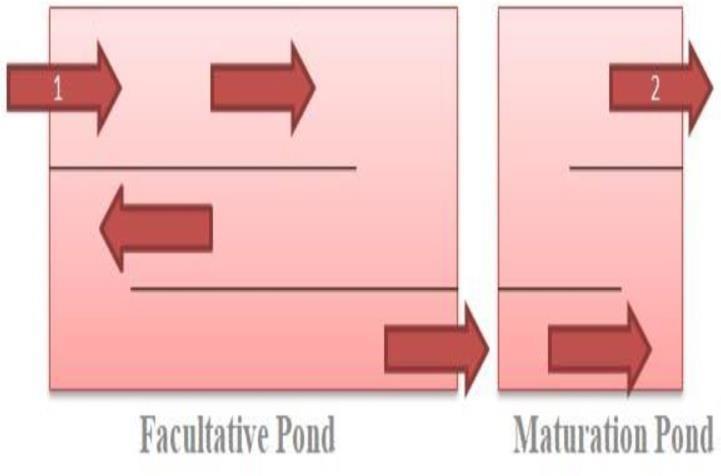
The Cauvery and Kabini rivers, along with certain groundwater sources, supply the majority of the city's residential water requirements. Three basins receive the waste water released from Mysore city due to gravity. The northern drainage system in Kesare Village, Mysore, feeds intoa30.0MLDSTP(mechanicalsystemwithaerators).The southwestern drainage flow links to the 67.65 MLD Vidyaranyapuram STP (Biological treatment that uses required microorganisms (OS-1&2) inoculum) before it approaches Dalvai Kere. The 60 MLD Rayankere STP (remedia-tionbasedonFermenta'sbacillus)islocatedatH. D.KoteRoad,tothesouth.TheVidyaranyapuraSTP,situated near a solid-waste disposal site on the foothills of the Chamundi Hills in the downstream slope of the tributary to Dalvai Lake, between 12.273681◦ N and 12.270031◦ E, is where the field surveys were conducted. The treatment plantsconsistoftwomaturationponds(eachmeasuring2.5 ha in area and 1.5 m in depth) and two facultative lagoons (each with a surface area of 5.05 ha and a depth of 3.5 m).
Table 1 is a list of the details. Before arriving at the Kabini River,asourceofpotablewater,thecleanedwaterflowsvia the Dalvai kere for almost 20 kilometers. To make sure that Kabini water is not contaminated, this necessitates an evaluationofthetreatedeffluentfromtheSTP
This study's main objective is to investigate and assess the Vidyaranyapuram treatment plant's output in Mysore. Throughout the course of a year (2018), regular monitoring sample campaigns were conducted with a primary focus on three parameters: BOD, COD, and TSS (Table 2). Two locations for sampling were identified: the effluent from the wastewater treatment plant and the secondary treatment process outflow. A thorough examination of the VidyaranyapuramWWTPlabstudy'saverageconcentrations of COD, BOD, and TSS in comparison to their theoretical relationships demonstrates a high degree of reliability. Based on the outcomes, we may determine the removal efficiency of the various parameters for every step of the wastewatertreatmentfacility.
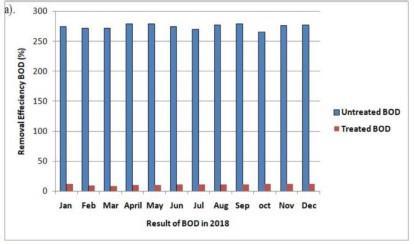
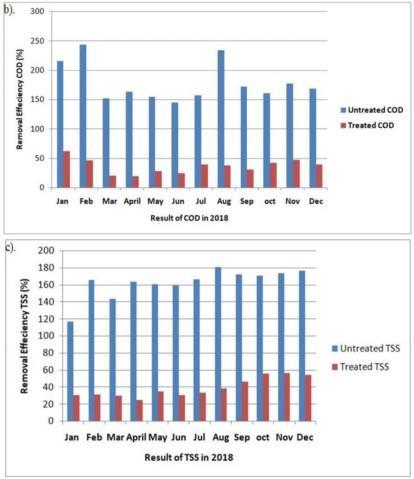
The wastewaters had a mean pH of 7.7 and ranged from 7.4to8.pHwascomputedandimportedsinceitisahighly effective parameter in calculating the removal efficiencies of different contaminants. The concentrations of several contaminantsthatweregatheredfromthetwodesignated sample stations throughout the study area are shown in Fig. 1. Three metrics for measuring the quality of wastewater BOD, COD, and TSS were collected and examined from samples that lasted a year. The % elimination for each of these factors has been calculated andisdisplayedinTable3andFig.2.
Table 3 demonstrates that under the aforementioned circumstances, the plant's BOD removal effectiveness is approximately 96%, although the removal efficacy of COD and TSS is less than that of BOD, at approximately 79% and75%,respectively.
The results of the current studies on the treatment efficacies of the STP showed that the removal of BOD (96%)wastreatedatagoodlevel,andtheremovalofCOD (79%) and TSS (75%) was treated with reasonable quality. Chemical and biological techniques were employedtodeterminetheremovalefficaciesoftreatment plants. Our results show that the effluent water's BOD level is higher than its COD and TSS values. BOD could be more than COD and TSS if the sample had highly degradable organic matter, larger concentrations of organic nitrogen or ammonium in the water, or organic nitrogen that could be physiologically oxidizable but not oxidizedbychromicacidintheCODtechnique.
InordertoimproveSTPefficiency,sourcesofrawsewage must be identified, treatment technologies must be effectivelymanagedandmaintained,andexistingfacilities must be updated accordingly. At predetermined intervals, skilled and knowledgeable personnel must assess treatmentperformancetoguaranteeproperoperationand maintenance.Tothegreatestextent possible,STPsshould be utilized to control the quality of the final product, and thesourcesofrawsewageshouldbeidentified.
Therearenoconflictsofinterest
[1] CoronaF,MulasM,HaimiH,SundellL,Heinonen M,VahalaR.Monitoringnitrateconcentrationsin thedeni-trifyingpost-filtrationunitofamunicipal wastewater treat- ment plant. J Process Control 2013 Feb 1;23(2):158e70. https://doi.org/10.1016/j.jprocont.2012.09.011.
[2] Al-Gheethi AA, Efaq AN, Bala JD, Norli I, AbdelMonem MO. Removal of pathogenic bacteria from sewage- treated effluent and biosolids for agricultural purposes. Appl Water Sci 2018 May;8(2):1e25. https://doi.org/10.1007/ s13201018-0698-6.
[3] Asano T, Burton F, Leverenz H. Water reuse: issues, tech- nologies, and applications. McGrawHillEducation;2007. www.accessengineeringlibrary.com/content/book/9 780071459273.
[4] Tee PF, Abdullah MO, Tan IA, Rashid NK, Amin MA, Nolasco-Hipolito C, et al. Review on hybrid energy systems for wastewater treatment and bio-energy production. Renew Sustain Energy Rev 2016 Feb 1;54:235e46.https://doi.org/ 10.1016/j.rser.2015.10.011.
[5] Akcin G, Alp O€ , Gulyas H, Büst B. Characteristic, analyticand sampling of wastewater. Emwater ELearningCourse2005Jan3:1e49.
[6] MengX,KhosoSA,JiangF,ZhangY,YueT,GaoJ,etal. Removal of chemical oxygen demand and ammonia nitrogen from lead smelting wastewater with high salts content using electro- chemical oxidation combined with coagulationeflocculation treatment. Separ Purif Technol 2020 Mar 18;235:116233.https://doi.org/10.1016/j.seppur.20 19.116233.
[7] Books L. Stepping Up the secondary: Impacts of increasingly stringent treated wastewater ammonia discharge Limits on small Montana communities (doctoral dissertation). https:// scholars.carroll.edu/handle/20.500.12647/3421.
[8] Karia GL, Christian RA. Wastewater treatment: concepts and design approach. PHI Learning Pvt. Ltd.;2013Apr2.
[9] Qasim SR. Wastewater treatment plants: planning, design, and operation. Routledge; 2017 Nov 22. https://doi.org/10.1201/9780203734209.
[10] Hegazy MH, Gawad MA. Measuring and evaluating theperformanceofawastewatertreatmentplant.In: Pro- ceedings of the world congress on civil, structural,andenvironmentalengineering,paperNo. AWSPT, 111; 2016. https://doi.org/10.11159/awspt16.111.
[11] Schellenberg T, Subramanian V, Ganeshan G, Tompkins D, Pradeep R. Wastewater discharge standards in the evolving context of urban sustainabilityeThe case of India. Front Environ Sci 2020 Apr 17;8:30. https://doi.org/10.3389/fenvs. 2020.00030.
[12] Edokpayi JN, Odiyo JO, Durowoju OS. Impact of wastewater on surface water quality in developing countries: a case study of South Africa. Water quality 2017Jan18;10:66561.https://doi.org/10.5772/66 561.
[13] Jasim NA. The design for wastewater treatment plant (WWTP) with GPS X modelling. Cogent Engineering 2020Jan1;7(1):1723782.https://doi.org/10.1080/ 23311916.2020. 1723782.
[14] PadalkarAV,KumarR.Commoneffluenttreatment plant (CETP): reliability analysis and performance evaluation.WaterSciEng2018Jul1;11(3):205e13. https://doi.org/10.1016/j.wse.2018.10.002.
[15] Qu J, Wang H, Wang K, Yu G, Ke B, Yu HQ, et al. Municipal wastewater treatment in China: development history and future perspectives. Front Environ Sci Eng 2019 Dec;13(6): 1e7. https://doi.org/10.1007/s11783-019-1172-x