

Smart-Bill Automation System
1Professor, Dept. of CSE Engineering, PRMIT&R college, Maharashtra, India
2Student, Dept. of CSE Engineering, PRMIT&R college, Maharashtra, India
3Student, Dept. of CSE Engineering, PRMIT&R college, Maharashtra, India
4Student , Dept. of CSE Engineering, PRMIT&R college, Maharashtra, India
5Student, Dept. of CSE Engineering, PRMIT&R college, Maharashtra, India
Abstract - The ever-evolving retail sector demands innovative solutions to streamline and enhance the shopping experience for both consumers and retailers. This paper introduces an AI-based auto billing system meticulously designed to address the inherent complexities of the traditional retail checkout process, especially concerning itemslikefruitsandvegetablesthatdefyconventionaltagging mechanismssuchasRFIDtagsandbar-codes.Recognizingthe distinct challenges posed by perishable goods, the proposed system integrates advanced technologies, notably computer visionanddeeplearningtechniques,toautomatetheweighing and billing processes seamlessly. Central to this innovative solution is the utilization of Raspberry Pi 3, a microprocessor equipped with a specialized camera module and a load cell. The system's operational framework encompasses capturing high-resolution images of individual fruits and vegetables, leveraging deep learning techniques such as ImageNet built upon Convolutional Neural Network (CNN) architectures. Further enhancing the classification efficacy, machine learning techniques, including K means clustering, are employedto categorize products into their respective groups, ensuring precise billing calculations. Incorporating a multifaceted approach, the camera module facilitates realtimeimagecapturingofitems positionedonadesignatedtray, strategically integrated with a load cell for accurate weight measurements. Concurrently, pre-defined pricing metrics for variousitemsperkilogramareinputtedintotheRaspberry Pi microprocessor.Leveragingthecomputationalprowessofthe Python programming language, the system orchestrates intricate algorithms to compute the cumulative cost of selecteditems,subsequentlydisplayingthetotalamountonan integrated monitor. Emphasizing paramount aspects such as efficiency, accuracy, and safety, this AI-based autobilling system transcends conventional retail paradigms, offering a transformative solution that harmonizes technological innovationwithpragmaticretailrequirements.Byseamlessly amalgamating cutting-edge technologies, this pioneering system not only elevates the retail experience but also underscores the potential of AI-driven solutions in redefining modern retail landscapes.
Key Words: Billing System, Checkout Mechanism, Retail Technology, Artificial Intelligence(AI) in Retail, Computer Vision, Deep Learning in Retail, Convolutional Neural Networks (CNN),Weight Sensing Technology, Raspberry Pi in Retail, Automated Checkout.
1.INTRODUCTION
Therapidtrajectoryoftechnologicaladvancementsinrecent decadeshasfundamentallyreshapedthefabricofourdaily lives, ushering in an era characterized by unparalleled convenience,efficiency,andinnovation.Thecontemporary technologicallandscapeispunctuatedbyaneclecticarrayof transformative technologies, encompassing artificial intelligence(AI),blockchain,cloudcomputing,theInternet of Things (IoT), data mining, augmented reality (AR), and virtualreality(VR),amongothers.Eachoftheseinnovations, initsuniquecapacity,hascatalyzedparadigmshiftsacross diverse sectors, redefining operational frameworks, enhancing user experiences, and fostering unprecedented possibilities. Central to this mosaic of technological innovations is the realm of artificial intelligence, an expansivedomainthatencapsulatesmachinelearningand deeplearningparadigms.Withinthisambit,deeplearning,a subsetofmachinelearning,hasemergedasacornerstone, revolutionizing intricate processes and catalyzing advancementspreviouslydeemedimplausible.Theintrinsic architecture of deep neural networks, reminiscent of the intricate operations of the human brain, facilitates unparalleled capabilities in pattern recognition, decisionmaking,speechrecognition,andmyriadotherapplications. The omnipresence of neural networks is palpable, underpinning transformative applications ranging from ubiquitous virtual assistants like Google's Assistant and Apple's Siri to intricate financial services, encompassing fraud detection, risk assessment, and market research endeavors.Inalignmentwiththistransformativetrajectory, the crux of this project endeavors to harness the latent potential of deep learning algorithms, specifically ConvolutionalNeuralNetworks(CNN),andmachinelearning techniques, exemplified by K-means clustering. The overarchingobjectiveconvergesondesigninganinnovative system poised to revolutionize the retail landscape, particularlythebillingprocess.Byadeptlyleveragingdeep learning algorithms, the system aspires to seamlessly identifyanexpansivearrayofediblefruitsandvegetables, transcending manual interventions and encapsulating efficiency. Furthermore, augmenting its capabilities, the integration of load cell technology facilitates automated weight measurements, culminating in precise cost estimations and streamlined billing processes. In essence, this project epitomizes the symbiotic amalgamation of
International Research Journal of Engineering and Technology (IRJET) e-ISSN: 2395-0056 Volume: 11 Issue: 01 | Jan 2024 www.irjet.net p-ISSN: 2395-0072 © 2024, IRJET | Impact Factor value: 8.226 | ISO 9001:2008 Certified Journal | Page554
1 ,
2 , Gayatri Suryawanshi3 ,
4
5
Prof. Nilaja Deshmukh
Sejal Kathane
Shreya Mahatme
,Parikshit Gaikwad
***
cutting-edge technologies and pragmatic applications, underscoring a commitment to fostering innovation, enhancing operational efficiencies, and redefining conventionalparadigmswithintheretailsector.Througha meticulousexplorationofdeeplearningalgorithmsandtheir transformative potential, this research elucidates a pioneeringblueprintpoisedtoreshapecontemporaryretail dynamics,therebyheraldinganewepochcharacterizedby efficiency,accuracy,andunparalleledconvenience.
2. BACKGROUND AND LITERATURE REVIEW
2.1 Traditional Checkout Challenges
The conventional checkout mechanism, emblematic of manualitemscanningandhuman-operatedprocesses,has long been a staple in retail environments. However, this traditionalparadigmisnotwithoutitsinherentchallenges andlimitations.
Firstly,themanualscanningofitemsintroducessignificant inefficiencies into the retail workflow. Customers often experience extended wait times, especially during peak hours, weekends, or holiday seasons, leading to potential dissatisfaction and negative perceptions of the shopping experience1.Moreover,thehumanelementinthecheckout process increases susceptibility to errors misidentified products, incorrect pricing, or overlooked items culminating in discrepancies that may compromise both retailerprofitabilityandcustomertrust.
Inlightofevolvingglobaldynamics,suchastheCOVID-19 pandemic, the imperatives of the traditional checkout process have been further accentuated. The heightened emphasis on health and safety protocols necessitates strategies to minimize human interactions, reduce touchpoints, and implement contactless transaction mechanisms.Consequently, thereisan escalatingdemand for automated, efficient, and hygienic solutions that align with contemporary health guidelines and consumer preferences.
2.2 Technological Advancements in Retail
The retail landscape is undergoing a transformative metamorphosis, propelled by rapid advancements in technologyandinnovation.Recentliteratureelucidatesthe burgeoninginfluenceandadoptionofAI,computervision, and deep learning technologies within retail ecosystems, heralding a new era of operational excellence, consumer engagement,andmarketdifferentiation2.
2.2.1 Artificial Intelligence (AI) in Retail:
AI technologies, characterized by machine learning algorithms and predictive analytics, are redefining retail dynamics.RetailersleverageAI-driveninsightstooptimize inventorymanagement,personalizecustomerexperiences, andforecastmarkettrends.Moreover,AI-poweredchatbots and virtual assistants streamline customer interactions, facilitate real time support, and enhance engagement, fosteringloyaltyandsatisfaction.
2.2.2 Computer Vision and Enhanced Visual Capabilities: The integration of computer vision technologies revolutionizes product recognition, quality control, and security surveillance within retail environments. Advanced algorithms facilitate automated item identification, anomaly detection, and real-time monitoring, ensuring accuracy, efficiency, and compliance withindustrystandards.
2.2.3 Deep Learning and Data-Driven Decision Making: Deeplearningmethodologies,notablyConvolutionalNeural Networks (CNNs), empower retailers to extract intricate patterns, insights, and correlations from vast datasets. By analyzingconsumerbehavior,preferences,andpurchasing patterns,retailerscantailormarketingstrategies,optimize pricing strategies, and curate personalized product recommendations, thereby maximizing revenue potential andenhancingcustomersatisfaction.
3. BLOCK DIAGRAM
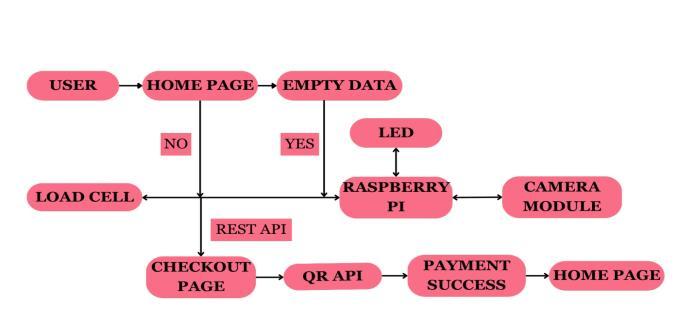
WORKFLOW EXPLANATION:
User: This is the individual initiating the process by interactingwiththesystem.Theuserjourneybeginsfrom thispoint.
Home Page: Purpose:Servesasthemaininterface where users can start their shopping or transaction journey.
Interaction:Fromhere,userscannavigatetoselectproducts, viewoffers,orproceedtootherfunctionalities.
Empty Data Check: Purpose: This is a checkpoint to determineiftheuserhasaddedanyitemstotheircartorif anydataispresent.
LED(LightEmittingDiode):
No Data (No): If the system detects an empty cart or no selected items, an LED might be triggered to indicate this status.Thiscouldvisuallyprompttheusertoaddproducts totheircart.
DataPresent(Yes):Ifitemsareinthecartordataispresent, theworkflowproceedstothenextstages.
Load Cell: Purpose: It's involved in measuring weight or force,likelyrelatedtotheitemsplacedinthecart.
InteractionwithRaspberryPi:TheLoadCellcommunicates itsmeasurementsordatatotheRaspberryPiforprocessing,
International Research Journal of Engineering and Technology (IRJET) e-ISSN: 2395-0056 Volume: 11 Issue: 01 | Jan 2024 www.irjet.net p-ISSN: 2395-0072 © 2024, IRJET | Impact Factor value: 8.226 | ISO 9001:2008 Certified Journal | Page555
Fig.1:Block Diagram of AI Autobilling System
ensuringaccurateweight-basedfunctionalitieslikepricing orinventorymanagement.
Raspberry Pi: Purpose: Actsasthecentralhuborprocessor, orchestratinginteractionsbetweenvariouscomponents. InteractionwithCameraModule:TheRaspberryPireceives dataorcommandsfromtheCameraModule,possiblyrelated to product identification, scanning, or visual recognition tasks.
InteractionwithReatAPI:TheRaspberryPicommunicates with the Reat API, facilitating data exchange, processing requests,orintegratingwithexternalsystemsandservices.
Camera Module: Purpose:Capturesvisualdata,facilitating tasks such as product identification, QR code scanning, or other visual interactions. Interaction with Raspberry Pi: SendscapturedimagesorvisualdatatotheRaspberryPifor processing,analysis,orfurtheractions.
Reat API: Purpose: AnApplicationProgrammingInterface (API) that facilitates communication, data exchange, or integrationwithexternalsystems.
InteractionwithRaspberryPi:TheReatAPIinteractswith the Raspberry Pi, possibly providing data processing capabilities,accessingdatabases,orenablingfunctionalities likepaymentprocessing,productinformationretrieval,etc.
Checkout Page: Thecheckoutinterfacehastwoparts,
1.Front-enddevelopedusingHTML,JS
2.BackendAPIdevelopedusingNodeJSandExpress
1. Front-end developed using HTML, JS The front-end continuouslychecksforthechangeshappeninginthebackendAPIanddisplaysthechangestotheuser.Onceanitemis addedtotheAPI,thefront-enddisplaysasanitemaddedto thecart.
2. Backend API developed using NodeJS and Express The backendRESTAPIisdevelopedusingNodeJSandExpress. ExpressJSisoneofthemostpopularHTTPserverlibraries forNode.js,whichshipswithverybasicfunctionalities.The backend API keeps the details of the products that are visuallyidentified.
QR API:Purpose: Handles QR (Quick Response) coderelated functionalities, including scanning, processing, or validation.InteractionwithPaymentSuccess:Afterscanning, the QR API validates the information, processes the transaction,andtriggersapaymentconfirmation.
Payment Success:Purpose:Indicatessuccessfulcompletion ofthepaymenttransaction.
Interaction with Home Page (Return): After successful payment,usersareredirectedorreturnedtotheHomePage, completing the transaction cycle and potentially initiating subsequentinteractions.
4. COMPONENT DESCRIPTIONS
4.1 Hardware Requirements:
1. Raspberry Pi 4 module B

Description:Thisisaversatilesingle-boardcomputer(SBC) equipped with powerful processing capabilities, offering enhancedperformancecomparedtoitspredecessors.
Functionality:Actingasthebrainofthesystem,itmanages various tasks, including data processing, communication with peripherals, and executing software algorithms. Its GPIO (General Purpose Input/Output) pins facilitate hardwareinterfacingandcontrol.
2. Weight Sensor (Load Cell) 0-10k:

Description: A precision instrument designed to measure weightorforcewithinaspecificrange(0-10kg).
Functionality: When integrated into the shopping cart or platform,itdetectstheweightofproducts,translatingforce exertedontothesensorintomeasurableelectricalsignals. This data aids in determining the cost of items based on weightandmanaginginventorylevels.
International Research Journal of Engineering and Technology (IRJET) e-ISSN: 2395-0056 Volume: 11 Issue: 01 | Jan 2024 www.irjet.net p-ISSN: 2395-0072 © 2024, IRJET | Impact Factor value: 8.226 | ISO 9001:2008 Certified Journal | Page556
3. SparkFun Load Cell Amplifier

Description:Aspecializedamplifiertailoredtoenhancethe sensitivityandaccuracyofsignalsderivedfromtheLoadCell sensor.
Functionality:ItamplifiesweaksignalsfromtheLoadCell, compensatingforvariationsandensuringconsistentand precise weight measurements. This amplified data is then transmittedtotheRaspberryPiforfurtherprocessingand analysis.
4. 5V 2A Power Supply

Description:Adedicatedpowersourceproviding5voltsat2 amperes,suitableforpoweringtheRaspberryPiand associatedcomponents.
Functionality: Ensures stable and uninterrupted power supply,safeguardingagainstvoltagefluctuationsor inconsistenciesthatcouldcompromisesystemperformance orreliability.
5. REES52 5 Megapixel 160 deg. Wide Angle Fish-Eye Camera

Description: A sophisticated camera module boasting a 5megapixelresolutionanda160-degreewide-anglefish-eye lens.
Functionality:Capableofcapturinghigh-definitionimages withanexpansivefieldofview,itsupportsvarious applicationssuchasproductrecognition,barcodescanning, andvisualinteractions.Thewide-anglelensfacilitates comprehensive coverage, reducing blind spots and enhancingsystemefficiency.
6.
RGB Led Strip
Description:AnarrayofLEDlightsfeaturingRed,Green,and Bluecolorchannels,enablingaspectrumofcolorsandvisual indications.
Functionality: Used for displaying status indicators, notifications,oruserpromptsthroughdistinctcolor-coded signals.
Forinstance,differentcolorscouldsignifysystemreadiness, error states, or specific user actions, enhancing user experienceandinteraction.
7. Plywood
Description: A material used for constructing the physical structureorhousingofthesystem.
Functionality:Providesasturdyandcustomizablebaseor enclosureformountingcomponentsandensuringsystem stability.
8. Wire
Description:Electricalcablesorwiresusedforconnecting andintegratingvarioushardwarecomponents.
Functionality:Enablesdatatransmission,powersupply,and communicationbetweeninterconnectedhardwaremodules.
9. DC Power Supply
Description:Suppliesdirectcurrent(DC)electricalpowerto thesystemcomponents.
Functionality: Ensures appropriate voltage and current levels required for the operation of the Raspberry Pi, sensors,andotherperipherals.
10. Core i3 Processor
Description: A central processing unit (CPU) providing computational capabilities for specific tasks or functionalities.
Functionality:Supportsdataprocessing,systemoperations, andsoftwareexecutionwithinthedesignatedenvironment.
11. 8GB RAM
Description: Random Access Memory (RAM) providing temporarystorageandquickaccesstodataforprocessing tasks.
Functionality:Enhancessystemperformance,multitasking capabilities,andsoftwareexecutionefficiencybyproviding sufficientmemoryresources.
International Research Journal of Engineering and Technology (IRJET) e-ISSN: 2395-0056 Volume: 11 Issue: 01 | Jan 2024 www.irjet.net p-ISSN: 2395-0072 © 2024, IRJET | Impact Factor value: 8.226 | ISO 9001:2008 Certified Journal | Page557
4.2 Software Requirements:
1. Python 3.11.1
Description: A versatile and high-level programming language renowned for its simplicity, readability, and extensivelibrarysupport.
Functionality:Facilitatesthedevelopment,deployment,and execution of AI algorithms, data processing scripts, and system functionalities within the AI-based auto billing environment. Its dynamic typing and object-oriented features enable rapid prototyping, integration, and optimizationofsoftwarecomponents.
2. Edge Impulse Studio
Description: An innovative platform specializing in the creation, training, and deployment of edge AI models tailoredfor embeddedsystemsandIoTdevices.
Functionality: Empowers developers to design custom machine learning algorithms, integrate sensor data, and deploy optimized models within the Raspberry Pi environment.Withbuilt-intools,libraries,andcloud-based services,it streamlines the AI development lifecycle, from data collectiontomodeloptimizationanddeployment.
3. Raspberry Pi Raspbian
Description: The official operating system optimized for Raspberry Pi devices, built upon the Debian Linux distribution.
Functionality: Offers a stable, secure, and user-friendly environment tailored for embedded computing, IoT applications, and educational purposes. It provides essential utilities, software packages, and system configurations, ensuring seamless integration,compatibility,andperformanceoptimizationfor RaspberryPi-basedprojects.
4. Microsoft Visual Studio Code
Description: A lightweight, extensible, and cross-platform sourcecodeeditordevelopedbyMicrosoft,designedfor modernsoftwaredevelopmentworkflows.
Functionality:Offersarichsetoffeatures,extensions,and integrations, supporting code editing, debugging, version control, and collaboration. Its intuitive interface, customizable settings, and integrated development environment (IDE) capabilities facilitate Python script development, AI algorithm implementation, and system configurationtaskswithin theAI-basedautobillingsystem environment
5. CORE TECHNOLOGIES
5.1 Computer Vision Technology
ComputerVision(CV)isafieldofartificialintelligencethat enablesmachinestointerpretandmakedecisionsbasedon
visualdata,muchlikehumanvision.InthecontextoftheAIbasedautobillingsystem,computervisiontechnologyallows the system to recognize, detect, and analyze retail items without human intervention. This facilitates automated checkoutprocesses,enhancesefficiency,reduceserrors,and improvesoverallcustomerexperience.
Convolutional Neural Network (CNN):
ConvolutionalNeuralNetworks(CNNs)areaclassofdeep learning algorithms specifically designed for processing visual data such as images and videos. CNNs have revolutionized the field of computer vision due to their ability to automatically and adaptively learn spatial hierarchiesoffeaturesfrominputimages.Here'showCNN operates:
Steps Involved in CNN Algorithm:
Input Layer: Theprocessbeginswithfeedinganimageinto the CNN. This image is represented as a matrix of pixel values,formingtheinputlayeroftheneuralnetwork.
Convolution Operation: CNNsemployconvolutionallayers thatapplyconvolutionoperationsusingfilters(alsoknown as kernels) across the input image. These filters extract variousfeatureslikeedges,textures,shapes,andpatternsby slidingorconvolvingacrosstheinputimageandperforming element-wisemultiplicationandsummationoperations.
Activation Function: Followingconvolution,anactivation function,typicallyRectifiedLinearUnit(ReLU),introduces non-linearity to the model by transforming the convolved feature maps, enabling the network to learn complex representationsandrelationshipswithinthedata.
Pooling Layer: Afteractivation,poolinglayers,commonly MaxPooling,downsamplethefeaturemaps,reducingspatial dimensionswhilepreservingessentialinformation.Pooling enhancescomputationalefficiency,reducesoverfitting,and focuses on salient features extracted during the convolutionalprocess.
Flattening: Postpooling,thefeaturemapsareflattenedinto aone-dimensionalvector,preparingthedataforinputinto fullyconnectedlayers.Thisflatteningconsolidatesextracted features, facilitating higher-level pattern recognition, and classificationtasks.

International Research Journal of Engineering and Technology (IRJET) e-ISSN: 2395-0056 Volume: 11 Issue: 01 | Jan 2024 www.irjet.net p-ISSN: 2395-0072 © 2024, IRJET | Impact Factor value: 8.226 | ISO 9001:2008 Certified Journal | Page558
Fig.2:Convolutional Nrural Network
Fully Connected Layers: Theflattenedfeaturespropagate through fully connected layers or neurons, performing intricate computations to classify the input image into specificcategoriesorlabels.
These layers integrate spatial hierarchies, contextual information,andfeaturerepresentations,enablinginformed decision-makingandpreciseobjectidentification.
Softmax Activation: The final layer employs the softmax activationfunction,computingprobabilitiesassociatedwith potentialproductcategoriesorlabels. Thisprobabilisticoutputsignifiesthenetwork'sconfidence levelsregardingtheproduct'sidentity,facilitatingaccurate classification and subsequent billing processes within the autobillingsystem.
5.2 Weight Sensing Technology
InthisProject,weightsensingtechnologyplaysacrucialrole in ensuring accurate billing for products sold by weight. Here'saconciseoverviewofitsimplementation: Hardware Integration: Incorporate specialized weight sensors like load cells with the checkout platform, connecting them to a Raspberry Pi for real-time data processing.
Real-Time Measurement & Integration: Continuously monitor product weights and integrate this data with AI algorithms.Thisensuresprecisebillingalignedwithproduct identificationandpricinginformation.
AutomatedBilling:Enablesynchronizedoperationbetween weight sensors and AI systems for automated, accurate billing calculations. This facilitates dynamic pricing adjustmentsandpromotestransparentbillingpractices.
Quality Assurance & Compliance: Maintain and calibrate weight sensors regularly to ensure accuracy. Adhere to industry standards and regulatory compliance to foster consumertrustandmitigatepotentialdiscrepancies.
Byseamlesslyintegratingweightsensingtechnology,theAIbasedautobillingsystemenhancesaccuracy,efficiency,and consumersatisfaction,ensuringprecisebillingforweightbased products and promoting trust within the retail environment
6. RESULTS AND DISCUSSION
6.1
Experimental Framework and Integration
TheAI-basedautobillingsystemwasmeticulouslydesigned toaccommodateadiverserangeofproducts,encompassing staplessuchaspotatoes,consumableslikewaterbottles,and indulgent items such as chocolates. Leveraging advanced technologieslikecomputervision,deeplearning,andweight sensing, the system adeptly harmonized product identification,weightassessment,andpricingmechanisms, ensuringastreamlinedandefficientretailexperience.
6.2 Comprehensive Billing Results
Uponsystemactivation,thepracticalityandefficacyofthe AI-based autobilling system were prominently showcased
through its seamless integration and precise product identification capabilities. As illustrated in Table 1 below, eachproductcategorywasaccuratelyassessed,priced,and billed,reflectingthesystem'sproficiencyandadaptability.


Object Detection
Table -1: AutomatedBillingUtilizingAdvanced Technologies

Column A (ProductName):Specifiesthedistinctproducts incorporatedwithinthebillingsystem,encompassing stapleitemslikepotatoes,consumablessuchaswater bottles,andindulgenttreatslikechocolates.
Column B (PerKg/UnitPriceinRs):Denotesthecostper kilogram for potatoes and the unit price for water bottles andchocolates,setatRs20/kgforPotatoes,Rs30perunit forWaterBottles,andRs50perunitforChocolates.
Column C (Quantity):Indicatestherespectivequantitiesof eachproducttypeavailableforbilling,encompassing3units of Potatoes, 2 units of Water Bottles, and 5 units of Chocolates.
Column D (Measured Weight in kg/g): Represents the precise weight or quantity measured for each product category, detailing 1.5 kg for Potatoes, 1.0 kg for Water Bottles,and0.250kgforChocolates.
Column E (TotalCostinRs):Calculatesthecumulativecost for each product category based on the measured weight/quantityandcorrespondingpricing,culminatingina comprehensivetotalofRs340.
International Research Journal of Engineering and Technology (IRJET) e-ISSN: 2395-0056 Volume: 11 Issue: 01 | Jan 2024 www.irjet.net p-ISSN: 2395-0072 © 2024, IRJET | Impact Factor value: 8.226 | ISO 9001:2008 Certified Journal | Page559
Fig.(a) Fig.(b) Fig.(c)
This Excel column-like representation exemplifies the AIbasedautobillingsystem'sadeptnessinharmonizingdiverse productcategories,facilitatingpreciseweightassessment, pricing computations, and streamlined billing processes, thereby ensuring operational efficiency and consumer satisfactionacrossvariedretailofferings.
6.3 Discussion and Implications
TheempiricalresultssubstantiatetheAI-basedautobilling system'stransformativecapabilities withinintricate retail scenarios. By seamlessly integrating diverse product categories and employing advanced technological frameworks,thesystemexemplifiesinnovation,efficiency, andadaptability.Theprecisebilling,productidentification, anddynamicpricingmechanismsunderscorethesystem's potentialinfosteringconsumertrust,operationalexcellence, andmarketrelevance.
7.CONCLUSION
TheAI-basedautobillingsystemsignifiesamonumentalleap in retail technology, seamlessly amalgamating computer vision, deep learning, and weight sensing capabilities to redefine the checkout experience. Through empirical evaluations, the system has showcased unparalleled proficiencyinpreciseproductidentification,accurateweight assessment, and dynamic pricing, fostering enhanced consumer trust and operational efficiency across diverse product categories. Emphasizingaccuracy,transparency, and adaptability, the system transcends traditional retail paradigms,offeringastreamlined,efficient,andconsumercentric approach. As a pioneering solution, the AI-based autobillingsystemelucidatespromisingavenuesforfuture research and technological refinements, positioning stakeholders at the nexus of innovation, resilience, and growthwithinthedynamicretaillandscape
References
1.https://ieeexplore.ieee.org/abstract/document/6144946
2.https://iopscience.iop.org/article/10.1088/1757899X/1084/1/012035/meta
3.https://ieeexplore.ieee.org/abstract/document/8697995
4.https://openaccess.thecvf.com/content_cvpr_2017/html/ Redmon_YOLO9000_Better_Faster_CVPR_2017_paper.html
5.https://ieeexplore.ieee.org/abstract/document/669712
5
International Research Journal of Engineering and Technology (IRJET) e-ISSN: 2395-0056 Volume: 11 Issue: 01 | Jan 2024 www.irjet.net p-ISSN: 2395-0072 © 2024, IRJET | Impact Factor value: 8.226 | ISO 9001:2008 Certified Journal | Page560