
IOT BASED PORTABLE HEART RATE & SPO2 PULSE OXIMETER
Bharath N1, Darshan BB2, Devraj M3, Dr. Nirmala S4
1Student, Dept. of Data Science and Engineering, AMC Engineering College, KARANATAKA, INDIA
2Student, Dept. of Data Science and Engineering, AMC Engineering College, KARANATAKA, INDIA
3Student, Dept. of Data Science and Engineering, AMC Engineering College, KARANATAKA, INDIA
4Prof., Dept. of Computer Science and Engineering, AMC Engineering College, KARANATAKA, INDIA
ABSTRACT
A pulse oximeter is a gadget that uses light sensors attached to the finger to monitor a person's heart rate and oxygen saturation level. Doctors or carers can monitor the data from an IoT-based pulse oximeter by sendingitvia Wi-Fitoaremoteserverorapplication.In the setting of COVID-19, where low oxygen levels can signifyseriousinfection,thiscanaidinthedetectionand prevention of any significant health concerns. Additionally helpful to patients with long-term respiratoryconditionslikeasthma,COPD,orlungcancer isanInternetofThings-basedpulseoximeter.
In this project, we design and implement an IoT-based pulse oximeter system that can measure and transmit theoxygensaturationlevel andheartrateofapersonto a cloud platform. We use a MAX30100 sensor, which combines a red LED and an infrared LED with a photodetector, to capture the blood volume changes in the finger. We use an ESP8266 microcontroller, which hasbuilt-inWi-Ficapabilities,toprocessthesensordata and send it to a Blynk application, where it can be displayed and stored. We compare the performance of our system with a commercial pulse oximeter and evaluate its accuracy and reliability. We also discuss the potential applications and benefits of our system for healthcareandremotepatientmonitoring.
Thisprojectaimstocreatea low-cost,portable,Internet of Things (IoT) heart rate and SpO2 sensor that can be used to track real-time health during the COVID-19 pandemic. The system includes a MAX30100 pulse oximeter sensor, an embedded OLED display, and an HTML webpage with Wi-Fi capability for online data access. The device is simple to use, consumes little energy, and can perform measurements at high sample rates. The proposed system aims to give everyone an easy-to-use, Internet of Things (IoT)-based pulse oximeter/heartmonitoringsystem.
KEYWORDS: IOT Based SpO2 Pulse Oximeter, We Mos D1 mini- ESP8266, MAX30100
I. INTRODUCTION
Pulse oximetry is a non-invasive method of measuring theoxygensaturationlevelandheartrateofapersonby usinglightsensorsattachedtothefinger.Itisavitalsign thatcanindicatethehealthstatusofaperson,especially inthecontextofCOVID-19,wherelowoxygenlevelscan signal severe infection. However, conventional pulse oximeters are standalone devices that do not allow remotemonitoringordatalogging.
Therefore, there is a need for an IoT-based pulse oximeter system that can transmit the data to a cloud platform or an application, where it can be accessed by doctors or caregivers. Such a system can enable early detection and intervention of critical health conditions, as well as provide convenience and comfort for the patients.Inthisproject,weaimtodesignandimplement anIoT-basedpulseoximetersystemusingalow-costand low-power sensor module, a Wi-Fi-enabled microcontroller, and a Blynk application. We will also evaluate the performance and accuracy of our system andcompareitwithacommercialpulseoximeter.
The IOT project pulse oximeter is a portable, affordable medical device that measures blood oxygen levels and heart rate. The device is easy to use and convenient for real-timehealthmonitoring becauseithasanintegrated OLED display and can communicate acquired data online. Because the pulse oximeter is built on the MAX30100sensor,itcanhostanHTMLpagethatcanbe accessed remotely over a local area network. This IOTbased pulse oximeter can help ease the strain on healthcare systems by enabling remote health monitoring.Itisaninvaluabletoolforkeepinganeyeon patients' vital signs, particularly during the COVID-19 pandemic.
II. LITERATURE SURVEY
Pulse oximetry is a non-invasive technique for determining heart rate and oxygen saturation level of a personbyusinglightsensorsattachedtothefinger.Itis widelyusedinclinicalsettingsandhomecaretomonitor the health status of individuals with respiratory conditions, like COVID-19, asthma, COPD, etc. However, conventional pulse oximeters are standalone devices that require manual recording and transmission of the data, which can be inconvenient, time-consuming and imprecise. Additionally, they don't offer real-time feedback or alerts to the patients or the doctors in case ofanyabnormality.
Several academics have invented the Internet of Things (IoT) to get around these restrictions-based pulse oximeter systems that can wirelessly forward the information to a smartphone or a web platform via WiFi, Bluetooth, or GSM. These systems can enable remote monitoring, data analysis, and notification of the vital signs of the patients, which can improve the quality of care and reduce the risk of complications. Some of the examplesofIoTbasedpulseoximetersystemsare:
IoT Based Pulse Oximeter System: This system uses Utilising an ESP8266 microcontroller and a MAX30100 sensor, the oxygen level and heart rate to a Blynk app on a smartphoneorawebserver
Smart Pulse Oximeter: This system uses oxygen sensor and pulse rate sensor to detect the values and Arduino microcontroller to send themtoaUbisoft’sapponasmartphone
IoT Based Pulse Oximeter: This system uses Utilising the Neelum microcontroller and MAX30100sensor,theoxygenlevelismeasured and transmitted. heart rate to a Things peak platformonawebbrowser
Vital Signs Monitoring Based on Pulse Oximeter Sensor and IoT platform: This system measures and transmits the heart rate andoxygenleveltoaFirebaseplatformonaweb browser using an ESP32 microcontroller and a MAX30100sensor.
Sensors and the microcontrollers may vary depending on the environmental conditions,the finger placement, the skin color, the motion artifacts,etc.
The security and privacy of the data transmission and storage may be compromised by unauthorized access, hacking, or data leakage.
The power consumption and battery life of the devices may be affected by the frequency and duration • Additional features, such data visualisation, data analysis, data sharing, data export,etc.,couldenhancetheuserinterfaceand experience of smartphone apps and web platforms. These include data transfer and the usage of Wi-Fi, Bluetooth, or GSM modules. Therefore, there is still room for improvement andinnovationinthedesignanddevelopmentof IoT based pulse oximeter systems that can address these issues and provide better performance,functionality,andusability
III. BLOCK DIAGRAM AND WORKING PRINCIPLE
Apulseoximeterisadevicethatdemonstratingthepulse oximeter and saturation of oxygen the of a person’s blood. It uses two light sources (red and infrared) and a photo-detectortosensethechangesinbloodvolumeand colourduetotheheartbeat.Thedevicecanbeconnected to the internet using an ESP32 microcontroller and a Blynk application, which allows remote monitoring of thehealthdata.
ApossibleblockdiagramforapulseoximeterIoTproject isshownbelow:
|PulseOximeter | |ESP32 | |BlynkServer | |Sensor | |Microcontroller| |andApplication| |(MAX30100) | | | | |
|RedLED | |OLEDDisplay | |Smartphone |
|InfraredLED | |WIFIModule | |Dashboard | |Photo-detector | |ADC | |Notifications | |I2CInterface |< >|I2CInterface |< >|Internet |
Fig.3.1 Block representation of connections
The working principle of the pulse oximeter IoT project isasfollows:
The pulse oximeter sensor emits red and infrared light through the finger or earlobe of the person and detects the amount of light that passes through or reflects back to the photodetector.The sensor uses the I2C protocol to send theraw data totheESP32microcontroller, which converts the analog signals to digital values using an ADC (analogue-to-digital converter)
The ESP32 microcontroller processes the information and determines the pulse rate (PR) and oxygen saturation (SpO2) of the person
usinganalgorithm.Italsodisplaystheresultson anOLEDdisplaymoduleconnectedviaI2C.
• The data is sent from the ESP32 microcontrollertotheBlynkserver,whichsaves anddisplaysit ona smartphoneapplication, via aninternetconnectionmadepossiblebyaWi-Fi module.
The Blynk application allows the user to continuously check the health data and get alertsormessagesifthevaluesareabnormalor outofrange.
IV. HARD DESCRIPTION
TheInternetofThings(IoT)pulseoximeterprojectisthe designandimplementationofamonitoringsystem.
ThedeviceusesBluetoothtotransferthedata itcollects froma patient'sbodytemperature,heartrate,andblood oxygensaturationlevel(SpO2)toamobile
The project's main goal is to make greater affordability and accessibility of healthcare services for the general public.Thesystem'sgoalistomakeiteasierforpatients to use a medical gadget that would otherwise be complicated while at home for the least amount of money. The system applies a maximum relative error of 5% to all measures pertaining to the patient's health metrics,hence providing a 95%confidence interval.The general public's adoption of these gadgets as assistance aidsinparticularcircumstancesmayhaveabiginfluence ontheirownlife.
Individuals with long-term conditions that require ongoing observation, such as COVID-19, high blood pressure, diabetes, and other ailments, will find the system very helpful. Real-time monitoring of the
patient's health parameters by the system makes it possible to identify any irregularities early on and take appropriate action. Additionally, the system can give medical personnel access to the patient's health information,empoweringthemtodecideonthepatient's carewithknowledge.
A temperature sensor, a microprocessor, a Bluetooth module, a mobile application, and a pulse oximeter sensor make up the system. The patient's body temperature is measured by the temperature sensor, while their heart rate and SpO2 level are determined by the pulse oximeter sensor. After processing the data gathered by the sensors, the microcontroller uses Bluetooth to transmit it to the mobile application. The patientandhealthcareproviderscankeepaneyeoneach other's health thanks to the user-friendly format in which the results are shown on the smartphone application.
The system was tested on three different human participants and the findings demonstrated that the system could measure the patient's health data accurately. The study of temperature measurement data revealed that, despite small variances brought on by the various body types of test subjects, the temperature values were quite near for each measurement setting. Theexaminationofthepulseratemeasurementrevealed that the heart rates of the three subjects were similar, andthesuggestedmethoddisplayedstandardheartrate values. The examination of the SpO2 measurement revealed that the three individuals' SpO2 levels were quite similar, and the suggested method displayed standardSpO2values.
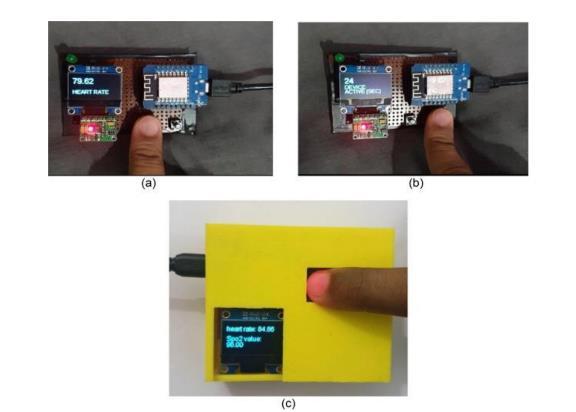
APCB with the entirehardwarecircuitry completedand soldered to it is housed in a PLA case that was 3D printed.
Thisdevice'ssalientfeaturescomprise:
●AnInternetofThings-basedhealthmonitoringsystem
●Easytoputupandoperate.
V BUILD INSTRUCTION
To build an IoT pulse oximeter, you will need the followingcomponents:
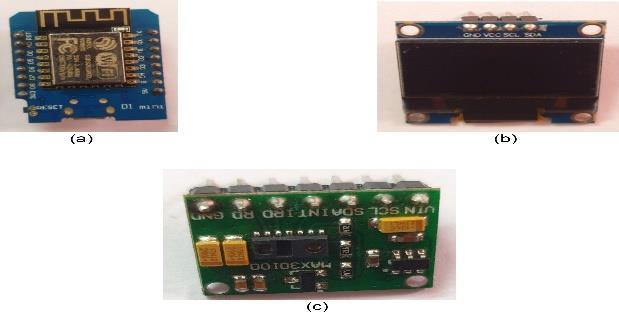
ESP32: A microcontroller board that can connect to Wi-Fi and communicate with the pulseoximetersensorandtheOLEDdisplay.
MAX30100: A pulse oximeter sensor that can measure the SpO2 and BPM of a person using redandinfraredLEDsandphotodetectors.
OLED Display: A 0.96 inch blue OLED display modulethatcanshowtheSpO2andBPMvalues onthescreen.
3D Printed Enclosure: A case that can hold the ESP32, the MAX30100, and the OLED display together and provide a slot for the finger to insert.
Blynk Application: A smartphone app that may build a dashboard to show the BPM and SpO2 readingsonline.
The basic steps for building an IoT pulse oximeterareasfollows:
Connect the I2C pins (SCL and SDA) of the ESP32, the MAX30100, and the OLED display together.Also,connecttheVCCandGNDpinsof the ESP32 to the VCC and GND pins of the MAX30100andtheOLEDdisplay.
Download and install the Arduino IDE and the ESP32 board support package. Also, download and install the libraries for the MAX30100 and theOLEDdisplay.
Create a Blynk account and a new project. Choose ESP32 as the device and get the auth token. Also, add a gauge widget and a super chart widget to the dashboard and set the virtualpinstoV5andV6respectively.
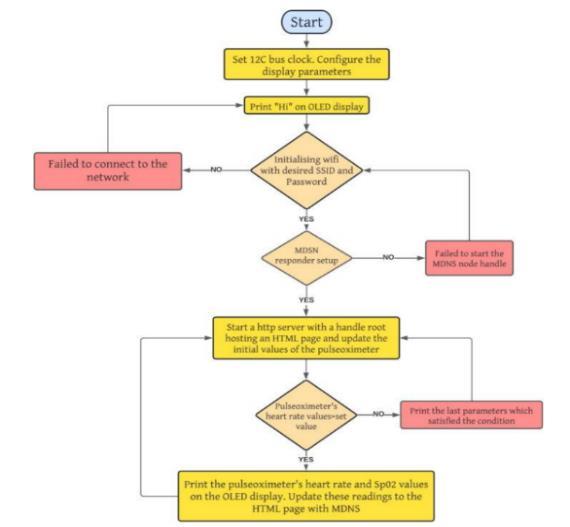
Write the code for the ESP32 to read the SpO2 and BPM values from the MAX30100 sensor, display them on the OLED screen, and send them to the Blynk server as a template and modifyitaccordingtoyourneeds.
Upload the code to the ESP32 and test the device. Insert your finger into the slot of the MAX30100 sensor and see if the OLED display
showsthecorrectvalues.Also,checkiftheBlynk appshowsthesamevaluesonthedashboard.
Interfacing between Adafruit OLED module and D1 mini microcontroller: OLED module The SSD1306 model of organic light-emitting diode (OLED) display, which has monochromatic colour and resolution, was utilized in this project
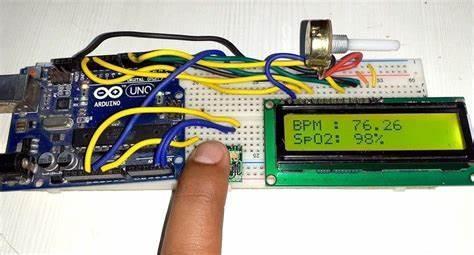

Fig.5.1: A) Schematic Diagram Of Jioning Circuit B). Connection Of Oled Display126*64, Max8266mod, Aurdino Uno, Hc-05 Blutooth Module

128 x 64 pixels and a 0.96-inch display size. When compared to LCD displays, OLED displays have the advantage of not requiring a backlight, which enhances the contrast of the image when seen in low light.When compared to other displays, these OLED screens have a
relatively low power consumption. This OLED is interfaced with D1 small, via I2C protocol. Of the seven pins on the chip, only four (VCC,GND,SDA, and SCL) are used for communication. Unlike conventional LCDs, whichrequireinterfaceswith12pinconnections,OLEDs onlyrequire4pins.

VI OPERATION INSTRUCTION
Apulseoximeterisatoolusedtoevaluateblood oxygensaturation.Youmustdothefollowing actionsinordertoutiliseapulseoximeter:
Install:
Two AAA batteries according to the battery installationinstructions.
Opentheoximeterandinsertoneofyourfingers intotherubberhole.Makesureyournailsurface isfacingupward.
Press the function button once on the front panel. The oximeter will turn on and display youroxygensaturationandpulserate.
Keepyourfingerstillanddonotshakeitduring the measurement. The reading may take a few secondstostabilize.
Read the corresponding data on the display screen.Thenormalrangeofoxygensaturationis 95% to 100%. If your reading is lower than 90%, you may have hypoxemia and should consultadoctor.
To turn off the oximeter, press the function button again or remove your finger from the device.
VII VALIDATION AND CHARACTERIZATION
Validation and characterization are important steps for ensuring the accuracy and reliability of pulse oximeters.
Validation is the process of testing the performance of a pulse oximeter against a reference standard, such as an arterial blood gas analysers or a pulse oximeter simulator. Characterization is the process of analysing the factors that affect the pulse oximeter’s accuracy, such as perfusion, motion, skin pigmentation, ambient light, and temperature .
Depending on the device's intended usage and application, there are many protocols and methods for characterising and verifying pulse oximeters. For instance,astandard(ISO80601-2-61:2017)producedby the International Organisation for Standardisation (ISO) outlines the minimal specifications and testing procedures for pulse oximeters meant to be used in medical electrical equipment. Guidelines for the characterization and validation of pulse oximeters intended for over-the-counter and prescription usage arealsoofferedbytheFDA.
Some of the common parameters that are measured during validation and characterization of pulse oximetersare:
Accuracy: the degree of agreement between the pulse oximeter’s measurement and the referencevalue.
Precision: the degree of repeatability or consistency of the pulse oximeter’s measurement.
Linearity: the degree to which the pulse oximeter’smeasurementchangesproportionally tothereferencevalue.
Sensitivity: the ability of the pulse oximeter to detectchangesinthereferencevalue.
Specificity: the ability of the pulse oximeter to distinguish between different types of haemoglobin, such as oxyhaemoglobin, carboxyhaemoglobin,andmethaemoglobin
Response time: the time required for the pulse oximeter to display a stable measurement after achangeinthereferencevalue.
Stability: the ability of the pulse oximeter to maintain a consistent measurement over time andunderdifferentconditions.
Range: the minimum and maximum values that thepulseoximetercanmeasure.
The following are some typical techniques and resourcesforcharacterisingandvalidatingpulse oximeters:
Arterialbloodgasanalysis:alaboratorytestthatgauges the arterial blood's pH, partial pressure of carbon dioxide, oxygen saturation, and other characteristics. Although this is the gold standard for determining oxygen saturation, it is costly, time-consuming, and invasive.
Pulse oximeter simulator: a device that simulatestheopticalpropertiesofhumantissue and blood, and generates a PPG signal with known oxygen saturation and pulse rate values. This is a convenient and non-invasive method for testing the accuracy precision of pulse oximeters, but it might not take into consideration every physiological and environmentalelementthatinfluenceshowwell apulseoximeterworksinpracticalsettings.
Multi-analyte calibration: a method that uses a mixture of different types of haemoglobin, such as oxyhaemoglobin, carboxyhaemoglobin, and methaemoglobin, to test the specificity and linearity of pulse oximeters. This method can also be used to generate a calibration curve for the pulse oximeter, which can improve its accuracyandreduceitsbias.
Clinicaltrials:amethodthatinvolvestestingthe pulse oximeter on human subjects under controlledor natural conditions,andcomparing the results with a reference method. This is the mostrealisticandreliablemethodforvalidating andcharacterizingpulseoximeters,butitisalso the most complex, costly, and ethical. Clinical studies need a sizable sample size, a strict design, and a thorough data analysis.
VIII. A DISCLOSURE OF COMPETING INTERESTS
The authors state that none of their known financial conflictsorinterpersonalconnectionsmighthavehadan impactontheworkpresentedinthispaper
VIII CONCLUSION
AnIoT-basedpulseoximeterforPCs ensuresconvenient health monitoring. With real-time data transmission, it facilitatesremotetrackingandtimelyinterventions.This technology enhances accessibility, enabling users to monitortheirhealtheffortlessly.TheintegrationofIoTin pulse oximetry brings about a paradigm shift in healthcare, making it more proactive and personalized. The convenience of PC connectivity further expands its usability, providing users with comprehensive health insights. Overall, this innovation signifies a significant step towards advancing digital health and empowering individualstotakechargeoftheirwell-being.
REFERENCES
[
1].A.Anzueto,R.Casaburi,S.Holmes,T.Schermer"Pulse oximeters:Projectinitiationdocument" (NationalHealth Service (UK) Centre for Evidence-based Purchasing, 2009).
[2].S.Dei-Vasi-Gamani,M.R.Narmadha,H.Prasad,P.Nai ATMEGA 328 Microcontroller-Based Smart Pulse Oximeter Design and Development International Journal ofEmergingTechnologies(2020).
[3]. B. Layout, A. Setup I2C interface for LCD supplied data: Board Layout Specification: I2C Address Configuration:"(2017).
[4].P.A.B. Pavani, N.L. Alitha A Novel Method for Modern Home Monitoring and Control Using an ARM Controller and an ESP8266 International Journal of Innovative ResearchandAdvancedTechnology,10(2018).
[5] S. Yıldız, M. Burun kaya Third International Symposium on Multidisciplinary Studies and Innovative Technologies(ISMSIT)2019:Web-BasedSmartMeterfor All-PurposeSmartHomeSystemswithESP8266