

Assessing Anthropogenic Impact on Water Quality in the Musi River: A Study of Urbanized
and Industrialized
Hyderabad
Mounika Chiluka11Department of Applied Geochemistry, Osmania University, Hyderabad, India
Abstract - Water, vital for life on Earth, faces severe challenges in Hyderabad due to rapid industrial and urban expansion. Over the past three decades, this growth has heightened water consumption and deteriorated water quality. The Musi River, a tributary of the Krishna River, undergoes a drastic transformation as it flows through Hyderabad, turning into a sewerage drain due to the dischargeofuntreatedsewage andpollutantsfromindustries. The city discharges a staggering 700 to 800 million liters of untreated sewage intothe MusiRiver daily.Groundwater,the primary watersource, getscontaminated,compellingreliance on municipal water from distant locations. Downstream residents, often economically disadvantaged, are forced to consume the contaminated water due to limited alternatives. The study area, the Musi basin, spans specific longitudes and latitudes and experiences diverse uses along its course. To comprehend pollution extent and pollutant fate, river water samplesweresystematicallycollected.Physicalandbiological parameters were analyzed to understand the river's water quality dynamics. The downstream stretch experiences significantchanges,indicatingrecoveryattributedtodilution andbio-physicaltransformations.SewerageTreatmentPlants contributetowaterpollution, withidentifiedinletsfromareas with various industries and substantial populations. Water quality parameters such as pH, DO, BOD, EC, SAR, and total coliform were analyzed, revealing challenges from industrial and domesticdischarges.Thestudyunderscorestheurgencyof robust water quality management to safeguard downstream communities facing diverse health problems due to contaminated water. Regular testing and comprehensive monitoring are crucial for maintaining water quality and ensuring the safety of water resources.
Key Words: Musi River, Urban Sewage, Pollution, Water Quality,HealthImpacts
1.INTRODUCTION
Water is a crucial resource for sustaining life on Earth. However,therapidexpansionofindustrialdevelopmentand urbanizationoverthelastthreedecadesinHyderabadcity hasnotonlysignificantlyincreasedwaterconsumptionbut hasalsohadaprofoundimpactonwaterquality(Salveetal., 2008). Unfortunately, the city lacks proper outlets for wastewaterdisposal,leadingtothedischargeofwasteinto the Musi River. Consequently, the Musi River's ecological balance has been severely disrupted, affecting even the groundwatersourcesintheregion(Hujareetal.,2008).
TheMusiRiver,atributaryoftheKrishnaRiver,initially flows through Hyderabad metropolitan city in Telangana state with a substantial discharge in the upstream areas. However,asitreachesHyderabadcity,theriverundergoesa transformation into what can be described as more of a seweragedrain.Thisdrasticchangeisattributedtothehigh disposal of domestic sewage and pollutants from nearby industries. Astonishingly, Hyderabad city discharges approximately700to800millionlitersofuntreatedsewage water into the Musi River each day. This concerning situationisexacerbatedbythemunicipalitiessurrounding Hyderabad.
TheinfiltrationofsurfacewaterfromtheMusiRiverand nearbylakestotheaquifershasledtothecontaminationof agroundwatersourcesintheregion.Asaconsequenceofthis groundwater contamination and a declining the groundwatertable,thecityiscompelledtorelyonmunicipal water sources. However, this municipal water, crucial for meeting the city's water needs, is sourced from distant locations,necessitatingsignificantexpenditureofresources, (Pullaiahcheepietal.2012).Thispredicamentparticularly affectsthedownstreamresidents,whooftenbelongtolower economicstrataandarecompelledtoconsumetheavailable contaminatedwatersduetolimitedalternatives.
The degradation of water quality in the Musi River has reachedaconcerninglevel,contributingtoahostofhealth issues observed in the downstream villages. The compromisedwaterqualitybecomesabreedinggroundfor pathogenic bacteria, viruses, and parasites present in the wastewater.Asaresult,thecommunitiesresidinginthese areas are confronted with a myriad of health problems, underliningtheurgentneedforcomprehensiveandeffective waterqualitymanagementstrategiestosafeguardthewellbeingoftheaffectedpopulation.
2. STUDY AREA
The study area, encompassing the Musi basin, is situated between780to79044΄eastlongitudesand16040΄to170 50΄ northern latitudes. The Musi River flows through the Hyderabadmetropolitanarea,withatotalcatchmentsizeof 1,275km2.Approximately90kmfromitssource,theriver entersHyderabadcity,whereitcommencesreceivingsewage frombothpointandnon-pointsources.Overastretchof47 km,extendingfromGandipettoPratapasingaram,theMusi River is impacted by sewage inflow. However, for the
International Research Journal of Engineering and Technology (IRJET) e-ISSN: 2395-0056 Volume: 11 Issue: 01 | Jan 2024 www.irjet.net p-ISSN: 2395-0072 © 2023, IRJET | Impact Factor value: 8.226 | ISO 9001:2008 Certified Journal | Page539
***
remaining 119 km downstream of the city, the water is utilized for irrigation purposes. Ultimately, the Musi River joins the Krishna River at Wadapally in Nalgonda district. This geographical overview outlines the critical points of sewageinfluenceandthevariedusesoftheMusiRiveralong itscourse.
2. METHODOLOGY
To assess the extent of pollution, identify various sources, and determine the fate of pollutants, river water samples were systematically collected at different points along the Musi River. A total of 11 samples were obtained: before enteringthecity,withinthecity,afterleavingthecity,andat theconfluencewiththeKrishnaRiver.Thiscomprehensive approach aimed to monitor changes in river water compositionacrossdifferentlocations.
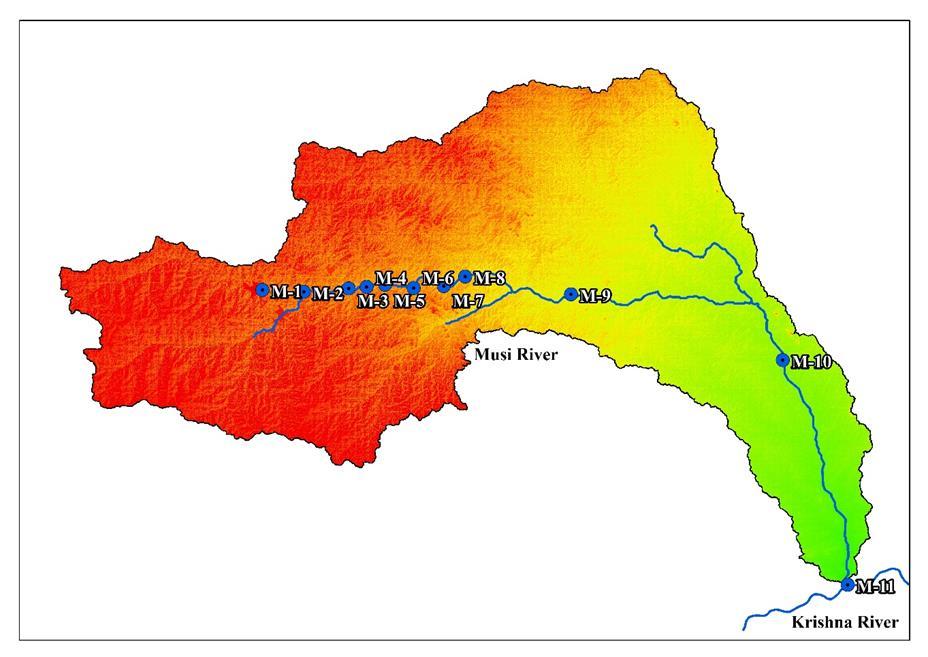
Fig -1:Studyareamapshowingthesamplelocations (basin-scale)andsewagetreatmentplants(STPs)fortimeseriessamplecollection
To better understand the physical and biological parameters,analyseswereconductedonsamplestakenfrom themiddlepartoftheriver,aswellasfromadistantlocation where the Musi River is not utilized for irrigation. These specificsamplingpointsweremarkedusingaGarminhand GPSdeviceduringthecollectionprocess(Fig.1).
Watersampleswerecollectedfromthemiddlecourseofthe riverusingbucketsfromvariousbridges.Toensureaccurate analysis,thesecollectedwatersampleswerecarefullystored inHDPEbottles,maintainingtheirintegrityuntiltransported to the laboratory for further examination. This meticulous sampling strategy provided a holistic view of the river's water quality across different segments and allowed for a thoroughinvestigationintotheenvironmentaldynamics.
The physical parameters of the river water samples were meticulously assessed, including pH, EC (Electrical Conductivity),DissolvedOxygen(DO),BiochemicalOxygen Demand(BOD),TotalColiform,Boron,FluorideandSodium AbsorptionRatio(SAR)aspresentedinTable1.
In-situmeasurementsofpHandECwereconductedusingthe probes of the Hanna Edge instrument. Following sample collection,thewatersampleswerepromptlytransportedto the laboratory and stored in a freezer at -4°C to maintain theirintegrity.
Forfurtheranalysis,watersampleswerefilteredinthelab usingMilliporenylonmembranefilterswitha0.45µmpore size.Thefilteredsampleswerethenacidifiedwithultra-pure nitric acid and stored in a refrigerator for subsequent examinations.
Sampling for the study specifically targeted Sewage Treatment Plants (STPs) managed by the Hyderabad Metropolitan Water Supply and Sewerage Board, with oversightfromtheTelanganaStatePollutionControlBoard (TS-PCB)withintheMusiRiverbasin.Comprehensivein-situ measurements, including DO, pH, and EC, were complementedbydetailedlabteststodetermineBOD and Total Coliform levels. This approach ensures a thorough understanding of the water quality parameters crucial for assessingtheenvironmentalconditionsoftheMusiRiver.
4. RESULTS AND DISCUSSION
Anoticeableescalationinallobservedphysicalparameters wasidentifieddownstreamfromGandipet(STP-1),marking the point where the river begins to receive sewage water. This trend persists for approximately 42 km until Pratapasingaram.Beyondthisjuncture,thereisadiscernible shiftintheparameters,indicatingareturntoamoretypical watercomposition.
Physicalandbiologicalparametersassessedattheextreme downstreamlocationofWadapally,justbeforetheMusiRiver merges with the Krishna River, provide insights into the recoveryoftheMusiRiverfromanthropogenicimpacts.The observed recovery is attributed to factors such as dilution and bio-physical transformations during the downstream transportofpollutants.However,adetailedanalysisofhow chemicalparametersevolveduringthisrecoveryprocessis anaspectthatrequiresfurtherinvestigation.

International Research Journal of Engineering and Technology (IRJET) e-ISSN: 2395-0056 Volume: 11 Issue: 01 | Jan 2024 www.irjet.net p-ISSN: 2395-0072 © 2023, IRJET | Impact Factor value: 8.226 | ISO 9001:2008 Certified Journal | Page540
Fig -2:Showingdistributionofsewagetreatmentplants fromsampleswerecollected
Theaveragevaluesofsamplescollectedfrom11Sewerage TreatmentPlants(STPs)aresummarizedinTable1.Notably, variousinletstotheMusiRiverwereidentifiedassources contributing untreated domestic sewage and industrial effluents. These inlets stem from locations such as Jeedimetla, Kukatpally, Peerjadiguda, Nagole, Charlapally, Bapughat Sangem, and Moosarambagh. These areas are characterized by the presence of small to medium-scale industries, metal industries, pharmaceutical industries, electricalindustries,andsubstantialpopulationsgenerating bothindustrialandhouseholdwaste.
anindicator ofthe water body'soxygenstatus.Significant DO depletion suggests the presence of substantial biodegradable organic matter in the river water. During monsoonperiods,DOvaluesgenerallyincreased,reaching the highest level of 6.8 mg/l in downstream areas that received municipal sewage and domestic wastewater. DO depletion may also result from phytoplankton respiration andsedimentoxygendemand,withapotentialcontribution fromalargeproportionofinflowfrombedspringsdueto lowercatchmentflow.
Testing water quality parameters is crucial to ensure its suitabilityforvariouspurposes,includingdrinking,domestic use,agriculture,andindustry.Theselectionofparameters for water testing depends on the intended use and the desired level of quality and purity. Water can contain fluctuating, dissolved, suspended, and microbiological impurities,necessitatingarangeoftests
PhysicaltestssuchaspH,totaldissolvedsolids(TDS),and electrical conductivity (EC) are essential to assess basic watercharacteristics.Chemicaltests,includingbiochemical oxygen demand (BOD), dissolved oxygen, fluoride (FA), boron, sodium absorption ratio (SAR), and total coliform, provideinsightsintothechemicalcompositionofwater.For achievinghigherwaterqualityandpurity,testingfortrace metals, heavy metal contents, and organic pollutants like pesticideresiduesisrecommended.
In developed countries, these criteria are rigorously monitoredtoensurethesafetyandqualityofdrinkingwater. Regulartestingofwaterqualityparametersisnecessaryto maintainandimprovetheoverallqualityofwaterresources. ThepHlevelsinthestudyarearangedfrom7.05to8.1mg/l, potentiallyinfluencedbyindustrialeffluentsandsewerage discharges. The fluctuating dissolved oxygen (DO) levels, rangingfrom3.9to6.8mg/lalongtheriverstretch,serveas
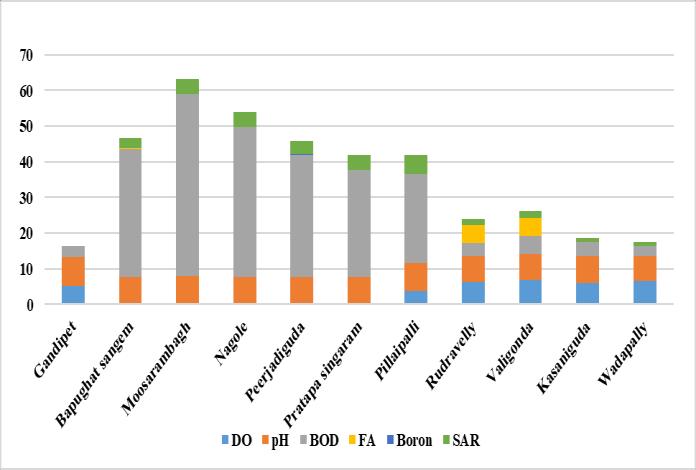
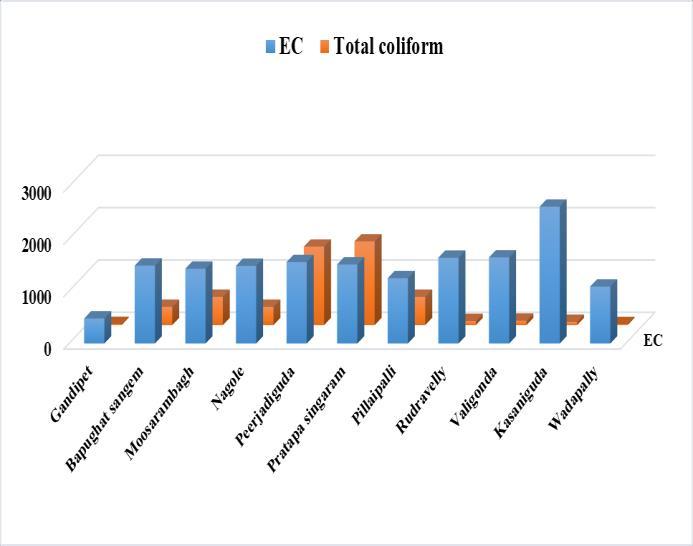
Biochemical oxygen demand (BOD), a measure of organic pollution, showed values varying from 3 to 51 mg/l, exceedingthestandardlimits(WHO,1984:5mg/l).Electrical conductivity(EC)valuesrangedfrom478to2615mg/l,with higherconcentrationsobservedinthedownstreamareaof Kasaniguda. Sodium absorption ratio (SAR) values ranged from1.1to4mg/l,fallingwithintheexcellentcategory(<10) based on the calculated SAR values for all water samples.
International Research Journal of Engineering and Technology (IRJET) e-ISSN: 2395-0056 Volume: 11 Issue: 01 | Jan 2024 www.irjet.net p-ISSN: 2395-0072 © 2023, IRJET | Impact Factor value: 8.226 | ISO 9001:2008 Certified Journal | Page541
Fig -3:Showingtheconc.ofdifferentparameterslikeDO, pH,BOD,FA,Boron,SARtoupstreamtodownstream.
S.no Locations DO pH Con BOD Total coliform FA Boron SAR 1 Gandipet 52 81 478 3 22 BDL 2 Bapughat sangem Nill 77 1489 36 350 015 004 29 3 Moosarambagh Nill 79 1429 51 540 01 BDL 43 4 Nagole Nill 78 1484 42 350 BDL 41 5 Peerjadiguda Nill 78 1555 34 1500 02 004 39 6 Pratapa singaram Nill 78 1511 30 1600 0 4 7 Pillaipalli 3.9 7.78 1248 25 540 BDL 5.1 8 Rudravelly 62 747 1640 36 79 5 005 16 9 Valigonda 68 725 1645 5 84 51 006 19 10 Kasaniguda 61 743 2615 4 63 003 12 11 Wadapally 65 705 1088 28 20 BDL 11
Table -1: ArithmeticaverageofvariousparametersofsamplescollectedfromSTPs.
Totalcoliformconcentrationsvariedfrom22to1600mg/l, with higher concentrations observed in the urban stretch fromBhapughatSangemtoPillaipalli.Thesefindingsindicate variouswaterqualitychallenges,emphasizingtheimpactof anthropogenicactivitiesontheMusiRiver.
3. CONCLUSIONS
DuetotherapidgrowthofHyderabad,asubstantialvolume of wastewater is generated in the city, and with no alternativeoutletsfordisposal,thisuntreatedwastewater, along with domestic sewage and industrial effluents, is dischargedintotheMusiRiver.Thispracticehassignificant adverseeffectsontheriver'secologyandthewell-beingof downstream villagers. The poor water quality not only negativelyimpactsthehealthoffarmersbutalsorendersthe waterunsuitablefordrinkingpurposes.
Groundwater, being the primary source of water in these areas, is crucial for the communities, making knowledge aboutitsavailabilityandsustainabilityessentialforeffective management and future development. The stretch from BhapughatSangemtoPillaipalliexhibitselevatedlevelsof physio-chemicalparameters,exacerbatingtheMusiRiver's conditions. The situation in these regions is further deteriorated by the heavy dumping of organic waste and sewage from various sources, including industrial and municipal sources. Anthropogenic activities contribute significantlytothecontaminationofthewatertable.
Implementingproperwastewatertreatmentsystems,bothat thesourcelevelandbeforedisposal,cansubstantiallyreduce pollutantloads.Utilizingadvancedscientifictechnologiesfor safetreatmentiscrucialforminimizingtheaccumulationof pollutantsdownstream,improvingwaterquality,protecting the river's ecology, and reducing health impacts on downstream villagers. Sustainable development practices, suchaswastewatertreatmentsystemsandnaturalfiltration techniques,cancontributetothepreservationoftheMusi
River environment and mitigate various skin and health hazardsassociatedwithwaterpollution
ACKNOWLEDGEMENT
The author (MC) thanks DST, Govt of India for INSPIRE fellowship.
REFERENCES
[1] Salve VB, Hiware CJ. Study of water quality of Wanparakalpa reservoir Nagpur, near Parli Vaijnath, district Beed, Marathwada region. J Aqua Biol. 2008; 21(2):113–7.
[2] Hujare MS. Seasonal variation of physico-chemical parameters in the perennial tank of Talsande, Maharashtra. Ecotoxicol Environ Monitor. 2008; 18(3):233–42.
[3] Pullaiahcheepi.ImpactofpollutionofMusiRiverwater in downstream villages-A study. IOSR Journal of Environmental Science, Toxicology and Food Technology. 2012 Sep-Oct; 1(4):40–51. ISSN: 23192402,ISBN:2319-2399.
[4] Sarma,C.,Deka,D.K.andK.G.Battacharyya:Qualityof waterinafewurbandrinkingwatersources.IJEP,22, 173-183(2002).
[5] Wani, M.M., Renu Bhargava, A. Gairola and M.R.D. Kundangar:StatusofwaterqualityinDalLake.IJEP,22, 121-128(2002).
International Research Journal of Engineering and Technology (IRJET) e-ISSN: 2395-0056 Volume: 11 Issue: 01 | Jan 2024 www.irjet.net p-ISSN: 2395-0072 © 2023, IRJET | Impact Factor value: 8.226 | ISO 9001:2008 Certified Journal | Page542
Fig -4:ShowingtheConc.ofElectricalconductivity(EC) andTotalcoliform(TC)toupstreamtodownstream.