
International Research Journal of Engineering and Technology (IRJET) e-ISSN:2395-0056
PEG- Piezoelectric Electricity Generator
Sarthak Agarwal1
1High School Student, Shirdi Sai Public School, Uttar Pradesh, India
Abstract – Discovering, finding, and evolving alternate sources of renewable energy is the need of the hour. We never know, which alternate we discover, turns out to become much more energy efficient than the already existing ones. In this paper, I introduce a yet another revolutionary way of harnessing energy through the concept of Piezoelectricity. Piezoelectricity is producing electricity by applying pressure on a particular stone[1]. This paper delves into the application of this concept in harnessing electricity from tidal pressure with the help of results from the experiments conducted and the calculations made. Along with this, it also provides several other applications of this concept while explaining at the end, how this is going to be cost-efficient.
Key Words: Renewable Energy, Tidal Energy, Piezoelectricity,Tidal Pressure.
1.INTRODUCTION
A piezoelectric crystal produces a voltage generating AC currentwheneveramechanicalstressisappliedtoit.
Already creation of piezoelectric footpaths and footsteps is put in place where electricity is produced due to the mechanical stress applied by the action of placing one’s foot in the special footpaths or footsteps made of piezoelectricmaterial.
But this is not a very efficient way of producing loads of electricity.
I casually came up with a thought of harnessing tidal energywiththisconcept,thedaywhenIexperiencedthe strongforceofwavesattheseashore.
I have performed few experiments, trying to calculate and estimate, the extent of energy generation with this method.
In this process, I also came up with several other applications of Piezoelectricity which could also be significantinenergygeneration.
One such is a suggestion of a new design of water turbines.
1.1 Chemistry behind Piezoelectricity
Piezoelectric crystals are generally made of Quartz, andthemechanisminvolvedisactuallythemovementof electronsduetoapplicationofstress[2].
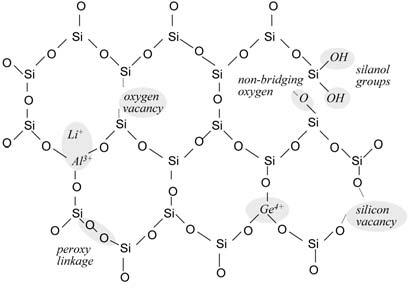
Quartzismadeupofahexagonalstructureof Siliconand OxygenatomwhereonesiliconbondswithtwoOxygen.
Since Oxygen is more electronegative then silicon, the silicon-oxygenbondispolar.
In the hexagonal structure, the net electric charge gets developed in the center of the hexagonal structure.
However, when a mechanical stress is applied, there is a change in this hexagonal structure, and the net electric chargeshiftsitsposition.
This change in the position of electric charge produces a voltage[3].
Thediagramgivenbelowshowsthestructureof Quartz.
2. The concept of PEG( in oceans)
PEGisaplatemadeofpiezoelectricmaterial,installed verticallyuprightontheseafloors,neartheseashore.
It is placed in a such a way that the piezoelectric part of the plate is just on the surface of ocean so that impact withthewavescouldbemadeeasily.
Whenever the oceanic waves will hit the PEG rhythmically,voltagewillbeproduced.
ThisisthereforeacleanerandgreenersourceofEnergy.
Also, quartz, of which the piezoelectric disc is made of, also yields silicon which is used in making the Photovoltaiccellsofsolarpanels.
Therefore,wemaysaythattheinfrastructureforthePEGs isalreadyreadyforus.
© 2024, IRJET | Impact Factor value: 8.226 | ISO 9001:2008 Certified Journal | Page527
-
***
Fig -1:StructureofQuartz
www.irjet.net
Volume: 11 Issue: 01 | Jan 2024
p-ISSN:2395-0072
2.1 Experimentation and Results
Totesttheefficiencyofthisconcept, I conducted a test by preparing a PEG setup at a small scale and then using the principles of proportionality to find the results in real life scenarios, that is, oceans or seas.
Forthetest,ImadeaPEGplateofsize375cm^2.
Toreplicatethedynamicof wave,Iuseda polythenefull of water and dropped at from a certain height over the PEGtofindthereadingsofVoltageinthemultimeter.
Thisishowthecalculationswent-
Mass(ofwater)=1kg
Height(offreefall)=1m
Timeofthefreefall=1s(approximately)
Area(ofPEG)=375cm^2
PotentialEnergy(Ep)=mgh =1*9.81*1=9.81J
Consideringthatresistanceofferedbyairwasnegligible, the entire Potential energy possessed by the water was onlyconvertedtokineticenergyexactlybeforethepoint itcontactedthePEG.
Therefore,
Ep=Ek
Ek=9.81J=(1/2)mv^2
V(velocityatthetimeofmakingcontact)=(2*9.81)^1/2 V=4.43m/s(approximately)
F(force)= Change in momentum/time= m*Change of velocity/time
Since, initial velocity was zero, change of velocity was equal to the final velocity and the time is the time taken forthefreefall.
F=m*4.43/1
F=1*4.43/1
F=4.43N
P(pressure)=Force/Area
P=4.43/0.0375=118.13Pa(approximately)
Hence,thesetupIhavemadewasexertingapressureof about118pascalsonthePEGIhavemade.
The corresponding values on the multimeter I obtained wereasfollows-
MaximumCase-3V
MinimumCase-0.5V
Now, interestingly, the average pressure of waves near seashorerangesfrom10,000Pato50,000Pa.
If we consider the basic rules of proportionality, then if minimumvaluewegetwith118Paofpressure is0.5,so a25000Papressurewillprovideavoltage(minimum)of about105.8V
Similarly, if the maximum case we get from 118Pa of pressure is 3 V, so a 25000 PA pressure will provide a voltage(maximum)ofabout634.9V.
The ideal 220V value for India ranges between the minimumandmaximumvaluehenceiseasilyattainable.
Also, on increasing the no, of experiments, we may get evenmoreaccuratemeasure.
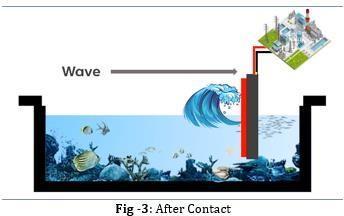
Given below is a diagram of a PEG. The yellow-black disc connectedtoapowerhouseisthePEG.Thediagramshows awavehittingthePEG.

© 2024, IRJET | Impact Factor value: 8.226 | ISO 9001:2008 Certified Journal | Page528
International Research Journal of Engineering and Technology (IRJET) e-ISSN:2395-0056 Volume: 11 Issue: 01 | Jan 2024 www.irjet.net p-ISSN:2395-0072

3. New Design for Water Turbine
Water turbines are already effectively used as a renewable source of energy where the kinetic energy of water is used to turn the turbine to generate electricity. All present-day turbines used, have a flap like plates, placed one after another in a circular shape so that they can easily contact with the flowing water and therefore, couldrotate,orratherrevolve,togenerateelectricity.
I propose to fulfil a dual objective by making those flaps from piezoelectric material or install piezoelectric plates on the flaps so that whenever the flowing water hits the flaps, energy gets generated not only by the rotation of the turbine but also by the tidal pressure of the waves exertedonthepiezoelectricplates.
This way, we can design a water turbine combining the concept of PEG, to harness even greater amount of tidal energy.
4. Concept of PEG in Scrap Yard
In the scrap yards, the metal scrap is compressed by being pressed by two metal plates help on opposite sides.
This compression generates immense amount of mechanicalstress.
I propose to make these plates of piezoelectric material. This way, whenever these plates compress the metals i.e., makes a mechanical contact with the scrap, electricitycouldbeproducedwiththismechanicalstress.
This way, a way of processing waste, will start contributingtoenergyproductionaswell.
5. CONCLUSION
Therefore, the concept of PEG can be used at anIndustrial level to generate renewable energy. It offers two major benefits-
Is cost efficient, since the infrastructure used for making PEG is quite like the one used to make Solar Panels, so not much resource has to be spentonresearchanddevelopment.
Isenergyefficient,sincethepiezoelectriccrystals produce AC current which has low power loss factorandcanbeeasilytransmitted.
REFERENCES
[1] Definition of Piezoelectricity by Cambridge, https://dictionary.cambridge.org/dictionary/englis h/piezoelectric#google_vignette
[2] Mechanism of piezoelectricity, https://www.sciencedirect.com/topics/materialsscience/piezoelectricmaterial#:~:text=Piezoelectric%20materials%20or% 20piezoelectrics%20are,electron%20upon%20ap plication%20of%20stress.
[3] ExplanationofPiezoelectricitybyLesicsYouTube channel, https://www.youtube.com/watch?v=_XABS0dR15
International Research Journal of Engineering and Technology (IRJET) e-ISSN:2395-0056 Volume: 11 Issue: 01 | Jan 2024 www.irjet.net p-ISSN:
© 2024, IRJET | Impact Factor value: 8.226 | ISO 9001:2008 Certified Journal | Page529
2395-0072