
Enhancing Video Understanding: NLP-Based Automatic Question Generation
JAGAN G, AKILA K
Department of Computer Science and Engineering, SRM Institute of Science and Technology, Vadapalani, Chennai, Tamil Nadu, India
Abstract - The goal of the abstract project is to improve video comprehension using an autonomous question creation system that is NLP-based. The system creates pertinentandcontextuallyappropriateinquiriesbased on the content of a particular video using NLP (Natural Language Processing) techniques. This procedure entails transcribing the audio from the film, identifying the main ideas,andcreatinginquiriesthatspeaktovariousfacetsof the material. The produced questions can help students interact with the content of the video more deeply, foster critical thinking, and act as a tool for summarizing the topic.ThisstudydemonstratesthepotentialoffusingNLP with video contentto offer a more dynamicandthorough learning experience by bridging the gap among visual knowledge and textual comprehension. An ongoing researchtrendinnaturallanguageprocessingisautomatic question generation (AQG). AQG is very beneficial for computer-assisted assessments since it lowers the cost of manually creating questions and meets the demand for a steady stream of fresh questions. The majority of examstyle questions produced by automated question generation are of the "WH" ("What," "Who," and "Where" types) or reading comprehension variety. Based on their degrees of assessment, the questions must be varied or semanticallydistinct,althoughtheresponsesmaystaythe same, in order to be as natural or human-like as possible. As a result, creating different sequences as part of questionproductionhasemergedasacrucialNLPactivity, particularlyinthepublishingandeducationsectors.
Keywords - NLP, AQG, Extract Audio, STT.
I. INTRODUCTION
NaturalLanguageProcessing,afieldofstudythathasbeen active over the past few decades, is responsible for the task of question generation. It seeks to produce inquiries from a given passage of text when the passage itself contains the answers to the Questions. There are many potential and beneficial uses for automatic question generation across several industries. A significant area of useforAQGiswithinthepublishingandeducationsectors, where it has the potential to significantly improve tasks for both teachers and their pupils [5]. Not only that, but AQG can also support conversations between agents or
Chabot, assist with intelligent teaching, and even support self-learning tutorials by generating questions for testing andtrainingpurposes.
Our primary goal in this research is to create question pairs for educational purposes. We are motivated by the fact that manually creating questions is quite tedious and time-consuming. Additionally, based on the evaluation levels, students need to be exposed to inquiries for a certain topic that range in difficulty [7]. For this reason, numerous studies have been conducted by researchers to producea varietyof queries thataresemanticallydistinct from one another from a single source. For instance, handled a scenario of this nature using an encoderdecoderapproach.Thismodelisoneofthemostwell-liked machine learning models and has attained an accuracy that,insomesituations,evenexceedsthatofhumans.
When creating a variety of questions with the same responseforthecreationofvarioustargetsequences,Cho et al. suggested focused content selection in addition to a traditionalencoder-decoderarchitecture.Theyemploythe Stanford Question Dataset for training, testing, and data validation, along with several other AQG studies [10]. However, when trying to apply these methodologies in real-world circumstances, the inference-drawing process is not as straightforward as it may be. The data must always bein a particularformattobeused withSquad or any other common dataset. For instance, the training set for Squad contains a few words, a question, and the appropriateresponse.Thisrestrictionisaddressedbyour model [4]. Our model's architecture is built to automatically generate inquiries from any text minus the need for manual intervention, making the process of testingandassessingtheoutputfluidandapproachable.
II. LITERATURE REVIEW
Ragasudha, I., & Saravanan, M. (2021, March) et al Examinationisimportanteverywhereintheworld.Exams are the basic approach used to gauge a student's knowledge and aptitude. A teacher is required to develop setsofexamquestionsinaccordancewiththeinstitutions or universities. The preparation of the question paper is difficult for the teacher and requires a lot of their time.
International Research Journal of Engineering and Technology (IRJET) e-ISSN:2395-0056 Volume: 11 Issue: 01 | Jan 2024 www.irjet.net p-ISSN:2395-0072 © 2024, IRJET | Impact Factor value: 8.226 | ISO 9001:2008 Certified Journal | Page509
--***
Despitegreatattempts,mistakesareoccasionallymadeby people. The taxonomy developed by Bloom and random package suggested for this project make the process of creating test questions simple. It covers the six hierarchy levelsofBloom'sclassificationsysteminordertoproduce a question paper of the highest caliber. Users can quickly addquestionstothedatabase,whichwillbreak questions into sections. The question will generate itself in the format of a PDF and be sent to the teacher after you click the"Generate"button.
Nwafor,C. A., &Onyenwe, I. E.(2021) et al.Thechallenge of creating multiple-choice questions automatically is useful yet difficult in the field of Natural Language Processing (NLP). The objective is to automatically generate accurate and pertinent questions from textual input. Despite its value, manually generating substantial, significant, and applicable questions is a taxing and difficulteffortforteachers.Inthisresearch,weprovidean autonomous MCQG for Computer-Based Tests Evaluation (CBTE) system based on NLP. We extracted keywords important words that are included in the instructional material using the NLP technique. Five lesson materials were utilized to evaluate the system's effectiveness and efficiency in order to confirm that it is not perverse. The results demonstrate that the program was capable of generating keywords from instructional materials in setting visible questions when the traditionally extracted keywords by an instructor were compared to the automaticallygeneratedkeywords.Foreaseofaccess,this resultisdisplayedinauser-friendlymanner.
Gangopadhyay,S.,&Ravikiran,S.M.(2020,September) et al. An ongoing research field in processing natural languages is Automatic Questions Answer Generation (AQAG). AQAG is very beneficial for computer-assisted assessments since it lowers the cost of manually creating questions and meets the demand for a steady stream of fresh questions. Automatic Question Generation typically produces "WH" (What, Who, and Where) or reading comprehension-style questions for exams. Based on their degrees of assessment, the questions must be varied or semanticallydistinct,althoughtheresponsesmaystaythe same, in order to be as natural or human-like as possible. As a result, creating different sequences as part of query generation has emerged as a crucial NLP activity, particularly in the publishing and education sectors. In a conventional "encoder-decoder" paradigm, this module directs the decoder to create questions depending on particularemphasiscontents.Tocreatesolutiontagsanda collection of candidates concentration from which the threegreatestfocusesareselectedbasedontheamountof information they include, we employ a keyword generatingalgorithm.Afterthat,wecreatequeriesthatare semantically distinct from one another using the focus content. Our research employs a straightforward design with a single "Set your sights Generator" module, and
experimentalfindingsrevealthatourmoduleachieves1.2% BLEU4scoregainswhilerequiring20%lesstrainingtime than the most recent state-of-the-art model. Our model is simpletouseandmakesdrawinginferencessimple.
Lyu, C., Shang, L. (2021) et al. The goal of Question Generating (QG) is to create a believable inquiry for a given pair. While supervised QG trains a system to create questionsgivenpassagesandanswers,template-basedQG employs existing Query Addressing (QA) datasets to convert declarative statements into interrogatives. The generatedquestionsfortheheuristictechniqueareclosely related to their declarative counterparts, which is a drawback. The supervised approach's dependence on the language and domain of the QA sample used as training data is a drawback. We suggest an unsupervised QG approach that employs questions produced heuristically from abstracts as an avenue of training information for a QG system in order to get around these drawbacks. In order to train a from end to end neural QG model, the resultant queries are then integrated with previous news items. Utilizing unsupervised QA, we extrinsically assess ourstrategy.SyntheticQApairingsareproducedusingour QGmodelinordertotrainaQAmodel.
Cho,J.,Seo,M.(2019)etal.InmanyNLPapplications,such as question formulation or summarization, where the sourceanddestinationsequencesexhibitsemanticone-tomanylinks,itiscrucialtoprovidediversesequences.With the use of a general plug-and-play module (named SELECTOR) that wraps over and directs an existing encoder-decoder model, we provide a technique to explicitly decouple diversification from generation. In the diversification stage, a variety of specialists sample variousbinarymasksontheoriginalsequenceinorder to pick diverse content. Given every piece of chosen content from the original sequence, the creation stage employs a conventional encoder-decoder paradigm. We use a proxy for the basic truth mask and use stochastic hard-EM to teach because discrete sampling is non-differentiable and binarymasklacksgroundtruthlabels.
III. RESEARCH METHODOLOGY
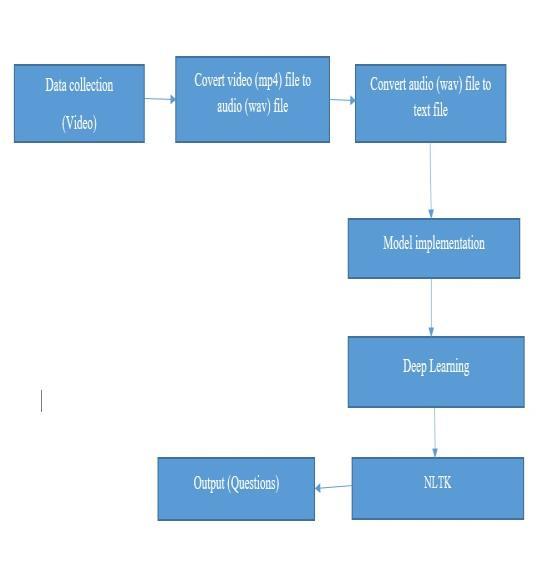
The suggested system intends to integrate cutting-edge technology to create a sophisticated video understanding platform.Moderncomputervisiontechniqueswillbeused by the system to evaluate video information and extract important visual elements, objects, and scenes. While simultaneously collecting the semantic meaning of the audio,methodsinvolvingNaturalLanguageProcessing,or NLP, will be used to transcribe spoken content. A comprehensive knowledge of the footage context will be provided by combining these retrieved visual and audio characteristics. An automatic question-generation module will create a wide range of inquiries on the video content based on this framework. These inquiries will cover a
International Research Journal of Engineering and Technology (IRJET) e-ISSN:2395-0056 Volume: 11 Issue: 01 | Jan 2024 www.irjet.net p-ISSN:2395-0072 © 2024, IRJET | Impact Factor value: 8.226 | ISO 9001:2008 Certified Journal | Page510
range of difficulty levels and focal points, encouraging users to interact more deeply and critically. With the ability to provide more engaging, individualized, and thorough educational experiences, the suggested system hasthepowertochangevideo-basedlearning.
3.1. Video Analysis Module:
The video information in this module is analyzed using computer vision algorithms. It takes out visual elements including experiences, objects, motion, etc. spatial relationships [16]. To provide an extensive illustration of the visual context, sophisticated algorithms are required to locate and track pertinent features within the video frames.
3.2. Audio Transcription Module:
The spoken words in the video are converted into text using this module. Technologies called Automatic Speech Recognition, or ASR, capture the cultural significance of theutteredwordsastheyarebeingconvertedfromaudio to text. The visual analysis [14] is complemented by the textual depiction, which improves the overall comprehensionofthematerial.
3.3. Content Integration:
The previous modules' verbal and visual representations are combined to create a thorough knowledge of the context of the film [17]. The system obtains a stronger understanding of the connections between the visual features and the associated spoken content by coordinatingthevisualandauralsignals.
3.4. Question Generation Module:
Thismodulecreatesavarietyofquestionsthatdependon the integrated comprehension of the movie by utilizing NLPtechniques.The questionsrange from factual queries [13] to higher-order thinking prompts, covering several cognitive levels. These inquiries are intended to promote
analysis, participation, and enjoyment of the multimedia content.
3.5. Question Variability Enhancement:
This module makes use of strategies like paraphrase, rephrasing, and randomization to guarantee the quality and variety of questions [11]. This leads to a wider range of questions that investigate different facets of the multimedia content and accommodate varied learning preferences.
3.6. Model Implementation:
The goal of the artificial intelligence area known as "naturallanguageprocessing"(NLP)istomakeitpossible for computers to comprehend, analyze, and produce human language. To enable robots to extract meaning, attitudes,andassociationsfromlanguagethatiswrittenor spoken, it entails creating mathematical models and algorithmsthatprocessandinterprettextandspeechdata. Language translation, sentiment assessment, summarization of texts, speech recognition, and autonomous question production are just a few of the diverseactivitiescoveredbyNLP.NLPplaysacrucialrole in technologies ranging from artificial intelligence and chatbots to text analysis and communication-driven automation by overcoming the gap between human conversationandcomputerunderstanding.
IV. RESULTS
The designed video understanding system has been put into practice with encouraging findings that show it has the ability to completelychange how people interact with video information. A thorough representation of the movie's context was made possible by the video analysis module's successful extraction of pertinent visual elements. A thorough comprehension of the subject was made possible by the audio transcription module's accurate transcription of spoken materials. The system wasbetter abletograspthe complexlinksacross the two modalitiesthankstothecombinationofvisualplustextual signals. The question creation module demonstrated the capacity to generate a wide variety of inquiries that covered various levels of cognition and aspects of the movie's content. Due to the diversity, users were more engaged and encouragedto think critically.Thestrategies usedtoincreasequestionvariabilityexpandedthepoolof questions that were generated, resulting in a more thorough investigation of the issue. The user interface allowedforsmoothcommunicationandgaveconsumersa simple way to view video content, participate with questions, and get feedback. In order to promote the best understanding and skill development,thecustomizedand adaptive education module successfully adapted the learningexperiencefordistinctproficiencylevels.
International Research Journal of Engineering and Technology (IRJET) e-ISSN:2395-0056 Volume: 11 Issue: 01 | Jan 2024 www.irjet.net p-ISSN:2395-0072 © 2024, IRJET | Impact Factor value: 8.226 | ISO 9001:2008 Certified Journal | Page511
Figure 1 - Methodology
Additionally, the data collection and reporting part provided insightful information about user habits and educational outcomes, allowing teachers to improve techniques and content. The platform's integration and scaling capabilities demonstrated how easily it could be adapted to different educational environments and contentdeliveryframeworks.

V. DISCUSSIONS
The potential repercussions, difficulties, and benefits of the suggested video understanding system are the main topics of discussion. The use of NLP and computer vision to improve video perception and engagement has considerable educational and non-educational potential. The system promotes intellectual inquiry and active engagement with video information by automatically creating contextually appropriate questions, leading to deeperlearningexperiences.Butthereareafewproblems worth taking into account. It is essential to ensure the accuracy of computerized voice transcription because errorscanresultinincorrectcomprehension.Additionally, maintaining user involvement without causing annoyance requires finding the ideal balance between question difficulty and user proficiency. Validating the variability augmentation module's capacity to produce interesting andusefulqueriesisalsoimportant.
Positively, the system's mixture of textual and visual information provides a thorough grasp of video content and accommodates various learning preferences. The possibility for individualized content distribution and adaptive learning caters to the needs of individual students, increasing the overall efficiency of educational systems. The insights from the analytics component can help with data-driven enhancements in content development and user experience. Practically speaking, the system's wider acceptance would depend on its scalability and interoperability with current educational platforms. Additionally, privacy and security concerns for data are essential, particularly if the system engages with user-generatedmaterial.
VI. CONCLUSION
Asa result,the proposedvideounderstandingsystemhas agreatdealofpotentialtotransformhowweinteractwith videocontentforpedagogicalandinformationalpurposes. This system has the ability to close the gap across visual information and textual interpretation by seamlessly merging cutting-edge machine learning and Natural Language Processing, or NLP, methods. A key component ofthissystem, theautomatic questioncreation module, is an effective tool to promote engagement in learning, intellectual curiosity, and a deeper comprehension of videocontent.
Throughitsadaptivelearningcharacteristicsandcapacity to extract and blend visual and aural signals, the system makes a substantial advancement towards individualized and interesting instructional experiences. This cuttingedge method has the potential to improve video-based learning as the digital world changes, making it more engaging, thorough, and available to a wide spectrum of learners. The suggested video understanding system creates new opportunities for dynamic and successful learning by fusing education and technology, meeting the variedneedsofstudentsinthedigitalage.
VII. REFERENCES
[1] Ragasudha, I., & Saravanan, M. (2021, March). Secure Automatic Question Paper with Reconfigurable Constraints. In 2021 Sixth International Conference on Wireless Communications, Signal Processing and Networking(WispNET)(pp.16-20).IEEE.
[2] Nwafor, C. A., & Onyenwe, I. E. (2021). An automated multiple-choice question generation using natural language processing techniques. arXiv preprint arXiv:2103.14757.
[3]Gangopadhyay,S.,&Ravikiran,S.M.(2020,September). Focused questions and answer generation by key content selection. In 2020 IEEE Sixth International Conference on MultimediaBigData(BigMM)(pp.45-53).IEEE.
[4]Lyu,C.,Shang,L.,Graham,Y.,Foster,J.,Jiang,X.,&Liu,Q. (2021). Improving unsupervised question answering via summarization-informed question generation. arXiv preprintarXiv:2109.07954.
[5]Cho,J.,Seo,M.,&Hajishirzi,H.(2019).Mixturecontent selection for diverse sequence generation. arXiv preprint arXiv:1909.01953.
[6]P.Rajpurkar,J.Zhang,K.Lopyrev,andP.Liang,“Squad: 100,000+ questions for machine comprehension of text,” arXivpreprintarXiv:1606.05250,2016.
International Research Journal of Engineering and Technology (IRJET) e-ISSN:2395-0056 Volume: 11 Issue: 01 | Jan 2024 www.irjet.net p-ISSN:2395-0072 © 2024, IRJET | Impact Factor value: 8.226 | ISO 9001:2008 Certified Journal | Page512
[7] A. Fan, M. Lewis, and Y. Dauphin, “Hierarchical neural storygeneration,”arXivpreprintarXiv:1805.04833,2018.
[8] X. He, G. Haffari, and M. Norouzi, “Sequence to sequencemixturemodel for diversemachinetranslation,” in Proceedings of the 22nd Conference on Computational NaturalLanguageLearning.Brussels,Belgium:Association for Computational Linguistics, Oct. 2018, pp. 583–592. [Online]. Available: https: //www.aclweb.org/anthology/K18-1056
[9] S. Subramanian, T. Wang, X. Yuan, S. Zhang, Y. Bengio, and A. Trischler, “Neural models for key phrase detection and question generation,” arXiv preprint arXiv:1706.04560,2017.
[10]J.H. Wolfe,“Automatic questiongenerationfrom text an aid to independent study,” in Proceedings of the ACM SIGCSE-SIGCUEtechnicalsymposiumonComputerscience andeducation,1976,pp.104–112.
[11] H. Kunichika, T. Katayama, T. Hirashima, and A. Takeuchi, “Automated question generation methods for intelligent Englishlearning systemsandits evaluation,” in Proc.ofICCE,2004
[12] R. Mitkov, H. Le An, and N. Karamanis, “A computer aided environment for generating multiple-choice test items,” Natural language engineering, vol. 12, no. 2, pp. 177–194,2006.
[13] V. Rus, Z. Cai, and A. C. Graesser, “Evaluation in natural language generation: The question generation task,” in Proceedings of the Workshop on Shared Tasks and Comparative Evaluation in Natural Language Generation,2007,pp.20–21.
[14] I. Labutov, S. Basu, and L. Vanderwende, “Deep questions without deepunderstanding,”inProceedings of the 53rd Annual Meeting of the Association for Computational Linguistics and the 7th International Joint Conference on Natural Language Processing (Volume 1: LongPapers),2015,pp.889–898.
[15] I. V. Serban, A. Garc´ıa-Duran, C. Gulcehre, S. Ahn, ´ S. Chandar, A. Courville, and Y. Bengio, “Generating factoid questions with recurrent neural networks: The 30m factoid question-answer corpus,” arXiv preprint arXiv:1603.06807,2016.
[16] I. Sutskever, O. Vinyals, and Q. V. Le, “Sequence to sequence learning with neural networks,” in Advances in neural information processing systems, 2014, pp. 3104–3112.
[17] D. Bahdanau, K. Cho, and Y. Bengio, “Neural machine translationbyjointlylearningtoalignandtranslate,”arXiv preprintarXiv:1409.0473,2014.
[18] O. Vinyals, M. Fortunato, and N. Jaitly, “Pointer networks,” in Advances in neural information processing systems,2015,pp.2692–2700.
[19]C.Gulcehre,S.Ahn,R.Nallapati,B.Zhou,andY.Bengio, “Pointing the unknown words,” arXiv preprint arXiv:1603.08148,2016.
[20] Q. Zhou, N. Yang, F. Wei, C. Tan, H. Bao, and M. Zhou, “Neural question generation from text: A preliminary study,” in National CCF Conference on Natural Language Processing and Chinese Computing. Springer, 2017, pp. 662–671.
International Research Journal of Engineering and Technology (IRJET) e-ISSN:2395-0056 Volume: 11 Issue: 01 | Jan 2024 www.irjet.net p-ISSN:2395-0072 © 2024, IRJET | Impact Factor value: 8.226 | ISO 9001:2008 Certified Journal | Page513